fbpx

January 26, 2018

Armed and Divided – Torah Portion Be-shalach

Armed and Divided

Shabbat Thought Torah Portion Beshalach 2018 (adapted from 2017)

In the Torah portion this week, Beshalach, we are told in Exodus 13:18, that the Israelites arose from Egypt “chamushim.” From how the word “chamush” is used in other passages from the Bible, the translation “armed” seems to be right. They came out with swords at their sides, ready for battle.

Some ancient rabbis playfully interpreted the word chamush to mean “a fifth” – the Hebrew word for “five” is “chamesh.” According to this interpretation, only a fifth of the Israelites came out of Egypt. What happened to the other four-fifths? Perhaps the rest were undecided, afraid, or ambivalent. The Israelites come out of Egypt armed, but divided.

I would like to offer a more psychological approach. Maybe that the division into fifths was within each Israelite, referring to our divided selves. Only a fifth of each person, some small part of them, wanted out of Egypt and to serve God. Historical events had swept them out of Egypt to the shores of the Sea of Reeds. The Egyptians were hounding them, about to pounce, when the sea opened and they ran panting toward the other side. Once there, they celebrated their having escaped with their lives. And then the ambivalence arose – the other four fifths began to do battle inside each of them.

One fifth of each person was terrified of God. They saw what God had done to the Egyptians. They knew that if you get on the wrong side of this God, that one could be struck down with terrible plagues. Egypt had been devastated, but at least the devastating force of the Hebrew God was gone. That force of fury and devastation was now with them. Maybe Egypt was safer now. Maybe we should go back.

One fifth of each person deeply resented being terrified, and wanted to challenge God, even if it meant pain and death. Being afraid was bitter to the soul. This fifth of each person wanted to challenge God, to rid themselves of the fear, daring God to bring on his worse.

One fifth of each person was glad to be out of Egypt, but did not want to be a servant of God. God freed them from Egypt, but now the bill was due. They weren’t given any option as to what the freedom from Egypt would bring. They didn’t even know who they were, what they believed; events happened too fast. An identity was imposed upon them before they even had time to think.

One fifth of each person focused their ambivalence on Moses, who perhaps seemed a petty tyrant replacing the depredations of Pharaoh. Why was he in charge? Moses hadn’t even been in Egypt with them. He was a poser, speaking for and to people he barely knew. He was a Levite, but there were many Levites. He stuttered. His Hebrew was not very good. He had anger issues. He had a black wife. One fifth of each person was fixated on Moses.

And one fifth of each person wanted out of Egypt and, out of gratitude and trust, wanted to serve the God who had proven to be a force of liberation.

As with most of us, the divisions within the self are pushed down, silenced, as we try to live one day after the next in lives that sometimes feel that we did not choose, lives that we feel we were swept into. As with most of us, events in life bring those deeper ambivalences to the fore – we symptomize.

The soul has many, many dimensions, many chambers, and one chamber is the repository of the divided selves. We try to live as if there is no ambivalence, no second-guessing of what and who we have become, but nonetheless, those divisions in the self live on within us.

I think there are two ways forward, many versions of the two ways, but at the core, only two ways forward. Repress and symptomize, or enter into the realm of the soul and work with what we find there.

When we enter to the realm of the soul, and unlock the chamber of the divided selves, there can be disruption. We recover forgotten prayers, unrealized hopes, thoughts never concluded.

A rabbi once taught that we should “stop hoping, stop praying and stop thinking.” I think this rabbi meant this as it applied to living a life of virtue. A life of virtue only stops the symptomizing; a virtuous life does not address the deeper battles being waged within.

It is true, though: We should stop hoping that we and others will change, because hoping for change can have destructive consequences. That hope within oftentimes causes us to batter them or ourselves into the change we are hoping for. Stop praying for the universe to take care of you; maybe the universe doesn’t even like you. You are on your own. Get used to it.

Stop thinking and rethinking the rules of life that you have arrived at. We achieve clarity at great cost and then our ambivalence has us constantly undo our conclusions and rethink us into a morass.

I agree with this rabbi that for a life of virtue, to restrain the symptoms of inner discord, we should “stop hoping, stop praying and stop thinking.” I would simply add to those teachings that once we can behave with restraint and mindfulness, despite the battles within, then we can then enter into the dark territory of the soul, including the chamber of the divided self.

A life marked with some degree of virtue and consciousness can care for the wounds stored up in the soul. With virtue and consciousness in place, we can discover and cultivate a sense of purpose in light of a soul sometimes torn with ambivalence.

A mind calmed can discover that for which we can authentically hope. A mind calmed with virtue can discover the stillness of true prayer and cultivate the joy and awe in knowing God. A mind shaped by virtue can think well and clearly about what has been, what is now, and what to do next.

We come out of Egypt divided. We can use our trek in the desert, and the epiphanies that we encounter, either as a marred journey of symptomizing the divided self, or as a path to purpose, and even occasional bliss.


Armed and Divided – Torah Portion Be-shalach Read More »

This Organization Provides Financial Assistance to Holocaust Survivors In Need

With International Holocaust Remembrance Day happening on Jan. 27, it’s important to note that there is only one organization in the United States that provides financial assistance to Holocaust survivors in need: The Blue Card.

The Blue Card was first established in 1934 to provide aid to Jews in Germany who suffered under the Third Reich and was established in the United States in 1939 to help refugees who were fleeing the Nazis. Today, The Blue Card offers a variety of programs to aid Holocaust survivors, which includes the Emergency Cash Assistance Program that provides survivors with the money necessary to cover their basic necessities and the Stipend Program, which provides monthly checks for impoverished Holocaust survivors.

The Blue Card also offers programs that have the purpose of putting a smile on the faces of Holocaust survivors, one such program is called the Bring a Smile program that provides terminally ill Holocaust survivors with the opportunity to check off items on their bucket list. Another program like this is the Mazel Tov Birthday Program that gives birthday cards to Holocaust survivors.

Elie Rubinstein, vice president of The Blue Card, told the Journal in a phone interview about a recent conversation he had with a Holocaust survivor who passed away from cancer where she stated that she felt like she had “failed twice in my life” – for being unable to save her little brother from the gas chambers and for having to be dependent on The Blue Card in order to get by.

“I think it’s our responsibility as members of the Jewish community to provide people with this much need of support so they can live with dignity,” said Rubinstein.

Rubinstein also noted that Holocaust survivors have a 2.5 times higher incidence rate of cancer than those of the same age who weren’t in concentration camps, with women typically facing breast cancer and men facing colorectal cancer.

“The immune system was so compromised in their formative years so late in life it comes and catches with them,” said Rubinstein.

According to a press release from The Blue Card, “Holocaust survivors face a higher rate of chronic and acute illness” in general due to the damage taken by their immune systems during the Holocaust, which puts more stress on their finances. The press release also noted that “61% of survivors live on less than $23,000 per year” and around “one-third of the approximate 100,000 Holocaust survivors living in the United States today live at or below the poverty line.” Additionally, the vast majority of Holocaust survivors live alone and are over 75 years old, according to The Blue Fund’s website.

Overall, The Blue Card sees a 20% increase in requests for aid every year.

“On this International Holocaust Remembrance Day, we want to honor the memories of those we lost by remembering those survivors still with us who are trying to live their remaining years in dignity,” Masha Pearl, Executive Director of The Blue Card , said in a press release. “For those senior citizens that survived the atrocities of the Holocaust, many are struggling to make ends meet in the face of a growing number of medical issues, the rising cost of living and challenges navigating the health system.”

“The time to help is now. The mission of The Blue Card to help survivors is incredibly time-sensitive. As we remember this dark time, we are looking to the larger community to spread awareness about those still in need, and to help us find others who can use a helping hand.”

Visit BlueCardFund.org to donate and find out more information about the organization.

This Organization Provides Financial Assistance to Holocaust Survivors In Need Read More »

New Software Monitors Anti-Semitic Posts

A new system was introduced by the Israeli Diaspora Affairs Ministry on Thursday that monitors anti-Semitic posts on social media and alerts companies that they need to be removed.

The Anti-Semitism Cyber Monitoring System (ACMS) is capable of detecting posts and tweets that reek of anti-Semitism and is able to determine the area in which they originated from and the reach of that post or tweet. During a one-month trial run, the ACMS discovered around 10,000 anti-Semitic posts and tweets per day; the cities with the most anti-Semitic posts and tweets were Santiago (Chile), Dnipro (Ukraine) and Bucharest (Romania).

The Diaspora Affairs Ministry is also utilizing a command center to analyze the information collected by the software and using the data to inform Internet companies about the anti-Semitic posts and tweets and the need for them to be taken down.

“From today every anti-Semite online should know he is exposed, the hatred he spreads is being watched and he will be held responsible,” Diaspora Affairs Minister Naftali Bennett told reporters at a Thursday press conference. “It’s time to set a mirror in front of our enemies and expose the ugly face of the modern anti-Semite, he who tweets Swastikas instead of branding them in the street. From now on we will know who the leading anti-Semites are and they will be dealt with.”

Bennett mentioned that the ACMS wouldn’t necessarily deal with posts or tweets that are anti-Israel, as there is a difference between criticisms of the Jewish state and anti-Semitism.

“This system does not deal with critique of Israel, we are talking about antisemitism and sometimes that is under a cloak of anti-Israeliness,” said Bennett.

The ACMS will initially monitor anti-Semitic posts in English, Arabic, German and French on Facebook and Twitter, but will eventually have a higher reach across other platforms.

“Anti-Semitism hasn’t vanished,” said Bennett, “it has shifted shape and moved from the street to the web. Especially during the week we commemorate International Holocaust Remembrance Day, we must turn the spotlight to the places from which anti-Semitism stems and spreads, as part of the mutual responsibility Jews have for one another.”

The ACMS is the latest example of Jews and Israelis fighting back against vile social media posts and tweets. Earlier in January, the Journal reported on the Act.IL app that alerts users of anti-Israel posts and provides them with an opportunity to counter such posts.

New Software Monitors Anti-Semitic Posts Read More »

The International Reform Movement Stands with African Refugees in Israel

Reform Jewish Movement Statement on Expulsion of Asylum Seekers from Israel

You shall not wrong nor oppress a stranger, for you were strangers in the land of Egypt. (Exodus 22:20)

January 26, 2018 – The statement below is issued by the following organizations of the Reform Jewish Movement, the largest movement in Jewish life:

We strongly urge the Israeli government to reverse its decision and recognize the legitimate status of the 37,885* asylum seekers in the country.

These asylum seekers, including men, women, and children—primarily from Eritrea and Sudan—are likely to face imprisonment, indefinite military conscription, additional expulsion, physical harm or even death if they are deported. The plight of Jewish refugees inspired the nascent State of Israel to ratify the 1951 United Nations Refugee Convention, a commitment that is being ignored today. A State founded by refugees should feel a special responsibility to provide safe haven to those facing persecution and violence.

We are equally disheartened by the rhetoric used to incite the public against asylum seekers. Prime Minister Netanyahu’s blanket rejection of the status of “refugees” for those who have fled to Israel (calling them all “infiltrators”) and his assertion that granting refugee status to these asylum seekers endangers the Jewish character of the State belie the facts.

We recognize that there are many in the world in need of assistance, and it is unreasonable to expect Israel to accept an indefinite number of newcomers. Still, Israel has the ability to assist and absorb the 37,885 asylum seekers already in the country. The real threat to its Jewish character is the refusal to provide shelter to the persecuted.

*According to the Israeli Population and Immigration Authority

American Conference of Cantors
Arzenu – International Federation of Reform and Progressive Religious Zionists
Association of Reform Jewish Educators
Association of Reform Zionists in Canada
Association of Reform Zionists of America
Central Conference of American Rabbis
Early Childhood Educators of Reform Judaism
Men of Reform Judaism
North American Federation of Temple Youth
Reform Pension Board
Union for Reform Judaism
Women of Reform Judaism
World Union for Progressive Judaism

The International Reform Movement Stands with African Refugees in Israel Read More »

Arise, Arise and Rock Out! - A Poem for Haftarah Beshalach by Rick Lupert

Arise, Arise and Rock Out! – A Poem for Haftarah Beshalach by Rick Lupert

I was so pleased to come across
the story of Deborah and find out it
culminates as a musical.

Praise! Praise Deborah
Utter a song.

And she does. A lengthy one
of Don McLeanean proportions.
This is Israeli Pie or

Devorah’s Restaurant, if you prefer.
It goes on and every detail of
every victory is sung.

It’s epic.
It’s Biblical rock and roll.
It’s milk instead of water.
It’s stakes through temples.
It’s men who refuse to fight
     without women by their side.
It’s curses and blessings.
It’s chariots and swords.

It’s Deborah, our Deborah
staked out under her palm tree
on a mountain, doling out wisdom
and instruction and judgement.

It’s all of us taking the time
to sing a song, like Miriam did before
to recount our history
to take stock of what
we’ve got going on.

How much of history do
we know better thanks to
the rock operas of our day?
Give me a test on Joseph
or even the American Revolution –
I’ll rap my way to an A+.

We’ve been uttering songs since
Deborah sang of Harosheth-golim
Since Moses sang his way
to the edge of the Holy Land
Since Miriam put on the first Woodstock
on the far side of a closing sea.

Arise arise Devorah!
We’ve got the best seats
in the house.


God Wrestler: a poem for every Torah Portion by Rick LupertLos Angeles poet Rick Lupert created the Poetry Super Highway (an online publication and resource for poets), and hosted the Cobalt Cafe weekly poetry reading for almost 21 years. He’s authored 21 collections of poetry, including “God Wrestler: A Poem for Every Torah Portion“, “I’m a Jew, Are You” (Jewish themed poems) and “Feeding Holy Cats” (Poetry written while a staff member on the first Birthright Israel trip), and most recently “Donut Famine” (Rothco Press, December 2016) and edited the anthologies “A Poet’s Siddur: Shabbat Evening“,  “Ekphrastia Gone Wild”, “A Poet’s Haggadah”, and “The Night Goes on All Night.” He writes the daily web comic “Cat and Banana” with fellow Los Angeles poet Brendan Constantine. He’s widely published and reads his poetry wherever they let him.

Arise, Arise and Rock Out! – A Poem for Haftarah Beshalach by Rick Lupert Read More »

Tanque Verde Dude Ranch and Lisa Niver

How to go from City Slicker to Cow Girl

Want to Saddle up with me at Tanque Verde Ranch?

During my first horsemanship fundamentals course, I did not forget to breathe. That happened the following day when I took the same beginning class again. At Tanque Verde Dude Ranch in Tucson, Arizona, I was willing to get back on a horse. I had been terrified as a child when an adult took me riding and cantered on the horse. I had been promised we would only walk. I remember grabbing at her and screaming to get off but she just laughed and kept going. I did not ride again for decades.

Tanque Verde: From City Slicker to Cow GirlYears later, I was again promised that we would only walk. This time I was in Costa Rica and again I was on a horse that was running away with me. My friend, Janine, said, “I cannot get you off of that horse until you stop screaming!” I yelled back at her, “I cannot stop screaming until you get me off of this horse.” Yes Dallas, we had a problem.

I did continue to ride that day in Costa Rica on a decidedly more docile horse but I remained so scared that at one point, my contact lens fell out of my eye and onto my jeans. I was no longer blinking and my contact simply dried up and landed on my leg.

VIDEO: From City Slicker to Cow Girl at Tanque Verde Dude Ranch

So it was with trepidation that I agreed to try again. Braelyn, the wrangler, helped me get on my horse, Frankie, and explained the basics to myself and four other riders in the arena. We were to walk our horses around some barrels and in-between cones. I was focused on the facts that I was up high in the air and there was no seatbelt on a horse. I did as she requested and walked my horse around the arena. Towards the end of our beginner class, Braelyn came over and asked if I wanted to trot with my horse. I said, “No. Thank you. I am good.” She said, “Everyone else has done it so I just want to know if you want to try it.” I said, “Not today.”

Tanque Verde: From City Slicker to Cow GirlI had no idea that there would be accidental trotting the following day. I showed up the next morning for Horsemanship Fundamentals and reminded Braelyn and the other wranglers that I wanted a nice calm horse. The class that day was much larger and we had two wranglers with us. As the children were in the closest arena, we had to walk on our horses to the next arena. I was told to lean back as we went down the incline so I would stay on my horse. I was scared but I did it and Stetson, my horse, seemed to know what to do. Someone asked me if I audited the beginner class the day before as most people were eager to get to Intermediate Horsemanship or Loping and I was taking fundamentals again.

Tanque Verde: From City Slicker to Cow GirlWhen Nicole and Courtney told me to walk my horse around the cones, all of a sudden we were going so fast. I kept repeating, “Something is happening!” I did not scream but I was very surprised. Nicole came over on her horse and said, “Breathe. You have to breathe. Take deep breaths down to your pockets. Feel your pockets on the saddle.” I was not sure what happened exactly but Nicole said that my horse knew I was unsure of myself and was taking advantage and went trotting toward the barrel.

I was able to control Stetson during the rest of the session and even noticed how beautiful it was in the desert. I signed up for the afternoon walk ride as I was promised that we would only be walking and there would be no trotting.

Tanque Verde: From City Slicker to Cow GirlWhen I got off my horse, it was not my most graceful walk back to the room. Another rider told me, “Motrin is your friend. We call it ranch tic-tacs.” I stretched and did not need any painkillers but I enjoyed the camaraderie of ranch life.

I loved when I was at lunch and someone told me, “I am going to saddle up right now so I will talk to you later.” I realized I did not have to go on another ride. I took two classes and I was getting over my fears. But I decided I wanted more time in the saddle to feel more comfortable.

Tanque Verde: From City Slicker to Cow GirlFor my first walk ride, my horse, Casey, was not renown as the best behaved. He did not like another horse right behind him or he might kick the offending intruder. He needed his space. I needed a space right near the teacher and I went on this ride right behind Wrangler Taylor. She was the perfect leader for me because she told us all about the cactus and the environment and gave many helpful tips about leaning back when we were going down and leaning forward as we were going up. If I had known we would be traveling up to Cowboy Lookout, I might have chickened out but Casey and I went one step at a time and I remembered to breathe!

The entire team of wranglers was on a first name basis with all 170 horses and extremely skilled in managing the groups of horses and riders. I was working on keeping my heels down and toes up and remembering to enjoy the moment.

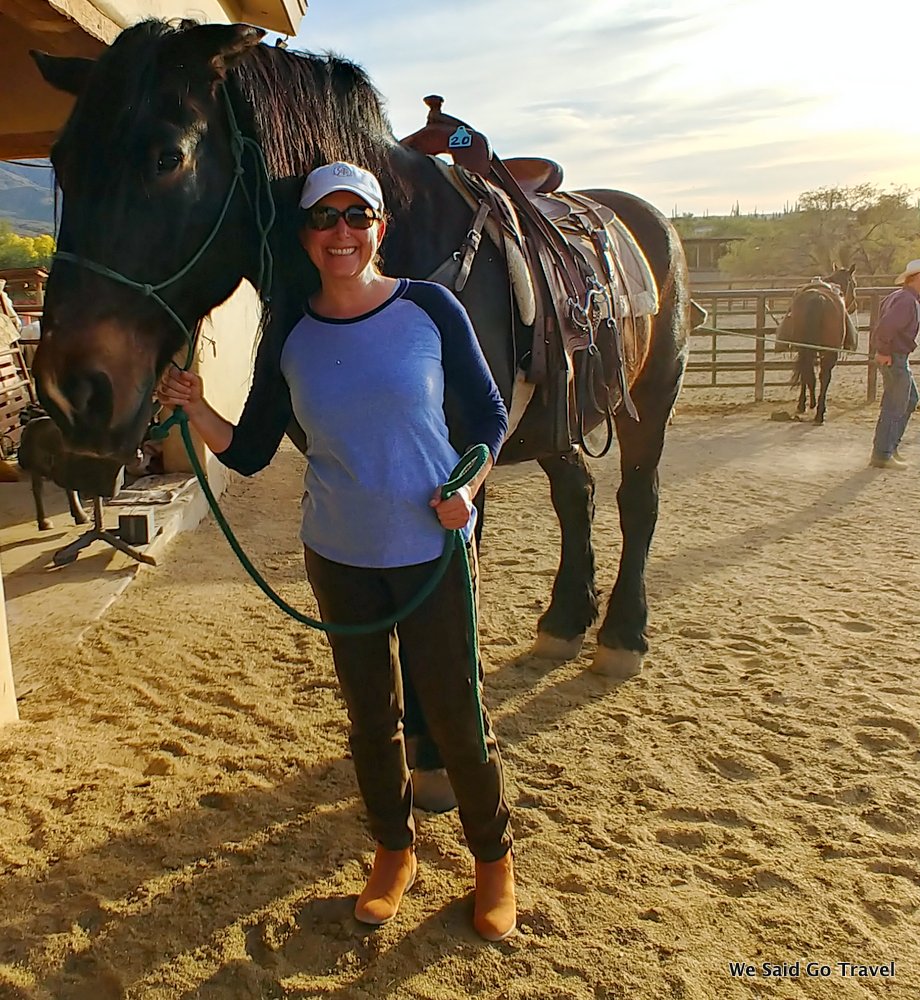
I took a class with Hope, the head wrangler, and learned about her journey to the ranch. She and her family used to rescue horses in Oregon and she studied Animal and Comparative Biology of Equine at University of Arizona. Her knowledge about horses was extensive. I learned about King who is a percheron or French Draft Horse and looks like a clydesdale. This giant horse can pull thousands of pounds. I learned that a bigger horse still has the same number of vertebrae in their back so they cannot carry more weight on their backs. The limit for any rider at Tanque Verde Dude Ranch is 250 pounds.

I learned about thoroughbred horses but did not realize I would ride one the following day. These horses are more long legged and built for speed.

Did you know that horses have no muscle below their knee? They only have tendons and ligaments similar to a cow. If your horse has a healthy foot, they are a healthy horse which is why horses need their hooves trimmed and have a “shoe” nailed on. It does not hurt the horse and keeps them safe.

I learned some quirky facts about horses:

*Horses cannot throw up

*There are only male horses at Tanque Verde—-they are all geldings

*Horses do have to lay down to sleep. They can have a nap standing up but must lie down for REM sleep.

For my second walk ride, I was on Sticks, a Thoroughbred horse, and again I walked right behind the wrangler, this time with Sarah. Braelyn made sure I had a good horse and as our group was eleven riders she was with us too.

This time when we got to Cowboy Lookout, I felt very comfortable. My horse was very tall and I was breathing into my pockets. I learned so much about riding and about sitting in the saddle. I can highly recommend Tanque Verde Dude Ranch and being out in the Tucson desert.

Tanque Verde: From City Slicker to Cow GirlThere is so much to do at Tanque Verde. I had an evening stroll through the desert with Marcia from the Nature Center and learned about how to use a barrel cactus as a compass, when saguaro grow their arms and which plants are native to Arizona. I met Cal the 86 year old artist who gives the afternoon watercolor class and is part of the evening marketplace once a week. During the evening rattlesnake viper class, I learned that dinosaurs were really more like birds and probably had feathers.

There is something for everyone here. You can fish, swim, hike, play tennis or mountain bike at Tanque Verde. You can participate in Team Penning and round-up cows, you can take a sunset ride or sit on your porch and star gaze. There are private lessons, half day rides and two hour loping rides in the National Park. You can sign up on the website tvrfun or with the manager at dinner or just call the office. You can participate as much or as little as makes you happy.

Tanque Verde: From City Slicker to Cow GirlPersonally, I loved watching the sunset when the sky looks like a painting but I also loved the Sunday night homemade bread.  Every day there is a very good new flavor to try like Green Chile and Cheddar, Garlic and Rosemary Focaccia and Honey wheat. Do not miss the Cowboy cookout on Weds or Sat night and taking a horse or mountain bike to Thursday or Sunday brunch at the Old Homestead.

Tanque Verde Ranch is 2400 feet above sea level so it is cooler than Phoenix. It is about 70 miles from the Mexican border and eight hours drive from Los Angeles. There are over one million people living in Tucson but you could never tell that at the Ranch.

Spending time at Tanque Verde is a great way to relax. The desert air, amazing sunsets and fantastic food are a terrific complement to the wonderful wrangler team and all the amazing activities. The children looked well cared for during their horseback riding lessons and activities and were thrilled to eat their meals in the kids-only room in the dining hall.

Thank you to the entire team at Tanque Verde Ranch for taking such great care of me! I cannot wait for another chance to saddle up! Hope to meet you riding into the sunset someday soon.

Did you know We Said Go Travel does TRAVEL PLANNING?

Do you want to go to your first Dude Ranch?

Contact Lisa to plan your next amazing adventure.

Tanque Verde: From City Slicker to Cow Girl

This post first appeared on We Said Go Travel

How to go from City Slicker to Cow Girl Read More »

5 Things You Must Know Before Hiring Employee Number One

If you want to scale your business the day will come when you need to hire your first employee. It can be scary if you’ve never hired anyone before. Still, it’s one of those things you need to do if you want your business to become truly successful.

I’m sure you don’t want to mess up on your first attempt, so you should be prepared. You’ll need to investigate a few things before pulling the trigger. Let’s look at what they are in case you’re desperate to proceed right now.

1. You Must Know Who You’re Hiring


We’re not going to get into the specifics of how to hire employees. It will change depending on the kind of business you run. Do you have any experience searching people online to find out who they really are?

Thanks to the internet you can do a deep dive into someone’s life. It will tell you if they have any skeletons in their closet. You’re looking for anything that will affect your company negatively.

2. Everything Must Be Running Smoothly


Make sure you’re bringing someone on for the right reasons. If your business is failing it’s unlikely a new employee is going to save the day. In the end, you’ll only end up pouring money down the drain.

Everything should be running smoothly, to begin with. Your new employee will be able to hit the ground running. If you’re in trouble at the moment you should fix any big problems on your own.

3. Create Standard Operating Procedures


It’s not just money you’ll need to invest when bringing on your first employee. You’ll have to spend a lot of time training them too. After all, they’re the first employee so nobody else can do it.

Your life will become a million times easier if you come up with standard operating procedures for every task you do. Your new hire will be able to follow the directions you lay out for them with ease.

4. You Can Test Everything Out First


Hiring a full-time employee is a huge commitment, which you’ll understand soon enough. It’s possible to start slowly. You can test everything out first by bringing in someone on a part-time basis for a while.

They don’t even need to live in the same county as you if they can work online. Also, you can choose the number of hours you want them to work. If all goes well, you’ll know bringing on a full-time employee is in your best interests.

5. Make Sure They Can Boost Your Profits


A business can boost their profits in a couple of different ways. You can obviously perform tasks that will bring in more money. It’s possible to achieve the same end goal by saving money too.

When employee number one comes onboard they should be able to handle one of them. It means they’ll be able to cover their wages at the very least. Ideally, they’ll take you to the next level within months.

It’s Your Future We’re Talking About


Even though hiring your first employee doesn’t sound like a big deal, it’s a huge step for your business. If you get the first one right it’s likely you won’t make big mistakes when you hire even more employees.

5 Things You Must Know Before Hiring Employee Number One Read More »