Ellen Koontz, a Kansas contract schoolteacher, is asking a federal judge to re-affirm the anti-Jewish boycott campaign begun by Adolf Hitler on April 1, 1933, openly adopted shortly thereafter by the Mufti of Jerusalem as part of the Arab-Nazi alliance during the Holocaust, internationalized against the Jewish State after WWII by the Arab League in December 1945, made illegal in America by a 1976 amendment to the Tax Reform Act and a 1977 amendment to the US Export Administration Act, which governs commercial activity impacting foreign policy, reaffirmed by continuous Presidential Executive Orders, and re-labelled in recent years with glitter and violent disruption as the Boycott, Divestment and Sanctions movement, otherwise known as BDS.
The IRS publishes specific reports explaining the criminal nature of anti-Israel boycotts by individuals or companies in commercial transactions as a function of foreign policy. In this vein, anti-BDS legislation has been adopted by more than 20 states, including Kansas. Koontz says Kansas Law HR 2409 infringes on her religious right to boycott Israeli Jews and those individuals and companies who do business with Israel.
So, Koontz sued—Koontz vs. Watson—to overturn the Kansas law and now seeks a temporary injunction of the enforcement of HR 2409. Watson disguises her purely political campaign as a religious duty handed down from the sixteenth-century, non-confrontational teachings of the pacifistic Mennonite religion.
Koontz has duped the court.
The Mennonite Church USA has abandoned its spiritual underpinnings and jumped from its religious exemption into the realm of political and racial bias.
Among the little-known Mennonites are some of the finest people on the planet, considered “salt of the earth” precisely because they faithfully embrace Christ’s “Sermon on the Mount,” admonishing, “You are the salt of the earth.” Mennonites are, in fact, a wing of the of the Anabaptist movement that eschews baptism at birth in favor of free-will, adult, belief-based baptism. Sixteenth century Dutch Catholic priest Menno Simons and his followers broke away from the Catholic Church, joined the Anabaptists, and adopted the seven principles enunciated in the Sermon on the Mount. These include adult baptism, a credo against swearing oaths, and turn-the-other-check Christian pacifism. So fervent is the Mennonite ethos of non-confrontation that not members only refuse military service, but they shun lawsuits and most types of confrontational behavior. What’s more, since, the essence of government is the enforcement of law, many Mennonites have shied away from being involved in government altogether, historically harboring a quasi-anarchism that sometimes expresses itself in tax resistance, civil disobedience, communal separateness, and classic conscientious objection in times of war.
For their beliefs, Anabaptist Mennonites have been beheaded, burned at the stake, and suffered repeated group expulsion or been forced to flee. Mennonites and other Anabaptists have traditionally lived in closely-knit and identifiable communities and commonly marry within the group, passing on recognizable family names. As a result of centuries of persecution and surviving cohesion, they are considered an ethno-religious group akin to the Jews.
Some experts estimate that of 1.2 million self-identifying Mennonites worldwide, fewer than a third live in the United States, with the next largest concentrations being in the Democratic Republic of the Congo and Ethiopia.
More than a few Mennonites, especially the most Bible-believing old-time Mennonites in Kansas, have whimsically wondered out loud if they are not “a lost tribe of Israelites,” a branch of Wandering Jews scourged and scarred for their beliefs. It is a comic comparison that one branch of the Anabaptists, the buggy-driving Amish of Pennsylvania fame, dress like East European Hasidism and many even speak a Low German dialect known as Plautdietsch, which resembles Yiddish. Some will remember the film The Frisco Kid where a Polish Hasidic Jew, played by Gene Wilder, encountered Pennsylvania Amish farmers; they looked and spoke alike, and for a while, believed they were “lansmen.”
The Anabaptist movement has been cleft by many schisms within schisms. These include the Mennonite branches, which are splintered into numerous direct and indirect offshoots protruding from offshoots. The list is long and only begins with the Dutch Mennonites, German Mennonites, Russian Mennonites, Old Mennonites, Mennonite Brethren, Beachy Mennonites, River Brethren, Hutterites, and others.
No one speaks for the Mennonites. They answer to no one but their God and their conscience. But in the highly-fragmented world of Anabaptist Mennonite thought, there are several sects and branches which have darkly drifted far away from the teachings and have embraced hate, fascism, terrorism, and politics.
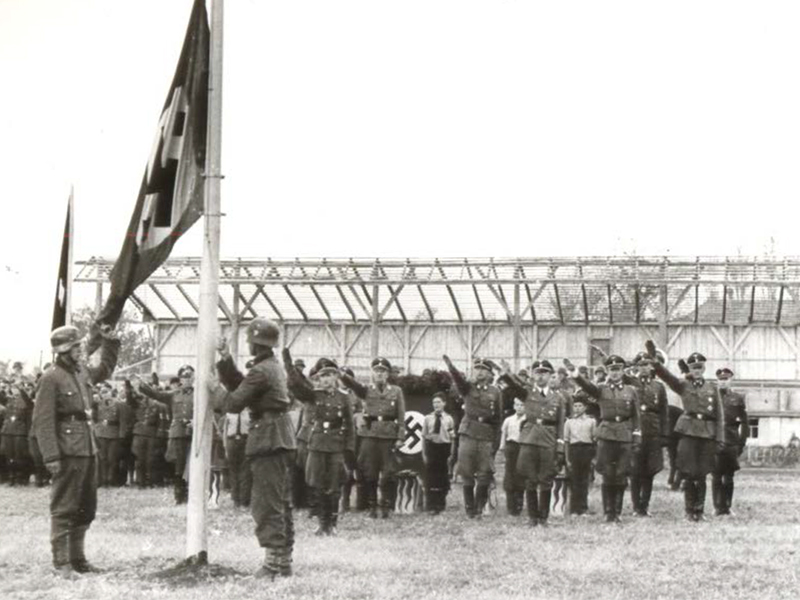
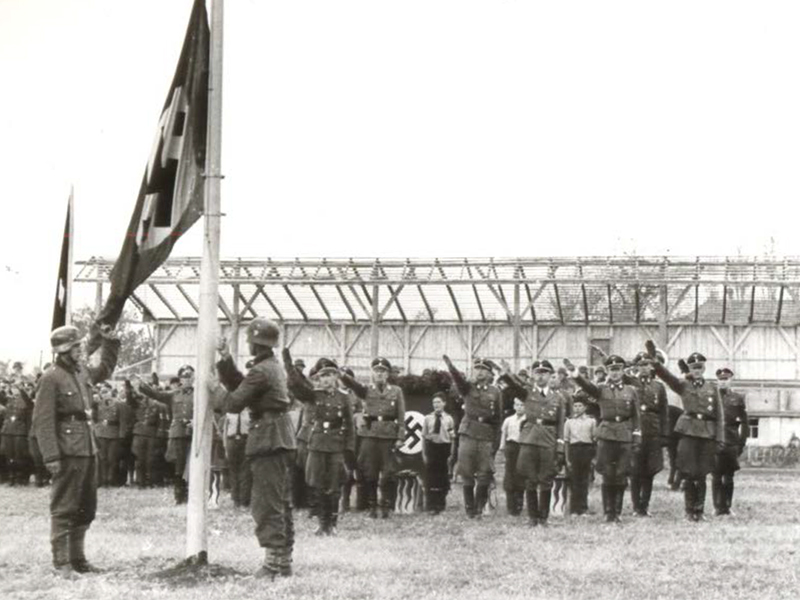
During the Holocaust, Nazism appealed to many German and Ukrainian Mennonites. In 1942, the Molotschna Mennonite colony in the Ukraine formally hosted an SS gathering and raised the swastika flag, as the Mennonite Library and Archives in Kansas has preserved. Ukrainian Mennonites volunteered to assist Nazi death squads as they machine-gunned helpless Jews in pits.
Other Mennonites in Poland served as brutal camp guards in concentration camps such as Stutthof, where some gained infamy for their vicious treatment of prisoners.
Mennonites in the Stutthof area regularly exploited slave laborers to build factories and harvest farms. One particularly brutalizing Mennonite SS officer was known as “Lord of Death and Life.”
Nazi Mennonites were interned as collaborators by Soviet forces when the Third Reich withdrew from occupied eastern Europe. As Hitler’s Germany collapsed, Nazi Mennonite colonies transplanted to Paraguay, where they joined existing Nazi-like colonies that for years racially afflicted and exploited indigenous Indians. Auschwitz mass murderer Josef Mengele fled to Paraguay, where for a time, he found shelter among Mennonite colonies near the Bolivian border.
Groups of Paraguayan Nazi Mennonites later migrated to Canada, where they encountered established Russian Mennonite communities. A study published by The Manitoba Historical Society found the three leading Canadian Mennonit
e newspapers during the Hitler era to be overwhelmingly pro-Hitler, spewing racial and anti-Jewish theory. The pro-Nazi newspapers —Der Bote, The Mennonitische Rundschau, and theSteinbach Post—were not religious but Nazified community news outlets. Mennonite Nazism, for years hushed up, is now being explored by Anabaptist historians in conferences, books, and journal articles. Nazi Mennonites acted not as a religious group but as a fascist ethnic group.
The catalog of other dark deviations from Mennonite piety has recently included the Mennonite Church USA (MC-USA). Leadership of this faction has steered its flocks away from religion and into undisguised alliance with Jew hatred, economic warfare, and confrontation tactics. Originally one of the largest but already shrinking down to one of the smallest groups within the Mennonite realm, the MC-USA finalized its departure from the Mennonite mainstream in May 2015 when it re-defined membership and required adherents to agree to same-sex marriage and increased involvement in pro-Palestinian issues.
“Our interactions show that the church is divided on understandings of human sexuality and same-sex marriage,” and other MC-USA agreements, including its anti-Israel program, the MC-USA board conceded in a 2015 statement. But the board asked for “exercising Christian forbearance with those who differ in their understanding and application of those agreements.”
The MC-USA’s resolution same sex unions and other LGBTQ issues passed, but the anti-Israel BDS resolution was delayed for two years by a 55 percent majority, showing that many were reluctant to stray into this political territory. Nonetheless, from that moment, Mennonites began to flee MC-USA.
By the end of 2016, an estimated 17 percent had formally withdrawn that year, that is,16,416 out of 95,308 members. In a January 26, 2016 Mennonite World Review report on the exodus, a subhead explained, “A few churches want to stay with MC USA; others are dropped from denomination’s membership number.” The article reported that the largest component of MC-USA’s church rolls—those affiliated around Lancaster, Pennsylvania, had almost entirely disaffiliated. “Last fall’s proposal from LMC’s [Lancaster Mennonite Conference] Board of Bishops to withdraw, was ratified by 82 percent of credentialed leaders.” Mennonite World Review asserted, adding, “The updated Lancaster membership for MC-USA (1,091) means 92 percent of the conference’s members are not considered to be in churches “opting in” to MC-USA.”
Just days before the controversial May 2016 MC-USA resolution, the Franklin Conference in Maryland and Pennsylvania voted to quit, precisely over political resolutions, especially LGBTQ issues.
MC-USA officials issued a statement, “As a national church, we are mired in conflict. Many believe a split is inevitable, given our polarization specifically on issues of human sexuality and scriptural interpretation.”
An April 2016 Mennonite World Review editorial asked whether MC-USA should disband itself, asserting, “Dissolving MC-USA would clear the way to bring back the small, comfortable denominations Mennonites prefer.” A Religion News Service report, written by a former editor of the Mennonite World Review and reprinted in Mennonite World Review, opened with the conclusion: “A year ago, Mennonite Church USA was one of many Christian groups struggling with dissension over the place of gays and lesbians in the church. Today, it’s not just struggling, but falling apart.”
In July 2017 at its national conference, and with only about 75,000 solidly pro-BDS remaining in the whittled down MC-USA, the boycott resolution finally passed. Some 98 percent of the delegates approved. The vote was orchestrated in open collaboration with Jewish Voice for Peace (JVP), a group now reviled in much of the Jewish community for its leadership of the anti-Israel movement. JVP attended the conference and spoke on stage. In celebration of the various resolutions adopted, Hillsboro, Kansas Delegate Tim Frye was quoted by Mennonite media as proclaiming, “For the past 100 years we’ve tried to be normal … We need to go back to being weird again.”
MC-USA’s July 2017 BDS resolution was just its latest act of anti-Israel agitation. It co-sponsors an agitation brigade, Christian Peacemaker Teams (CPT), which, according to Israeli officials, harass Israeli soldiers at security checkpoints during regularly scheduled confrontation riots by uttering insults at security forces, nose-to-nose, hoping soldiers will over-react as cameras whir. Sometimes CPT obstruct soldiers before anti-terrorist arrest efforts. CPT coordinates with similar confrontation efforts waged by groups such as the International Solidarity Movement. On American campuses, CPT has teamed up Students for Justice in Palestine and Jewish Voices for Peace, both groups now known for harassing Jewish students for their identity. Economic warfare, anathema to most Mennonite religious precepts, is now a holy obligation at MC-USA.
The Kansas anti-BDS legislation took effect July 1, 2017. MC-USA adopted its pro-BDS resolution five days later. Four days after that, Koontz, who had been hired by a Wichita magnet school as a math curriculum coach, received the new Kansas State form, certifying she was not boycotting Israel. She stated she could not sign, citing her MS-USA church belief. This set up the constitutional challenge.
When she filed here suit seeking religious protection, Koontz knew her actions were strictly political—not religious. Koontz had previously worked for three years with the Mennonite Central Committee in Egypt as a highly politicized anti-Israel Mennonite activist. Her own first-person statement explaining the lawsuit, published by her attorneys, the American Civil Liberties Union, on the ACLU website, declares, “It seems preposterous that my decision to participate in a political boycott should have any effect on my ability to work for the state of Kansas.” She self-describes her action as “political” four times in that declaration. Koontz’s suit was filed for a political goal—not a religious one.
The ACLU’s court filing in the case reinforces the political nature of the case, stating, “Every day, Ms. Koontz is being financially penalized for refusing to disavow her political boycott.” The court filing repeats the assertion, “Ms. Koontz is unable to sign the Certification because she is currently participating in a politically motivated boycott of consumer goods and services offered by Israeli companies and international companies operating in Israeli settlements in the occupied Palestinian territories.”
It is true the U.S. Supreme Court has upheld freedom of personal belief. But this case is not about belief, it is about actions. The Kansas law does not ask Koontz to disavow any beliefs, just not to take actions—to wit, a boycott—which will discriminate against Israeli Jews. Koontz will not boycott Israeli Arab institutions, only Jewish ones.
Furthermore, Koontz is not acting as an individual employee, but as an outside contractor. Every university guest lecturer, caterer, and plumber knows it is commonplace to sign mandatory contractor pledges not to discriminate against women, minorities, and other protected groups. A typical example is, the University of Kansas which for years has required, in paragraph 5 of its sub-contractor form, a pledge not to discriminate against at least eight classes of people, including on the basis of “national origin.” The KU pledge form cites two other pre-existing state anti-discrimination laws. Hence, an Israeli professor or an Israeli purveyor could not be boycotted due to national origin. Nor can a Mexican-American or African-American be singled out. Beliefs are untouched by such policies. But economic actions can be regulated.
NAACP v Claiborne Hardware, the very Supreme Court ruling cited in the third paragraph of the ACLU lawsuit, makes clear “this Court has recognized the strong governmental interest in certain forms of economic regulation, even though such regulation may have an incidental effect on rights of speech and association.”
Prior to enacting HB 2409, the Kansas Legislature received a statement from the State Department of Commerce averring, “In 2016, Kansas exported $56,681,800 in total commodities, while importing $83,650,853. It is in the best interest of Kansas to continue our strong trade relationship with Israel. Any company openly boycotting Israel and its products, is openly boycotting a Kansas trade partner and ally, an action Secretary Antonio Soave and the Department of Commerce feels provides enough merit to prevent as a state vendor … The implementation of what the BDS movement is attempting to achieve is the illegal discrimination on the basis of nationality.”
Bob Jones University vibrantly proved it could not shield its blatant discrimination against African-Americans by citing bizarre Biblical beliefs. The U.S. Supreme Court upheld the IRS revocation of BJU’s tax exemption due to racial discrimination.
Moreover, as a Mennonite, Koontz knew she did not have to sue and seek an injunction. Kansas HR 2409 makes clear, even in its short form, “The Secretary of Administration has the authority to waive application of this prohibition if the Secretary determines the prohibition is not practicable.”
No group in America knows more about filing for government exemptions than Mennonites. During both World Wars, Mennonites comprised a large number of America’s conscientious objectors, exempted from combat. The exemption is still published by the dormant Select Service System.
Indeed, in a filing, the Kansas Attorney General confirmed the obvious to the court: “If plaintiff [Koontz] had requested a waiver, the Secretary would have granted it.”
But Koontz did not want to exercise her legal options to request religious exemption. She wanted a show trial and headlines.
Koontz is sincere in her activism. However, she has been duped, by revisionist Frankenhistory that pretends that the Jews have colonized Israel and that the indigenous people of Palestine are Arabs. In fact, history has known for more than a millennium that after the Romans evicted the Jews from Judea, the Arabs of Arabia, during the seventh century, invaded and conquered three continents, including Palestine— an exonymic name imposed by the Romans for the Philistines who were Greek Island invaders. Far from a violation of international law, the Jewish right to reclaim their land was specifically enshrined in Article II of the 1919 Eilat Agreement between the Zionist Organization and Emir Faisal on behalf of the Arab Nation in waiting, the San Remo Treaty Article 6 ratified by 52 countries, the League of Nations Mandate, the Treaty of Sèvres in Chapter 95 also signed by Arab representatives, the UN Charter’s Article 80, and many other instruments of international law.
If Koontz will return to any of the simple Mennonite churches in central Kansas, she can refresh her knowledge of history and the restoration of the Jews in Israel. She can read the one international law that predated the League of Nations, the Arab invasion, and even the Roman expulsion. She can refer to Leviticus 25:10 which commands the Israelites to “proclaim liberty throughout the land to all its inhabitants. It shall be a jubilee for you; each of you is to return to your family property.” No Hitler decree, Arab League boycott, BDS chant, MC-USA resolution, or ACLU lawsuit can erase those words from the churches of Kansas— or from its courtrooms.
Edwin Black is the NYT bestselling author of IBM and the Holocaust and Financing the Flames. Winner of the Moral Compass and Justice for All awards for his human rights work, Black has studied both boycotts and Mennonites for nearly half a century.