
fbpx

November 19, 2017

Sunday Reads: Is Israel getting worried about Trump?, Remembering the Sadat visit, The Saudis’ Iran problem

U.S.

Brian Katulis and Yoram Schweitzer describe concerns heard in Israel about the Trump administration’s Middle East policy:

Put simply, the Trump administration’s unclear and disjointed approach to the Middle East has unnerved key allies like Israel while giving the emerging coalition of Russia, Iran, Syria, and Hezbollah a free pass. Many Israelis were dismayed earlier this week when Russian Foreign Minister Sergei Lavrov stated that Iran’s presence in Syria was legitimate and that they would not force Iranian-aligned Shiite militias to withdraw from positions close to Syria’s border with Israel.

Jonah Goldberg explains why Putin isn’t interested in helping America:

Trump believes that every country should follow its own narrow self-interest. That’s a defensible position. The only problem is that Russia’s — or at least Putin’s — definition of self-interest is at war with ours.

Israel

Aviad Kleinberg tries to figure out why Avi Gabbay has been shooting his own political camp in the foot: 

But Gabbay isn’t producing such a complicated display. He is producing a simple and completely coherent display of a rightist. Granted, he is a rightist who opposes corruption, but the Bibi government’s corruption isn’t part of the right-wing agenda anyway, rather something right-wing voters are willing to accept. That being the case, they would rather vote for the real thing than for someone who talks like a rightist.

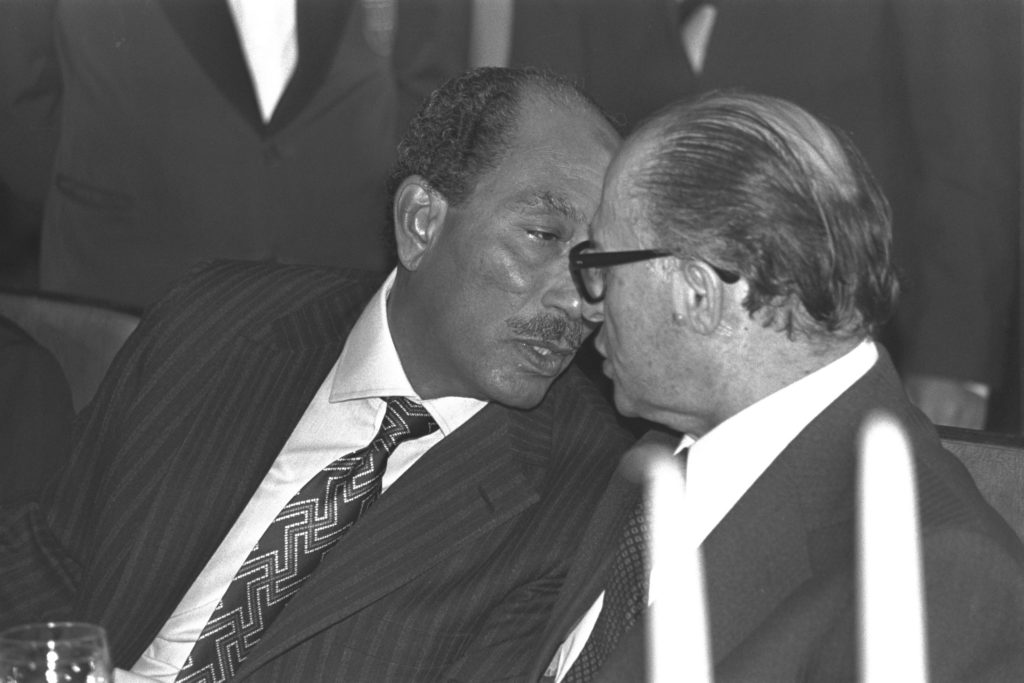
Israeli Consul Yehuda Yaakov takes a moment to remember Anwar Sadat’s historic visit to Israel, 40 years ago today:

Last week I hosted in Boston recently-retired Israeli Supreme Court Justice Elyakim Rubinstein, who was part of the Israeli team at the Camp David talks with Egypt. He described waiting for Sadat at Ben-Gurion Airport as the most significant experience of his professional career. In his words, it was as if he could “hear the wings of history.”

Rubinstein recalled being told at the time by an otherwise skeptical Israeli minister: “Look, if this is hopeful in another 15 years, I’ll think the price was worthwhile.” Forty years later, with tensions between Israel and Arab states on the decline, I believe that the price was categorically worthwhile.

Middle East

Emile Hokayem writes about the Saudi government’s struggle to tame Iran:

Fundamentally, who prevails in the rivalry between Tehran and Riyadh comes down to capacity and competence. Iran has the networks, expertise, experience and strategic patience required to fight and win proxy wars at low cost and with plenty of disingenuous deniability. The Saudis simply don’t, which is why seeking to beat the Iranians at this game is dangerous and costly.

 Mustafa Akyol explains why Erdogan has surprisingly been embracing the Ataturk legacy these days: 

Yet there is an important nuance between the image of Ataturk with which Erdogan now identifies and the image of Ataturk that Turkey’s “Ataturkists” have traditionally upheld. In the latter one, Ataturk was a Westernizer who secularized his nation with top-down “reforms” during his absolute presidency from 1923 to 1938. Erdogan and his followers understandably skip those un-Islamic themes. The Ataturk they rather like is the anti-Western war hero who saved the motherland from the occupation by European imperialists in 1919-1922. This also allows them to argue that Erdogan is not “undoing Ataturk,” as the Ataturkists typically claim. Erdogan, in this view, is only re-doing Ataturk by making Turkey “independent” again.

Jewish World

Susan Weiss has a modest proposal to settle Israel’s problem with Agunot, women unable to remarry because their husbands refuse to grant them a religious divorce (a get):

So here’s my (obviously tongue-in-cheek) Modest Proposal. It’s based on the now discovered “solution“ to the problem of agunot, ie: ex-parte restraining orders that prevent tourists from leaving the country they are visiting. I suggest that Israel enter into a multi-national agunah treaty with all the other nations in the world. The treaty will provide that all nations have the right, and indeed the obligation, to unilaterally, ex-parte, and on the basis of one party‘s pleading, temporarily restrain the travel of all Jewish tourists who are suspected of being get refusers — including, of course, Israeli tourists. If a tourist happens to give a get under the hurried circumstances of an ex-parte restraining order in a foreign county, the get will not be considered invalid or “forced.”

Responding to Martin Kramer, Professor Michael Mandelbaum points out the ordinary aspects of Israel’s struggle for independence:

To be sure, the Jews have had to fight harder and longer for their state than have many other nations; but the difference is one of degree. Much of the large-scale violence of the last 100 years, and most of it during the last three decades, has had as its cause the related questions of who gets a state and where states’ borders begin and end. Israel’s experience is all too typical.

 

Sunday Reads: Is Israel getting worried about Trump?, Remembering the Sadat visit, The Saudis’ Iran problem Read More »

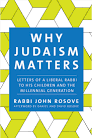
“Why Judaism Matters – Letters of a Liberal Rabbi to His children and the Millennial Generation” – Book Signing

I’ll be at Chevaliers Book Store – Monday, November 27 at 7 PM to read and sign my new book “Why Judaism Matters – Letters of a Liberal Rabbi to His children and the Millennial Generation”

Chevaliers Books, the oldest independent book store in Los Angeles, is located at 126 N Larchmont Blvd, Los Angeles, CA 90004 in Hancock Park

Endorsements

“Why Judaism Matter – Letters of a Liberal Rabbi to His Children and the Millennial Generation” with an Afterword by Daniel and David Rosove is now available for purchase on Amazon.com (publishing date – October 10). This book is a collection of thirteen letters offering a common sense guide and roadmap for a new generation of young men and women who find Jewish orthodoxy, tradition, issues, and beliefs impenetrable in 21st Century society. It is published by Jewish Lights Publishing, a division of Turner Publishing.

Endorsements

“Rabbi Rosove’s letters to his sons are full of Talmudic tales and practical parables, ancient wisdom with modern relevance, spiritual comfort, and intellectual provocation. Whether his subject is faith, love, intermarriage, success, Jewish continuity or the creation of a meaningful legacy, you’ll find yourself quoting lines from this beautiful book long after you’ve reached its final blessing.” – Letty Cottin Pogrebin, writer, speaker, social justice activist, author of eleven books including Debora, Gold, and Me: Being Female & Jewish in America, a founding editor of  Ms. Magazine, a regular columnist for Moment Magazine, and a contributor of op-eds in the New York Times, Washington Post, Boston Globe, Philadelphia Inquirer, Toronto Star, and LA Times, among other publications.

 “John Rosove does what so many of us have struggled to do, and does it brilliantly: He makes the case for liberal Judaism to his children. As Rosove shows, liberal Judaism is choice-driven, messy, and always evolving, “traditional” in some ways and “radical” in others. It is also optimistic, spiritual, and progressive in both personal and political ethics. Without avoiding the hard stuff, such as intermarriage and Israel, Rabbi Rosove weaves all of these strands together to show the deep satisfactions of living and believing as a liberal Jew. All serious Jews, liberal or otherwise, should read this book.” Rabbi Eric H. Yoffie, President Emeritus of the Union for Reform Judaism and a regular columnist for the Israeli daily newspaper Haaretz.

“Rabbi John Rosove has given a gift to all of us who care about engaging the next generation in Jewish life. The letters to his sons are really love-letters from countless voices of Jewish wisdom across history to all those young people who are seeking purpose in their lives. From wrestling with God, to advocating for peace and justice in Israel and at home, and living a life of purpose, this book is a compelling case for the joy of being Jewish.” – Rabbi Jonah Pesner, Director of the Religious Action Center of Reform Judaism in Washington, D.C.

“Rabbi John Rosove gets it. Here is a religious leader not afraid to tell it like it is, encapsulating for his audience the profound disaffection so many young Jews feel towards their heritage. But instead of letting them walk away, he makes a powerful case for the relevance of tradition in creating meaningful lives. In our technology-saturated, attention-absorbing age, Rosove offers religion-as-reprieve, his fresh vision of a thoroughly modern, politically-engaged and inclusive Judaism.” – Danielle Berrin, columnist and cover-story journalist for the Los Angeles Jewish Journal, commentator on CNN and MSNBC, and published work for The Guardian, British Esquire, and The Atlantic.

 “If you’re a fellow Reform millennial, give yourself the gift of John’s insights. This book is written in a breezy, gentle, readable style that is welcoming without losing sharp insight. It was so enjoyable and refreshing to read and persuasive without ever being pushy. Rosove managed to do what only a truly worthy slice of kugel or chance viewing of Fiddler has done for me; reactivate my sense of wonder and gratitude about being Jewish. I’m a huge fan of WJM.” – Jen Spyra, staff comedy writer on The Late Show with Stephen Colbert (CBS), former senior writer for The Onion, actress, and stand-up comedian. Jen’s writing has appeared in The New Yorker, The Wall Street Journal, The New York Daily News, and The Daily Beast, and has been featured by The Laugh Factory Chicago’s Best Standup Show Case.

“Rabbi Rosove has written a wonderful book, a love letter to his children, and through them, to all our children. Prodigiously knowledgeable, exceedingly wise, and refreshingly honest, Rabbi Rosove has described why Judaism Matters. It should serve as a touching testament of faith, spanning the generations for generations to come.” – Rabbi Ammiel Hirsch, Senior Rabbi of Stephen Wise Free Synagogue in NYC, former Executive Director of the Association of Reform Zionists of America-World Union for Progressive Judaism, author of One People, Two Worlds: A Reform rabbi and an Orthodox rabbi explore the issues that divide them with Rabbi Yaakov Yosef Reinman.

“Rabbi Rosove has written a book of the utmost importance for our time. It is an imperative read for all those who struggle with the changing and evolving attitudes towards belonging, behavior and belief.  His analysis, stemming from deeply personal contemplation and decades of rabbinic experience, offers clear yet sophisticated approaches to tackling the challenges facing this generation and those to come. This book offers a treasure of wisdom through the lens of Jewish texts – both ancient and modern – which help to frame life’s major issues taking the reader from the particular to the universal. Israel is one of the most complicated of issues and he bridges the divide between Israel’s critics and staunch supporters and moves beyond the conversation of crisis for the millennial generation.” – Rabbi Joshua Weinberg, President of the Association of Reform Zionists of America

“John Rosove’s letters to his sons based on his life, philosophy, and rabbinic work address what it means to be a liberal and ethical Jew and a lover of Israel in an era when none are automatic. He writes in an unassuming personal style steeped in traditional texts as he confronts conflicts of faith and objectivity, Zionist pride and loving criticism of the Jewish state, traditional observance and religious innovation. He is never gratuitous and invites his readers into his family conversation because what he says is applicable to us all.” – Susan Freudenheim, Executive Director of Jewish World Watch,  journalist, former managing Editor of the Los Angeles Jewish Journal, and a former editor at the Los Angeles Times.


“Why Judaism Matters – Letters of a Liberal Rabbi to His children and the Millennial Generation” – Book Signing Read More »

Addictions and Eating Disorders Information & Treatment

Merriam Webster describes addiction as “constant use of the known substance. Many people do think the word addiction means drug addiction. But the work addiction is stretching beyond these substances? The substance does not have to be entirely detrimental for causing addiction, and even an essential part of life can be ill from obsessions or addictions. Addiction is also known as food disorder in today’s world.

History of Food Additional


It is recorded that alcohol and drug addictions affect over 23.5 million people in Americans recently, and studies show that almost eight million people are fighting form food addiction. While the “addiction food” classification may seem to be relatively modern, the study of addiction food in some years back (the 1890s), just as when chocolate is introduced to as an addictive substance and to the consciousness of narcotic drug abuse. In the 1950s, the term “food addiction” was created and Overeaters Anonymous was discovered in 1960. Despite the fundamental situation regarding food, knowledge was very little during the 1960s and 70s, and the concept of group dining is discussed, rather than psychology journals and scientific research.

During the 1980s, eating disorders such as bulimia and anorexia tempted most people attention, and during that time there is a similarity between eating disorders and drug addiction. Research findings have confirmed that those striving for anorexia are physically helpless on the outcomes of hunger. Most time, their bodies developed tolerance and insufficient food eating also achieve the same results in their body. Just like drug detoxification, when anorexia patient began to overeat, they may experience specific symptoms of “abstinence.” In addition to this studying, bulimia studies in the 1980s have shown high records on addition personality.

In the next year, the idea of addiction to the food industry may be difficult to examine, and it may lead to arguments among the professional experts. Further patterns of drug addiction and food addiction were found, such as abuse of substances, use of materials to treat negative emotions, loss of control, and laziness of habit to behavior despite the adverse consequences. Information obtained after the “food addiction” has been created, psychologists and researchers have broken this widespread disease into sub-categorized disorders, generally referred to as eating disorders.

Subcategories of Food Addiction in human health


Diet consumption disorders are different and look different from individuals to individuals. Although Mental Health experts have widely recognized the following classifications, many atypical cases are not included in these categories, as well as some minor subcategories.

  • Anorexia: Hunger and high weight loss
  • Bulimia: Eat and purging for weight loss.
  • Poor eating disorder: Compulsive, excessive feeding with uncontrolled purging.
  • Compulsive diet: unlimited eating without purging.


Why Food Addiction Matters To Our Health


Too much of Diet usually leads to addiction to the substance. In fact, most people who are struggling with food addiction are five times more likely to develop drug addiction and alcohol than healthy people. This is partly due to drugs used to relieve anxiety and depression, often associated with food addiction, but alcohol and many prescription drugs and medicines can be used for appetite and AIDS. On the other hand, substance addiction can lead to food addiction as an adaptation mechanism that does not seem to be controlled.

Studies show that these two diseases often relate to the history of the trauma, they are common neurotransmitters involved in food and substance addictions. Many experts assume that the genetic component is responsible for dependencies transmitted between generations, as a significant number of eating disorders affect families with at least one alcoholic father.

Visit Alo Recovery Center for Your Health Treatment


At Alo Recovery Center, we use our knowledge of comorbidity (the appearance of two chronic diseases) when evaluating each of our clients. As a result of new research, it is essential that mental health professionals tailor their method accordingly, so we offer a dual diagnosis program. If you have the substance addiction, know that your treatment is available and can be renewed at Alo Recovery Center.
Alo Recovery Centers offers modern treatments breathtaking in a great environment of the Pacific Ocean. Extensive holistic care makes this installation more like a luxurious and relaxing experience on the beach.

Addictions and Eating Disorders Information & Treatment Read More »