Princeton Hillel’s Center for Jewish Life (CJL) issued an apology on Wednesday for cancelling their event hosting Israeli Deputy Foreign Minister Tzipi Hotovely.
Eric Fingerhut, president of Hillel International, and Rabbi Julie Roth, executive director of the CJL, issued their apology in a letter published in the Jerusalem Post, where they acknowledged that they made “a mistake” in canceling her event.
“We did not treat the Israeli deputy foreign minister with the respect that her office deserves, and postponed the event,” Fingerhut and Roth wrote.
They explained that the event wasn’t vetted by the CJL’s Israel Advisory Committee, but they admitted that it was wrong to cancel the event on that reason alone.
“We should have engaged a broader range of students in this program from the beginning, rather than right before the event and we should have made a stronger case within our campus community that the event should go forward as planned,” wrote Fingerhut and Roth. “This is an isolated incident – and Hillel International stands squarely behind the value of hearing from the Jewish state’s elected leaders.”
After listing Hillel’s various programs, Fingerhut and Roth concluded their letter by stating that they would “do better next time.”
“We are also proud to work for a movement that when, amid the pressures and realities of today’s campus life, we make a mistake, we acknowledge it, learn from it and strive to do better next time,” wrote Fingerhut and Roth. “That is another value we are proud to be modeling for our students.”
Despite Hillel’s cancelation, Hotovely spoke at Chabad of Princeton. Hotovely criticized Hillel for “infringing on the fundamental academic freedom of the students” and “silencing the voice of Israeli democracy.”
The cancellation came amid sharp condemnation from The Alliance of Jewish Progressives (AJP), which accused Hotovely of being a racist.
Say the name “Marcus Freed” and many Jews in Los Angeles and beyond know exactly who he is.
The 42-year-old British-born actor, teacher and author has been living in Los Angeles for several years now. He’s a regular staple at Pico Shul and he’s reinvigorated many Jewish lives by using his artistic talents to allow people to connect with their Judaism.
From his Bibliyoga classes to his Kosher Karma Sutra books, his one man show about King Solomon, his Shabbat services at Pico Shul, his Soul Revival sessions or a myriad of his other Jewish and artistic endeavors, Freed is a much sought after teacher and educator as well as beloved by Jewish communities around the world.
On Nov 3, Freed was on his way home from synagogue near Olympic and Shenandoah/Sherbourne when he was hit by a car traveling at about 10 miles per hour.
In shock, Freed asked the driver to take him to his friend Metuka Daisy Lawrence’s house a few streets away. He never asked the driver for his details.
Lawrence told the Journal, “Marcus knocked on the door and said, ‘Hi, I’ve just been hit by a car.’” Despite insisting he felt fine, Lawrence said, “I told him we should get him checked out by a doctor and walked with him the four blocks to his apartment to get his medical card.” But once there, Lawrence suggested they call Hatzolah (the Jewish emergency service). “They were there within 90 seconds,” Lawrence said, “and one of them realized right away that something was wrong.”
Freed was rushed to Cedars Sinai Medical Center and underwent immediate brain surgery to stem bleeding in his brain. By Sunday morning he had been moved out of the ICU into a regular room. But on Tuesday morning he was back in surgery for a second attempt to stop the brain bleed. That surgery went well and if all goes to plan Freed could be out of the ICU within the next 12 hours.
Because Freed has only basic MediCal insurance, his close friend Audrey Jacobs, who is a crowd funder by profession, launched a campaign to raise $250,000 to cover Freed’s extensive medical costs. When Jewcer, the Jewish crowdfunding organization heard about Marcus’s plight they waived all their fees to host his fundraiser on their platform.
“I truly believe in the power of the crowd to fund ideas, to change people’s lives and help others in their time of need and I’m so grateful that Jewcer exists and did this for Marcus,” Jacobs said.
Within 48 hours almost $100,000 had been raised on the site. “That’s because people are truly inspired by who he is,” said Jacobs.
Throughout his ordeal, Freed has remained in great spirits and has been lucid. The nurses have been overwhelmed by how many visitors he’s received.
“It’s truly a miracle that he could have had two brain surgeries and be as lucid and charming as he always is – joking and sharing his words of Torah – it comes from a real sense of gratitude from God,” Jacobs said.
Lawrence, who has known Freed for years, said of all Freed’s joking, “I told him ‘I know you love to perform, but you need to stop performing for your visitors so you can heal.’”
Following the accident, Freed’s parents – Jill and Barry – flew in from London on a one-way ticket and plan on staying here until Freed is ready to leave the hospital.
Speaking by telephone to the Journal from their son’s apartment – on a rare break from their hospital vigil – the couple said they are overwhelmed by the outpouring of love and support.
“I don’t know how we would have got through the last four days without the amazing Pico Shul community and especially Metuka [Lawrence] who was there through the darkest hours,” said Jill.
“She saved his life,” Barry said.
“And the wonderful care he’s receiving at the hospital,” Jill added.
They’re also in awe of how much money has been raised for Freed’s medical bills. “We are very humbled and totally embarrassed,” said Jill. “It’s not our style to ask for anything. My immediate thought was, ‘We’re going to have to sell our home, but as long as [Marcus] lives that was the main thing.’”
Barry choked up speaking of all the donations that have come through the Jewcer site. “We saw donations from everything from $10 to $5,000 but we also saw people that donated $1 and that was the most moving thing for me. People were giving whatever they could.”
Were the Freed’s aware of how much of an impact their son has had on the community?
“No,” said Jill. “However much one loves their children or how proud they are, you don’t expect this.”
The couple was here two years ago for Freed’s 40th birthday and said they met all his friends and realized that he would be fine. “He had a new family here in Los Angeles,” Jill said. “There are so many people I’d like to name: Audrey and Metuka and Rabbi Yonah and Rachel Bookstein and Rabbi Levin.”
For now, the Freeds are focusing on one day at a time. “We’re hoping he’ll be out of hospital sooner rather than later,” said Jill. “We just want him settled back home and to put him back in the safe care of his Pico Shul community.”
“Please God, he’ll make a full recovery,” Barry said. “And we want to thank everyone from the bottom of our hearts.”
To date, Freed’s prognosis is good but he has a long road ahead and the bills keep piling up. “We haven’t even got the ambulance bill yet,” said Barry.
Organi Daycare in Reseda has all the trappings of a typical preschool — and then some. Tricycles are stationed out front, and the rest of its half-acre property features a tree house, a vegetable garden and even a bonfire area.
But what really sets the facility apart is a certain vibe that makes it particularly attractive to Israelis. Not only is everything done in Hebrew, parents say it feels like a kibbutz.
“Once you get there, you feel like you are in Israel,” said Sherri Elizam, who sent her daughters Ella and Shaya there before they turned 5. “The Hebrew part was important for me, but we speak only Hebrew at home, so I knew they are going to know Hebrew regardless. What I was looking for was the Israeli culture and the freedom to run around and express yourself.”
Many Israeli parents living in Los Angeles don’t think twice about which day care center they should send their kids to — as long as it’s an Israeli-owned center where the children speak in Hebrew and celebrate the Jewish holidays Israeli-style. Such facilities are common around the city and the San Fernando Valley, mostly in private homes.
Organi allows the 14 children in its care — all of whom are ages 2 to 5 and come from homes with at least one Israeli parent — to roam about the place to pet and feed the animals, collect chicken eggs, play with bunnies and a guinea pig, or care for the garden.
Ori Nottea bought the place two years ago to house the day care center she ran previously in Tarzana.
Born in Israel, Nottea arrived in Los Angeles in 1999 and studied child development and yoga for children at Santa Monica College and Pierce College. She taught yoga and was a teacher at Stephen Wise Temple and the Jewish Community Center at Milken before opening her own day care center, with 11 children enrolled, nine years ago.
As a mother of two boys, 11 and 9, she knew exactly how she wanted her day care facility to look — with an emphasis on its “Israeliness.”
“Once you get there, you feel like you are in Israel.” — Sherri Elizam
“I speak to the kids only in Hebrew and all of our activities are in Hebrew,” she said. “But we also expose them to some English during the day because, after all, they are going to continue from here to a school where they will need to speak English, and we want them to be ready.”
Parents at Organi say they want their children to have the same childhood experience they had while growing up in Israel, including the country’s unique Hebrew songs and holiday activities.
“On Israel’s Independence Day, the kids simulate a flight to Israel and dress up like soldiers,” Nottea said. “We eat and prepare Israeli dishes such as falafel, tahini and Israeli salad. The kids cut the salad themselves and participate in all the preparation of the food. I have a tabun oven in the yard where we prepare pita bread. On Tu b’Shevat, I invite the parents to plant trees. On my first year here, the parents and the children planted together all the fruit trees you see here.”
It’s hard to distinguish between Nottea’s home and the day care center. Her house looks like an extension of the center at the rear, with playful murals on the walls.
Not far from Organi, in Winnetka, Hadas Kamry operates another Israeli-style day care center in her home, called Hadas Day Care. Israeli-born, she has lived in the United States for 25 years, first in New York, where she also ran a day care center, and the past 13 years in Los Angeles.
Like at Organi, all of the children at Hadas Day Care speak Hebrew and come from Israeli homes.
“It’s important for the parents that their kids will speak Hebrew, in part in order to maintain their connection to Israel and their roots, and in part so they will be able to talk to their grandparents and family in Israel,” Kamry said. “I make sure to talk to them only in Hebrew. All of the songs we learn are in Hebrew. We will never sing, for example, “Oh, Dreidel, Dreidel, Dreidel,” during Chanukah, but instead, “Sevivon, Sov Sov Sov.”
While other day care children learn their ABCs, children at Hadas learn their Aleph Bet and the names of colors and seasons in Hebrew. Kamry said she hopes that once the children graduate and move on to elementary school, they will still remember their Hebrew.
Eyal Shemesh from Tarzana sent his two sons, Oz and Lior, to Hadas.
“I wanted that my children’s first language would be Hebrew and that they would be able to communicate with our family in Israel,” he said. “Once they have graduated and moved to kindergarten … in order to maintain their Hebrew language and connection to Israel, I enrolled them in the Israeli scouts and to AMI School, an afterschool program, where they learn Hebrew once a week.”
Throughout the years, Kamry said, she has found that many of the parents have developed close friendships that started with play dates between their kids and continued with getting together during weekends and holidays.
“Many of the parents don’t have their extended families here, so they are looking for connections with other Israeli parents, and they find them here,” she said. “I arrange for gatherings with the parents, like Shabbat dinners, activities in the park during Passover, Purim parties.”
When I graduated high school, I chose to go to University of Toronto. It was close to home, and one of the best universities in the country. That said, it had more than 80,000 students, and I did not know a soul.
I felt out of my depth and out of place until, on a whim, I signed up for a Jewish literature course. I was hoping that my years of Jewish education would give me an upper hand in the class, but was shocked to discover I did not have answers to any of the fundamental questions underlying the course: What does being Jewish mean? Can a piece of literature be Jewish if it is written by a non-Jew? Is Judaism primarily a religion or a culture?
How had I gone through 12 years of a Jewish education and never thought about these questions?
While I completed my undergraduate and master’s degrees in English literature, that first-year Jewish literature course made more of an impression than any other class I took in college. Being introduced to Saul Bellow, Philip Roth and Cynthia Ozick gave me new giants to look up to as both cultural and Jewish icons. Later, when I became a teacher, it saddened me that so many students graduated Jewish high schools with strong religious textual backgrounds, but little sense of their rich cultural Jewish heritage.
Intent on remedying the issue, last year I taught a yearlong Jewish literature course to seniors at Shalhevet High School. The students, however, were not as enthusiastic as I’d hoped.
When, at first, the students did not immediately love the Yiddish literature unit, I tried not to panic. I was only a year older than them when these texts were introduced to me. I had been floored by the sincerity and wit of the Yiddish stories, but perhaps my world was different?
As the modern Jewish literature unit began, however, it soon became clear that my students were struggling with the material. They were frustrated that there was no clarity in answering questions about what being Jewish means.
I surveyed my students at the year’s end and the results were illuminating: I had misidentified the point of the class. I had even misunderstood the effects that the earlier university course had had on my own identity.
As the teacher, I had my students analyze whether the texts had a Jewish identity, but had neglected to make them think enough about how these texts impacted their own Jewish identities. Instead of putting a text on trial to prove its Jewish roots, I should have been forcing my students to unearth who they were as Jews and how their personal identities connect to Philip Roth’s “Eli the Fanatic” or Jonathan Safran Foer’s “Everything is Illuminated.”
For me, college was a Jewish wasteland, compelling me to search for a way to connect my secular studies to my Jewish life. Most Jewish texts are about a Jewish character who lives as a minority in a majority culture, which is how I felt in college. It became important for me to understand that I was part of something culturally larger.
My students, on the other hand, are surrounded by Judaism and not looking for these connections during their senior year. In their current lives, in a Jewish high school, their Judaism makes them part of the majority. But one day, that will not be the case. Later, whether in Jewish or non-Jewish environments, they will need to think about what their Judaism means to them.
As I prepare to teach the class this coming year at Shalhevet, I think about what Rabbi Jonathan Sacks writes in his book, “Radical Then, Radical Now”: “If Jewish survival is problematic, it is because Jewish identity itself is problematic.”
The way to reconnect my students to the material will be to have them face what is problematic about their own Jewish identities and use the texts to face those problems head on.
My students might not connect to every text, but they will at least be reading and asking these questions. If I can teach them how to build confusion stamina, hold on to these eternal questions and keep asking, that could be the most important lesson I can give them.
Na’amit Sturm Nagel is a writer who teaches English at Shalhevet High School in Los Angeles.
We cannot help but cast a shadow,
wherever we walk a trail of darkness
follows.
This is our nature.
We light a fire for our Lord,
and we burn down his world, blinded by
Love.
This is our nature.
We carry flowers to an altar for our Lord,
and once more we leave a wake
of loss.
This is merely our nature.
We live lives of lasting loss—
a loss of knowing
all the lives we cost.
But so long as we live for Love
we might feel a deep sense of solace
in knowing that we,
ever troubled, ever shadow ridden we,
get the privilege
of so much as getting to dance with the light.
This is the nature of our being.
Hannah Arin is a junior at Pitzer College pursuing a double major in religious studies and philosophy.
The Simon Wiesenthal Center has expressed concern about allegations of sexual harassment and misconduct against Hollywood producer and director Brett Ratner, who serves on its board.
“Our Center has zero tolerance for this kind of behavior,” the center said in a Nov. 3 statement. “We are deeply distressed by these reports and we will be following the developments closely.”
The Los Angeles Times reported Nov. 1 that six women had come forward with accusations against Ratner.
“Our Center has zero tolerance for this kind of behavior.” — Wiesenthal Center statement
Wiesenthal Center Communications Director Michele Alkin said on Nov. 6 that the organization’s board plans to discuss the accusations against Ratner during a regularly scheduled meeting next week.
The center is one of at least two Jewish organizations with which Ratner has ties. He is also a supporter of Jewish National Fund’s (JNF) Alexander Muss High School in Israel. JNF honored Ratner Oct. 29 at its Tree of Life dinner.
JNF did not respond to multiple requests for comment about the allegations and its decision to honor him.
In a 2008 Journal story, writer Danielle Berrin said Ratner had made unwanted sexual advances as she attempted to interview him in his home.
In 2011, he resigned as producer of the Academy Awards after he came under fire for making an anti-gay slur during an interview.
“Wonder Woman” star Gal Gadot, who is Israeli, had been scheduled to to present Ratner with the JNF award, but backed out, citing a scheduling conflict. That decision caused speculation that she was distancing herself from Ratner.
“Wonder Woman” director Patty Jenkins, filling in for Gadot, told the JNF audience that Ratner supported her early in her career, asking nothing in return. Ratner “singlehandedly made my presence here as a director possible,” she said in presenting the award.
Ratner, who is Jewish, is one of Hollywood’s most successful filmmakers. The website of his entertainment company, RatPac Entertainment, says his films have grossed more than $2 billion. The movies include the “Rush Hour” franchise, “Horrible Bosses” and “X-Men: The Last Stand.”
He is one of several Jewish figures in Hollywood and other industries facing recent accusations of inappropriate behavior toward women. Others include disgraced Hollywood executive Harvey Weinstein and actors Dustin Hoffman and Jeremy Piven. The allegations against Weinstein have spurred the #MeToo social-media campaign, with women recounting alleged sexual assault or undesired attention from men.
Literary editor Leon Wieseltier, journalist Mark Halperin and screenwriter James Toback have also faced accusations.
None of the allegations has led to criminal charges. Ratner, through his attorney, has disputed the accusations against him, the Los Angeles Times reported.
In my 20s and 30s, while living in Manhattan, I worked as a journalist, and attended press events, art openings and parties every single night for 13 years. I flirted with everyone I met — older men, younger men, women, dogs.
I wasn’t even always conscious of doing it — smiling coyly, teasing, paying rapt attention, offering praise, withholding praise. It didn’t need a clear motive or direction. Flirting was more part of the background, the emotional soundtrack of those days. It was an attitude, a way of saying, “Let’s take the fun and supercharge it.”
It takes some charm to flirt, some confidence. I was aided by assuming that people wanted to talk to me, that I was, as my mother had insisted throughout my childhood, “like sunshine entering a room.”
I’m not saying I actually was all that attractive or sunny. But if you think you’re sunshine, you can bring in the warmth. As the study of emotional contagion shows, we pick up the body language, tone and enthusiasm of others, map it in our own brains, then bounce it back. If you make an effort to be interesting and engaged, you get a lot of attention back at you.
This flirting didn’t have a sinister underside. I did experience manipulation at work, but not sexual. People in power can bully and exploit younger employees in a variety of ways, it turns out.
My boyfriend was a big flirt, too, which was fine. We always were out, and every encounter was a possible story, a potential connection.
There was plenty to complain about in this lifestyle. Such as being unmarried, childless and living in a tiny apartment in a dirty, loud city of ever-escalating rents. My boyfriend began lamenting our “extended adolescence.” Wasn’t it time to grow up?
So we married. Moved to the country. Had a child. Then fled the country, split up, and moved to Los Angeles. I was 45 and single again.
I assumed I’d step out into the busy, buzzy social scene I’d known. Imagine my surprise — most people my age are married, it turns out. Or super-set in their single ways. And everyone is tired by 9 p.m.
Not that I could go out anyway. My son needs dinner and a bath. I’m in the comfy-fleece-pajamas stage of life, cuddling on the couch with my child and our dog. I’m happy to be here, truly. But for me, middle age and parenthood have dovetailed with a near-total lack of daily flirtation.
Perhaps it’s my age. My neck looks fine, but I feel bad about my chin. Of course, we should value ourselves — and others — by the content of our character, not the elasticity of our skin. We all age, if we’re lucky; the visible appearance of said good fortune is not a moral failure.
Maybe it isn’t about looks. Maybe it’s work. Newspapers and magazines have contracted, grown sober, disappeared. Even if I go to the nearby WeWork, or the WeWork down the street from that, I’m usually hunched over my laptop, alone, as are so many other solo-preneurs.
I could flirt with a man on an OKCupid date, or someone I meet at comedy club or at a theater. But most divorced men my age only want one thing: remarriage. Many older men who have been single for more than three months have had their fill of freedom and its handmaiden, loneliness.
I think there might be a new reticence among men, a prudishness, a fear of making a mistake.
I often don’t flirt these days for fear of being taken seriously. The men seem to worry about something similar. I think there might be a new reticence among men, a prudishness, a fear of making a mistake, being taken as a predator when they meant to add some spark.
Flirting has a real role in human relations, and I miss it. I miss the champagne-like fizz of possibility, the zing of recognition that you’re saying something without using your words. I also miss the innocence that relating comfortably in this way now seems to suggest.
I don’t want to lose the playfulness, the nuance. Constantly suspecting indecency can certainly expose it, but it also can go too far, create a culture of mistrust and fear, which is not decent or humanist or loving.
Eventually, my child will grow up. The sounds of his laughter and running — and of the dog skidding across the wooden floor after him — won’t fill my rooms. Whether I’m single or remarried, I hope the feeling in my life once again will be super-social and a little sexy, light and giddy and free.
Wendy Paris is a writer living in Los Angeles. She is the author of “Splitopia: Dispatches from Today’s Good Divorce and How to Part Well.”
Roosevelt Island is a curious spit of land in the East River, nestled between Manhattan and Queens. It began as farmland, then housed a penitentiary and lunatic asylum and, later, hospitals.
Once home to the diseased and criminally insane, today it is home to a cutting-edge complex that is a marriage of Cornell University and Israel’s Technion Institute of Technology. Their union is launching new companies in an effort to create New York City’s own Silicon Valley. And, not incidentally, boost Israel’s image.
Based on what is already percolating at Cornell Tech and the related Jacobs Technion-Cornell Institute, they are on their way.
The Cornell-Technion marriage — and a great deal of philanthropic and city funding — has produced architecturally interesting, environmentally sensitive new buildings, which house academic programs and the nascent businesses.
Cornell Tech is the overall owner of the Roosevelt Island enterprise. Within it is the Jacobs Technion-Cornell Institute, a first-of-its-kind partnership between the two universities that includes a double degree-granting master’s program and a post-doctoral fellowship designed to launch inventive tech businesses.
Cornell Tech and the Jacobs Institute moved into their new home in August, in time to open their doors for the current school year. The programs are housed in two buildings at the south end of the almond shaped, 2-mile-long, 800-feet-wide island. Elsewhere on the island, some 14,000 people now live in apartment buildings that first opened in 1975.
The story of the joint venture begins seven years ago, when then-Mayor Michael Bloomberg announced a competition to create an applied sciences campus on Roosevelt Island. Fifty educational institutions were invited to compete. Technion was the only one from Israel.
Technion President Peretz Lavie recalls asking Bloomberg why Technion was invited. The mayor told him that “you took Jaffa oranges and turned them into semiconductors and I’d like you to do the same in New York,” Lavie said in an interview with the Journal. At its home campus, Haifa-based Technion has 14,500 students majoring in engineering, science, medicine and architecture.
The ultimate goal of their union? To create New York’s own Silicon Valley.
The project’s ultimate goal is to be an economic engine for the city of New York and feed talent into the growing tech sector. In a Jacobs Technion-Cornell Institute video, Bloomberg says he expects Cornell Tech to contribute $23 billion to New York’s economy over the next three decades.
It was a high-stakes, hugely visible competition. The mayor pledged nearly free use of Roosevelt Island and $100 million of the city’s money.
Once it decided to apply to the New York City competition, Technion forged ahead with a sky’s-the-limit approach.
“Designing a university from scratch is the fantasy of every university president,” Lavie said. He told Technion’s deans to “think out of the box. It is a new academic adventure. Let’s think about a new way of education that would be difficult to implement usually because universities are very conservative.”
Twenty seven universities, from Manhattan’s Columbia University to one in Korea expressed interest. Seven submitted complete proposals, with Stanford and Cornell considered the front-runners. After months of secret talks, Cornell and Technion decided to join forces.
“Technion didn’t have a chance” of winning the competition alone, said philanthropist Sanford Weill during a tour of the Cornell Tech campus on Oct. 26. Weill is chairman emeritus of Citigroup and a major donor to New York institutions, including Carnegie Hall and the Weill-Cornell School of Medicine. “Not because it wasn’t capable, with its graduates running half the high techs in Israel,” he said in a presentation welcoming about 200 Technion donors who were visiting the campus, “but because the Israeli government wouldn’t invest in the United States.”
Stanford dropped out after Cornell announced it received a $350 million then-anonymous gift toward construction costs. On Dec. 19, The New York Times reported that the Cornell-Technion partnership was the winner, which soon was formally announced.
Google quickly offered them free space to kick off their partnership until Roosevelt Island’s campus was ready. The new enterprise stayed at Google, whose building takes up an entire square block in Manhattan’s Chelsea neighborhood, from 2012 until August, when it moved onto Roosevelt Island with about 300 graduate students.
When construction on Cornell Tech concludes in roughly 15 years, plans call for 2 million square feet of educational space on two acres, accommodating 2,000 students and 280 professors.
At the moment, three buildings are finished. Two house classrooms, studios and offices: The Bridge, and the Emma and Georgina Bloomberg Center. The latter is named for Michael Bloomberg’s daughters and funded with a $100 million gift from Bloomberg Philanthropies.
Nearby is a boxy, 26-story building called The House, which provides housing for 550 students and faculty. Built to Passive House standards, which require little energy to achieve a comfortable temperature year round, and LEED (Leadership in Energy and Environmental Design) Platinum certified, it is designed to optimize energy consumption by using passive solar heating and cooling techniques and is essentially airtight.
Enormous arrays of photovoltaic panels top The Bridge and Bloomberg buildings. Under a rolling lawn outside, 80 tanks collect rainwater through the grass. They provide gray water used to water the lawn during dry periods and flush toilets inside the Bloomberg Center.
There are other ways the Jacobs Technion-Cornell Institute is special, as well. As the only overseas university approved to grant degrees on American soil, it is a jewel in Technion’s crown, Lavie said. While it is Technion’s first foray into international branching out, the Israeli university is slated to open its second international campus, in China, next month.
The Jacobs Institute, which occupies about a third of the overall Cornell Tech space, is named after donors Irwin and Joan Jacobs, who gave the project $133 million. Irwin Jacobs is a founder of mobile chipmaker Qualcomm.
The Jacobs Institute has two interdisciplinary parts.
One is a master’s degree program focused on “hubs” in health technology and in connective media. The 70 master’s students earn two degrees: one from Cornell and one from Technion. A third hub, now in the planning stages, will focus on urban cyber-physical systems, said Ron Brachman, Jacobs Institute’s director.
The hubs are designed to be flexible. They “could have a finite lifetime and be phased out when they’re no longer providing something unique you can’t get elsewhere,” Brachman said. “At other universities, programs go on indefinitely.”
Eva Stern-Rodriguez is a first-year master’s student focusing on connective media. In one required course, called Product Studio, students develop projects with potential real-world applications. She is collaborating with students from inside and outside of the Jacobs Institute. The app they are designing would connect skilled immigrants with nonprofit organizations to help them build financial stability.
Many immigrants don’t know how to access that kind of support, Stern-Rodriguez said, and “a lot of NGO [nongovernmental organizations] websites are hard to parse or out of date because they don’t have the money to do updates.” Their app will launch in English and Spanish presenting a curated list of NGOs meant to allow immigrants to find the information they need in one place.
In another class Stern-Rodriguez is taking on new media, students are partnering with media companies to develop new ways of fact-checking.
“You took Jaffa oranges and turned them into semiconductors, and I’d like you to do the same in New York.” — Michael Bloomberg
In the master’s program’s second semester, student teams compete to win one of four $100,000 awards given to projects with the best startup potential, said Jacobs Institute Director Brachman.
Plans for the Cornell Tech campus call for 2 million square feet of educational space on two acres. Photo by Iwan Baan
The last of the Jacobs Institute hubs will focus on “the convergence of the digital world and urban life,” Brachman explained. It relates to “intelligent transportation systems, smart buildings, the social media elements of governance and other types of urban planning, like urban robotics, which could be helping people and populations.”
The other part of the Jacobs Institute is its Runway program.
Runway offers salaried fellowships to post-doctoral students, providing the training, space and seed money they need to launch new tech companies. Each post-doc student has mentors both in their discipline and on the business side. They get instruction on finance and fundraising and the program files patents for them. The value of each fellowship, which lasts between one and three years, starts out at $175,000 for the first year, said Fernando Gomez-Baquero, a nanomaterials engineer recently appointed director of Jacobs’ Runway and Spinouts. In return, the Jacobs Institute gets a small ownership stake in the new business.
The first 21 post-doc fellows launched 17 companies, 14 of which are still in business, Gomez-Baquero said.
One Runway startup is Shade. It developed a small sensor to attach to clothing and measure the ultraviolet rays to which its wearer is exposed. Its first market will be people with autoimmune diseases triggered by sunlight, like lupus, explained its creator, Emanuel Dumont, in a presentation. Since sunlight also ages skin, it also has a potential market in the beauty industry, he said.
Another startup, Biotia, is aimed at battling hospital infections. One in 25 people admitted to the hospital acquires an infection there, according to Biotia, and one in nine people will die from that infection. The risk is even higher for cancer patients and others with compromised immune systems. Their product helps hospitals quickly sequence swabbed pathogens’ DNA to identify what it is and treat it appropriately. Their first major customer, a large hospital in Southeast Asia, has just bought the product, Gomez-Baquero said.
A third new product, already on the market — perhaps Runway’s most successful launch to date — is the Nanit baby monitor (see sidebar).
A product that failed was an app that would take a photo of food and provide nutritional information, Gomez-Baquero said. Its inventors “were very close to doing a partnership with Weight Watchers, but it didn’t work in the end. The market didn’t really want to pay for a service like that. It didn’t seem to be a viable business model,” he said.
The Bloomberg Center is one of three finished buildings on campus. Photo by Matthew Carbone
Runway is fine trying startups that fail, he said.
“We don’t measure ourselves by the ones that are successful. Our mandate as Jacobs and as Runway is to experiment. To really push the boundaries,” he said.
The Jacobs Technion-Cornell Institute endeavor is also having a more prosaic impact. It has boosted fundraising for the American Technion Society, said Jeffrey Richard, its executive vice president. “[Now] when our staff, lay leaders and supporters are out in public trying to tell the Technion story, there’s much more recognition [of the university],” he said.
That’s showing up in its bottom line. In its last big fundraising campaign, which ended in 2014, the U.S. development organization for Technion raised an average of $84 million a year, he said.
“Now we’re averaging $140 million a year in campaign support. We’re definitely seeing increases,” Richard said.
“It makes things more tangible” to potential donors, said Reyna Susi Dominitz, who heads the Miami branch of ATS, during the Roosevelt Island tour.
“We don’t measure ourselves by the ones that are successful. Our mandate…is to really push the boundaries.” – Fernandez Gomez-Baquero
Daniel Doctoroff is CEO of Sidewalk Labs, an Alphabet (i.e., Google-related) company focused on designing cities of the future. When Bloomberg was mayor, Doctoroff worked as New York City’s deputy mayor for economic development. He went on to run Bloomberg L.P., the financial information company.
While Doctoroff wasn’t involved in creating Cornell Tech or the Jacobs Technion-Cornell Institute, he is familiar with the project, and bullish about its prospects for contributing to the technology industry and New York City’s economy.
“They’re still in the very early days,” Doctoroff said. “But it’s very encouraging. … It offers incredible promise.”
Debra Nussbaum Cohen is a freelance writer in New York.
Every November, the Jewish Federations of North America (JFNA) convenes thousands of Jewish lay and professional leaders to discuss pressing issues, share knowledge and network in hotel conference rooms and hallways at its General Assembly. The GA, as it is known, returns to Los Angeles for the first time since 2006, running from Nov. 12-14.
“The GA has changed a great degree over the past 10 years,” said Rebecca Dinar, JFNA’s associate vice president of Strategic Marketing and Communications. Instead of opening with a large plenary session, this year’s event will kick off with “four powerful sessions that touch on some of the biggest looming questions that the Jewish communal world is thinking about.” Participants can opt to participate in one of the two-part sessions, which carry titles such as “Distressed Donors & Discourse: Maintaining Mission Amid Conflict,” “Imagining and Re-Imagining, Engaging and Re-Engaging: The Present and Future of Jewish Life” and “Israel and Us: A Changing Relationship.”
The conference’s theme, “Venture Further,” is about “going really deep into conversations that some might say are hard conversations to jump-start,” said Dinar, who added that organizers have made efforts to understand what draws GA participants and provide pertinent programming. “It’s all done in a way that is relevant to the people who power Jewish Federations.”
One of those is Julie Platt, chair of The Jewish Federation of Greater Los Angeles, who is co-chairing the GA with her husband, Hollywood producer Marc Platt. Julie Platt said she has attended “more than many” GAs, with highlights such as engaging with Supreme Court judges and touring the National Museum of African American History and Culture in Washington, D.C., with Susannah Heschel and John Lewis.
“But more than all of those things, I am always rejuvenated and re-energized being with people for whom this is the way they want to spend three days,” she said. “The kind of person whose priority it is to take time out of your life to be inspired and enriched — you’re my kind of person. I love that people care in the same way that I do.”
Jay Sanderson, the L.A. Federation’s President and CEO and a veteran of about 15 GAs, said that compared to previous GAs, the this year’s will be “much more current and about today, tackling hard issues in the system and in the community.”
Platt noted that, in Los Angeles, Federation’s conversations “are truthful, dynamic and bold, and the Federation is on the cutting edge of open discussion, and innovation. We are not afraid to try things, to be nimble, innovative and dynamic.”
“I love that people care in the same way that I do.” – Julie Platt
Platt and Sanderson hope to show off the L.A. Federation’s “leading-edge” programs. Platt pointed to NuRoots, a project to build and curate unique Jewish experiences for Jews in their 20s and 30s. She also mentioned JQ International, a Jewish LGBTQ-support organization, saying she was “so proud” that it “formed before anyone else was thinking about it, so people don’t have to choose between doing LGBTQ and being Jewish.”
Sanderson highlighted the First 36 Project, an initiative that uses neuroscience and psychology to help early childhood educators in contributing to the growth of Jewish children.
In a typical year, the GA draws 30 to 40 people from Los Angeles; this year, 250 people from the greater L.A. area are registered, and many will bring specific agendas.
Michelle K. Wolf, a disability activist and executive director of JLA Special Needs Trust, who is also a Journal contributor, said she plans to advocate for disability inclusion, “encouraging JFNA to take a very strong and public stand to stop the proposed Medicaid cuts in the Trump budget.”
Rachel Sumekh, founder and CEO of Swipe Out Hunger — which helps college students direct dining credits toward fighting hunger — will participate in a GA mainstage panel about Jewish millennial engagement. But she said she feels Federation doesn’t represent her as much as organizations such as American Jewish World Service, IKAR and Bend the Arc.
While her organization is secular, Sumekh said she feels more connected to Judaism than do many of her colleagues at Jewish nonprofits, because she has paved her own Jewish path. “That old model of simply inherited Judaism no longer sticks,” she said. “My Judaism shows up in every right (and left) swipe on JSwipe and every page of Abraham Joshua Heschel I read, every meal I serve.”
Sumekh said her goal in attending the GA is “to make the Federation more representative of me and my values.”
Susan Freudenheim, executive director of Jewish World Watch (and former Journal managing editor), said she is attending “to learn more about the philanthropic climate we are working in today, about networking with the next generation and other creative ideas.” She also looks forward to promoting her organization and “the opportunity to be with so many engaged Jews.”
Janelle Eagle-Robles, a first- time attendee, and her wife Jenna Eagle-Robles, will be introducing a Honeymoon Israel video, and, she said, “representing both the LGBTQ and interfaith communities of Los Angeles” in what she called “a big and valuable visibility moment.”
David Katz, executive director of Hillel 818, in Northridge, attended three previous GAs, but owes a particular debt to the 2014 gathering, in Washington, D.C., which he attended “with the specific goal of finding my next professional opportunity,” he said. His conversations and networking there influenced his decision to accept the Hillel 818 job.
Besides highlighting the Los Angeles Jewish programs, this year’s GA will also reflect its location and connections to Hollywood. One session, featuring Marc Platt, will focus on social consciousness in filmmaking. Another features Nina Tassler, past chair of CBS Entertainment, and Marta Kauffman, creator of “Friends” and “Grace & Frankie.”
“What we want to do this year is to create conversations in the room that stimulate conversation outside the room and for days, weeks, and months ahead,” L.A. Federation’s Sanderson said. “I’m hoping this GA is taking the GA, and the system, in a proactive, relevant direction, dealing with the great challenges we are facing.” n
There’s no question among reputable scholars and historians that the slaughter of 6 million Jews during World War II constitutes genocide. So why, after a full century, is it still considered controversial to declare the murder of approximately 1.5 million Armenians a genocide? That’s the driving question of award-winning filmmaker Joe Berlinger’s scathing new documentary, “Intent to Destroy,” which opens in Los Angeles on Nov. 10 and eviscerates Turkey’s campaign of denial.
The film’s title comes from the international legal definition of genocide, in which acts of violence are “committed with intent to destroy, in whole or in part, a national, ethnical, racial or religious group.” Berlinger explores why, despite volumes of evidence of the Ottoman government’s systematic extermination of Armenians from 1915-23, the present-day Turkish government still is determined to suppress the issue. Several countries, including the United States and Israel, refuse to fully recognize the genocide in order to maintain a strategic military and economic alliance with Turkey.
“Intent to Destroy,” which won the best documentary film award at 2017 DOC LA — The Los Angeles Documentary Film Festival, is a documentary hybrid. The movie includes elements of a traditional documentary, including archival interviews with survivors and black-and-white photographs depicting scenes of carnage. There are also interviews with historians and activists who describe the events of the genocide and the century-long efforts to repress those facts.
But what makes “Intent to Destroy” different from past documentaries on the subject is the “structural springboard,” as Berlinger calls it, of a behind-the-scenes look at the making of a 2016 feature film about the Armenian genocide, “The Promise,” starring Christian Bale and Oscar Isaac.
Berlinger is Jewish and has “always been kind of obsessed with the Holocaust,” and that led him to learn more about the Armenian genocide that preceded it. He knew the Ottomans also had deported Armenians in cattle cars to concentration camps, forced them on death marches and carried out mass executions — with assistance from the German military.
“Many of the deportation orders are actually signed by … German military officers that went on to have illustrious careers in the Third Reich,” Paul Boghossian, a professor at New York University, says in the film. “It’s very clear that German ideas about population control stemmed partly from their experience in the Ottoman empire.”
Berlinger knew that on the eve of the Nazi invasion of Poland in 1939, German Chancellor Adolf Hitler instructed his officers to kill Polish men, women and children without mercy, stating rhetorically, “Who, after all, speaks today of the annihilation of the Armenians?”
Berlinger’s films tend to focus on events happening in real time, such as the “Paradise Lost” trilogy about three teenagers wrongfully imprisoned for murder; “Some Kind of Monster,” spotlighting the rock band Metallica; and “Chevron,” which explores the environmental lawsuit filed by Ecuadorians against the oil giant.
He had been interested in the Armenian story for a long time, but didn’t know how to tell it until he heard about “The Promise.”
“Intent to Destroy” also explores how Turkish pressure has made it so difficult for Hollywood filmmakers to tell the Armenian story. Franz Werfel, a refugee from the Holocaust, wrote the 1933 best-selling historical novel “The Forty Days of Musa Dagh,” which told of an Armenian community that fought off Turkish soldiers until the French Navy rescued them. He penned it as a historical cautionary tale to warn the world about Hitler as the Nazis were consolidating power in Germany.
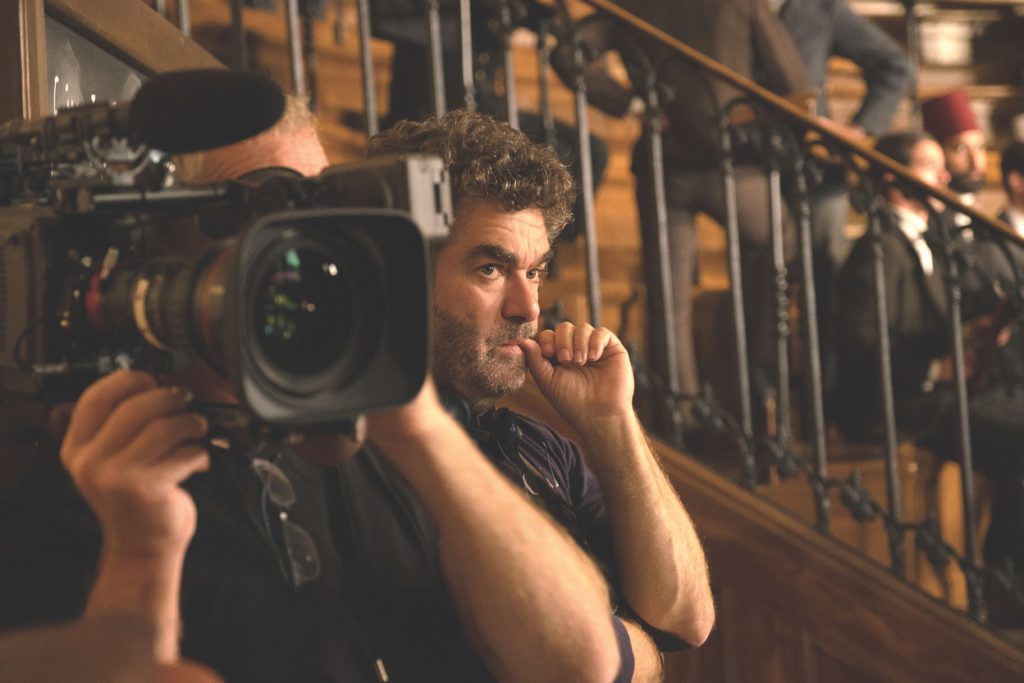
Documentary director Joe Berlinger films actor Christian Bale holding a child on the set of “The Promise.” Photo courtesy of Survival Pictures, LLC. Photo by Jose Haro
Irving Thalberg of Metro-Goldwyn-Mayer secured the film rights in the early 1930s, before it was published in English, and tentatively cast a rising young actor named Clark Gable in the starring role. Turkey’s ambassador to the United States, Mehmet Münir Ertegün, successfully pressured the United States State Department to scrap the project by threatening to ban all American films from screening in Turkey.
Several documentaries and low-budget films have since been made about the genocide. But the long-simmering effort to make an epic historical drama heated up when Armenian-American casino mogul Kirk Kerkorian set aside $100 million in his will to make a dramatized film about the Armenians. Terry George, the director and writer of 1994’s Oscar-nominated “Hotel Rwanda,” wrote and directed “The Promise,” and is also a central character in “Intent to Destroy.”
Berlinger embedded himself with the production, traveling with the cast and crew to Spain, Portugal and Malta (filming in Turkey was out of the question) for 72 days as they filmed a love story set against the backdrop of village burnings, death marches and mass executions. “Intent to Destroy,” like “The Promise,” was funded by the Kerkorian Foundation. Berlinger enjoyed full access to the set, interviewing the cast and crew, as well as extras who were descendants of genocide survivors.
“If it were truly a Hollywood production where a studio was making that film, like Warner Bros. or Paramount or whatever, there’s no way that I would have been allowed … on that set for even more than a couple of hours,” Berlinger said.
Berlinger is used to inserting himself into volatile situations, whether it’s a murder trial or a world-famous band’s psychotherapy sessions, and is aware that his presence might have had a disruptive effect on the making of “The Promise.”
“The artistic process is a very precious thing that is difficult to define. And throwing somebody into the mix, you don’t want that to affect or change the outcome,” he said.
“The Promise” had disappointing results at the box office (grossing just $10 million, far below its $90 million production budget) and was not well-received by critics. But Berlinger thinks it still achieved Kerkorian’s goal before his death: having his ancestors’ story told on screen for a mainstream audience.
“It created tremendous dialogue and that was the goal,” Berlinger said. “All the reviews invariably mentioned the Armenian genocide of 1915 as a historical fact.”
The memory of the genocide is engrained in Armenian identity, just as denying that it happened is critically important to the Turks. “Intent to Destroy” does interview a couple of historians who blame the mass killings on a “pogrom,” “forced migration,” “a war of mutual extermination,” and even “Holocaust envy,” instead of genocide.
But whatever word one uses to describe it, “Intent to Destroy” makes the case that genocide did happen, and we must now ask why it happened and how can it be prevented from happening again. The successful denial of genocide emboldens other leaders to carry out ethnic cleansing campaigns with impunity, whether it’s in Cambodia, Rwanda, Bosnia or Darfur.
Berlinger has no illusions that “Intent to Destroy” will convince Turkey to acknowledge the Armenian genocide.
“Let’s face it. It’s about land and money. If they recognize the genocide, eastern Turkey becomes western Armenia and there’s billions of dollars of reparations, just like the Germans have [made], that would have to be paid,” Berlinger said. “I believe it should be recognized, but I don’t think there’s the political will for a story that’s 100 years old. Even though, for the Armenians, it’s as current as if it were yesterday.”
“Intent to Destroy” will screen at Laemmle Playhouse in Los Angeles and Pacific Theatres in Glendale beginning Nov. 10.