fbpx

October 24, 2017

The Contemporary Left Antisemitism exchange, part 1: ‘Opposing antisemitism is about politics, not about race or religion’

David Hirsh is a senior lecturer in Sociology at Goldsmiths, University of London and the founder of Engage, a campaign against academic boycotts of Israel. Hirsh is a graduate of City University, London. He holds an M.A. in Philosophy and Social Theory and a PhD from the University of Warwick. Hirsh won the Philip Abrams Prize for the best first book in sociology from the British Sociological Association in 2004 for his book Law Against Genocide: Cosmopolitan trials.

The following exchange will focus on Hirsh’s new book, Contemporary Left Antisemitism (Routledge, 2017).

***

Dear David,

In the prologue to your new book, you write the following words:

It hardly seems controversial to say that while criticism of Israel may well be entirely legitimate, some forms of criticism of Israel may be antisemitic. Defining which kinds of criticism are which is a matter for judgment, and it is the subject of this book.

My introductory question: What types of definitions and answers can one find in your book, who are the definition discussions for and what do you expect your narrative to achieve?

Yours,

Shmuel

***

Dear Shmuel,

The first hurdle here, which is a considerable one, is agreeing that some kinds of criticism of Israel are legitimate while others may feed into, or draw upon, antisemitic cultures or ways of thinking. The antizionist movement may agree to this proposition in words, but in its practice it defines everything as criticism and it finds nothing to be related to antisemitism.

I describe in the book how, in the struggle over proposals for an academic boycott of Israel within the University and College Union, the boycotters would always include a clause in their motions to inoculate themselves in advance from a discussion about antisemitism, for example ‘criticism of Israel cannot be construed as anti-semitic.’ While the motion supported a boycott, the antisemitism clause referred only to ‘criticism of Israel,’ implying that boycott falls within the protection afforded to ‘criticism.’ The UCU Congress explicitly rejected an amendment to clarify the wording so that it would read as follows: ‘While much criticism of Israel is anti-semitic, criticism of Israeli state policy cannot necessarily be construed as anti-Semitic.’ And in the union, all kinds of antisemitic bullying and discourse were treated as ‘criticism of Israel’ and therefore part of the normal rough and tumble of debate.

When Bongani Masuku, the international officer for the once mighty Cosatu trade union federation in South Africa was judged guilty of hate-speech, the whole anitzionist and BDS movement rallied round him, even though what he had said was evidently not mere ‘criticism of Israel.’ He had threatened to mobilize Cosatu members on campus to make life there ‘hell’ for people he called ‘Zionists.’ He had threatened violence, ‘with immediate effect’ against families in SA whose children had moved to Israel and served in its army. He had threatened concrete harm against people who did not agree with him about Israeli politics. On a website, Masuku wrote about the overwhelming majority of living Jews, those who in one way or another identify with Israel, as though they were supporters of racism and fascism. To drive his point home about those Jews, including those who live in SA, he wrote that Hitler was their friend. The point here is that the antizionists who consider themselves to be progressive and antiracist rallied around Masuku and defended all of this, as though it were ‘criticism of Israel.’

Only a few weeks ago the celebrated film director Ken Loach normalized Holocaust denial at a pro-Palestine fringe meeting of the Labour Party Conference saying that ‘history is for all of us to discuss.’ Even Holocaust denial is defended by some as ‘criticism of Israel.’

The book is the story of how antisemitism has moved from the Stalinist fringes of the left towards the mainstream. It is the story of how antisemitic ideas and exclusions are more and more tolerated and licensed within the Labour movement, on campus and amongst the chattering classes. The explicit antisemitism of Hamas and Hezbollah, for example, or the Iranian regime, are overlooked and licensed by some who see them as allies against capitalism, imperialism or modernity.

People who stumble into antisemitic ways of thinking or alliances are generally treated leniently if they are considered to be ‘on our side’ in the global struggle. Those who oppose antisemitism, however, who are mainly Jews, are treated harshly. They are accused of trying to silence criticism of Israel and to smear the left. They are treated as though they were enemies, hiding within the progressive movement in order to do it harm.

The Donald Trump presidential campaign brought many of the shapes and forms of left antisemitism into the right-wing mainstream in America. The final day campaign video was a potent articulation of conspiracy theory even if it did not explicitly relate to Jews.  Steve Bannon’s alliances with ‘white nationalist’ politics, a world in which antisemitism figures strongly, were deniable because they were not explicit. We heard supportive Jews mobilizing their Jewish identity to declare the president free of antisemitism; we heard that some of his best friends (and his grandchild) were Jewish; we heard that people only raised the issue in order to smear the president; we heard mainstream acceptance and legitimization of the Nazis at Charlottesville who surrounded a synagogue chanting ‘The Jews will not replace us.’ All of these things are familiar to anyone who has studied the mainstreaming of left antisemitism; now we see them on the right. They are deniable, they are not obvious, they are difficult to pin down, but they are important. The left seems sensitive to right-wing antisemitism, and the right seems sensitive to left-wing antisemitism; but there is a great reluctance to see it within one’s own political milieu.

The discussion in the book of controversies over defining antisemitism is important, I think. People want an app for their iPhone which can tell them what is antisemitic and what is not. But the world is more complicated than that. It requires judgment of context, of intention, of effect and of meaning. The International Holocaust Remembrance Alliance definition of antisemitism (also adopted by the State Department) offers some useful guidelines to help make these judgments. But it is angrily rejected by those who wish to carry on doing the things that it says, according to context and judgment, may be antisemitic.

I think we need to hold on tightly to the tradition in which there is an alliance against racism and antisemitism; I think we need to be suspicious of the tradition which wants to label Jews as white and then as Zionist racists; and we need to be suspicious of the tradition which wants to label antisemitism as being essential to non-white culture. Opposing racism and antisemitism is about politics, not about race or religion.


The Contemporary Left Antisemitism exchange, part 1: ‘Opposing antisemitism is about politics, not about race or religion’ Read More »

Ambassador Dermer Talks About Israel’s Perils, Success

Ron Dermer, Israel’s ambassador to the United States, made his Los Angeles speaking debut on Oct. 23 and conducted an oratorical master class for some 450 invited guests at Stephen Wise Temple.

Talking for well over an hour without referring to a single note, the 46-year-old native of Florida’s Miami Beach neatly divided his speech into two parts.

In the first segment, Dermer painted a grim picture of the dangers facing Israel in a hostile world, pointing to a rising tide of anti-Semitism in Europe, with Jews bearing the brunt of religion-motivated hate crimes.

But the greatest danger, he said, comes from Iran, which makes no secret of its intent to destroy the Jewish state. The ambassador lauded President Donald Trump for urging a rewrite or complete scuttling of the 2015 nuclear deal with Iran, signed by Iran, the United States and five other nations.

If Dermer — who was in town for three days — frequently sounded like a rebroadcast of Israeli Prime Minister Benjamin Netanyahu’s address to Congress two years ago, it was no coincidence. The diplomat served for four years as Netanyahu’s top foreign policy adviser and wrote many of his speeches. Actually, the ambassador’s role in persuading Republican leaders to invite the prime minister to address Congress — without notifying the White House — earned him a sharp rebuke from President Barack Obama’s administration.

The greatest danger, he said, comes from Iran, which makes no secret of its intent to destroy the Jewish state.

But Dermer remains unshaken in his belief that Iran “got the deal of the century” in negotiating the pact. He believes that Trump must fix it or walk away from it, sounding a line advocated by most Republican lawmakers.

Just as Dermer had his audience fretting about the existential threat to Israel’s survival, he shifted gears and spent the rest of his time talking about the nation’s impressive achievements.

Looking at Israel’s accomplishments — past, present and future — Dermer saw the Jewish state’s glass not only half full, but actually overflowing.

To back his case, Dermer noted that U.S. News & World Report recently ranked Israel as the world’s eighth-most powerful nation, with the top intelligence service on the planet and a three-tier defense system.

In a bow to Obama, Dermer thanked the former president for signing a 10-year military assistance treaty with Israel.

On the economic side, Dermer put Israel’s gross domestic product per capita into the same league as Japan and the nations of the European Union. He mentioned that Israel is leading the world in water conservation, with the country recycling 90 percent of its waste water, compared to 1 percent for the United States.

And he reminded audience members that not only has Israel prevented two dozen major terrorist attacks around the world, but the U.S. and most European countries look to Israel for advice on foiling terrorist attacks and in developing self-driving vehicles.

On the political scene, the optimistic ambassador predicted that “in a few years, Israel will overcome the international pressure exerted against the Jewish state.”

Looking at the past, Dermer argued that in previous centuries, Jews had to plead with others to protect them against hostile forces, but now Jews “are blessed to live in a sovereign state which can defend the Jewish people.”

In an odd way, Israel can thank the Arab states for boycotting Israeli exports, Dermer noted. Without the boycott, Israel would have focused on exporting low-tech goods to its neighbors, but, by necessity, the country developed a high-tech economy.

The generally favorable outlook for Israel’s future has allowed its famously tense and argumentative citizens to become more relaxed, he concluded.

“We used to say that Israelis go to New York to relax, but now Manhattanites unwind by visiting Tel Aviv.”

Ambassador Dermer Talks About Israel’s Perils, Success Read More »

1965: When Dodger Sandy Koufax Didn’t Pitch Game One of the World Series

Ending a 29-year-old drought, the Los Angeles Dodgers will finally compete in the World Series, this time against the Houston Astros; the first game is tonight. To commemorate this fete, let’s take a look back when Jewish Hall of Famer Sandy Koufax made Dodger history in the 1965 World Series.

1965 was a landmark season for the Dodgers. During the playoffs, Koufax pitched a perfect game against the Chicago Cubs; it was the fourth straight season Koufax tossed a no-hitter. His legendary performance helped the Dodgers advance to the World Series vs. the Minnesota Twins.

Game One of the 1965 World Series coincided with Yom Kippur and Koufax famously decided not to pitch on the holiest day of the year. Koufax, who didn’t consider himself an observant Jew, told ESPN in 2000: “There was no hard decision for me. It was just a thing of respect. I wasn’t trying to make a statement, and I had no idea that it would impact that many people.”

In Koufax’s stead, future Hall of Famer Don Drysdale pitched Game One. The Twins scored seven runs in the first three innings and went on to an 8-2 victory. Drysdale told Dodgers manager Walter Alston, “I bet right now you wish I was Jewish, too.” Koufax returned to the mound to pitch Game Two and the star pitcher led the Dodgers to a World Series victory.

Koufax wasn’t the only Jewish Dodger to observe Yom Kippur in lieu of playing a game. Right-fielder Shawn Green skipped a significant game in 2001 and, according to Sports Illustrated, consulted Koufax before making the decision.

Here’s a list of Jewish Dodgers throughout the years:

https://www.facebook.com/JewishJournal/videos/10155574774414713/

1965: When Dodger Sandy Koufax Didn’t Pitch Game One of the World Series Read More »

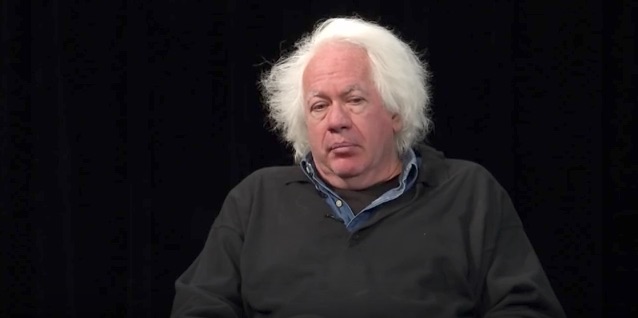
Leon Wieseltier apologizes for inappropriate behavior toward women

Leon Wieseltier, a former editor for The New Republic and a fellow for the Brookings Institute, has admitted to engaging in inappropriate behavior toward women.

“For my offenses against some of my colleagues in the past I offer a shaken apology and ask for their forgiveness,” Wieseltier wrote in an email to the New York Times. “The women with whom I worked are smart and good people. I am ashamed to know that I made any of them feel demeaned and disrespected. I assure them I will not waste this reckoning.”

Wieseltier was set to start to a new magazine after he left The New Republic three years ago, but the recent allegations have killed the magazine. Emerson Collective, a for-profit philanthropy organization headed by Laurene Powell Jobs, wife of the late Steve Jobs, announced that they were ending with their partnership with Wieseltier.

“Upon receiving information related to past inappropriate workplace conduct, Emerson Collective ended its business relationship with Leon Wieseltier, including a journal planned for publication under his editorial direction,” Emerson Collective said in a statement. “The production and distribution of the journal has been suspended.”

According to the Times, Wieseltier is alleged to have “sloppily kissed” female workers on the mouth and would frequently provide lurid details of his sexual escapades. He is also accused of criticizing women for wearing dresses that weren’t “tight enough” and forced a woman “to look at a photograph of a nude sculpture in an art book, asking her if she had ever seen a more erotic picture.”

The women also alleged that men in the workplace knew of Wieseltier’s behavior, yet did nothing about it.

Additionally, The Atlantic reports that some women had what they called “Leon stories” involving “everything from being called ‘sweetie’ in the workplace to unwanted touching, kissing, groping, and other sexual advances” and that there were rumors at The New Republic that Wieseltier frequently “bragged graphically about sexual encounters the way a teenaged boy might.” Former New Republic editor Michelle Cottle told The Atlantic that Wieseltier “delights in making women sexually uncomfortable.”

Wieseltier has a lengthy resume in the field of writing and commentating, having spent 30 years as the literary editor of The New Republic and is a current contributor to The Atlantic. He is now the latest person to be hit by the #MeToo movement of women sharing their stories of sexual harassment in the workplace.

Leon Wieseltier apologizes for inappropriate behavior toward women Read More »

Ex-Chasids Find Strength in Their Brokenness

One of Us,” the story of three millennials at various stages of exiting the insular Chasidic community, is hardly groundbreaking within the subgenre of ex-Chasidic stories.

The stories are unique, but not drastically different from those we’ve read in ex-Chasid memoirs such as Shulem Deem’s “All Who Go Do Not Return.” Still, as the first widely released documentary film about this struggle, it’s a significant addition to the canon.

A picture is worth a thousand words and a film is worth 24 pictures per second. Movies move us.

On film, “One of Us” becomes something much bigger than powerful stories about three courageous people. In pop culture terms, it’s a cocktail of one part “The Unbreakable Kimmy Schmidt,” one part “The Leftovers,” one part “This Is Us,” and a sprinkle of “Praying” by Kesha.

“One of Us” is a story about brokenness. Through the eyes of Luzer, Etty and Ari, we learn that their community is supposed to be perfect, but this perfection was the first thing that broke. Slowly, that imperfection broke each of them, too. But something incredible happens in the process. Their brokenness becomes their strength.

Luzer, Etty and Ari are like Kimmy Schmidt, the ex-cult member at the center of the Netflix sitcom. Each woke up one day in a world in which they know nothing — and the world where they know everything is gone. As Ari says, “I couldn’t Google how to Google because I didn’t know how to Google in the first place.”

Somehow, these people transcended their brokenness in a scary new world, despite missing decades of life experiences and knowledge. They were unbreakable.

Twenty-one years ago, “I’m there for you” was a punchline on “Seinfeld.” Now it’s our superpower.

“Life beats you up,” Kimmy Schmidt once said. “You can either curl up in a ball and die … or you can stand up and say, ‘We’re different. We’re the strong ones and you can’t break us.’”

“One of Us” is a story of that kind of strength.

Brokenness can make us curl up in a ball and die. That happens when the disappointment of discovering imperfections in the things we expected to be perfect is so crushing that we give up. “One of Us” is not the story of all those who were too broken to survive, those who didn’t make it out alive. It’s the story of survivors. Luzer, Etty and Ari are the ones who said, “We’re different,” when they realized their perfect world was a lie. Their brokenness didn’t break them.

Ironically, the insular Chasidic community was built by Holocaust survivors who refused to curl up and die. Their brokenness didn’t break them, either.

“One of Us” is the perfect film for the current pop-culture climate. Famous women in Hollywood silently suffered for years after they were harassed, abused, raped and controlled by powerful predatory men. Today, they are finding the strength to speak up.
Kesha became a symbol of this strength and her single “Prayer” has become an anthem of strength for this movement:

“I can make it on my own and I don’t need you / I found a strength I’ve never known.”

It’s spreading. Women around the world are supporting and empowering one another.
But how does it work?

It is surprisingly simple: Solidarity, empathy, validation and “being there” for one another just works.

Twenty-one years ago, “I’m there for you” was a punchline on “Seinfeld.” Now it’s our superpower.

“One of Us” shows ex-Chasids surviving and thriving because they have one another. They have Footsteps. They have Project Makom. They have us.

All of us will need superhuman strength during our lifetime. Life is fragile and things that seemed perfect betray us with their imperfections. Those moments can kill. Even if our bodies and minds survive, our hearts and souls can curl up in a ball and die. We all want to be the ones who channel our pain and turn a scream into a song. For that, we need to be there for one another.

The film’s most eloquent and beautiful moment comes at a Shabbat dinner. Ex-Chasids gather around an Old World table, eating traditional Chasidic Shabbos foods and singing traditional Chasidic songs.

They’re happy. They’re there for one another. That is power. That is strength.

“One of Us” is about us. Every ex-Chasid is one of us. Let’s be there for ex-Chasids. Let’s be there for all of us.

Ex-Chasids Find Strength in Their Brokenness Read More »

Anti-Fascist Activists Shut Down UCLA Free Speech Panel

A UCLA panel titled “What Is Civil Discourse? Challenging Hate Speech in a Free Society” was forced to move to another room when members of the activist group Refuse Fascism shouted down panelists during the Q-and-A session.

The Oct. 17 event, presented by the United States Holocaust Memorial Museum and the Los Angeles Times, took place during “Free Speech 101: UCLA’s Week on Freedom of Speech.” Holocaust historian Edna Friedberg moderated the panel, which included L.A. Times Deputy Editorial Page Editor Jon Healey, UCLA School of Law professor Eugene Volokh and Rachel Brown, executive director of the nonprofit Over Zero, which focuses on resisting violence.

During the presentation portion of the event, which drew about 50 people, panelists discussed issues such as the meaning of the term “hate speech,” the role of technology in the rapid spread of incitement and whether social media platforms like Facebook have the responsibility to moderate extremism on their sites. Friedberg drew parallels between the current dynamics surrounding campus political speech and Nazi propaganda strategies.

“It’s not a coincidence that Nazi book burnings took place [on college campuses],” she said. “They knew college students were susceptible to their ideas.”

When panelists opened the forum an hour later to questions from the audience, fifth-year UCLA geography student and Refuse Fascism member Tala Deloria was the first to take the microphone.

“This panel is bull—-,” she said. “There is a fascist in the White House, and you’re normalizing it by talking about [hate speech] in the abstract. People are dying in the streets.”

Deloria continued speaking over Friedberg’s requests that she give other audience members a turn, prompting event operators to cut off her microphone and campus security to urge her to leave the venue. Deloria sat down in the auditorium aisle to resist her removal and accused a security guard of twisting her arm.

Three audience members affiliated with Refuse Fascism rose to join Deloria, chanting, “No Trump, no KKK, no Fascist U.S.A.” One activist offered the audience flyers advertising Refuse Fascism’s Nov. 4 march in downtown Los Angeles.

“We don’t only say, ‘Never Again’ about Jews,” explained UCLA graduate and Refuse Fascism member Luna Hernandez. “We say, ‘Never Again’ for everyone.”

Several audience members booed and cursed at the anti-fascist activists. Healy attempted to take an audience question but was drowned out by the chanting.

“This is a prime example of uncivil speech,” Friedberg said to the disrupters.

Event organizers announced that the Q-and-A would move to the room next door. There, panelists took uninterrupted audience questions about topics including controversial speakers on university campuses and Google’s decision to fire employee James Damore following his statements about the company’s diversity initiatives.

The Refuse Fascism activists remained outside the room to discuss the event with attendees.

“We’re Jewish, we’re gay and we hate Trump, too,” one audience member told Deloria before the Q-and-A resumed. “But we want to hear what these people have to say about how we can resist him.”

Deloria said in an interview that she did not enter the event with the intention to protest, but the panelists’ defense of speech rights for people like Charles Murray, a social science researcher who has been accused of scientific racism, put her over the edge.

“The disruption … opened up conversation in a way that I’ve rarely seen at a public program” — Edna Friedberg

“My heart didn’t let me sit there while they normalized death,” she said.

Refuse Fascism is a grass-roots, protest-oriented group seeking to drive President Donald Trump from power, according to its website.

Friedberg said she considered the event a success — not in spite of the disruption, but in part because of it.

“Look, it’s never good when conversation is shut down,” she said. “But I actually feel that the disruption in the audience tonight opened up conversation in a way that I’ve rarely seen at a public program. People were speaking from the heart.”

Friedberg said she was particularly grateful to hear honest inquiries from students, whose questions spanned the many perspectives regarding freedom of speech.

“Part of the reason that the [Holocaust Memorial Museum] seeks out partners like UCLA is to be present on a college campus,” she said. “It shows that our history is relevant.”

Anti-Fascist Activists Shut Down UCLA Free Speech Panel Read More »

The Holocaust Memorial of the Heart

The following article is the fourth in a series of articles published in Fluter.de, a governmental German political magazine for young adults. The German translation could be read on Fluter’s. website. 

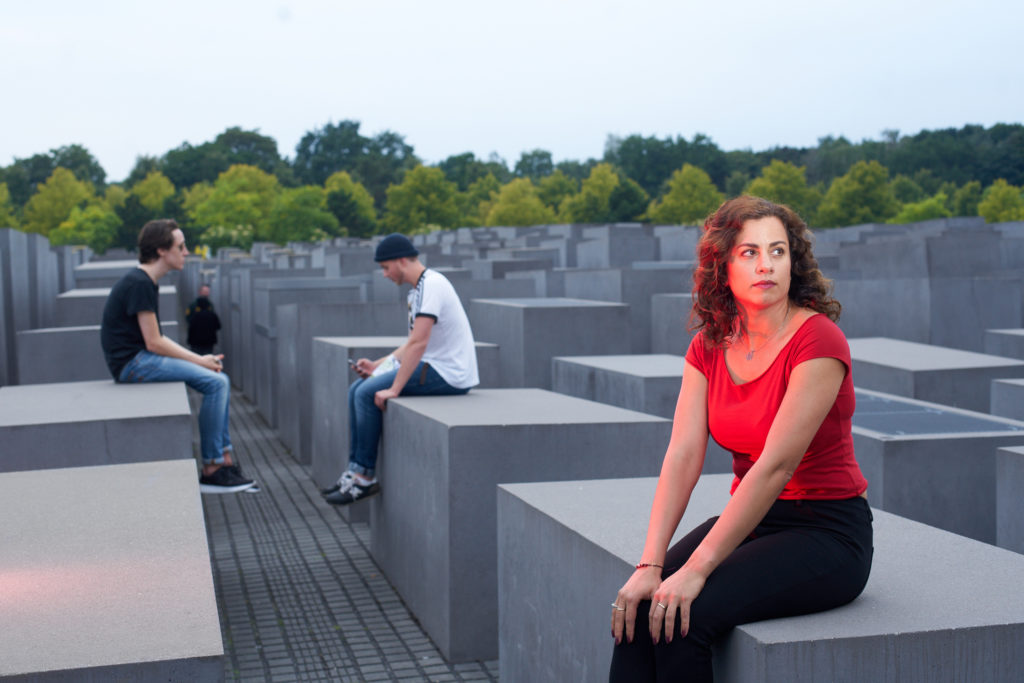
For years, I’ve wanted to watch my grandmother’s Holocaust testimony recorded by the Shoah Foundation, an LA-based foundation that collects survivor testimonies so that their stories will forever be told. I never imagined I’d watch it in Berlin, at the Topography of Terror library, on the former grounds of SS headquarters.

I can’t think of a better symbol of Germany’s repentance over the murder of six million Jews, including the families of my father’s parents.

On the surface, Germany has attempted to make amends for its past crimes, the first step being to own up to them. The Holocaust Memorial to the Murdered Jews of Europe near Brandenburg Gate is often perceived as a grand gesture of confession. Its inauguration in 2006 coincided with the World Cup, and both events attracted a new generation of Jews, mostly Israelis, to the German capital. Germany and the Jewish people could now be friends.

Germany’s brave openness about its history has eased my comfort living in and loving Berlin. The Holocaust is taught in classrooms; high school students visit concentration camps regularly. Ironically, Germans took pride in finally shedding any lingering “Nazi image” when the government, out of “historic responsibility,” opened the borders to about one million refugees from Muslim countries steeped in antisemitism.

But when I sometimes took a chance on the question Jews secretly like to ask Germans: “Where were your grandparents during the War?”, I wondered how the Holocaust could have happened.

-“They were pacifists who opposed war.”

-“They lived on the countryside and thought Hitler would pass.”

-“My grandfather just dreamed of being a pilot, so he joined Hitler’s air force.”

-“He served in the Wehrmacht, so he was clean.”

Most Germans I casually meet seem to deny, excuse, whitewash, or plead ignorance to any family involvement in Jewish genocide, direct or indirect, prompting me to explore the subject for the Jerusalem Post.  I discovered that it’s very rare for young adults to look into probable Nazi family history. In many families, the topic is taboo.

I now better understand why a recent Bundestag report found that 40 percent of Germans hold antisemitic attitudes in the form of hostility towards Israel and why some Germans are quick to (wrongly) equate Israeli soldiers to Nazis and Muslim refugees to persecuted Jews. Holocaust education and commemoration runs the risk of becoming grossly generalized and superficial if it doesn’t get personal.

Individuals and institutions have diligently collected survivor testimonies, but what about the side of perpetrators? While such an endeavor would be complicated, personal German testimonies recounting the war days, in honest detail, would enable us to better understand and particularize how the German people allowed its country to turn into a thieving, murderous tyranny.

Since the Nazi generation is dying out, the burden of storytelling lies with the second and third generations. So instead of, or in addition to, taking students to concentration camps, I challenge German educators to guide them towards painstaking, even painful genealogical research.

Because setting up memorials of brass and stone, going on field trips, and even opening the country’s gates is easy, even cathartic. And it looks good in the eyes of the world.

It’s much harder to open the gate of the heart and scrape and sculpt a memorial inside. But if Germans undertake this difficult, uncomfortable, unpleasant work of tracing Nazi-era family history, they could reclaim the quality their ancestors will probably reveal to have lost when Hitler took power: individual moral courage.

Orit Arfa is a journalist and author based in Berlin. Her latest novel, Underskin, is a contemporary steamy love story between an Israeli woman and German man. 


The Holocaust Memorial of the Heart Read More »

‘One of Us’ co-director apologizes for Holocaust comment

Heidi Ewing, a co-director of the “One of Us” Netflix documentary, has apologized for her comments about Hasidic Jews being targeted during the Holocaust for not blending into society.

Ewing appeared on The Charlie Rose Show on Thursday and said, “The vast majority of Hasidic Jews were exterminated in the Holocaust, partly because they refused to blend in.

“They kept wearing the clothing,” said Ewing. “They sort of were loud and proud about their identity, and the vast majority died in the Holocaust.”

Ewing received some serious backlash on social media for her comment:

https://twitter.com/bethanyshondark/status/922869949072314370

https://twitter.com/bethanyshondark/status/922870126617284608

https://twitter.com/bethanyshondark/status/922871234945306625

https://twitter.com/bethanyshondark/status/922871398636417024

https://twitter.com/bethanyshondark/status/922871570590326784

https://twitter.com/bethanyshondark/status/922871783581274112

Others weren’t quite as taken aback by it:

https://www.facebook.com/yoel.schaper/posts/10159682594370500

https://www.facebook.com/zac.mordechai/posts/10159739978860352

https://www.facebook.com/rachmuna/posts/1168817046551422


Ewing eventually apologized for her Holocaust remark.

“I am sorry if my words on Charlie Rose caused any pain and would like to clarify their meaning,” Ewing said in a statement. “The devastating losses that the Jewish community suffered at the hands of the Nazis is unspeakable. Almost half the population of world Jewry was destroyed by the Nazis and their collaborators, whole communities destroyed.”

She added that “Hasidic Jews suffered disproportionate losses” since “they were more easily identified and therefore had more difficulty hiding.”

“It took great courage for Hasidic Jews at that time to refuse to change their appearance to look more like the general European public,” said Ewing. “I am only filled with respect and admiration for any person who chooses to live their own truth.”

Some weren’t satisfied with her apology:

https://twitter.com/SethAMandel/status/922861353362165762

Others felt that her comments shouldn’t take away from the substance of the movie:

https://twitter.com/jhoffman/status/922120874622373889

“One of Us” is a documentary that follows three former Hasidic Jews who have been ostracized by the community since they left. The documentary was released on Friday. Gerri Miller wrote about it for the Journal here.

‘One of Us’ co-director apologizes for Holocaust comment Read More »

#MeToo: No More To Violence and Degradation

#MeToo: No More To Violence and Degradation

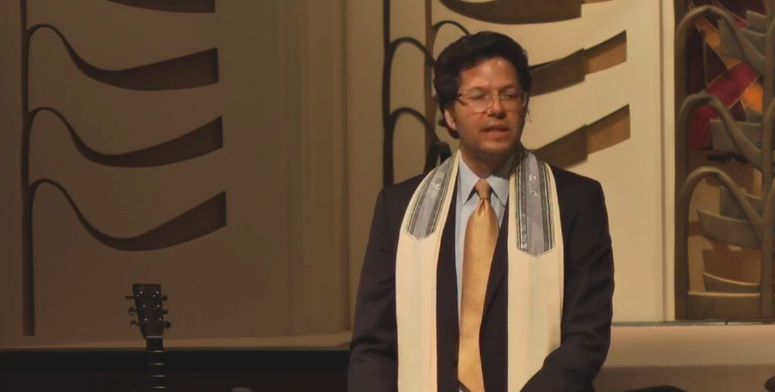
Rabbi Yoshi ZweibackRabbi Yoshi Zweiback granted me permission to share his moving and meaningful #MeToo sermon from Friday, October 20, 2017 at Stephen Wise Temple in Los Angeles, California:

“This is the line of Noah: Noah was a righteous man; he was blameless in his age; Noah walked with God.”

It was good that Noah walked with God. It was good that he was blameless in his age. It was good that he was a righteous man.

Because no one else was.

According to our tradition, Noah was the only righteous man of his generation. Everyone else was pretty much disgusting.

Our Torah portion this week tells us in fact that the whole world had become corrupt.

The great medieval commentator, Rashi, tells us that the Hebrew word “וַתִּשָּׁחֵ֥ת” refers to a particular type of corruption – ערווה, usually translated as “liscentiousness” – sexual depravity.

WATCH: Soulful Shabbat Service Oct 20 2017 with Rabbi Yoshi’s sermon

Rashi notes that according to the midrash, ערווה so offends God that it leads ultimately to indiscriminate punishment, the “end of all flesh,” a punishment that is meted out on good people and bad people alike. It, in the words of the midrash, is something that הוֹרֶגֶת טוֹבִים וְרָעִים – it kills both the righteous and the wicked.

What a parasha for this week.

Like many of you I’m sure, I’ve been reading one #metoo story after another on facebook.

Friends, classmates, colleagues sharing horrifying stories of aggression, discrimination, degradation, humiliation, and violence.

Details of Harvey Weinstein’s behavior and the degree to which so many were complicit in it continue to emerge. There is a corruption, a type of ערווה in this town, in the entertainment industry, and – more broadly – in our world, that is gross, disgusting, nauseating.

How should we respond? What should we do? How can we make things better?

Although I had a mother and I have a sister, a spouse and three daughters, it is very difficult for me to relate personally to so many of the stories I read.

I’ve found it helpful, though, to simply try to listen to the experiences of others.

In yesterday’s New York Times, Margaret Renkl shared a moving piece about her own experiences. A few years back, she found herself sitting around her kitchen table with her sons. The subject of travel came up and her boys asked her why she hadn’t backpacked around Europe like their father had.

Here’s what she shared with them:

“It’s dangerous for a woman to camp alone,” I finally said at the table that night. “There are women who do it, but I’m not that brave.”
My children grew up with stories of their father’s adventures. They did not grow up with stories of mine. I didn’t tell them the story of the 16-year-old family “friend” who babysat while his parents and mine went out to dinner the year I was 11, how he followed me around the apartment, tugging on my blouse and telling me I should take it off, pulling at the elastic waistband of my pants and telling me I should take them off, how I finally locked myself in my bedroom and didn’t come out till my parents got home.

I didn’t tell my children the story of walking with my friend to the town hardware store when we were 14. I didn’t tell them that my friend used her babysitting money to buy a screwdriver and a deadbolt lock to keep her older brother out of her room at night.

I didn’t tell my children the story of my first job, the job I started the week I turned 16, and how the manager kept making excuses to go back to the storeroom whenever I was at the fry station, how he would squeeze his corpulent frame between the counter and me, dragging his sweaty crotch across my rear end on each trip…

There is nothing unusual about these stories. They are the ho-hum, everyday experiences of virtually every woman I know, and such stories rarely get told. There will never be a powerful social-media movement that begins, ‘Today I ate breakfast’ or ‘Today my dog pooped and I cleaned it up’ or ‘Today I washed my hair with the same shampoo I’ve been buying since 2006.’ We tell the stories that are remarkable in some way, stories that are surprising, utterly unexpected. The quotidian doesn’t make for a good tale.

And maybe that’s why the avalanche of stories on Twitter and Facebook this week has been so powerful. It started on Oct. 5, when The New York Times first broke the story of accusations of sexual harassment against the Hollywood producer Harvey Weinstein, but it became a juggernaut 10 days later, when the actress Alyssa Milano tweeted, “If you’ve been sexually harassed or assaulted write ‘me too’ as a reply to this tweet.” Within minutes the hashtag #MeToo was all over Twitter, Facebook and Instagram — over 500,000 times on Twitter and 12 million times on Facebook in the first 24 hours alone — and the deluge shows no sign of slowing. The numbers keep ticking up as women tell the stories of men who used their power to overwhelm or coerce them.” (“The Raw Power of #metoo “-NY Times, Oct 19, 2017)

There is a terrible corruption in this world.

In this week’s Torah portion, God gets so fed up with humanity that She decides to start over, to destroy Her creation and begin again.
Our parasha tells us that Noah was indeed righteous.

But he is criticized by the rabbis who contrast Noah’s behavior with the behavior of Abraham. When Noah is told that God wishes to destroy the world, he says nothing. He builds the ark and saves his own family but he does nothing to address the core issue, the fundamental problem, the corruption that so angered God.

And maybe that’s one of the lessons for us. It’s not enough to be upright in your own behavior. Of course each of us at work and in our interactions with others wherever we are should behave according to the highest standards of our tradition and be particularly careful not to degrade, humiliate or harass – ever. But our tradition requires us to go farther: we have to actively work to build communities where the norms and standards of upright behavior in this regard are widely embraced so that we can build a world where 14 year old young women don’t need to put deadbolts on their bedroom doors.

On a closed facebook page for Reform rabbis, I read many stories of female colleagues across the country who have felt uncomfortable in their own shuls because congregants or co-workers had made comments about their dress and their appearance. They shared stories of being hugged or kissed at the oneg when they didn’t feel comfortable with that type of touch.

We can and we must do better. And we have to help each other as a community to do better.

If you didn’t hear Rabbi Knobel’s powerful and moving High Holy Day sermon about gender violence, you can find the video of it on our website (https://youtu.be/B5S2opBM_Ss). And if you heard it, watch again and think about it in the light of what we’ve seen over the past two weeks.

And I invite you, if you feel comfortable doing so, to share any of your experiences and any suggestions you have about how we can make this sacred space more comfortable for you and about how we can work together to change things in our City of Angels where so many of those awful, awful stories we’ve been reading took place. And then we must change things more broadly so that the violence and degradation, the terrible corruption that led God to want to destroy the whole wide world will become a distant memory so that no woman or man will ever again have to say “#metoo.”

Thank you to Rabbi Yoshi and Stephen Wise Temple for all you do: 

“We make meaning and change the world.”

אנחנו יוצרים משמעות ומשנים את העולם.

#MeToo: No More To Violence and Degradation Read More »

Jenna Jameson Receives Death Threats After Expressing Outrage Over New Trans Playmate

When Jenna Jameson was converting to Orthodox Judaism, she chronicled her adventures on Twitter.

Last week, when the Iran Deal was being discussed, again she took to Twitter with the hashtag #IStandwithIsrael. Regarding abortion, she also posted, siding with Conservative pundits like Ben Shapiro.

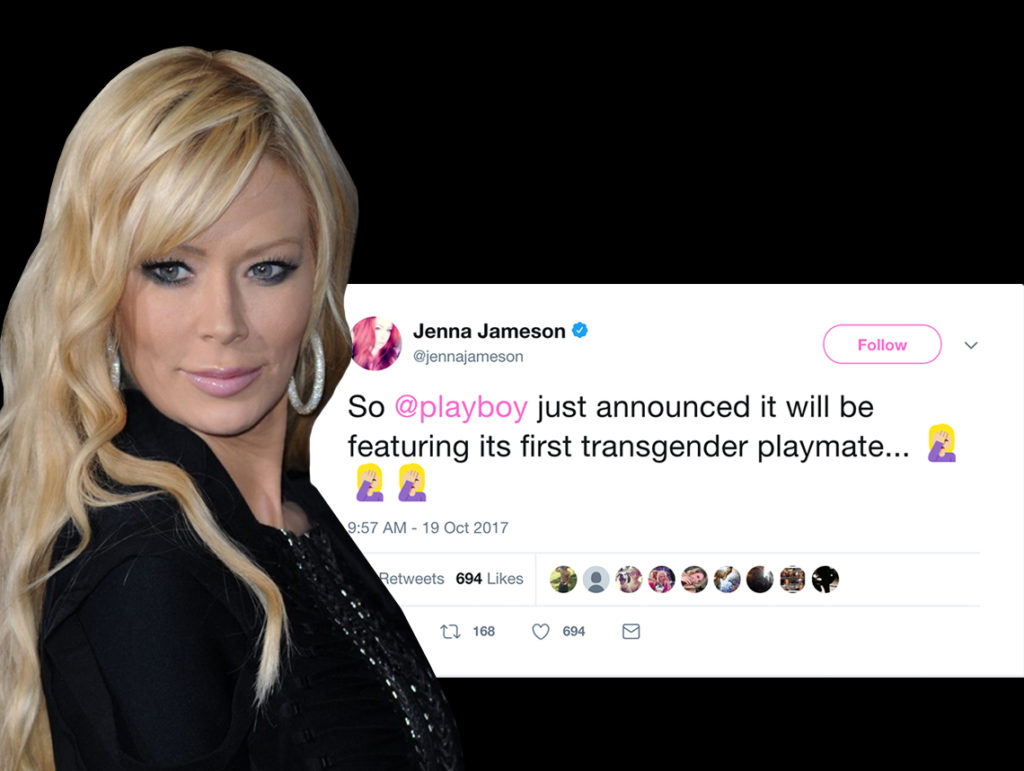
And when Playboy announced that the November centerfold was going to feature its first transgender Playmate, a French model named Ines Rau, she took to Twitter once again.

Later, Jameson, 43, told Fox News, “I just think it’s a ridiculous attempt by Playboy to stay relevant. It is a foolish decision that alienates its consumer base.”

Her responses were not well-received, to say the least – even inciting death threats against the former playmate and her daughter via Instagram, according to Jameson.

One user responded, “So many LGBTQ people have been fans of you & actually looked up to you & your empire. That’s sad you would be so judgmental.”

“Just because I don’t agree with a trans person being in Playboy doesn’t mean I’m ‘transphobic,'” said Jameson.

Playboy, however, was not surprised that controversy would erupt over their landmark decision.

The magazine responded with their own set of tweets, drawing parallels between Letters to the Editor from 1965 -when they featured their first African American playmate, Jennifer Jackson- to reactions on social media about Ines Rau.

“It’s the right thing to do. We’re at a moment where gender roles are evolving,” Cooper Hefner told The New York Times last week.

Jenna Jameson Receives Death Threats After Expressing Outrage Over New Trans Playmate Read More »