fbpx

September 26, 2017

The Debt Cycle: What to Do When You’re in Debt?

Once you fall into the debt cycle, it’s very difficult to get out of it. Most people try to prioritize and choose to borrow money to cover the existing debts, which practically leaves them digging a deeper hole for themselves. In the challenging economic climate and the consumer society we live in, people can rarely afford to invest or save money and the majority lives from paycheck to paycheck. Being in debt can be a lot to handle, no matter what brought you into that situation. Take a deep breath – there is a way out. Here’s where to start.

Understand the Reasons Behind the Debt


The only way to get out of debt is to have strong determination and analyze what went wrong. Today, the economic power of an individual is not big enough to obtain the middle class’ basic needs, which is why we are continuously pushed to getting loans. Credit cards can be tricky and they are certainly one of the most common reasons why people experience severe financial difficulties. If you don’t pay attention to your spending, the debt keeps piling up and before you know it – you owe too much money. In addition to underestimating your repayment capabilities, poor money management and unexpected circumstances are the two main slippery slopes. So, first things first: map out what got you where you are now so you don’t make the same mistakes again.

Get Organized


Use a spreadsheet and list all your debts, balances, interest rates, and minimum payments to get to the final figure you owe. Arrange your debts in accordance with the height of the interest rate. This is the only way you’ll be able to see exactly what you’re dealing with. Make a new spreadsheet to track down all of your expenses. This means you’ll have to adapt to living on the budget, which will not be a pleasant experience if you’re used to dining out or going to the spa often. It’s time to be brutally honest and tough to yourself. There are so many hidden expenses you don’t pay attention to on a daily basis. Commit to making smarter choices: for instance, if you always buy yourself lunch during the break at work, start packing food to save up. If you’re a smoker, this might be a great time to learn how to channel stress and try to kick the habit.

Stay Calm and Choose the Best Exit Strategy


There are three main options you can consider for pulling yourself out of debt, but not all are suitable for every particular debt situation. The first option would be to discuss the problem with your lenders or creditors. Credit card companies usually have internal hardship programs and the counselor on duty can help you by offering you certain solutions to repay your loan or lower your payments. This is a good solution for those who have instantly realized they’ve bit more than they could chew and now they are falling behind with payments. Debt relief options are the optimal option for those who are way over their heads and unable to pay minimum monthly payments. These include getting a debt consolidation loan or debt settlement, and allowing a professional come up with a structured plan with a defined time period, so you don’t go bankrupt. The third option is to start paying off your credit cards starting from the smaller debts you can cover. This triggers a positive mental shift and gives you the motivation to stay persistent, similar to the satisfaction we have by scratching one thing out of our to-do lists. This is a wise choice if you don’t mind the length of the time needed to pay off all the debts. Plus – it will better your credit score.

Experiencing debt is exhaustive and stressful, but there is a solution to everything. Consider these tips and take in mind new ways to earn some money on the side, so you can put your debts behind you in a shorter time period.


The Debt Cycle: What to Do When You’re in Debt? Read More »

Daily Kickoff: What Sen. Bob Menendez’s trial has to do with ‘tzimmes’ stew | Mike Doran on JCPOA | Gloria Allred’s Crusade | BDay: Walter P. Stern

Have our people email your people. Tell your friends to sign up for the Daily Kickoff here!

PROFILE: “Gloria Allred’s Crusade: The attorney takes on Bill Cosby, rape law, and Donald Trump” by Jia Tolentino: “She was born Gloria Rachel Bloom on July 3, 1941, to two doting Jewish parents, Morris and Stella. Stella was English; she and Morris had met, Gloria says they told her, “in Baltimore, on a streetcar named desire.” Both left school after the eighth grade. Morris worked six days a week as a door-to-door salesman, hawking Fuller brushes and photographic enlargements, and the family (Gloria was the only child) lived in a row house in southwest Philly. They didn’t attend synagogue together—Morris was too busy, and Stella explored many religious ideas, going to a church one week and an Ethical Culture meeting the next—but Gloria went there for Sunday school, and was confirmed.”

“Allred was approached years ago by people who wanted her to run for a seat in the California State Senate; she didn’t seriously consider it, she told me. She isn’t particularly religious, but she believes in the Jewish concept of tikkun olam, that it is the job of individuals to repair the world. “Each one of us has the responsibility of turning a negative experience into a positive experience,” she had told me the previous week, in Los Angeles. “Maybe that’s why these bad things happened. Maybe that’s the purpose—if there is a purpose, and I don’t know that there is. But a human being likes to think there is.” [NewYorker]

TZIMMES, THE TALK OF THE SEN. MENENDEZ TRIAL — by Matt Friedman: “Earlier, before the trial broke for Rosh Hashanah last Wednesday, Judge William H. Walls compared his decision on permitting certain evidence to a traditional Ashkenazi Jewish stew with “a little bit of this, and a little bit of that.” [Abbe] Lowell told Walls that the stew was called tzimmes, that it’s traditionally served on Rosh Hashanah and that he would bring some to share with the court. Lowell on Monday made good on that promise, bringing containers full of tzimmes for Walls and even the prosecution. “This is a new meaning of serving the government,” Lowell said as he handed some to prosecutors.” [Politico

“Walls, who had previously said he has to watch his sodium intake, asked whether it was a salty dish. Lowell assured him it was “sugary.” “Sweet as in sweet New Year,” Lowell said.” [NJ Advance]

Hollywood talent manager Scooter Braun posted on Instagram: “L’shana tova. Have a happy new year. For a split second I almost didn’t share this message because of all the hate I see online for my heritage and culture. But no. I’m a proud Jew so happy new year. And if you are a proud Christian or Muslim be proud. If you are who you are, whether it be race, religion, sexual orientation, or you just like being different… Be you. Never be afraid to express it and embrace others for being exactly who they are. This year may we all be better TOGETHER. So once again…. l’shana tova and happy new year. Much love.” [Instagram] • From last week: “Scooter Braun on philanthropy, working with Kanye and trying times with Justin Bieber” [CBSNews]

BREAKING OVERNIGHT: “Palestinian kills 3 Israelis in settlement near Jerusalem” by Aron Heller: “A Palestinian gunman on Tuesday killed three Israeli security men and critically wounded a fourth outside a West Bank settlement before being shot dead, in one of the deadliest attacks of a two-year spate of violence. Israeli officials said the attacker was a 37-year-old father of four, with a valid work permit in Israel and a troubled personal life who appeared to have acted alone. The attack comes at a tense period amid the Jewish high holidays and is likely to complicate the mediation efforts of U.S. peace envoy Jason Greenblatt, who just arrived in the region for meetings with Israeli and Palestinians leaders.” [AP]

Greenblatt tweets: “My family & I are horrified by the attack in Har Adar. Shame on Hamas & others who praised the attack. All must stand against terror! We pray for the victims of today’s attack at Har Adar, and their loved ones as well.” [Twitter]

KAFE KNESSET — by Tal Shalev and JPost’s Lahav Harkov: The tragic news of the Har Adar terror attack took over the agenda of the weekly cabinet meeting, which was postponed from Sunday and convened this morning. The traditional wave of political reactions and calls for punitive measures focused this time on revoking work permits for Palestinians, as the terrorist who stabbed the three Border Policeman to death had a permanent work permit. Economy Minister Eli Cohen said that all work permits should be suspended until after the holiday season, and Transportation Minister Yisrael Katz said the attack will have “grave consequences on employing Palestinians and easing movement restrictions.”

Netanyahu, in his opening statements, stopped short of announcing any collective punishment for now, announcing three immediate steps in response to the attack: demolishing the terrorist’s house, imposing a curfew on his village, and revoking entry permits from his family. Netanyahu also pointed a finger at Palestinian incitement and demanded Abu Mazen “condemn the attack and not justify it,” a talking point echoed by all of his cabinet ministers, with some saying the attack is proof there is “no partner” on the Palestinian side. Deputy FM Tzipi Hotevely said the attack is a “message” for the US administration, just as Jason Greenblatt arrives in Israel for another round of peace talks, and the attack is likely to complicate his already complicated mission. Several right-wing ministers and MKs stressed that in the midst of terror, there is no room for economic gestures and initiatives for the Palestinians, and others – Like Bayit Yehudi’s Uri Ariel – demanded settlement construction as a suitable reaction. Read today’s entire Kafe Knesset here [JewishInsider]

UN Mideast envoy says Israel ignoring UNSC resolution — by Edith Lederer: “Israel is not complying with a UN Security Council resolution demanding a halt to all settlement activity and instead is continuing to expand settlements, making a two-state solution “increasingly unattainable,” the UN envoy for the Mideast said Monday. Nickolay Mladenov told the council that in the three months since June 20 Israel’s settlement activity “continued at a high rate, a consistent pattern over the course of this year.” [AP

DRIVING THE CONVO: “How Trump Can Improve the Iran Deal” by Mark Dubowitz and David Albright: “We propose the president “fix” U.S. policy by making it clear he does not accept the Iran deal’s dangerous flaws. He should insist on conditions making permanent the current restrictions on Iran’s nuclear program and the testing of advanced centrifuges and nuclear-capable ballistic missiles, as well as the buying and transferring of conventional weaponry. He must insist on unfettered access for U.N. weapons inspectors to Iranian military sites.” [WSJ]

HEARD YESTERDAY — Hudson Institute fellows Michael Doran and Peter Rough, along with Michael O’Hanlon of the Brookings Institution discussed President Trump’s policy on Iran in a panel “The Trump Administration and the Middle East: What Should America Do Next?” hosted by the Hudson Institute and moderated by the think tank’s Senior Fellow Lee Smith.

Highlights — Doran: “As much as I abhor the JCPOA, I don’t think that trashing it at this moment is the priority. The priority is Syria and breaking up this (Iranian) beltway. If we are not going to compete with the Iranians in Syria, we are not going to roll back the JCPOA. There has to be a paradigm shift in Washington about competing with the Iranians in the region.”

Doran on Syria ceasefire: “We should use our own considerable air defense assets to send a message to tell the Iranians and the Russians that if they violate that (Syrian) belt, they’ll be in trouble. Eastern Syria should be American dominated territory… We should adopt the Israeli red lines as our own and send a message to the Russians that we are with the Israelis. That increases their deterrence and empowers the Israelis.”

O’Hanlon on Egypt: “President Sisi is [Hosni] Mubarak on steroids… I don’t think we should be giving Egypt the same amount of aid as in better days — not that there were such incredibly better days. I would be giving half as much aid these days.” [Video

“Europeans say Trump can win on Iran without ripping up nuclear deal” by Laura Rozen: “In a sense, this administration has changed the climate on Iran,” British Ambassador Kim Darroch said at a panel of four European ambassadors at the Atlantic Council. “It is succeeding. … But let’s keep the JCPOA [Joint Comprehensive Plan of Action].” Darroch said he has noticed an intensification of contacts over the past couple of months between the Europeans and experts within the US administration on how to increase the pressure on Iran… Whether or not Trump certifies next month is “basically a domestic issue,” French Ambassador Gerard Araud said. “What matters will be the consequences. We are not going to criticize the president for certification or decertification. That is your problem.” [Al-Monitor; NYTimes]  

“Iran’s supposed missile launch was fake, US officials say” by Lucas Tomlinson: “The video released by the Iranians was more than seven months old – dating back to a failed launch in late January, which resulted in the missile exploding shortly after liftoff, according to two U.S. officials. President Trump had originally responded to the reported launch in a late-Saturday tweet, saying, “Iran just test-fired a Ballistic Missile capable of reaching Israel… Not much of an agreement we have!”” [FoxNews

ON THE HILL — House committee to vote Thursday on Hezbollah sanctions bill — by Aaron Magid: The House Foreign Affairs Committee’s bill — introduced by the Chairman Ed Royce (R-CA) and Ranking Democrat Eliot Engel (D-NY) —  further restricts Hezbollah’s ability to fundraise and recruit along with cracking down on foreign states that do business with the Lebanese terror group, including Iran. Additionally, the House Foreign Affairs Committee will also markup a bill on Thursday that condemns Hezbollah for its usage of civilian shields during warfare while imposing sanctions on individuals who are involved in this practice. [JewishInsider]

JARED INSIDER: “How Jared Kushner Is Dismantling a Family Empire” by Rich Cohen: “His future seemed certain. But, as Kushner’s great-grandparents would’ve said, kicking it in the shtetl, Der mentsh trakht un Got lakht. Man plans, God laughs… Jared Kushner is six feet three and thin—rangy if you like him, reedy if you don’t. He has dark eyes and brown hair, a broad smile, and a facial expression, captured in newspapers, that goes from surprised to amused to flat. Something about him remains opaque, unknowable. Something held in reserve.” [VanityFair]

“Jared Kushner’s lawyer, fooled by ’email prankster,’ offers window into private email controversy” by Natasha Bertrand: “Top Washington lawyer Abbe Lowell engaged in an email exchange with a prankster posing as client Jared Kushner on Monday, at one point telling the prankster that he needed “to see all emails” sent and received from a private email account the president’s son-in-law had set up in December… On Monday, the prankster wrote to Lowell from the email address “kushner.jared@mail.com” asking what he should do with “some correspondence on my private email … featuring adult content… Lowell replied: “Don’t delete. Don’t send to anyone.  Let’s chat in a bit.” [BusinessInsider]

“At Least 6 White House Advisers Used Private Email Accounts” by Matt Apuzzo and Maggie Haberman: “Other advisers, including Gary D. Cohn and Stephen Miller, sent or received at least a few emails on personal accounts, officials said. Ivanka Trump… used a private account when she acted as an unpaid adviser in the first months of the administration, Newsweek reported Monday. Administration officials acknowledged that she also occasionally did so when she formally became a White House adviser… Most of Mr. Trump’s aides used popular commercial email services like Gmail. [jared] Kushner created a domain, IJKFamily.com, in December to host his family’s personal email. That domain was hosted by GoDaddy on a server in Arizona, records show.” [NYTimes; Newsweek]

HAPPENING TODAY: “Trump Dinner at NYC’s Le Cirque Seeks Up to $250,000 Per Couple” by Zachary Mider and Jennifer Jacobs: “Some of the biggest names in U.S. finance and real estate are expected to gather at New York’s Le Cirque restaurant on Tuesday as President Donald Trump raises money for the Republican National Committee… Many of the anticipated attendees, such as the executives Howard Lorber and Steve Witkoff, come from New York real-estate circles where the president’s career began.” [Bloomberg]  

SPOTTED in Playbook: “Michael Flynn last night having dinner at Char Bar, the kosher restaurant in Foggy Bottom. Asked what his mood was these days, he replied: “My mood is good. Very good.” [Politico]

“Anthony Weiner sentenced to 21 months in federal prison” by Matt Zapotosky: “Disgraced former U.S. congressman Anthony Weiner, whose exchange of illicit messages with a teenager wound up playing a role in the 2016 presidential election, was sentenced Monday to 21 months in prison… The penalty marks a stunning downfall for the New York Democrat whose propensity for sending lewd photos to women repeatedly derailed his career in politics, and — in a roundabout way — might also have affected Hillary Clinton’s bid to become president… Weiner is scheduled to report to prison on Nov. 6, prosecutors said.” [WashPost

** Good Tuesday Morning! Enjoying the Daily Kickoff? Please share us with your friends & tell them to sign up at [JI]. Have a tip, scoop, or op-ed? We’d love to hear from you. Anything from hard news and punditry to the lighter stuff, including event coverage, job transitions, or even special birthdays, is much appreciated. Email Editor@JewishInsider.com **

BUSINESS BRIEFS: From Bistricer to Rockpoint: The new Starrett City deal is a far cry from what might have been [RealDeal] • Wells Fargo Bank provides apartment construction loan for Sole Mia in North Miami by Soffer and LeFrak [Bizjournals] • Inside the $524 Million Bucks Arena & Entertainment Mecca [MilwaukeeMag

HOLLYWOOD: “Can a Hollywood Celebrity Find the Truth About Trump and Russia?” by Edward-Isaac Dovere: “[Rob] Reiner is trying to break through to Trump voters over Russia’s unprecedented meddling in the 2016 election. His new project is The Committee to Investigate Russia, a website gathering news and information on the various Russia inquiries that he hopes will help spur a 9/11-type, bipartisan commission that will bring everything together in a definitive report and make concrete recommendations. On its board are former Director of National Intelligence Jim Clapper, prominent Never Trumpers David Frum, the Atlantic senior editor… So far, Reiner says, he has donated about $100,000 of his own money, and sits on its board of advisers. He says he and his wife will “probably put more in as is needed.”” [Politico]

“The Abbie Hoffman of the Right: Donald Trump” by David Brooks: “In the late 1960s along came a group of provocateurs like Abbie Hoffman, Jerry Rubin and the rest of the counterculture to upend the Protestant establishment. People like Hoffman were buffoons, but also masters of political theater…  America is seeing nearly as much cultural conflict as it did in the late 1960s. It’s quite possible that after four years of this Trump will have effectively destroyed the prevailing culture. The reign of the meritocratic establishment will be just as over as the reign of the Protestant establishment now is.” [NYTimes]  

“‘We Believe Deeply In Lox And Bagels’: What It Means To Be A Secular Jew” by Michel Martin: “Bob Garfield, co-host of WNYC’s On The Media… on what it means to be a secular Jew: “There’s this bizarre, sometimes hostile ambivalence about the religion and the culture from which we spring. You know, it’s a big part of the American-Jewish community. The best way I can put it to you is this, Michel: We don’t read much Torah, but we’ve read every word Philip Roth ever wrote. We don’t necessarily even believe in God, but we believe deeply in lox and bagels. So we, on one hand, are not really participants in the spiritual part of the religion, but we’re as Jewish as can be.””[WAMU

SPORTS BLINK: “Hank Greenberg: Caught Between Baseball And His Religion” by Noam Hassenfeld: “Let’s be real clear,” Aviva [Kepmner] says. “Hank Greenberg did not play on Yom Kippur in ’34, as Hitler was rising in Europe, and that’s what made it even more powerful. And after what happened in Charlottesville, I hope some more Jewish baseball players don’t play on Yom Kippur.” [WBUR

BIRTHDAYS: Vice Chairman and a Director of Capital International, Inc. and long-time Board Chair of the Hudson Institute, Walter Phillips Stern turns 89… Stage, film and television actor, he is best known as “The Most Interesting Man in the World” appearing in Dos Equis beer commercials (2006-2016), Jonathan Goldsmith turns 79… Escondido, California resident, Edward Karesky turns 70… CEO of Israel Longhorn Project, dedicated to bringing Texas Longhorn Cattle home to Israel, Robin Rosenblatt turns 69… Five Towns (NY) resident, Barry Mandel turns 69… Former chairman and CEO of the French engineering conglomerate Alstom, he is the son of Holocaust survivors, Patrick Kron turns 64… Senior political adviser to President Bill Clinton during his second term and co-author of a New York Times best-seller on the future of politics in the United States, Doug Sosnik turns 61… Teaneck-resident with a Jersey City dental practice, Paul Lustiger, DDS turns 61… Historian, senior fellow at the Brookings Institution and a member of the Council on Foreign Relations, Robert Kagan turns 59… Chief of Staff to Ohio Senator Rob Portman, Mark Isakowitz turns 51… Head coach of the Georgia Tech Yellow Jackets men’s basketball team, he was the 2017 ACC Coach of the Year, Josh Pastner turns 40… Former Communications Director for NY Governor Paterson, Senator Schumer and Congresswoman Jane Harman, she now heads a NYC based PR firm whose past clients have included Jared and Ivanka, Risa Beth Heller tuns 38… NYC-based senior editor of global digital video programming at Bloomberg LP, Henry Seltzer turns 32 (h/t Playbook)…

Gratuity not included. We love receiving news tips but we also gladly accept tax deductible tips. 100% of your donation will go directly towards improving Jewish Insider. Thanks! [PayPal]

Daily Kickoff: What Sen. Bob Menendez’s trial has to do with ‘tzimmes’ stew | Mike Doran on JCPOA | Gloria Allred’s Crusade | BDay: Walter P. Stern Read More »

Trump: Otto Warmbier ‘was tortured beyond belief by North Korea’

President Donald Trump said that Otto Warmbier, an American college student who died earlier this year after being imprisoned in North Korea, had been “tortured beyond belief.”

Trump’s comment on Tuesday followed an interview with Warmbier’s parents on “Fox & Friends” in which they described their son’s condition when he was released in June.

“Otto had a shaved head, he had a feeding tube coming out of his nose, he was staring blankly into space, jerking violently,” Fred Warmbier said in the interview. “He was blind. He was deaf. As we looked at him and tried to comfort him, it looked like someone had taken a pair of pliers and rearranged his bottom teeth.”

On Twitter, Trump called the interview “great” and made the claim about North Korea torturing Warmbier, 22.

Warmbier died in the United States in June, days after after being sent back here in a coma. In 2016, North Korea sentenced him to 15 years of hard labor for stealing a propaganda poster while on a student tour there. North Korea released Warmbier, saying his health had deteriorated after a bout of botulism. Warmbier’s doctors in the U.S. said he suffered extensive brain damage.

Prior to Warmbier’s death, JTA reported that he had been active in the Hillel at the University of Virginia. Following his death, it was revealed that his family hid their son’s Jewishness from the public as negotiations for his release took place.

A family spokesman, Mickey Bergman, told The Times of Israel that the family chose not to disclose Warmbier’s Jewish background as negotiations went forward so as not to embarrass North Korea, which had announced that Warmbier stole the poster on orders from the Friendship United Methodist Church in Wyoming, Ohio.

Trump: Otto Warmbier ‘was tortured beyond belief by North Korea’ Read More »

VIDEO: What happens when I enter an AfD victory party at a Munich beer hall?

People know me as a fearless fighter for the Jewish people and Israel. I entered Gaza in August 2005 when it was a restricted military zone to write about and fight with the Jewish residents of Gush Katif who eventually lost their homes to the IDF. I’ve organized countless pro-Israel events in Los Angeles. I even challenged the Jewish establishment when it wanted to prevent anti-jihad activist Pamela Geller from speaking at the Jewish Federation building in Los Angeles. I recently moved to Berlin where I’m writing about German-Israel relations, often confronting Germans about anti-Israel sentiment and their Nazi past.

So, it was not out of character for me to enter an AfD victory party on the eve of elections, at a Munich beer hall no less, and find Nazis to expose and challenge. After all, the AfD is widely considered the neo-Nazi party. Take a walk inside with me into the lion’s den…(YouTube video comes with English subtitles; click on bottom right of video. For the German subtitles, go to Die Achse Des Guten, here.)

Orit Arfa is a journalist and author. Her second novel, Underskin, is a sexy German-Israeli love story. Her website is: www.oritarfa.com.

VIDEO: What happens when I enter an AfD victory party at a Munich beer hall? Read More »

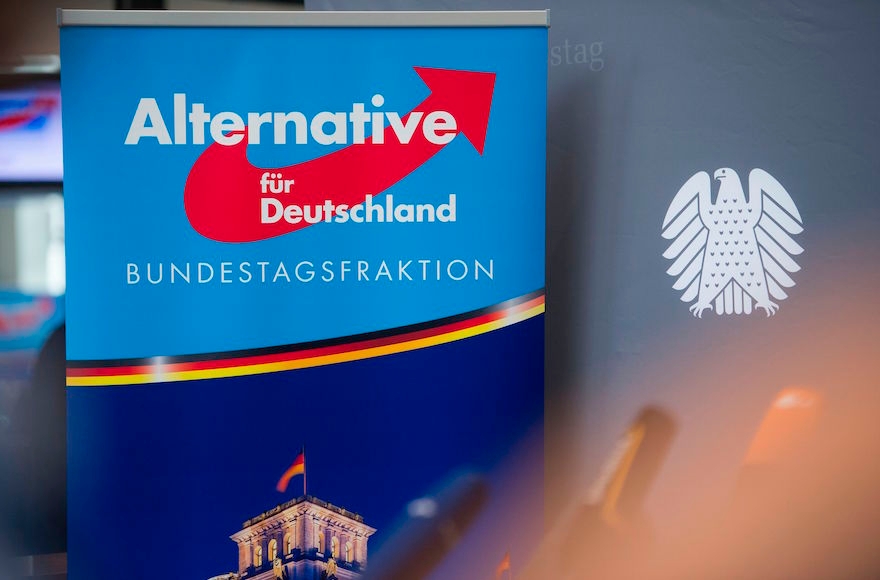
What you need to know about the far-right Alternative for Germany party

Chancellor Angela Merkel clinched her fourth term and her center-right Christian Democratic Union party maintained its parliamentary majority in the German national elections on Sunday.

The victory, however, was hardly a landslide: With some 6 million votes, the populist, far-right Alternative for Germany, or AfD, finished in third place, securing 94 seats in the national parliament, the Bundestag, which now has 709 seats in all.

With a platform focused on Islam and migration, and rhetoric tinged with Nazi tropes, the AfD garnered 12.6 percent of the vote — nearly three times better than in 2013.

The unprecedented showing for a far-right party in postwar Germany alarmed Jewish and Muslim leaders.

“A party that tolerates right-wing extremist ideas in its ranks has managed not only to win seats in almost all our state parliaments, but also in the Bundestag,” Josef Schuster, head of the Central Council of Jews in Germany, said in a statement.

Schuster expressed the urgent wish that German democratic leaders “reveal the true face of the AfD, and expose its empty, populist promises.”

Here is a look at the AfD: its history, its leaders and backers, and where the party stands on key issues.

When was the AfD founded, and why?

Riding a wave of popular resentment against German bailouts of bankrupt European Union member states, the party was launched in April 2013. The AfD has since developed into an anti-immigration, anti-Muslim and euro-skeptical party.

The party gained popularity primarily for its attacks on Merkel’s liberal policy toward refugees — since 2015, Germany has opened its doors to more than 1.5 million, mostly Muslims — and xenophobic and nationalistic campaign platforms. Akin to President Donald Trump’s “America First” position and the U.K.’s rejection of the European Union, the AfD promotes a “pro-Germany” stance, even going so far as to urge citizens to have more babies “made in Germany.”

Who are the party’s leaders?

The party has a moderate and a far-right fraction. Heading the latter is Alexander Gauland, a 76-year-old attorney and journalist who left the conservative Christian Democrats after 40 years to co-found the AfD. His “moderate” counterpart is Alice Weidel, a 38-year-old economist.

Gauland recently said Germans “don’t have to be held accountable anymore for those 12 years [of the Nazi regime]. They don’t affect our identity today any longer. And we’re not afraid to say so.”

Germans, he added, “have the right to be proud of the achievements of German soldiers in two world wars.”

Are AfD politicians anti-Semitic?

Right-extremist parties in Germany have learned over the years how to avoid pitfalls: They don’t deny the Holocaust, which is illegal. But they might say it wasn’t as bad as Jews make it out to be, or that the firebombing of Dresden was worse.

Recently, Bjorn Hocke, the AfD party leader in the eastern German state of Thuringia, caused a stir when he said that too much attention to the Holocaust was making German history “appalling and laughable.” He called the Holocaust memorial in Berlin a “monument of shame” and has recommended a radical departure from “these stupid politics of coming to grips with the past.”

Hocke said “we need nothing other than a 180-degree reversal on the politics of remembrance.”

A party candidate in the western state of Saarland, Rudolf Muller, is under investigation for allegedly selling Nazi paraphernalia in his antiques store.

Concerning their attitudes toward Jews, “many AfD members do share anti-Semitic ideas,” Jan Riebe, who has researched anti-Semitism within AfD for the Berlin-based Amadeu Antonio Foundation, said in an interview with Deutsche Welle.

While the party itself may not be anti-Semitic, many members “believe that Jews are the masterminds of all evil,” Riebe said. “So, in that sense, anti-Semitism does play an essential role in the AfD.”

Riebe added that a former member of the AfD in the Weserbergland region, Gunnar Baumgart, once wrote that Zyklon B, the poison used in the gas chambers, “was used to protect lives and that not a single Jew was killed by it.”

Dirk Hoffmann, a party executive in Saxony-Anhalt, equated Israeli policies in the Palestinian territories with the Holocaust.

Wolfgang Gedeon, an AfD legislator in Baden-Württemberg, has been accused of spreading anti-Jewish propaganda, among other things by reviving debate about the infamous anti-Semitic hoax “The Protocols of the Elders of Zion.”

“The AfD instrumentalizes Judaism and Jewish people, but has no interest in a real Jewish life in Germany,” Sigmount Konigsberg, who handles issues related to anti-Semitism for Berlin’s Jewish community, wrote in a commentary for Germany’s Jewish weekly, the Juedische Allgemeine.

AfD also wants to ban kosher slaughter in Germany, as well as the import and sale of kosher meat, in line with its opposition to halal, or Islamic ritual  slaughter.

“This puts them squarely in the camp of [Hitler’s] National Socialist party, which banned kosher slaughter as early as April 1933,” Konigsberg wrote.

Furthermore, he wrote, “if Holocaust remembrance is termed a ‘Cult of Guilt’ and AfD chairman Gauland is proud of the Wehrmacht, then we can all put two and two together and understand the consequences.”

Some observers have noted that other parties have their share of anti-Semites as well and should be scrutinized in that area as much if not more than the AfD. In particular, they say, left-leaning parties are far more likely to be anti-Zionist and supportive of boycott movements against Israel than are parties on the right.

An AfD poster in Berlin, Sept. 26, 2017. (Steffi Loos/AFP/Getty Images)

Who are some of the party’s legislators? 

Among those expected to take seats in the Bundestag are:

* Martin Hohmann, former member of the Christian Democratic Union, who in 2003 referred to Jews as a “nation of perpetrators.”

* Siegbert Droese, a nationalist who last year raised eyebrows when it turned out that one of his cars bore the license number AH 1818 – the initials of Adolf Hitler in letters and numerals.

* Wilhelm von Gottberg, who in a 2001 essay quoted Italian Holocaust deniers and commented, “We have nothing to add here.”

* Detlev Spangenberg, a former informant for the East German state security apparatus, is a German nationalist who reportedly wants to see the country’s 1937 borders restored.

What about the AfD’s views on Israel?

Though the AfD decided not to include a discussion about Israel in its party platform, reportedly because of concern by some party leaders about Israeli “war crimes,” there has been a generally supportive attitude toward the Jewish state.

Observers say there are two reasons for this: Israel is seen as a bulwark against radical Islam, and support for Israel is used as an alibi against charges of anti-Semitism.

But only one day after Sunday’s elections, Gauland triggered a debate about whether Israel’s right to exist should really be a German “reason of state” – referring to Merkel’s 2008 declaration of solidarity in the Knesset.

“Of course we stand with Israel,” the co-party leader emphasized at a news conference, while questioning whether the viability of the Jewish state should be high on Germany’s agenda. But if that would mean “that we are really prepared to sacrifice our lives for the State of Israel,” he said, “I don’t feel that way.”

Meanwhile, the AfD head in the state of North-Rhine Westphalia, Marcus Pretzell, told the Suddeutsche Zeitung newspaper that he would not support any change in the status of Germany’s support for Israel, which he termed Germany’s only reliable partner in the Middle East.

In Israel, reactions to the AfD’s success were mixed: While some Israeli politicians look to Europe’s populist parties for support in fighting radical Islam, others have called the AfD’s evident appeal to right-wing extremists and racists a warning signal for Israel and Jews.

Who supports the party?

The largest base of support comes from Germany’s eastern states, where it received more than 20 percent of the vote. Nationwide, the AfD has some 23,000 members. By contrast, Merkel’s Christian Democrats have more than 400,000.

Jewish supporters of the AfD may not be many or vociferous, but some — like the Berlin-based artist Pavel Feinstein — have openly declared that the AfD is “the only party that will stop this invasion” of Islamist extremists.

“You don’t have to marry” the AfD, Feinstein told JTA in an interview last year.

Some observers say the AfD has drawn voters from across the political spectrum — including those who never voted — and liken its success to the approval for Brexit in the U.K. and the election of Trump in the United States. This phenomenon has been described as a “radicalization of the center,” though it remains to be seen whether the AfD’s strong showing will lead Germany’s mainstream parties to whistle a more populist tune.

What you need to know about the far-right Alternative for Germany party Read More »

Conan and ‘Transparent’ give Israel the normalcy it craves

“It looks just like L.A.”

A character in the Amazon series “Transparent” says this as she gets her first glimpse of Tel Aviv, and if you work for the Israeli government, or any of a number of pro-Israel groups, you probably couldn’t be happier.

Even if the show will go on to acknowledge the political and human rights mess of the Israeli-Palestinian conflict (and don’t worry, it will), such glimpses of an extremely appealing and otherwise normal Israel have the feel of “mission accomplished.”

The start of the fall TV season has been very good to Israel. Anxious about the BDS movement and other efforts to delegitimize Israel, its boosters were treated to a season-long arc on “Transparent” largely set in Israel, as well as an hourlong “Conan In Israel” special on TBS. “Transparent” used Israel as background and counterpoint to its usual explorations of identity, sexuality and family dysfunction, while Conan O’Brien used his charming “idiot abroad” shtick to poke gentle fun at Jews, Palestinians and mostly himself.

Yet both shows appeared to have emerged from an earlier, less complicated era when Israel was largely seen as a regional good guy and the Palestinians as an uncomfortable but ultimately solvable nuisance if only haters on both sides would let go of their broyges.

I say that realizing that “Transparent” acknowledged  the complexities and contradictions of the conflict in ways likely to anger the right. As Season 4 begins, Maura Pfefferman, the transgender matriarch of the show’s distinctly Jewish and proudly secular central family, is invited to Israel to deliver a lecture on gender and the Cold War. (All 10 episodes of “Transparent” are available on Amazon.) Pfefferman’s youngest daughter, Ali (short for Alexandra), asks to go along, having been humiliated by a former lover in a poem published in The New Yorker. She wants to go for “the history and the suffering and the bloodshed — all that real stuff.”

A scene from the fourth season of  “Transparent” featuring Jeffrey Tambor, left, and Gabi Hoffmann in Israel. (Screenshot from YouTube)

Ali, a grad student, is the most “woke” of the three grown Pfefferman children, and unsurprisingly it is through her perspective that the show relates the Palestinian experience. A feminist activist scoops her up in front of the Tel Aviv Hilton (having declined to spend money in Israel in deference to the boycott), and brings her to meet a Palestinian friend at a hip cafe in the West Bank city of Ramallah. Ali is amazed by the normalcy of life in the “Ramallah bubble,” although her companions remind her about the checkpoints and promise to “catch [her] up” on life under occupation.

Next stop is a nearby farm, where attractive young Palestinians (and at least one pro-Palestinian Jew) share their experiences. A gay man explains that he was jailed in Israel (he doesn’t say why) and that his jailers threatened to out him to his family. A Canadian-Palestinian says that Jews in the Diaspora have more claims to citizenship in the land than the Arabs who actually live there. Another says, “We can’t breathe, can’t move, can’t go to the next city.”

The episode, tellingly, is titled “Pinkwashing Machine,” an allusion to the charge that Israel asserts its positive gay rights agenda to distract from its oppression of the Palestinians.

You can almost hear the clacking of the keyboards as Jewish organizations work on their news releases refuting the Palestinians’ claims, but the scene is oddly nonconfrontational for a show that is so, well, transparent in its left-wing politics. Set outdoors around a table groaning with Palestinian food (maqluba, yum), the scene is right out of a commercial for a California wine or Olive Garden. The viewer is left wondering how bad their lives can be if they live like this. Although a wide-eyed Ali seems converted to the Palestinian cause by all she sees and hears, loyal “Transparent” watchers are by now used to her various intellectual enthusiasms, which she tends to pick up and discard as easily as her ever-changing hairstyles.

In a later episode, the Pfeffermans will debate the conflict during a bus ride to Jerusalem, but the dialogue again seems carefully, and blandly, balanced. Ali scoffs when an Israeli says there never was a Palestinian people; her mom, Shelly, counters that the Holocaust made the Jewish state a necessity. Ali reminds her family of the displaced Palestinians. Maura says there were Jews in the Holy Land well before there was an Israel.

In the end, you are left with the message that “it’s complicated,” and the family goes on to enjoy a raucous morning in the Old City. On a visit to the Western Wall — “Jesus Christ, it’s like an Orthodox Jewish Disneyland!” says one of the Pfefferman kids, not inaccurately — an androgynous-looking Ali sneaks into the men’s section. Shocking? Iconoclastic? Maybe. But considering the broad American Jewish consensus in support of pluralistic prayer at the Wall, hardly transgressive. Ultimately, “Transparent” plays it safe, assuaging Israel’s critics with a nod toward the Palestinian reality and soothing the pro-Israel crowd with a portrait of a cool, bourgeois Israel that feels like home even to Diaspora Jews as disaffected as the Pfeffermans.

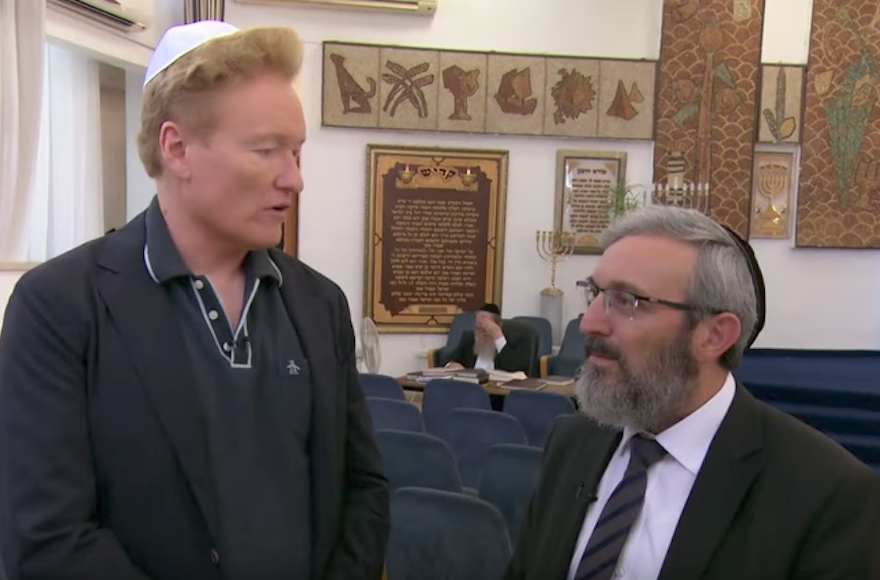
Conan O’Brien filming a scene for his Israel special with Rabbi Dov Halbertal at the Tel Baruch Central synagogue in Tel Aviv. (Screenshot from YouTube)

Conan also acknowledged the Palestinians in his special, although here, too, the balance was with the Israel as the most ardent Israel booster would like it to be seen. He visits the Aida refugee camp for a sober although hardly enlightening conversation with a few of its residents. But this is Conan, and he’d rather amuse than enlighten. The brief segment includes a number of complaints about the security wall and Israel’s military, after which Conan is careful to remind viewers, “To be fair, we did not have a conversation with people who dispute these views.”

Instead, the unmistakably Irish-Catholic talk-show host jokes with handsome young men and woman on a Tel Aviv boulevard, jams with an Elvis impersonator at the beach, visits the Waze headquarters for a view of “startup nation” and trains with the IDF. He even gets face time with Prime Minister Benjamin Netanyahu, an indicator, perhaps, of how seriously Israel takes the notion of hasbara — public diplomacy, as it were — and how grateful it was that Conan turned over an hour of prime time and a pervasive social media campaign to presenting Israel at its best.

It’s impossible not to enjoy Conan’s man-on-the-street bits, and he does the important work of humanizing both Jews and Palestinians, itself an accomplishment and a contribution in a region too often portrayed as a war zone. Pro-Palestinian social media, however, didn’t seem pleased with his visit, mocking him as naive and ensorcelled by the Israeli side.

But at least he went to Aida and Bethlehem, just as “Transparent” took its cast beyond the Green Line. Maybe it is impossible to capture Israelis and Palestinians in all their complexity — activists on both sides certainly don’t make it easy.

The problem in fully understanding the conflict is that the people who seem to care the most about the issue have almost no interest in hearing the other side or having them heard. That goes for Jews as well as Arabs. So both sides attack the media and other observers for trying to get a complete, nuanced picture. And the gun-shy media, when they are not taking sides, either over-correct or play it safe.

Still, given the choice between a portrait of the region that displays its antagonists as “normal” versus one that demonizes either side, I’ll take normal any day.


Andrew Silow-Carroll is JTA’s editor in chief.

Conan and ‘Transparent’ give Israel the normalcy it craves Read More »

This Panoramic Sukkah re-creates Jerusalem in your backyard

When it comes to Sukkot, the weeklong festival in which Jews live and eat in temporary huts known as sukkahs, no place does it better than Jerusalem. City schools and plenty of workplaces close, and a festive spirit permeates the air.

Many Jews around the world make a tradition of visiting Jerusalem to celebrate the holiday, which is also known as the Feast of Booths. Can’t make it to the Holy City? Fear not. Your sukkah can now transport you and your loved ones here.

Well, sort of. The Panoramic Sukkah is a creation by Andy “Eliyahu” Alpern, a photographer specializing in 360-degree images. Thanks to his sukkahs, which consist of panoramic photos of famous places in Israel, celebrants can easily pretend that they are actually at notable Jerusalem sites such as the Western Wall at night or smack in the middle of Mahane Yehuda market.

Alpern, 50, is a native Chicagoan who now lives in the northern city of Safed, where he runs his own gallery. Five years ago he was wandering through Safed during the festival, listening to the voices of families who were celebrating in their sukkahs, when the idea for the Panoramic Sukkah hit him.

By providing an immersive, inside-Israel experience, the Panoramic Sukkah is “a way of sharing Eretz Yisrael with people all over the world who can’t be here,” he told JTA, using the Hebrew term for the Land of Israel.

Alpern added that the point of Sukkot is to hearken back to life during biblical times — for example, wandering in the desert after the Exodus from Egypt (hence the origin of the sukkah), thus one of his panoramic images is of the Negev Desert. Also, as Sukkot is one of the three pilgrimage festivals  (the others being Passover and Shavuot), it was tradition for Jews to travel to the Temple in Jerusalem.

Launching Panoramic Sukkah as a business two years ago, Alpern had to find the material to print the walls on and a printer to transfer the images, taking into consideration both quality and affordability for the consumer.

Alpern declined to say how many sukkahs he has sold to date, but said his goal is to sell 100 by the time next year’s festival begins. (And while it’s too late to purchase a Panoramic Sukkah for this year, it’s not too early to plan for next: Keep an eye out for a sale during the intermediary days of the holiday, when Jews have Sukkot on the brain.)

A view of a Panoramic Sukkah from the outside. (Courtesy of Eliyahu Alpern)

A variety of images and styles are available. The full Panoramic Sukkah kit (from $1,080) includes a frame, as well as four walls with a 360-degree image on semi-translucent fabric. Other options include walls only (from $800) or single-wall panels (from $210) if, as the website says, you’re “looking to bring Israel into your Sukkah, but not for quite so much Israel.”

Of course, Alpern can also create custom sukkahs. This year he created a wall panel for a customer depicting the Ushpizin, mystical special guests that are ritually welcomed each evening of the holiday. The panel included the images of the traditional “guests” — Abraham, Isaac, Jacob, Moses, Aaron, Joseph and King David — and interspersed them with images of the customer’s family members and inspirational figures such as Gandhi and the Rev. Martin Luther King Jr.

If Alpern’s Panoramic Sukkahs can bring Jerusalem to anywhere in the world, then it’s probably no surprise that the reverse can also be true. Perhaps the greatest custom sukkah that Alpern has created was for himself: Wrigley Field. A diehard Chicago Cubs fan since he worked as a vendor at the iconic ballpark in 1984, Alpern was disappointed that he could not make it back to his hometown last year for the World Series. So he took a panoramic photo of Wrigley that he had shot a few years back and turned it into a Panoramic Sukkah of his own.

Last year, Alpern and his three sons slept in the sukkah, waking up in the middle of the night to watch the games broadcast over the internet. This year — with the Cubs on a hot streak and ready to defend their title — they plan to do the same: Major League Baseball’s postseason begin Oct. 3, the night before Sukkot begins.

This Panoramic Sukkah re-creates Jerusalem in your backyard Read More »

Jewish groups condemn new US travel ban

Several Jewish groups criticized the Trump administration’s new travel ban, which tailors restrictions on eight countries — three more than in the current ban being challenged in the U.S. Supreme Court.

The executive order signed Sunday by President Donald Trump replaces one that detractors said was an attempt to keep Muslims out of the country.

The new ban adds citizens of Chad and North Korea, as well as some Venezuelan government officials and their families, to Iran, Libya, Somalia, Syria and Yemen. It goes into effect Oct. 18.

On Monday, the Supreme Court signaled it may dismiss the challenge to the ban after the White House announced the new order, Reuters reported. Legal experts said the new restrictions stand a better chance of holding up in court.

But the Anti-Defamation League was among the Jewish groups that stood against the new ban.

“Another day, another discriminatory #TravelBan. We’re standing firmly against it,” the ADL said in a tweet.

In a statement, the group added, “This new proclamation, like the first two travel bans, tears families apart and runs counter to our values as a nation that has stood as a beacon of hope for people around the world.”

J Street called the revised travel ban “ill-conceived, discriminatory and dangerous.” The liberal Middle East policy group’s statement noted that the ban likely would not prevent the entrance to the United States of real terrorists.

“Rather than making Americans safer, the travel ban will further erode the United States’ image around the world, helping the cause of terrorist organizations which promote anti-American sentiment,” it said.

Bend the Arc Jewish Action CEO Stosh Cotler said in a statement that the ban “undermines fundamental American and Jewish values with its explicit bigotry and xenophobia.”

U.S. courts have struck down earlier bids by Trump to install a travel ban on Muslim-majority countries.

Jewish groups condemn new US travel ban Read More »

House committee to vote on Hezbollah sanctions bill

The House Foreign Affairs Committee announced that this coming Thursday it will vote on legislation that tightens sanctions against the Lebanese terrorist organization Hezbollah. H.R. 3329 enjoys wide bipartisan support and was introduced by the Chairman Ed Royce (R-CA) along with Ranking Democrat on Committee, Rep. Eliot Engel (D-NY). The bill restricts Hezbollah’s ability to fundraise and recruit by cracking down on foreign states that do business with the Lebanese terror group, including Iran, while increasing pressure on banks that service Hezbollah.

[This story originally appeared on jewishinsider.com]

Senators Marco Rubio (R-FL) and Jeanne Shaheen (D-NH) introduced a companion anti-Hezbollah legislation in the Senate. The bill is still sitting in the Senate Banking, Housing and Urban Affairs Committee.

AIPAC has placed the Hezbollah sanctions bills on its legislative priorities list for 2017. In addition to fighting a bloody war with Israel in 2006, Hezbollah has repeatedly launchedstrikes at Jewish and Israeli civilian targets worldwide.

“Congress must close any possible loophole that could allow foreign funding of Hezbollah. Acting swiftly—and in a bipartisan manner—will show Hezbollah’s foreign sponsors that the United States will not sit by while Hezbollah grows stronger,” Engel said in a statement.

Additionally, the House Foreign Affairs Committee will also markup a bill on Thursday that condemns Hezbollah for its usage of civilian shields during warfare, while imposing sanctions on individuals who are involved in this practice.

House committee to vote on Hezbollah sanctions bill Read More »

Swedish court moves neo-Nazi march on Yom Kippur away from synagogue

A court in Sweden has rerouted a neo-Nazi march on Yom Kippur farther away from a synagogue.

The Gothenburg administrative court ruling concerning the Sept. 30 march by the far-right Nordic Resistance Movement overrode the suggested route by police. The court also shortened the route.

The group had initially wanted to march on the main streets of Gothenburg, but the police offered an alternate route taking demonstrators only about 200 yards from the main synagogue in Sweden’s second largest city.

An outraged Jewish community appealed the police decision earlier this month along with several other groups. The Anti-Defamation League and the World Jewish Congress were among others to protest.

Among other factors, the court said it considered the fact that the route would have passed near the synagogue on the Jewish holiday and the demonstration would fall during the Gothenburg Book Fair, when some 100,000 people are expected to gather in the city for the largest literary festival in Scandinavia.

Swedish Jewish leaders cautiously praised the decision.

The Jewish community “welcomes the Gothenburg administrative court’s decision to not allow the neo-Nazi group to march close to Gothenburg’s synagogue on the holiest day of the Jewish year, Yom Kippur,” Aron Verstandig, chairman of The Official Council of Swedish Jewish Communities, said in a statement to JTA.

“Even if the Council had wished that the protest would have been moved to a different day, it views it as a positive development that the court took into consideration that Yom Kippur is celebrated on that day, which the police had not taken into consideration.”

The chairman of the Gothenburg Jewish community, Allan Stutzinsky, said the court’s ruling was “a significant improvement,” noting that members could now walk to synagogue without fearing they would encounter neo-Nazis.

“The ruling means that we are much safer,” he told JTA in a statement.

Earlier this month, Stutzinsky said the community, which is typically under tight security, feared harassment and physical threats both from the neo-Nazi marchers and potential left-wing counterprotesters.

Swedish court moves neo-Nazi march on Yom Kippur away from synagogue Read More »