fbpx

September 25, 2017

Three Israeli security officers killed in attack by Palestinian gunman

A Border Police officer and two Israeli security guards were killed and another man seriously injured in a terror attack at the entrance to a settlement near Jerusalem.

The shooting took place Tuesday morning as the security officers were opening the back entrance of the Har Adar settlement to Palestinian workers.

Israeli police identified the injured man as the community security officer for Har Adar.

The gunman, identified by the Israel Security Agency, or Shin Bet, as Nimr Mahmoud Ahmed Jamal, 37, was shot and killed by security forces, Ynet reported.

Jamal, a father of four, had a permit to work in Har Adar. It is the second time since October 2015 that a Palestinian with an Israeli-issued work permit has committed a terrorist act.

According to the Israel Security Agency, Jamal has significant personal and family problems. His wife fled to Jordan several weeks ago, reportedly due to domestic violence, leaving him with their children.

At the start of a regularly scheduled Cabinet meeting that convened hours after the attack, Israeli Prime Minister Benjamin Netanyahu said the home of the terrorist would be demolished. He also announced that the all work permits for members of his extended family have been revoked.

“This murderous attack is the result of, among other things, systematic incitement by the Palestinian Authority and other elements, and I expect Abu Mazen to condemn it and not attempt to justify it,” Netanyahu said, using the nom de guerre of P.A. President Mahmoud Abbas.

The prime minister also expressed condolences to the families of the victims and wishes for the recovery of the injured security officer.

Jamal was from the neighboring village of Beit Surik, which was placed under closure after the attack.

The Fatah movement led by Abbas did not immediately comment on the attack. The terrorist Hamas movement praised the shooting, calling it “a new chapter in the Jerusalem Intifada, and is a confirmation from the uprising youth that the fighting will continue until the complete freedom of the people and the land.”

“Once again Jerusalem proves that it is at the heart of the conflict with the occupation, and that there is no way to get it out of the equation of the conflict,” the statement also said.

U.S. Ambassador to Israel David Friedman posted a statement on his Twitter account and in Hebrew on the Facebook page of the U.S. Embassy in Tel Aviv.

“Once again, Israelis confront the cruel and evil brutality of unprovoked terrorism,” he wrote. “We pray for the victims at Har Adar and their families.”

Three Israeli security officers killed in attack by Palestinian gunman Read More »

Why I support CUFI’s “Mizrahi Project”…

Last year I had the unique opportunity to cover a story about the “Mizrahi Project”, a program launched by the Christians United For Israel (CUFI) non-profit in an effort to help educate Christians and others about the plight of Jews from Arab lands and Iran and to strengthen their pro-Israel advocacy efforts. The program has since interviewed countless Jews from Islamic countries about the painful experiences in fleeing or being expelled from their homes during the 20th century and released their interviews through short videos circulated on social media sites. The organizers of the Mizrahi Project later approached me to share my own family’s painful story of fleeing Iran after the 1979 Islamic revolution and here it is…


I thank CUFI for giving us Mizrahi Jews a voice and reminding the world of the horrors we endured in the Arab lands and in Iran during the last century! I chose to participate in this program because for too long the vast majority of Iranian Jews in America, (aside from a handful of passionate activists here in Los Angeles and the efforts of the “30 Years After” non-profit organization), have largely remained on the sidelines of speaking out against the evil Iranian regime. While some Iranian Jews in Los Angeles and New York have endure horrible hardships, imprisonments, torture and even lost family members at the hands of the Ayatollahs in Iran, they have remained silent about their experiences. In my opinion, their silence has been due to fear of what the regime may due to their remaining friends and family still in Iran, or just because of an indifference to any political activity, or because reliving the memories from nearly four decades ago is too painful of an experience for many of them.

In my humble opinion, now is the time for Iranian Jews in America to stand up and undertake a critical grassroots advocacy campaign to educate every other community in America–  Jewish and non-Jewish alike about the rising threat of Iran’s regime. We as Iranian Jews not only understand the Farsi language declarations of genocide repeated by Iran’s ayatollahs, but the majority of us have experienced the evils of the Iranian regime firsthand. So who better than Iranian Jews, who experienced firsthand anti-Semitism, random arrests, unceasing tortures and imprisonments at the hands of this Iranian regime, to speak out today about the evil nature of the regime? Who else but Iranian Jews, who have had family members randomly executed by the Iranian regime, to educate the public about the regime’s unmerciful thugs? Who else but Iranian Jews, who have witnessed their Christian, Baha’i, Zoroastrian, Sunni and other religious minority countrymen experience unspeakable abuse and murders at the hands of the Iranian regime’s secret police, to speak out? Who better than Iranian Jews to educate the larger American public about how Iran’s Supreme Leader Ali Khamenei and other regime strongmen are very openly calling for the elimination of all people who do not follow their radical form of Shiite Islam? While in recent years, individual Jewish-Iranian activists in Los Angeles have indeed spoken out about the cancerous spread of the Iranian regime’s evil among its own people in Iran and the entire Middle East, much more of this type of public advocacy must be done on a larger scale by Iranian Jews in LA and New York. Additionally, while the Iranian president, Hassan Rouhani, has attempted to put on a happy and nicer face for the Iranian regime with his fraudulent public relations campaigns, we as Iranian Jews have a duty to remove the smiling mask from Rouhani and his minions in order to expose their true nature and evil actions to the American public.

I proudly support and applaud CUFI’s efforts to educate all Americans about the plight of Jews who fled or were expelled from the Arab lands and Iran in the last century. Aside from the “Jews Indigenous to the Middle East and North Africa” (JIMENA) organization based in San Francisco, what other Jewish or non-Jewish organization has stood up and given a voice to Mizrahi Jews in the 70 years? While I have tremendous love and respect for my friends in the Ashkenazi community, they have failed to mobilize in any effective effort to stop the horrendous Iran Deal in 2015 which has emboldened the Ayatollahs in Iran with sanctions relief and a path to an eventual nuclear weapons program. I have personally been deeply disappointed with many leaders in the Ashkenazi Jewish community here in LA who have said little and done next to nothing to raise public awareness of about the growing danger of the Iranian regime with their pursuit of nuclear weapons. Instead many of them blindly followed the Obama administration’s marching orders about how “great the Iran Deal” would be for all.

Today we see the folly of the Iran Deal with the Iranian regime increasing their hegemonic reach from Tehran to the Mediterranean Sea, from Syria to Yemen and even to parts of South and Central America. With their sanctions relief and billions in free cash Obama gave the Ayatollahs in 2016, the Iranian regime’s leaders have filled the coffers of their terrorist proxy Hezbollah and other terror groups with billions in petro-dollars to fund terrorism against Israel and anyone else who they claim as their enemies.

Perhaps most importantly, our voices as Iranian Jews in America must be raised even louder in advocacy against this evil Iranian regime today as it is on a daily basis calling for the annihilation of the only Jewish homeland on earth. Likewise how can we remain quiet while this Iranian regime is also calling for destruction of our adopted home America?! The Ayatollahs and Iranian Revolutionary Guard leaders are ruling Iran with an iron fist want a world that bows and is submissive to their radical Shiite Islamic theology. Those who rule Iran today have no problems bringing destruction to the world in order to achieve that objective. For nearly 2,500 years we Jews lived in Iran and endured horrific oppression at the hands of different kings and Islamic leaders in that land. Yet after 1979, our once 80,000 strong Jewish community was forced to flee our homes, abandon our business, forfeit our properties and assets in order to avoid destruction at the hands of this evil Iranian regime. Today some 5,000 to 8,000 Jews still remain in Iran either due to poverty, a lack of education or foolishly believe that the regime will not come after them.

In the end how can I or anyone else, Jew or non-Jew not speak about the evils of Iranian regime?! Artists, filmmakers, LGBT advocates, union supporters, musicians, journalists, women’s rights advocates, children’s rights advocates and just lovers of freedom worldwide can no longer stand idle and say nothing while the aggression of this Iranian regime continues? While I do not call for war or violence against the Iranian regime, I do believe we must place international economic, social and political pressure on the regime for its crimes against humanity and calls for genocide against Israel and America. We must join with those in the Christian Zionist community and other communities who cherish life and liberty against the tyranny of the Iranian regime.  We must vocally emboldened and support those voices of democracy and true freedom in Iran who wish to overthrow the chains of oppression that have been shackled to by the Iranian regime.

So to my friends at CUFI and others who stand with Israel and America, I offer you my 100 percent support and help in exposing the evils of the Iranian regime and helping to eventually bring their reign of terror to an end in the Middle East. Only together can we champion the cause for freedom, tolerance and co-existence in that part of the world.

Why I support CUFI’s “Mizrahi Project”… Read More »

After Hurricane Maria disrupts Rosh Hashanah, Puerto Rico’s Jews vow to ‘start living again’

Rabbi Norman Patz stood on a 13th-floor balcony overlooking the flooded streets, stripped trees and downed power lines of the Condado neighborhood of San Juan, Puerto Rico.

It was Sept. 25, the first weekday after Rosh Hashanah, and Patz had no way of communicating with the majority of his congregants at Temple Beth Shalom; Hurricane Maria had knocked out the island’s communication grid.

“The irony of the thing is that we’re here to celebrate the beginning of the new year, and we wish each other a shanah tovah, and this crap is all around us,” he told the Journal, speaking on a cell phone he managed to keep charged thanks to his building’s diesel generator.

The historic hurricane delivered devastating winds and rain that halted the rhythms of normal life on the island, disrupting synagogue services at the holiest point in the Jewish calendar. Some 1,500 Jews live on the island, mostly concentrated in San Juan, forming the largest Jewish community in the Caribbean. 

At Temple Beth Shalom, a Reform congregation, services for the first day of Rosh Hashanah were cancelled. On the second day of the holiday, however, 15 people showed up, according to Patz.

Though some second-floor classrooms at the synagogue flooded due to driving rain, the sanctuary had been spared flooding. But the lack of air conditioning rendered the sanctuary hot and airless — so congregants carried folding chairs across the street and held a service underneath the cover of a drive-through window of a bank.

Click here to donate to Temple Beth Shalom of Puerto Rico

The Chabad Jewish Center of Puerto Rico, in a touristy area of San Juan, took on hundreds of gallons of water, the center’s director Rabbi Mendel Zarchi told Chabad.org.

“The natural flow of water on Rosa Street, where Chabad is located, is toward the north, in the direction of the ocean,” Zarchi said. “At 5:30 a.m., there was a raging river with waves about 3 feet high flowing in the opposite direction, towards the south.”

Emerging from the synagogue, where he took shelter, Zarchi said he encountered “blasted-out windows, toppled utility poles mangled with an overwhelming amount of downed trees [and] smashed cars.”

He said the synagogue still managed to attract a prayer quorum on both days of the holiday.

By Sept. 25, a relief fund had been set up on the center’s website to raise emergency funds for food and water distribution, fuel for Chabad’s generator, repairs to the synagogue building and a 24-hour armed guard to protect the synagogue from looters.

Click here to learn more and donate to Chabads relief fund.

Representatives for the island’s oldest congregation, Shaarey Zedeck Synagogue, could not be reached for a status update, as dialed phone calls met with error messages. But in the hurricane’s wake, the Conservative congregation set up a fund “to aid our Synagogue and vulnerable communities in Puerto Rico,” according to its website.

Click here to donate to Shaarey Zedeck Synagogues relief fund. 

The downed communication network posed a challenge for those hoping to deliver aid.

Patz, who commutes to Puerto Rico from New Jersey to officiate for the High Holy Days, said the Union for Reform Judaism and the Jewish Federations of North America (JFNA) had reached out with offers of help.

“They’ve offered all kinds of things — personal help, monetary help, anything that we need,” he said. “And I said to all of them, ‘Listen, we can’t assess the needs. We can’t contact people. We don’t know.’”

Hurricane Maria comes as Jewish organizations are still working to meet the needs of the communities impacted by Hurricane Harvey in southeast Texas and Hurricane Irma in Florida. The JFNA is now collecting funds for victims of all the year’s hurricanes, to be distributed as needed.

“We have been actively engaged with the leadership of the Jewish community in Puerto Rico and are working to bring immediate relief resources,” JFNA spokesperson Rebecca Dinar said in an email to the Journal. “We anticipate that the needs of the community will be significant and once we have a clear idea of what those needs are we will determine the best way to support and help them.”

Click here to learn more and donate to JFNAs hurricane relief fund.

Meanwhile, Patz, 79, said he and his wife were stuck walking up and down the 13-story staircase to the apartment loaned to him by a congregant, as the power outage had rendered the elevator useless. “We’re just walking the calories right off,” he said.

He described Puerto Ricans as a resilient community that would inevitably bounce back from the tragedy.

“As we celebrate our new year, we do the best we can,” he said. “The spirit of renewal is the thing that says get up and start living again. And that’s what people here are trying to do.”

After Hurricane Maria disrupts Rosh Hashanah, Puerto Rico’s Jews vow to ‘start living again’ Read More »

Rabbi Sharon Brous’ Rosh Hashanah sermon: The bug in the software of the West

America is turning from a place with an undercurrent of antisemitism, to a place in which antisemitism is condoned by the state. What are we going to do about it?

The synagogue in Charlottesville, bracing itself for the Nazi rally planned in late August, requested a police presence to protect worshippers on Shabbat morning. You may have heard: the police failed to send even a single officer, so the synagogue hired a private armed security guard to stand in front of the building. As Nazis paraded by, waving swastika flags, they shouted, “There’s the synagogue!” and “Seig Heil.” Learning that Nazi websites had specifically posted a call to burn the place, congregants left out the back exit and removed the sifrei torah from the premises. It’s true that law enforcement was busy that weekend, but also confounding that they would fail to understand the particular threat neo-Nazis pose to Jews.

I’ve never given a High Holy Day sermon on antisemitism. It’s not that it wasn’t a problem before Charlottesville: it’s that there were always bigger, graver, more urgent problems. As Jews in an America facing moral crisis, plagued by racism and white supremacy, poverty, inequality and climate denial, I didn’t want us to focus primarily on our own victimization. Instead, I wanted to draw our attention to the ways in which Jews were called to engage as a fairly privileged segment of a broader culture. I still believe all of that, but this year I wanted to start with antisemitism both because it’s taking dangerous new shape in America, and because antisemitism is bound up in the broader challenges facing our country. Very simply: the way that the Jewish community addresses antisemitism today matters.

They say that antisemitism is the world’s oldest hatred—and its most pernicious manifestations, in Europe, left that land drenched in our people’s blood. Massacres, expulsions, inquisitions, pogroms, libels and ultimately gas chambers stand in eternal testimony to the danger of hatred fueled by church and state alike. James Carroll recently described antisemitism as “the bug in the software of the West,” that insidious, ever-present illness that excludes Jews from moral concern and allows for heinous crimes like the Holocaust to happen.

Antisemitism caused holy hell in Europe. In America, it has been ever-present, but it has never brought the same kind of existential risk that we confronted elsewhere. Thank God. For Jewish immigrants from Europe and Arab lands, even the cold embrace of America was a welcome contrast to the storm of bloodthirsty hatred overseas. Yes, Peter Stuyvesant, the Director-General of New Amsterdam called Jews “deceitful… repugnant… enemies and blasphemers.” Yes, we suffered a century of discrimination in employment, housing and education. The lynching of Leo Frank, wrongly convicted in the rape and murder of a 13-year-old girl, is seared into the Jewish collective conscience, and yes, Henry Ford funded mass distribution of the Protocols of the Elders of Zion. We must not downplay the sharp immigration quotas of eastern European nations with large Jewish populations and Jewish exclusion from American social, educational, political and economic life in the first half of the 20th century. Roosevelt’s “New Deal” was derisively referred to as the “Jew Deal,” and the SS St. Louis was mercilessly turned away and nearly 1000 Jews seeking asylum from Nazis were sent back, most to their deaths. We must remember to teach our children about the prohibitive housing covenants that restricted where Jews could live, and I will always remember the mix of confusion and shame I experienced as a child learning that two of the three country clubs in the New Jersey suburb I grew up in had strict “No Blacks, No Jews” policies.

Yes, we constantly joke about (and I hope also take seriously) the need to have our passports updated. And many of us still quietly note potential Nazi escape routes when deciding on a new home. But have we not come to feel pretty safe and comfortable here?

In America, Jews have achieved unprecedented prominence in nearly all sectors: political, social and financial. Here we have become Supreme Court Justices, Senators, Professors and Chief Oncologists. A few years ago, the mayors of the three largest U.S. cities were all Jews– one of them is a member of our own shul. Several years ago, when David and I walked into the Hanukkah party in the White House, I cried watching the West Point cadets, wearing kippot, sing “Ma’oz Tsur”—certain that my Grandma Harriet never could have dreamt of such a thing.

Yes, America has been good to us. So good that maybe we’ve forgotten a little bit who we are.

So good that many of our Jewish institutions failed to find the words to condemn the spike in anti- Semitic attacks that coincided with the 2016 presidential campaign. Failed to speak out against White Nationalist sympathizers– men who have trafficked in antisemitism and racism for years—becoming senior White House officials. Failed to protest when—again and again—our deepest Jewish commitments—care for the stranger, the poor and the vulnerable—have been thrashed about in a political tempest that demands outrage and resistance.

So good that somehow, Jewish senior cabinet members silently abided the President of the United States as he delivered one of the most damning equivocations in modern history, revealing a profound and disturbing inability to simply say: “There is no place for Nazism and white supremacy in this country. Take your hatred and get off our streets.”

What has happened to us?

I was recently asked in high-profile interview: “Why isn’t the Jewish community more involved in the struggle for the rights of targeted minorities in this country? Given your history, you’d think Jews would be on the front lines!”

My initial reaction: what are you talking about? We’re fighting with all we’ve got! Of course, I told her about all the Jews deeply involved in multi-faith and racial justice work today, about the electrifying presence of Jewish activists on the street, opposing efforts threatening the rights and dignities of Muslim and Mexican and LGBTQ allies and neighbors. Standing strong in solidarity and friendship. I spoke of how proud I was of our own community, with our inexhaustible Minyan Tzedek leadership inspiring folks to step up in strategic and meaningful ways. I talked about how Jews are on the front lines, fighting for democracy, equality and justice.

But even days later, I couldn’t get her question out of my head. What made her think the Jewish community wasn’t involved? And then I realized: who are the dominant voices in our community shaping the public perception?

There’s Israel’s Prime Minister, who frequently claims to speak for the Jews, who has repeatedly given cover to, indeed warmly embraced, this President, even after his most egregious missteps. There’s the Prime Minister’s son, who, in the week leading up to Rosh Hashanah, was the banner photo on the neo- Nazi Daily Stormer website after posting a classically antisemitic cartoon on his Facebook page. There are the President’s own family members, observant Jews, who have their rabbis contorting themselves to permit them to fly on AirForce One on Shabbat… I wonder: did they seek rabbinic dispensation for their silence in the face of the Muslim Ban, the rescinding of DACA, the ban on transgender people in the military? And of course, there are the unelected, self-appointed leaders of the American Jewish Establishment, funders and organizational heads who will, of course, decry Nazism, but fail to call out the clear and present role of the administration in normalizing white supremacy and antisemitism, for fear of falling out of favor.

Do you think I’m overstating the point?

I wonder how many here know the difference between white supremacy and White Nationalism? I didn’t, until I started reading and listening to Eric Ward, an African-American senior fellow at the Southern Poverty Law Center, who has been sounding the alarm on the difference between the two. White supremacy is an ideology of racial superiority and subjugation of people of color built into this country’s DNA. The much newer White Nationalism is a radical social movement committed to building a white-only nation. And antisemitism, Ward argues, is the beating heart, the fuel that moves the engine of White Nationalism.2 Thus, the conflation of Nazi and White Nationalist symbols and aspirations in Charlottesville: this is a movement modeled after Nazi Germany whose goal is to eradicate Jews and people of color from the country.

In his thirty years of studying and fighting White Nationalism, Ward says he has not seen the movement operating at such a level of sophistication as we’re now seeing. It has been simmering, he says, waiting for an opportunity. And now the perfect storm has occurred.

Derek Black, the now-estranged son of the Grand Wizard of the KKK explains: White Nationalists expect to be condemned by everyone. Every elected official knows it’s political suicide not to condemn Nazis and White Nationalists. Until one Tuesday in August when the President of the United States could bring himself only to say: “You had some very fine people on both sides.” According to Black, that was a huge victory for White Nationalists. “Tuesday was the most important moment in the history of the modern White Nationalist movement.”

Make no mistake: not only was that Tuesday in August the most important moment in the history of the modern White Nationalist movement, it was a critical moment, potentially a turning point moment, for Jews in America. Because suddenly, in one press conference, America turned from a place, like so many, with an undercurrent of antisemitism, to a place in which antisemitism is condoned by the state.

Yes, these people, with their menacing hatred born of fear and ignorance, with their contorted faces and their murderous chants, they who play softball with words and symbols that cut to the heart of our people’s trauma, they who worship the statues—literally idols to an American past that degraded and dehumanized millions of Black Americans—they are the ones with whom the administration found sympathy.

Charlottesville did not happen in a vacuum—it is the inevitable outcome of racism being met with anything short of forceful, explicit condemnation. There’s a reason white supremacists didn’t wear hoods to march in streets this summer. They didn’t feel they had anything to hide… because this time they marched with nods of approval from the highest offices in the land.

There have always been angry white men who have held some kind of erotic fascination with Hitlerian symbols, who get high off of and may even kill for their Jew-hatred. But we know from history that the real danger comes when antisemitism is supported by the state. That’s what makes this moment different.

That’s what’s at stake when well-intentioned leaders ignore the whitewashing of Jews from Holocaust remembrance and remain silent at the suggestion of moral equivalence between Nazis and those protesting Nazis.

Mind you, these are some of the same Jewish leaders who continue to sound the alarm daily on any hint of antisemitism in the racial justice movement, where it does rear its ugly head all too often. Our allies on the left need to know who they’re getting in bed with when they dabble in, enable and give license to antisemitic trope. But it is communal malpractice to focus our collective outrage and resources on the left while excusing, minimizing and even ignoring antisemitism from the one place it’s ever presented an existential threat to our people: the armed and state-supported far right. As if BDS, problematic as it is, poses a greater danger to the Jewish people than Nazis emboldened by the President of the United States.

Is it wealth and power that have caused this misalignment? Is it our dependence on a few mega-donors who essentially control the public agenda of the Jewish community? I wonder: is it our voice, or our will that we’ve lost?

Listen to the terrifyingly prescient words of Hannah Arendt, written in 1942: “…Our people—those who are not yet behind barbed wire– are so demoralized by having been ruled by philanthropists for 150 years that they find it very difficult to begin to relearn the language of freedom and justice.”

Is that how we, too, have forgotten to see the world through prophetic eyes? Forgotten that we’re called “to do justice, to love mercy and to walk humbly with God” (Micah 6:8)? Is that how, only 70 years after our greatest tragedy, with the words “Never Again!” still emblazoned on our hearts and the walls of our institutions, we somehow find ourselves downplaying the danger of a regime that rose to power stigmatizing vulnerable minority populations and daily manifests disturbingly fascistic tendencies? Is “Never Again” just an empty promise?

Or is it that we now can only see through one lens: “Is it good for Israel?” As if it is in any way conceivable that an America that is profoundly morally compromised is good for Israel. How could we, who measure time in millennia, be so utterly myopic?

For 70 years, our driving force as a community was vigilance to antisemitism. Forgive us, but witnessing the near extermination of your people tends to leave an impression. Yes, much of our communal obsession was rooted in trauma. Some of it also came from the realization that there was no greater adhesion than shared terror; if we kept front and center others’ eternal hatred of us, we’d stick together in a country that offered more open doors, more access and more ability for many Jews to pass than any we’d previously inhabited.

So from trauma and fear, we set off five star alarms every time a swastika appeared on a school desk. For 70 years, we led with the threat of existential crisis—precisely, ironically, as our community grew to be the strongest and most secure we’ve ever been, anywhere in the world.

But now, as the smoke of antisemitic hatred fills the classroom, we’re asking the students to please stay calm and remain seated, because we don’t want to cause a stir. No need to threaten political alliances. Let’s not misconstrue bombast as ideology! And, by the way, why should I be worried if the Prime Minister of Israel is entirely unconcerned?

It’s no wonder the growing alienation of young people from the institutions our grandparents built. We desperately need a new play book.

Rosh Hashanah is a time for soul examination. It’s also a time for us to examine at the soul of our community and our nation. We do this in the hopes that some clear-headed thinking might help us figure out where our bruises and blind spots are, and what we can do to move forward.

In his 1965 commencement address at Oberlin, Martin Luther King, Jr. told the story of Rip Van Winkle. What Dr. King was taken by was not the fact that Rip slept for 20 years, but instead “that he slept through a revolution. While he was peacefully snoring up on the mountain, a great revolution was taking place in the world – indeed, a revolution which would, at points, change the course of history. And Rip Van Winkle knew nothing about it; he was asleep.”

“There are all too many people,” King said, “who, in some great period of social change, fail to achieve the new mental outlooks that the new situation demands. There is nothing more tragic than to sleep through a revolution.”

In a few moments, we’ll hear the sound of the shofar, calling us to awaken from our slumber. This is the central moment of the Rosh Hashanah experience. Think of what it means that our tradition places an alarm clock right at the heart of the new year celebration. It’s as if the spiritual architects of our tradition understood one critical fact about human beings: we will sleep through the revolution. It’s human. But then Rosh Hashanah bursts into our September, shaking us awake, reminding us that sleeping while the world burns is simply not an option.

Last year, the shofar came as a jolt in the night, calling us to grapple with our nation’s moral crisis, to defiantly lift our gaze toward a politics of aspiration. The year before, the shofar was a call to action: to pair our broken hearts over three-year-old Aylan Kurdi in his tiny sneakers with some real effort on behalf of Syrian refugees.

Some years, the blasts of the shofar free us from the folly of presumed powerlessness. Some years, they come to awaken us from our privileged detachment. And some years, it’s about recalibration—a call back to our core values and true purpose.

Chants of “Jews will not replace us!” are our wakeup call this year. It’s our task to walk away from Charlottesville with a renewed sense that we were put here not to be comfortable, but to be prophetic.

Remember Joseph, thrown by his brothers into a viper pit and sold into slavery in Egypt? Abandoned by everyone who should have cared for him, Joseph is disoriented, dislocated, forced to rebuild his life in a land not his own.

But through some mix of grit, luck and divine intervention, this slave quickly rose in the ranks working וַיְ הי י ֵסף יְ ֵפה־ for the powerful Potiphar, giving him respect and authority. Until the Torah tells us that Joseph was well built and handsome (Gen 39:6). That’s a strange comment for the ת ר וי ֵ פה ַמ ְר אה׃ Torah, so sparse with words, to make. (This isn’t a Tinder profile, it’s the Book of Genesis. What’s going on here?) Rashi explains: As soon as Joseph began to gain power and influence in Potiphar’s home, he started to eat and drink and curl his hair. This infuriated the Holy One, who cried out: Your father mourns for you and you’re curling your hair? Has all this power and luxury made you forget who you are? You’re so enamored by Egypt that you’ve forgotten your people, their suffering, your destiny? Do you think this is what you are here for?

Nehama Leibowitz describes that Joseph then found himself on the brink of spiritual disaster. “The plight of the poor and downtrodden exiled from their land is difficult enough,” she writes, “but doubly dangerous is the plight of one who achieves favor in the eyes of his masters so that they advance him for their own needs to the highest of positions.”

And it was in that moment that God plotted Joseph’s fall from grace.

Privilege, comfort, abundance: these are all great blessings. If we’re paying attention, the shofar wakes us up before they become curses.

So what can we do? I’m going to suggest three things.

First, we—the Jewish community—have to be clear and honest about the dangers we’re facing today. We cannot sugarcoat this. Especially in a time of all-out assault on truth, we have to speak openly and clearly about the threat. We need to hold our leaders accountable: this is not a moment for normalizing, justifying or hedging. Timothy Snyder warns that “Most of the power of authoritarianism is freely given.” Anticipatory obedience is when regular people voluntarily compromise on small values or principles, signaling to a regime how willing they are to conform to new standards. The problem is that eventually, it’s simply too late to stand up and resist. We cannot be party to this.

Second, we have to get creative and we have to be bold. On one hand, you heard about the 2014 counter-protest to the annual Nazi march in Bavaria, when residents sponsored the marchers in what they called Germany’s “most involuntary walkathon,” festooning the town in pink banners, throwing confetti at the Nazi marchers and encouraging them to keep walking because every meter brought in donations to an organization promoting defection from extremist groups. Inspired by this model, we did something similar last year when the antisemitic and homophobic Westboro Baptist Church protested outside this building, raising thousands of dollars for The Trevor Project, which provides suicide prevention services to LGBTQ youth.

And at the same time, we have to be bold in our thinking and organizing, particularly around the advancement of racial healing in this country. We have to commit to helping America make teshuvah— reckon with and reconcile our nation’s past. I’ll be talking more about this tomorrow.

Finally, and perhaps most importantly, we have to take the vulnerability that we felt from Charlottesville, in Ruth Messinger’s words, the “body shock” of seeing Nazis on US soil, and renew our commitment to join forces with other marginalized and vulnerable people in the US. Many of these communities have far fewer resources and are more directly and dangerously targeted than the Jewish community. What I’m suggesting is that at precisely the moment that we Jews feel most vulnerable in America, we need to turn to our Muslim, Latino, Black, Sikh and immigrant neighbors and double down on support, solidarity and love.

It is precisely in our moments of greatest danger that we must affirm exactly who we are. Now we need to lead with the Jewish values that are the air we breathe, that give us both life and reason to live. Now we must remember that we were put in this world to bring a message of justice and love, that the memory of degradation, dehumanization, near extermination lives in our bones, calling us to work to transform the societies we live in. Our goal is not to eat, drink and curl our hair. Nor is it simply to survive. We are called to a higher purpose, to be bearers of light and love, sources of hope and strength. As Abraham Joshua Heschel said, “To be or not to be is not the question. How to be and how not to be is the question.”

We are here to cry out against injustice, to fight for human dignity. To give love and to receive it. To pry open hearts and minds, to lift the fallen and strengthen the vulnerable, give voice to the voiceless, to advance the causes of dignity and peace—for our people and for all people. We must not abandon our core commitments when things get tough; we must make justice roll on like a river, righteousness like a mighty stream.

Mother Teresa once brought food to a family with eight children who had not eaten in days. She entered their home and looked into the faces of children “disfigured by… the deep pain of hunger.” She handed a plate of rice to the mother, who divided the rice in two and left the house. When she returned a few moments later, she served the remaining half plate to her children. “Where did you go?” Mother Teresa asked her. “To my neighbors; they are hungry also.” “I was not surprised that she gave,” Mother Teresa recalled, “—poor people are really very generous. I was surprised she knew they were hungry. As a rule, when we are suffering, we are so focused on ourselves, we have no time for others.”

Antisemitism is a real and present danger in the US today, inextricably woven into the fabric of the racialized hatred that is tearing our country apart. It’s now more than ever that we must stand together. Join us for interfaith actions with our LA Voice partners. Join and support the Poor People’s Campaign. Go to an Iftar at the Islamic Center. Affirm that the best antidote to White Nationalist hatred is multiracial and multifaith alliances.

Luxury and power were a toxic combination for Joseph. He lost himself beneath those fancy dinners and curled eyelashes. It took many years for him to find himself again. At some point, with his estranged brothers standing before him, וְ לא־יָ כל י ֵסף ְלה ְת ַא ֵפק– Joseph could no longer constrain himself. He wept so loudly that all of Egypt heard him as he said, ֲא ני י ֵסף — I am Joseph (Gen 45:1). I look like an Egyptian, I live in the palace, but know that I am yours. #JeSuisJuif. I am a Hebrew. My loyalty is to my people.

His brothers were dumbfounded, but Joseph had never been more clear about anything in his life.

We should not be ashamed of our success or achievements in this country; we should be grateful for the opportunities we’ve found in America. But we also must never forget who we are, and who we are called to be in the world.

Susan Bro, mother of 32-year-old Heather Heyer, murdered by a Nazi on American soil in 2017, spoke at her daughter’s funeral:

“They tried to kill my child to shut her up, but guess what, you just magnified her. I’d rather have my child, but by golly if I got to give her up, we’re going to make it count.”

Yes, Susan: we will make it count. May your daughter’s memory be a blessing—for you and for us all. This moment is a clarion call; it is a wakeup call. Let us not sleep through the revolution.


Sharon Brous is the senior and founding rabbi of IKAR.

Rabbi Sharon Brous’ Rosh Hashanah sermon: The bug in the software of the West Read More »

Man, G-d and the Great Conundrum

On Wednesday evening, Sept 20th, Jews ushered in the Jewish New Year. The first day of the Semi-lunar Calendar month of Tishrei commemorates 5,778 years since the Biblical story of the creation of Mankind as recorded in the opening chapters of the Book of Genesis. As part of New Year celebrations many attend a local synagogue and read the liturgy of prayers, hymns, supplications and confessions. For others, the holiday is simply a reunion of family and friends over dinner festivities. Bread and apples dipped in honey will be eaten, accompanied by reciprocal wishes for a sweet New Year. The agnostics, atheists, and believers will convey good wishes.  

Merubim Tzarchei Amcha. Plenty are the needs of your Nation we proclaim. Indeed!

Oh Lord the Omnipotent:

May the heart surgeons have much success, may the elderly have healthy hearts. May the litigators find work, may the businessmen have no conflicts. May the unemployed find jobs, may the employers have a leaner staff. May the veterans be honored, may all war cease.  May the academics attain tenure, may the universities have a more innovative workforce.  May the plumbers keep busy, may there be no leaks. May the retailers thrive, may the consumer save online. May the teachers attain wealth, may private education be affordable. May the dentist have patients, may our children have no cavities.  I envy you not, My dear G-d.

Oh Lord the Omniscient:

May our leaders speak truth even just once, long live our political leaders. May the markets rise, may the short sellers see another day. May our pensions grow, may our posterity cease to fund them. May those mourning find solace, may mortality strengthen us. May the pharmaceutical companies make discoveries, may humans experience eternal well-being. May humanity achieve a solar powered world, may the oil drillers find work. May the auditors pore over our books, may the regulators resign. May our taxes be reduced, may the roads be paved. I covet you not, my dear Father.

Oh Lord the Omnipresent:

May the incarcerated be redeemed, may crime disappear. May the winds blow on the high seas, may the islands survive their wrath. May the coal miner have their sustenance, may we breathe cleaner air. May the mail carriers relax, may the packages arrive on the weekend. May the ski resorts have an abundance of snow, may there be no blizzards. May the flight attendants find empty seats, may the airline shareholders receive large dividends.  May the hotels be full, may all Airbnb listings be oversubscribed.  May the policemen protect us, may there be no arrests. May the rich share graciously, may there be no poor.

To the Undertakers we say, “Go out of business, but not quite today.” For to whom would we turn when our lives expire?

I lose no trust in you, my dear Master.

For the atheists there are no answers, for the agnostics but a few, for those of us who still consider ourselves believers, there are meant to be no questions. But mortality and the human condition have overtaken us. Can we truly resolve with absolute conviction that you will work this all out?

I seek optimism in those around me. I lean over and glimpse at the diversity of our people.  I hear the believer expressing a heartfelt cry. I notice the agnostic shrugging with a mix of anticipation and despair. But then a flicker of hope emanates from the soul and pierces the heavens. I hear the atheist softly praying, not for himself of course, but for the rest of us that line the pew.

Shmully Hecht is the Co-founder of Shabtai; the Jewish Society at Yale University.

Man, G-d and the Great Conundrum Read More »

Guilty of good grammar: you’re right and your right and ur rite

“You know the difference between ‘your’ and ‘you’re.’ ”

That line shows up in a JDate profile. It’s from the section where you tell prospective partners what you’re looking for in a match. The sentence that comes before it is, “You love to dance.” The one after is, “You keep up with the news.” If someone’s profile had included that, she’d definitely have aroused my attention. And since you insist on dragging it out of me, the profile I’m quoting is (or was, actually) mine.

What reminded me of that snarky line was a recent email from a friend, who at one point wrote “it’s” when it should have been “its.” When I came across his error, my heart gave a little sigh.

It was an involuntary, embarrassing and ridiculous sadness.

Involuntary, because I can no more hold back the thought that I know better than that than King Canute could hold back the tide. The rules of grammar and usage, of punctuation and pronunciation, had been thoroughly drubbed into me by the time I graduated from high school (not, of course, “graduated high school”). I was grateful for that instruction. Everyone knew that learning to write and speak educated English was a prerequisite for an elite higher education and a successful career. Ever since, when I see “your” where “you’re” should be, a phantom arm of mine reaches for a red pencil to circle it; when I hear “primer” pronounced “primmer,” or “off-ten” instead of “off-en,” an interior voice corrects it, whether I want it to or not.

A tangle of guilt and ambivalence, which amounts to embarrassment, accompanies that silent correction, especially if the mistake has been made by someone I think well of (yes, it’s okay to end a sentence with a preposition). I’m pained that he or she doesn’t realize that the error is a flashing signal of (at best) carelessness or (at worst) ignorance. I’m concerned that someone less forgiving than I am will think less of this lovely person the next time it happens. I often couple this with an excuse or dispensation. If the mistake is in an email, I tell myself it must be that damn auto-fill that got it wrong. If it’s in conversation, I swat it away as so widespread a mispronunciation, really anyone might have been led astray.

Then I reproach myself for being such a condescending snot. Then I fault my self-reproach as cover for my caving on excellence. Then I remind myself that I write most of my own emails in lower case; punctuate my texts as if I were a drunken sailor; and use plenty of juvenile emojis and acronyms like rotflmfao (if you don’t know what that is, please don’t google it). Then I defend myself from that charge: It’s exactly because I know the rules that I can break them, with impunity, for effect. Then I’m back on the attack: Face it, bro, what you’re doing is lexicological slumming. By that point, I want to take a nap.

What makes my inner warfare over standards and class so ridiculous, and what stings when I think about the dude who wrote that JDate profile, is how little any of this yammering matters. “It’s,” “its” – who cares? The only threat to my understanding what you mean when you write “your right” or “ur rite” when “you’re right” is right is the tribally constructed black hole that sucks attention away from the meaning you obviously intend and sucks generosity from the act of communication.

I get the case for good grammar. Sloppy language makes for sloppy thinking. To think clearly, write clearly and speak carefully. Grammatical norms are guardrails that protect us from intellectual anarchy.  Consensus rules aren’t tools of oppression; they’re the foundation of democratic culture. The discipline you exercise as you master those rules is a transferable skill, a mental muscularity that will benefit you for a lifetime, at home, at work and in society.

But I just can’t get myself to argue that universal competence in the use of apostrophes would have made it less likely that we’d now be living in a world where two madmen seem to be tweet-taunting each other, and the rest of us, into nuclear war. Orthographic fastidiousness seems kind of silly in the shadow of climate change. When an earthquake or hurricane – or a biopsy or drunk driver – can rob you of hope or life in an instant: that limits the upside of peerless pronunciation.

The best case I can make for impeccable language is the aesthetic punch it packs. Its power is not in the rules it follows, but in the infinite it reveals. Perfect prose contains multitudes, including imperfections, and is as beautiful as a perfect rose.

Measured by outcomes, my JDate profile was a bust. If I were to redo it, I’d drop the crack about contractions. I might not go quite so far as to write U 2 dance. But I’d definitely hang on to the stuff about lexicological slumming at least until the second date.


Marty Kaplan holds the Norman Lear Chair at the USC Annenberg School for Communication and Journalism. His Jewish Journal columns have won First Place in the Southern California Journalism Awards six times in the past six years. Reach him at martyk@jewishjournal.com

Guilty of good grammar: you’re right and your right and ur rite Read More »

These photos of Holocaust survivors from the SS Exodus are incredible

In the summer of 1947, when the British turned away the SS Exodus from the shores of Palestine, the world was watching.

Before the eyes of the international media, British troops violently forced the ship’s passengers — most of them Holocaust survivors — onto ships back to Europe. The resulting reports helped turn public opinion in favor of the Zionist movement and against the pro-Arab British policy of limiting Jewish immigration to Palestine.

But much else was happening in the aftermath of World War II, and attention soon shifted elsewhere. One of the few journalists to stick with the story was Jewish Telegraphic Agency correspondent Robert Gary, who filed a series of reports from displaced persons camps in Germany.

Seventy years later and decades after his death, Gary is again drawing attention to the “Exodus Jews,” albeit mostly in Israel.

An album of 230 of his photos will be sold at the Kedem Auction House in Jerusalem on Oct. 31, and a number of the images reveal the reality inside the camps, where the Jews continued to prepare for life in Palestine under trying conditions.

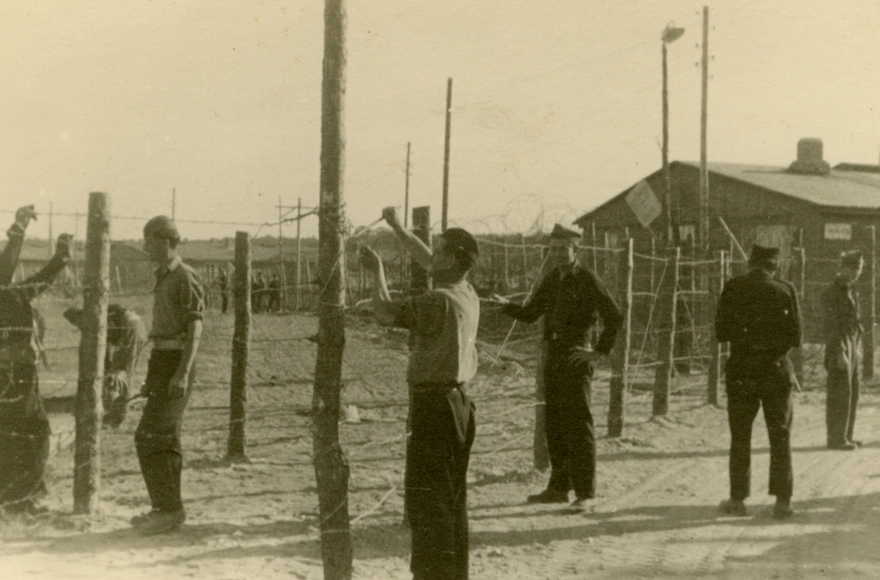
Some of the photos, which have little to no captioning, capture the haunting similarities of the DP camps to those in which the Nazis interned and killed millions of Jews during the Holocaust, including images of Exodus Jews repairing barbed-wire fences under the watch of guards.

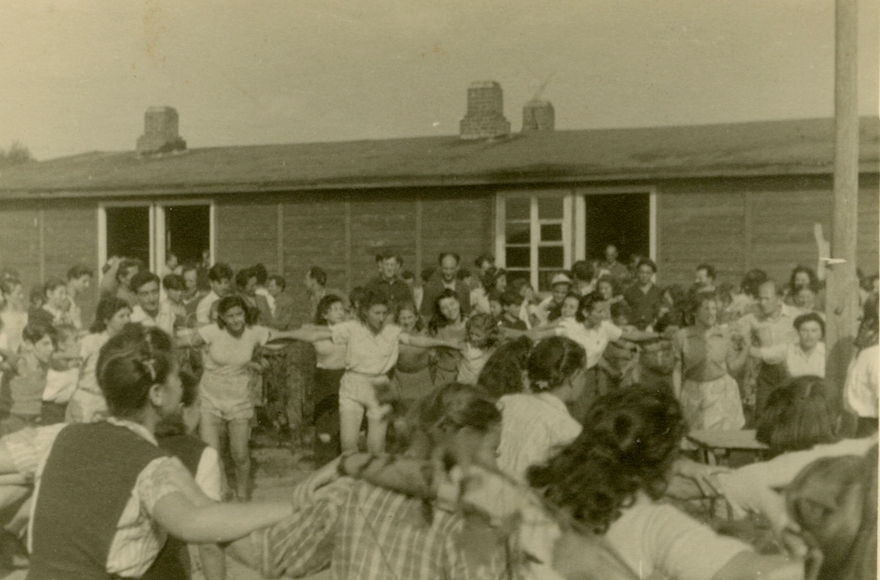
But others show the Jews participating in communal activities and preparing for their hoped-for future in Palestine. In one photo, Zionist emissaries from the territory — young women dressed in white T-shirts and shorts — appear to lead the Exodus Jews in a circular folk dance.

Shay Mendelovich, a researcher at Kedem, said he expects there to be a lot of interest in the album, which is being sold by an anoymous collector who bought it from the Gary family. Mendelovich predicted it could be sold for as much as $10,000.

“The photos are pretty unique,” he said. “There were other people in these camps. But Robert Gary was one of the few who had a camera and knew how to take pictures.”

Jews dancing in a DP camp in Germany, September 1947. (Robert Gary)

Between 1945 and 1952, more than 250,000 Jews lived in displaced persons camps and urban centers in Germany, Austria and Italy that were overseen by Allied authorities and the United Nations Relief and Rehabilitation Administration. Despite having been liberated from the Nazi camps, they continued to languish in Europe under guard and behind barbed wire.

Gary was an American Jewish reporter who JTA sent to Europe to cover the aftermath of World War II. He detailed the living conditions in the camps more than a year before the Exodus journey: inadequate food; cold, crowded rooms; violence by guards and mind-numbing boredom. But he reported in September 1946 that the greatest concern among Jews was escaping Europe, preferably for Palestine.

“Certainly the DP’s are sensitive to the material things and sound off when things go bad (which is as it should be), but above all this is their natural desire to start a new life elsewhere for the bulk in Palestine, for others, in the U.S. and other lands,” he wrote. “Get any group of DP’s together and they’ll keep you busy with the number one question: When are we leaving?”

In July 1947, more than 4,500 Jews from the camps boarded the Exodus in France and set sail for Palestine without legal immigration certificates. They hoped to join the hundreds of thousands of Jews building a pro-Jewish state.

Organized by the Haganah, a Zionist paramilitary force in Palestine, the mission was the largest of dozens of mostly failed attempts at illegal Jewish immigration during the decades of British administration of the territory following World War I. The British largely sought to limit the arrival of Jews to Palestine out of deference to the often violent opposition of its Arab majority.

The Haganah had outfitted and manned the Exodus in hopes of outmaneuvering the British Navy and unloading the passengers on the beach. But near the end of its weeklong voyage, the British intercepted the ship off the shore of Palestine and brought it into the Haifa port. Troops removed resisting passengers there, injuring dozens and killing three, and loaded them on three ships back to Europe.

Even after two months on the Exodus, the passengers resisted setting foot back on the continent. When the British finally forced them ashore in September 1947 and into two displaced persons camps in occupied northern Germany — Poppendorf and Am Stau — many sang the Zionist anthem “Hatikvah” in protest. An unexploded time bomb, apparently designed to go off after the passengers were ashore, was later found on one of the ships.

Jews repairing fencing at a DP camp in Germany, September 1947. (Robert Gary)

The widely reported events won worldwide sympathy for European Jews and their national aspirations. An American newspaper headlined a story about the Exodus “Back to the Reich.” The Yugoslav delegate from from the United Nations Special Commission on Palestine called the affair “the best possible evidence we have for allowing Jews into Palestine.”

Later, the Exodus achieved legendary status, most famously as the inspiration and namesake of the 1958 best-seller by Leon Uris and the 1960 film starring Paul Newman. Some, including former Israeli Foreign Minister Abba Eban, credited the Exodus with a major role in the foundation of the State of Israel in May 1948.

Gary, who was stationed in Munich, had close ties to Zionist activists; he reported early and often on the continuing plight of the Exodus Jews in the camps. His dispatches highlighted their continued challenges, including malnutrition, and unabated longing to immigrate to Palestine.

In a report from Poppendorf days after the Exodus Jews arrived, Gary said the dark running joke in the camp was that the alternative to Palestine was simple: “Everyone would choose a tree from which to hang himself.”

“The Jews of Germany demand and expect a chance to start life anew under reasonably secure circumstances,” he wrote. “They feel these places exist mainly in Palestine and the U.S. And they are determined to get there, either by legal or illegal means, or just by plain old fashioned patience.”

Pnina Drori, who later became Gary’s wife, was among the emissaries that the Jewish Agency for Israel sent to the camps from Palestine to prepare the Jews for aliyah. As a kindergarten teacher, she taught the children Hebrew and Zionist songs. Other emissaries, she said, offered military training in preparation for the escalating battles with the Arab majority in Palestine.

“In the photos, you see a lot of young people in shorts and kind of Israeli clothes,” she said. “We were getting them ready for Israeli life, both good and bad. You have to remember Israel was at war at the time.”

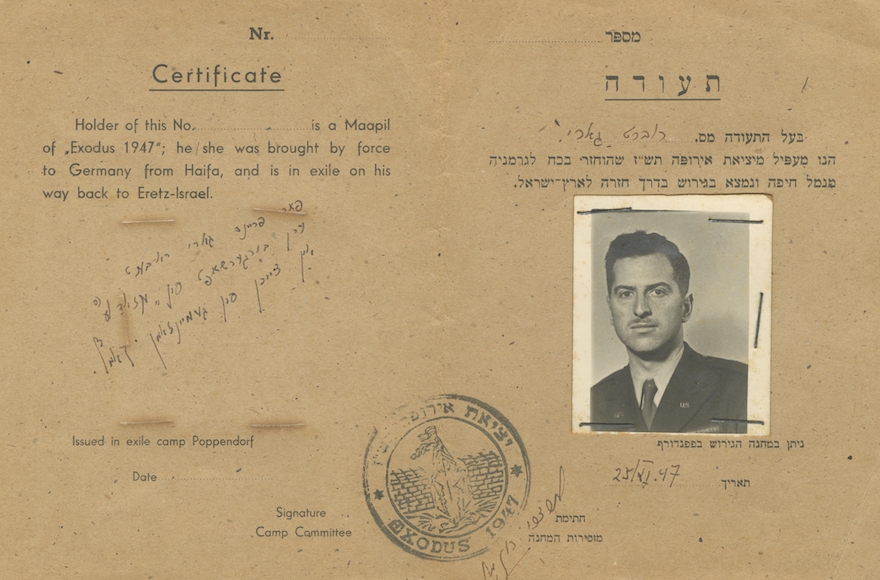
A 1947 photo of the fake certificate identifying Robert Gary as a passenger of the SS Exodus. (Courtesy of Kedem Auction House)

Gary was one of the few journalists who continued visiting the DP camps in the weeks after the Exodus Jews returned to Europe. Somehow he even obtained a fake certificate identifying him as one of the former passengers of the ship. But by late September 1947, JTA reported that British authorities had tired of Gary’s critical coverage and barred him from entry.

“The fact that Gary and [New York newspaper PM reporter Maurice] Pearlman were the only correspondents still assigned to the story, and had remained at the camps, aroused the authorities, who charged that they ‘were snooping about too much,’” according to the report.

Israel declared independence in May 1948, and after Great Britain recognized the Jewish state in January 1949, it finally sent most of the remaining Exodus passengers to the new Jewish state. Nearly all the DP camps in Europe were closed by 1952 and the Jews dispersed around the world, most to Israel and the United States.

Gary soon immigrated to Israel, too. He married Drori in 1949, months after meeting her at a Hanukkah party at the Jewish Agency’s headquarters in Munich, and the couple moved to Jerusalem, where they had two daughters. Robert Gary took at job at The Jerusalem Post and later worked for the British news agency Reuters. Pnina Gary, 90, continued her acting career.

She said her husband always carried a camera with him when he was reporting, and their home was filled with photo albums.

Decades after Robert Gary died in Tel Aviv in 1987, at the age of 67, Pnina Gary wrote and starred in a hit play, “An Israeli Love Story.” It is based on her real-life romance with the first man she was supposed to marry, who was killed by local Arabs in an ambush on their kibbutz.

“We knew life wouldn’t be easy in Israel,” she said. “That’s not why anyone comes here.”

These photos of Holocaust survivors from the SS Exodus are incredible Read More »

Rosh Hashanah sermon: Rabbi Steven Z. Leder

My name is Steve and I’m procrastinator.  For years the Temple staff has known that when my assistant says, “Steve is home working on his High Holy Day sermons,” it really means, Steve is home cleaning the garage.  Every year it’s all there, calling out to me:  the car mats from two models ago, vases from flower arrangements dead for a decade, a dirty aquarium filter, an electric chainsaw I never use, hinges, screws, light bulbs, paint cans, one refrigerator full of beer we never drink.  One empty refrigerator—up and running in case the Zombie Apocalypse arrives– an infomercial ladder I can’t figure out even with the Youtube video, Aaron’s 9th grade Lacrosse gear, Hannah’s college microwave, a dried-out sponge mop, tangled cords, cables, clippers and a Poncho Gonzales tennis racket from 1972—it’s all there just begging to be reorganized.

Each August I reorganize, but by the next August there’s the same mess waiting for me.  How does that happen?  It happens because I have been making the same mistake most of my life—a lot of us have.  As Marie Kondo put it in her book The Life Changing Magic of Tidying Up, “Putting things away creates the illusion that the…problem has been solved.”

Are we hear tonight to create an illusion–to listen to the music, read the prayers, acknowledge a few troubling things about ourselves and then store them away until they spill into next year, and the next, and the next until our lives are over?  Or are we here to really get rid of some things, to make real peace, to really say goodbye to our bitterness and our regrets, casting them away forever?  Are we here to engage in change Kabuki, or real change?

Kondo’s method for deciding what to keep and what to discard from our homes is to pull everything out of the closet, everything off the shelves, everything out of the cabinets, the drawers and the boxes, everything in in every room and then, hold each thing up to light of a single question:  Does this spark joy?  If the answer is no, let it go.   Does this spark joy?  If the answer is no, let it go.

Imagine if we ask ourselves “Does this spark joy?” not about our overstuffed garage or chaotic kitchen drawers, but about our inner lives.  That is what the rabbis meant when they commanded a cheshbone hanefesh during these ten days—an inventory of our souls.  These next ten days are not for reorganizing our sins into neater piles and storing our demons in newer, stronger containers; not for restacking our regrets in the basement of our souls, but for facing them and letting them go.

The Rosh Hashanah custom of tashlich, when Jews all over the world take the lint from their pockets and throw it into water, must be done in a body of water that contains fish.  Why?  Because as one sage suggests, just as fish have no eyelids, so too the eyes of God are always upon us.  Jews going to the oceans, rivers, streams and wells of their villages, cities and suburbs on Rosh Hashanah afternoon to do tashlich is more than a metaphor.  It is a promise.  A promise before the ever-watchful eyes of God that we will cast away our sins and our guilt.   Tashlich is a promise to let go….

So is prayer.  That’s what we are doing here with these ancient words and soaring melodies—we are letting go.  God is not some cosmic grantor of wishes.  To pray is not to wish, not to get, not to persuade God to change our fortunes.  To pray is to change ourselves.  To rid ourselves of the sin of indifference, the sin of bitterness, the sin of having betrayed another, of gossip, of cynicism, of pettiness, of an angry, senseless grudge that has gone on for too long.  To pray, is to let go, to lighten, to shed and to know that the shedding and letting go is at one and the same time an embrace of a lighter, better, freer, happier, wiser, more beautiful life….

Ask yourself, what grudges, what bitterness, what guilt, what shame, what avoidances, what foolish pride, what sins tucked away in the cabinets, closets and secret hiding places of your life should you hold up to the light tonight and admit bring you no joy?  Tonight, God and three thousand years of Torah are asking us to hold our joyless, ugly habits, our joyless regrets, mistakes and grudges up to the light.   To think about what we are carrying inside and to ask, does it spark joy?  If the answer is no, pray tonight to let it go.

Is your life not what you hoped for?  Is that what is weighing you down tonight?  After thirty years of being on the inside of other people’s lives—I have learned that no one—no one has it easier than anyone else, and no one has it all.  Tom Waits put it pretty well when he sang:  “Got the sheets, but not the bed.  Got the jam, but not the bread.”  My Yiddish speaking grandmother put it differently:  “God,” she quipped, “doesn’t give with both hands.”

That billionaire you envy may have an ill child, or a child who will not speak to him or grandchildren she rarely, if ever sees.  That woman’s body you envy, she might be living with chronic, debilitating pain in her gut.  The uberkinder you wish your kid could be like might be headed for an unbalanced life that will someday implode.  No one has more or less than you have when you add it all up.  Does envy or jealousy bring you joy?  Count your own blessings, and let your jealousy go…. 

“OK Rabbi, I can let go of my envy, but not my pain.  Do you know what she did?  What he said?  How he hurt me?”  Is it the bitterness of betrayal that is cluttering your soul tonight?  I don’t blame you, unless… Unless the person who hurt you has stopped, has apologized, has changed, and has asked to be forgiven.  We know what Jewish law demands of us then, especially tonight.  We have to forgive; to let it go.  Have you never betrayed another?  Have your passions never gotten the best of you?  Have you never dealt with the stress of your life in some terribly dysfunctional and hurtful way?  Is it right to carry bitterness in our hearts for someone who has done what we ourselves have also done?  Maybe it is, if the person who hurt us shows no remorse.  If that person has not stopped, has not apologized, will never stop or apologize, then it’s true that we do not have to forgive.  But we can let go, move on, make peace with what they will never be—we can release ourselves from their grasp.  To paraphrase the Buddha, “In life, we are not punished for our anger, we are punished by our anger.” 

Remember the 23rd Psalm?  “The Lord is my Shepard, I shall not want.”  Remember that line that says:  “Thou preparest a table before me in the presence of mine enemies?”  Most people consider it is a verse about revenge in the afterlife.  A vision of eternity wherein we will feast at a table while our enemies who wounded us in life can only watch, starve and suffer.  I do not see it that way.  I think sitting down at a table with our enemies is about an opportunity in this life, the opportunity these High Holy Days present us with.  Sit down with your enemies, reach out to those with whom you have fallen out but whose arms may well be open, pick up the phone, apologize, seek forgiveness, do your very best to make peace with what can and what cannot be changed, what ought and ought not to be held in your heart. 

Your unloving mother, your stubborn brother, your egotistical boss, your friend who let you down, hurt you, gossiped about you, failed to be there for you—do your best with them, and when your best creates no change, ask yourself how long will they remain a poison in your heart?  Does that bitterness in you spark joy?  Let it go….

And invite one more kind of enemy to your table this year too.  Sit down with your enemies that dwell within and punish you every day–your shame, your regret, your moral failures, stupidity, arrogance, pettiness, greed—get help to change what you can, stop what you can, vanquish what you can, and then, sit at the table with your own sins, make peace, loosen their grasp on you and grant the most difficult forgiveness of all–the forgiveness, after honest effort, you owe yourself. 

Look at this.  I bought this in a tiny village in India outside of Bhubaneshwar.  It is a village that time forgot.  No running water.  No electricity.  No paved road.  No doctor.  Most people without shoes and with only a goat or a small garden with turmeric and lentils drying in the sun.  It was the kind of place our ancestors during the time of the Torah likely lived their entire lives. 

Inside this is a tiny elephant surrounded on the outside with this beautiful filigree.  This began as a solid piece of stone rounded by an artist who then carefully, meditatively, with the deepest of intention, removed small bits of stone with ancient tools hewn over time, until this delicate, amazing, work of art remained.  This was created by taking away everything that was not beautiful–everything that prevented light from entering.

People think the Torah is a book of light and love but that mostly isn’t true.  Every family in the Torah is incredibly dysfunctional.  Eve convinces Adam to eat of the forbidden tree.  Cain murders his brother Abel.  At his infertile wife’s request Abraham has a son with the housekeeper.  Then Sarah makes him banish the boy and his mother to die in the dessert.  Next, as we read in the Torah tomorrow, Abraham nearly murders his other son Isaac.  Jacob steals his brother Esau’s entire inheritance.  Joseph’s brothers sell him into slavery and tell their father he was dead.  Add to these stories the hundreds of thousands dying in plagues or at the tip of a spear. 

Why?  Why is Torah so filled with negative examples of human behavior?  Why of the 613 commandments in the Torah, are 248 positive “Thou shalts,” but 365 are negative “Thou shalt nots?”  Because the Torah knows we can become better people by choosing how not to behave.  Because what we choose not to do, not to say, not to envy, not to hold onto from within any longer, because of what we remove from our hearts and lives…the true light of Torah, of God, of who we really can be, shines upon our innermost soul.       

Reject the America of Charlottesville and you will find within you the America of Houston’s good Samaritans; that rag tag navy of compassion.  When you see someone, anyone, who does not welcome the stranger, the gay, the new kid, the neighbor of color, the poor, the immigrant, the slow, the large, the small, the disabled, the different, the devout Muslim, the faithful Christian, the pious Orthodox Jew, the liberal or the conservative of good conscience—when you see anyone who hates without reason, without even knowing the object of their hatred–reject that narrowness and that arrogance and that indecency.  Throw it out and let the light of tolerance shine in our country and our souls.   

When you see unkindness reject cruelty.  When you see cheating reject the moral short cut.  When you see someone abusing his or her body with drugs or too much or too little food, or exercise, or alcohol, or cigarettes, or weed, reject the desecration of you own God given body. 

When you know you have a problem with money, with anger, with addiction, with workaholism, with stubbornness, with anxiety, depression, with the friend you no longer know, the loved one you no longer call—do something, get help, don’t just tidy up, reorganize, re-shelve and wait another year.    

When someone is truly sorry, forgive, let go.  If you have slayed some terrible demon because you did face it, you did stop, you did confess, you did change, you did hold your moral failing up to the light—then forgive yourself.  Your shame, your regret, they spark no joy–let them go.  We are all, after all, only human.      

Why three-hundred-sixty-five “Thou Shalt Nots” in the Torah?  Because every day we encounter something we should no longer hold onto, or someone we should never become or believe in.   Because every day we have the opportunity not just to reorganize that which brings us no joy, but to cast it from our lives forever. 

The High Holy Days, repentance, forgiveness are all tashlich—are all a casting away with the time hewn tools of Torah, Teshuvah and love.  Use these ten days.  Use these tools.  Use them to finally let go of what is hurtful, and ugly and brings you no joy.  Then, what remains for you in the New Year will be lighter, gentler and more beautiful than before.

L’shana tova.

Rosh Hashanah sermon: Rabbi Steven Z. Leder Read More »

Alternative for Germany leader says Jews have nothing to fear

Jews should not fear the strong election showing by the Alternative for Germany, a leader of the populist far-right party said.

“There is nothing in our party, in our program, that could disturb the Jewish people who live here in Germany,” co-party head Alexander Gauland told reporters Monday, a day after AfD garnered more than 13 percent of the vote to finish third in German national elections.

Gauland also said that he was ready to meet with German Jewish leaders “at any time.”

Chancellor Angela Merkel was re-elected to a fourth term and reportedly has rejected the idea of including AfD in a coalition government.

“Unfortunately, our worst fears have come true: A party that tolerates far-right views in its ranks and incites hate against minorities in our country is today not only in almost all state parliaments but also represented in the Bundestag,” the president of the Central Council of Jews in Germany, Dr. Josef Schuster, said in a statement issued late Sunday.

“I expect all our democratic forces to unveil the real face of the AfD and to expose the party’s empty, populist promises. The goal that should unite all democratic parties: to make it clear to the voters that the AfD is not an alternative, so that it can land where it belongs — under the 5 percent hurdle! ”

The council called on the parliament to “fight for democracy and to defend its values ​​vehemently” in the face of the AfD successes.

The Anti-Defamation League called AfD’s entrance into the national parliament “a disturbing milestone in modern German politics,” saying the party is “proudly extremist, anti-immigrant, and anti-minority.” The party leaders have made anti-Semitic statements and played down the evil of the Nazi regime, the ADL also said in its statement.

“Chancellor Merkel has a strong track record of protecting the Jewish community and other minorities,” CEO Jonathan Greenblatt said. “We appreciate that she has excluded the possibility of AfD joining her coalition, and we count on her strong leadership going forward to diminish the appeal of AfD among German voters.”

Hundreds of protesters gathered in cities throughout Germany on Sunday evening to protest the AfD’s election successes. In the Alexanderplatz public square in central Berlin, protesters chanted “Racism is not an alternative,” “AfD is a bunch of racists” and “Nazis out!”

Alternative for Germany leader says Jews have nothing to fear Read More »

Facebook CEO Sheryl Sandberg defends targeted ads in face of ‘Jew hater’ controversy

Allowing hateful terms as options was “a fail on our part,” Facebook CEO Sheryl Sandberg said in a post in which she also defended targeted advertising.

Sandberg also announced in the message posted on Facebook last week that the company is strengthening its policies and tools on targeted ads.

ProPublica, an investigative website, reported earlier this month that a news website was able to target ads at Facebook users who expressed interest in “Jew hater” and “how to burn Jews.” Facebook removed the categories after being alerted to their existence and said it would seek to prevent such categories from popping up for potential advertisers.

Sandberg wrote in her post: “Seeing those words made me disgusted and disappointed – disgusted by these sentiments and disappointed that our systems allowed this. Hate has no place on Facebook – and as a Jew, as a mother, and as a human being, I know the damage that can come from hate. The fact that hateful terms were even offered as options was totally inappropriate and a fail on our part. We removed them and when that was not totally effective, we disabled that targeting section in our ad systems.”

She defended targeted advertising, which allows companies to place ads based on demographics on the buying history of consumers, or on behavior and self-identification. Facebook relies heavily on algorithms to find and highlight content.

“Targeted advertising is how Facebook has helped millions of business grow, find customers, and hire people,” Sandberg wrote. “Our systems match organizations with potential customers who may be interested in their products or services. The systems have been particularly powerful for small businesses, who can use tools that previously were only available to advertisers with large budgets or sophisticated marketing teams.

Sandberg said Facebook would clarify its advertising policies and tighten enforcement processes to ensure that content that goes against Facebook’s community standards cannot be used to target ads; by adding more human review and oversight to the automated processes; and by creating a program to encourage users to report potential abuses directly to the company.

“We hope these changes will prevent abuses like this going forward,” Sandberg note, adding that Facebook has had “a firm policy against hate.”

Meanwhile, on Wednesday, Facebook sent out Happy New Year messages to users it believed to be Jewish. But many who received the message are not Jewish and may have received the greetings because they followed a group with a Jewish theme or posted a message on the Facebook page of a Jewish friend, Mashable reported.

“We send messages about religious moments to people in countries where a large proportion of the population observes the religion, or where the religious date is a public holiday,” firm policy against hate. “We may also show the message to people who’ve expressed interest in the holiday.”

Facebook CEO Sheryl Sandberg defends targeted ads in face of ‘Jew hater’ controversy Read More »