fbpx

September 20, 2017

Energy Saving: 5 Strategies For Lower Energy Bills

Handling a house budget is not an easy task. Once you put it all on paper and add everything up, the total costs you need to cover might turn out to be extremely high. Worrying about bills you have to pay is nerve-wracking, time-consuming, and exhausting. But there is a way to go around this so you can, just like it has been said in the Josco Energy’s brand commercial – “save your energy for what matters the most”. Just by adjusting your habits a bit or turning to eco-solutions, you can lower your energy bills and make your house both cost- and energy-efficient. Read on to find out how.

Be Mindful About How You Spend


How many times has it happened to you to leave the lights on and go out? Or to forget to turn your computer off over the night? This little thing might seem insignificant, but they gradually add up, and by the beginning of next month – you’re left with an unpleasant surprise when you see the bill. In addition, it today’s digital era, we’re plugging in all sorts of devices – phones, tablets, laptops. The convenience we’re used to, as well as the fast-paced every day, make us forget to unplug the appliances we’re not currently using. These continue using energy even if they are not charging.

Investing More Means Gaining More (In the Long Run)


According to the U.S. Energy Information Administration, in 2015 – households in the States were spending around $114 per month solely on electricity. One of the ways to permanently cut down the costs is to invest in home renovation and implement energy-efficient solutions. If you choose to replace your windows and opt for the vinyl ones, statistics show that you can save up to 15% annually on your energy bills. Solar panels are a great solution, but since this is a source of energy that is fairly new when it comes to the accessibility for the public – it’s still rather expensive. Depending on the size and strength, the price range is between $13.000 and $23.000 for an average household.

Seal Air Leaks to Save Up


If you’re looking for a way to keep the energy you use inside of your home, think about the option of adding insulation and weather strips. By doing so, you will kill two birds with one stone: not only will this lower your energy bills, but it will also create temperature consistency within your home, as well as the optimal air quality. The average costs for these works are between $250 and $300, and these save over $60 per year on your energy bills. Seal attics, plumbing lines, and electric wires for the best efficiency.

Switch to LED Bulbs


Light emitting diode bulbs are probably the most common way of saving up energy within your home, a true long-term investment. They are more expensive than regular bulbs, but there is a fairly good reason for that: they are proven to be more efficient, they save money in the long run, plus they have a bigger lifespan. If you replace all the incandescent bulbs with LED ones, you can expect to save a minimum of $60 per year.

Mind the Water Temperature


Most of the freshly bought water heaters have set temperatures to 140 degrees. To save up, put it to 120 degrees. Fun fact: for every 10 degrees you turn it down, you save up to 5% on your bill. In addition, use insulating materials to wrap the hot water pipes and prevent heat loss. This way, the water arriving at the faucet will be up to 4 degrees warmer. This saves you both your money and energy. Same can be done with insulating blankets, in case you have an old water tank. It has proven to save up to 9% when it comes to the monthly energy bill.

A little bit of effort goes long way and the already mentioned mindful approach is definitely an ally to your wallet.


Energy Saving: 5 Strategies For Lower Energy Bills Read More »

Turkey-Meatloaf

Key to a great break-fast: Prepare a simple menu in advance

Yom Kippur, one of the holiest and most important days of the Jewish year, is observed by prayer and fasting all day. The 24-hour fast begins at sundown, and since no cooking traditionally is permitted during the holiday, all food that will be served for the break-the-fast meal must be prepared prior to the holiday.

 When planning a break-the-fast gathering at your home, a buffet of dishes that can be prepared in advance is the perfect answer. Your menu should offer something for everyone — from those who wish only a snack to the hearty eaters who crave lots of well-seasoned food to make up for their fasting. 

 In our home, after the shofar has sounded to mark the close of Yom Kippur, we begin the evening with apples dipped in honey, served with my special holiday challah — baked with apples and raisins — and our favorite honey cake.

 This year, I hope to make the preparation of the rest of the holiday meal less stressful with a delicious menu that can be ready to serve when we all gather for the break-fast. Consider this Turkey Meatloaf. It can be made in advance, stored in the freezer and served with Potato Salad, Carrot Slaw or Coleslaw. Include a Cauliflower-Anchovy Salad — the color and zippy flavor of its Parsley-Anchovy Dressing give the understated vegetable a dynamic boost. Add some surprise to the meal by serving candied apple slices with the meatloaf. 

 For dessert, a large platter of Crisp Almond Butter Cookies is the perfect end to the evening. My son-in-law, Jay, has been making delicious homemade almond butter that he always shares with me. It is the cookies’ secret ingredient. The cookie dough can be made in advance, kept in the freezer and baked before serving.  

TURKEY MEATLOAF

2 pounds ground turkey
2 eggs
1 medium onion, grated
1/2 cup breadcrumbs
4 cloves garlic, minced
1 teaspoon ground cumin
1 teaspoon salt
1/2 teaspoon freshly ground black pepper
3 tablespoons olive oil
2 large onions, sliced
1 can (15-ounces) crushed tomatoes
3/4 cup dry red wine
3 hard-boiled eggs, peeled
1/2 cup ketchup

Preheat oven to 350 F.

In a large bowl, combine ground turkey, eggs, onion, breadcrumbs, and 2 tablespoons of the minced garlic cloves; mix well. Add cumin, salt and pepper.

Heat oil in a skillet and sauté remaining 2 garlic cloves, sliced onions, tomatoes and wine until soft.

Place garlic mixture in a large roaster. Shape 1/2 of the meat mixture into a flat loaf and place on top of the onion mixture in the roaster. Place hard-boiled eggs lengthwise along center of molded turkey loaf. Mold remaining turkey mixture on top of the eggs, pressing to make a firm loaf. Spread ketchup on top of the loaf, frosting the loaf like a cake.

Bake in preheated oven, covered, for 1 1/4 hours, until baked through.

Makes about 8 servings.

POTATO SALAD

8 to 10 medium potatoes, cooked and diced
1/2 cup diced celery
1/2 cup diced fresh fennel
1 red bell pepper, seeded and diced
1 cup mayonnaise
1/2 cup finely sliced green onions (scallions)
1/2 cup minced parsley, optional
Salt to taste
Freshly ground black pepper to taste
Garnish with diced red bell pepper

In a large bowl, combine the potatoes, celery, fennel and red bell pepper. Add enough mayonnaise to moisten and toss gently. Add the green onions and parsley, and season to taste with salt and pepper; toss gently again. Garnish with diced red bell pepper.

Makes 8 to 10 servings.

COLESLAW 

1 head cabbage
1 large carrot, peeled and grated (optional)
3/4 cup mayonnaise
2 tablespoons sugar or honey
2 tablespoons lemon juice
Salt to taste
Freshly ground black pepper to taste

Cut cabbage lengthwise into wedges small enough to fit in feed tube of food processor. Remove core. With slicing disk in place, slice cabbage using moderate pressure on pusher. Or, using a sharp knife, slice the cabbage as thin as possible. Transfer sliced cabbage to a large bowl. Add carrot and toss. Set aside.

In a small bowl, combine mayonnaise, sugar and lemon and blend. Add salt and pepper to taste. Add additional sugar or lemon juice to taste. Toss with cabbage mixture to moisten completely.

Makes 8 to 10 servings.

CARROT SLAW

6 medium carrots, peeled and grated
3/4 cup diced celery
1/2 cup diced apples
1/3 cup golden raisins
1/2 cup mayonnaise
Salt to taste
Freshly ground black pepper to taste 

In a large bowl, toss the carrots, celery, apples and raisins. Mix in the mayonnaise; season to taste with salt and pepper. Serve on a lettuce leaf.

Makes 6 to 8 servings.

CAULIFLOWER-ANCHOVY SALAD

1 cup Parsley Anchovy Dressing (recipe below)
1 head cauliflower, rinsed and separated into florets

Prepare Parsley-Anchovy Dressing, cover with plastic wrap and chill.

In a large saucepan, using a vegetable rack, steam cauliflower until tender when pierced with a fork — about 10 minutes. Transfer cauliflower to a large bowl, cover with plastic wrap, and chill for at least 30 minutes. To serve, spoon just enough dressing over cauliflower to moisten and toss. Serve immediately.

Makes 6 servings. 

PARSLEY-ANCHOVY DRESSING

1/4 small onion, diced
1 can (2 ounces) anchovy fillets, drained
3/4 cup olive oil
2 tablespoons balsamic vinegar
2 cups tightly packed parsley sprigs, stems removed (about 1 bunch)
Freshly ground black pepper to taste

In a blender or food processor fitted with the metal blade, blend onion, anchovies, olive oil and vinegar. Add parsley, a little at a time, and puree until the dressing is a bright green color. Season with pepper to taste.

Transfer to a glass bowl, cover with plastic wrap and chill. If dressing thickens after chilling, add additional olive oil and mix well. Dressing will keep for several days in the refrigerator.

Makes about 1 1/2 cups.

CRISP ALMOND BUTTER COOKIES

1/2 cup unsalted nondairy margarine
1/2 cup sugar
1/2 cup packed brown sugar
1/2 cup almond butter
1 egg
1/2 teaspoon vanilla extract
1 1/4 cups unbleached flour
1/2 teaspoon baking soda
1/2 teaspoon baking powder
Additional sugar

Preheat the oven to 375 F.

 In the large bowl of an electric mixer, cream the margarine and sugars. Add almond butter, egg and vanilla; beat until smooth. In another bowl, combine the flour, baking soda and baking powder; add to creamed mixture and mix well. For easier shaping, chill in the refrigerator for 1 hour.

Shape cookie dough into 1-inch balls. Place them 2 inches apart on ungreased baking sheets. Flatten each ball by crisscrossing with the tines of a fork dipped in sugar. Bake in preheated oven for 10 to 12 minutes or until bottoms of cookies are lightly browned and cookies are set.

Makes 4 to 5 dozen cookies.


JUDY ZEIDLER is a food consultant, cooking teacher and author of 10 cookbooks, including “Italy Cooks” (Mostarda Press, 2011). Her website is judyzeidler.com.

Key to a great break-fast: Prepare a simple menu in advance Read More »

A shofar master blaster shares his calling

At first glance, Michael Chusid’s workshop looks like most any utility shed at the back of a house — a space somewhere between Tim “The Toolman” Taylor’s garage from “Home Improvement” and Jason Segel’s man cave from “I Love You, Man.”

Electrical cords run across the roof. A power drill rests on a wooden workbench. A loveseat that could use a good cleaning nevertheless appears comfy and inviting.

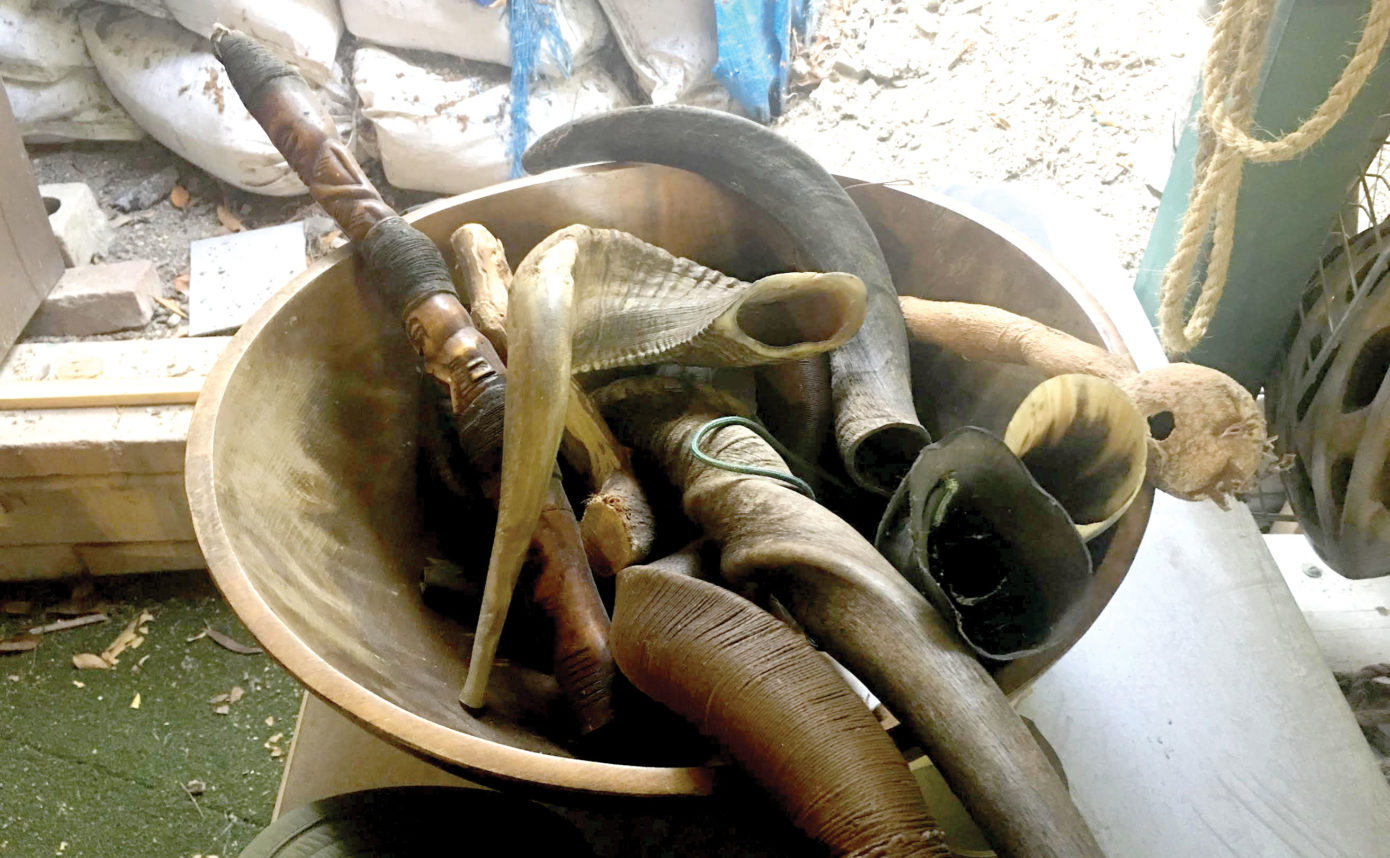
But Chusid’s Encino workspace differs from others in one major respect: It’s filled with the horns of rams and antelopes, piled up in bowls like pieces of fruit.

Chusid is a self-described ba’al tekiah, a shofar master blaster, and creator of the blog “Hearing Shofar.” He studies them. He buys them. He sometimes alters them. And he blows them.

Each year, Chusid blasts a shofar at synagogues on the High Holy Days, at American Jewish University and Hebrew Union College-Jewish Institute of Religion, and as a member of Shofar Corps, which blows shofar for the sick and elderly who cannot make it to synagogue on the holidays.

“The most difficult thing for me as a blower is to remember to listen,” Chusid said. “Sometimes in shul, I start thinking, ‘Oh, I’m blowing it really good; I’m impressing people. Look at how great I am.’ And then I’m completely out of it. When I’m really into it, I disappear, I no longer exist, I feel the energy coming out of the earth, rising through my body and going out the shofar and connecting with heaven, like the [Hebrew] letter, vav.”

As he stood barefoot, wearing a sarong, with a rainbow yarmulke covering his gray-white hair, he demonstrated what he meant. He closed his eyes, held his hand to his face and said a prayer. Then he blew one of his shofars, sounding the three different bursts familiar to anyone who has attended a High Holy Days service: tekiah, one long blast; shevarim, three broken sounds; and teruah, nine staccato notes.

“I have a calling for shofar,” he said later. “I would be diminished if I didn’t teach it.”

Chusid, 64, knows almost everything there is to know about shofars. Archaeologists have discovered images of the instruments that date back at least 20,000 years, he said, and while the shofar blast awakens the spirituality of the Jewish people every Rosh Hashanah and Yom Kippur, other historical peoples also have created sounds for ritual purposes.

“Almost every ancient culture found a sound through which they heard and which they spoke with that which is unknowable,” he said.

https://www.facebook.com/JewishJournal/videos/10155477166539713/


Chusid purchases shofar horns online, from Amazon, eBay and Atlantic Coral Enterprise Inc., a Florida-based wholesaler of seashells and wildlife products that imports horns from South Africa.

“There is something dramatic about the long ones — you can get more pitches on them — but the short ones are just as functional and easier to transport,” he said. “I have some that I slip into my pocket so I can carry it with me all the time just in case the Messiah should show up.”

Atlantic Coral Enterprise sold Chusid the horn of a gemsbok, a large antelope native to South Africa that has horns longer and straighter than ram horns. One end of the gemsbok horn is ribbed, which creates a percussive sound when a tool is rubbed against it.

A variety of horns, from different animals, sit in a pile in Chusid’s workshop.

“This, I believe, is biblically accurate,” Chusid said of a gemsbok shofar he made. “And it’s showy and beautiful, and it’s versatile. We’re told to praise God with shofar and drums.”

Chusid said he first heard the shofar when he was 8 years old. However, he didn’t hear it as an adult until 1994, after he had entered his 40s.

“I went out and bought a shofar, and I’ve been hearing it since,” he said.

As he crafted the gemsbok shofar, Chusid threaded a wire through the horn to determine its hollowness and the location of its bone. He marked the horn with a Sharpie where it would need to be cut to create a mouthpiece at one end. He debated whether to cut off a tip of the horn, which would compromise its dramatic shape, or drill a mouthpiece hole on its side so he could leave the shape intact. He chose the latter.

“People ask me, ‘Did you make that shofar?’ and I have to say, ‘No, I didn’t make it. The sheep made it. Or the antelope. I just fabricated it a little bit,’ ” he said. “This comes from beyond me. The horns come from dead animals.”

And then, Chusid said it was time for my lesson.

As we walked outside, he began to explain technique: Buzz the lips and press the shofar’s blowhole tight to the place where the air comes out between your lips.

I managed a weak but on-point tone out of the gemsbok shofar. It wasn’t much of a blast, but it was something.

Chusid laughed and offered encouragement, adapting an expression of Jewish wisdom that, like the blast of the shofar, has resonated through the ages.

“The rest is practice,” he said. “Go and study.”

A shofar master blaster shares his calling Read More »

To be or not to be political: That is the question for rabbis

Rabbi David Baron of Temple of the Arts learned the hard way the lesson of discussing politics on the High Holy Days.

Years ago, before the 2000 presidential election between George W. Bush and Al Gore, Baron invited Larry Greenfield, a future California director of the Republican Jewish Coalition, and David Sadkin, senior counsel to Democratic Congressman Henry Waxman, to participate in a community discussion on Yom Kippur afternoon about why they supported their respective party’s candidate.

The result, Baron recalled in a phone interview, was disastrous.

The speakers, he said, “were gentlemen, but their supporters were yelling epithets. It was totally contrarian to the spirit of Yom Kippur. The fangs were out. I said I would never do anything like this again.”

This year, as the Jewish community is consumed with events unfolding in the U.S. and beyond, rabbis are considering how to acknowledge those events during a sacred holiday period otherwise focused on personal introspection and renewal.

There is no rabbinical consensus on this topic — for the High Holy Days or any other time of the Jewish year — as evidenced by a debate over politics on the pulpit that unfolded in the Journal this summer after Sinai Temple Rabbi David Wolpe wrote an essay denouncing how “the litmus test for religious legitimacy has become political opinion.” A colleague, Rabbi Noah Farkas of Valley Beth Shalom, disputed Wolpe’s view, saying it is incumbent on clergy to provide guidance on the “urgent issues our communities, our nation, Israel and the world face today.”

These same choices face rabbis as the Jewish year 5778 approaches and the churn of disruptive events continues to occupy daily thoughts and conversations.

Stephen Wise Senior Rabbi Yoshi Zweiback told the Journal that while he does not want to preach politics from the bimah, he will strive to follow the advice from his temple’s founder, Rabbi Isaiah Zeldin, in delivering High Holy Days sermons that are timeless and timely.

One of several rabbis who said he will acknowledge the challenging times while refraining from expressing a political viewpoint, Zweiback said he intends to discuss how Judaism — specifically, engagement with the religion, its traditions and values — helps make a person better equipped to handle what’s happening in the world.

“I will touch on what Judaism and what the Jewish community teaches us about how we can disagree but still be in community with each other; how Judaism teaches us about compassion for the other at a time when we see Klansmen protesting in the streets and Dreamers wondering what their status will be in the next few months,” he said in a phone interview. “In that sense, it can be timely without being partisan.”

Taking an alternative approach, Rabbi Sarah Bassin of Temple Emanuel of Beverly Hills plans to address politics and call her synagogue to action. Her Rosh Hashanah sermon, “Un-Fracturing,” conveys how stunned she felt this year as anti-Semitism spiked; when an LGBT rally in Chicago kicked out three women for carrying gay pride flags with Stars of David on them; when death threats targeted Jewish journalists in unprecedented numbers; and when Nazis marched in Charlottesville chanting, “Jews will not replace us.”

Though it is in the DNA of the Jewish people to worry for the future, Bassin will preach that the way to counter darkness is with light.

“It’s not preaching politics, but it is very much about how do I engage in the public sphere right now,” she said. “I have had a couple of congregants across the political spectrum review it just to get their thoughts and input, both from the left and the right, and I’ve made a few tweaks. I want people across the spectrum to be able to hear it. It’s not my intention to offend or be off-putting, but to give people a positive message.”

Her sermon draws on a theme selected by Temple Emanuel synagogue clergy that will tie together all of their sermons. This year, the theme is from Pirkei Avot, or “Ethics of the Fathers,” teaching that “In a place where nobody is acting human, strive to be more human.”

Temple Emanuel Senior Rabbi Jonathan Aaron, for his part, will not be going into politics.

“I kind of feel the synagogue is a place to get away from that,” he said, adding that he supports Bassin’s decision to address controversial issues.

“I believe she has the right to speak about what she wants to speak about,” he said.

Rabbi Jonathan Jaffe Bernhard of the Conservative synagogue Adat Ari El in Valley Village said his sermon will draw inspiration from an August New Yorker article headlined “Is America Headed for a New Kind of Civil War?” He plans to talk about the polarization in the country, which he described as a “low-level civil war, with occasional bursts of violence,” and “what I think religious people, and therefore Jews, can do to address that situation.”

The rabbi doesn’t want his politics to turn off people, but he feels the need to be true to his convictions.

“There is a responsibility on the part of clergy to be thoughtful about what they are speaking about while also taking stands and putting themselves out there and sharing a point of view and not just being totally pareve,” he said, referring to food that can be eaten with meat or dairy dishes in accordance with kosher laws.

Like Bassin, Rabbi Denise Eger of Congregation Kol Ami in West Hollywood said she will discuss what is going on in the world in a way she feels is apolitical.

“I will address a bit of what happened in Charlottesville on erev Rosh Hashanah because I think it is on everyone’s mind, but it is not the main focus. It is: What do we have to do Jewishly at this season and within ourselves to overcome the hatred and the bigotry and the racism that’s become so openly present,” she said. “That’s not a political message.”

Senior Rabbi John Rosove of Temple Israel of Hollywood plans to deliver a Kol Nidre sermon he described as “political, but in a very high-minded sense.” He said he plans to focus on how Western liberalism — not liberalism in the political sense — appeals to the impulses of the Jewish people.

“I try to give people faith and hope and renewal about what is important to us as Americans,” he said.

His colleague, Rabbi Jocee Hudson, will address issues of racial justice and intersectionality — the concept that people of different minority groups have a shared struggle. Speaking to concerns of activists of the millennial generation, she, like Bassin, plans to call on the community to become involved, “to engage in justice work, and to do it as members of an organized Jewish community, not just as individuals who happen to be Jewish.”

Wilshire Boulevard Temple Rabbi Steven Leder’s approach falls closely in line with Wolpe’s and Zweiback’s. His goal in delivering a sermon, he said, is to provide a timeless and timely message, but being timely doesn’t have to mean a discussion of current events. He believes his congregants want something more.

“My general approach to preaching, and in particular on the High Holy Days, is to create insights for people to transcend the news of the day that are both deeper and more transcendent, because the news of the day on any given day fits into a much broader picture,” he said.

On Rosh Hashanah, Leder said, he will examine the art of letting go, going beyond what he called “the kabuki of change” — earnestly compiling, but not acting upon, intentions to do better in the new year — to actually work at achieving personal and societal transformation. On Yom Kippur, drawing on what he has experienced in his 57 years of living and his 30 years serving Wilshire Boulevard Temple, Leder plans to talk about death — a central theme of the day.

He will offer 10 lessons he has learned over the past three decades, a time during which he has seen approximately 700 corpses. What could be morbid, he explained, will be a plea to live life to the fullest.

“The rabbi does not write your eulogy after you die,” he will say in the sermon. “You write it with the pen of your life.”

The sermon will touch on larger themes, he said, and won’t mention Charlottesville, hurricanes or DACA.

“You’re dealing with something that transcends the headlines,” Leder said. “Not that the headlines are absent, but they ought to be illustrations for something more important on the holidays.”

Rabbi Yonah Bookstein of the Orthodox, young adults-oriented synagogue Pico Shul, said he plans to leave politics out of the discussion when he delivers sermons on Rosh Hashanah and Yom Kippur.

“I am working hard on increasing people’s sensitivity to others and inspiring people to deepen and maximize their Jewish experience,” he said. “That is my goal.”

Rabbi Elazar Muskin, senior rabbi of Young Israel of Century City and president of the Rabbinical Council of America, an Orthodox membership organization, has had a policy for more than 35 years of separating politics from the pulpit. This year, he said, he will discuss faith in God and the importance of family, topics he insisted are relevant and appropriate for the bimah.

“In my experiences, every rabbi who speaks about politics ends up in trouble because he will alienate his congregation and he isn’t doing what he is supposed to do,” he said. “A rabbi is supposed to teach you.”

Baron, of Temple of the Arts, said he will talk about the hurricanes in Texas and Florida and the fires in California, despite his weariness of politics during the Holy Days.

“I wasn’t going to talk about hurricanes and the impact on our lives, but the words [from the High Holy Day poem, ‘Unetanah Tokef’] never rang more true: ‘Who by fire and who by flood,’ ” he said. “The Western part of the country is burning up, and the East Coast is flooding out. Human frailty to violence in nature is something I think we talk about on the chaggim [holidays]. It’s one of the central prayers.”

Still, he considers expressing political opinion to be unwise.

“It’s a minefield, because I guess the level of discourse has so degenerated,” Baron said. “It’s something we get too much of all year long. The holiday needs to be an alternative to that. It needs to be an alternative universe to the one we inhabit.

“This is about our inner journey. The trial-and-error of politics is not worth getting into, unless it is something that is so core, so vital to the survival of our Judaism, of American Judaism in general.”

To be or not to be political: That is the question for rabbis Read More »

Conan meets activists in West Bank, hangs out with Gal Gadot in Israel special

When Conan O’Brien announced in August he would be going to Israel, he suggested he might try to solve the Israeli-Palestinian conflict when he visited.

Didn’t happen.

But what he did achieve in a humorous perspective is a deep-dive into Israeli life while humanizing both Israelis and Palestinians during his stops in Tel Aviv, Jerusalem and the West Bank.

His special, “Conan Israel,” aired Sept. 19 and is available for viewing in its entirety at teamcoco.com.

In O’Brien’s special, he covers 1,300 years of fighting, conquests and disputes in just over one minute. A nice detail Angelenos will appreciate is a one-liner about in-fighting among Orthodox, Conservative and Reform Jews in which Reform Jews are represented by a Los Angeles Dodgers baseball hat.

At the comedian’s first stop, Tel Aviv, the lanky, ginger Harvard University alumnus explores the city’s beaches. The physical attractiveness of the young Israeli people sweeps him up. There’s just one problem: From a lifeguard tower he calls for all the Israeli men wearing speedos to immediately remove themselves from the beach.


During his second stop, he visits the Tower of David museum, overlooking the old city of Jerusalem. Eilat Lieber, director of the museum, points out the Christian, Muslim, Jewish and Armenian quarters to O’Brien.

“The Armenians have a quarter?” O’Brien says. “I don’t understand why they get a quarter. They got all of Glendale.”


Punctuating the traveling tour is a parody of the hit Israeli television series, “Fauda,” during which O’Brien threatens to electrocute “Fauda” star Lior Raz, who co-stars in the clip, unless Raz provides him with a very crucial piece of information: The home address of “Wonder Woman,” Gal Gadot. When that doesn’t work, O’Brien threatens to torture him using more creative technique:

“I won’t kill you. I’ll do something worse. I am going to sing ‘Hava Nagila’ the way an Irish man sings ‘Hava Nagila,’” O’Brien says.


When O’Brien visits Gadot apartment, he tries to sweet talk his way inside. Unfortunately, she’s busy entertaining friends. Before the clip ends he notices the mezuzah on her door post. Indeed, the episode shows O’Brien, who is not Jewish, not only learning about Israel, but becoming more knowledgeable about Judaism. He even has a bar mitzvah.


A visit to the West Bank begins with O’Brien’s trying out an affable Palestinian’s man coffee and haggling over the price of a hookah pipe which turns to be decorative and not functional.

Then, as O’Brien visits a piece of the separation wall dividing Israel from the Palestinian territories, things take a serious turn. Palestinian activists approach and share their side of the story. They denounce the foreign aid the United States provides to the Palestinians. O’Brien doesn’t counter so much as give them a platform to share their views. When it’s over, O’Brien offers a disclaimer, that he did not conduct interviews with people who oppose the views just expressed in the segment.


In the next clip, he visits with U.N. inspectors who man Israel’s border with Syria in the Golan Heights. They discuss Hollywood karate star Chuck Norris’s having previously visited Israel. Undercutting the playfulness is that in the distance the gunfire from Syria’s civil war can be heard.

In the next sequence, O’Brien sees the results of the Syrian civil war up close when he visits an Israeli hospital, Ziv Medical Center, which is affiliated with the faculty of Bar-Ilan University and has been treating victims of Syria’s civil war. He meets a surgeon, Argentinian-Israeli Dr. Alejandro Roisentul, who has been honored for his work treating Syrians, along with a social worker named Fares.

“I think you’re doing God’s work here. I honestly sincerely think you are doing beautiful work here,” O’Brien says to Roisentul and Fares.


O’Brien then meets Syrian patients, who have been treated at the border and taken to the hospital. The Syrians’ faces are blurred to protect their identities.

Ziv Medical Center is located in Safed, home to a large Arab population. In an email, Ron Solomon, executive vice president of American Friends of Bar Ilan University, told the Journal that O’Brien’s visit must have meant a great deal to both the Jewish and Arab people of the northern Israeli city in the Galilee.

“The fact that a star, [on] the level of Conan, made the time to go all the way up to Ziv Hospital and see for himself the care that is given to all people in need, has to have an impact on both the Arab and Jewish populations in all of Galilee,” he said.

The episode concludes with O’Brien’s acknowledging he does not have a solution to the problems plaguing the region but he has learned that Israel does not deserve international condemnation for being imperfect.

“Let’s remember we’re talking about a country that is only 69-years-old. Think about it, the U.S. is 240-years-old and last time I checked we are still working out a few kinks,” he says.

While he does not broker a peace agreement, in an interview that streamed live on Wednesday on Facebook he said he achieved his goals for the special.

“There is a lot of hot-button topics there, and I did want people to know very sincerely that our intention was to go and to really try to keep it simple: meet people, try to make them laugh, make friends, make friends with Israelis, make friends with Arabs and try to find common ground with things we find universally funny,” he said. “There was nothing else, and obviously there will be certain people who want to read intention. We did go there to try and make people happy, make people laugh and when I watched the show last night, I think we did that, and that makes me very happy.”

Conan meets activists in West Bank, hangs out with Gal Gadot in Israel special Read More »

Neilah: Ask not for whom the gates close

Like the grand finale culminating a fireworks show, something grand occurs in the synagogue’s sanctuary at the end of Yom Kippur.

After 24 hours, a full day of fasting, praying, reciting poetry and absorbing scriptural readings, our souls have immersed in the flow of a day of spirit. Like angels, we dress in white, refrain from eating or attending to bodily needs. And like angels, we seek to soar upward, aided by our renewed sense of authenticity, purified from the distractions and dirt of daily life. The culmination of this packed day — filled with more mitzvot than any other 24-hour stretch during the year, crammed with ample time for reflection, contemplation and honest self-scrutiny — asks for something noble to drive home its message.

The uncertainty

Neilah delivers that grandeur, in music that is a hit parade of the High Holy Days Top 10, asking us to stand throughout the entire final service, ark open, all eyes forward, and with a culmination of responsive back-and-forth liturgy between cantor and congregation, culminating in the final blasts of the shofar.

Small wonder that as the noise crescendos and then finally tapers away, we have the sense of being at a rally, at a crop harvest or the final paces of a marathon. We’re sweaty, tired and hungry but champions of the spirit.

Again and again, our liturgy suggests the image of gates closing. We rush to squeeze through, but the gates are closing. Which gates? The gates to our hearts, cracked open by the time of intense prayer and introspection? The gates of God’s compassion, eager to welcome us home? The gates of heaven, inviting weary pilgrims to return? Perhaps even the gates of evening, as the setting sun meets a darkening firmament?

Or maybe the gates refer to a time limit. Isn’t part of what is special about Yom Kippur is that it is a time of particular promise for repentance, for changing our ways, for remapping our journey toward a more worthy destination? If so, then the gates closing refers to the time yet available for us to repent.

The gates: when and where

It turns out that the liturgy doesn’t help us resolve this ambiguity. “Where” are those gates: inside our hearts? In God’s ample love? At heaven’s door? We never step outside the spatial metaphors to specify where those gates are. The choreography of keeping the Ark open throughout the Neilah services offers a visual that the gates that are closing are literally just before our eyes: the gates of Torah.

But that “where” is never nailed down, never specified. And we don’t identify the “when” of our gates, either: The end of services? The end of Yom Kippur?

For us, the bigger paradox is that the very tradition that is rushing us to repent while there’s still time is unambiguous in holding that God always welcomes the sinner, is always eager for us to turn in repentance. There is never a time when God’s love is not greater than our shortcomings; never a time when God is too fatigued by our presence that we are not welcome to return. But if God always is eager to receive the sinner in repentance, then what’s the rush? Why do we feel pushed to hasten our process to coincide with the conclusion of Yom Kippur?

Unspecified gates in multiple time frames hardly sounds like a recipe for spiritual growth. Yet it turns out that precisely in this uncertain swirl of multiple possibilities and shifting occasions is precisely where human transformation becomes possible.

Through paradox to growth

Were we to operate only with the assumption that repentance is always available, then we would never be motivated to actually change at a particular instance. Just as knowledge of our certain mortality infuses our life with a need to seize the day, so does the push of Yom Kippur as a time particularly favorable to teshuvah inspire us to more focused contemplation than a more open-ended process would.

But if all we had was a sense that we must repent today, before the end of the day, then repentance is paralyzed by the ticking of the clock, by the desperation inspired by time running out. It is precisely the paradoxical balance of an open-ended process joining hands with a particularly favorable moment that makes forward movement happen.

Similarly, were our tradition to limit the gates to one, then so many other portals would be closed to us. The gate of Torah is precious and vital, but not the only door we pass through. We turn, in different moments of our lives, to different openings: family, marriage, children, professional training and practice, spiritual discipline, pursuit of justice, to name a few. Each of these gates manifests the ways that the cosmos creates new possibilities for us, shows different ways that the sacred lures us toward our own optimal greatness. The gates must be specified, but not limited. There, too, it is precisely the paradox that allows us to squeeze ourselves through, self-surpassing as is our God.

Rabbi Bradley Shavit Artson holds the Abner and Roslyn Goldstine Dean’s Chair at Ziegler School of Rabbinic Studies and is vice president at American Jewish University. 

Neilah: Ask not for whom the gates close Read More »

Obituaries: Week of September 22

Aaron Ainsfeld died Aug. 22 at 87. Survived by sons Jeffrey, Kevin. Mount Sinai

Melvin Bayer died Aug. 23 at 83. Survived by daughters Fran, Lindsey; son David; 5 grandchildren. Hillside

Genevieve Dimond died Aug. 28 at 96. Survived by niece Karen Schwartz. Hillside

Pauline Dubin died Aug. 22 at 95. Survived by daughters Hali (Rick) Karr, Amy (Chuck) Scottini; son Marc (Ila); 4 grandchildren; sister Phea Gottlib. Mount Sinai

Faye Eisen died Aug. 23 at 87. Survived by daughter Terry (Leon) King; son David (Geri); 4 grandchildren. Mount Sinai

Barton Joel Feldmar died Aug. 28 at 75. Survived by wife Vicki; daughters Erin, Shawna (Tim) Kidman; son Jason (Andrea); stepdaughter Dena (Dave) Kaplan; stepson Jeff; 10 grandchildren; sister Toni (Don) Goldstein; brother Tom (Janet) Feldmar.

Gersh Fleyshman died Aug. 31 at 92. Survived by sons Leonid, Dimitri. Hillside

Marsha Lynne Franklin died Aug. 26 at 70. Survived by husband Roger; sons Darren (Alexis Leland), David (Caryn); 4 grandchildren; sister Lauren (Stephen) Rivetti. Mount Sinai

Gordon Goodman died Aug. 19 at 66. Survived by father Walter; brother Alan (Deborah). Mount Sinai

Galina Gorin died Aug. 25 at age 82. Survived by husband Iza; daughter Olga Margulis; sons Slavik (Marina), Greg (Maria), Vladimir; 6 grandchildren; 7 great-grandchildren. Mount Sinai

Ruth Gruber died Aug. 27 at 99.  Survived by sons Fred (Susan), Martin, Barry; 7 grandchildren; 10 great grandchildren. Mount Sinai

Martin Halperin died Aug. 20 at 89. Survived by son Mark (Evelyn); 2 grandchildren. Mount Sinai

Nissan Kahen died Aug. 27 at 65. Survived by wife Daliah; daughters Deborah (Sharone) Yerushalmi, Daniella (Michael) Alyeshmerni, Sarah; sons Dan Moshe (Daniella), Aaron, David; sisters Sorayah (Farajolah) Monavari, Faride (Iraj) Rabiean; brothers Esagh (Molouk), Elias (Diana), Eskandar (Sharona), Parviz (Elham); 9 grandchildren. Chevra Kadisha

Charlotte Kahn died Aug. 27 at 84. Survived by daughters Hillary Fisch, Lisa (Jeff Singer); 2 grandchildren; brother Harold (Sylvia) Eisner. Mount Sinai

Shirley Karton died Aug. 26 at 100. Survived by sons David (Cheryl), Joshua, Mitchell (Ann Gardner); 1 grandchild. Mount Sinai

Shirley Beverly Kosberg died Aug. 25 at age 86. Survived by daughters Iris (Don) Consolazio, Heidi; son Paul; 3 grandchildren. Mount Sinai

Barry Joel Kustner died Aug. 22 at 78. Survived by wife Suzanne; daughter Stephanie (Arjeh) Baumgarten-Kustner; son Bryan (Nicole); 5 grandchildren. Mount Sinai

Jordan P. Lesavoy died Aug. 23 at 46. Survived by mother Jean (Jack Brown); father Malcolm; sister Nichole; brother Brian; aunt Patricia. Mount Sinai

Julius Lesner died Aug. 22 at 93. Survived by daughters Gail (Bruce) Bodman, Stephanie (Paul) Bolger; sons Howard (Michal), Todd; 6 grandchildren; 5 great-grandchildren; sister Ruth Wachspress. Mount Sinai

Clifford Levine died Aug. 25 at 89. Survived by sons Kenneth (Deborah) Levine, Corey (Jan) Levine; 4 grandchildren; 1 great-grandchild. Mount Sinai

Betty Lou Miller died Aug. 26 at 85. Survived by husband Robert; daughter Gayle Plummer; son Richard Miller; 2 grandchildren. Mount Sinai

Yaffa Minster died Aug. 28 at 70. Survived by sister Haya Reisbord. Hillside

Marvin Porton died Aug. 24 at 89. Survived by wife Sally; daughters Eliana (Elian Savodivker), JoAnn (Chris Johnson) Bright, Patrice (Greg) Fisher; 1 grandchild; 1 great-grandchild. Mount Sinai

Harold Rice died Aug. 26 at 88. Survived by wife Billie; daughters Sandra, Valerie Cronin; son Andy; sister-in-law, Rachel Werb. Mount Sinai

Lore Rosen died Aug. 27 at 93. Survived by sons Peter (Marla), Joel; 4 grandchildren. Mount Sinai

Rae Rosenblum died Aug. 29 at 86. Survived by daughter Shana Ramis; son Ronald (Jacki); 4 grandchildren; 2 great-grandchildren. Hillside

Henry C. Sigman died Aug. 19 at 78. Survived by daughter Elena; son Jonathan (Kristen Gunning); 4 grandchildren; sister Felice Rhiannon.

Alan G. Silverman died Aug. 27 at 84. Survived by wife Leeda; daughter Lisa (Ruben) Cuero; sons Marc (Liz), Jeffrey (Cara Kates); 6 grandchildren. Mount Sinai

Irving Slome died Aug. 21 at 82. Survived by wife Ann Slome; daughter Sarah Elisabeth (Stephen) Slome-Schwartz; son Steven Herbert (Rebecca); 4 grandchildren. Mount Sinai

Philip Smith died Aug. 25 at 93. Survived by wife Lila; daughter Melinda; son Martin; 4 grandchildren; sister Goldie Perkiss; sister-in-law Marilyn Hyman. Hillside

Ann Tobman died Aug. 22 at 94. Survived by daughter Gail (Stephen) Shapiro; son David (Lyn); 4 grandchildren; 5 great-grandchildren. Mount Sinai n

Obituaries: Week of September 22 Read More »

The mensch test

Last Friday, I was rushing through a to-do list from hell. It’s High Holy Days season, which means my rabbi wife disappears into her study, and if she emerges before five sermons are finished, it’s a sign that fall will be extra harsh, or at least seem that way.

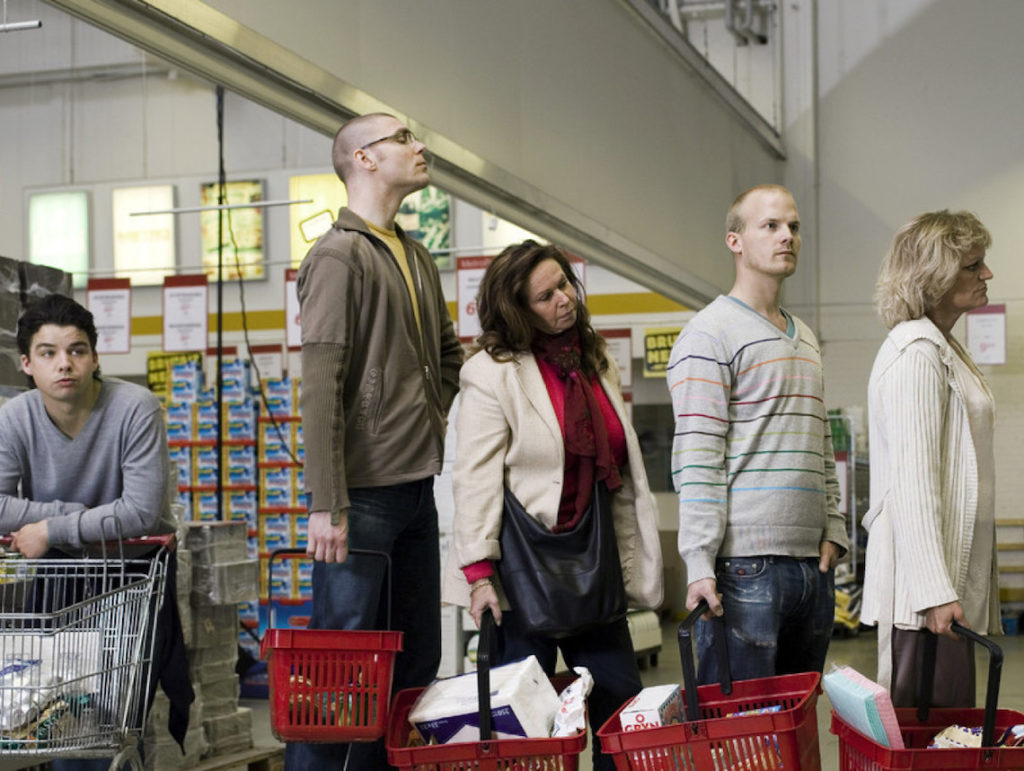
So the list was all on me,  and by 11 a.m., I had barely made a dent. I raced through Santa Monica Kosher, loading up my shopping cart until the wheels splayed, then headed for the cashier — where I was, miraculously, first in line.

If you’re strictly the Ralphs or Amazon Fresh type, let me describe Santa Monica Kosher, or as I call it, S&M Kosher.  The clientele is largely Persian Jewish, except on Sundays, when they set up a BBQ grill in the parking lot and the smoke from the koobideh and kebab lures Latino families by foot and Brentwood types by Tesla. The produce is varied, fresh — and a bargain. You can find exotic flatbreads, Israeli cheeses, organic meats, even “Original Pistachios,” which means they’re really from Iran — and the best you’ve ever tasted.

But on the day Shabbat begins, it can be a blood sport. Can you get to the cucumbers before the grandmother parks herself in front of them and inspects them, one by one, as minutes tick by? Can you grab the attention of the man behind the meat counter before the customer who came after you commandeers him? Sure, there’s a ticket dispenser, but I think it’s for decoration. Or Ashkenazim.

And at the cashier, the shopper in front of you always seems to use the conveyor belt as her personal shopping cart, putting down a bunch of fenugreek, then going off and returning with a bag of chicken thighs, then leaving again to bring back some eggplant — oblivious to the line growing ever longer behind her.

So imagine my relief to be first in line at the checkout. The problem was, when I looked behind me, I saw a middle-aged Persian woman holding four items in her hands. She’d wait 20 minutes for me to get through.

I said, “Please, go ahead.”

Her tense face melted.  “Really?” she said.  “Are you sure?”

“Of course.”

“Oh, you are so nice!” she said. “You have done your mitzvah for the day. For the week!”

As she moved ahead, she said to the cashier, “Did you see what he did?”

Either she was laying it on thick, or she was genuinely shocked — which might just reflect how rare it is for her to come across an act of kindness in the bustle of the Friday market.

Then another woman got in line behind me — and she had two items. Really? The clock was ticking on my to-do list — and my parking meter. But what could I do?

“Why don’t you go ahead?” I said.

The first woman overheard my offer. She turned to the cashier.  “Did you hear that?  This is the nicest man!  I think this is the nicest man!”

The cashier smiled. The elderly Persian man wearing a security guard uniform, who doubles as a grocery bagger, didn’t even look up.

Maybe he didn’t understand English. Or maybe he suspected that as nice as I was face to face with a kindly woman at S&M Kosher, 20 minutes later I’d be in some parking structure, screaming at the SUV in front of me who was crawling up all three levels looking for a space. Go faster, you idiot. Just go! And I would blast my horn like a shofar — which, by the way, is exactly what happened.

Almost as quickly as I earned my sainthood, I blew it away. It’s true we all tend to be nastier versions of ourselves behind the wheel — or behind a computer screen. But what’s also true is that if we can control our harshest impulses, no matter where, we always feel better.

There was a lot of commentary after the violence in Charlottesville and after Hurricanes Harvey and Irma about the power of exercising “the better angels of our nature.”   Americans came together in times of tragedy and emergency, put aside their differences, and helped one another. 

But then, more often than not, the better angels take a hike.  We go back to nursing our grievances, emphasizing our differences, taking advantage, losing our patience, distancing ourselves from other people’s needs when they aren’t part of an urgent disaster or on CNN. 

In other words, being an angel is easy, being a mensch is hard. Angels make the news, mensches make a few minutes a little better.

But those minutes add up, and they are the minutes that most of us experience as daily life. That’s why, in the wisdom of the tradition we follow these High Holy Days, the liturgy doesn’t ask us to be great, just good. The faults we are held to account for — such as stubbornness, gossip, indecision, anger — they don’t make us evil, they just make the people around us a little worse for wear.

In these messy, cruel, divided and confusing times, I don’t really see a grander path forward than each of us struggling to behave a little better to the person beside us, and to the person we can’t see.   

Let the struggle begin, again, for 5778.

Shanah tovah.


ROB ESHMAN is publisher and editor-in-chief of TRIBE Media Corp./Jewish Journal. Email
him at robe@jewishjournal.com. You can follow him on Instagram and Twitter @foodaism
and @RobEshman.

The mensch test Read More »

Some High Holy Days sermons become words to live by

Jennifer Stempel, a Los Angeles-based writer, changed her approach to life after hearing a High Holy Days sermon at Temple Emanuel of Beverly Hills.

Stempel was shul-hopping when the wife of a Temple Emanuel rabbi gave her and her husband tickets to the synagogue’s holiday services. Little did she know that Temple Emanuel Rabbi Jonathan Aaron would deliver a sermon that, inspired by “A Complaint Free World” — a book by Will Bowen that posits that people can transform their lives if they stop complaining — would have such an impact on her.

Aaron concluded the sermon by challenging his community to go the 10 days between Rosh Hashanah and Yom Kippur without complaining. If they caught themselves complaining, they were to start their 10 days over again. They could keep track of it with bracelets that read, “Be Complaint Free,” distributed to all 1,200 people in the sanctuary that day. He told people to wear the bracelets on their right wrist, and if they caught themselves complaining to move their bracelets to their left wrist.

The sermon so resonated with Stempel that she asked the rabbi for a copy of it and even shared it with her friends who were therapists, with the suggestion that their patients might get something out of it.

Nearly a decade later, she remembers the sermon.

“For me, personally, it was a very profound experience,” she said. “I felt like this was the first time I was engaged in a High Holy Day sermon. I was challenged and I actually took action from it.”

Every year, rabbis across Los Angeles attempt to deliver High Holy Days sermons that will leave a lasting impression on their congregations. The test, perhaps, is whether years later congregants can recall — and live by — what their spiritual leaders said.

In 1992, the Rabbinical Assembly, the rabbinic arm of the Conservative movement, did not recognize the rights of gay people to be ordained as rabbis. Moreover, it prohibited its rabbis from officiating same-sex marriages. This, despite the fact that it had been two decades since the Reform movement had admitted Beth Chayim Chadashim (BCC), an LGBT synagogue in Los Angeles, into what is today known as the Union of Reform Judaism, an umbrella organization for the Reform movement.

It was against this backdrop that Rabbi Harold Schulweis, spiritual leader of Conservative congregation Valley Beth Shalom (VBS), set out to determine whether homosexuality actually was the sin some believe it is described to be in the Torah, which says one man is not to lie with another. He visited BCC and spent time speaking with some of its congregants. He read many scientific studies on the subject. On erev Rosh Hashanah in 1992, he delivered a sermon that addressed his movement’s position on gays in a sermon titled, “Morality, Legality and Homosexuality.”

In part, it said, “It is one thing to quote a verse. It is another thing to look into the pained eyes of a human being. I’m not dealing with words, and I’m not dealing with texts. … I do not regard these people as sinners or their love as abomination. The God I have been raised with is el moleh rachamim — God who art full of mercy — and the attribute which Jews are to emulate is that of compassion.”

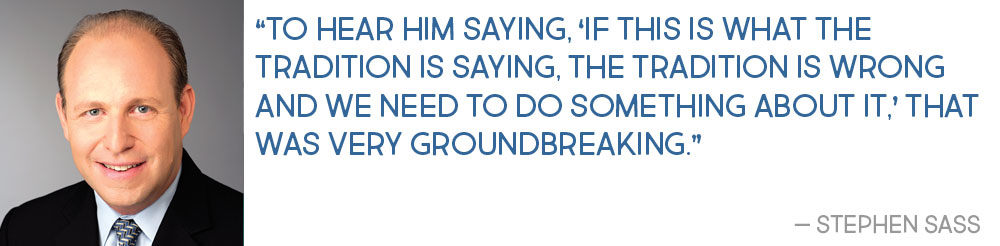
Stephen Sass was seated in a pew that day. He was both a member of BCC and of VBS. He was in a same-sex relationship. What he heard made an impact on him.

“To hear him saying, ‘If this is what the tradition is saying, the tradition is wrong and we need to do something about it,’ that was very groundbreaking,” said Sass, an attorney and president of the Jewish Historical Society of Southern California.

“It’s hard to imagine now, but at the time, there was a conspiracy of silence where nobody would talk about that,” he said. “Even then in those days, people at BCC would not be identified by their last name; they would just use an initial because they could lose their job or their family.”

Schulweis’ sermon paved the way for the acceptance of gay Jews in the Conservative world. A support group for gays and their families launched at VBS. Eventually, same-sex couples could join the synagogue together as members.

“The Reform movement had made those strides and in a way the Conservative movement was just catching up,” Sass said. “He took this on. He didn’t have to, just like he took on so many issues.”

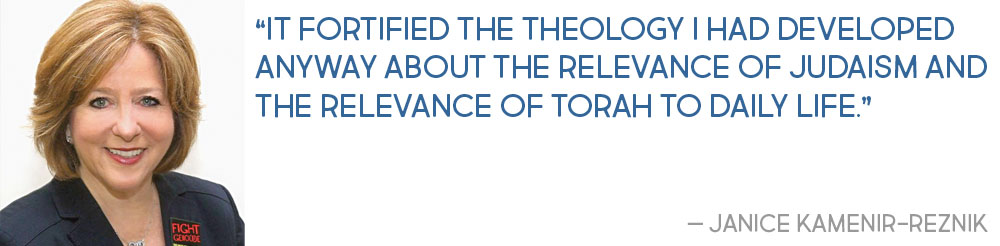
In 2004, Schulweis, who died in 2014, made another deep impression with a High Holy Days sermon titled, “Globalism and Judaism.” In it, he asked where Jews who said “never again” to the Holocaust stood as a genocide was unfolding in  Rwanda in 2004. Janice Kamenir-Reznik, then an attorney who was an active volunteer at VBS, was in the sanctuary that day. She was struck by Schulweis imploring his congregation to open a newspaper: “You can’t close the newspaper once you believe in a global God,” he said.

“It fortified the theology I had developed anyway about the relevance of Judaism and the relevance of Torah to daily life,” Kamenir-Reznik said. She went on to co-found Jewish World Watch — an anti-genocide nonprofit organization that is active in Sudan, South Sudan and the Democratic Republic of Congo — with Schulweis.

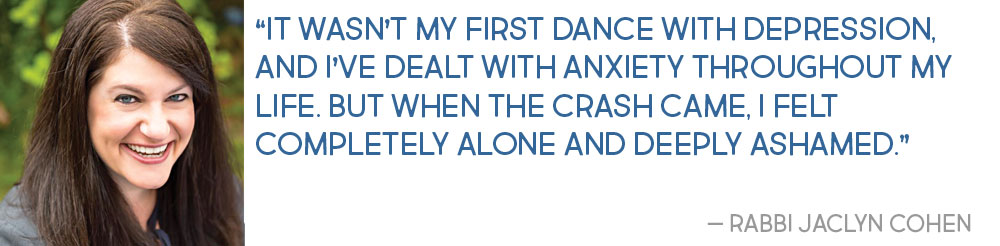
Last year, Emily Alhadeff, a Seattle resident and member of Temple De Hirsch Sinai, the largest Reform synagogue in the Pacific Northwest, was transfixed as Rabbi Jaclyn Cohen delivered a sermon on Rosh Hashanah about postpartum depression.

“It wasn’t my first dance with depression, and I’ve dealt with anxiety throughout my life. But when the crash came, I felt completely alone and deeply ashamed,” Cohen said in the sermon.

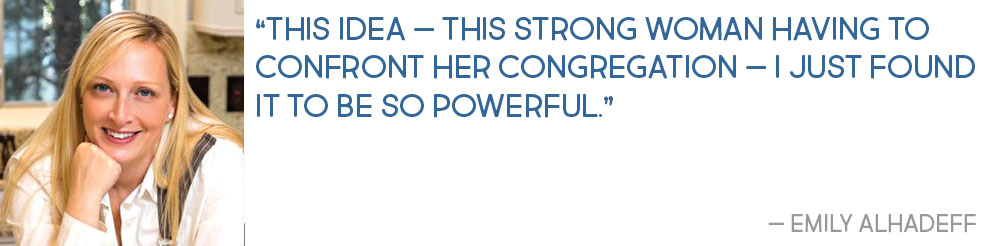
Alhadeff, a chef and founder of Emily’s Granola in Seattle, said the rabbi’s willingness to make herself vulnerable was transformative. 

“This idea — this strong woman having to confront her congregation — I just found it to be so powerful,” Alhadeff said.

Cohen, a Los Angeles native who joined Temple Beth Torah in Ventura this year, said she was nervous about opening up to her congregation that way. She did not know how people would react to a sermon that called on eliminating the stigma around mental illness. So when the community erupted with applause at the end of her remarks, she was at a loss for what to do.

“I was so taken aback, I looked down uncomfortably,” she said. “I said something that mattered. It was really amazing.”

Effective sermons are speaking to the realities of the times, Stempel said.

“What’s going on in the world, the sermon should take that into account,” she said. “I think you should be talking about a universal truth, something everybody in the room can relate to on some level.”

Of course, a profound sermon for one person is a dud for another. Stempel acknowledged that her husband did not respond to Aaron’s “complaint” sermon in 2008 as enthusiastically as she did.

“He likes to complain,” she said.

Some High Holy Days sermons become words to live by Read More »