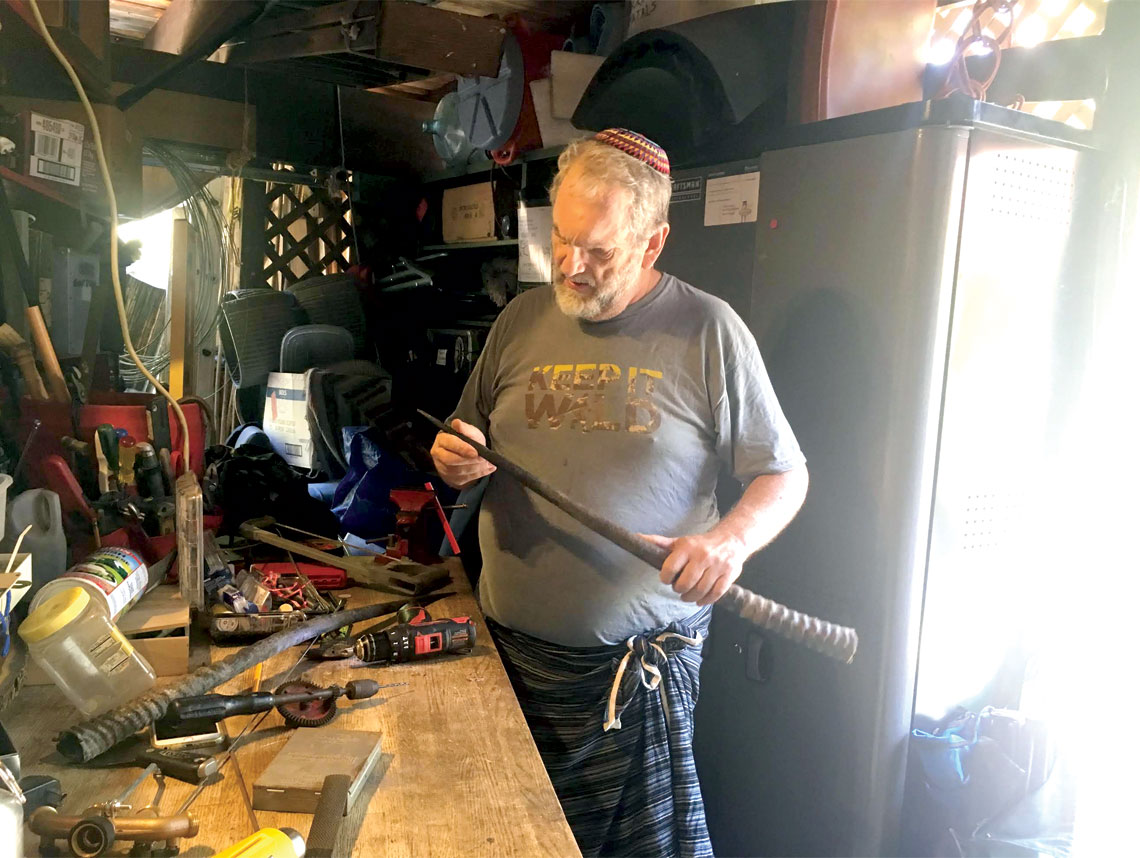
 Michael Chusid puts a blowhole into an African antelope horn in his shofar workshop. Photos by Ryan Torok
 At first glance, Michael Chusid’s workshop looks like most any utility shed at the back of a house — a space somewhere between Tim “The Toolman” Taylor’s garage from “Home Improvement” and Jason Segel’s man cave from “I Love You, Man.”
Electrical cords run across the roof. A power drill rests on a wooden workbench. A loveseat that could use a good cleaning nevertheless appears comfy and inviting.
But Chusid’s Encino workspace differs from others in one major respect: It’s filled with the horns of rams and antelopes, piled up in bowls like pieces of fruit.
Chusid is a self-described ba’al tekiah, a shofar master blaster, and creator of the blog “Hearing Shofar.” He studies them. He buys them. He sometimes alters them. And he blows them.
Each year, Chusid blasts a shofar at synagogues on the High Holy Days, at American Jewish University and Hebrew Union College-Jewish Institute of Religion, and as a member of Shofar Corps, which blows shofar for the sick and elderly who cannot make it to synagogue on the holidays.
“The most difficult thing for me as a blower is to remember to listen,” Chusid said. “Sometimes in shul, I start thinking, ‘Oh, I’m blowing it really good; I’m impressing people. Look at how great I am.’ And then I’m completely out of it. When I’m really into it, I disappear, I no longer exist, I feel the energy coming out of the earth, rising through my body and going out the shofar and connecting with heaven, like the [Hebrew] letter, vav.”
As he stood barefoot, wearing a sarong, with a rainbow yarmulke covering his gray-white hair, he demonstrated what he meant. He closed his eyes, held his hand to his face and said a prayer. Then he blew one of his shofars, sounding the three different bursts familiar to anyone who has attended a High Holy Days service: tekiah, one long blast; shevarim, three broken sounds; and teruah, nine staccato notes.
“I have a calling for shofar,” he said later. “I would be diminished if I didn’t teach it.”
Chusid, 64, knows almost everything there is to know about shofars. Archaeologists have discovered images of the instruments that date back at least 20,000 years, he said, and while the shofar blast awakens the spirituality of the Jewish people every Rosh Hashanah and Yom Kippur, other historical peoples also have created sounds for ritual purposes.
“Almost every ancient culture found a sound through which they heard and which they spoke with that which is unknowable,” he said.
https://www.facebook.com/JewishJournal/videos/10155477166539713/
Chusid purchases shofar horns online, from Amazon, eBay and Atlantic Coral Enterprise Inc., a Florida-based wholesaler of seashells and wildlife products that imports horns from South Africa.
“There is something dramatic about the long ones — you can get more pitches on them — but the short ones are just as functional and easier to transport,” he said. “I have some that I slip into my pocket so I can carry it with me all the time just in case the Messiah should show up.”
Atlantic Coral Enterprise sold Chusid the horn of a gemsbok, a large antelope native to South Africa that has horns longer and straighter than ram horns. One end of the gemsbok horn is ribbed, which creates a percussive sound when a tool is rubbed against it.
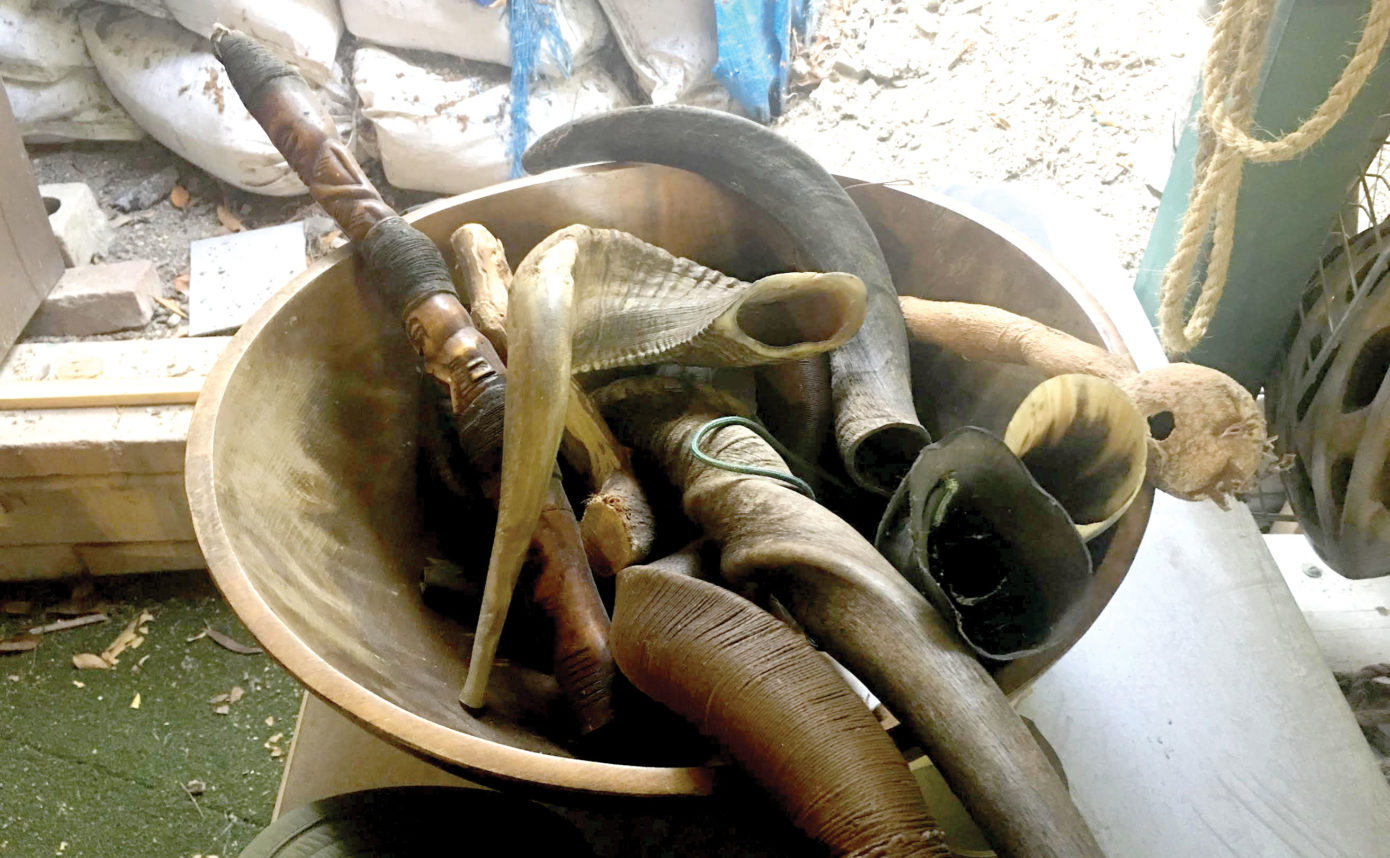
“This, I believe, is biblically accurate,” Chusid said of a gemsbok shofar he made. “And it’s showy and beautiful, and it’s versatile. We’re told to praise God with shofar and drums.”
Chusid said he first heard the shofar when he was 8 years old. However, he didn’t hear it as an adult until 1994, after he had entered his 40s.
“I went out and bought a shofar, and I’ve been hearing it since,” he said.
As he crafted the gemsbok shofar, Chusid threaded a wire through the horn to determine its hollowness and the location of its bone. He marked the horn with a Sharpie where it would need to be cut to create a mouthpiece at one end. He debated whether to cut off a tip of the horn, which would compromise its dramatic shape, or drill a mouthpiece hole on its side so he could leave the shape intact. He chose the latter.
“People ask me, ‘Did you make that shofar?’ and I have to say, ‘No, I didn’t make it. The sheep made it. Or the antelope. I just fabricated it a little bit,’ ” he said. “This comes from beyond me. The horns come from dead animals.”
And then, Chusid said it was time for my lesson.
As we walked outside, he began to explain technique: Buzz the lips and press the shofar’s blowhole tight to the place where the air comes out between your lips.
I managed a weak but on-point tone out of the gemsbok shofar. It wasn’t much of a blast, but it was something.
Chusid laughed and offered encouragement, adapting an expression of Jewish wisdom that, like the blast of the shofar, has resonated through the ages.
“The rest is practice,” he said. “Go and study.”

















 More news and opinions than at a Shabbat dinner, right in your inbox.