fbpx

September 12, 2017

11 inspiring Jews who died in 5777

It’s always difficult to whittle down the list of influential Jews who died in a given year, but this year the task seemed to be especially tough. The number of Jews who left historic marks on their fields — and, more broadly, on Jewish culture — was remarkable.

As 5777 draws to a close, here are some members of the tribe — representing areas as diverse as pop culture to politics — we’ve mourned since last Rosh Hashanah.

Carrie Fisher60

Carrie Fisher

Carrie Fisher as Princess Leia in “Star Wars” in a photo from Aug. 23, 1978. (CBS via Getty Images)

Most know Carrie Fisher because of her iconic role as Princess Leia in the original “Star Wars” films, but her tumultuous career extended beyond that. The actress, who struggled with addictions to cocaine and prescription medications, also wrote four novels and three memoirs along with acting in dozens of other films. Fisher landed the “Star Wars” role as a relative unknown despite being the daughter of Jewish singer Eddie Fisher and movie star Debbie Reynolds. After she died of a heart attack in December, her only child pointed out that Fisher’s real cause of death was her substance abuse issues.

Leonard Cohen, 82
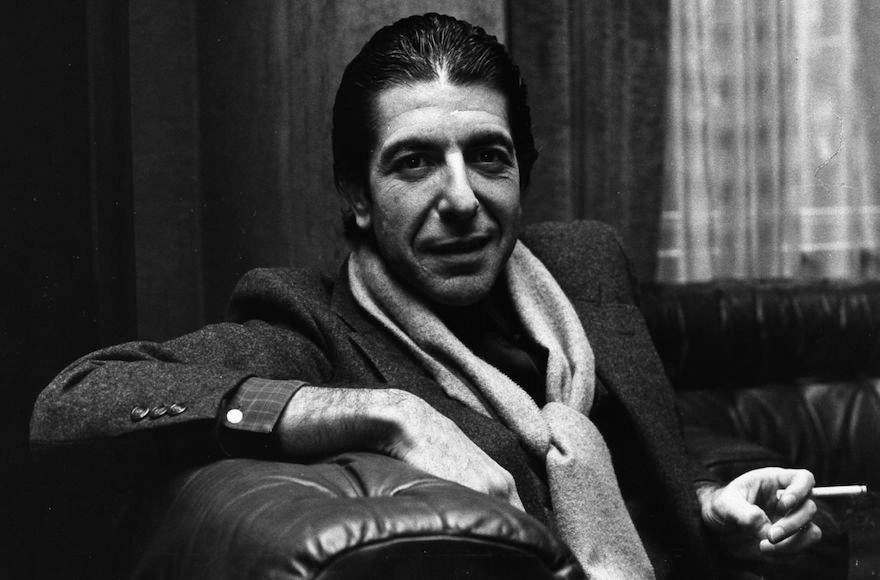
Leonard Cohen sharing a joke and smoking a cigarette in 1980. (Evening Standard/Getty Images)

The grandson of a rabbi who grew up in an Orthodox home in Montreal became one of the most beloved folk artists of the 20th and 21st centuries. Leonard Cohen launched his musical career late, releasing his first album at 33 after writing multiple books of poetry. But he would go on to release 13 more records and often incorporate Jewish themes into his meticulously crafted songs. His song “Hallelujah” became one of the most covered and revered songs in pop music history. Just weeks before his death in November, Cohen released his final album, which included a track featuring a chorus saying “I’m ready, my Lord.”

Simone Veil, 89
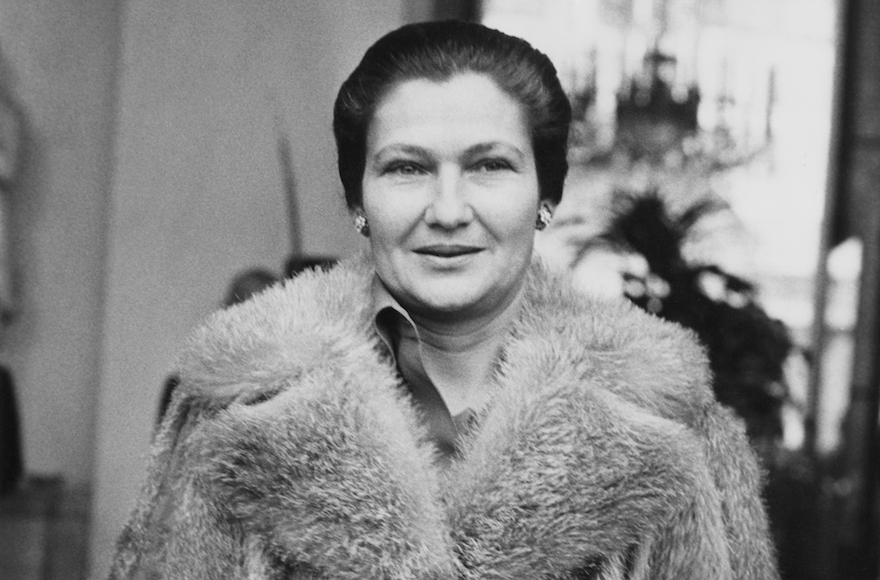
Simone Veil

Simone Veil, then France’s minister of health, outside the Elysee Palace in Paris, 1974. (Keystone/Hulton Archive/Getty Images)

Fewer than 70 people have been awarded France’s Grand Cross of the Legion of Honor — Simone Veil, a Holocaust survivor who became a pillar of French politics, was one of them. After making it out of Auschwitz and Bergen-Belsen, Veil became a lawyer and served as France’s minister of health and later as president of the European Parliament. She also was one of the few female members of the prestigious French Academie Francaise and spearheaded the legalization of abortion in France in the 1970s. Veil died in June, less than a month from her 90th birthday.

Jerry Lewis, 91

Jerry Lewis

Jerry Lewis in 1971 (Evening Standard/Getty Images)

Don’t let the funnyman’s stage name fool you: Jerry Lewis was born Joseph Levitch to parents who performed on the Borscht Belt hotel circuit. Lewis, who died of cardiac disease in August, rose to prominence as part of a duo with Dean Martin, with whom he made over a dozen wacky comedy films from 1949 to 1956. He would go on to star in dozens of other films, including “The Nutty Professor” (yes, the original one, well before Eddie Murphy’s 1996 remake) and Martin Scorsese’s “The King of Comedy.”

Zsa Zsa Gabor, 99

Zsa Zsa Gabor in 1952 (Nixon/Express/Getty Images)

Though this legendary Hollywood socialite and sex symbol was buried in a Catholic cemetery, she had Jewish roots. Born to Hungarian Jewish parents in Budapest, Sari Gabor (her real name) was married nine times and appeared in films such “Moulin Rouge” and “Lovely to Look At.” Her love life was a tumultuous public affair, and she has been called the first celebrity to be famous for being famous. Zsa Zsa Gabor died in February, less than two months from her 100th birthday.

Don Rickles, 90

Don Rickles

Comedian Don Rickles at Book Soup in West Hollywood, May 31, 2007. (Mark Mainz/Getty Images)

The well-known comic nicknamed “Mr. Warmth,” who loved to hurl insults at his audience members, was also a serious actor trained at the American Academy of Dramatic Arts. He appeared in countless TV shows, performed standup into his 80s and acted alongside legends such as Clark Gable and Clint Eastwood on the silver screen. Younger audiences know him as the voice of Mr. Potato Head in the “Toy Story” series. He passed away in April from kidney failure.

Vera Rubin, 88

Vera Rubin

Vera Rubin in her office at the Carnegie Institution of Washington in Washington, D.C., Jan. 14, 2010. (Linda Davidson/The Washington Post via Getty Images).

Without this groundbreaking scientist, we still might not understand what 27 percent of the universe is made up of: dark matter. Rubin, an astronomer from Philadelphia, discovered that galaxies don’t rotate the way previous scientific models led us to believe, which led to the proof of the invisible, undetectable stuff that makes up nearly a third of our world. Rubin, who passed away in December, once said that science was separate from religion: “I’m Jewish, and so religion to me is a kind of moral code and a kind of history,” she said. “I try to do my science in a moral way, and I believe that ideally, science should be looked upon as something that helps us understand our role in the universe.”

Otto Warmbier, 22

Otto Warmbier

Otto Warmbier arriving at a court for his trial in Pyongyang, North Korea, March 16, 2015. (Xinhua/Lu Rui via Getty Images)

After being held in North Korea for more than 17 months for allegedly tearing down a propaganda poster during a student tour, Otto Warmbier was released, comatose, in June. He did not survive the injuries — Warmbier died a week after being returned to the United States. JTA reported that he was an active member at the University of Virginia Hillel, but North Korea’s narrative said that Warmbier stole the poster for an American church. So his Jewish identity was kept under wraps so as not to embarrass North Korea during negotiations for the release of the student — “if that’s what their story is, there’s no point fighting it if your objective is to get him out,” the family spokesperson explained — who had been sentenced to 15 years of hard labor.

Ruth Gruber, 105

Ruth Gruber

Ruth Gruber at The Paley Center for Media in New York City, Feb. 3, 2011. (Andy Kropa/Getty Images)

Among the impressive accomplishments on Ruth Gruber’s resume: a pioneering reporting stint in the Soviet Arctic, a trip ordered by President Franklin Roosevelt to comfort post-Holocaust Jewish refugees, and reportage of the Nuremberg trials and Operation Moses. The writer, who will go down as one of the 20th century’s most important journalists, Jewish or not, began her career at the New York Herald Tribune in 1947. She lived to 105.

Henry Heimlich, 96

Henry Heimlich

Henry Heimlich demonstrating his famous eponymous maneuver on Johnny Carson, April 4, 1979. (Gene Arias/NBCU Photo Bank)

Yes, that Heimlich — the person who invented the famous Heimlich maneuver that has saved countless numbers of choking people since its inception in 1974. Dr. Henry J. Heimlich was a thoracic surgeon born to Jewish parents in Wilmington, Delaware. Besides the famous life-saving method, he also invented the chest drainage flutter valve, known as the Heimlich valve. He died last December from complications following a heart attack.

Sara Ehrman, 98

Sara Ehrman in 2016 (Screenshot from The New York Times)

This longtime Democratic Party activist, adviser on the Israeli-Palestinian conflict and friend of the Clintons described herself as “first a Jew, second a Democrat and above all a feminist.” Sara Ehrman may be most famous for advising Hillary Clinton not to move to Arkansas to marry Bill, though she worked on George McGovern’s 1972 presidential campaign and later advised President Clinton on Israel-Arab peacemaking. She also helped organize Bill Clinton’s first trip as president to Israel, served as AIPAC’s political director and later worked with J Street. She died in June, more than 50 years after her entree into politics.

Edie Windsor, 88

Edith Windsor. Photo from Twitter


The gay rights activist at the heart of the Supreme Court’s landmark 2013 decision to nullify the Defense of Marriage Act, Windsor died earlier this month. She was the lead plaintiff in the case that extended federal recognition and a number of government benefits to same-sex couples. Later, a 2015 Supreme Court ruling built on the so-called Windsor decision to legalize same-sex marriage nationwide.

Windsor’s case arose from a tax dispute after the death of her wife, Thea Spyer, in 2009, two years after the women were married following a 40-year engagement. Windsor was denied a $363,053 estate tax refund by the Internal Revenue Service and sued, appealing up to the nation’s highest court. In a 5-4 decision, the court struck down the 1996 law — and ordered the IRS to issue Windsor the refund, with interest.

Windsor was the daughter of Russian-Jewish immigrants. Her death was met with mourning by LGBT communities across the country.

11 inspiring Jews who died in 5777 Read More »

Who are the Jewish ‘Dreamers’?

Our email inboxes were stuffed last week with statements from Jewish organizations urging continued protection for “Dreamers,” undocumented immigrants who arrived in the United States as children.

Last Monday, President Donald Trump said he was giving six months notice to end the DACA, or Deferred Action for Childhood Arrivals program, launched by his predecessor, Barack Obama, in 2011. Trump has signaled a willingness to sign congressional legislation that would codify its provisions.

One statement, though, from Agudath Israel of America, stood out in its concern not just about Dreamers, but Jewish Dreamers.

“It affects hundreds of thousands of young people, including many in the Jewish community, who have grown up and been educated in the United States, the only home they have known,” the haredi Orthodox organization said in its statement issued Thursday.

We covered one such Dreamer who has become an activist, Elias Rosenfeld of Boston, but I was curious about the “many in the Jewish community” in the release. Agudah put me in touch with David Grunblatt, the lay chairman of its immigration task force and the co-head of the immigration department at Proskauer, a major law firm.

Grunblatt told me that he started hearing from Jewish Dreamers almost as soon as Agudah put out a release offering to assist them, soon after DACA was launched in 2012.

He said the number of Jewish Dreamers among the 800,000 known to have applied for protections under DACA was “not huge but not negligible,” and there were a variety of reasons for their illegal status among the cases he has handled.

“They tried to apply for a green card or for employment sponsorship, and it went wrong and they’ve been here five or six or seven years and they’re not going anywhere,” Grunblatt said. “Or a family comes here because someone in the family needs medical treatment, they stay six months, another six months, another six months and the situation is resolved one way or the other — but the family is here.”

In some cases, he said, parents successfully obtain green cards but fail to obtain them for their children.

The case of Rosenfeld, a Venezuelan native, involved an illness: His mother, a media executive, traveled to the United States on an L1 visa, which allows specialized, managerial employees to work for the U.S. office of a parent company. When he was in the fifth grade, his mother was diagnosed with kidney cancer. She died two years later.

Grunblatt said that in one case, he was contacted by an all-girls school.

“They discovered one of the girls in the school was undocumented because they were going on a school trip to Canada and the kid didn’t even know [if] she was documented,” he said.

That’s fairly common, said Melanie Nezer, a vice president at HIAS, the lead Jewish organization handling immigration advocacy.

“If a child is brought over when they’re a baby or a very young child, they just grow up American,” she said. “They speak English — why would they think they’re different from anyone else?”

While support for the Dreamers has been fairly bipartisan, and Jewish organizational consensus is for a solution that lets them stay in the country, some Jews have major qualms about the program — especially with the way it was created by executive order under Obama.

“If the Obama administration wanted to implement the DACA program, it should have made the case to Congress and try to pass its proposal into law,” Rep. Lee Zeldin of New York, one of two Jewish Republicans in Congress, said in a statement. “The administration absolutely did not have the authority to write its own ‘laws.’

“If the proposal did not have the support to pass, then it should not go into effect. That is how our process is designed and must be respected.”

Zeldin said he is “open” to debating the issue with his colleagues, but “[m]y priority will always unapologetically remain with fighting for the people following the laws rather than the ones breaking them.”

Nezer said her impression was that the majority of Dreamers fit the profile that gets the most prominent play in the media: those who arrive here as babies or toddlers with their parents from Mexico or Central America.

But, she said, that the population is more diverse than that template — and includes Jews — should not surprise members of the Jewish community.

“Our parents and grandparents took these risks not for themselves but for us,” Nezer said. “And that’s exactly what the Dreamers’ parents did.”

Few lives track an easy trajectory, Grunblatt said, and Dreamers are no different.

“It’s life,” he said. “Things happen in life, plans go awry, ambitions fail and people end up here.”

Who are the Jewish ‘Dreamers’? Read More »

Israeli wine exports to China skyrocket

An Israeli winery is set to build an $8 million facility in central China, hoping to take a piece of what has become one of the largest wine markets in the world. The winegrower, Hayotzer, has signed a preliminary agreement with the Pen Dun Group to build the joint project.

Hayotzer, which is owned by Arza, one of Israel’s largest wineries, will hold a 20-25 percent stake and will advise on winemaking and viticulture of the proposed venture. China is currently the world’s fourth largest wine consumer, and is set to surpass France and the United Kingdom by 2020, making them second only to the United States.

“They welcomed me like I was a Jewish Nobel Prize winner,” Guy Edri, the CEO of Hayotzer told The Media Line. “They are very enthusiastic about Jews and Jewish creativity. They say that Jewish culture is very close to Chinese culture and both are thousands of years old. They also see the kosher symbol as a mark of quality.”

China is already buying a lot of Israeli wine. When Edri met Chinese importers at a recent wine fair in China, they placed an order for 40,000 bottles. That’s the kind of market Israel, with its total population of just eight million, can only dream about.

“China is a nirvana for Israeli winemakers – it’s one of the biggest wine markets in the world,” Adam Montefiore, a wine writer for the Jerusalem Post told The Media Line. “’We joke that if we can sell wine to just one village in China, we can all retire. The Chinese have great respect for Israel’s history and its technology.”

But he said, the Chinese bureaucracy can make it difficult for new companies to succeed. And oenophiles might cringe if they saw their product being mixed with Sprite to appeal to the Chinese, who like sweet drinks.

“Drinking wine is more about status than actually liking wine,” Montefiore said.

The plan for the winery is only the latest agreement between Israel and China. This week Israel’s finance minister, Moshe Kahlon, was in Beijing for the signing of a $300 million trade agreement for “clean-tech” Israeli companies, meaning environmental-friendly energy and agricultural technology. In a statement, Israel’s foreign ministry said that the new deal, “allows the two sides to expand bilateral economic activity into other environmental-friendly technologies, including advanced agriculture technologies and smart and green energy technologies, which the Chinese government wants to implement using Israeli experience and expertise.”

China is hungry for Israeli technology and Israeli companies are happy to provide it. Press reports say that more than 1,000 Israeli companies have set up shop in China, and large delegations of Chinese businessmen visit Israel every year. China has also recently bought a controlling interest in Tnuva, an iconic Israeli food company, and Ahava Dead Sea products.

“We are looking for investment opportunities in Israel and we will help them in development and marketing,” Liu Hao Peng, of New Alliance, a Shanghai based investment fund told The Media Line. “We aim to help them settle down in China and to manufacture their product in China.”

China is Israel’s third largest trading partner after the US and the European Union. Israel’s exports to China were more than $3.2 billion last year, up from just $300 million a few years ago. In recent years, China has invested more than $15 billion in Israeli technology companies.

Israel and China established diplomatic relations in 1992, and recently marked 25 years of close ties. As criticism of Israel’s actions in the West Bank has grown in Europe, and calls to boycott Israeli products have grown, China offers an alternative market where the Palestinian issue is not seen as crucial.

Israeli wine exports to China skyrocket Read More »

Neo-Nazis plan to march near Swedish synagogue on Yom Kippur

Jews in the Swedish city of Gothenburg were bracing for a neo-Nazi march scheduled to pass near the city’s main synagogue on Yom Kippur.

Community leaders said they will appeal a police decision last week that would allow the Nordic Resistance Movement to march during the Gothenburg Book Fair, when some 100,000 people will gather in the city for the largest literary festival in Scandinavia.

The police had denied the far-right group’s initial request to march on the main streets of Gothenburg, which is the second largest city in Sweden and located on the country’s west coast. The alternate route offered by police would take the marchers only about 200 yards from the Gothenburg Synagogue on Judaism’s holiest day, which this year falls on Sept. 30.

Members of the Jewish community, which typically is under tight security, are worried about harassment and physical threats from the marchers, said Allan Stutzinsky, chairman of the Gothenburg Jewish community. People affiliated with the Nordic Resistance Movement were responsible for anti-Semitic threats that led to the shuttering in April of the Jewish community center in Umea, a city in northeastern Sweden, according to Stutzinsky. A community center is part of the synagogue complex in Gothenburg.

”The threat against us is always large, and it becomes even larger when they are marching,” Stutzinsky told JTA, adding that left-wing counter protesters may also be a threat to Jews.

Swedish Jews face anti-Semitism both from the nationalist far right as well as the far left, whose strong criticism of Israel sometimes veers into anti-Semitism.

Stutzinsky noted that Holocaust survivors and their descendants are members of the Gothenburg Jewish community.

“Almost all of our members have some sort of connection to the Holocaust,” he said. “It is obvious that it is upsetting for them to see, and maybe hear, Nazis protest close to the synagogue, when everyone is there at the Yom Kippur service.”

The community is not opposed to the group’s right to march, he said, but to the event’s location and timing.

Gothenburg’s police chief, Erik Nord, said that everyone who wanted to march had the right to do so, but that anyone who engaged in incitement would be detained, according to SVT, Sweden’s national TV broadcaster.

The Anti-Defamation League urged Sweden to “ensure that the route of the neo-Nazi march is far from the synagogue.”

“As ardent defenders of freedom of speech — even hateful speech — we would not ask for the neo-Nazi march to be banned. We do implore you, however, to ensure that the Jewish community of Gothenburg ‘feels safe and secure, and is free to flourish,'” ADL’s national director, Jonathan Greenblatt, wrote to Prime Minister Stefan Lofven in a letter posted online by Stockholm’s Jewish community.

Meanwhile, Stutzinsky said the planned march did not represent an isolated incident.

“One would have thought that World War II was an effective vaccination against anti-Semitism. But it didn’t last that long, now it’s back again,” he said.

“We have anti-Semitism here again like in the 1930s. We thought Europe had learned its lesson, but that’s apparently not the case.”

Neo-Nazis plan to march near Swedish synagogue on Yom Kippur Read More »

Trickiest part of an aggressive Iran strategy? Trump

The question of Iran’s ambitions and actions is back on the table. On the ground, Iran seems to be gaining influence in Syria. In New York, the United Nations General Assembly is about to convene to discuss matters of importance that surely will include the proliferation of nuclear weapons — North Korea at the front, and Iran as the next potential crisis.

In Washington, D.C., President Donald Trump reportedly is undecided on whether to recertify the Iran deal when the time comes to do it in October. He also reportedly is considering options for a more aggressive American policy on Iran, with the aim of containing its advances in Iraq and Syria. In Jerusalem — or rather, Buenos Aires, Argentina, where Israeli Prime Minister Benjamin Netanyahu is visiting — a renewed call for recognizing Iran’s role in spreading terrorism, including terror attacks on Israelis and Jews in Argentina, is heard.

Often mixed, there are several issues at stake. Iran’s compliance with the nuclear deal is one: The International Atomic Energy Agency (IAEA) still believes that Iran is in compliance with the agreement it signed. The Trump administration has its doubts, but has not provided any evidence of noncompliance. To argue that Iran ought to be censored or punished, the administration will have to present proof. Lacking such proof, it still can argue that Iran isn’t complying with the deal but will hardly find international partners as it seeks to turn such a declaration into action.

Truth is, Iran’s compliance with the deal is hardly the most important issue at stake. The deal was flawed, and hence compliance with it doesn’t significantly advance the cause of halting Iran’s violent and hegemonic ambitions in the Middle East. So the real dilemma for the Trump administration is not whether to claim that Iran is holding to the deal; it is whether to counter Iran even though it is holding to a problematic deal. Putting it more bluntly: It is up to the U.S. and partner nations to decide whether to alter the deal.

There have been calls on Trump to cancel or suspend the Iran deal. Indeed, if Trump does that, it could be a proper opening act for a better policy on Iran. But only an opening act — that is, an act that must be followed by a sustained, well-crafted, campaign aiming to achieve two objectives: to curb Iran’s nuclear weapons aspirations and to make it abandon its policy of expansion and aggression against other countries in the region.

Again, there are several questions involved in crafting such policies. The first is one of trust. Can the Trump administration, incompetent as it seems today, create and implement a “sustained, well-crafted, campaign” against anyone (but the media)? Then come the questions of essence: What should be the policies? What will be the price of implementing them? What are the chances for long-term success?

The trickiest problem with any plan aimed at curbing Iran’s nuclear program and aggressive foreign policy is the problem of having to square these two objectives. If the U.S. and partner nations keep the Iran deal and ensure it is implemented, they might achieve the first objective (no nuclear weapons for now) but fail on the second objective (keep Iran’s aggressiveness in check). If the U.S. and partner nations scrap the Iran deal and increase pressure on the country and its forces and proxy allies, they could achieve the second objective only to find out that Iran rushed back to expedite its nuclear program.

And of course, there are ways to achieve both objectives: The U.S. is strong enough to prevent Iran from developing nuclear weapons and from spreading its wings of expansionism. But the level of necessary American commitment to achieve these goals could be very high, much higher than the commitment advertised by the “America First” president when he was campaigning for office and much higher than the commitment Americans seem willing to accept after the Middle East wars of the last decades.

And we did not yet mention the Russians, who have forces nearby. And we did not yet mention Hezbollah and its terrorist wing that can potentially strike American forces or civilians. And we did not yet mention Trump’s bid to end the Gulf crisis and its complications. Is Trump able to carve a realistic path forward that takes into account all these factors? Some of his top aides have doubts. Some of Israel’s top policy makers have doubts. The Iranians have no doubts: They do not think he is able to do it.

Trickiest part of an aggressive Iran strategy? Trump Read More »

Palestinian teen pulls knife on Israeli police in Hebron, third time in the last week

A Palestinian teen was arrested near the Cave of the Patriarchs in Hebron after he was found to be concealing a knife.

The incident on Tuesday is the third in the last week, according to Israel Police.

The boy, 15, had been hiding the knife under his shirt, and when he was asked to lift his shirt he pulled it on the police officers at the checkpoint.

He was arrested and taken for questioning with no shots fired, according to the police.

The other two incidents also occurred at checkpoints near the flashpoint Tomb of the Patriarchs, known by Muslims as the Ibrahimi mosque.

Palestinian teen pulls knife on Israeli police in Hebron, third time in the last week Read More »

I’m Israeli, and Rosh Hashanah is just not the same in the US

Last year, in a fit of desperation and loneliness, I booked tickets for a five-day trip to Israel for Rosh Hashanah. I didn’t tell my friends I was coming — the sole purpose of my travel was to have a holiday dinner with my family.

Financially, logistically and even physically, it was an ill-advised decision, I know. But for my soul, it was the right thing to do.

I left Israel for New York in 2009. I feel at home in my lush Brooklyn neighborhood with its beautiful brownstones, in an apartment my husband and I have filled with paintings and books. I love that the city has so much to offer as far as diverse faces and stories and religions. I love how New Yorkers refuse to meet a stranger’s gaze, but if you drop your wallet or MetroCard on the sidewalk (as, um, I often do) they will come running after you to make sure you retrieve it.

But there are some days when I feel like moving to the U.S. was a huge mistake. These feelings are most acute on the Jewish holidays — especially on Rosh Hashanah.

Celebrating Rosh Hashanah with my family in Israel is the best. We’ve never gone to synagogue; we rarely even mention the fact that it’s the new year. We stain our hands eating juicy pomegranates; we clear our sinuses by slathering horseradish on my grandmother’s homemade gefilte fish. For the main course we eat all kinds of treif delicacies like seafood paella and blue crabs, the preparation of which my mom has long perfected, having become fast friends with the local fishermen. We assure my grandmother and my mother that, yes, there is enough food, and yes, the dishes are just as good as they were last year. But most important we are together, and that fills us all with giddy delight and a certain spiritual awe.

My husband, a nice American Jewish boy, has told me about his own family’s habits on the High Holidays, particularly the long services at his Kansas City synagogue. He does not seem too gung-ho about celebrating the new year. Sure, he’ll fast on Yom Kippur, but he is happy to forgo any rituals when it comes to Rosh Hashanah.

Once, when we visited his parents on the holiday, I attended synagogue with his mother, just to see what it was like. While the service was warm and filled with music, it felt completely alien. It reminded me of a time a few years ago when I snuck into a Midnight Mass with a few other restless Jews. Certainly I could see the awe that came with such a ritual, but I felt very distinctly that this wasn’t for me.

Like about 40 percent of the Jews in Israel, my family is secular. My grandfather, the descendant of more than one rabbi, famously (according to family folklore) held cookouts on Yom Kippur. I now live a short walk away from South Williamsburg’s Satmar community, who believe the Holocaust was divine punishment for a lack of religious piety. But to my grandfather, who lost most of his family to the Nazi regime, the only religious epiphany the Holocaust had in store was that no deity would have let such a horror happen. He decided there was no place for religion in his life.

My family takes being secular very seriously. They scarf down bacon and cheeseburgers whenever they’re available. They love going on road trips on Shabbat. For my grandmother’s 70th birthday, we all take a tour of Jerusalem’s many churches, and, encouraged by our tour guide, sing “Jerusalem of Gold” on a rooftop of a haredi Orthodox neighborhood, where the singing voices of women are explicitly forbidden.

What does it mean to be Jewish when you’ve lost your faith? Most secular Israelis consider themselves Israelis first and then Jewish, according to a recent Pew study. To them, Judaism isn’t about religion — it is about culture, ancestry and history.

When you are an Israeli living in Israel, it is so easy to take your Judaism for granted. Judaism is in the language you speak every day; in a golden Star of David necklace; in the foods of myriad Jewish cultures that intermingled; in the Friday-afternoon rush to get your weekend groceries before the stores close for Shabbat.

But more than anything, it’s in family. And in my family, it means Shabbat dinners where candles don’t get lit and blessings don’t get recited, yet everyone is laughing and talking as roasted eggplant and matzah ball soup are passed around. After centuries of persecution, here we are sitting as a family, strongly anchored and aware of our history, but confident in our future together. Is there anything more Jewish than that?

When you’re an Israeli outside of Israel, it becomes increasingly hard to take Jewish secularism for granted. Certainly I am still Israeli — but I feel disconnected from my culture, my rituals. In America, doing Jewish things usually means making a religious choice, and with so many diverse and open synagogues, the choices do seem abundant.

Secularism, on the other hand, implies a fast track to assimilation — which isn’t my thing, either. You would think that in eight years in the U.S., I would have found some solution that works for me for the Jewish holidays. Yet I still feel just as helpless and lonely whenever September rolls around.

Most of my Israeli friends don’t seem to have solutions, either. Many of them just choose to ignore the Jewish holidays or find a certain comfort in hanging out with other Israelis eating shakshuka at a local Israeli restaurant. Some institutions have tried to introduce Israelis to synagogue culture on their own terms.

None of these have felt right to me, nor has celebrating the new year at services, American-style. So this year, my family is doing something really radical for Rosh Hashanah: My parents and brothers are flying in from Israel, and then we’re all heading to Chicago, where my in-laws will be waiting.

For the holiday meal, we’ve reserved a large table at a seafood restaurant, where we will most certainly delight in treif delicacies. I suppose I have found a way to keep some traditions alive, after all.

I’m Israeli, and Rosh Hashanah is just not the same in the US Read More »

ADL alarmed by author speaking to Congress who links gun control and Holocaust

The Anti-Defamation League expressed concern that a witness at a congressional hearing on a controversial gun bill  wrote a book arguing that gun control rendered Jews defenseless during the Holocaust.

Stephen Halbrook, who wrote “Gun Control in the Third Reich” in 2015, is set to appear Tuesday at a meeting of the U.S. House of Representatives Committee on Natural Resources, which is considering the Sportsmen’s Heritage and Recreational Enhancement Act. The bill would loosen controls on transporting firearms across state lines, an area that Halbrook has litigated as a prominent gun rights attorney.

“We have long been concerned about facile comparisons of gun control legislation in America to policies upheld by Nazi Germany during the Holocaust,” Jonathan Greenblatt, the ADL’s national director, said in an email to JTA. “The national debate over gun control is a divisive issue with many strong opinions. While there are legitimate arguments on both sides, the notion that Jews could have saved themselves from the Nazi onslaught is not one of them. It is historically inaccurate and deeply offensive to bring the Holocaust into this debate where it simply does not belong.”

Halbrook’s book argued that a key element in the Nazis’ repressive policies was the disarming of Nazi enemies, a theory embraced last year by the then-presidential candidate and now-Housing Secretary Ben Carson. Halbrook emphasizes in his book that gun control was not a factor leading to the Holocaust. Instead, he says, it facilitated it.

Historians of Nazi Germany have widely discredited the theory, saying that whatever restrictions on gun purchases the Nazis placed on Jews must be seen as part of the array of repressive measures Nazis imposed on Jews and not as Nazis favoring gun controls per se. In fact, the Nazis in 1938 loosened controls on gun ownership for non-Jewish Germans.

Others have questioned how Jews in Germany, who made up only 1 percent of the population, could have staged an effective rebellion against the Nazis’ military regime.

JTA was alerted to Halbrook’s scheduled appearance before the committee by Americans for Responsible Solutions, a gun control advocacy group founded by Gabrielle Giffords, the Jewish Democratic congresswoman from Arizona who was shot and critically wounded by a gunman in 2011 in a deadly attack. She has since retired from Congress.

David Chipman, a senior adviser to the group, also appeared as a witness, testifying against a provision of the bill that would loosen restrictions on silencers. Its sponsor, Rep. Jeff Duncan, R-S.C., says silencers protect hunters’ hearing.

ADL alarmed by author speaking to Congress who links gun control and Holocaust Read More »

Greeting the Guests

The other week, relatives visiting from abroad were coming for dinner.  I knew in advance that it wasn’t the best timing on that particular day. I had long ago booked an appointment on the other side of town that same day.  But as I purveyed my week, there was no best day.

Don’t get me wrong, I love to host my visiting relatives.  The only problem was I wasn’t on vacation.  When my guests mentioned how much they would love to see other extended family members at the same time, I had to decline.  My home wasn’t going to easily accommodate another 15 people pleasantly, nor was I up to cooking for this enlarged crowd.  I suggested the visitors make time to see these relatives separately.

Visiting day dawned and I hit my regular Sunday morning pilates class as usual.  I needed the stretching after a long hot Shabbat afternoon in which I didn’t find myself moving around much.  I then attended to the regular Sunday morning duties before going to a shiur by a well-known rabbi in my area.

The current heatwave was burning on but I realized I better pick up some fruit for dessert.  Ice cream was too messy and who needed to eat cake on Sunday night? So fruit it would be.  When I got into my car, the thermostat that had been baking in the sun read 47 degrees Celsius.  I had a short drive to the supermarket before the air conditioner could even start working.  I jumped in, grabbed a box of firm, large, round, green grapes and a sweet-smelling melon.  I ran across the street in the furnace-air to the bookstore to pick up a few needed presents.

I got back to my airless, steamy car for the drive across town to my appointment.  It was one of those appointments that women routinely undergo.  Unpleasant but necessary.  It happened to be the first one I was doing so my discomfort at the unknown was heightened.  In the end all went well.  I didn’t have to wait more than a few minutes and the test, while not a joy could be endured.  It was time to get back home to supervise the vacationing kids and prepare for the guests.

In my well air-conditioned home, I got to work.  I used my go-to chicken recipe for any large crowd.  Fast, easy and tasty.  What more could anyone want? A pot of rice.  A pan of frozen green beans with cut up cherry tomatoes, garlic cloves and frozen basil popped into the oven.  One of my boys cut up a master salad.  Now we would need to run around tidying up the living room, open and set up the table to serve the 14 of us, not including the baby.  Can’t say I wasn’t happy we kept it to a mere 14.

(my little ones help me bake cookies for the guests)

The guests came… almost on time.  To be expected when it’s a large crowd I suppose.  After all the round of hellos, hugs and kisses, we found our places at the table.  The meal was enjoyed on each person’s level.  The schmoozers schmoozed.  The eaters ate and the picky ones disappeared to books or toys.  My own youngest son, age 5, was exhausted from having been up too late the night before.  It was hard to concentrate on getting him to bed with everything going on.

The guests looked happy and were ready to leave.  I even packed up some food for one of their family members who couldn’t join us.  Suddenly one of the young kids decided she was hungry.  I looked on in disbelief.  Her mother caught my look and said, “Don’t worry, she would be happy with some grapes.”  A bag of washed grapes were gently placed in a bag with one more smile and final kiss goodbye.

Visiting day had ended.

Greeting the Guests Read More »