fbpx

August 6, 2017

Netanyahu, a dead man walking (aren’t we all?)

When there is no news, there is speculation. And in recent days there has been very little news about the criminal investigations into allegations against Israeli Prime Minister Benjamin Netanyahu.

Investigations are slow and, besides, there is a gag order that’s preventing the news media from reporting about any developments. So there is a vacuum, and the vacuum is filled by speculation, and by ever-chatting politicians and pundits. Some of them try to convince us that the prime minister is a dead man walking. Some are trying to convince us that “there will be nothing, because there is nothing,” which is Netanyahu’s usual response to questions about the investigations.

He is not dead yet. But the potential of a sudden political death no longer can be denied. Netanyahu suffered a blow last week when his close aid, Ari Harow, signed a state-witness agreement. One assumes that such an agreement only is signed with a witness who has something incriminating to say. One assumes that Harow was in a position that provided him unique access to Netanyahu. What did he tell the investigators? We don’t know. What does he tell his acquaintances? “I did not rat out Netanyahu” is what he says.

Is that possible? Is it possible that the police signed an agreement with a state witness when the witness believes that he said nothing incriminating about his former boss? In fact, it is. It’s possible if what Harow has to tell is open to interpretation. Harow told the investigators stories that he considers legal and they might consider illegal. Harow told them stories that he believes are not incriminating enough to put Netanyahu on trial and they might believe are incriminating indeed and strong enough to indict Netanyahu.

He is not dead yet. But the potential of a sudden political death no longer can be denied.

Harow might be naïve. He might not understand the severity of his actions. The investigators might be overeager. They might not see that in their zeal to search for an elusive truth, they criminalize trivial actions. As I remarked four years ago, prosecutors have sniffed around every prime minister for nearly two decades, with mixed results. Netanyahu, first term: investigated, not charged. Ehud Barak: investigated, not charged. Ariel Sharon: investigated, not charged. Ehud Olmert: investigated, charged, found guilty (mostly for his actions as the mayor of Jerusalem). Netanyahu, second term: under investigation again.

Olmert was forced out as prime minister because of the investigation and indictment. Netanyahu has vowed not to repeat Olmert’s actions, that he will not leave his position even if an indictment is put before the court. There is no clear indication in the law that a prime minister must resign if he is indicted.

For now, his coalition partners support his position. But political grounds can shift. Today’s support is essential but hardly guarantees tomorrow’s support. The legal situation might be navigable. But Olmert was pushed out by the political system: The Labor party’s Barak forced the Kadima party to get rid of Olmert or else (the coalition would crumble). And, of course, Barak said at the time that his motivation was pure and that his ambition was for Israel not to be corrupt.

Still, more cynical observers and members of the political cast believed at the time, and still believe, that Barak wanted Olmert ousted because of personal ambitions and his belief that a vacuum created an opportunity for him to become more powerful.

So, Netanyahu’s political fate is hanging in the air and a decision to cut short his time in office could only begin with the political system. And that comes with a lot of ifs: if the prime minister is indicted, if the public (not just his rivals but also voters of coalition parties) wants him out, if his fellow politicians master the courage to stand up to him, if coalition partners believe they can benefit from a new election or get more from another prime minister.

Last week, it appeared that some of Netanyahu’s colleagues were beginning to entertain such thoughts. This week, the tide turned, and Netanyahu proved, once again, that he is quite good at disciplining his party members. Likud ministers who were somewhat reluctant to defend him are back on the airwaves, declaring his innocence. They do it not because they like Netanyahu, not because they want him to stay as their leader, not because they are truly convinced that he is innocent; they do it because that’s the smart thing for them to do politically. It is the smart thing to do as long as Likud voters want Netanyahu to stay.

There are four scenarios under which Netanyahu could be forced out. One: If the politicians decide it is time. Two: If Netanyahu believes he needs to step aside and take care of his legal troubles. Three: If he is indicted and found guilty. Four: If the court interprets the law in a way that forces out the prime minister as soon as he is indicted.

What is the timetable for these scenarios to materialize? With politicians, one never knows, but for now, there is not one important member of the ruling coalition who wants Netanyahu to step aside. There also is no sign that Netanyahu is considering leaving. In fact, he has vowed time and again to fight and remain in office. Indictments take time. A lot of time. In any of these scenarios, Netanyahu is not leaving anytime soon.

Of course, there still is the option of a court decision that forces him out. This will not be an easy decision, because unlike throwing out a minister in Israel — a decision that is problematic personally for the minister but hardly impacts the public — throwing out a prime minister would be perceived as a political revolution by the court.

The bottom line is simple: Either we see a change of political hearts or we are destined to slog through a very long process. That Netanyahu might have to leave at some point is true. But that was true even before the investigations began (it is true with every prime minister). That the end is much closer today than it was before also is true.

But that was true even before the investigations began — it is true for all of us with every passing day.

Netanyahu, a dead man walking (aren’t we all?) Read More »

gal-gadot

Gal Gadot as Wonder Woman slated to appear in ‘Flashpoint’ film

Israeli actress Gal Gadot’s iconic Wonder Woman character is expected to make an appearance in the upcoming movie “Flashpoint.”

“Flashpoint,” a DC Extended Universe film, and the first solo movie for the DC Comics character Flash, is scheduled to be released in 2020, Forbes columnist Mark Hughes reported over the weekend.

It will be the third DC film in which Gadot as Wonder Woman will appear. She also will be seen in the film “Justice League,” with a scheduled release this fall, and a sequel to “Wonder Woman” has already been announced for December 2019.

“Wonder Woman” was expected to break $400 million at the box office in the United States over the weekend and close in on $800 million in worldwide receipts.

Gal Gadot as Wonder Woman slated to appear in ‘Flashpoint’ film Read More »

Iranian President Hassan Rouhani tweets swipe at Trump over nuclear deal

Iranian President Hassan Rouhani tweeted a swipe at President Donald Trump, hours after skewering the United States during his inauguration for a second term.

“Those intend to tear up the JCPOA, surely be tearing up the scroll of their political life and the world will not forget their disloyalty,” read the tweet from Rouhani’s Twitter account posted on Saturday afternoon.

Rouhani last tweeted in June.

The JCPOA refers to the Joint Comprehensive Plan of Action, which trades sanctions relief for a rollback of Iran’s nuclear program.

Trump has said that Iran is violating the “spirit” of the agreement by engaging in activities, including testing missiles and military adventurism in the region, not covered by the agreement.

Trump last month recertified Iran’s adherence to the 2015 deal brokered by President Barack Obama. But he did so reluctantly, at the behest of his national security adviser, H.R. McMaster; his defense secretary, James Mattis; and his secretary of state, Rex Tillerson. They argued that decertification would alienate U.S. allies because Iran is indeed complying with the deal’s strictures.

However, within days of giving the go-ahead to recertify, Trump reportedly tasked a separate team, led by his top strategic adviser, Steve Bannon, to come up with a reason to decertify Iran the next time the 90-day assessment rolls around, in October.

Rouhani, who was reelected for a second term in May, took the oath of office on Saturday before the Iranian Parliament in Tehran and in the presence of foreign dignitaries including senior European figures, Reuters reported.

“The U.S. lack of commitment to implementation of the nuclear deal … proved it to be an unreliable partner to the world and even to its longtime allies,” Rouhani said in the ceremony broadcast live on state television.

“Those who want to tear up the nuclear deal should know that they will be ripping up their own political life,” Rouhani said, referring to Trump.

“Iran would not be the first to pull out of the nuclear deal, but it will not remain silent about the U.S. repeated violations of the accord,” he also said.

Iranian President Hassan Rouhani tweets swipe at Trump over nuclear deal Read More »

Stephen Miller and Julia Hahn have a past

We already discovered that Special Assistant to the President Stephen Miller wouldn’t be living in the United States, pushing a law to cut legal immigration by half, if not for liberal immigration laws that allowed his great-grandfather Sam Glosser into this country in the first place.

The fact is, his family tree would have withered and died long ago—in the pogroms, in the Holocaust, in the gulag – if at the turn of the century the United States didn’t allow his poor, non-English-speaking great-grandfather in.

That bit of irony doesn’t on its own make the law Miller pushed in front of a suitably skeptical press corps last Wednesday bad policy. The reason the bill won’t work — why it will actually hurt American workers and American productivity — can  be found in his own family history.

In fact, it’s all about family.

The Reforming American Immigration for Strong Employment, or RAISE Act, replaces a system that favors immigrants with relatives already here with a “merit-based” system that grants legal residency green cards based on skills, education and English language ability. Under the bill, immigrants could no longer sponsor visas for extended family members and adult children.

If your aim is to halve the number of legal immigrants to the United States, cutting out family visas should do the trick. In 2014, fully 64 percent of immigrants admitted with legal residency were immediate relatives of American citizens or sponsored by family members

But if the aim of the bill’s sponsors, Sen. Tom Cotton (R-AK) and David Perdue (R-GA), is to strengthen the economy, local communities and the country, it’s a big mistake.

Why should Miller of all people know that? Because of his family, the Glossers.

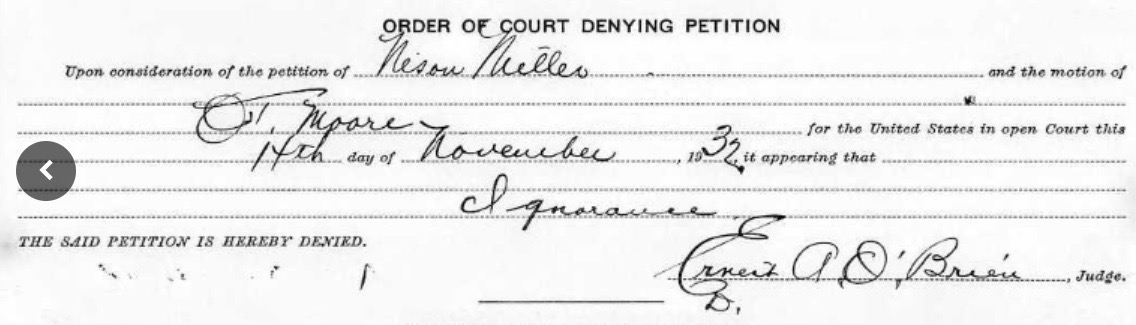
Nison (Max) Miller, Stephen Miller’s great-grandfather, was denied naturalization in 1932 on account of “Ignorance.”

Wolf Glosser, Miller’s great-great grandfather, escaped poverty and persecution in Russia and came to Ellis Island on January 7, 1903 aboard the German ship the S.S. Moltke. He had $8.00 in his pocket.

How did Wolf survive? His brother-in-law, Samuel Levine, who had already established himself in New York, helped him get started with a pushcart in the Lower East Side. Soon Wolf’s son Nathan joined him, escaping the misery of Poland. The two migrated up to Pennsylvania, where Wolf’s brother Moses had started a business. Nathan liked Johnstown, he stayed, and Morris Cohen, another Jewish immigrant, loaned him $200 to buy Cohen’s tailor shop, where Nathan was working.

Wolf joined Nathan. Then, on July 9, 1906, Saul, Bella, their mother Bessie and 13-year-old Sam Glosser sailed to America to join their family, and work in the business.

Sam, who was Stephen Miller’s great-grandfather, would eventually run Glossers Department Store—which went on to serve and employ thousands of Americans for generations.

As Robert Jeschonek writes in Long Live Glosser’s, had this Russian Jewish family not been reunited in America, “We might never have had that institution at the heart of our community for eighty years.”

That history shows two fallacies in the RAISE Act.

Limiting family immigration is bad business. Immigrants don’t just build America, families and communities build America.

Cultural and familial ties matter in business because they lower transaction costs, the sociologist Joel Kotkin wrote in Forbes, “Tribal loyalty fosters trust. Cultural affinity supercharges communication. Reading a contract is useful, but you also need to be able to read people. Even as free trade and electronic communications bring the world closer together, kinship still counts. Indians in Silicon Valley team up with other Indians; Chinese-Americans do business with Taiwan and Shanghai.”

In his book Tribes, Kotkin demonstrated how Jewish immigrants tossed into a hostile diaspora, spurned as “elitists” and “cosmopolitans,” were able to thrive: by using trusted bonds of family and community to create strong businesses.

He quotes Ibn Khaldun, a 14th-century Arab historian: “Only tribes held together by a group feeling can survive in a desert.”

By cutting family visas, you cut off the very thing businesses and communities need to grow strong. There is plenty of evidence to show that immigrant families and the ethno-religious tribes they belong to don’t take jobs, but, like the Glosser brothers, create jobs. According to the U.S. Bureau of the Census, about 90 percent of American businesses are family-owned or controlled.

If Miller et. al. want to switch to a point system, fine—but family and even tribal relations must count.

The other fallacy is that immigrants should speak English. Again, look at the Glossers: they arrived not speaking a word, and they did just fine.

A point system that accurately predicts which immigrants will succeed and contribute to American society could be a fine thing indeed. But as the conservative The Federalist pointed out, if it really works– then why limit immigration at all? Would Tom Cotton really mind if Arkansas, which is ranked #43 for business in the country, imported 50,000 young Sam Glossers?

Aside from Miller, there’s another RAISE Act booster whose family history also demonstrates the proposed law’s flaws.

In 1906 a young Russian Jew named Hyman Korman fled poverty and anti-Semitism in his home country and immigrated to the United States– which took him in.

Hyman settled northeast of Philadelphia. After 14 years, Hyman, according to the editors of Philadelphia Jewish Life, was “still mastering English.” But when a new road sliced through his farm, he saw an opportunity. He bought up surrounding land and began building houses for the expanding city. He turned to family members and fellow Russian Jews to grow the business.

The Kormans grew into one of America’s wealthiest and most philanthropic families. They married with the Honickmans, another incredible Jewish immigrant family success story. Businesswoman and philanthropist Lynne Honickman is the grandmother of Special Assistant to the President Julia Hahn, the former Breitbart staffer who teamed with Miller at the White House to support and promote the RAISE Act. What’s with these two?

Of course there should be effective immigration standards and laws. But Miller and Hahn are both the offspring of very wealthy families because government officials let their extended families in, and because they didn’t use poor English as a reason to deny naturalization.

Well, sort of. It turns out that Miller’s great-grandfather on his father’s side, Nison (Max) Miller, first applied for naturalization in Detroit in 1932. On Nov. 14 of that year he received his reply: “The said petition is hereby denied.”

The officer only stated a one-word reason: “Ignorance.”

Order of Court denying Nison Miller naturalization in 1932.

Stephen Miller and Julia Hahn have a past Read More »