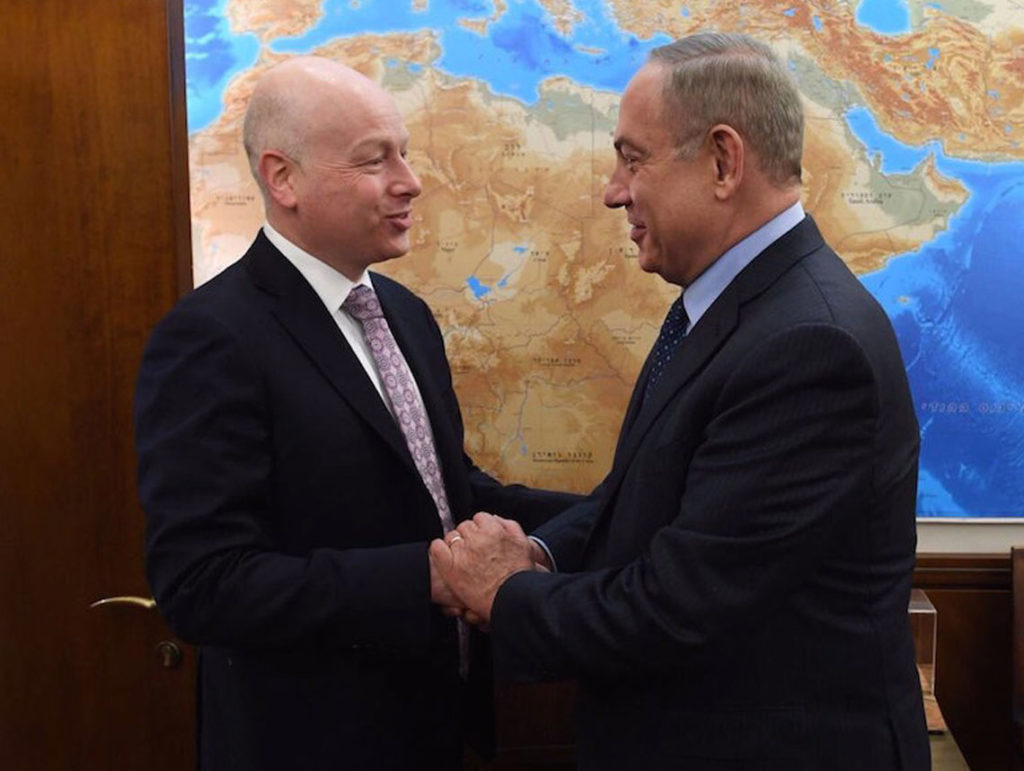
Jason Greenblatt, President Donald Trump’s special envoy for international relations, is headed to Israel in a bid to help reduce tensions as Jerusalem’s Temple Mount remains a flash point and after a Palestinian terrorist killed three Israelis in a stabbing attack.
“President Trump and his administration are closely following unfolding events in the region,” a senior administration official told JTA on Sunday night, speaking on condition of anonymity and reporting Greenblatt’s departure.
“The United States utterly condemns the recent terrorist violence including the horrific attack Friday night that killed three people at their Shabbat dinner table in Halamish and sends condolences to the families of the innocent victims,” the official said. “We are engaged in discussions with the relevant parties and are committed to finding a resolution to the ongoing security issues.”
Greenblatt would closely coordinate with the National Security Council and with Jared Kushner, Trump’s son-in-law who is a top aide and is charged with renewing Israeli Palestinian peace talks, the official said.
Yosef Salomon, 70, and his children Chaya Salomon, 46, and Elad Salomon, 36, were killed and Yosef Salomon’s wife, Tovah, 68, was injured when Palestinian attacker Omar al-Abed, 19, from the nearby Palestinian village of Kobar, entered the home in the West Bank settlement of Halamish and began stabbing the family members, who had gathered at the Salomon home to celebrate the birth of a baby to another of the senior Salomon’s sons.
Thousands attended the funerals on Sunday afternoon at the cemetery in the central Israel city of Modiin.
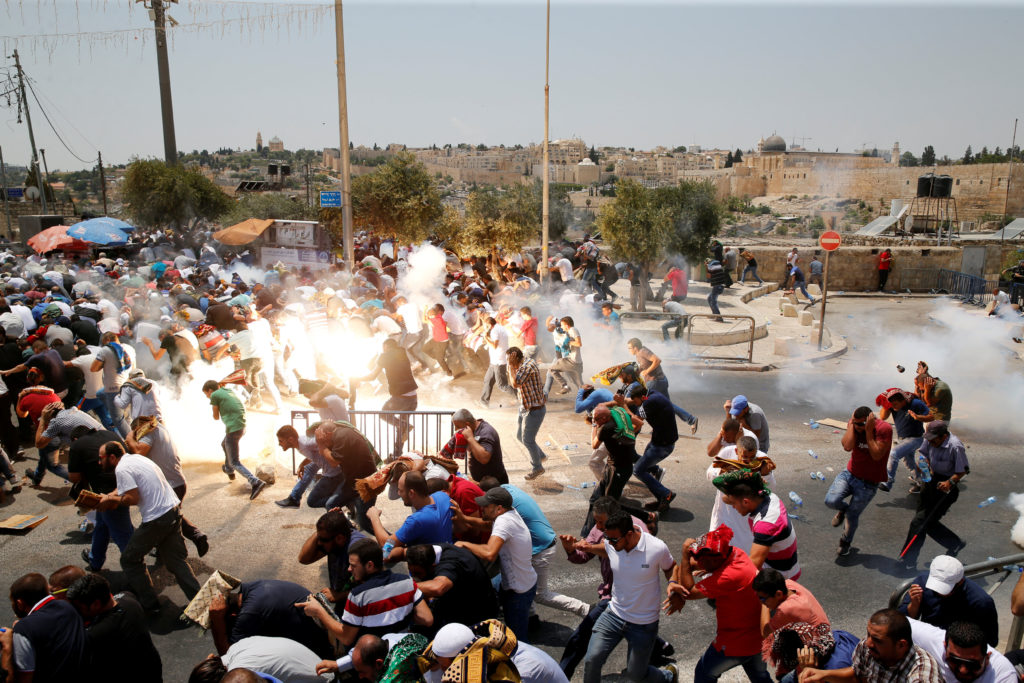
The area around the Temple Mount, the holiest site in Judaism and also the location of the Haram A-Sharif, the third holiest site in Islam, has been riven with tensions since June 14 when three Arab-Israelis shot and killed two Israeli police officers at the holy site.
Israeli authorities installed metal detectors at the site in the wake of the attack and since then, Muslims have refused to enter the Temple Mount, instead praying outside of its gates, leading to clashes and the deaths of at least 5 Palestinians in recent days.
RAND’s Doug Irving analyzes the results of a report on what the US gains financially from its overseas security commitments:
They found clear evidence that those overseas commitments do indeed strengthen trade between America and other countries, likely worth tens of billions of dollars every year. In fact, they estimated that doubling the number of treaties could expand U.S. trade, especially imports, by 34 percent. Doubling troop numbers would increase trade by up to 15 percent.
All this makes President Trump something other than either the narrow realist that his critics fear or the passing oddity for which his critics hope. Like it or not, the emerging Trump doctrine has deep roots in American tradition. Six months in, the time has come for advocates of American world leadership to own up to a fact: Donald Trump is one of you.
Admittedly, the murderers got what they wanted. They created an explosive chain of events that blew up in our faces, just like they had planned. The Israeli government wasn’t wise enough to try to reach a compromise with the Jordanians, the Waqf and the Palestinian Authority, which could have neutralized this explosive charge. Prime Minister Benjamin Netanyahu preferred to preach to Europe’s leaders, the Israeli public was busy with the submarine affair, and the foretold explosion at the Temple Mount was left to the police, as if it were a local Jerusalem event, while the Shin Bet and IDF warned that placing metal detectors on the Temple Mount under the current circumstances would be interpreted as a violation of the status quo.
Mazal Mualem presents the enigma of Avi Gabbai, the new contender for the PM position:
After the surprising election of a man who never voted for the party and joined it only eight months ago, Gabbay is in many ways an enigma — to Knesset members from the party, its veteran activists and party operatives, who have all known each other for many years. Most of them are unfamiliar with his style of management, his character, his opinions, his temperament or even his political identity.
But it’s a mistake to impute strategic brilliance to ISIS rather than acknowledging that it is an entity run by humans capable of grave errors. Otherwise, we risk becoming inadvertent propagandists for the group.
There is no Sunni Arab center of gravity. Saudi Arabia, the wealthiest player, is trying to offer leadership. But its source of power is being drained every day that the price of oil, the lifeblood of its economy, is low. Even if that was not the case, the Saudis have historically relied on the United States to guarantee their national security. How could they provide for regional security and protect Sunni Arab interests if they cannot protect themselves? The Saudi-led war in Yemen is a prominent example of Riyadh’s inability to impose order in its own backyard. But perhaps the most glaring example is Qatar, a tiny Gulf Arab state that refuses to subordinate itself to Saudi Arabia’s strategy for the region.
To some, the Holocaust is the defining event of modern Jewish history; there are people like the Jewish-studies teacher at my former day school who said the purpose of taking students to the U.S. Holocaust Memorial Museum is “Jewish identity-building.” But then there are people for whom the Holocaust is just one instance of persecution in a long history of similar events—like Gordon, program coordinator at Amud Aish, who said to me: “The Holocaust is not my Judaism.”
At least in the American context, the political situation on campus at the moment adds more fuel to the distaste for traditional Christian positions, and sometimes Jewish ones as well. That academics, and elite academics all the more so, lean strongly to the left on politics has been true for some time. So has the disproportionate rate of secularity among professors.
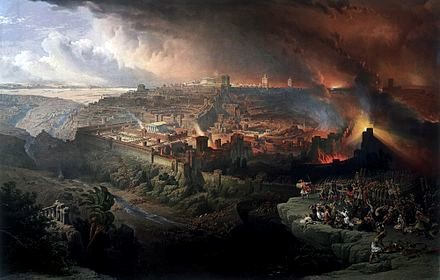
During the burning heat of summer, between the 17th of Tammuz and the 9th of Av— the saddest day of the Jewish calendar—Jews remember and mourn the Romans’ breach of the walls of Jerusalem, the sacking of the city and the destruction of the Second Temple. And we remember so much more: throughout history, the 9th of Av is the date on which we commemorate a series of profound Jewish losses.
We Are All Mourners
This time of set mourning on the Hebrew calendar makes the Three Weeks a period of communal observance that is both specific and inclusive. It’s different from personal observances of Yahrzeits, the anniversaries of the deaths of beloved family members, or the four Yizkor services that provide public opportunities each year for mourning by those in our communities who have experienced bereavements. The Three Weeks, and especially their culmination, Tisha B’Av, mark specific traumatic experiences that resonate deeply within our collective Jewish historical consciousness. For me, moving mindfully through the Three Weeks is an annual reliving of mourning that tethers my mind and heart to Judaism in very particular ways.
I find deep comfort and meaning in communal mourning. When I am observing a Yarzheit, I feel set apart; my heart aches with the reminder of my personal loss even though I am saying Kaddish within the embrace of a loving community. It’s not that my heart aches less when we chant the Book of Lamentations—it’s that I am experiencing a different kind of loss. My heart aches differently. When we sit together on the floor and chant a text that is illuminated by a flashlight, we establish a special, intimate bond of shared grief with those who sit with us and with the entire Jewish community, past and present. For me, collectively connecting to our shared sadness reminds me that I am never alone.
Rabbi Janet Madden PhD was ordained by The Academy for Jewish Religion-California. She serves as the rabbi of Temple Havurat Emet and Providence Saint John’s Health Center and has been a student of the Gamliel Institute.
Rabbi Janet Madden
[Ed. Note: Rabbi Janet Madden has agreed to submit a series of entries for Expired And Inspired – watch for them to appear fairly regularly. — JB]
___________
GAMLIEL INSTITUTE COURSES
LOOKING FORWARD: UPCOMING COURSE
The Gamliel Institute will be offering course 2, Chevrah Kadisha:Taharah & Shmirah, online, afternoons/evenings, in the Fall semester, starting September 5th, 2017. This is the core course focusing on Taharah and Shmirah ritual, liturgy, practical matters, how-to, and what it means.
CLASS SESSIONS
The course will meet online for twelve Tuesdays (the day will be adjusted in any weeks with Jewish holidays during this course).
There is a Free preview/overview of the course being offered on Monday August 14th at 5 pm PDST/8 pm EDST. You are welcome to join us to decide if this course is one in which you would like to enroll. Contact info@jewish-funerals.org or j.blair@jewish-funerals.org for information on how to connect to the preview webinar.
There will be an orientation session on how to use the platform and access the materials on Monday, September 4th, 2017, at 5 pm PDST/8 pm EDST online. Register or contact us for more information.
Information on attending the online orientation and course will be sent to those registered.
REGISTRATION
You can register for any Gamliel Institute course online at jewish-funerals.org/gamreg. A full description of all of the courses is found there.
Donations are always needed and most welcome to support the work of Kavod v’Nichum and the Gamliel Institute, helping us to bring you the conference, offer community trainings, provide scholarships to students, refurbish and update course materials, expand our teaching, support programs such as Taste of Gamliel, the Gamliel Café, and the Gamliel Gracuates courses, provide and add to online resources, encourage and support communities in establishing, training, and improving their Chevrah Kadisha, and assist with many other programs and activities.
You can donate online at http://jewish-funerals.org/gamliel-institute-financial-support or by snail mail to: either Kavod v’Nichum, or to The Gamliel Institute, both c/o David Zinner, Executive Director, Kavod v’Nichum, 8112 Sea Water Path, Columbia, MD 21045. Kavod v’Nichum [and the Gamliel Institute] is a recognized and registered 501(c)(3) organization, and donations may be tax-deductible to the full extent provided by law. Call 410-733-3700 if you have any questions or want to know more about supporting Kavod v’Nichum or the Gamliel Institute.
If you would like to receive the periodic Kavod v’Nichum Newsletter by email, or be added to the Kavod v’Nichum Chevrah Kadisha & Jewish Cemetery email discussion list, please be in touch and let us know at info@jewish-funerals.org.
Be sure to check out the Kavod V’Nichum website at www.jewish-funerals.org, and for information on the Gamliel Institute, courses planned, and student work in this field also visit the Gamliel.Institute website.
If you have an idea for an entry you would like to submit to this blog, please be in touch. Email J.blair@jewish-funerals.org. We are always interested in original materials that would be of interest to our readers, relating to the broad topics surrounding the continuum of Jewish preparation, planning, rituals, rites, customs, practices, activities, and celebrations approaching the end of life, at the time of death, during the funeral, in the grief and mourning process, and in comforting those dying and those mourning, as well as the actions and work of those who address those needs, including those serving in Bikkur Cholim, Caring Committees, the Chevrah Kadisha, as Shomrim, funeral providers, in funeral homes and mortuaries, and operators and maintainers of cemeteries.