
fbpx

July 4, 2017

UNESCO World Heritage Council votes to condemn Israeli actions in Jerusalem

The United Nations’ cultural agency voted to condemn Israeli actions in Jerusalem.

The United Nations Educational, Scientific, Cultural Organization’s World Heritage Council on Tuesday during its meeting in Poland passed a resolution submitted by the council’s Arab states rejecting Israeli sovereignty over Jerusalem.

The resolution that was passed was a softened version of the original text submitted, reportedly due to pressure exerted by Israel and the United States.

The resolution was passed by a vote of 10 countries in favor, three opposed and eight abstentions.

The three states that opposed the resolution were Jamaica, the Philippines and Burkina Faso. The eight countries that abstained were: Angola, Croatia, Finland, Peru, Poland, Portugal, South Korea and Tanzania.

The resolution called Israel the “occupying power” and said that  the UN body “regrets the failure of the Israeli occupying authorities to cease the persistent excavations, tunneling, works, projects and other illegal practices in East Jerusalem, particularly in and around the Old City of Jerusalem, which are illegal under international law,” the Times of Israel reported, citing the resolution.

Unlike in previous years, the resolution stressed “the importance of the Old City of Jerusalem and its Walls for the three monotheistic religions,” and does not refer to the Temple Mount compound solely by its Muslim names, “Al-Aqsa Mosque/Al-Haram Al-Sharif,” instead calling it “a Muslim holy site of worship,” according to the Times of Israel.

A UNESCO resolution passed last October  ignored Jewish ties to the Western Wall and Temple Mount sites. In May, UNESCO approved a resolution that called on Israel to rescind any “legislative and administrative measures and actions” it has taken to “alter the character and status” of Jerusalem and rejected the idea of a “basic law” in Jerusalem, based off of a 1980 Knesset law, which implies that the city is one unified whole and governed solely by Israel.

The UNESCO World Heritage Council is expected to vote Friday on a resolution which would declare  the Old City of Hebron — including the Tomb of the Patriarchs — a Palestinian “World Heritage Site in danger.”

U.S. Ambassador to the United Nations Nikki Haley on Friday sent a letter to UN Secretary-General Antonio Guterres and UNESCO Director-General Irina Bokova asking them to oppose the resolution that would designate Hebron as a Palestinian heritage site.

The resolution, in which  Palestinians claim that the Tomb of the Patriarchs and the Old City of Hebron are endangered by the Israeli occupation, needs a two-thirds vote to pass.

In her letter, Haley said passage of the resolution could undermine the Trump Administration’s efforts to advance the Israeli-Palestinian peace process, Haaretz reported.

“The Tomb of the Patriarchs, which is sacred to three faiths, is in no immediate threat. Such a designation risks undermining the seriousness such an assessment by UNESCO should have,” Haley also wrote. “Many precious sites — from the Democratic Republic of Congo to Libya to Iraq to Syria — are under real and imminent threat of destruction today. They urgently demand UNESCO’s full and immediate attention, which should not be wasted on this sort of symbolic action.”

UNESCO World Heritage Council votes to condemn Israeli actions in Jerusalem Read More »
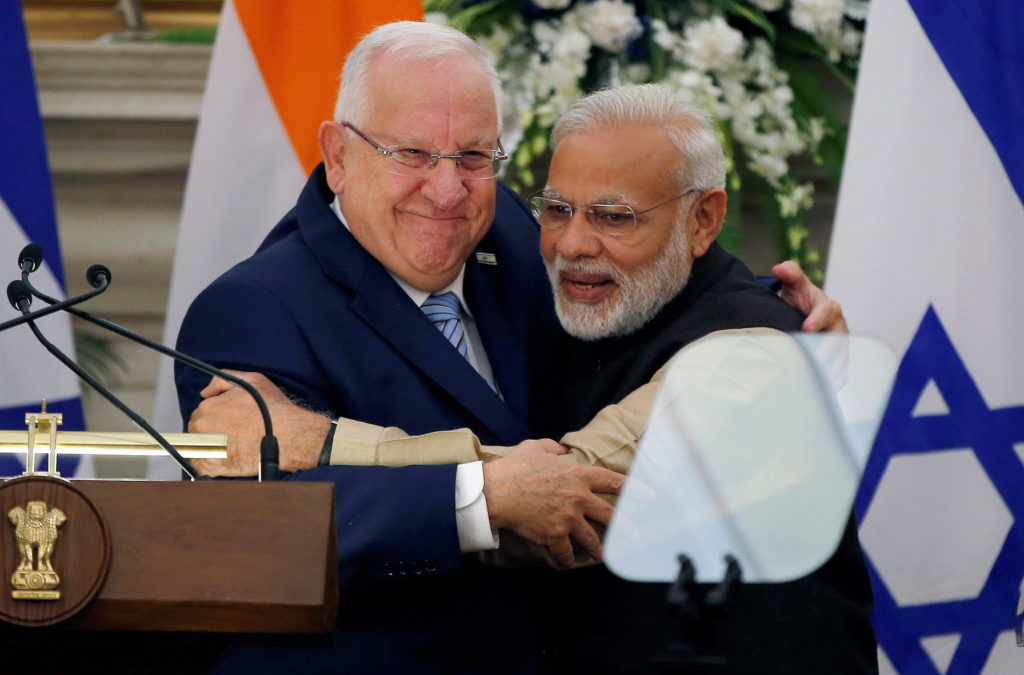
Looking for ‘history’? Try the Indian Prime Minister’s visit to Israel

Have a happy July Fourth. Here are three comments on countries that are not celebrating Independence today – but are celebrating other things.

1.

Today is a historic day. You might not know this, as you might be too busy with thinking about other things – primaries in Israel’s Labor Party, another tweet from President Trump, the aftermath of the Kotel crisis. But you ought to pause and recognize the significance of this day – the day in which, for the first time, an Indian Prime Minister visits Israel. The day in which the perpetual warnings about Israel’s declining diplomatic status seem somewhat outdated, or at least doubtful.

A few days ago, JPPI released a book by Shalom Wald and Arielle Kandel on India, Israel and the Jewish People. It is a long and comprehensive discussion of these relations. I chose one long paragraph from the book that is the most relevant for a historic day like today: It talks about the person who is visiting Israel – Prime Minister Narenda Modi – and his ability to alter the long-term trajectory of India-Israel relations.

The question, then, is whether Modi’s victory represents a watershed in Indo-Israeli relations that will become permanent. A look at long-term trends cannot give a final answer to this question, but they can indicate the main developments that must be watched.

One decisive trend is the future of the Muslim factor. India’s Muslim population may continue growing more rapidly than the majority Hindu population. Muslim political power may become determinant in a number of key states as power continues to shift from the central government to state governments. And more Muslims may become radicalized. If these trends materialize, India’s new Israel policy may not be sustainable in the long term.  

However, against these – only possible, not certain – trends stand the deep socio-economic changes that explain Modi’s victory. He won the elections with the massive support of India’s young and of India’s middle and lower middle classes who ignored or rejected the traditional warning of India’s elites and the Congress Party that voting for the BJP was anti-Muslim. This urban, mostly non-Muslim middle class, currently over 300 million people, is projected to exceed 500 million by 2025, and represents the main countervailing trend to the possible growth of Islam in India. This middle class is modern, Western in outlook, and (with the exception of some intellectuals) not interested in Palestine and the Arab-Israeli conflict. This middle class is partly indifferent, and partly sympathetic to Israel.

Modi’s victory demolished a long-held taboo in Indian politics: until 2014, it was taken for granted that a friend of Israel and the Jews – as Modi is known to be – could not become India’s leader because of Muslim constraint. With the Muslim deterrent power thus eroding, at least in the short and medium terms, other Indian politicians are likely to regard Israel in a new light.

2.

And to less important news: the Labor Party is electing a new leader today. In fact, as of this morning, it seems more likely that it will only elect the two front runners that will later have to go through another round of elections.

The list of candidates is solid, but not exciting. The question looming over this election is whether the next leader’s main job will be to put the party to rest and preside over its further decline – or whether this next leader will find a way to carve a new path for this party.

What is the source of the Labor party’s decline? I’d count four main reasons. Its pool of voters is dwindling, its message is unclear and often garbled, other parties now occupy the territory that was once Labor’s territory, and its image is one of a losing party. Can any of the competing candidates solve these problems? The answer is that some candidates hope to attract new voters from different demographics – but their message is unclear. Some candidates have a clearer message – but would not be attractive to new voters. Some candidates don’t yet have the image of losers – but also don’t have the experience that could make voters comfortable with their ability to lead the country.

Thus, the election today is the beginning of a process, not the end of it. This will be a process of exploration of opportunities: Can the party be a part of a larger bloc of parties and groups aiming to topple Prime Minister Netanyahu? Can the party and its newly minted leader draw attractive candidates to join its ranks? Can the party exploit the weaknesses of the ruling coalition and convince the voters that a different coalition is even feasible?

3.

Kotel news: a chapter from the study I am working on (with Dr. John Ruskay) on Jerusalem and the Jewish People was just published. It explains why Israel’s decision to cancel its commitment concerning the Kotel compromise elicited a sense of betrayal. This begins with the fact that Jews around the world – whether Israelis like it or not – believe that they have the right to be taken into account when decisions concerning the future of Jerusalem are made:

Diaspora Jews want to be considered in decisions made by Israel…. the more the question concerns “Jewish” themes the more inclined s/he was to want Israel to consider Diaspora views. Thus, the expectation that Diaspora viewpoints be considered… in shaping the cultural future of Jerusalem was higher than in shaping its political future.

The Kotel compromise is about the cultural future of Jerusalem. 51% of the Jews who participated in JPPI dialogue sessions told us Israel should “consider the views of non-Israeli Jews, mostly because Jerusalem is the Holy City of all Jews.”

Looking for ‘history’? Try the Indian Prime Minister’s visit to Israel Read More »
