fbpx

July 3, 2017

Is Jay-Z’s new song anti-Semitic?

Is Jay-Z’s new song anti-Semitic? Does it perpetuate negative stereotypes about Jewish property ownership?

That’s what some are saying online after the June 30 release of Jay-Z’s new album, “4:44,” which features the song, “The Story of O.J.” The song contains the lyric, “You wanna know what’s more important than throwin’ away money at a strip club? Credit / You ever wonder why Jewish people own all the property in America? This is how they did it.”

“Wasn’t really expecting Jay-Z to go anti-Semitic when I started the new 4:44 album this morning,” a Twitter user said in response, as BuzzFeed reported.

The Anti-Defamation League (ADL), however, said the song is not anti-Semitic.

“We do not believe it was Jay-Z’s intent to promote anti-Semitism. On the contrary, we know that Jay-Z is someone who has used his celebrity in the past to speak out responsibly and forcefully against the evils of racism and anti-Semitism,” the ADL said in a statement. “The lyric does seem to play into deep-seated anti-Semitic stereotypes about Jews and money. The idea that Jews “own all the property” in this country and have used credit to financially get ahead are odious and false. Yet, such notions have lingered in society for decades, and we are concerned that this lyric could feed into preconceived notions about Jews and alleged Jewish “control” of the banks and finance.”

In 2006, Jay-Z appeared with hip-hop mogul Russell Simmons in a public service announcement denouncing anti-Semitism.


The Foundation for Ethnic Understanding (FFEU), the self-described “national address for Black-Jewish relations,” sponsored the 2006 pubic service announcement. Simmons chairs FFEU, which also promotes Muslim-Jewish relations. 

In the wake of criticisms that the new track is anti-Semitic, Simmons defended Jay-Z.

“I am the Chairman of the Foundation for Ethnic Understanding and my job for the past 20 years or so is to point out the ‘sameness of different religions and races.’ First, let me state that mischief-makers would like to take Jay’s statements about the culture and practices that exist within some parts of the Jewish community (notice I say some),” Simmons tweeted July 4. “The fact is this culture that promotes good business and financial well being is and has been a guiding light to the black and specifically the hip-hop community.”

On Instagram, Israeli-American talent manager Guy Oseary said the lyric, if anything, compliments the Jewish community.

“Jewish people do NOT ‘own all the property in America.’ Jay knows this. But he’s attempting to use the Jewish people in an exaggerated way to showcase a community of people that are thought to have made wise business decisions…In my opinion, Jay is giving the Jewish community a compliment,” Oseary said.

Jay-Z has previously rapped about Jews in a controversial way. On his 2007 soundtrack album, “American Gangster,” Jay-Z raps, “Had to get some challah bread so you can holla back and holla that/My Jewish lawyer too enjoyed the fruit of letting my cash stack.”

Is Jay-Z’s new song anti-Semitic? Read More »

A Moment in Time: Rabbi, Will You Bless Our Home:

Dear all,
Every once in a while, a member of our community calls asking, “Rabbi, will you bless our home?”  What this usually means is that those in the home want to hang a mezuzah, and they are seeking ritual to accompany the mitzvah/ commandment.
I go at every opportunity I can.
But I remind those in the home, “I don’t have the power to bless your home.  The mezuzah itself doesn’t bless your home.  You are the blessings in the home.  And the mezuzah is a reminder to leave the shtush of the day at the door when you enter and to bring the blessings of your home with you when you leave.
It is a daily reminder every moment in time we enter our homes.  Be the blessing. Live the blessing.  Embrace the blessing.
With love and Shalom,
Rabbi Zach Shapiro
Rabbi Zach Shapiro
A change in perspective can shift the focus of our day – and even our lives.  We have an opportunity to harness “a moment in time,” allowing our souls to be both grounded and lifted.  This blog shows how the simplest of daily experiences can become the most meaningful of life’s blessings.  All it takes is a moment in time.
 
Rabbi Zach Shapiro is the Spiritual Leader of Temple Akiba, a Reform Jewish Congregation in Culver City, CA.  He earned his B.A. in Spanish from Colby College in 1992, and his M.A.H.L. from HUC-JIR in 1996.  He was ordained from HUC-JIR – Cincinnati, in 1997.

A Moment in Time: Rabbi, Will You Bless Our Home: Read More »

BABY DRIVER *Movie Review*

Most people will say Baby Driver is a heist caper.  While writer/director Edgar Wright’s latest film features those elements, the real story comes during what happens in between the action scenes.

Baby (Ansel Elgort) is a getaway driver for a series of robberies coordinated by Doc (Kevin Spacey).  He’s trapped in a bit of indentured servitude following a run in with Doc from years earlier.  A diner waitress named Debora (Lily James) seems just as lost as Baby and the two form a connection.  Lest we learn more about her, the story belongs to Baby alone.

In fact, if there’s ever a question that Baby Driver is more about Baby than his driving, look no further than the action sequences for the answer.  During the actual robberies, we don’t even have the opportunity to watch the action; the camera remains steadily on Baby.  At one point, while waiting in the car as the getaway driver, he pulls forward so it becomes impossible to catch a glimpse of the action even in the deep background.  It isn’t until Baby himself begins to evolve that we begin to see the action as well.

The movie also stars Jon Hamm, Jon Bernthal, Jamie Foxx and Eiza González.

For more about Baby’s evolution as evidenced through the use of glasses, take a look below:

—>Keep in touch with the author on Twitter and Instagram @realZoeHewitt.  Looking for the direct link to the video?  Click here.

BABY DRIVER *Movie Review* Read More »

Roget’s Trumpasaurus

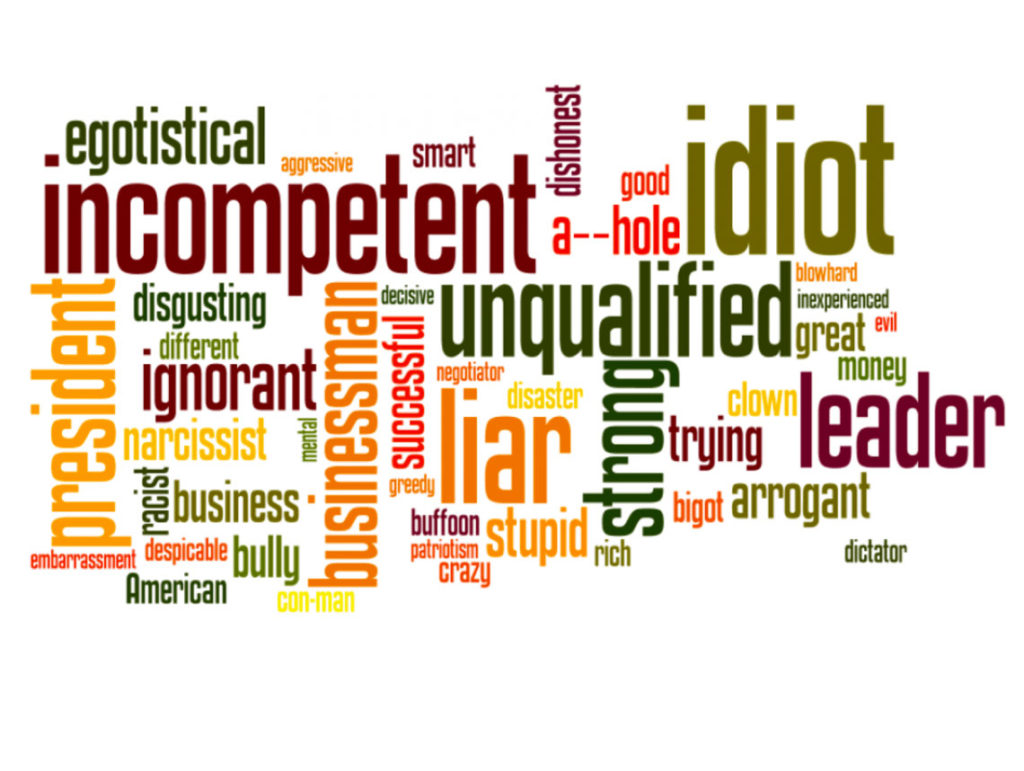
“What is the first word that comes to mind when you think of Donald Trump?”

That’s the open-ended question a Quinnipiac poll asked Americans in May. The No. 1 answer: “idiot.”

Have you seen anything since then that would move the needle away from “idiot”? Or from “ignorant” (the ninth most frequent answer), or “stupid” (12th )? He doesn’t know what’s in the Senate’s health care bill. He’s not reading his intelligence briefings. He’s watching more Fox News than your cranky uncle. His behavior seems engineered to provoke responses like, “Can you believe what an idiot/ignoramus/stupid person Trump is?”

I’ll grant you those aren’t exact synonyms. As Mrs. Bustard, my honors English teacher at Union High, always said, the reason there are different words for the same thing is that they’re not the exact same thing. “Ignorant” implies a lack of knowledge that can be remedied by education, while “idiot” suggests an irremediable mental deficiency. The difference between “idiot” and “stupid” seems subtler, and involves attitude. I’d also put “moron” in that cluster, which I was surprised not to see on the list of nearly 50 words.

It was Roget’s Thesaurus that encouraged me to differentiate among synonyms. When I first bought it, I hadn’t a clue how to pronounce “Roget” or “thesaurus,” but a note from Mrs. Bustard on a book report — she had beautiful handwriting — persuaded me that the 35-cent pocket Roget’s, though it cost a dime more than Mad Magazine, was worth it.

Early in the 19th century, British physician Peter Mark Roget invented an ingenious system to categorize the meanings of tens of thousands of words and phrases in a hierarchy of classes and sections. His taxonomy, like Carl Linnaeus’s organization of the animal, vegetable and mineral kingdoms, revealed distinctions among related items that an alphabetical system didn’t.

Today, with synonyms just a click away, Roget’s project seems sadly antiquarian, unlike the log-log slide rule, also invented by Roget, which Miss Bialecki, my AP physics teacher, made us master, and which fully merits its obsolescence. It’s Roget’s lifelong obsession with word lists that makes me want to organize the Quinnipiac answers.

Second on the Trump list, after “idiot,” comes “incompetent.” “Unqualified” is fifth; below that, “disaster” and “inexperienced” show up. Each of those accurately describes the president. It would not be redundant to use them adjectivally — “incompetent ignoramus,” for example — since technically there’s a difference between being a dummkopf and being a screwup.

“Liar” comes in third in the poll; the related “dishonest” and “con-man” turn up lower down. To me, this trio suggests moral culpability, as do “racist,” “bigot,” “dictator,” “evil” and “greedy.” The effect that those traits cause in us is captured by another cluster: “disgusting,” “despicable” and “embarrassment.”


I would draw a distinction between the 10th place word, “egotistical,” and — lexicological trigger warning — the 11th, “asshole.” “Egotistical” strikes me as a clinical diagnosis, as do “bully,” “narcissist” and “aggressive,” which are also on the list, as do the regrettably stigmatizing “crazy” and “mental.” On the other hand, I’d put “asshole” in the same group as “arrogant” (13th), along with “clown,” “buffoon” and “blowhard,” all of which imply volition or agency; all narcissists are not necessarily assholes. (The absence from the list of “juvenile,” impulsive” and “unstable” puzzles me.)

To be sure, the poll reports positive words, too.  “Leader,” “strong,” “successful,” “great,” “good,” “smart,” “decisive,” “negotiator” and “patriotism” turn up, roughly in proportion to his favorability with his base.  But I don’t know what spin to infer from the answers “president,” “businessman,” “business,” “American,” “money” and “rich” — I can’t tell if they’re meant to be merely factual, like calling him a golfer or a husband, or slyly ironic, like calling him a golfer or a husband.

As the poll makes clear, Americans see Trump as an idiot, a liar and an — um, and a clown. That’s the baseline. There was no fresh news about his character in his tweet assaulting Mika Brzezinski, co-host of MSNBC’s “Morning Joe”; we already knew he’s irredeemably disgusting. His indifference to Vladimir Putin’s sabotage, his complicity in savaging Medicaid, his vendetta on truth and journalism: nothing new there, either. We already knew his narcissism is sociopathic.

The only thing we don’t know is if he can be pulled down before he pulls us down with him.  Will some behavior of his be so despicable that even his toadies and enablers gag on the shame he makes them swallow? Will some evidence emerge that’s so irrefutably damning that Paul Ryan and Mitch McConnell are compelled to care more for country than for power? On the brink of exposure and ridicule, in the vise of global crisis, in the panic of mental meltdown, will Trump clutch — and quit? The suspense of following those storylines is mesmerizing. But the stress of it is traumatizing our psyches.

Roget knew from trauma. His father and wife died young. His depressed mother dominated him. His sister and daughter were wracked by mental illness. A beloved uncle killed himself in his arms. Roget’s biographer, Joshua Kendall, says that as a boy, Roget “stumbled upon a remarkable discovery — that compiling lists of words could provide solace, no matter what misfortunes may befall him.”

Hmmm. “Despicable,” “disgusting,” “buffoon.” Who knows? Maybe lists can soothe us, too.

Roget’s Trumpasaurus Read More »

Can American Jews threaten Israel?

The question presented in the headline has a short answer and a long one. The short answer is yes, they can. In fact, in the past week many of them have. Some leaders warned – an implied threat, no doubt – that philanthropy is going to dry down. If Israel does not change its policy, it will no longer get the billions that it used to get from American philanthropists and activists. If Israel does not change its policy, it will no longer benefit from the political support of American Jews. So, factually, American Jews can make a threat, and in the last couple of days some of their leaders have, much more than they did in the past.

That’s the short answer.

The long answer is really an answer to a different question: Do American Jews have a better chance of getting their way, of achieving their goals, by making threats or implied threats (“it’s not a threat, it’s a warning”)?

To that question there is no simple, short, definitive answer. I suspect that many of the implied threats made in recent days – some quite awkward – were more an expression of anger over Israel’s two decisions concerning conversion and the Kotel compromise than a well-planed and well-executed move to alter Israel’s behavior. And, of course, most of the anger is justified. The government of Israel decided to renege on an agreed compromise, and to change the status quo on conversion. Still, anger is not a plan. Anger can be channeled to become a planning process. And the planning process ought to include the question: will threats make it more likely that Israel’s policy will change?

Here are some things to consider when trying to answer this question:

1. Israelis have interest in Diaspora Jews if they feel that there is a partnership and an unconditional bond between all Jews. Threats could suggest that the bond is conditional and make Israelis more suspicious of US Jews.

2. Israelis are stiff necked and dislike threats. They have been threatened by many forces in the past, some of which were more dangerous and deadly than US Jews – and threats usually makes them less inclined to compromise, not more so.

3. Israel is a powerful country. It can probably manage without the support of other Jews (or not – but Israelis believe that they can).

4. Threats will split the camp of angered Jews, because some will feel uncomfortable with them, and some will go overboard in making them. A generally unified call for Israel to be more considerate of Diaspora Jews could become yet another intra-Jewish battle.

5. Threats carry the risk of escalation. Unless one wants Israel-Diaspora relations to deteriorate even further, one has to take this into account.

“But what can we do if we can’t even warn the Israeli government and public that the actions they take have consequences?” – that’s the question I was asked by a senior Jewish leader two days ago. I have to admit: I do not have a very good answer to this question. Clearly, the Israeli cabinet did not treat the danger of the consequences of its recent decisions very seriously. Without proper threats, how can US Jews make Israeli Jews internalize the dilemma facing them and the penalties they might have to endure if US Jews distance themselves from the country?

A partial answer would be: make sure you have a real plan when you make threats – or voice concerns and warnings. Use threats cautiously, sparsely. Be attuned to the reaction of Israelis to statements that sound like threats to the Israeli ear. Do not rush to escalate. Try to use back channels and quiet communication with policy makers – rather than making public statements. Yes, put pressure on Israel. No, don’t make it sound like threats. Yes, use available toolboxes to have an impact. No, don’t make Israelis think that you are out to get them and make them surrender. Yes, show Israel that you care about its character. No, don’t sound as if its current character might make you reconsider your support for the state.

A long answer – and not quite satisfying. Unfortunately, it’s the only one I got.

Can American Jews threaten Israel? Read More »