
fbpx

June 26, 2017

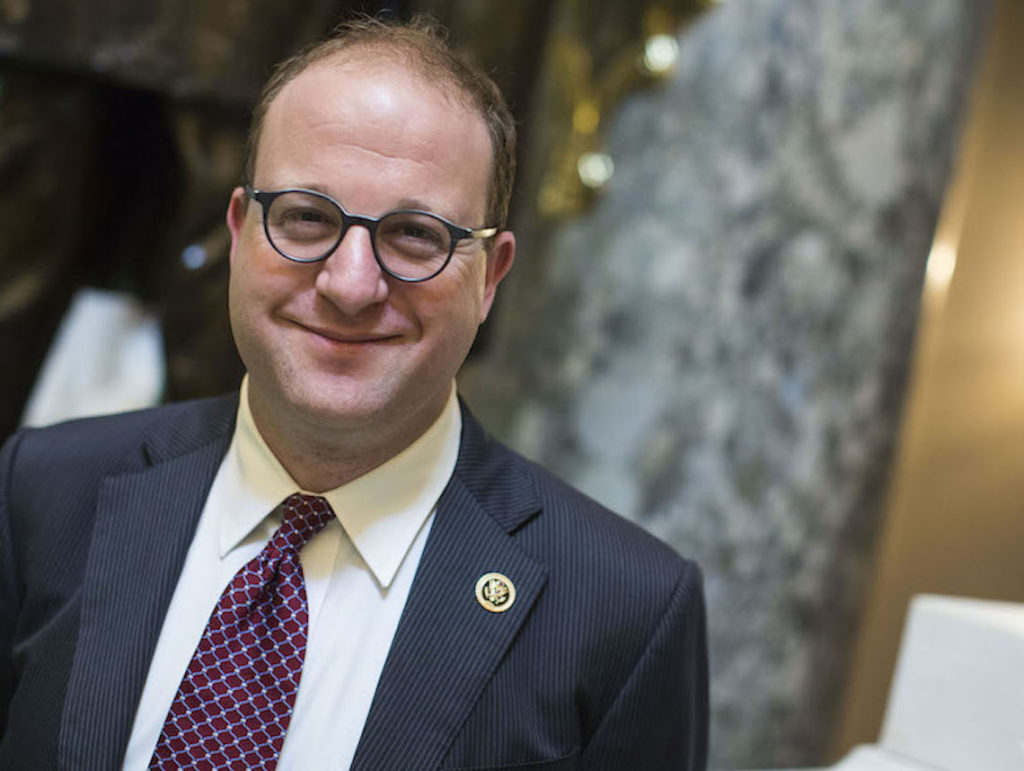
Jewish tech millionaire turned lawmaker could be first openly gay governor of Colorado

Jared Polis is already on to the next thing. That shouldn’t come as a surprise to anyone who has looked at his resume.

By the age of 25, he had founded three companies, which would shortly make him a multimillionaire. He then turned his focus to education, establishing two charter school systems to cater to immigrant and homeless youth and serving on the Colorado State Board of Education.

At 33, he entered national politics, when he was elected to represent Colorado in Congress.

Less than 10 years after his Washington debut, Polis now has his sights set on a new goal: to serve as governor of Colorado.

The Jewish Democrat announced earlier this month that he was joining the already crowded race with an ambitious three-pronged platform: to ensure Colorado uses only renewable energy by 2040, provide free preschool and kindergarten across the state, and fight income inequality.

If he wins, the 42-year-old would make history in more ways than one — by becoming both the first Jewish governor in Colorado and its first openly gay person to serve in the post.

Polis’ candidacy has upset the gubernatorial race, where Rep. Ed Perlmutter, also a Democrat, was previously seen as the front-runner, said David Flaherty, a political consultant who runs the Colorado-based firm Magellan Strategies.

“Perlmutter was the odds-on favorite for the Dem primary, and I also think he was the odds-on favorite to win the general election, but that’s not the case now,” Flaherty told JTA. “And some discussions I’ve had with Democratic political insiders have really felt that Jared has a good shot of winning the primary — but the general is more of a debatable issue.”

Perlmutter, 64, a Christian with Jewish ancestry on his father’s side, served in the Colorado state Senate for eight years prior to being elected to Congress. He appeals to the “established Democrat crowd,” including those who voted for Hillary Clinton in November, said Flaherty.

Meanwhile, Flaherty said Polis, with his focus on renewable energy, appeals to younger voters and Bernie Sanders backers. Sanders won nearly 60 percent of the vote in Colorado’s Democratic caucuses last year.

“Right now it’s an even fight between Ed Perlmutter and Jared,” said Flaherty, adding that some of the other Democratic candidates also should not be discounted.

Polis was exposed to civic involvement from an early age, growing up in a Reform Jewish family in Boulder.

“My parents were active in the anti-war movement in the 1960s, so I grew up with a tradition of civic activism around our dinner table and going to different marches for different causes,” such as civil rights and anti-nuclear proliferation, he told JTA.

His family moved to San Diego, where he attended La Jolla Country Day School. As a 19-year-old student at Princeton University, he founded his first company, the internet access provider American Information Systems, which he later sold for $23 million.

In 1996, Polis founded the online greeting card company Blue Mountain, a spinoff of a firm started by his parents. He later sold the dot-com startup for $780 million. In 1998, Polis launched the online flower retailer ProFlowers, which he later sold for $470 million.

Polis, who is among the top five wealthiest members of Congress — his net worth is estimated at $90 million to $390 million — sees his business background as an asset to his political career.

“One, voters trust somebody who has a background creating jobs instead of just talking about it, who knows how to balance a checkbook, who knows how to build a business,” he said. “And second of all, the experience has been very helpful to me in creating policies that allow businesses to grow and flourish in our state and country.”

Polis dismisses accusations that he used his wealth to buy his way into office. He spent $1 million on his campaign to serve on the State Board of Education compared to his opponent’s $100,000, and $6 million on his 2008 congressional campaign, defeating Democratic establishment candidate Joan Fitz-Gerald in the primary.

“When people run campaigns they have to raise a lot of money, and I’ve been one of the top fundraisers nationally for the Democrats, and people do appreciate it when you’re able to say no to special interests and PACs, like I have. I’ve never accepted any PAC money,” Polis said.

His Jewish background has a large influence on his political beliefs.

“I derive a lot of the values that I try to bring into the public sphere from my private faith,” Polis said. “Certainly for me I focus a lot on education, and I’m running for governor to bring [free] preschool and kindergarten to our state and improve our schools, and that’s an important Jewish value.”

Polis, whose great-grandparents immigrated to the United States from Poland and Ukraine in the early 20th century, added: “And also being so close to the immigrant experience, I’m a strong defender of immigrant rights and refugees, of course with the experience that Jews had prior to World War II, that few countries wanted to accept Jewish refugees.”

Judaism also plays a big role at home for Polis, who with his partner Marlon Reis has two young children, 6-year-old son Caspian Julius and 2-year-old daughter Cora Barucha (named after Polis’ great-great-aunt Kasha Barucha). He is the first openly gay parent to serve in Congress.

The family attends three synagogues in Boulder: the Conservative Bonai Shalom, the Reform Har HaShem and the Renewal Nevei HaKodesh.

Polis, who defines himself as “in between Conservative and Reform,” won’t pick favorites.

“They’re all great. I like to support Jewish life in our community, and they’re all doing great things,” he said.

He also recently joined his cousin Rabbi Shmuel Herzfeld, the rabbi of Ohev Sholom-The National Synagogue in Washington, D.C., for Shabbat dinner.

The lawmaker also has another way of connecting to the Jewish tradition — through food. When not cooking his way through his grandmother’s collection of recipes of traditional dishes, he and Reis, who also is Jewish, have been trying to re-create the cheese blintzes of Reis’ great-grandmother Dora.

Polis said they’ve tried “a few dozen times” but haven’t quite gotten it right yet. They aren’t giving up anytime soon.

“We’ll know when we get there if they taste the same as he remembers,” Polis said.

Jewish tech millionaire turned lawmaker could be first openly gay governor of Colorado Read More »

THE BIG SICK *Movie Review*

The Big Sick is marketed as a romantic comedy.  After all, it’s based on the real-life romance between Kumail Nanjiani and his now-wife Emily V. Gordon who co-wrote the screenplay together.  While the movie explores their relationship, seemingly cemented during a hospitalization which lands Emily in a coma, their romance isn’t the heart of the film.

Kumail is torn between two worlds as the product of a mostly-Americanized upbringing by traditional Pakistani parents.  Torn between his family’s expectations and his own desires Kumail leads two separate lives that must inevitably intersect.

Emily’s more of a free spirit who doesn’t feel the same constrictions.  However, in a bit of storytelling symmetry, her mother confesses about her own disapproved romance with Emily’s father.  Lest it make her parents more accepting, they challenge Kumail at every turn.  As in life, nothing comes easy.

Director Michael Showalter (Hello, My Name Is Doris) creates a world in which every character feels like a star.  This is a testament to the world he’s created.  No matter how small a role, it feels like there’s another story.  The Big Sick generates a lot of questions after the credits roll–and that’s okay.

The Big Sick stars Kumail Nanjiani as himself, Zoe Kazan as Emily, Ray Romano and Holly Hunter as Emily’s parents Terry and Beth, respectively, and Bollywood legend Anupam Kher as Azmat, Kumail’s father.

For more about The Big Sick, take a look below:

—>Keep in touch with the author on Twitter and Instagram @realZoeHewitt.  Looking for the direct link to the video?  Click here.

THE BIG SICK *Movie Review* Read More »

Suspension of Western Wall deal leaves Jewish leaders feeling betrayed

They’ve tried strongly-worded statements. They’ve tried private meetings with the prime minister. They’ve tried negotiations, protest and prayer.

But for the past five years, despite broad internal consensus and consistent pressure, the American Jewish establishment has been unable to persuade Israel’s government to create an equitable space for non-Orthodox prayer at the Western Wall.

The latest setback in that fight came Sunday, when Prime Minister Benjamin Netanyahu announced the suspension of a 2016 agreement to expand the holy site’s southern section, used for egalitarian prayer, and appoint an interdenominational commission to oversee it. The compromise was a result of three years of negotiation between the Jewish Agency for Israel, non-Orthodox leaders, the Israeli government and the Western Wall’s Charedi Orthodox management.

Work to expand the egalitarian section will continue during the suspension.  But a new agreement will now be negotiated by Israel’s cabinet, and will need to come to a new vote before moving forward.

The suspension is a result of pressure from Netanyahu’s Charedi Orthodox partners, who allowed the compromise to pass last year but have since railed against it, blocking its implementation. American Jewish leaders had hailed the agreement last year as a step forward for Jewish pluralism, and at the time, Netanyahu called it a “fair and creative solution.”

Now, the American Jewish leaders who pushed for the agreement say they feel betrayed by Netanyahu. They will be meeting in Israel this week to discuss a response, and the Jewish Agency will hold a special session Monday to discuss the issue. But no leaders committed to concrete plans for a response, beyond continued vocal protest.

“It’s deeply troubling and very disappointing that they would suspend the implementation of this resolution,” Jerry Silverman, CEO of the Jewish Federations of North America, told JTA Sunday. “We are going to be assertive in asking what’s next.”

Various advocates for the agreement have warned of a crisis among American non-Orthodox Jews should the compromise collapse. Last year, Rabbi Rick Jacobs, president of the Union for Reform Judaism, said the collapse of the deal “will signal a very serious rupture in the relationship between North American Jewry and the State of Israel.”

On Sunday, Jacobs expressed strong disappointment in the suspension, but did not say it would lead to any concrete loss of support for Israel from the Reform movement. He included it in a list of recent Israeli government decisions the Reform movement opposes, including recent legislation to bar supporters of Israel boycotts from entering the country, and another law legalizing Israeli settlements’ appropriation of Palestinian land.

“This decision screams out that when all is said and done, the state of Israel and government of Israel is willing to sell our rights and our well-being for coalition politics,” he told JTA. “This does not add up to be a compelling example of what all of us understand Jewish life to be, and if there’s growing dissonance between those who lead the state of Israel and those who lead American Jewry, the consequences are serious.”

Rabbi Julie Schonfeld, executive vice president of the United Synagogue of Conservative Judaism, said the best way forward for non-Orthodox leaders may be Israel’s Supreme Court. A court petition filed by a range of Israeli pluralist groups in 2013  seeks to compel the government to provide for non-Orthodox prayer at the wall, but had been tabled while the 2016 agreement was being negotiated and implemented.

Now that the agreement is suspended, Schonfeld feels the Supreme Court may rule favorably on the petition, forcing the government to accede to non-Orthodox demands.

“The Israeli Supreme court seems to be the only governmental venue that appreciates the long-term impact of Israel advocating its role as the home for all Jews,” she said. “Inevitably, we will find our way back to the courts. We will continue to protest.”

A range of other groups have also criticized Sunday’s decision, including the American Jewish Committee, the Women of the Wall prayer group, the Israel Democracy Institute think tank and the Jewish Agency, whose chairman, Natan Sharansky, was one of the architects of the 2016 agreement.

“After four years of intense negotiations, we reached a solution that was accepted by all major denominations and was then adopted by the government and embraced by the world’s Jewish communities,” Sharansky said in a statement. “Today’s decision signifies a retreat from that agreement and will make our work to bring Israel and the Jewish world closer together increasingly more difficult.”

Non-Orthodox leaders also decried the Israeli government’s advancing a bill to centralize authority for Jewish conversions under the Israeli Chief Rabbinate, a Charedi Orthodox body. Silverman compared the bill to a 2010 bill on conversions in Israel, which American Jewish groups also opposed because they argued it would delegitimize non-Orthodox conversions.

“The conversion bill that was approved by the ministerial committee and Knesset is one that definitively changes the status quo in conversions,” Silverman said. “This is something that almost every 10 years comes up, and would have a dramatic effect on who is a Jew, which obviously has a significant impact.”

Suspension of Western Wall deal leaves Jewish leaders feeling betrayed Read More »

gal-gadot

Gal Gadot ranked most popular actor on social media

Gal Gadot, the Israeli star of the film “Wonder Woman,” rose to No. 1 on The Hollywood Reporter’s Top Actors list.

Gadot moved up from No. 4 over the past two weeks in the ranking of the most popular actors on Facebook, Instagram, Twitter, YouTube and Google Plus. The last tracking week ended June 20, according to The Hollywood Reporter; the latest list was released Saturday.

Others on the list include Dwayne Johnson, Zendaya, Priyanka Chopra, Lucy Hale, Jennifer Lopez, Kevin Hart, Lily Collins, Shay Mitchell and Mark Wahlberg.

Gadot, 32, has become an international sensation since “Wonder Woman” premiered, but she has been a household name in Israel since winning the Miss Israel pageant in 2004 at 18.

Gal Gadot ranked most popular actor on social media Read More »

Jewish Agency, Reform movement cancel meetings with Netanyahu following Western Wall decision

The Jewish Agency’s board of governors canceled a scheduled dinner with Prime Minister Benjamin Netanyahu after the Israeli government decided to freeze a plan to create an egalitarian prayer section at the Western Wall.

Also Monday, the heads of the Reform movement in the United States and Israel said they would cancel a meeting with the prime minister scheduled for Thursday in the wake of the decision. The meeting had been arranged several weeks ago.

The Jewish Agency announced the cancellation on Monday, the day of the dinner. The statement also said the group would change its entire agenda for the remaining two days of its meetings in Jerusalem “in order to address the ramifications of these decisions.”

A Knesset ceremony Monday to kick off the board of governors meeting also was canceled.

The Jewish Agency also announced that it had unanimously adopted a resolution calling on the Israeli government to reverse its decision to suspend the deal and a separate decision to advance a bill that would only recognize conversions completed under the auspices of the haredi Orthodox-dominated Chief Rabbinate.

The resolution said the proposed conversion bill “has the devastating potential to permanently exclude hundreds of thousands of Israelis from being a part of the Jewish people.” It also said the board “deplores” the decision to freeze the Western Wall agreement intended to “establish the Kotel as a unifying symbol for Jews around the world, as stated: ‘One Wall for One People.’”

“The Government of Israel’s decisions have a deep potential to divide the Jewish people and to undermine the Zionist vision and dream of Herzl, Ben-Gurion, and Jabotinsky to establish Israel as a national home for the entire Jewish people,” the resolution also said.

The Jewish Agency’s newly installed board of governors chairman, Michael Siegal, told Haaretz on Monday that his agency would re-evaluate its relationship with the Israeli government.

Rabbi Rick Jacobs, president of the Union for Reform Judaism, explained in a statement that his movement had been “deeply encouraged” 18 months ago when Netanyahu and his Cabinet, over the objection of haredi Orthodox parties, had passed an agreement that was negotiated by the Reform and Conservative movements, Women of the Wall, the Jewish Agency and the Israeli government.

Jacobs said Netanyahu rescinded the agreement without discussion with North American leaders.

“The decision cannot be seen as anything other than a betrayal, and I see no point to a meeting at this time,” Jacobs said. “After yesterday’s shameful decisions, we feel that at this moment, after more than four years of negotiations, it is not clear that the current Israeli government honors its agreements.”

The agreement would have doubled to nearly 10,000 square feet — half the size of the Orthodox main section just to its north — a section where men and women could pray together on the western side of the Temple Mount. A committee of non-Orthodox leaders and government officials was to manage the non-Orthodox section, and a single entrance was to lead to both sections.

Jewish Agency, Reform movement cancel meetings with Netanyahu following Western Wall decision Read More »