Last Sunday the Akiba Angels, Temple Akiba’s softball team, won the game in t Synagogue Softball league semi-finals! I cheered as the batter sent the ball across the diamond.
As I know little to nothing about baseball/ softball, I consulted Rabbi Google to learn about batting averages.
It turns out that a seasonal batting average of .300 is considered excellent.
.300?
In most other disciplines, this average would be failing.
So often, we measure our own success in ways that may not be relevant. Do we measure it in numbers? In grades? In assets? Do we measure it by popularity or by “Likes” on social media?
Or do we measure it by personal growth and wisdom gained?
Others may define your success in life with false benchmarks. But you…. You should remember to take a moment in time to focus on the elements that matter most. And only you can define what those are.
With love and Shalom,
Rabbi Zach Shapiro
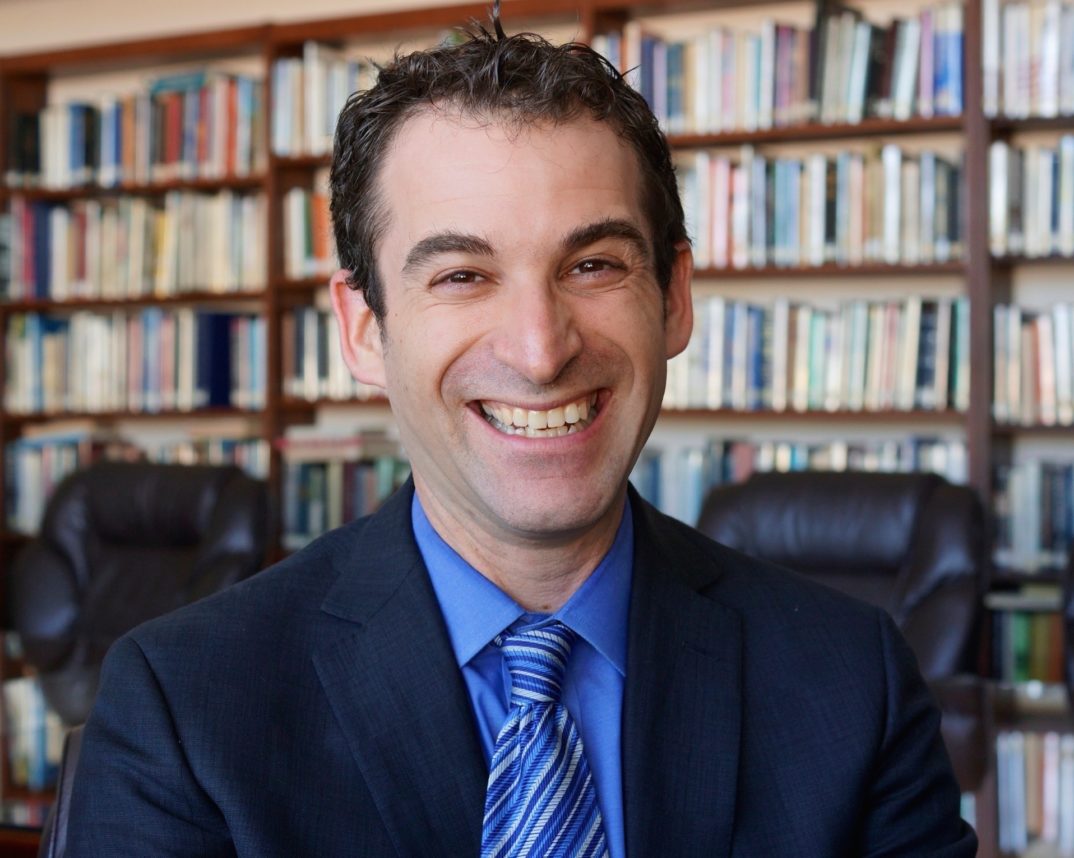
Photo by Jeremy Gimbel
A change in perspective can shift the focus of our day – and even our lives. We have an opportunity to harness “a moment in time,” allowing our souls to be both grounded and lifted. This blog shows how the simplest of daily experiences can become the most meaningful of life’s blessings. All it takes is a moment in time.
Rabbi Zach Shapiro is the Spiritual Leader of Temple Akiba, a Reform Jewish Congregation in Culver City, CA. He earned his B.A. in Spanish from Colby College in 1992, and his M.A.H.L. from HUC-JIR in 1996. He was ordained from HUC-JIR – Cincinnati, in 1997.
“It was once said that the moral test of government is how that government treats those who are in the dawn of life, the children; those who are in the twilight of life, the elderly; and those who are in the shadows of life, the sick, the needy and the handicapped.” (Former Senator and Vice President of the United States, Hubert H. Humphrey)
So – the question is this! Does the Senate’s health care reform bill released yesterday pass this moral test?
Our own Reform movement sharply criticized this Republican Senate bill because it would repeal and replace major parts of the Affordable Care Act, make severe cuts to Medicaid, get rid of the legal requirement that most Americans have health coverage, and remove federal tax credits to aid Americans in paying for health insurance.
The Religious Action Center of Reform Judaism in Washington, D.C. has called this measure “deeply harmful” and yesterday, the RAC made the following statement:
“The Senate bill revealed this morning is a major undermining of American health care that will hurt Americans most in need: the elderly, the poor, children and people with disabilities…Jewish tradition’s emphasis on caring for the sick and lifting up those in need inspires us to call on Senators to reject the Better Care Reconciliation Act of 2017.”
Here are some of the specifics in the bill’s provisions:
• It enables insurance companies to charge five times the cost of insurance to people over fifty;
• It denies coverage for maternity care, mental health care, and substance abuse to millions of Americans;
• It dramatically cuts treatments for those who have opioid disorders;
• It defunds Planned Parenthood on which 2.4 million people depend for their health care;
• It has dramatic cuts to Medicare effective over time;
• The following categories of people will be affected: 49% of all births – 64% for all nursing home residents – 30% of adults with disabilities – 40% of all poor – 39% of all children – 76% of poor children – 60% of all children with disabilities
This bill is an attack on the weakest Americans in order to give massive tax cuts for the top 1% of the wealthiest of Americans – consequently, it does indeed fail Hubert Humphrey’s moral test of government.
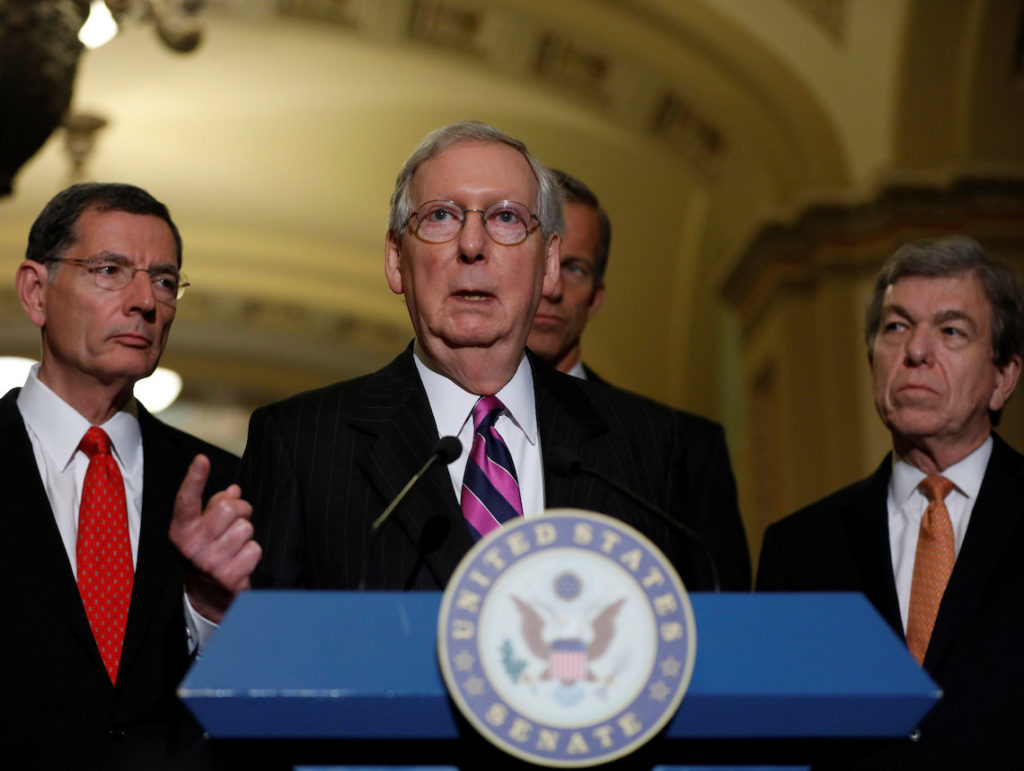
The Congressional Budget Office (CBO) will issue a cost analysis at the beginning of the week, but Senate Majority Leader Mitch McConnell has insisted that there be a vote before the Fourth of July Congressional recess. For a bill that affects one-sixth of the American economy and impacts negatively the lives of more than 20 million Americans, he refuses to allow time for debate, discussion, or analysis of this bill.
The Affordable Care Act of 2010 took one year to pass with massive amounts of House and Senate discussion and more than 200 amendments. Senator Mitchell thinks that Americans and the Senate have discussed health care enough and it’s time to fulfill the President’s and the Republican promise to repeal and replace Obamacare, though a great majority of the American people don’t want it replaced.
This is not democracy, nor is it reflective of the humane tradition of America.
What ought we to do?
We have a weekend to have our voices be heard and we should make them heard by calling the ten fence-sitting Senators who have not as yet signed onto this Senate bill (per Families USA).
We ought to flood their Washington DC offices with calls and emails to demand that they vote no on this Senate bill.
The ten include Senator Susan Collins (R. Maine), Senator Lisa Murkowski (R. Alaska), Senator Bill Cassidy (R. Louisiana), Senator Jeff Flake (R. AZ), Senator Cory Gardner (R. Colorado), Senator Rob Portman (R. Ohio), Senator Ted Cruz (R. Texas), Senator Rand Paul (R. Kentucky), Senator Mike Lee (R. Utah), and Senator Ben Sasse (R. Nebraska).
We Jews are inspired by the example set over many centuries in Jewish tradition which instructs communities to provide health care to their inhabitants. In RAMBAM’s Mishneh Torah (Hilchot De’ot IV: 23) it’s written:
כל עיר שאין בה עשרה דברים האלו אין תלמיד חכם רשאי לדור בתוכה ואלו הן
רופא
“A Torah Sage is not permitted to live in a community which does not have the following: a doctor.”
Israeli race car driver Alon Day’s rise to the highest ranks of NASCAR has been an unexpected one for a variety of reasons.
Here’s one of them: The 25-year-old has done the bulk of his training on computer-screen simulators. That’s because Israel didn’t have a motor sport race track until this year.
On Sunday, he will become the first Israeli to compete in the Monster Energy NASCAR Cup Series — the sport’s highest league of competition — when he races the No. 23 car for the BK Racing team at the Sonoma Raceway in Southern California.
And here’s another anomaly: While NASCAR has made efforts to diversify its pool of athletes, the sport’s fans and drivers remain mostly white and Christian — at times to a controversial extent.
Day, by contrast, wears his Israeli and Jewish identities proudly. His car for Sunday’s race will sport a few Israeli flag stickers, and he’ll also have Stars of David on the left arm of his racing suit and on his belt. He has previously driven a car featuring an Anti-Defamation League sticker (even if the ADL was not an official sponsor of the vehicle).
It’s pretty remarkable, given that it is unknown if a Jewish driver has ever made it to the top tier of the racing circuit.
Day, speaking to JTA from a taxi following his flight to California on Thursday, is well aware of the unlikeliness of his story — one that involves Israeli go-karts, plenty of computer games and a Florida attorney eager to get a Jewish driver into the NASCAR mainstream.
“I’m going to make history for myself and for my country, Israel,” the Tel Aviv resident said.
Day grew up in Ashdod, where he learned about NASCAR from playing video games such as Grand Prix Legends. Motor sports have never been popular in Israel, in part because an old British Mandate law (dating to the days when the British ruled Palestine) that banned any cars that could be used for more than commuting was only recently scrapped.
In his early teens, Day became champion of the country’s only semi-professional motor sport league: go-karting. His father, realizing his son’s potential, sent him to compete in Europe. He began racing in Formula Three and was on a trajectory toward Formula One, among the top racing leagues in the world.
But a couple of years ago, Day decided to switch gears (pun intended). He shifted from driving the Formula One open cockpit style of car to stock cars, the ordinary cars that have been modified to be raced in NASCAR.
It was mostly a business decision — the world of motor racing is driven by sponsorships. Since Israel’s business ties with the U.S. are much stronger than those with Europe, Day recognized he had a greater likelihood of being sponsored to drive for NASCAR.
“It’s definitely much easier for me to get sponsorship here in the states than in Europe,” he said.
Based on his strong start in Europe and the U.S. — he raced a full season in a sub-league of the Indy 500, the U.S. version of Formula One — Day was selected early last year to be a part of the 2016-17 NASCAR Next program, which highlights young, up-and-coming racers.
That happened to be right around the time that Phil Robertson, the controversial member of the “Duck Dynasty” clan, delivered an eyebrow-raising speech before a NASCAR race in Forth Worth, Texas.
“All right Texas, we got here via Bibles and guns, I’m fixin’ to pray to the one who made that possible,” Robertson said. “I pray Father that we put a Jesus-man in the White House.”
Robertson’s pre-race prayer didn’t sit well with David Levin, a Jewish lawyer from Florida and longtime NASCAR fan. Levin had just waded into the world of NASCAR sponsoring, and the reality star’s rhetoric gave him extra motivation to do something he had long wished for: He would find and help promote a Jewish driver into NASCAR’s top circuit.
Day called it perfect timing.
“It’s just kind of karma,” he said.
Since then, Levin has raised significant sums of money to support Day — he’s even enlisted a former NFL player as a backer. Drivers need sponsors to cover the costs of fuel, a pit crew and its tools, as well as salaries for the driver and his or her manager. In return, sponsors get stickers of their brand logo on their drivers’ car. Over the course of a full season, one sticker can cost over $1 million.
“I don’t really know how he does it, he makes magic,” Day said. “And somehow I’m driving in the car.”
Depending on the results of the Sonoma race — and if Levin can continue to work his “magic” — Day said his goal is to race in the next Cup Series race at Watkins Glen in western New York in August.
Meanwhile, Day is gaining recognition in Israel, where he was named Athlete of the Year in 2016 by the Sports and Culture Ministry. He points to the newly opened race track in Arad and an article about him in Yediot Acharanot, one of Israel’s biggest newspapers, as signs that motor sports are on the rise in the Jewish state.
Day himself is contributing to car racing’s increased visibility in Israel. Alongside his fledgling celebrity, he opened a racing “gym” in Tel Aviv with an old go-karting buddy. The gym houses several driving simulators, which are basically higher-tech versions of arcade games. The building has turned into an all-ages school where Day teaches pupils about racing, as well as about difficult situations a driver encounters on normal roads.
When he’s not abroad racing, Day typically spends three to four hours a day practicing on the race track simulations.
“I’m 25 now, but I still use simulators like I’m 10 years old,” he said with a laugh.
Day says he celebrates Jewish holidays, recites the Kiddush blessing over the wine on Friday nights and is proud to talk about his service in the Israeli army. Although he is an anomaly in the white Christian world of NASCAR, he points out that many stock car racing fans — some of whom are evangelical Christians — are big supporters of Israel, which has helped make him feel comfortable in the United States.
“I think they like seeing someone without that Southern accent, does not have the American flag [on a car] … does not believes in Jesus,” he said. “I’ve gotten tons of media because I’m different.”
Several members of Congress are urging President Donald Trump to continue a 40-year tradition by immediately appointing a White House liaison to the American Jewish community.
“While it is still early in your term, increased anti-Semitism in the United States, the rise of the Boycott, Divestment and Sanctions (BDS) movement, and persecution of religious minorities across the globe create an urgent need for a designated point of contact to work with and provide outreach to the American Jewish community,” Representatives Jacky Rosen (D-Nev.), Lee Zeldin (R-N.Y.), Stephanie Murphy (D-Fla.), and Doug Lamborn (R-Colo.) wrote in a bipartisan letter addressed to the President.
Trump has continued to blame the Democratic Party congressional leadership for the slow pace of filling vacancies in administration posts, calling them “obstructionists.” In this instance, however, the House Members note that the position does not require Senate confirmation.
During the 2016 presidential campaign, David Friedman and Jason Greenblatt, two Trump confidants, served as Trump’s unofficial representatives to the Jewish community and advisors on Israel and Jewish-related matters. Friedman has since been appointed as U.S. Ambassador to Israel and Greenblatt is serving as special envoy to the Middle East and White House Special Representative for International Negotiations.
“On Yom HaShoah, Holocaust Remembrance Day, you declared in the Capitol Rotunda that you ‘will always stand with the Jewish people.’ We respectfully encourage you to follow through on this commitment and appoint the best person you believe would serve in this role,” the Representatives concluded.
“People are policy,” Matt Nosanchuk, a former White House liaison under President Barack Obama, told Jewish Insider. “Which roles are filled and by whom and at what level speaks volumes about as to whether an administration is committed to engaging on particular policy issues with specific communities.”
The challenge of serving as the President’s representative to the Jewish community is “trying to accommodate all of the different interests and voices in a diverse Jewish American community that is not shy about sharing its views,” Tevi Troy, who served as White House Jewish liaison in President George W. Bush’s first term, told Jewish Insider. “For a Jewish liaison in a Republican White House, an additional challenge is that the community as a whole is Democratic territory. This does not, of course, apply to the Orthodox community, where GOP liaisons are on friendlier turf, and where Democratic liaisons face more of an uphill battle.”
“This administration seems to be doing something that is making some parts of the American Jewish community happy, but other parts feel like they don’t have anybody they could call,” Jarrod Bernstein, the liaison during Obama’s reelection, explained the importance of having somebody who focuses on the Jewish community in a full-time position. “You have to worry about the people who don’t agree with you politically and making sure that they feel they have an open door. That’s where having a dedicated Jewish liaison is really important.”
However, according to Noam Neusner, another former White House Jewish liaison for President Bush, filling this position is not a matter of urgency. Instead, he advised the signatories of the bipartisan letter to “work with their colleagues in the Senate to assure a speedy confirmation of nominees for far more important positions – especially positions that are essential to America’s global leadership, prosperity and security.”
Nosanchuck, who held the Jewish liaison position for nearly three years during Obama’s second term, noted, “Appointing someone does not obviate stark policy differences, and many of this White House’s most important priorities, on economic, climate, and social welfare and social justice issues, are way out of line with the priorities of the overwhelming majority of American Jews. No Trump Jewish liaison is going to bridge that divide.”
Read the full letter below:
Dear Mr. President:
We write to encourage you to continue the forty-year tradition of appointing a White House liaison to the Jewish community. While it is still early in your term, increased anti-Semitism in the United States, the rise of the Boycott, Divestment and Sanctions (BDS) movement, and persecution of religious minorities across the globe create an urgent need for a designated point of contact to work with and provide outreach to the American Jewish community.
Previous Presidents have appointed White House Jewish liaisons, and these individuals served as valuable intermediaries between the wider Jewish community and the President and his staff. Many past liaisons worked to foster Middle East peace, combat anti-Semitism, strengthen the US-Israel relationship, promote interfaith dialogue, and celebrate Jewish-American heritage on the national stage. You have expressed a strong commitment to defending our ally, the eternal Jewish State of Israel, and specifically designating a Jewish liaison would make it known to American Jews that you stand with them and care about their priorities. We understand that this position does not require a nominee subject to confirmation by the U.S. Senate, removing a significant barrier in selecting a qualified individual to serve in this role.
On Yom HaShoah, Holocaust Remembrance Day, you declared in the Capitol Rotunda that you “will always stand with the Jewish people.” We respectfully encourage you to follow through on this commitment and appoint the best person you believe would serve in this role.
Sincerely,
Jacky Rosen, Lee Zeldin, Stephanie Murphy, Doug Lamborn
The Ku Klux Klan still “poses a threat to society,” though it is relatively unstable and unorganized, according to the Anti-Defamation League.
The findings of an ADL report released this week found that 42 KKK groups are active in 33 states, with an estimate of some 3,000 members. More than half the groups were either formed or restarted in the past three years.
Most of the groups are concentrated in the South and the East, with a slight increase since early 2016.
The report showed that some groups not only are still involved in criminal activity and violence, but have formed alliances with other white supremacist groups in hopes of restoring their continuity.
But their main activity is the “distribution of racist, anti-Semitic, homophobic and Islamophobic fliers,” the report said.
“These hardened racists and bigots are looking to spread fear,” Jonathan Greenblatt, the ADL’s CEO said, “and if they grow dissatisfied with the Klan, they move on to other groups on the extreme far-right.”
Oren Segal, the director of ADL’s Center on Extremism, said that despite the hate group’s decline from its heyday, “we are still seeing the same extremist ideology manifesting itself into violence from some of its purported membership.”
“The somewhat new collaboration with some of the most vehement white supremacists out there is a concerning trend we will continue to monitor and expose.”
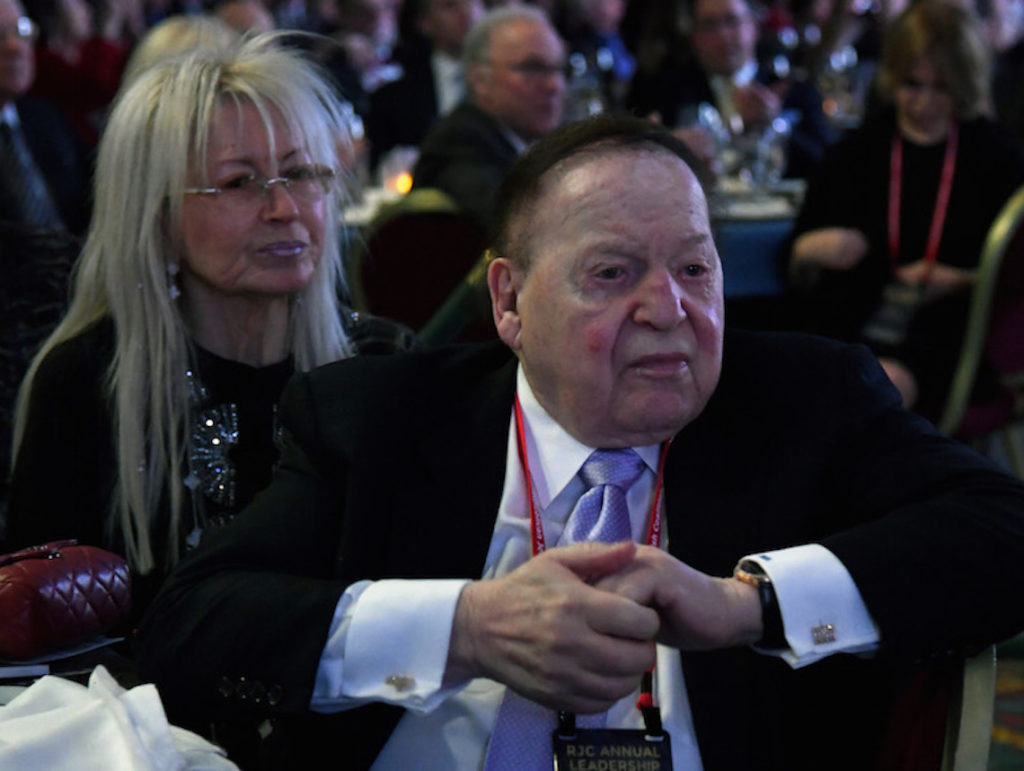
American billionaire Sheldon Adelson will provide about $20 million for the major expansion of a West Bank university.
Ariel University, located in the settlement of that name, plans to double in size within the next five years, according to a plan promoted by Education Minister Naftali Bennett.
Part of the project, which includes an additional 10 to 12 facilities, is to build a four-year medical school to be named after Adelson, who owns the Israel Hayom newspaper, and his physician wife, Miriam. It would be the sixth medical school in Israel.
The estimated cost for the entire project is approximately $113 million.
According to Haaretz, though the plan has the support of the finance subcommittee of the Council of Higher Education, it “still needs the approval of the full council” before new faculties can open.
The university, which is expected to go from about 56,000 square yards to about 125,000 square yards, has already begun construction on some of the buildings.
Since the university shifted from a college to a university in 2012, it has been granted extra funding by the state of about $4 million. With the expansion, the state would have to further increase its funding, Haaretz reported.
The expansion will include buildings will be dedicated to natural sciences, social sciences and community health, as well as a faculty of Jewish heritage.
The U.S. State Department’s office to monitor and combat anti-Semitism will be unstaffed as of July 1.
A source familiar with the office’s workings told JTA that its remaining two staffers, each working half-time or less, would be reassigned as of that date.
The Trump administration, which has yet to name an envoy to head the office, would not comment on the staffing change. At full staffing, the office employs a full-time envoy and the equivalent of three full-time staffers.
The State Department told JTA in a statement that it remained committed to combating anti-Semitism – and cited as evidence the tools, including the department’s annual reports on human rights and religious freedom, that existed before Congress mandated the creation of the envoy office in 2004.
“We want to ensure the Department is addressing anti-Semitism in the most effective and efficient method possible and will continue to endeavor to do so,” the statement said.
“The Department of State condemns attacks on Jewish communities and individuals. We consistently urge governments around the world to address and condemn anti-Semitism and work with vulnerable Jewish communities to assess and provide appropriate levels of security.
“The Department, our Embassies, and our Consulates support extensive bilateral, multilateral, and civil society outreach to Jewish communities,” the statement continued. “Additionally, the State Department continues to devote resources towards programs combating anti-Semitism online and off, as well as building NGO coalitions in Europe. We also closely monitor global anti-Semitism and report on it in our Country Reports on Human Rights Practices and International Religious Freedom Report, which document global anti-Semitism in 199 countries.”
Secretary of State Rex Tillerson told Congress in testimony earlier this month that he believed special envoys were counterproductive because they provided an excuse to the rest of the department to ignore the specific issue addressed by the envoy.
Congressional lawmakers from both parties have pressed the Trump administration, in letters and proposed bills, to name an envoy and to enhance the office’s status. They have noted that unlike other envoys, whose positions were created by Trump’s predecessors, the office of the envoy on anti-Semitism is a statute and requires filling.
“As the author of the amendment that created the Special Envoy to Monitor and Combat Anti-Semitism, I remain hopeful that these critical positions will be filled,” Rep. Chris Smith, R-N.J., who authorized the 2004 law, said in a statement to JTA.
Jewish groups have lobbied President Donald Trump to name an envoy, saying that despite Tillerson’s testimony, the position has been key to encouraging diplomats and officials throughout the department to focus on anti-Semitism. Hannah Rosenthal, a special envoy on anti-Semitism in the Obama administration, instituted department-wide training on identifying anti-Semitism.
“The idea of having a dedicated envoy who can travel around the world to raise awareness on this issue is critical,” the Anti-Defamation League CEO, Jonathan Greenblatt, told JTA in an interview.
“That doesn’t mean there isn’t value for all ambassadors and every embassy in addressing issues of anti-Semitism and bigotry in countries they operate,” he said. “But if the administration is truly committed” to combating anti-Semitism, “maintaining the special envoy for anti-Semitism seems like a no-brainer.”
The ADL, coincidentally, launched an online petition Thursday to the White House to fill the position.
Officials of the Simon Wiesenthal Center, which has enjoyed a good relationship with the Trump administration, said that if the unstaffing was coming ahead of a reorganization of the office, that was understandable. But positions remain unfilled in all of the major federal departments and agencies since Trump took office.
“However, we are almost in July and there is still no one of proper rank at the State Department whom the Wiesenthal Center and others can work with to re-activate US leadership in the struggle against anti-Semitism at a time when global anti-Semitism is rising,” said an email from Rabbi Abraham Cooper, the associate dean of the center, and Mark Weitzman, its director of government affairs.
Jason Isaacson, the American Jewish Committee’s director of government and international affairs, said the position was essential.
“It’s not as though the need for a special envoy has diminished,” he told JTA in an interview. “If anything it has increased.”
A Libyan’s nomadic journey of self-discovery and understanding
That hot afternoon seems like yesterday, but it was 50 years ago this month. I was 15 and living in Sabha, a small city in the Sahara Desert of southern Libya. An older cousin told me about the reports on Cairo Radio about the dire situation facing the Egyptian army.
“We’ve got to do something,” he said.
I didn’t fully understand the politics of what would come to be known as the Six-Day War, but I knew that what was happening was bad for us as Arabs and Muslims. All around me were other teenagers absorbing the tense mood and looking to vent their rage at the Jews.
I followed the crowd to the only Western-style establishment nearby, a bar. It was early afternoon and the place hadn’t opened yet. A few older boys broke down the door, and a crowd stormed in, breaking bottles and dumping alcohol onto the street outside.
Standing in a crowd, I joined the chants: “Death to the Jews!” “Drive the Jews into the sea!”
The truth is that I had never actually met a Jew. I grew up in a small nomadic village of 20 families, a collection of mud huts with palm-frond roofs that wouldn’t have looked much different 2,000 years earlier. Health care was so primitive that by the time I was a young boy, my parents had lost three children to illness.
Sunni Islam was the only way of life I knew. My preschool was in a mosque, where an imam taught us to read and write by drilling us with verses from the Quran. After that, our education was more secular — I went to mosque, going through the motions, but I was hardly devout. I never was exposed to any alternatives or avenues to question the life we had.
Our textbooks didn’t mention Israel, and people used the word Yahudi, Jew, only as an insult. The Jews had rejected the Prophet Muhammad, so they were considered to be condemned. The only Jews I saw were in Egyptian movies, in which they were portrayed as menacing, monstrous characters — hunched over and speaking with high-pitched nasal accents.
I did know Palestinian Arabs. My elementary school had once hired a young Palestinian as a teacher. Because he was Palestinian, the community welcomed him warmly and supported him generously.
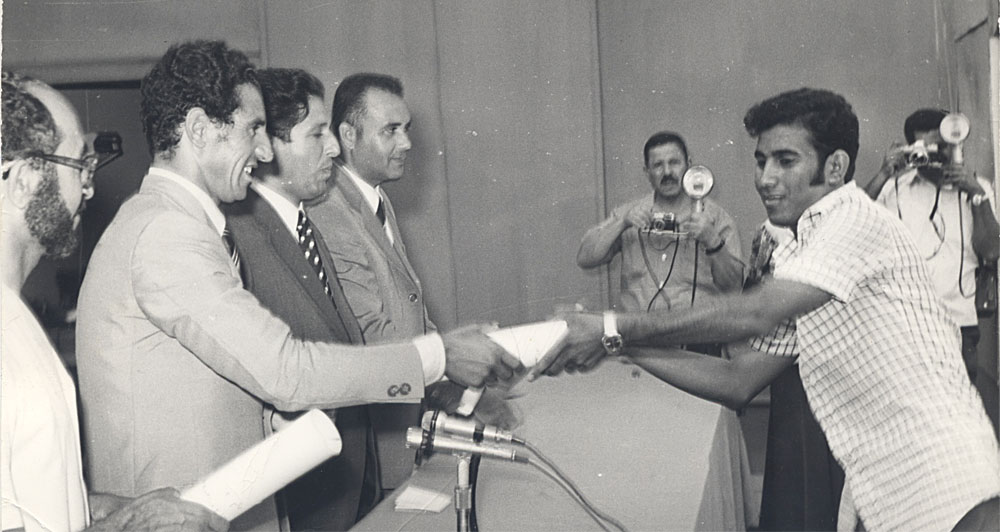
Elhaderi receives the prestigious First Honor National Academic Award from Libyan Prime Minister Abdessalam Jalloud in 1974.
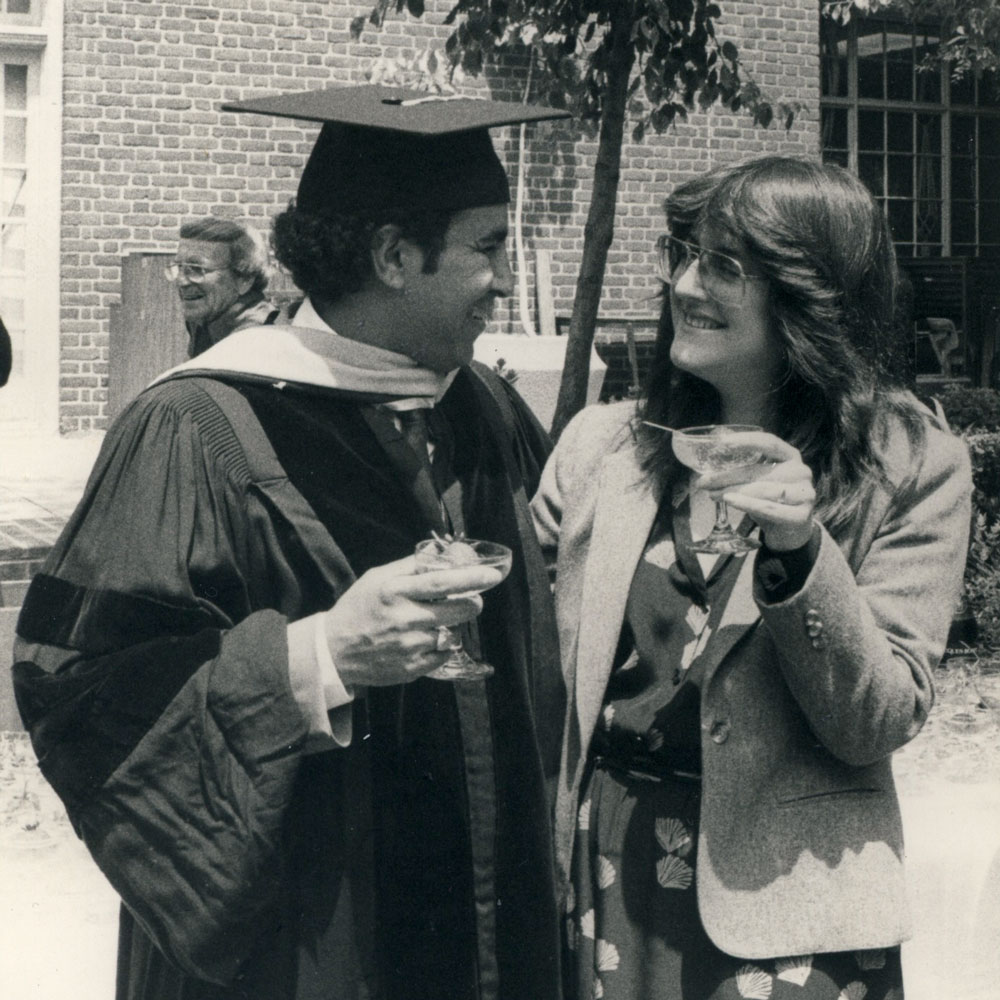
After high school, I went to the University of Tripoli, where I was neither politically active nor religiously observant. During my first year there, my father arrived to deliver tragic news: My mother had died. I channeled my grief into focusing on my studies, earning a place in the prestigious chemical engineering program.
Hoping for a career in the country’s burgeoning oil industry, I won a scholarship to study abroad in one of the top-ranked programs in my field, at the University of Wisconsin, Madison. Leaving behind my father and one younger brother, I set out for my first journey beyond Libya.
In Madison, I discovered a campus teeming with international students — Iranians, Nigerians, Europeans, Asians. Amid the activist ferment of the mid-1970s, each group freely and openly expressed its political and cultural identity.
I did that, too: When I moved into an office I shared with two other graduate students, I tacked up a large poster of Yasser Arafat, the Palestine Liberation Organization leader, wearing his iconic kaffiyeh and brandishing a semiautomatic rifle.
It was 1974, just two years after the murder of Israeli athletes and coaches at the Munich Olympic Games and the same year as the terrorist massacre in the Israeli town of Ma’alot. Half of the department’s faculty and perhaps a quarter of its students were Jewish, yet it didn’t strike me that my choice of décor might offend anyone. Many colleagues undoubtedly reacted by steering clear of me.
And then, for the first time, I began getting to know Jewish people. The encounters happened organically, in classrooms and the student union. Two Jewish professors in my department were kind and understanding. Over one leisurely summer, I spent time with a Jewish philosophy professor who engaged a group of us over beers in leisurely discussions about politics and life. I was struck by how they were just people — wonderful, decent, normal people. They defied every stereotype I had been fed while growing up in Libya.
The contrast was so striking that not only did I begin to reconsider my assumptions about Jews, but I also came to re-examine every aspect of my life. Gradually, I came to see how the black-and-white worldview I had grown up with didn’t jibe with reality.
The more experiences I had with Jews, the more I felt drawn to them. I even began thinking that I wanted to marry a Jewish person (although I didn’t have a particular one in mind). Perhaps that would help me to cleanse myself of the hateful mindset of my upbringing.
Elhaderi and his wife, Barbara, after he received his doctorate in chemical engineering from USC in 1982.
After three years in Madison, I transferred to USC. A few months after arriving in Los Angeles, I was practicing tennis at the Ambassador Hotel when I struck up a conversation with an attractive young woman named Barbara and suggested we volley. When I told her my background, she said, unprompted, “I just want you to know, I’m Jewish.”
We exchanged phone numbers, and a week later, I called her. It took a couple of weeks before we connected again, meeting to play tennis and dine on Mexican food. We got along well. Not long after that, I went out of town to take a break from my studies and returned to find a note from Barbara telling me she missed me.
Before long, she invited me to meet her parents. Barbara’s father had lived in Israel, serving as an officer in its War of Independence. And one of her sisters’ boyfriends was an Israeli who had served in the Israel Defense Forces.
I’m sure that when they learned that she was dating a Libyan named Abdulhafied (the name I had grown up with and still used), they thought Barbara had lost her mind.
Still, we grew closer. After a couple of months, we moved together into an apartment her parents owned in Koreatown. At first, the arrangement was one of convenience, but soon our lives became intertwined. Barbara lovingly helped me through my doctoral thesis and cared for me in ways no one had since my childhood.
She also welcomed me into her family’s life, and, despite our contrasting backgrounds, her parents accepted me with love. Barbara’s family wasn’t particularly observant — they celebrated only Rosh Hashanah, Chanukah and Passover.
In 1980, we married at their Fairfax District home. At that point, I didn’t consider myself a Muslim, but rather a spiritual searcher. Together, Barbara and I had explored a nondenominational church called Science of Mind. Our wedding ceremony blended elements of Judaism with some of our own personal touches.
By then, my relationship with my aging father, still back in Libya, was distant. I spoke to him only occasionally, and his question was always: “When are you coming back?” I chose not to share the news of my marriage.
As we settled into our life together, Barbara and I had only limited Jewish observances: Rosh Hashanah dinners, Chanukah gift exchanges, seders hosted by her parents. Together, we continued our spiritual search, occasionally joining a colleague of Barbara’s at Rick Warren’s Saddleback Church in Lake Forest.
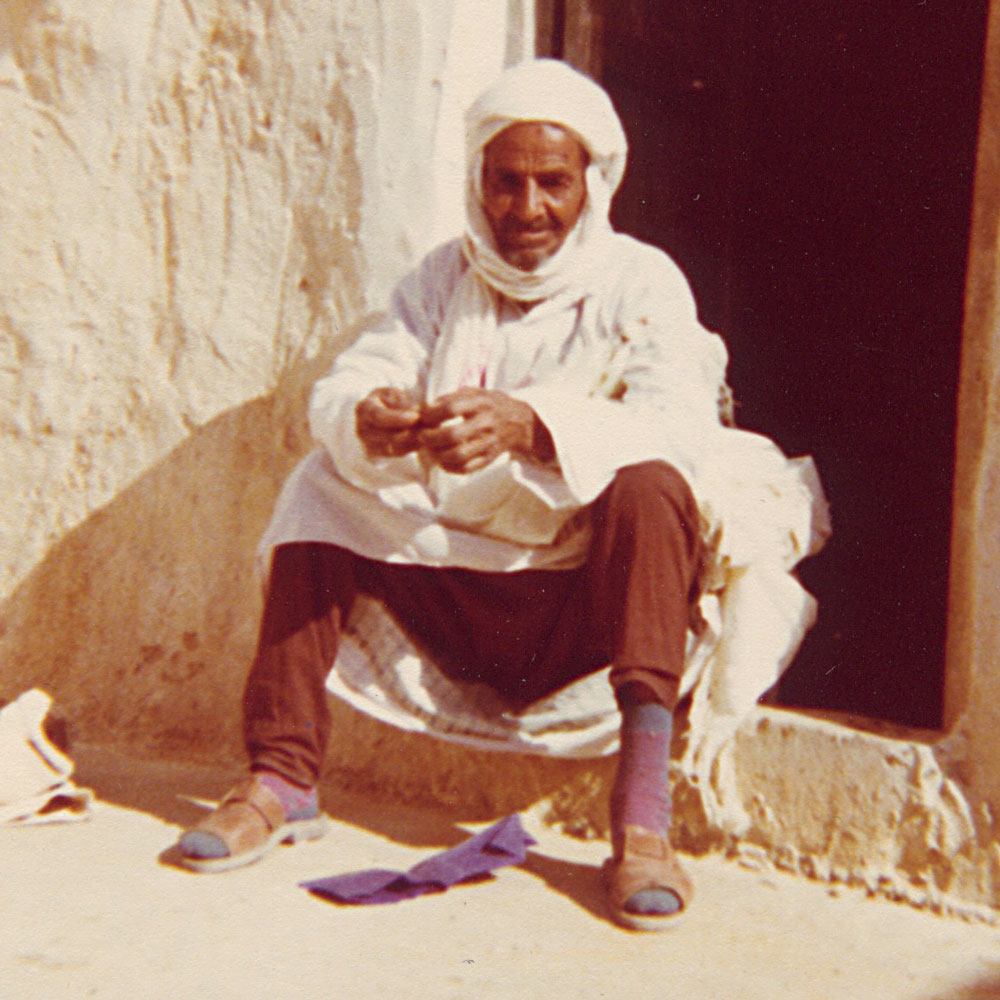
Elhaderi’s father, Elsaidi, in front of his home in the Libyan village of Hatiet Bergen in 1979.
Eager to start a family, we struggled with infertility for many years. We were just days from adopting a baby when the birth mother had a last-minute change of heart. Then, just a week later, Barbara learned she was pregnant. Our daughter, Jessica, was born in 1991 and, two years later, we had a son, Jason.
Not long after that, my father died. We had spoken only occasionally since my last visit to Libya, in 1979. I had shared little about my new life with him, knowing it would have been nearly impossible for him to grasp the pluralism and openness I had come to cherish.
Surely he couldn’t have imagined the next step in my spiritual journey. When Jason turned 12, he announced that he wanted to have a bar mitzvah. We were living in the Pico-Robertson neighborhood and a neighbor, the Israeli-born wife of a rabbi, offered to teach him to read Hebrew and start some initial religious study.
He also began studying Judaism and his Torah portion with a Chabad rabbi at a shul not far from Barbara’s parents. I sat in on every class, slowly learning about Jewish prayer and customs, as Jason studied his haftarah and maftir. The more I absorbed, the more I felt drawn to Judaism.
On the day he became bar mitzvah, I stood on the bimah, filled with pride in my son and awe for the beauty of the service I could barely understand — and overflowing with emotions I could not fully explain.
The power of that day also made me start to ponder my own mortality. It pained me to realize that since I wasn’t Jewish, I could not be buried in a Jewish cemetery beside my beloved wife.
Not long after the bar mitzvah, I told Barbara that I wanted to convert to Judaism. A rabbi we knew directed us to American Jewish University’s Introduction to Judaism Program, and Barbara and I enrolled.
Our 18 months in the class felt like a second honeymoon: While I learned about Jewish history, Torah and Jewish rituals, I felt closer than ever to Barbara, and I fell in love with Judaism.
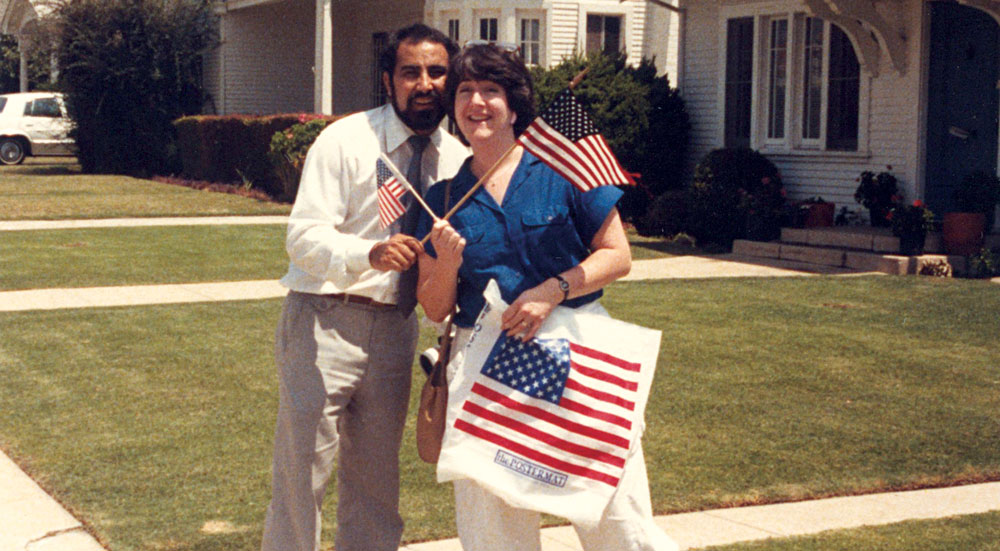
Ed Elhaderi and his wife, Barbara, celebrate his becoming a U.S. citizen in 1985.
When I met with my sponsoring rabbi, Perry Netter, then at Temple Beth Am, he asked only one question: “Why do you want to be Jewish?” Choked up with emotion, I couldn’t speak. I simply cried.
“OK,” he said, smiling. “You pass.”
Something else happened: The more I learned about Judaism, the more I saw parallels in my own upbringing in Libya. When I learned about the mezuzah, I remembered how in my childhood village, families posted palm fronds wrapped around verses from the Quran in their doorways. Words I learned from biblical Hebrew seemed to echo colloquial terms unique to the region of my youth.
Investigating, I learned that Jews had lived for thousands of years in Libya, including in my native region of Fezzan — although most left in 1948, and nearly all of those remaining fled just after the Six-Day War. My strong feeling was that I wasn’t so much discovering a new faith as uncovering a long-hidden part of myself, that perhaps some of my ancestors were Jews.
On the morning when I went before the beit din — the rabbinical court — to finalize my conversion, and plunged into the waters of the mikveh, I felt joy combined with a serenity that had eluded me for decades. I felt that I was returning to where I belonged.
Our family joined Temple Beth Am, where I felt increasingly at home, regularly attending on Shabbat and weekdays. At home, we shared weekly Shabbat dinners, at which I started offering each of my children a blessing.
I also engaged in regular Torah study and found particular resonance in Rabbi Akiva’s wisdom from Pirkei Avot: “Everything is foreseen, yet free choice is given.”
That essential tenet — that we can embrace God but decide our own fates — encapsulates much of what I hold dear about America and Judaism. I grew up like so many people in closed societies, knowing one way of life, having one set of beliefs, and taught to despise anything beyond that realm.
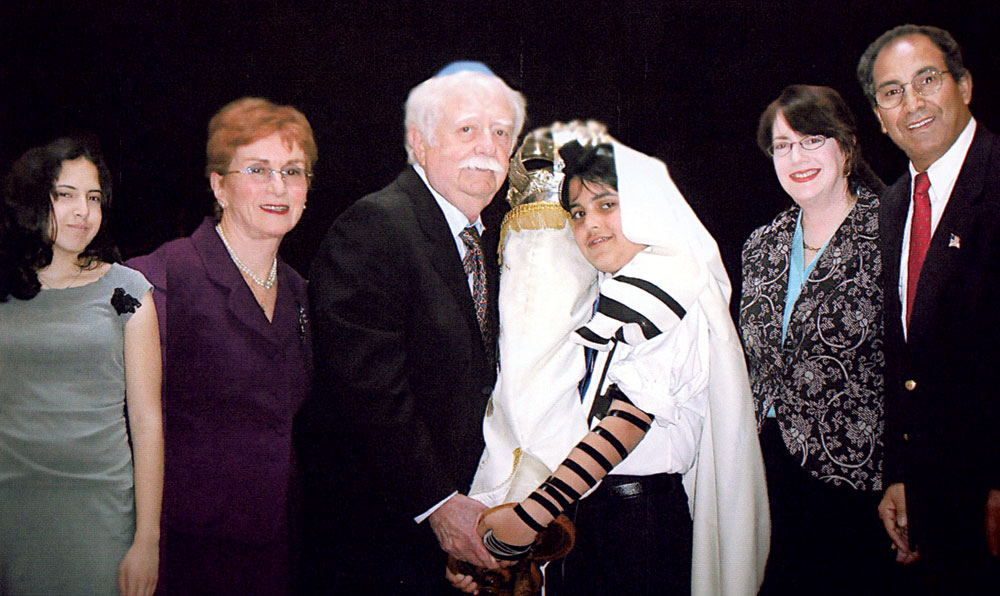
Ed Elhaderi (far right) at his son’s bar mitzvah in 2006 with (from left) daughter Jessica, in-laws Ellen and Bob Levin, son Jason and wife Barbara.
The best guidance for overcoming that kind of internal and external strife is another piece of advice from Pirkei Avot: “Who is wise? The one who learns from all people.”
My own learning came full circle in November 2012, when Barbara and I traveled to Israel. We landed in the late afternoon, and by the time we arrived at our Tel Aviv hotel, Barbara wanted to rest, but I felt energized, so I took a walk. Traversing the streets of Tel Aviv and Jaffa until midnight, I marveled at the variety of people I saw — young and old, from so many ethnic backgrounds. I was amazed by the sights and smells and how alive the city was.
Scanning the faces I passed on the street, I could not help but think back to my youth, to the hatred for Israel and Jews that had been fed to me.As we traveled the country — Jerusalem, Safed, the Golan, Rehovot — Israel entered my bloodstream. I felt at home.
The trip deepened my connection to Israel and to being Jewish. In synagogue on Shabbat mornings, I began to take notice of a part of the service that I hadn’t thought much about: the prayer for the State of Israel.
Now I say it each week with full intention: “Bless the land with peace, and its inhabitants with lasting joy.”
Occasionally, as I say those words, I think back to my 15-year-old self, on that hot June afternoon on the streets of Sabha. And I say an extra prayer of gratitude to God for carrying me on this remarkable journey to myself.
ED ELHADERI is a real estate investor and developer who lives in West Los Angeles with his wife, daughter and son. He is writing a memoir about his journey from his Libyan childhood to his life as an active and committed American Jew. Tom Fields-Meyer is a Los Angeles author and editor who helps people tell their life stories in writing.
Everybody who comes to Israel adores the food – it’s colorful, diverse and multi-cultured. As Israelies, we grow up eating Tunisian, Romanian, Iraqi and Italian food, and many other cuisines – sometimes all in the same week. And for us it’s quite normal. So normal, perhaps, that we rarely stop to ask ourselves: Is there even such a thing as Israeli cuisine?
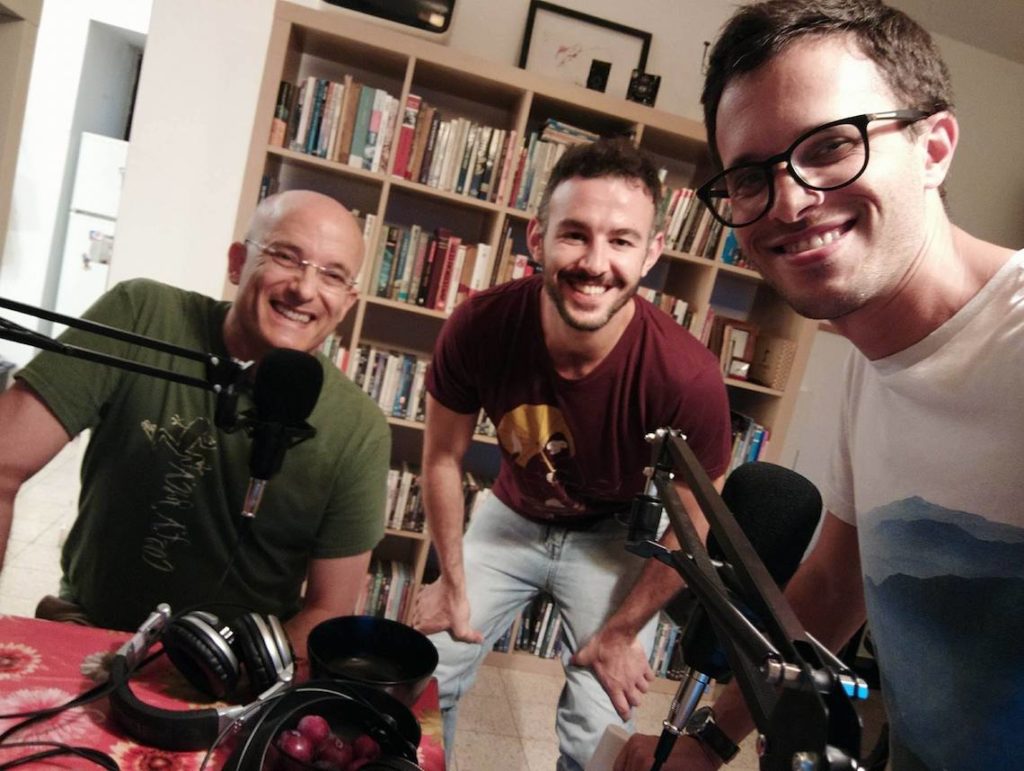
To try and answer this question, Two Nice Jewish Boys called upon the master of Israeli food, Gil Hovav. Every Israeli household has been eating from Gil’s plate for over two decades. He’s starred in numerous televised cooking shows and food documentaries. He is a man of the world, an author, a lover of Hebrew (and Arabic!), the great-grandson of Ben Yehuda (the reviver of the Hebrew language) and above all – one helluva mench. Join us for a gastronomic episode.
We also played an amazing song by Hagar Levy! Check her our on Bandcamp and Facebook.
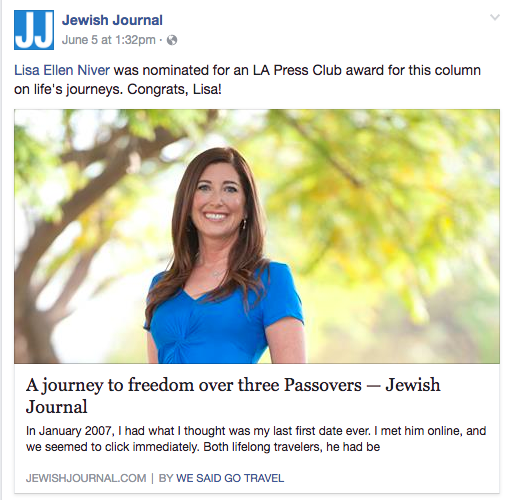
I am a finalist in two categories for the Southern California Journalism Awards! The ceremony is June 25 at the Biltmore. I am honored to be included. There were 1200 entries for the 59th annual awards. Thank you to the Los Angeles Press Club for my nominations. I will let you know what happens!
Where did I travel recently?
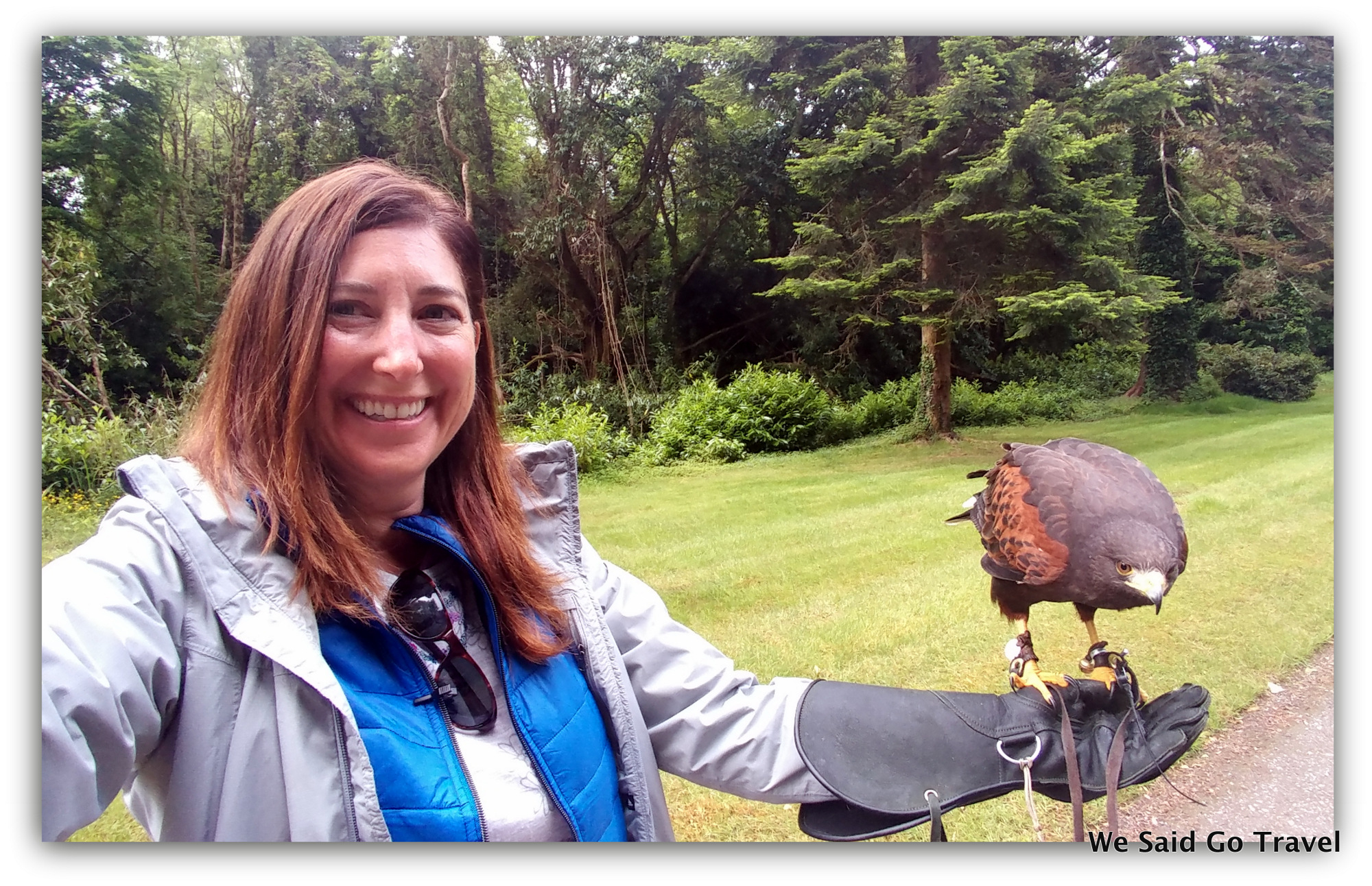
I have links below to videos from my Florida and China trips. I told you last month I would be in Europe for nearly four weeks and in six countries: Monaco, France, Ireland, Scotland, Italy and San Marino. Country 97, 98 and 99 were amazing! I loved my travels and am working on all the videos to share with you.
This month, I am going on my first private jet for a one day adventure to Napa! This is definitely going on my list of 50 things before I am 50! At the end of June, I will be at The Ritz-Carlton Lake Tahoe and conquering my fear of mountain biking. Look for photos on all my social media–I have been verified on Twitter and am now also verified on Facebook!
Wondering what else is new? Check out my new page on LisaNiver.com Please let me know your feedback and suggestions.
As my fortune cookies said: “You are on the verge of something big.” and “Getting the right answers is only possible when you have asked the right questions.” I am diligently working every day to make my goals into reality and it is actually happening! If you have suggestions for my country #100, let me know!