US white supremacists recently embraced a brand new slogan that is a rallying cry at various events and a common catchphrase that is used on fliers promoted at universities. The slogan is: “You Will Not Replace Us!” The choice of the motto revolves around highlighting issues that the supremacists are now preoccupied with, including preserving the white cultural history and the entire white race. It also showcases the fear that white people will become a minority without power as demographics are changing.
All minorities in the US are now feeling run down with the election of Donald Trump as president and the support that white supremacy groups receive. White supremacists are doing all that they can in order to rally people to support the cause. White supremacists claim that immediate action has to be taken or the entire race will be doomed as there is a “rising tide of color” that is manipulated and controlled by Jews.
“You Will Not Replace Us” is a slogan that initially appeared in February 2017. This was when Identity Evropa, a right white supremacist group under the leadership of Nathan Damigo appeared at the New York City Moving Image as Shia LeBeouf was using a live-stream to protest against Donald Trump. His project was promoted as “He Will Not Divide Us”. Domingo showed up and declared that people will not replace them with globalism. Then, others joined and started shouting “You will not replace us”. Then, as time passed the slogan started to become popular among white supremacists on social media.
During the month of May, the slogan started to appear in fliers posted by white supremacists at different country universities. This includes the DC George Washington University, the Philadelphia Temple University, and the Dallas Southern Methodist University. In the fliers, there were also different websites owned and operated by supremacists.
White supremacist supporters are looking for services like logo design to create visuals associated with the motto. However, many agencies refuse such work as the supremacist supporters are mostly using homemade signs to carry at rallies.
Twitter had 2,000 posts with the reference on May 2, as the fliers were posted in the campuses and people shared images on the network. On the 13th of May, the slogan became the main rallying cry of white supremacists that were protesting at the Confederate monument removals in Virginia and Charlottesville. It was Identity Evropa members that carried the banner with the slogan at the protests. Another spike of social media posts appeared as the protests were carried out.
On May 20 we saw the latest appearance of this slogan as 2 Marines ended up in police custody when a banner they created was unfurled. The banner featured “YWNRU”, the obvious acronym for the new white supremacist slogan. Once again, because of the arrest of the supremacists more following appeared on social media.
The new slogan is starting to get a strong following around the white supremacy groups in the USA. As politics and questions related to racism keep popping up, we have to wait and see when the new “You Will Not Replace Us” mention is going to appear. Several white supremacist rallies are scheduled in the following months so this is where we will see if the slogan becomes official for all the groups or just some of them.
Nitzan Stein Kokin, who completed her final year of studies at the Ziegler School of Rabbinic Studies at American Jewish University (AJU) in Los Angeles, became the first graduate of Zacharias Frankel College in Berlin on June 18, making her the first Conservative rabbi to be ordained in the country since before World War II.
“The training at the Zacharias Frankel College really enhanced me intellectually and spiritually,” Kokin said in a statement. “I am looking forward to serving the Jewish people and spreading the word of Masorti Judaism in Germany and Europe.”
The 4-year-old rabbinical seminary of the Masorti/Conservative movement in Germany is under the religious auspices of the Ziegler School. The two share a dean and vice dean, Rabbi Bradley Artson and Rabbi Cheryl Peretz, respectively. Both took part in the ceremony at the Great Hall of the Jewish Community Center in Berlin.
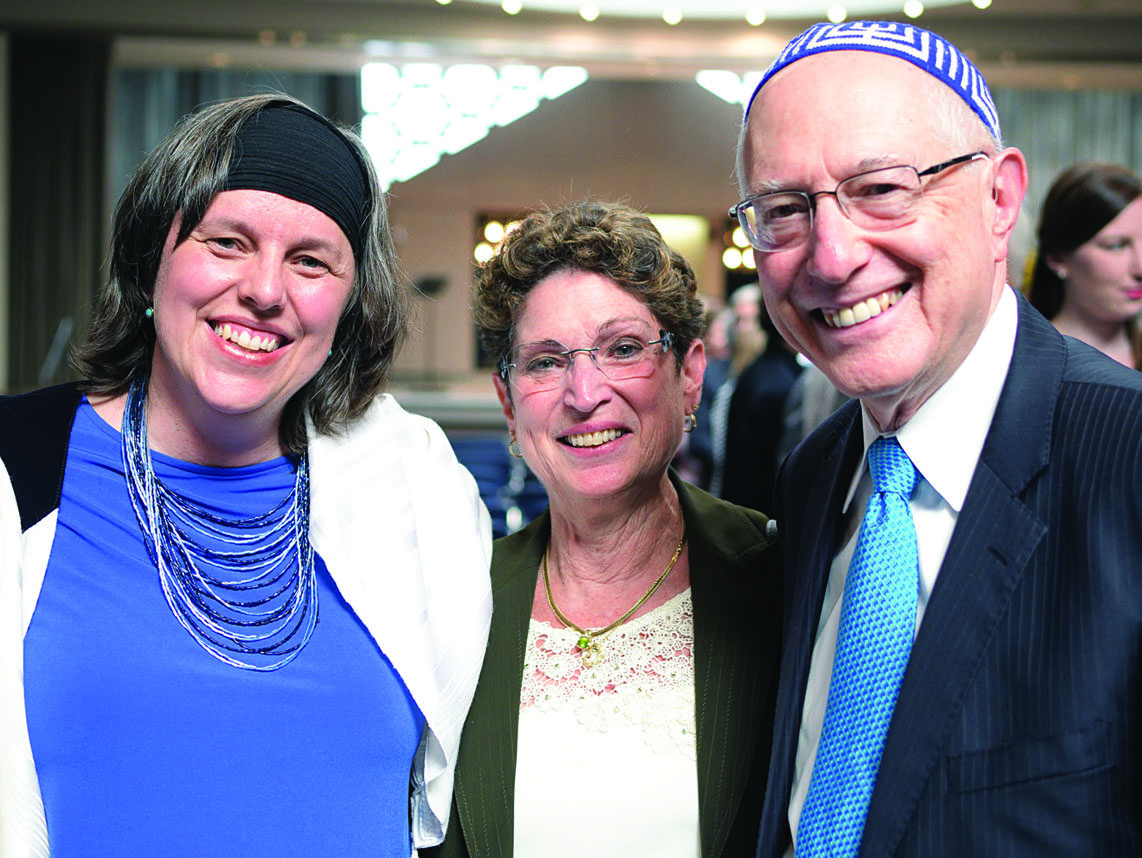
From left: Nitzan Stein Kokin, the first graduate of Zacharias Frankel College, and Fredi and husband Rabbi Joel Rembaum attend Kokin’s ordination ceremony at Zacharias Frankel College in Berlin. Photo by Tobias Brains
During the ceremony, which was held in a venue that was one of Germany’s grand synagogues prior to Kristallnacht in 1938, Artson described Kokin as one of “the student pioneers who have had faith to walk with us in this new enterprise and its future,” according to Fredi Rembaum, a retired Jewish community professional and wife of Rabbi Joel Rembaum, both of whom attended.Rabbi Rembaum, a Ziegler School lecturer in history who has spent multiple semesters in Berlin teaching Jewish law to Frankel students, bestowed a priestly blessing with Rabbi Harvey Meirovich upon Kokin.
Kokin, 42, grew up in a Protestant household in a small town in southwest Germany. Her ordination culminated a journey that began when she converted to Judaism in 1999. She had been interested in the ministry and felt an exploration into Judaism would deepen her appreciation of Christianity. She eventually embraced Judaism wholeheartedly and made aliyah to Israel. She moved to Germany around 2010 after her husband, a Los Angeles native and former graduate student at Hebrew University in Jerusalem, took a job there.
Jeffrey Levine, chairman of the board at the Ziegler School; L.A.-based husband and wife Benjamin and Irma Breslauer, who helped establish ties between Zacharias Frankel College with the Ziegler School; and Barton Kogan,a Ziegler board member, were among those who attended the ceremony.
Founded in cooperation with the Leo Baeck Foundation, the Zacharias Frankel College operates at the University of Potsdam. The school, named for Rabbi Zacharias Frankel, an intellectual progenitor of the Conservative movement, is attempting to rejuvenate Jewish life in a country that saw its Jewish population essentially wiped out during the Holocaust.
On Memorial Day Weekend, Wise School students traveled to Michigan and participated in the world finals of Odyssey of the Mind, an international problem-solving competition.
The Jewish day school’s fifth-grade team took on the technical “Odd-a-Bot” problem and placed eighth out of the top 52 teams in the world.
The school’s fourth-grade team took on the Classics problem and earned third place while competing against 67 teams.
Wise School, associated with Stephen Wise Temple, was the only Jewish day school to participate in Odyssey of the Mind, which involves teams of seven students from schools around the world selecting a problem and developing creative solutions to solve it.The competition showcases student teamwork, artistic abilities and engineering aptitude.
Jason Meth,project studio specialist at Wise School, served as the program coordinator and the head coach. Additional coaches were Rachel Mitzman and Edina Hartstein. Benjamin Goldenstein and Raisa Effress were the student assistant coaches, and Allison Ross was the coach of the third-grade team, which placed first at regionals and third at the state championship.
“Our Odyssey teams winning at a world-level competition is a tangible example of deep learning and extreme creativity,” Wise School Head of School Tami Weiser said.
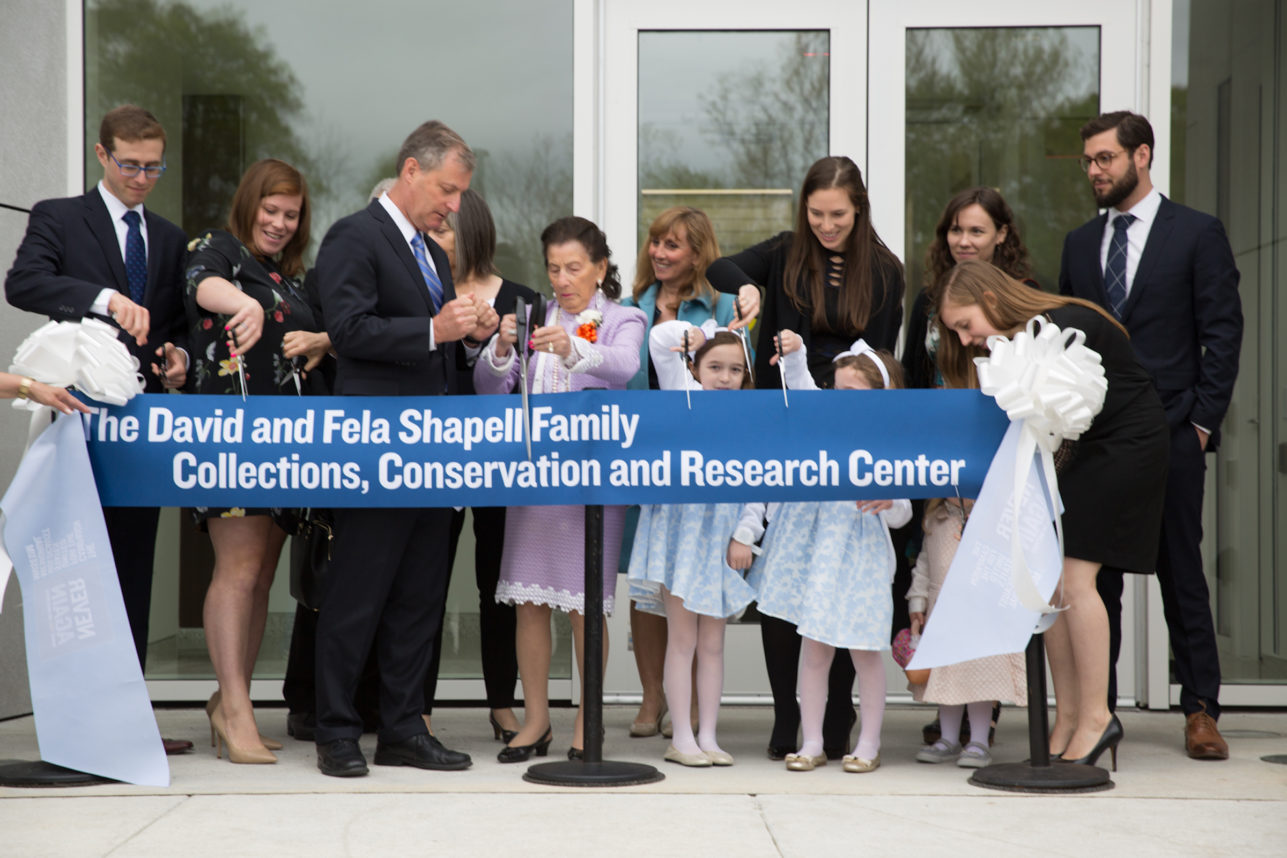
Fela Shapell (center) and her family lead a ribbon-cutting ceremony for the David and Fela Shapell Family Collections and Research Center of the U.S. Holocaust Memorial Museum. Photo courtesy of the U.S. Holocaust Memorial Museum
The United States Holocaust Memorial Museum dedicated its new David and Fela Shapell Family Collections, Conservation and Research Center on April 24 during a ceremony that attracted Holocaust survivors and supporters from around the country.
The center is named for the late David Shapell, who died in 2015, and for his wife, Fela, who lives in Los Angeles with her family. David Shapell was a Los Angeles real estate developer and philanthropist.
The 80,000-square-foot center with specialized laboratories, equipment and climate-controlled environments will house and preserve the Washington, D.C., museum’s growing collection of media and artifacts.
In 2014, the Shapells gave $15 million to the museum to help with “the construction of a massive repository for Holocaust artifacts,” the Los Angeles Times reported.
The ceremony for the center, located in Bowie, Md., coincided with Yom HaShoah, Holocaust Remembrance Day.
Fela Shapell, who survived the Bergen-Belsen concentration camp, attended the ceremony.
Michael Grunberger, director of the museum’s National Institute for Holocaust Documentation, welcomed the center’s opening.
“We are building the collection of record on the Holocaust, a collection that belongs to the nation,” Grunberger said in a statement. “It is our responsibility to ensure that it is preserved for posterity and its truth made accessible to the world.”
From left: American Society for Yad Vashem (ASYV) Chairman Leonard Wilf; Kiss co-founder Gene Simmons; ASYV honoree Rita Spiegel; “Denial” producer Gary Foster; and ASYV Director Ron Meier attend the ASYV Generation to Generation 2017 Gala. Photo by Vince Bucci
The American Society for Yad Vashem (ASYV) celebrated its Generation to Generation 2017 Gala on June 14 in a packed ballroom at the Beverly Wilshire hotel. The organization dedicated to advancing Yad Vashem, the World Holocaust Remembrance Center in Jerusalem, honored Gene Simmons of the rock band Kiss and his mother, Holocaust survivor Flora Klein; the family of the late Edita and Abraham Spiegel, represented by their daughter, Rita Spiegel; and Gary Foster and Russ Krasnoff, producers of the film “Denial.”
“My name is Chaim Witz,” Simmons said in Hebrew when he took the stage, his voice choked with emotion. “I am an Israeli. I am a Jew.”
Simmons, dressed in a dark jacket and wearing his trademark sunglasses under a pile of jet-black hair, repeated the same phrase in Hungarian, then in German, before translating it into English. Simmons’ mother, at age 14, was sent to Auschwitz, where she saw her mother, brother and entire extended family killed. She survived and moved to Haifa, where Simmons was born in 1949. Simmons credited his mother, who remained at her home on Long Island, for his drive, toughness and hopefulness: “ ‘Any day above ground is a good day,’ she always says.”
Sheldon and Dr. Miriam Adelson presented Rita Spiegel and the Spiegel family with the Lifetime Achievement Award. Adelson said Rita’s father, who survived Auschwitz with Rita’s mother, inspired him to get involved in Jewish philanthropy.
Also in attendance were Consul General of Israel in Los Angeles Sam Grundwerg; Leonard Wilf, chairman of ASYV; gala chair Karen Sandler; Remember Us Director Samara Hutman; The Jewish Federation of Greater Los Angeles President Jay Sanderson; former Wynn Las Vegas President Marilyn Spiegel and her husband, Tom; ASYV Executive Director Ron Meier; J Media Group CEO Jess Dolgin; philanthropist Jake Farber; and Paul Stanley,Simmons’ Kiss bandmate.
The event raised approximately $800,000 for Yad Vashem.
— Jewish Journal Staff
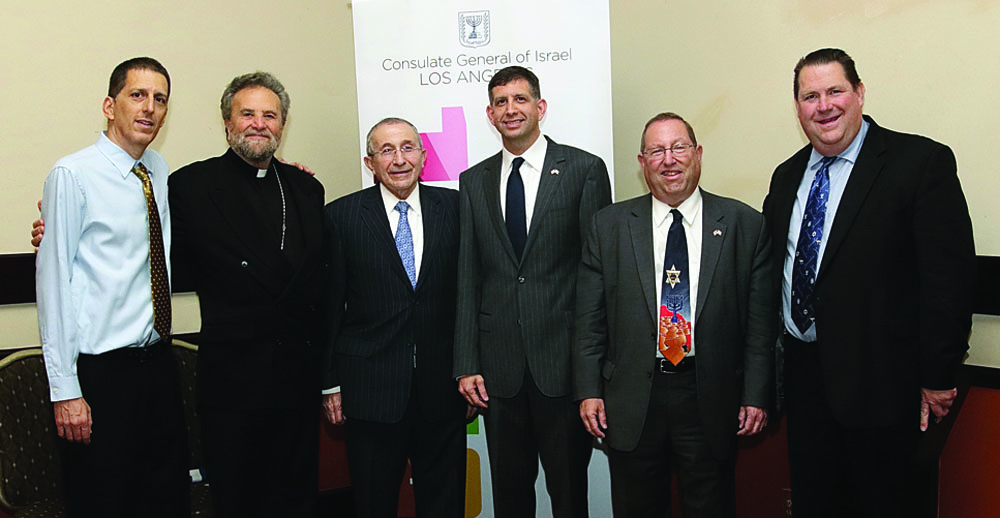
From left: “Jerusalem of Gold” organizer Ari Bussel; Reverend Father John Bakas, dean of Saint Sophia Cathedral; the Simon Wiesenthal Center’s Rabbi Marvin Hier; Consul General of Israel in Los Angeles Sam Grundwerg; L.A. City Councilmember Paul Koretz; and Pastor Timothy Hinkle from Sacramento attend “Jerusalem of Gold.” Photo by Michelle Mivgan
Fifty years after Israel Defense Forces soldiers raised the Israeli flag over the Temple Mount in Jerusalem, nearly 700 Christians, Jews and others gathered at Neman Hall at Temple Beth El in West Hollywood and declared, “There is no other place like Jerusalem, ‘Jerusalem of Gold,’ the city of God.”
A group of Israeli and American community members, including Jews and Christians unaffiliated with any organization, organized the June 7 event, titled “Jerusalem of Gold,” commemorating the reunification of Jerusalem.
“We were a group of people who care about Jerusalem and wanted to celebrate that special day,” said Ari Bussel, an event organizer. “We didn’t have any celebrities attending the event. The only name that drew people was the name of the city Jerusalem.”
Additional participants included Consul General of Israel in Los Angeles SamGrundwerg; Simon Wiesenthal Center Dean and Founder Rabbi Marvin Hier; and Beverly Hills Mayor Lili Bosse, the daughter of Holocaust survivors from Poland.
Bosse presented Holocaust survivors in attendance with a special proclamation: “Just like we vow never to forget Jerusalem, we vow never to forget you.”
Among the survivors was Mireille Wolf, a philanthropist who shared her moving story with the audience.
“I am a survivor,” Wolf said. “I have stories of evil to tell. I also have stories of survival and of the joys of being alive with family, tradition and a life well lived in freedom. We should commemorate the memory of the Holocaust by listening to those survivors who still have stories to tell us as we celebrate each day of our survival and of Israel.”
The event featured performances and appearances by the Christian Fellowship Chorale;the Leaves of Healing Tabernacle worship team; Valley Beth Shalom Cantor Herschel Fox; Los Angeles City Controller Ron Galperin; musician Sam Glaser; Sephardic Temple Cantor Haim Mizrahi; Temple Emanuel of Beverly Hills Cantor Lizzie Weiss;musician David Yakobian;and Israeli singers Gilat Rapaport and Liel Kolet.
— Ayala Or-El, Contributing Writer
Moving & Shaking highlights events, honors and simchas. Got a tip? Email ryant@jewishjournal.com.
Graphic artist Jill Arons died June 7 from breast cancer. She was 56.
Born Dec. 22, 1960, Arons owned her own graphics business for many years before becoming a graphics design editor of The Bingo Bugle, a bingo publication.
Arons’ family said she loved movies, puzzles, TV, bowling, bingo, the Los Angeles Kings, traveling, ’70s pop songs andtchotchkes.
She is survived by her husband, Rich; daughter Samantha (Mark Prindle); parents Sue and Arnold Kogen; brother Jay Kogen; sister-in-law Brown Kogen; nephew Charlie Kogen; in-laws Stan and Loretta Arons, and sister-in-law and brother-in-law Janet and Bob Schultze.
Ephraim Isaac Baran died June 7 at 95. Survived by daughter Naomi; sons Josh, David; 2 grandchildren. Armstrong Family Malloy-Mitten
Marie Boren died June 13 at 80. Survived by daughter Eve (Tom) Stout; son Joseph; 2 grandchildren; sister Diane (Sheldon) Dzodin. Mount Sinai
Milton Bromberg died June 8 at 94. Survived by wife Diane Lautman-Bromberg; sons Marc, Bruce; 1 grandchild; sisters Shirley Cooperman, Florence Zarin. Mount Sinai
Rena Deutsch died June 7 at 73. Survived by husband Ralph; stepdaughter Stacey; stepson Todd; sister-in-law Barbara Sherman. Mount Sinai
David Eissler died June 12 at 68. Survived by wife Marjorie; daughters Jillian, Rebecca; sisters Nancy Fichera, Katherine Longer; brother Robert Eissler. Mount Sinai
Rhoda Galardi died June 8 at 85. Survived by daughters Lain Kennedy, Roxy Dee, Gigi Galardi, Kelly Galardi; sons Rob (DeAnne Brining) Beller, Michael (Edwin Billiot) Zephyr, Joe; 5 grandchildren; brother Gary (Carol) Zimmerman. Malinow and Silverman
Ira Gerber died June 8 at 67. Survived by daughter Pamela (Eric) Abraham. Mount Sinai
Andrew Glauberg died April 7 at 37. Survived by mother Rhoda; father Joe; brother Daniel. Mount Sinai
Sam Kappe died June 13 at 87. Survived by wife Anita; daughter Jill (Brian) Stanley; sons Randall, Matthew Kappe; brother Leonard (Abbey) Kapelovitz. Mount Sinai
Randy Harlan Katz died June 3 at 62. Survived by wife Tina; daughter Ashley (Brandon) Shapiro; sons Michael, Matthew; sister Lisa (David) Weld; brothers Greg, Jeff. Mount Sinai
Joseph Kaufman died June 15 at 91. Survived by wife Phyllis; sons Jeffrey, Gary; 4 grandchildren; 3 great-grandchildren. Mount Sinai
Abraham Saraga Koresh died June 10 at age 71. Survived by wife Sharon; stepdaughter Nicole (Brandon Abraham) Berlin; sisters Marga Rockopf, Nava. Mount Sinai
Rhoda Lesh died June 16 at 83. Survived by daughter Susan; sons Scott (Darla), Mitchell (Aleta); 4 grandchildren; 2 great-grandchildren; sister Mickey Bilsky. Mount Sinai
Sandra Joan Levinthal died May 31 at 83. Survived by husband Eugene; daughter Linda (Jamie) Hunter; son David; 5 grandchildren; 1 great-grandchild; brother Robert (Millie) Peskay. Mount Sinai
Lebarose Mirochnick (Miro) died June 14 at age 87. Survived by daughters Sandra (Ralph) Sklarew, Sheri (Phil) DeCarlo; sons Jeffry Miro, Marc (Sunny); 12 grandchildren; 5 great-grandchildren. Mount Sinai
Evelyn N. Potkin died June 6 at 100. Survived by sons Ralph (Eugenia), Steven, Jeffrey, Benjamin; 10 grandchildren; 8 great-grandchildren. Mount Sinai
Jan Rimer died June 12 at 81. Survived by husband Seymour; daughters Kelly Nolan, Julie Caruso. Mount Sinai
Adele Schachter died June 12 at 86. Survived by sons Steven (Debbie), Gary; 5 grandchildren; 3 great-grandchildren. Mount Sinai
Shirley Schwartz died May 6 at 88. Survived by daughter Barbara (Rodger) Sadikoft; son Mark (Lea); 2 grandchildren; 3 great-grandchildren. Chevra Kadisha
Gertrude Small died June 10 at 90. Survived by daughters Deborah, Jacqueline (Mike) Easely; son Mark (Lisa). Mount Sinai
Henry Young died June 12 at 76. Survived by wife Valerie; daughter Heidi (Tina) Young-Lefferty; sons David (Zaira), Michael (Julee); 9 grandchildren; sister Gena Gutman. Mount Sinai
Norma Zane died June 5 at 92. Survived by daughter Eileen Zane Rieder; son Arnold (Trisha Thordarson); 8 grandchildren. Mount Sinai
Hannah Rachel Zukerberg died June 16 at 93. Survived by daughter Janis (Wayne) Wershow; son Jeffrey (Mary); 3 grandchildren; 5 great-grandchildren. Mount Sinai
Adat Chaverim is having a huge garage sale. Come early and find items such as clothes, linens, 78-rpm records and much more. 8 a.m. Free. Private home, 5116 Varna Ave., Sherman Oaks, near West Magnolia Boulevard and Fulton Avenue. (888) 552-4552. humanisticjudaismla.org.
“THE DEAFENING CRIES OF WOMEN AND GIRLS”
Jewish Platform for Advocacy and Community Engagement presents “The Deafening Cries of Women and Girls: A Voice for Chibok and Yazidi Girls Tortured by Boko Haram and ISIS.” Speakers include Isha Sesay, CNN anchor who recently worked with former first lady Michelle Obama for the CNN film “We Will Rise: Michelle Obama’s Mission to Educate Girls Around the World”; and Rabbi Avraham Berkowitz, senior adviser for Global Impact, Synthetic Neurobiology Group, MIT Media Lab. 9:30 a.m. Shabbat service; 11:30 a.m. presentation. Free. The Beverly Hills Hotel, 9641 Sunset Blvd., Beverly Hills. (310) 276- 4246. beverlyhillsjc.org.
MARILYN ANDERSON
Marilyn Anderson will discuss and sign her new book, “How to Live Like a Millionaire When You’re a Million Short.” Learn how to save thousands of dollars on entertainment, restaurants, shopping, fashion, travel, health, beauty, home decor and more. Plus, you will get plenty of tips on how to get things at no cost, even how to receive a six-night stay at a four-star resort in Spain for free! Food and book available for purchase. 11:30 a.m. Free. Il Piccolo Verde, 140 S. Barrington Place, Los Angeles. howtolivelikeamillionaire.com.
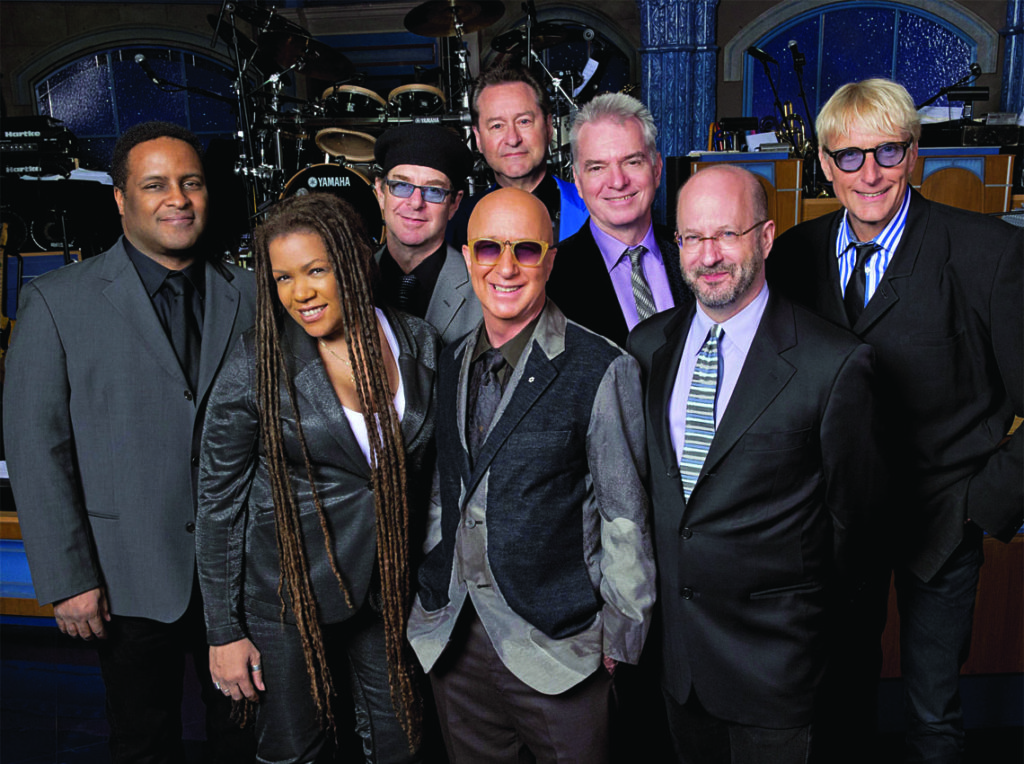
PAUL SHAFFER & THE WORLD’S MOST DANGEROUS BAND
Until recently, if you wanted to hear Paul Shaffer and his crew of musicians, all you had to do was turn on your television. They performed nightly, first on NBC’s “Late Night With David Letterman” and later on CBS’ “Late Show With David Letterman,” shifting their persona from the World’s Most Dangerous Band to the CBS Orchestra. They soon will be releasing a new album and are on a North American tour. Audience members younger than 18 must be accompanied by a paying adult. 6 p.m.; 8 p.m. main event. Tickets start at $48. Saban Theatre, 8440 Wilshire Blvd., Beverly Hills. (323) 655-0111. sabanconcerts.com/events/paul-shaffer.
JEWISH COMEDY FESTIVAL
The Los Angeles Jewish Comedy Festival will showcase more than 20 comedians in an evening of stand-up comedy. Featuring Kira Soltanovich, who has appeared on “The Tonight Show With Jay Leno,” and including Adam Gropman, Alex Caine, Benny Spiewak, Brandon Morganstein, El Smith, Elijah Katz, Fiona Reid, and many more. Hosted by Alex Kojfman.Presented by Temple Emanuel of Beverly Hills YoPro. 18-and-older event. 8 p.m. $18; $36 at the door. Tickets available at eventbrite.com. Temple Emanuel of Beverly Hills, 8844 Burton Way, Beverly Hills. (310) 288-3737. tebh.org.
SUN JUNE 25
“THE DIARY OF ANNE FRANK” 70TH ANNIVERSARY
The Los Angeles Museum of the Holocaust and the Anne Frank Center for Mutual Respect commemorate the 70th anniversary of “The Diary of Anne Frank.” The program will include a screening of the award-winning documentary “No Asylum,” about the U.S. refusal to grant asylum to the Frank family, followed by a Q-and-A with film director Paula Fouce and professor Diane Wolf, director of the Jewish Studies Program at UC Davis. 3 p.m. Free. Los Angeles Museum of the Holocaust, 100 The Grove Drive, Los Angeles. (323) 651-3704. lamoth.org.
HIKE WITH ATID
Join Atid, Sinai Temple’s group for people in their 20s and 30s, for a hike in Los Leones Canyon. Hike up to the first overlook and then back (about 3 miles total) or go all the way up to the peak (about 7 1/2 miles total). Bring water and a hat. Atid events are for Jewish young professionals ages 21 to 39. 10 a.m. Free. Los Leones Canyon Trailhead, 510 Los Linnes Drive, Los Angeles. atidla.com.
BRUNCH WITH STEPHEN TOBOLOWSKY Temple Etz Chaim Men’s Club presents actor and author Stephen Tobolowsky, who will discuss his new book, “My Adventures With God,” in which he tells true stories about life, love and Hollywood in a biblical context. 10:30 a.m. $10; $8 for members. Temple Etz Chaim, 1080 E. Janss Road, Thousand Oaks. (626) 773-0251. templeetzchaim.org.
“LOSS AND FOUND”
This powerful triple narrative takes the audience on a single journey in three perspectives. Follow as a young adoptee searches for her identity and answers to questions of her Jewish and African-American heritage, while her biological mother and grandmother receive the reunion they had long hoped for. Presented by the Santa Monica Playhouse Benefit Series and Jewish Heritage Program. 3:30 p.m. $18. (310) 394-9779. Santa Monica Playhouse, 1211 Fourth St., Santa Monica. santamonicaplayhouse.com/loss-and-found.
TUES JUNE 27
CREATIVE COMMUNITY FOR PEACE
Enjoy a private viewing of “Paul Simon: Words & Music,” an exhibition organized by the Rock and Roll Hall of Fame and Museum, at the Skirball Cultural Center, with a special performance by David Draiman, frontman for the band Disturbed. 6:30 p.m. $54. Skirball Cultural Center, 2701 N. Sepulveda Blvd., Los Angeles. creativecommunityforpeace.com/music-of-paul-simon-rsvp.
The Chloé Pourmorady Ensemble will perform June 27 at Skirball Cultural Center.
CHLOE POURMORADY ENSEMBLE
Violinist, vocalist and composer Chloe Pourmorady is a new voice with an ensemble of dynamic musicians from diverse backgrounds. Pourmorady fuses soulful Persian and Jewish roots with Balkan, rock, classical and avant-garde sensibilities. Community partners for the concert are 30 Years After and JIMENA (Jews Indigenous to the Middle East and North Africa). 8 p.m. Tickets starting at $30. Skirball Cultural Center, 2701 N. Sepulveda Blvd., Los Angeles. bit.ly/chloeskirball.
WED JUNE 28
“THE CRYPTO-JEWS”
Rabbi Arinna Shelby will discuss “The Crypto-Jews.” Also called Marranos or Conversos, Crypto-Jews were Jews forced to convert to Catholicism in 14th- and 15th-century Spain. Shelby will present their history with a glimpse into their everyday lives and secret practice of Judaism. After lunch, there will be a screening of “The Secret Jews of Calabria,” about Jews of southern Italy descended from Crypto-Jews. 11 a.m. Free. Temple Menorah, 1101 Camino Real, Redondo Beach. (310) 316-8444. templemenorah.org.
“CULTURE LAB: TRUTH”
See a preview of “Culture Lab: Truth,” an interactive, mixed-media art installation and performance piece created by a group of four artists: Brendan Eder, Andrea Hodos, Betsy Medvedovsky and Alexx Shilling. Working in wide-ranging disciplines, including dance, spoken word, sound and design, these artists draw on both current events and stories from the Jewish tradition.“Culture Lab: Truth” asks, “How can you discern what the truth is?” 6 p.m. (Opening night, June 29, at 7 p.m. ) Free; donations encouraged. Silverlake Independent Jewish Community Center, 1110 Bates Ave., Los Angeles. (323) 663-2255. sijcc.net.
WINE TASTING
Rosé season is here. Join YALA’s Wine Cluster for a taste of value-driven summer pleasers and a fun evening with new friends. 7:30 p.m. $25; tickets available at eventbrite.com. The Belmont, 747 N. La Cienega Blvd., Los Angeles. yala.org.
I applaud Rabbi David Wolpe’s call for rabbis to focus their public teaching on texts and Jewish traditions — on Jacob and Rachel, not Pence and Pelosi, as he put it (“Why I Keep Politics Off the Pulpit,” June 9). Too often rabbis focus their sermons exclusively on contemporary politics — whether American or Israeli — and squander their weekly opportunity to teach Jewish texts to a semi-captive audience that does not regularly study our traditions. However, Wolpe’s argument that rabbis should avoid politics almost entirely — whether on or off the pulpit — contains at least two fundamental flaws.
First, there is no neutrality in politics any more than there is neutrality in Sabbath observance. Sabbath comes, and one observes it or not in whatever way they choose. So-called political neutrality is itself a form of political expression. It is support for those in power, or for those destined to be victorious without the voice of the rabbis.
Second, there is no single Judaism today. Judaism is divided among competing denominations with different core values. Insisting that neither support for Trump nor opposition to him necessarily opposes the Torah is itself setting the Jewish values of one’s community in a specific way. Wolpe’s brilliant caricature of the Jewish claims of the right and left does not prove that a rabbi must avoid these positions. Rather, each rabbi and community must decide if the Torah in fact does support one position.
Joshua Shanes
College of Charleston
In the current fraught environment, almost any effort to discuss political issues through a Torah perspective will result in half of the congregation concluding that the rabbi has debased, disgraced or even outright falsified the Torah in order to promote her political opinion. Even if or when the rabbi is positive that he is right about the Torah and the issue at hand, all he will be achieving is preaching to the choir (useless), and alienating the non-choir (useless or worse). Best thing is to preach about the importance of having deep, open-minded dialogue with people we disagree with.
Rabbi Yosef Kanefsky
B’nai David-Judea
We have a standing policy at Pico Shul to keep politics out of shul. Our community of mostly millennial Jews is diverse politically, ethnically and religiously. But that does not stop us from raising money to help the homeless, feed the hungry or pray for the sick. It does not prevent us from advocating and praying for the welfare of Jews and others in need around the world. If we take the sacred day of Shabbat and turn it into a platform for politics and potential divisiveness, we actually may be desecrating rather than elevating our synagogues — built to be houses of worship and connecting with the Divine.
Rabbi Yonah Bookstein
Pico Shul
As the rabbi whose picture online accompanied Rabbi David Wolpe’s op-ed on politics and the rabbinate, I feel compelled to offer a clarification and a question. In the photo, I was being arrested along with 17 other rabbis across denominations in an act of civil disobedience to protest President Donald Trump’s proposed ban on refugees and immigration from (then) seven Muslim-majority countries. The action, sponsored by T’ruah: the Rabbinic Call to Human Rights, took place under the aegis of that organization and not our respective congregations or other organizations we serve.We were, therefore, keeping our “politics” separate from our “pulpits.”
Nevertheless, the photo raises a principled objection to Rabbi Wolpe’s argument, namely, that a rabbi should be someone who marshals Jewish tradition to clarify the severity of the injustices we tolerate day to day, and then acts with others to do something about it. For many rabbis of all sensibilities, this understanding of the rabbinic role is one of the great legacies of Rabbi Abraham Joshua Heschel. Rabbi Wolpe’s own record of work is profound, and he would make an important contribution were he to express himself forthrightly on the issues that so profoundly affect our collective well-being as a society.
Rabbi Justin David
via jewishjournal.com
A Father’s Calling
Amazing journey by Dan Freedman (“Dad Steps Into Unexpected Role After Tragedy Strikes,” June 16). Incredible words hit home on a lot of levels. Thanks for putting it out there. Life, to a large extent, is how you handle life’s curveballs. I can say you’ve handled it with grace and determination. Congrats on a Life’s Journey, Part 1, well done! Dads rock !
Bo Greene
via jewishjournal.com
Courage in the Face of Terror
My deepest respect and appreciation for everyone in this story (“Synagogues Carry On in Face of Bomb Threats,” June 16)who refused to give in to such cowardly acts, including Rabbi Steven Z. Leder, Rabbi Morley T. Feinstein, Michelle at the Beverly Hills Marriott, the Ansell family and — perhaps, most of all — Zachary Ansell, for demonstrating how ready he was and is to become a man. Terror cannot win so long as we remain resolute.
By the looks of all the moving vans and U-Haul trucks on my street, I’d say we’re smack in the middle of moving season. Relocating to a new house or apartment can be exciting, but it also can be incredibly stressful — and that’s even before you meet the crazy neighbors. But with a little planning and foresight, moving day can go a lot more smoothly. Just keep these tips in mind and you’ll be moving right along.
1. Research moving services. Look for reviews and make sure the companies are licensed.
2. If you need to hire a moving service or rent a truck, schedule your move on non-peak days. There is more availability on weekdays and the middle of the month.
3. Reserve your moving service at least a month in advance, or a truck rental at least two weeks in advance.4. Donate or sell items you don’t need anymore. Now is not the time to be sentimental. If you haven’t used an item in a while, get rid of it. The more you purge, the less you’ll have to move.
5. Get free boxes from grocery and liquor stores.(but check to see if there are any bugs in them). And ask if your office is discarding photocopier paper or file boxes.
6. Wrap smaller, delicate items with T-shirts and sweaters. You’ll save on paper and bubble wrap — and transport your clothing at the same time. Wrap larger items that might break with blankets and sheets.
7. Remove light bulbs from lamps before packing them.
8. Pack a little every day before you move so you’re not overwhelmed.
9. Label your boxes by category and room.
10. Label the tops and sides of the boxes.
11. Number your boxes so you can keep track of them more easily, and compile a master list of what is in each numbered box.
12. Put lighter items in the larger boxes, and heavier things in smaller boxes. A lot of heavy objects in big boxes will break your back.
13. Pack dishes vertically as you would record albums. Wrap them with paper or T-shirts so they don’t jiggle in the box.
14. Roll up socks to fill any empty spaces in boxes to keep things from moving around.
15. Take pictures of the back of your television, computer and other electronics so you’ll remember which cords get connected to which ports.
16. Place a piece of masking tape on all cabinets and drawers as you empty them so you can keep track of what’s been packed — and if you’ve forgotten anything.
17. Feed your helpers. And make sure there’s plenty of water for everyone.
18. Have a point person to direct traffic in your new place, telling movers where everything goes as it comes in.19. All boxes and furniture should go directly to their intended room. Do not waste time and energy by placing everything in the living room and then having to move it all again later.
20. Zip-tie several hangers of clothing together. Then wrap them all with a sheet so the clothes don’t fall off during the move.
21. Pack your cleaning supplies last so you can give your old place a good cleaning before you leave.
22. If you’re renting, take photographs of both your new and old spaces. It comes in handy if there’s a dispute getting back your security deposit.
23. Pack what you’ll need immediately in a clear plastic container so you can see the contents, and keep it separate from the other boxes.
24. Keep a bag of essentials, e.g., toiletries, medicine and phone chargers. You’re going to want them handy.
25. If you’re moving locally and have pets, find a sitter for the day so they aren’t stressed by all of the commotion.
Jonathan Fong is the author of “Walls That Wow,” “Flowers That Wow” and “Parties That Wow,” and host of “Style With a Smile” on YouTube. You can see more of his do-it-yourself projects at jonathanfongstyle.com.
Ever dreamed about a singular event changing your life for the better? For me, it took place Sept. 18, 1972, on the steps of my synagogue, just outside of Philadelphia.
It was Yom Kippur, I was 22, and I noticed a beautiful young woman I had never seen before. We stared at each other through the rest of the day’s services.
When we left, I turned to my friend David and asked her name. “Millie,” he said, “but she is close to being engaged.”
Weeks later, I was planning to move out of our family’s home and into an apartment with a friend. As I walked into the house, my mom said Millie had called twice. I said that I did not know a Millie. Mom responded, several times, “You really need to call her back.” Nothing more. (Little did I know that our mothers knew each other from the beauty parlor.)
I called and my first words were, “Hi, but I don’t know who you are.” She replied, “We stared at each other on Yom Kippur. Why didn’t you contact me?”
I told her what happened — that David had said she was close to getting engaged. “That isn’t true,” she said. “He always wanted to date me and is probably jealous.”
We spoke for an hour and I asked her out on a date on Saturday night, four days later. The next day, however, she called and said a friend needed her to drive to State College — a few hours away — but she would go only if I agreed to go out on Monday after work. I said that would be fine.
So, a little more than a month after first eyeing each other from afar, we met. It was the last Monday night in October. While neither of us was a film buff, we decided to see a movie. Too bad it was “Deliverance.”
Despite the unforgettable horror of the movie, I wasn’t thinking about it when I dropped off Millie afterward. My brain was in overdrive. It was like we had known each other for years. It was so easy to talk about anything.
Our next date was two days later on Wednesday night; we grabbed a bite to eat at a diner. That weekend I took Millie, 19, to her first hockey game, the Chicago Blackhawks versus the Philadelphia Flyers. I already had the tickets — the one I gave to Millie was originally supposed to be for a friend, but he understood.
I don’t remember which team won, but I’ll never forget how we sat in the top row at center ice of the Spectrum arena and I explained the game of hockey to Millie.
The following week we saw each other on Monday, Tuesday and Wednesday nights after work. Driving back to Millie’s house on Wednesday, we parked outside and spoke about many important things.
Before I walked her to the front door, I spontaneously said, “I am not afraid of getting married.”
“Me, too,” Millie said.
“Let’s get married.”
She responded: “YES.”
In just 10 days, my life had changed for the better.
I ordered Millie’s engagement ring and gave it to her the Tuesday night before Thanksgiving. We were married on June 24, 1973. (It would have been earlier, but the shul was booked!)
Now, 44 years later, our life together still never gets old.
Millie has made the bad times tolerable and the good times better. We have worked together and I never tire of being with her. She is the love of my life who has been the most wonderful wife, mom and treasured friend.
Last year, some words popped into my head — “Just 10 Days to Make a Life Complete” — and I decided to commission a song for Millie. Lucky for me, I came across a talented folk-rock singer/songwriter/musician, Natalie Gelman, who took my thoughts and turned them into a song that we recently presented to my wife.
It was a wonderful surprise — and a lasting reminder of a quick courtship that has proven everlasting.
Looking back, it still amazes me: The best decision I ever made was also one of the fastest.
Warren Potash trains athletes and lives in Moorpark.
Israeli researchers have developed a new therapy to treat atherosclerosis — the hardening and narrowing of the arteries — and prevent heart failure, using a new biomedical polymer that reduces arterial plaque and inflammation in the cardiovascular system.
Atherosclerotic cardiovascular disease causes 56 million deaths annually worldwide, according to the 2015 Lancet Global Burden of Disease Report.
Arteries are lined by a thin layer of cells, the endothelium, which keeps arteries toned and smooth and maintains blood flow. Atherosclerosis begins with damage to the endothelium, typically caused by high blood pressure, smoking or high cholesterol.
When endothelial cells become inflamed, they produce a molecule called E-selectin, which brings white blood cells (monocytes) to the area. That leads to dangerous plaque buildup in the arteries.
At present, there are several available treatment options for atherosclerosis, but no therapy can reverse arterial damage and improve the heart muscle. An innovative nano-polymer made in Israel shows promise in reducing arterial damage and improving the heart muscle.
This E-selectin-targeting polymer selectively repairs damaged tissue without harming healthy tissue, so it has no side effects — unlike statins, which currently are the leading medication used for treating atherosclerosis.
“Our E-selectin-targeting polymer reduces existing plaque and prevents further plaque progression and inflammation, preventing arterial thrombosis, ischemia, myocardial infarction and stroke,” said Ayelet David of the Ben-Gurion University of the Negev (BGU) department of clinical biochemistry and pharmacology.
Patented and in preclinical stage, the new polymer has been tested on mice with positive results.
In a study soon to be published, David and fellow researchers describe how they treated atherosclerotic mice with four injections of the new biomedical polymer and tested the change in their arteries after four weeks.
“We were stunned by the results,” said Dr. Jonathan Leor, director of the Cardiovascular Research Institute at Sheba Medical Center and professor of cardiology at Tel Aviv University, who collaborated with David on the research study.
“The myocardial function of the treated mice was greatly improved, there was less inflammation and a significant decrease in the thickness of the arteries,” Leor said.
David and Leor suggest that this polymer-based therapy also may be helpful to people with diabetes, hypertension and other age-related conditions.
As such, the new polymeric therapy may have life-changing benefits for millions of people, they said.
“We are now seeking a pharmaceutical company to bring our polymer therapy through the next stages of drug development and ultimately to market,” said Ora Horovitz, senior vice president of business development at BGN Technologies, BGU’s technology and commercialization company.
“We believe that this therapy has the potential to help a great number of people,” Horovitz said.
It was midday in China, early morning in Syria and dusk in Los Angeles — time for Philip and Tamar Koosed to get to work.
Each night in their San Fernando Valley home, they say goodnight to their children, Asher, 3, and Itzhak, 1, then turn to a do-it-yourself operation that is saving lives daily halfway around the world in Syria.
With no staff and virtually no overhead, they have stitched together a network of doctors, suppliers and shippers to send medical aid to the war-torn provinces of Idlib and Aleppo.
Working from a wish list provided by the doctors they work with, the Kooseds source the goods either from Chinese factories or in-kind donations from medical companies. In just more than a year, they have moved more than $20 million in medical supplies, working from their home office in Sherman Oaks.
The need is unrelenting. Now in its sixth year, the Syrian civil war has displaced some 12 million people and trapped hundreds of thousands more in war zones. Idlib and Aleppo have been the sites of intense bombing by the Syrian government, which uses munitions designed to maximize civilian casualties. Throughout the persistent conflict, humanitarian groups have faced a gamut of obstacles, from cities besieged and choked off by militants to a government that allegedly targets medical workers intentionally.
“Our focus is extremely narrow,” Philip said. “How do we provide doctors with lifesaving medical supplies, medical equipment and save as many children as possible?”
The couple’s own children are a major motivation for their work.
“There’s not a time in which I see an image of a 3-year-old and I don’t see my own 3-year-old,” Philip said, sitting nex to Tamar in their living room, “or see a 1-year-old being pulled from the rubble and think, ‘That could be my own son.’ ”
“It’s so transparent that we’re just lucky,” Tamar added. “Like Asher and Itzhak were born to us — but they could have been born in Aleppo. It’s just pure luck.”
‘Two naïve Jews from the Valley’
Philip described their effort as “two naïve Jews from the Valley, trying to save the world in Syria.” The reality is more complex.
Philip, 34, grew up in the San Fernando Valley before co-founding what would become a multimillion-dollar supply-chain management firm while he was an undergraduate at USC. Tamar, 33, runs a consultancy that assesses the impact of social investments by nonprofits and businesses around the world. They didn’t know it at the start, but their skills and contacts were well-suited to saving lives.
From left: Philip and Tamar Koosed and their sons, Asher, 3, and Itzhak, 1.
By June 2016, the couple, who met at USC, had made donations to aid groups in increments of $50 or $100, sometimes more, but they remained largely aloof. “We actively chose to be numb,” Philip said. “I think you kind of have to do that to a certain extent to live.”
The onslaught of horrific images from Syria began to weigh on them. It became the subject of their bedtime conversations, night after night.
Philip and his business partner recently had sold their supply-chain management business for $30 million — though Philip still is the company’s president — and the couple was looking to make a onetime sizable donation and move on with their lives. But they were underwhelmed by their donation options.
“You see Doctors Without Borders, and you see the number of [medical] kits they’re able to send into those areas, it’s something like 800 kits they’re able to get in,” Tamar said. “You see that they’re having a really difficult time.”
With Philip’s manufacturing contacts and Tamar’s involvement with humanitarian nongovernmental organizations (NGOs), they figured they could do better. They hatched a plan to reach out to doctors in Syria to assess their needs, then build a supply chain to meet them.
“Anybody else that would have come to me and said, ‘So, we’re starting to send medical supplies inside of Syria,’ I would have looked at them like they had three heads,” said Mike Brand, director of programs and advocacy for Jewish World Watch (JWW), an Encino-based anti-genocide organization.
Brand had worked with Tamar over the years and was impressed by Philip’s background. Unlike multinational humanitarian organizations, the couple had no red tape or bureaucratic delay to deal with.
“A lot of bigger NGOs don’t have the ability to find locals and just have them take care of stuff,” Brand said. “It’s just not how they operate.”
The couple got to work. By March, less than a year after they started, trucks rolled from Turkey into Syria bearing banners with the name of their fledgling organization, Save the Syrian Children, depositing medical supplies in hospitals across Idlib and Aleppo.
Call for support is answered
At first, most of the work for Tamar and Philip was vetting doctors and hospitals in Syria thoroughly to make sure they were who they said they were, and not the likes of the Islamic State of Iraq and Syria (ISIS) or the jihadist group known as the Al-Nusra Front. “There are a lot of bad actors in Syria,” Philip said.
Finding doctors on the internet or through Tamar’s contacts, they cross-referenced each of their identities with sources inside and outside Syria.
Once they had vetted the doctors and assessed their needs, the next step was to build a supply chain from China to Syria. That was the easy part — building supply chains literally is Philip’s job. “It’s what I do every day and what I have done for the last 17 years,” he said.
For the first six or seven months, they didn’t think about how they were going to pay for the supplies they were shipping. By December, the goods were being loaded onto a 40-foot shipping container in Shanghai.
“The goods were about to ship, and we were like, ‘OK, we’re $100,000 on the hook, we better start talking to people about this,’ ” Tamar said.
They put out the word, with Philip’s sisters helping on social media. They didn’t know what kind of response they would get.
“To a person, everyone said, ‘How can we help?’ ” Philip said. “I guess it shouldn’t have been surprising, but it was surprising.”
His network at Stephen Wise Temple proved to be of particular help. Philip had attended the day school there — it’s where he first met the co-founder of his supply-chain business — and his parents were longtime members of the temple.
At a synagogue event a few months after the Kooseds’ plan began to take shape, Philip and his father ran into Rabbi Yoshi Zweiback. Philip told Zweiback what he was working on.
“I was just really blown away,” the rabbi said.
The Kooseds were looking for a fiscal sponsor, a nonprofit organization that could accept tax-deductible donations on the couple’s behalf and channel the money into buying more supplies. In rabbinic school, Zweiback had started an organization called Kavod, whose purpose is to funnel money from donors to qualified charities. It was exactly what Tamar and Philip needed, sparing them precious time in obtaining nonprofit status.
“If they had to wait six or 12 months to do this, that would mean four shipments they couldn’t make,” Zweiback said. “And that would mean children that can’t have access to basic medical supplies.”
Zweiback helped the Kooseds put an appeal in the temple newsletter. Soon, word of their activism spread beyond the synagogue.
This month, JWW finalized a grant to allow the couple to ship a container of medical goods to Syria on its behalf.
“Nobody has called Syria a genocide per se yet, but it certainly has moved in the direction of the most horrific violence,” said Susan Freudenheim, JWW’s executive director. “We don’t want to take sides in this; we just want to help save lives.”
Though Freudenheim declined to provide the dollar amount of the grant, she said it was enough to fill a 40-foot container with supplies, slated to be filled and shipped in July. She said JWW was attracted to the project because of its low overhead, the cut-rate cost of goods Philip is able to acquire and the couple’s entrepreneurial spirit.
“We’re talking about the equivalent of a garage band,” Freudenheim said. “These people are very, very devoted to what they’re doing.”
The couple also reached out to their professional networks.
Sue Chen, CEO of Carson-based Nova Medical Products, heard about the couple’s work through an email they sent out to members of the Santa Monica Bay chapter of the Young Presidents’ Organization, a business networking group.
“I wrote them [back] at 2 o’clock in the morning because I just couldn’t wait,” she said. “I couldn’t sleep, and I was like, ‘I have to be involved.’ ”
Nova specializes in products that help people with physical challenges or disabilities maintain independence and mobility. In April, two containers donated by Nova left the port of Long Beach with canes, wheelchairs and crutches, along with thousands of items of clothing and canned food donated by the company’s employees. The shipment was expected to arrive this month.
“Thousands of people are dragging themselves around to get from point A to B to try to somehow go on with life, and I have products that are sitting here right now that could change their entire world,” Chen said. She told herself, “I’ve got to get this product over there as soon as possible.”
Working with ‘real heroes’
Tamar was born in a small city in Brazil, where much of her family still lives. She communicates with them through WhatsApp and Telegram — the same technology she uses to talk to doctors in Syria.
Each morning, after working well past midnight, the couple gets up with their kids at around 6:30 a.m.
“I wake up to messages from my family in Brazil and from doctors in Syria,” Tamar said.
Their long nights have begun to pay off for people in Syria. Their first shipment, distributed to 28 hospitals in Idlib and Aleppo, included 200,000 surgical masks, 800,000 pieces of gauze and 150,000 surgical blades.
Each step of the shipping and distribution, from crossing the Turkish border to ripping open boxes in hospitals, is documented carefully at the couple’s request. They also ask doctors to shoot video testimonials about the materials they receive.
“We hope that you continue to support us, as it is impossible for us to get medical supplies as we are trapped here in Idlib,” one doctor, who asked to remain unnamed for security reasons, said on video after receiving supplies from the first shipment.
After a gas attack in April that killed dozens of people, the Kooseds launched an emergency appeal and outfitted hospitals in the war zone with hazmat kits to keep doctors safe as they treated patients who might carry the residue of harmful chemicals.
Two Syrian children embrace in a memorial photograph. Photographs such as these sometimes circulate in Idlib and Aleppo after children die in gas or bomb attacks.
The requests have become more specific and complicated as doctors have grown to trust the couple, and vice versa. The Kooseds have shipped X-ray and electrocardiogram machines, costly medications and a cranial drill for neurosurgery.
Dr. Omar, a neurosurgeon in Idlib who asked that his surname not be used for security reasons, said in an email to the Journal, “The hospital I am working in now has received a lot of the lifesaving medical supplies. These supplies also have been delivered to about 30 hospitals in the area of Idlib province. Philip and I have been working on special orders for brain surgery and other special surgeries, as well.”
In total, the Kooseds have delivered five shipments, with another three en route and two more planned. They estimate their aid has amounted to more than $21 million worth of goods. But the couple still feels that their work is merely a footnote to the heroic daily efforts of the surgeons and other medical staff they work with in Syria.
“We’re trying to help real heroes on the ground and real victims,” Philip said. “That’s all we’re really doing and, I don’t know, it just doesn’t feel special. It’s something that anyone can do. The first step is just doing something.”




 “THE DIARY OF ANNE FRANK” 70TH ANNIVERSARY