
fbpx

June 18, 2017

Malka

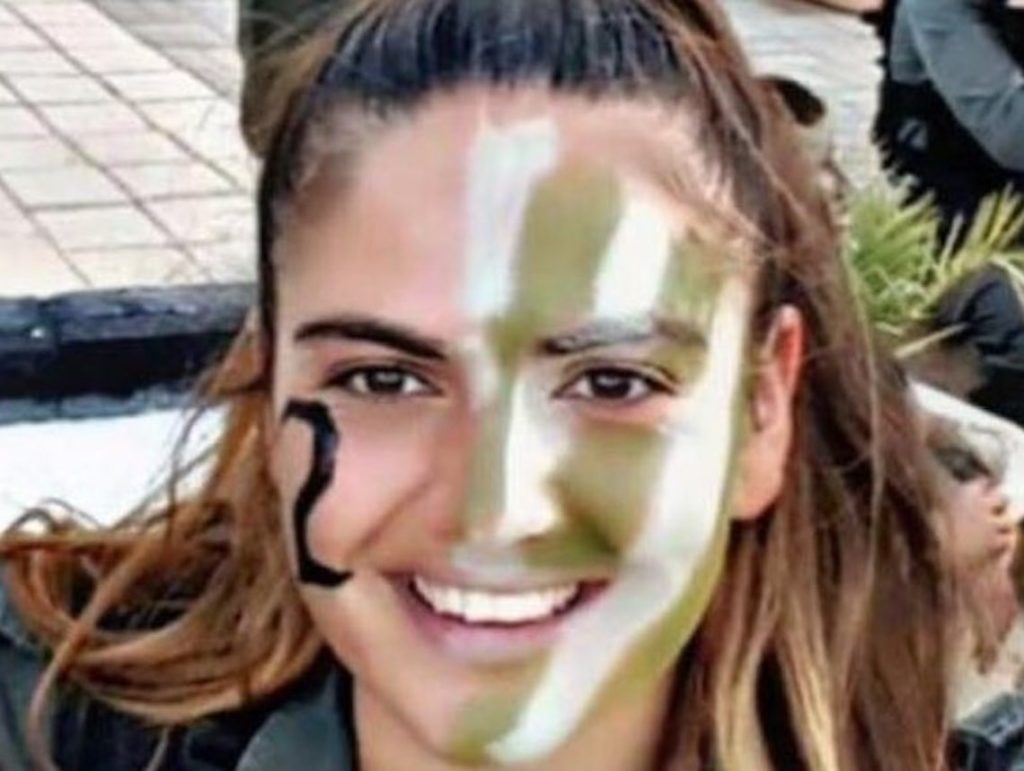
Thousands attend funeral for Israeli police officer killed in terror attack

Thousands attended the funeral of Israeli Border Police officer Hadas Malka, who was killed by a Palestinian terrorist.

The funeral at a military cemetery in Ashdod began just after midnight Sunday morning, about 24 hours after she died of her wounds sustained during the Friday night attack near the Damascus Gate in the Old City of Jerusalem.

Malka, 23, was killed as she responded to a Palestinian shooting attack at the nearby Zedekiah’s Cave. All three attackers were killed by Israeli forces. Malka reportedly worked to free her weapon while fighting off her attacker.

“You cared for everyone, always lent a helping hand; your joy for life swept everyone away,” Police Chief Roni Alsheich said at the funeral as part of his eulogy, The Times of Israel reported. “You loved everyone. You stayed away from gossip and speaking ill of others. You were a fighter who loved people.”

Malka is survived by her parents and five siblings.

Israeli Prime Minister Benjamin Netanyahu expressed condolences on behalf of the government and the nation to the Malka family Sunday morning at the start of the weekly Cabinet meeting. “Their grief is our grief; their sorrow is that of the entire nation. Hadas was a young person full of life. She was imbued with a sense of mission of defending the State of Israel. Her commanders and those under her command loved her and trusted her,” Netanyahu said.

He announced that in the wake of the attack, Palestinian visits to Israel that were approved for the Muslim observance of Ramadan were revoked and that security forces are preparing to demolish the homes of the attackers. He added that he instructed police to beef up security around the Damascus Gate.

The Palestinian Authority issued a statement on Saturday condemning the deaths of the three attackers, calling it a “war crime” by Israeli forces. The PA has not condemned the Friday night attacks.

“I call on the countries of the world to condemn both the murder and those who praise it, and demand the immediate cessation of Palestinian Authority payments to the families of terrorists, something that only encourages terror,” Netanyahu also said Sunday.

The Islamic State initially claimed responsibility for the attack, the first time it has claimed responsibility for a Palestinian terror attack in Israel. Hamas later denied the claim, saying that one of the attackers was a member of Hamas and the other two identified with the Popular Front for the Liberation of Palestine.

Thousands attend funeral for Israeli police officer killed in terror attack Read More »
The Torah is Political – Rabbis, Jews and Synagogues ought to be too

The debate in the pages of the Los Angeles Jewish Journal between my colleagues Rabbi David Wolpe and Rabbi Rick Jacobs with comments from other colleagues as well about whether it is ever appropriate for rabbis to speak on “politics” from the bimah recalls a blog I wrote some time ago addressing this issue that I present here again with modification.
It’s important, however, before going any further to distinguish between politics, policy, and partisanship. I do not believe it is the rabbi’s place, under almost all circumstances, to ever endorse candidates for political office from the bimah. If they choose to do so as individuals, they have to accept the consequences of alienating members of their communities.
Supporting policy is a different matter, and Rabbi Wolpe believes that we rabbis are not ordained to discuss policy as such, regardless of what we personally believe. He notes as well that in our pews are people who have far more expertise on matters of policy than are we – and he is right.
However, though good people can bring to bear Jewish values and apply them to different policy options on the great moral and ethical challenges we face as a society, if the rabbi can apply Jewish texts and values to a particular policy position while recognizing that there is a legitimate position from Jewish tradition on the other side of the aisle, I see no harm in doing so especially if the rabbi says explicitly that he/she does not claim the last word.
The matter of politics and Judaism is a larger one, and it is that issue that I have written about in a former blog.
Here are the salient points I once wrote that are relevant here:
….Should we [rabbis and synagogues] speak collectively about contemporary issues confronting our nation in particular, such as health care, economic justice, prison reform, the poor, women’s and LGBTQ rights, racism, immigration, religious minorities, civil rights, climate change, war, and peace, etc? Or should we refrain and concentrate purely upon “spiritual” and ritual matters? What, if any, limitations should rabbis and synagogue communities impose upon themselves?
Before I offer a few operating principles that have guided me, it is important to understand what we mean by “politics.” Here is a good operative definition from Wikipedia:
“Politics (from Greek πολιτικός, “of, for, or relating to citizens”), is a process by which groups of people make collective decisions. The term is generally applied to the art or science of running governmental or state affairs. It also refers to behavior within civil governments. … It consists of “social relations involving authority or power” and refers to the regulation of public affairs within a political unit, and to the methods and tactics used to formulate and apply policy.”
The first question is this – Should rabbis and synagogue communities be “political” in the sense of this definition?
I believe we should and have every right to speak and act in the sense of the meaning above.
There are, of course, limitations. What we Rabbis, Jews, and synagogue communities say must be said on the basis of Jewish religious, ethical and moral principles that promote common decency, equality, justice, compassion, humility, human freedom, and peace as founded upon the values of B’tzelem Elohim (that every man, woman, and child is created in the Divine image and is therefore infinitely worthy and valuable) and Ohavei Am Yisrael (that we share a “love for the people of Israel”).
We need to remember as well when speaking that Jews hold multiple visions and positions on the myriad issues that face our community and society. Rav Shmuel (3rd century C.E. Babylonia) said “Eilu v’eilu divrei Elohim chayim – These and those are the words of the living God.” In other words, there are many legitimate and authentic religious and moral perspectives within Judaism that must be respected and deemed as Jewish values even when they seem to conflict.
In the realm of partisan politics, the American Jewish community has no unanimous political point of view, though since WWII between 60% and 90% of the American Jewish community has supported moderate and liberal policies and candidates for political office locally, at the state and national levels. We are a politically liberal community, but there are also conservatives among us.
The Reform movement (represented by the Religious Action Center in Washington, D.C., the social justice arm of the Union for Reform Judaism) has consistently taken moral, ethical, and religious positions on public policy issues that come before our government and in our society as a whole, though the RAC does not endorse candidates nor take positions on nominees for high government positions unless specifically determined conditions are met. The RAC’s positions on policies, however, are taken based on the Reform movement’s understanding of the Jewish mandate L’aken ha-olam b’malchut Shaddai (“To restore the world in the image of the dominion of God, which means for us to adhere to standards of justice, compassion and peace – i.e. Tikun olam).
There are a few operating principles that guide me personally when I speak or write:
I do not publicly endorse candidates for political office and have never done so in my 38 years as a congregational rabbi, except this past year when it was clear to me that the Republican candidate for President’s statements, tweets, and policy recommendations were, in my opinion, contrary to fundamental Jewish ethical principles and common decency. I did publicly endorse the Democratic candidate for President – the first time I have ever done so as a Rabbi;
When I offer divrei Torah, sermons, and blog posts, I do so always from the perspective of what I believe are the Jewish moral, ethical and religious principles and concerns involved. At times those statements are, indeed, “political,” but they are not “partisan.” That is a very big difference.
We as Jews ought never to claim to have the absolute Truth. There are many truths that often conflict with one another. Respect for opposing views is also a fundamental Jewish value. The synagogue ought to be a place where honest civil and respectful debate occurs. We at Temple Israel have invited people to speak in our congregation with whom many of us may not personally agree, I included;
When we speak in the media, we have an obligation explicitly to say that we do not speak for our synagogue community but only as individuals;
The Mishnah (2nd century CE) says “Talmud Torah k’neged kulam – the study of Torah leads to all the other mitzvot.” The Talmud emphasizes that action must proceed from learning.
Plato warned that passivity and withdrawal from the political realm carry terrible risks: “The penalty that good [people] pay for not being interested in politics is to be governed by [people] worse than themselves.”
Rabbi Joachim Prinz, the President of the American Jewish Congress who spoke in Washington, D.C. in August 1963 immediately before Dr. Martin Luther King delivered his “I have a dream speech” said the following:
“When I was the rabbi of the Jewish community in Berlin under the Hitler regime, I learned many things. The most important thing that I learned under those tragic circumstances was that bigotry and hatred are not ‘the most urgent problem. The most urgent, the most disgraceful, the most shameful and the most tragic problem is silence.
A great people which had created a great civilization had become a nation of silent onlookers. They remained silent in the face of hate, in the face of brutality and in the face of mass murder.
America must not become a nation of onlookers. America must not remain silent. Not merely black America, but all of America. It must speak up and act, from the President down to the humblest of us, and not for the sake of the Negro, not for the sake of the black community but for the sake of the image, the idea and the aspiration of America itself.
Our children, yours and mine in every school across the land, each morning pledge allegiance to the flag of the United States and to the republic for which it stands. They, the children, speak fervently and innocently of this land as the land of “liberty and justice for all.
The time, I believe, has come to work together – for it is not enough to hope together, and it is not enough to pray together, to work together that this children’s oath, pronounced every morning from Maine to California, from North to South, may become. a glorious, unshakeable reality in a morally renewed and united America.”
Respectfully,
Rabbi John Rosove


The Torah is Political – Rabbis, Jews and Synagogues ought to be too Read More »

Sunday Reads: Trump & the Qatar crisis, David Grossman’s Man-Booker prize, The intermarriage wars

US

Kate Brannen, Dan De Luce, and Paul McLeary report on the Pentagon’s objections to the White House’s Iran and Syria plans:

Despite the more aggressive stance pushed by some White House officials, Mattis, military commanders, and top U.S. diplomats all oppose opening up a broader front against Iran and its proxies in southeastern Syria, viewing it as a risky move that could draw the United States into a dangerous confrontation with Iran, defense officials said. Such a clash could trigger retaliation against U.S. troops deployed in Iraq and Syria, where Tehran has armed thousands of Shiite militia fighters and deployed hundreds of Revolutionary Guard officers.

Benjamin Friedman and Joshua Shifrinson take a curious look at the hysteria around President Trump’s attitude towards America’s NATO allies:

Now that the dust has settled on President Donald Trump’s first foreign trip, we can assess the damage. The conventional hysteria notwithstanding, Trump’s rudeness towards NATO allies did not reveal his intention to abandon them and end U.S. global leadership. It’s actually worse than that, at least from our perspective. Trump is alienating allies without reducing U.S. defense commitments to them. He isn’t surrendering U.S. leadership so much as defiling it.

Israel

Peter Berkowitz discusses Micah Goodman’s new book about pragmatic ways forward in the Israeli-Palestinian conflict:

Another name for the ambition to solve the unsolvable is messianism. Easing the conflict between Israel and the Palestinians depends on Israelis on the left and right overcoming their messianic inclinations. It also requires Palestinians to overcome theirs. And American presidents to overcome theirs.

It is not every day that an Israeli author wins the Man-Booker prize (in fact, this is the very first time). Here is Jonathan Freedland’s interesting interview with author and bereaved father David Grossman:

“There is life and there is joy and there is our granddaughters and friends and writing books. There are many things,” he says, his voice quiet. “Yet in order to do almost anything, you have to act against the gravity of grief. It is heavy, it pulls you down, and you have to make a deliberate effort to overcome it. You have to decide that you won’t fall.

Middle East

Daniel Byman and William McCants argue that the US shouldn’t take sides in the Qatar crisis:

As long as the United States wants to provide security for the Arab Gulf nations and fight terrorism, it cannot afford to pick sides in a destabilizing fraternal squabble. That would undermine the very purpose of U.S. involvement in the first place, and risk incurring disaster. Instead, Washington would do well to encourage its allies to resolve their differences while pushing all of them to do better on counterterrorism and curtailing government-sponsored hate speech.

Tom Stevenson examines Egypt’s current social and economic state of emergency under General Sisi:

Against the backdrop of declining quality of life, increasing hardship for the poorest and the unrelenting threat of radical extremism, the regime has felt compelled to maintain high levels of political repression. All this, while doing little to address the basic demands of the Egyptians who took to the streets in 2011 to unseat Mubarak. Opponents of the regime remain divided and fatigued, but the situation has put serious strains on the social and political fabric.

Jewish World

Jeffrey Woolf muses on the “intermarriage wars” going on in the Conservative movement:

Over the past days, the Jewish media (including Facebook) has been abuzz over suggestions by three Conservative rabbis, Amichai Lau-Lavie, Ben Hoffman, and Daniel Stein to embrace intermarriage (Lau-Lavie and Stein) and patrilineal descent (Hoffman). Having watched the trajectory of the Conservative Movement over the past five decades, I am sure that both positions will be adopted, despite the stated objections of the head of United Synagogue. The reason I say this is that such a development would be consistent with the underlying philosophy of the Conservative Movement.

Jewish mother expert Marjorie Ingall, whom we recently had an exchange with, shares her thoughts on the current state of the Jewish father:

So where does that leave American Jewish dads today? Who are they, and what do they stand for? It seems that in a more diverse Jewish world, generalizations about Jewish dads are relics, much as they are for Jewish mothers. Diversity, acculturation, and secularization mean that Jewish dads, for better or worse, are just American dads.

Sunday Reads: Trump & the Qatar crisis, David Grossman’s Man-Booker prize, The intermarriage wars Read More »