fbpx

June 11, 2017

Young Israel of Century City rabbi elected president of Rabbinical Council of America

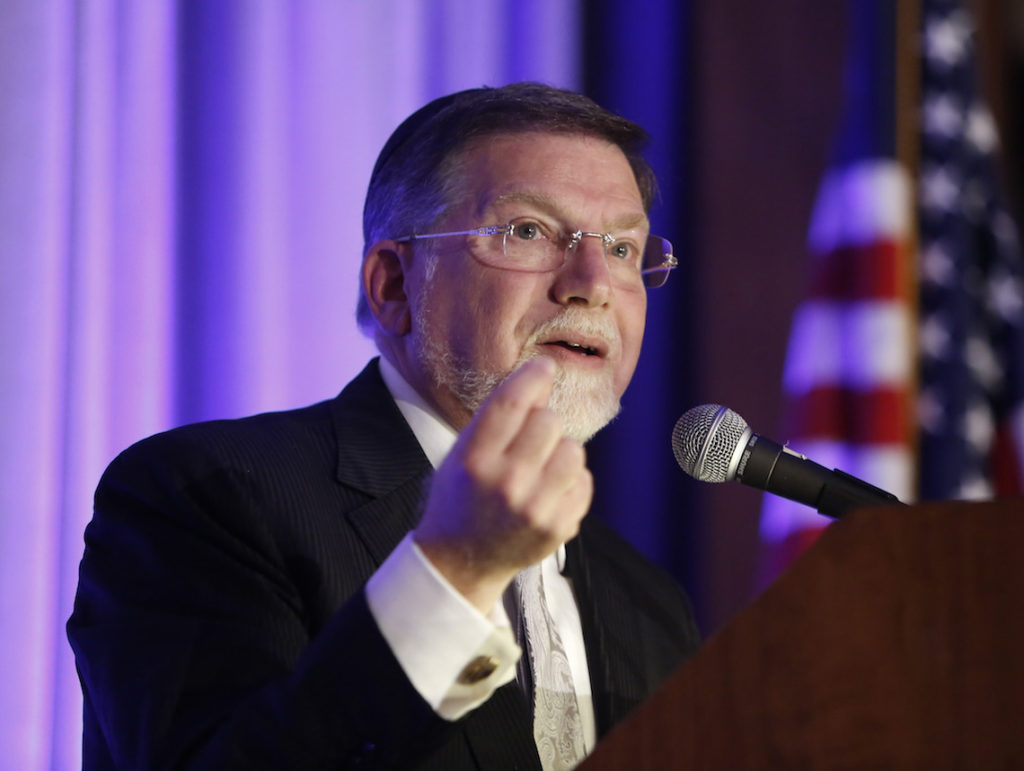
Rabbi Elazar Muskin, senior rabbi of Young Israel of Century City, has been elected president of the Rabbinical Council of America (RCA), marking the first time a Los Angeles rabbi has headed the organization, which has a membership of 1,000 Orthodox rabbis in 18 countries.

“It represents the fact the world has changed,” Muskin said of his election.

He recalled that when he began his rabbinic career more than 35 years ago, a fellow rabbi told him: “If you want to have influence, the national scene is on the East Coast.”

Now, rabbis from all parts of the country make up the organization’s leadership. “There isn’t one officer from the New York area in this coming administration,” he said.

Muskin, who held the position of first vice president at the RCA, was elected to his new post on June 12, succeeding Rabbi Shalom Baum, spiritual leader of Congregation Keter Torah in Teaneck, N.J.

RCA presidents are elected to one-year terms, and most presidents are re-elected to serve a second year, he said.

Muskin hopes the RCA under his stewardship will be “proactive and not reactive.” Among other things, the RCA must work toward improving Diaspora Judaism’s relationship with Israel’s Chief Rabbinate, in light of clashes on marriage and conversion, he said.

“We try to sensitize [the Chief Rabbinate] to issues, and we do all the time,” Muskin said. “On marriage issues, on conversion issues, we’re working with them hand-in-hand.There are organizations that would like to see the end of the Chief Rabbinate, [but] that is not our agenda at all. We want to work with them.”

Muskin enters the presidency at a time of contention over female clergy in the Orthodox movement. Earlier this year, the Orthodox Union, a partner of the RCA, issued a ruling banning female clergy in its 400 member congregations across the United States. B’nai-David Judea, a Los Angeles synagogue, is among those at the center of the debate through its employment of Rabbanit Alissa Thomas-Newborn.

“The women’s issue is certainly an issue,” Muskin said. “We want to look at it in a positive approach. There are so many areas where women can have important roles in the Orthodox community and that will be our focus.”

Even with the demands of being the RCA’s leader, Muskin said Young Israel of Century City will remain his first priority. The congregation has 500 member families and is in the process of a major expansion of its facilities.

“I will do my work for the rabbinic council as well, but if there’s a [time] conflict, my shul comes first,” Muskin said.

Muskin is a past president of the Rabbinical Council of California. He holds a master’s degree in education from Columbia University and a master’s in medieval Jewish philosophy from the Bernard Revel Graduate School of Jewish Studies at Yeshiva University. He received his rabbinic ordination from Yeshiva University’s Rabbi Isaac Elchanan Theological Seminary.

Young Israel of Century City rabbi elected president of Rabbinical Council of America Read More »
Sunday Reads: Pax Americana in the age of Trump, Saudi Arabia vs. Qatar, The Settlers’ frustration with Netanyahu

US

Ross Douthat muses on the future of Pax Americana with Trump at the helm:

So we have a test: How well does American hegemony function when the colossus lacks a head? Is the basic structure of the Pax Americana — the weight of our military advantage, the geopolitical habits instilled by 25 years of unipolarity, the atrophy in other nations’ readiness for interstate conflict — strong enough to keep lesser powers out of major wars even if the president of the United States doesn’t understand his role or how to play it?

Fred Kaplan is afraid of the consequences of Trump’s ignorance:

Trump doesn’t know what he doesn’t know—and that’s the most dangerous kind of ignorant leader. Take the flare-up between the Gulf states and Qatar, which has a real potential of escalating to an all-out conflict between Iran and Saudi Arabia. The underlying tensions of this conflict have been brewing for some time, but the flare-up is entirely Trump’s doing. First, his speech in Riyadh encouraged the Saudis to step up their pressure on Qatar. Then, instead of sending his diplomats to calm matters, he took credit for the development in a tweet, in which he also tagged Qatar as a financier of terrorism—perhaps unaware that Qatar also hosts the United States’ largest military base in the region, home to 10,000 American troops and the Central Command’s air combat center.

Israel

Andrew Friedman writes about the settlers’ growing frustration with Netanyahu for not letting them build:

Samaria Regional Council head Yossi Dagan told Army Radio that it is “no secret” that the settlers are very disappointed with the fact that Netanyahu has not reversed building policy in the West Bank, especially after all the prime minister’s talk about “after Obama.”

“The prime minister promised us a rush of building after Obama left office, but he hasn’t kept his promises,” Dagan fumed. “We will no longer accept a situation in which a half-million Jews in Judea and Samaria, alongside 400,000 Jews and Israeli citizens in Jerusalem are treated as fourth-class citizens.”

Shlomi Eldar thinks Netanyahu and Abbas are on the same page for once:

That being said, when it comes to the PA, what is on the line is not the measure of trust between Abbas and Trump, but how Abbas is viewed by the Palestinian rank and file. Abbas will try to convince the Palestinians that wise, cautious and sagacious diplomacy on his part had stopped Trump from taking extreme, irreversible measures they oppose. Netanyahu will take the same approach with the settlers, telling them that wise diplomatic finesse will help him safeguard construction in the settlements.

Middle East

David Andrew Weinberg writes about the tense Saudi-Qatari dispute:

The Gulf monarchies face the most serious crisis in their history. It is largely being covered as a diplomatic spat, since several Arab nations terminated their relations with Qatar on Monday to protest its support for radical Islamists. But the crisis has an economic component as well. Saudi Arabia severed Qatar’s access to its only land border, across which roughly 40 percent of Qatar’s food needs are imported.

The story of how we got here dates back to 1990. It can be traced to Saudi Arabia and Qatar’s contrasting views on two dangerous forces: Iran and the Muslim Brotherhood.

Ilan Goldberg and Nicholas Heras take a look at how the US might be escalating its activities in Syria:

Yet, even as Washington potentially stumbles into war, there has been little public explanation from the highest levels of government, scant media coverage, and virtually no congressional oversight. This is no way to handle what could potentially mutate into a vastly expanded American military intervention in the Middle East.

Jewish Journal

Atar Hadari compares two classic pieces of liturgy that offer two visions of what Judaism is about:

As far as halakhah is concerned, you are not required to say either Yigdal or Adon Olam if you don’t want to—unlike the case with other parts of the liturgy that you have to find silent time for in the course of the service if you’re tardy getting to synagogue. But there they sit, giving two anthem-like views of what Judaism boils down to—one as a rational, daytime hymn and the other as a friendlier song that, even though the mortality of the laborer resigning body and soul to God is only hinted at, takes care to address the fears and weariness of night.

According to Cnaan Liphshiz, Jared Kushner’s family is the stuff of legend in a little town in Belarus:

In Novogrudok, the Kushners are remembered and revered — not for their Trump connections or their sprawling real estate empire, nor for the scandal that engulfed Kushner’s father, Charles, or the recent allegations that he proposed a back channel for communication between the Trump administration and Russia.

Rather, the Kushners are known for the daring escape from the local ghetto in one of the most famous acts of Jewish resistance to the Nazis.


Sunday Reads: Pax Americana in the age of Trump, Saudi Arabia vs. Qatar, The Settlers’ frustration with Netanyahu Read More »