fbpx

May 24, 2017

Manchester, Israel

Suicide Terror Attack Opens Painful Wounds

A Manchester suicide bomb attack on young people leaving a concert and memories of the what Israelis endured for years flood into my mind. The faces of the young people murdered at the Dolphinarium Disco, the Sbarro Cafe, on city buses, and at urban malls across the country flood back into view.

The bloodshed reawakens the trauma from all those years ago.

From 2001-2005, at least 136 suicide attacks were launched against Israel. During the Palestinian Al-Aqsa Intifada, Sept. 2000 – Dec. 2005, a total of 1,100 Israelis were killed and many thousands were injured, paralyzed, and maimed.

I don’t know how Britain will respond to the latest attack terror against innocent Brits.

I don’t know how Britain will respond to the faces of 22 dead concertgoers who had their entire lives in front of them, who are going to be buried this week.

I don’t know how Britain will respond to the dozens of injured, who will have to spend years rebuilding their lives, and only some who will regain full use of their bodies.

However, the next time a British politician of journalist condemns Israel’s response to Palestinian terrorism I ask all of us to remind these people of the names and stories off all those killed, injured and maimed in Manchester.

May God comfort those in mourning and heal the sick and take revenge on those that perpetrated this horror.

Manchester, Israel Read More »

Shavuot inspires children’s books

Shavuot — the celebration of the giving of the Torah at Mount Sinai — is not often associated with the variety of children’s literature inspired by other holidays, such as Chanukah or Passover. This year, however, one of the main publishers of Jewish children’s books, Kar-Ben, is offering two new holiday-themed titles.

And in another book, a Los Angeles author tackles the difficult task of explaining the Ten Commandments to a pre-school audience and creates a lovely, inclusive read-aloud story, appropriate for Jewish families of every denomination.

The Art Lesson: A Shavuot Story” by Allison and Wayne Marks. Illustrated by Annie Wilkinson. (Kar-Ben, 2017)

This story is based on Eastern European Jews’ custom of decorating their windows with Jewish-themed papercuts during the Shavuot holiday. Children should enjoy this cleverly imagined tale of a girl who loves spending time doing art projects with her talented grandmother. Young Shoshana dresses in her treasured artist’s smock and black beret for her weekly visit to the home of Grandma Jacobs, who stocks an art studio that would enchant any child. Calling her granddaughter “My little Chagall” or “My little Modigliani,” she stirs creative juices as she instructs Shoshana how to make papercuts — “something my bubbe taught me how to do when I was a little girl.” When Shoshana gets frustrated with what she believes are meager efforts, her grandmother encourages her to use her imagination to define success and states lovingly that “Every papercut is special. Just like you.” Adults will appreciate the various references to famous artists’ styles that the illustrator has hidden among the pages, helped by an author’s note explaining Grandma Jacobs’ use of nicknames. Simple instructions for a Star of David papercut are included.

“Yossi and the Monkeys: A Shavuot Story” by Jennifer Tzivia MacLeod. Illustrated by Shirley Waisman. (Kar-Ben, 2017)

Fun, colorful and off-kilter comic illustrations set the tone for this Ashkenazi-flavored folktale, an echo of the children’s classic, “Caps for Sale,” by Esphyr Slobodkina. When Yossi tries to sell his wife’s lovely handmade kippot at the local market, he meets a mischievous monkey who steals the merchandise. But Yossi and the monkey join forces when he realizes the animal’s antics charm customers. Yossi names the monkey “Zelig” (“Blessing”), and his business flourishes until rains come and Zelig is nowhere to be found. When Yossi realizes a circus is in town, he knows where to go find his new friend. The title, however, is a bit misleading as the Shavuot content is rather sketchy. In the final pages, Zelig joins Yossi and family at a festive Shavuot meal of blintzes as Yossi presents Shavuot flowers to his wife. A short author’s note explains a bit about the holiday.

The Greatest Ten” by Janice Surlin. Illustrated by Rivka Krinsky. (Hummingbird Jewel Press, 2017)

Los Angeles author Janice Surlin has been writing stories for Jewish children for years, and this first effort in self-publishing is a great success. She takes pains to show respect for all denominations of Judaism in the text and illustrations. Examples include depicting figures dressed modestly and all males wearing kippot, while the theme of universal ethics as depicted by the Ten Commandments is appropriate for all. The commandments are explained by a rhyme scheme that can be delightfully sung to the tune of “This Old Man,” such as the first verse, “I am God, I am One, I am God for everyone.” When dealing with the commandment not to commit adultery, readers observe a wedding couple under a chuppah and sing this verse:

When you love someone who

Cares about and loves you too,

How you act is the only way for your love to show

And be loyal, God says so

The bright watercolor illustrations will engage pre-school children at Shavuot and any other time of year.

Shavuot inspires children’s books Read More »

Letters to the editor, May 26 edition

Interpreting Biblical Concubinage vs. Rape

Danielle Berrin misunderstands me. Biblical concubinage can be termed rape only from later ethical perspectives (“Rape of the Handmaid,” May 12). Although exegetes inevitably interpret from their own historical and value standpoints, their task is not to discredit or reject the texts they interpret. Biblical narratives depict slavery and patriarchy, because these systems were omnipresent throughout the ancient world. The people who transmitted the narratives could not imagine alternative systems.

But Judaism does not consist only of the Bible. Judaism is a tradition. A tradition is a conversation among many participants over many generations, about the right and the good. Neither slavery nor gender oppression is an inherent Jewish value.  Judaism is committed to justice. Participants in our conversation try to determine what is right and good by interpreting sacred texts and on the basis of s’vara, contextually situated rational argument, according to Rabbi Eliezer Berkovits. As I explained to Berrin, Jews do not read the Bible like fundamentalists. Our texts are sacred because they are inexhaustible. We return to them, bringing ourselves, our contexts, our experiences, and we bring away new insights and new obligations. For Jews, there is no single “correct” interpretation. I make this claim, not because I am Reform, but because Judaism’s sacred texts, including writings long after the Bible, rest on this assumption.

The meaning of justice evolves through socio-historical contexts, reflected in the texts of Talmud, midrash, codes and Jewish philosophy. As we understand justice differently, our obligations change. Hence, Rabbi Chayyim David Regensberg (Mishmeret Chayyim), ruled that it would not be halachically permissible today to reinstitute slavery. Analogously, I’d say, now that we have names and analyses for the system of gender oppression, it too becomes impermissible. Moreover, now that Jewish women are among the participants in the Jewish conversation, their input too, affects the determination of justice and the evolution of Jewish thought. 

I will not be an accomplice to trashing Judaism’s sacred texts to enshrine an ahistorical “correct meaning.” Gender justice can be achieved while honoring the complexity and the multi-vocality of Judaism.

Rabbi Rachel Adler

David Ellenson Professor of Modern Jewish Thought, Hebrew Union College-Jewish Institute of Religion

Berrin responds: I am deeply disheartened that Rabbi Adler misunderstood my column. Not only did I quote her accurately, I specifically acknowledged her view that a multiplicity of interpretations is inherent to our tradition. I would never “trash” Judaism’s texts. Some, I wrestle with. The vast majority I treasure.

Jewish Law and Standards on Gay Relationships

Terrific article about gay and lesbian Orthodox youth (“Can Gay and Lesbian Teens Find a Home in Orthodoxy?” May 19). 

One point requires clarification: The Committee on Jewish Law and Standards (CJLS) in its 2006 teshuvah voted to prohibit only anal sex, not all forms of same-gender sexual expression. It is important to realize that the authors felt they needed to do this to produce a more welcoming attitude toward gays and lesbians in the movement. Still, I don’t think most people look to CJLS for what forms of sexuality happen in their relationships.

Rabbi David Novak
Manchester Center, Vt.

The Politics of Health Care

In “#IamAPreexistingCondition” (May 12), Michelle K. Wolf laments that Jimmy Kimmel’s emotional story about his infant son’s medical treatment did not dissuade even three GOP representatives from voting for the American Health Care Act (AHCA). I hear her asking: How can they turn their backs on sick babies!? It’s easy to suggest heartlessness, but let’s take a closer look.

Health insurance works only when the healthy overpay for their care. Their overpayment heals the sick who can’t afford their treatment. Unfortunately, millions of healthy people prefer saving money and letting ill patients or taxpayers cover expensive medical treatment. (Should we ask how this group turns their backs on sick babies?)

Democrats and Republicans know this but use different approaches to get healthy people to buy insurance. In the Affordable Care Act (ACA), Democrats provide for hefty subsidies and the individual mandate to encourage and force healthy people into the system. 

The GOP approach charges more when people develop ongoing medical conditions while uninsured. Only uninsured folks can be charged a “pre-existing” rate. Jimmy Kimmel’s son isn’t one of them. He was insured at birth and will likely stay insured and pay regular rates his entire lifetime.

History shows that Democratic and Republican approaches are flawed. Despite billions spent on subsidies and the weight of legal force, many healthy people stayed out under the Democratic ACA, and the system is contracting. And from experience, we know that despite the specter of financial ruin faced by those who choose to be uninsured under the Republican AHCA, many healthy people won’t join health insurance.   

I believe one’s stance isn’t a matter of one side helping sick children and another possessed of sickening indifference. These positions reflect different philosophies about getting people to make personal sacrifices for the good of society.

Jeff Feuer
Beverly Hills

Letters to the editor, May 26 edition Read More »

Innovative construction-tech hub opens in Israel

The Israeli launch of the world’s first construction-tech hub aims to provide construction companies and real-estate developers everywhere access to disruptive high-tech innovation.

Announced on April 27, the Construction Innovation Zone is a joint project of the Israel Builders Association, the Tel Aviv-based SOSA platform for global startup ecosystems, the Israeli Construction and Housing Ministry and the Israeli Economy Ministry.

“The State of Israel has proven itself as a leader in the world of high-tech and innovation, changing the way we communicate, the way we drive and now the way we build,” Minister of Construction and Housing Yoav Gallant said at the launch held at SOSA, where the hub will be based.

“We are championing the combination of new technologies to create new models of operation, improve methods of construction and accelerate production times. This initiative will lead to progress and innovation in the construction industry, and as more and more startups join, and as the program expands to new industries, many more breakthroughs will be created,” Gallant said.

Software and hardware solutions for the building process — as well as planning, managing and financing construction projects — are included under the new construction-tech umbrella.

“We are in a unique position to create the next ‘it’ technology field,” said SOSA CEO Uzi Scheffer. “Much like the efforts the Israeli government took to spark the auto-tech industry with grants and a positive regulatory environment, our partnership will help lay the groundwork for the fundamental disruption of the multitrillion-dollar global construction and real estate development industry.”

Connecting the two huge industries of construction and high-tech necessitates creating a niche ecosystem in Israel, involving startups, investors, academia, government agencies, regulators and service providers, Scheffer said.

“Most of the companies in this ecosystem will be Israeli, but not all,” he said. “We will start locally but we see huge opportunity for this program.”

Examples of Israeli companies that already offer high-tech products for construction include Dronomy of Tel Aviv and Beyon3D of Herzliya.

Dronomy uses off-the-shelf drones to inspect construction sites autonomously, creating 2-D and 3-D models to compare actual progress against building plans in order to spot discrepancies. “This will have a huge impact, and it doesn’t take much to implement it,” Scheffer said.

Beyon3D offers a fully automatic robotic manufacturing process to turn a 2-D drawing or 3-D model into a prefabricated building component using high-grade concrete and gypsum mixes and a self-leveling sealer for coating and finishing.

Scheffer said startups and established companies in the fields of project management, supply-chain management and financial technology, or fintech, also are of interest to construction companies.

The Israel Builders Association’s 2,000 members will help identify pain points, and will work with SOSA to create open innovation programs leading to pilots and partnerships with new and established companies with cutting-edge solutions for the traditionally conservative construction sector.

“The Israel Builders Association is trying to actualize the potential that the global high-tech community can offer to the ‘low-tech’ world of construction, which until now has remained under their radar,” said Chaim Feiglin, vice president of the Israel Builders Association.

Pain points in the construction industry are similar worldwide, yet Scheffer said SOSA searched unsuccessfully for construction-tech hubs elsewhere.

Given Israel’s robust and geographically dense innovation ecosystem and its collaborative business culture, situating the Construction Innovation Zone in the startup nation makes sense.

“Construction technology is really an unexplored vertical,” Scheffer said. “Through SOSA’s unique and extensive network we’re able to take new verticals and position them fast and efficiently in the center of the high-tech industry and connect them to the relevant people. We have the ability to help corporations tap into innovation taking place not only in their industries but in others as well.”

SOSA, founded in 2013 by 20 Israeli innovation pioneers, including Rami Beracha and Chemi Peres, helps corporations and individual members engage with startups across various verticals. SOSA will work with the Economy Ministry’s Israel NewTech program, which focuses on the development of full ecosystems involving stakeholders with a common vision.

“This initiative with SOSA, the Ministry of Economy and the Ministry of Construction and Housing will connect our industry with the high-tech world and help actualize the monumental potential which Israel can bring to the world of construction technology,” Feiglin said. 

Innovative construction-tech hub opens in Israel Read More »

Parashat Bamidbar: the wilderness speaks

At 4:30 this morning, my alarm went off. The Jerusalem streets below my hotel window were still dark and quiet. I dressed quickly in lightweight clothes and hiking boots, along with a big, floppy hat to protect my tragically pale Ashkenazi complexion from the 95-degree Middle Eastern sun.

Half an hour later, I joined my bus of 40 Angelenos for one of the quintessential Israel experiences — an early morning trek to Masada.

Masada stands more than 1,300 feet above the Judean desert, looking out over the Dead Sea and beyond to the mountains of Jordan — once the land of Moab, our ancestors’ last stop before crossing into the Promised Land. Standing at the top, as my participants snapped endless selfies and our excellent tour guide spoke about Second Temple-period history, my attention wandered to the vista and the thought that it was in landscapes exactly like this one that our People got their start.

From our earliest origins, 3,000 years ago, the Jews were a desert people. Abraham and Sarah left their home in Mesopotamia (modern day Iraq) and headed out across the wilderness to a new land that God would show them. Later on, their descendants would go into Egyptian slavery and then escape from there into the Sinai Desert — entering into a covenant with God at a desolate, rocky mountain and wandering for 40 years through shifting sands before arriving at almost exactly the spot that I spent the morning looking out upon.

This week begins the reading of Bamidbar, the fourth book of the Torah, whose name means “in the wilderness.” Over its 36 chapters tracing the Israelite journey from Mount Sinai to the edge of Canaan, it retells with poignant honesty the realities of the lives of ordinary people making their way through this harsh and beautiful landscape — their constant anxieties about food and water, their skirmishes with other desert tribes, their exhaustion and frequent discontent, and also their powerful faith that somehow propels them through the 40 years. As the book’s title suggests, the wilderness is not only a backdrop to these accounts, but a main character in them.

The Hebrew word for wilderness, midbar, also can be read with different vowels as the word for speech, m’daber. The wilderness spoke to our ancient ancestors, teaching them many of the core spiritual principles of Jewish faith.

Inside our comfortable homes it is easy to take many things for granted. But bamidbar, in the wilderness, we learn to notice and count our blessings.

The wilderness teaches humility. In the desert, it is hard to maintain the illusion that we are the center of the universe. Vast expanses of open land, exquisitely carved by millennia of wind and weather, stretch out in all directions. Gigantic night skies fill with uncountable stars. Wild places give us a sense of what Rabbi Abraham Joshua Heschel called “radical amazement,” an awe at the grandeur of creation and an intuition of the transcendent dimension of life. As anyone who has stood atop a mountain and watched the rising sun can attest, certain landscapes simply make it easier to believe in God.

The wilderness also teaches gratitude. Inside our comfortable homes it is easy to take many things for granted. But bamidbar, in the wilderness, we learn to notice and count our blessings. We take pleasure in every patch of shade, every drink of cool water, every unexpected moment of rest. My teacher, Rabbi Mervin Tomsky, says that gratitude is the engine of all true spirituality. It is a small wonder that a desert people, practiced in the art of gratitude, would bring so many spiritual gifts to the world.

Finally, the wilderness teaches courage. Setting out into the desert is an act of bravery. Our tradition teaches that the majority of the Israelites elected to stay in Egyptian slavery, rather than face the uncertainty of the journey. We, though, are the daughters and sons of those who were prepared to lay it all on the line, who had the faith in God and themselves that it took to go in search of a Promised Land.

This morning, as I looked out at the desert that gave birth to my ancestors, I could almost hear the midbar speaking to me. I wondered at its austere beauty and felt thankful to be surrounded by good friends, for my full canteen, and even for that silly hat. Most of all, I felt a surge of pride to count among my ancestors those who had the chutzpah to walk through this wild place, who taught me through their example that the world expands in proportion to our own courage.

Ha’midbar m’daber — the wilderness still speaks to us, whispering its timeless wisdom, as it taught our ancestors long ago. 

Parashat Bamidbar: the wilderness speaks Read More »

Why Are There Two Jerusalems?

Why is Yerushalayim plural,

One on high and one below?…

I want to live in one “Yerushal,”

Because I am just “I” and not “I”s.

—- Yehuda Amichai, “Open Closed Open”


Welcome to one of the great grammatical conundrums in the history of Jewish geography: why is the Hebrew word for Jerusalem – Yerushalayim — in the plural form?

Because, in fact, there is not one Jerusalem; there are two.

On a political level, there are two Jerusalems — the “new city” of west Jerusalem, and the Old City and eastern Jerusalem — two entities forged into one fifty years ago with the Six Day War.

On a linguistic level, there are two Jerusalems – Yerushalayim in Hebrew; al-Quds (“the holy city”) in Arabic.

On a geographical level, there are two Jerusalems. Jerusalem is on the border between the coastal plain that leads to Tel Aviv, and the wilderness that begins to its east. As soon as you leave Jerusalem, and head east, the Asian desert begins. Jerusalem, therefore, is at the nexus point of a Mediterranean climate and central Asian climate.

What is the origin of the “two Jerusalem” theory?

The first mention of Jerusalem in the Hebrew Bible is in Genesis 14, in the account of Abram’s war against the kings.

There Abram encounters Melchizedek, who is both the king of Salem and a priest of the Canaanite god El Elyon, God Most High. Melchizedek greets Abram with bread and wine and blesses him in the name of El Elyon. It is the first interfaith dialogue in history. There, the place is called Salem, or Shalem.

A few chapters later, in Genesis 21, Abraham returns to that place. He brings his son, Isaac, to “the land of Moriah” as a potential sacrifice.

Abraham calls the place Adonai-yireh, “God will see” — or simply, Yireh.

Abraham named the place Yireh, and Melchizedek knew it as Shalem. Yireh-Shalem becomes Yerushalayim. Those two names are soldered together: One name, given to it by a pagan king who blesses Abraham — representing the possibility of peace; and another name, given to it by Abraham himself, representing the presence of God and the sacrificial offerings that will be there at that place.

Peace between people and peace with God — wedded together in one name. A promise and a goad. A duality.

But, there is far more than this; as the late poet, Yehuda Amichai, intimates, there is a spiritual duality as well.

Jerusalem is Yerushalayim because of a subtle duality that is nevertheless omnipresent in our literature and thinking — the earthly Jerusalem (Yerushalayim shel matah) and the heavenly Jerusalem (Yerushalayim shel maalah).

Where does one begin on this quest for the heavenly Jerusalem and the earthly Jerusalem?

The idea of a supernal Jerusalem begins in Isaiah 6. The prophet has a vision of God in a supernal temple, surrounded by angelic beings, each one chanting “Holy, holy, holy is the Lord of Hosts.”

The rabbis imagined that the heavenly Jerusalem served as an alternative and antidote to the real, imperfect Jerusalem. Their fantasies took on new fervor after the destruction of Jerusalem by the Romans. They believed that the heavenly Jerusalem had its own temple with its own elite of priests and prophets.

Resh Lakish said: There are seven firmaments, and in one of those firmaments there is a place where millstones grind manna for the righteous, and in one of those firmaments there is a place where the heavenly Jerusalem, and the Temple, and the very altar are built, where the angel Michael stands and every day brings an offering.

The Rabbis idealized Jerusalem, twisting it beyond its own reality. For them, the mountains of Jerusalem pointed straight to heaven. They imagined Jerusalem as a place where no woman ever miscarried, where no one was ever stung by serpent or scorpion, where the fires of the altar were never doused with rain, where no wind blew the pillar of smoke over the worshipers.

The idea of a heavenly Jerusalem exists in Christianity as well.

For Christians, the earthly Jerusalem is Jewish and sinful; the heavenly Jerusalem, Christian and righteous. The heavenly Jerusalem is the place of the new covenant sealed through the blood of Jesus.

But you are come unto mount Zion, and unto the city of the living God, the heavenly Jerusalem, and to an innumerable company of angels, to the general assembly and church of the firstborn, which are written in heaven, and to God the Judge of all, and to the spirits of just men made perfect, and to Jesus the mediator of the new covenant. (Hebrews 12:22-24)

The ultimate vision of the Heavenly Jerusalem comes from Revelations. John sees the New Jerusalem descending from heaven, prepared as a bride adorned for her husband in gold and precious stones.

I will write upon him the name of my God, and the name of the city of my God, which is the new Jerusalem, which cometh down out of heaven from my God: and I will write upon him my new name…And I heard a great voice out of heaven saying, Behold, the tabernacle of God is with men, and he will dwell with them, and they shall be his people, and God himself shall be with them, and be their God. And God shall wipe away all tears from their eyes; and there shall be no more death, neither sorrow, nor crying, neither shall there be any more pain: for the former things are passed away. (Revelations 3;12)

For Christians, the heavenly Jerusalem was not real. It was an ideal. In the Middle Ages, there were many fanciful descriptions, maps, and paintings of Jerusalem, each one showing Jerusalem as the center of the world, as the sages themselves imagined it – as axis mundi.

The idea of the heavenly Jerusalem finds its way into even the very architecture and design of the modern city of Jerusalem.

Anyone who has been to Jerusalem marvels at the beauty of Jerusalem stone as a building material.

The man who first figured this out was Sir Ronald Storrs, the first British military governor of Jerusalem, and a vicar’s son. He enacted a law that permitted only Jerusalem stone to be used as a building material used in construction in Jerusalem. In his memoirs recalls the medieval hymn “Jerusalem is built in heaven/ Of living stone.” He believed that the earthly Jerusalem should be a replica of the heavenly Jerusalem.

By contrast, the Jewish view of the heavenly Jerusalem is that it is actually not entirely in heaven.

In fact, the heavenly Jerusalem is adjacent to the earthly Jerusalem.

Towards where should we pray? Rabbi Hiyya said: Toward the heavenly Holy of Holies. Rabbi Simeon ben Halafta said: Toward the earthly Holy of Holies. Rabbi Pinchas said: There is no disagreement here. The earthly holy of holies is directly opposite the heavenly Holy of Holies. (Jerusalem Talmud, Berachot 4:5).

Jerusalem represents the revealed presence of God in human history. In the liturgy, in seder kriat ha-Torah (the service for the reading of the Torah), you would expect references to the place from which Torah came – Sinai.

Not so. Instead, Jerusalem has a starring role. As we take the Torah from the ark, we echo the plaintive cry of Jews in Jerusalem during Crusader times: “Rebuild the walls of Jerusalem.” “For out of Zion Torah goes forth, and the word of God from Jerusalem.” In fact, the revelation at Sinai is absent; instead, the Torah service asks us to remember and dramatize the first time that Ezra read the Torah to the returning exiles at the newly built, makeshift second Temple.

Jerusalem represents the homecoming of the soul. At the end of Neilah, as well as at the end of Pesach seder: “Next year in Jerusalem!”

We can understand singing those words at the end of the seder; we have just imagined ourselves leaving Egypt, and about to trek into the wilderness on our way to the land of Israel/

But, why do we say those words at the end of the Day of Atonement? Because, here, Jerusalem is not “really” Jerusalem. It is a metaphor for inner wholeness, forgiveness, and redemption.

Jerusalem ultimately represents God. The Jerusalem Talmud says that in days to come, the name of the city will be “Adonai is there.” “Do not read ‘shama,’ there, but rather, shemah — her name.”

Jerusalem and God will have the same name.

Let us not read this as the deification of a city.

Rather, let us read this as the urbanization of an ideal of holiness.

Let us return to the Christian perception of the heavenly Jerusalem.

Because Jerusalem is not just Jerusalem. It is, properly, Zion – and beyond that, it is the state of Israel itself.

A theology is only as good as the implications that flow from it. Were it not for Christian (more precisely, British) philo-semitism of the nineteenth century, Zionism could never have come into existence. Sir Ronald Storrs – but not only Storrs, Balfour himself – personified that thrust. Christian Zionism is itself a child of this phenomenon – an over-idealization of the Jews and their land.

Over the last fifty years, since the Six Day War, criticism of the state of Israel – its policies, and even its very existence – has mounted. While some of the sharper, more pointed critiques verge on anti-Semitism, not all of them do.

Some, in fact, are the results of a welcome, but ultimately misplaced, philo-semitism. It is the expectation — not that Jews are devils, but that they should be angels. The same should be true of a Jewish state – that it should be angelic, perfect, beyond reproach.

Christian perceptions of the heavenly Jerusalem crowd into the public imagination. It is the problem of a misplaced philo-semitism. Like anti-semitism, philo-semitism relies on distorted, fantastical views of Jews and Judaism. Philo-semitism can become a malevolence, masked in benevolence. In fact, this love-hate relationship with Jews and Judaism is one of the most pre-dominant themes in Christian history.

Philo-semitism is the hope – even the expectation – of the moral excellence of the Jewish people. It is a moral excellence that has yet to be achieved.

The liberal Christian philo-semite does not hate the Jew because the Jew has rejected Jesus. The liberal Christian philo-semite is merely disappointed with the Jew because the Jews have not yet lived up to the advertisements of moral excellence that they have created for themselves. The liberal Christian philo-semite sees the reality of the earthly Jerusalem – an Israel that must still fight, has problematic policies, where the people are far from saintly – and is disappointed, sometimes, radically disappointed — that the heavenly Jerusalem is not yet here. They are not like the fabled Southern anti-semites who used to look for the horns on the Jews they met. They are looking for angel’s wings. And when they do not find those wings, the disappointment can become anger, can become hatred.

That disappointment with the all-too-human, realpolitik failures of the Jewish state has seeped into leftist Jewish critiques of Israel and Zionism. They are addicted to the prophetic ideal, while often forgetting that the Jews and the Jewish state have real enemies who never got that prophetic memo.

That is the paradox. In the Jewish soul, we live with the vision of a heavenly, perfect Jerusalem of our ideals. But, in real life and in real time, we live with the imperfect, morally tainted, earthly Jerusalem. The tension is built into Zionism, and Jewish historical longing – the struggle between being a “light to the nations” or “like all the nations.”

It does not seem likely that we will solve this conundrum and this tension any time soon. Jerusalem – like all of us – is a spiritual work in progress. Reb Naftali of Ropschitz, a Hasidic master, taught: “By our service to God, we build Jerusalem daily. One of us adds a row, another only a brick. When Jerusalem is completed, redemption will come.”

Let that be a new definition of Zionism, in our time – the work of making the earthly Jerusalem look more like the heavenly Jerusalem.


 

Why Are There Two Jerusalems? Read More »

One L.A. school: two German rabbis

Since its inception in 1996, the Ziegler School of Rabbinic Studies of American Jewish University in Bel Air has had students from various countries, but until recently, never from Germany.

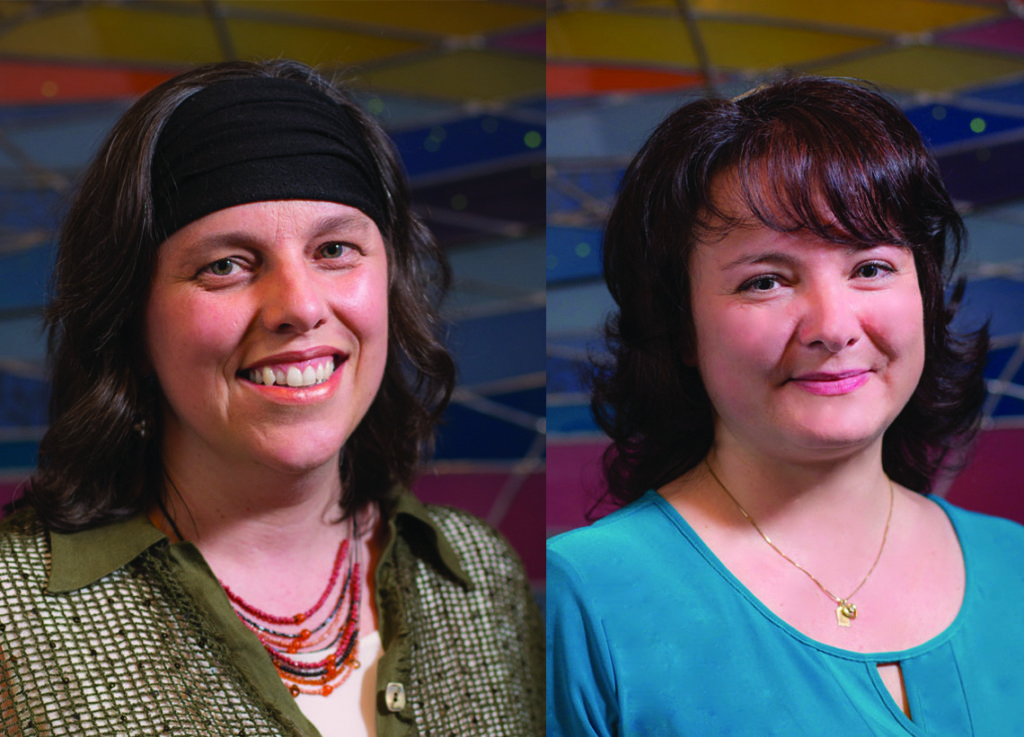
This year, however, the school has two German graduates, both women. Esther Jonas-Maertin completed her final year of the five-year program and was ordained, along with five others, on May 22. Nitzan Stein Kokin, a visiting student from Ziegler’s sister school in Berlin, Zacharias Frankel College, is completing her last year of studies and will be ordained in Berlin on June 18. Hers will be the first ordination of a Conservative rabbi in Germany since before World War II.

Though the women’s journeys to this point were different, they have one thing in common — besides their 42 years of age: neither was raised Jewish. Jonas-Maertin grew up in Leipzig when the Berlin Wall was still standing  and practicing any religion in communist East Germany was strongly discouraged. Her father is Jewish, her mother nonreligious. Stein Kokin grew up in a Protestant household in a small town in southwest Germany.

Despite East Germany’s aversion to religion, Jonas-Maertin became interested in Judaism at a young age, reading every book about it she could find. She recalled writing a paper as a teenager on the Jewish history of Leipzig. But her deep spiritual connection with Judaism came later. Specifically, she points to an exchange she had at 22 with her grandmother, a concentration camp survivor, at her grandfather’s grave on his yahrzeit. Although her grandfather also was a survivor, he died before she was born.

Jonas-Maertin took a stone from her pocket and placed it on the grave. She said this small act surprised her grandmother, who was unaware she was familiar with Jewish traditions.

“I had the feeling she recognized me for the first time,“ she said. “My gesture opened a door to a world I didn’t even know. Then [her grandmother] started to recite the Kaddish. I had no idea that my family was religious.”

That same month, an elderly Jewish man visiting his native Leipzig suggested she become a rabbi, given the depth of her feelings for the Jewish people. At the time, the idea seemed farfetched. After all, not only was Jonas-Maertin not a member of a congregation, she had never seen a rabbi, let alone a female rabbi.

Still, something had been kindled. She began lecturing on Jewish history to school groups and Christian congregations. She also switched universities to pursue a master’s degree in Jewish studies and comparative religion. Ten  years ago, she converted to Judaism. “I just confirmed something that was already there,” she said.

She began her rabbinical studies at Hebrew Union College-Jewish Institute of Religion in Jerusalem. “I found that some of the liturgical things weren’t resonating with me,” she said. She was so impressed by the accessibility and intelligence of the students she met from Ziegler — nearly all rabbinical programs require their students to do a year in Israel, so Jonas-Maertin was in a good position to meet students from various programs — she decided to continue her studies in Los Angeles at AJU.

Stein Kokin’s introduction to Judaism came from a high school religion teacher, a Protestant minister who, she said, was “very active in Jewish-Christian dialogue.”

In lieu of a traditional high school graduation gift, she asked her parents for a trip to Israel. She traveled with a youth group and was so intrigued that she decided to spend a gap year there, volunteering at an assisted living facility for disabled young adults. It was a good opportunity, she figured, to see if social work was a suitable fit for her. The other career she had seriously considered was ministry. She decided to study theology and determined that if she wanted to really understand Christianity, she needed to learn everything she could about Judaism as well.

During her year in Israel, she befriended a group of “deeply religious women.” She studied the Talmud and attended beth midrash. “Judaism became so much more personal,” she said. She converted in 1999 and made aliyah. Shortly thereafter, she met the man who would become her husband, an L.A. native who was a graduate student spending a year at The Hebrew University of Jerusalem.

In lieu of a traditional high school graduation gift, Stein Kokin asked her parents for a trip to Israel.

In 2010, her husband got a teaching job in Germany. It was around this same time that the Zacharias Frankel College opened at Potsdam University. There was already a Reform rabbinical school at the university, but this new program would be Europe’s first and only Conservative rabbinical school.

Rabbi Bradley Shavit Artson, the dean of both Ziegler and Zacharias Frankel, will preside at Stein Kokin’s ordination. “I am going to wrap a prayer shawl around Nitzan’s shoulders,” he said.

While every ordination is an occasion for celebration, Artson said this one is particularly meaningful. “In returning liberal Judaism to Germany, I am restoring a lost object to its original location,” he said, referring to Conservative and Reform Judaism. “If I can ordain a German rabbi in Berlin, then I am showing that Hitler lost and we survived and thrive.”

Even though their personal situations are different — Jonas-Maertin is single; Stein Kokin and her husband have two children — both women said that having a fellow German in the program this past year has been a huge positive.

“It’s very tough to come in here and realize you are Jewish, so there is a certain amount of similarities [between German and American Jews],” Jonas-Maertin said. “But the culture is very different. That has become my struggle. We talk a lot about this.”

It’s also clear the two have immense respect for each other. “I think [Jonas-Maertin] is in many ways a real pioneer coming here all by herself and going through the program,” Stein Kokin said.

As for their future plans, Jonas-Maertin and Stein Kokin are applying for a variety of jobs. Jonas-Maertin would love to work in Germany some day, but with only two Conservative synagogues in the country, job opportunities are extremely limited. Stein Kokin is focusing her efforts in Los Angeles.

Of course, Stein Kokin still has her ordination next month. She said she doesn’t feel added pressure, given the historic significance of the occasion.  She feels lucky.

“I wrote my final thesis for rabbinic school on the first woman rabbi ever ordained, Regina Jonas, who was ordained in 1935 in Berlin,” Stein Kokin said. “She fought for being able to be ordained. She was very observant, very religious, halachah, kept Shabbat. She also believed in the full equality of men and women.

“That’s what I also believe. She is one of my role models. She was 42 when she perished in Auschwitz. I will be 42 when I enter the rabbinate. To pick up at her footsteps and receive my ordination in Germany … it’s not a weight. It’s a present I was presented with by life or circumstances or God or father, whatever you’re going to call it.”

One L.A. school: two German rabbis Read More »

Animal rights group appeals kapparot court ruling

Maryland-based animal rights organization, United Poultry Concerns, is appealing a recent federal court ruling that determined that Chabad of Irvine acted legally in its performance of kapparot, an ancient High Holy Day ritual involving the slaughtering of chickens.

The animal rights group is claiming that the use of the chickens violates California’s business code. However, Judge Andre Birotte Jr. of the Central District of California ruled on May 12 that the Chabad was not engaged in a “business act” because the ritual is supported by donations.

The case now goes to the United States Court of Appeals for the Ninth Circuit.

The case began last year when United Poultry Concerns argued that the Chabad was violating the Unfair Competition Law, which prohibits “intentional killing of an animal and does not contain an exception for religious sacrifice.” The group alleged that the Chabad group was engaging “in business practices for profit in which they charge a fee to kill and discard animals.”

The Chabad typically accepts donations of $18 from each participant of kapparot, according to Rabbi Alter Tenenbaum, Chabad of Irvine’s spiritual leader.

In an interview, Tenenbaum praised the judge’s decision.

“I think he saw through it — that this is nonsense, this whole case is nonsense. We do kapparot once a year with 100 chickens. That issue today of animal rights is bogus,” he said. “We do it legally.”

Tenenbaum said the organization has not been donating the chickens, as is customary, but that an organization picks them up and discards them.

Bryan Pease, the attorney for United Poultry Concerns, said that while the judge determined that the practice failed to meet the criteria of an unfair business act, he did not address the legality of slaughtering chickens without the intention of eating or donating them.

“We’re charting legal territory here that hasn’t been covered — whether an institution accepting donations for this kind of ritual is considered a business practice,” Pease said. “It’s appropriate for the Ninth Circuit to weigh in.”

Tenenbaum defended the practice as comporting with thousands of years of Jewish history.

“It is a service we are offering people,” he said. “If people want to do it the right way, the original way, they have the ability to do it, and I don’t think it’s the government or any agency to tell us how we practice religion, as long as we are staying within the confines of law.”

Performed annually around the time of Yom Kippur, when community members atone for their sins, kapparot is an ancient ritual that involves transferring one’s sins to a slaughtered chicken. The atoning person waves a live chicken around his or her head, and the chicken is slaughtered afterward in accordance with kosher laws. According to Chabad.org, “its monetary worth [is] given to the poor, or, as is more popular today, the chicken itself is donated to a charitable cause.”

The practice has become problematic with animal rights organizations, prompting some Jews to perform the ritual by waving a bag of coins around their heads instead of using live chickens.

Those opposed to it include progressive faith-based organizations. Clergy & Laity United for Economic Justice (CLUE) has long opposed kapparot. Rabbi Jonathan Klein, executive director at CLUE, said he was disappointed over the federal judge’s decision in the Irvine case. He said his organization would continue to fight against the practice.

“I don’t think it’ll change the momentum or the desire to stop it. So in terms of organizing, it will not change much of anything,” he said. “I think it’s a disappointing decision — I’m not surprised by it — but nevertheless we will continue to really focus on just the audacity of the ritual in public spaces.”

Animal rights group appeals kapparot court ruling Read More »

Benkof: Palestinians have long commutes? Boo hoo.

Over the weekend, The New York Times ran an opinion piece by Palestinian lawyer-writer-activist Raja Shehada decrying Israeli policies on the freedom of movement by West Bank residents like him. Anyone even a little familiar with Israeli life who reads it closely will reject two complaints in particular as completely bogus.

First, in a paragraph The Times also used as a sub-head, he bemoaned:

I was going to London for a week, and my flight was at 5 in the afternoon. Twenty years ago, the drive took 50 minutes. Now, with so many checkpoints on the way, I left the house at noon, five hours before the flight. (Emphasis added.)

The paragraph suggests the commute now took five hours instead of one, and the sneaky use of the numbers 5 and 50 might even lead a casual reader to conclude Israelis had made Palestinian travel to the airport ten times as long (ever since the start of the present round of anti-Jewish violence).

Clever malarkey is still malarkey. Anyone who has flown out of Ben Gurion Airport even once knows that tight security for all passengers requires arriving at least three hours before a flight. So if Shehada left the house at noon, his commute to the airport was only about two hours, not five.

Americans can spend more time commuting to JFK or O’Hare, and in fact Israelis living in Haifa and Tiberias can, too. A two-hour commute to the airport!

Boo hoo.

The 1,500-word essay (well over twice the size of a typical op-ed) bewails the travails of Shehada’s two-hour ride to the airport (soldiers signaling he can pass, children begging for money, “getting lost in your own country”) yet he fails to mention even once the reason Israelis have expanded checkpoints and road closures: Palestinian violence. For him, it’s all about Israeli discrimination.

But Israel isn’t complicating life for Palestinians because it hates Palestinians. It’s responding to the fact most terrorists who have killed Israeli Jews are Palestinian. Israel hasn’t cracked down on Mormons or dentists – or Israel’s minority Druze, ethnically related to Arabs but loyal to the State. If Palestinian violence disappeared, the checkpoints would dissolve.

Terrorism inconveniences everyone. Since the September 11 attacks, Americans have faced increasingly longer lines at airports. Heck, for eleven years we’ve been following intricate rules about liquids to avert a purely theoretical terrorist threat. And American security rules apply to people who are not terrorists, who have never been terrorists, and have completely innocent reasons for flying. Again, though, if terrorism went away, flying would be a breeze.

In his other bit of slight-of-hand, Shehada dramatically described donning his glasses to make out a West Bank border sign reading “This crossing is reserved only for Israelis.” He hastened to add the text specified that it was “including, in fine print, those entitled under the Law of Return of 1950” – i.e., Jews.

But including Jews doesn’t exclude other Israelis, like the country’s 1.6 million Arab citizens. Shehada could not mention their existence, of course, without undermining his “Israel is racist” tone.

The most shocking thing about the essay, though, is the casual, sympathetic way Shehada evokes what appears to be ethnic cleansing. He quotes a cab driver:

I’m so tired of Jerusalem. All its people are bad and don’t deserve this great city. The whole lot should all be evacuated and the city handed over to an international power. Then whoever wants to visit to pray there could use the houses of the former inhabitants, now turned into hotels.

Nowhere does the driver say Jerusalem’s Arabs as well as Jews should be expelled, nor that Jews as well as Arabs should be welcome to visit and pray. In the context of an essay without a single word of criticism for Arabs that had yet to say a single kind word about Jews, the implication is clear.

Well, it’s only an opinion piece, right? But The Times reviews thousands of opinion pieces a year, including dozens or hundreds about the Middle East. It chose one with that shocking paragraph that also obscured two key facts in a clear attempt to deceive.

Did no Israel-based staff look at the piece? Even if the “Editorial Wall” prevented participation by Times reporters and editors, anyone living in Jerusalem or Tel Aviv – indeed anyone with a basic familiarity with Israeli culture – would have known about Arab Israelis and the airport’s rules. And frankly, once the trickery was identified, the whole essay should have been scrapped.

Hopefully Israel can soon facilitate freer movement for everyone living within its borders. But the Jewish state isn’t solely responsible for the congestion. Palestinians themselves play a part – as does, sometimes, the media.


David Benkof is a columnist for The Daily Caller, where this essay first appeared. Follow him on Twitter (@DavidBenkof) and Muckrack.com/DavidBenkof, or E-mail him at DavidBenkof@gmail.com.

Benkof: Palestinians have long commutes? Boo hoo. Read More »

In the land of milk and silan

The Bible drips with mentions of honey. There’s the Promised Land flowing with milk and honey; its symbolic use at Rosh Hashanah for a sweet new year; and at Shavuot, coming next week, to represent the sweetness of the gift of the Torah. And then there are those sensual lines in The Song of Songs: “Sweetness drops from your lips, O bride; honey and milk are under your tongue.”

But what sort of honey? Historians now believe that most biblical mentions of honey refer not to the golden nectar produced by bees, but to a syrup prepared from dates. This makes sense. Reducing bushels of dates — one of the revered seven biblical species — into amphorae of “honey” turns out to be a perfect preservation method. Not to mention, those long-lasting jars of the region’s first sweetener were immensely portable just in case of an expulsion, say, to Babylon.

[Recipe: Silan recipe for Shavuot]

Creating date honey, dibs in Arabic (also translated into English as date molasses or syrup), was, and is, a processing technique common to all date-growing regions of the Middle East and North Africa. For Jews, the culinary tradition is most associated with the Jews of Iraq (ah, Babylon), who spoke Judeo-Arabic. They called it silan, the term adopted into modern Hebrew.

According to Jewish food scholar Gil Marks, Iraqi silan-based charoset, halek in Judeo-Arabic, is the original “mortar,” a logical deduction, given the abundance of dates in early Jewish civilizations and the absence of apples. (The Ashkenazi apple-based version is a mere thousand or so years old.) Traditionally, silan was made once a year after the date harvest in early fall, giving dates and date honey first-fruit status at Rosh Hashanah.

Over the millennia, silan has never been out of production, whether at home or in date-syrup manufactories. (Date presses were found in the ruins at Qumran and elsewhere; modern Israeli commercial production didn’t begin until the early 1980s). The sweetener always has been highly regarded by locals for its antibacterial and antioxidant properties and thought to aid a variety of conditions, including lowering blood pressure and enhancing sexual prowess.

With today’s growing interest in Middle Eastern cuisines, silan is having a well-deserved moment. The ancient recipe is pretty much the same one used today: one ingredient plus water subjected to four basic techniques in sequence — soaking, cooking, extracting and reducing — that require no kitchen inventions beyond fire. The result is something of a miracle: silky smooth, rich brown that glows auburn when the light catches it, and complex notes of deep caramel, citrus and even coffee revealed through long, slow cooking. And, once upon a time I imagine, there were hints of smoke as the date extract slowly reduced over live embers.

I wanted in. I needed to join the ancient lineage of cooks in a process little changed by modern technology. My fascination with silan began with my paternal grandmother, Rachel Yochanan Ben-Aziz, who came from many generations in Iraq before she, my grandfather Ezekiel, and six of their seven children, among them my father, immigrated to the British Mandate of Palestine in the early 1930s. Although I learned a lot about Iraqi cooking from Safta Rachel during our visits to Israel and hers to us in Los Angeles, I somehow missed the bit about silan until after she had died.

A few years ago, my cousin told me about our safta’s delicious silan-and-toasted-pecan charoset. I immediately added it to our Passover traditions, using ready-made syrup I bought at the Iranian market in my neighborhood. Then, one day, my Aunt Hanna let slip that safta used to make her own silan. Wait, what?!?

I had little to go on. From Hanna, I knew only that my grandmother had soaked a lot of dates in water and enlisted her nephews to vigorously wring, that is, extract, the “juice.” Initial research in cookbooks and online didn’t offer much more. In fact, I discovered some pretty wild attempts to re-create silan, including the addition of copious amounts of sugar. This would have been unlikely in the original process, since, at 60- to 80-percent sugar, dates were the regional source for sugar production, not sugar cane or beets. And besides, how would my grandmother have had access to all that sugar in those early lean years in Israel? My guess is that the use of cane sugar is a modern shortcut to thick syrup, and that the missing ingredients lost through the years were a couple of steps plus time and patience.

But, the misguided sugar shortcut offers clues. Because date solids are very dense, water must be introduced to release the sugar, resulting in diluted flavor. A second step was needed — cooking the soaked pulp — to begin reconcentrating the sugars and start caramelization.

Then, using what I know about making clear caramel syrup by slowly heating, melting and reducing cane sugar with a little water to keep it liquified, I applied those principles to Safta Rachel’s extracted “date juice.” That was it; a slow reduction was the fourth and final step to gorgeous silan.

So, not exactly a recipe. Just four rudimentary techniques that ask a cook to slow down, pay attention and develop a feel for the process. Making silan never ceases to surprise me. I’ve learned something new with every batch I’ve made these past few months. I suspect it will always be thus. Perhaps by the time I will have been at it as long as my grandmother was, I’ll be OK with that.

Amelia Saltsman

Here’s what you need to know about making silan at home. It requires a lot of dates. Two pounds net a scant two cups of syrup, which is actually an ample amount of honey. Any number of date varieties will work, such as barhi, medjool, halawy or khadrawy. Each imparts its own color and flavor characteristics to the finished silan, and each particular batch of dates affects the cooking time and final yield, depending on how fibrous or dried it is. Avoid the deglet noor variety, the most commonly available cultivar; it changes color when exposed to heat and yields beet-red silan. And the honey date variety, I learned from Chef Jeremy Fox, turns purple when cooked.

Start soaking the dates the night before you want to make silan, and figure on a half day of intermittent work to finish. There’s not a lot of active work other than the extraction step; plan on puttering around the house as the dates cook, cool and reduce in turn.

Invest in a nut-milk bag to simplify the extraction step, but don’t bother to spend money on pitted dates or take time to pit them, since you’ll discard all the date solids anyway. The uncracked pits may even add flavor — there’s a traditional date-pit coffee substitute made from roasted and ground seeds.

The syrup is rather forgiving. If you’ve reduced it too far and it’s turning into taffy, stir in a little water and cook briefly to restore. After you pour the finished silan into jars, deglaze the pot with water for a small, second round of thin silan that is the cook’s reward.

And here’s what you should do with silan. Drizzle over almond butter or tahini and toast for a breakfast of champions. Spoon over thick yogurt or vanilla ice cream and top with strawberries, bananas or orange segments, and chopped nuts (a little crumbled halvah couldn’t hurt). Use silan instead of molasses or brown sugar in pies and cookies. Mix it with harissa for a spicy-sweet mop for grilled vegetables. When served with shanklish — a Lebanese way with labneh with za’atar and garlic — and the green wheat known as freekeh — “new ears parched with fire” — this main dish becomes a Shavuot homage to both milk and honey and the spring wheat harvest we’ve been so anxiously awaiting.

Ready-Made Silan

Let’s get real. Silan is too wonderful and versatile to enjoy only when you have time to make your own. Ready-made silan is a fantastic convenience condiment to have in one’s pantry — if you buy a good-quality one. Now you know to look for those that contain dates and nothing else (some ingredient lists include water; some don’t). Various brands have long been available at Middle Eastern, Iranian and Israeli markets. Silan has gone mainstream enough to show up at Whole Foods and other high-end supermarkets; Date Lady, an American brand selling imported silan, is the most commonly found. My favorite commercial Israeli brand is Kinneret Farm, the country’s largest producer of high-quality silan. It is available online at makoletonline.com and on Amazon. I haven’t yet found it on grocery shelves in the Los Angeles area.

In the land of milk and silan Read More »