Hebrew Word of the Week: miltser

Hebrew Word of the Week: miltser Read More »


I stuck out the tip of my tongue, earnest first-grader shaping
a’s, b’s, those final t’s I still use, swirling loops and bows
meant to loosen the wrist without straying outside the lines.
Too young to be called vain, my handwriting grew distinctive
and pretty with daily practice. How this passion propelled me,
figments scribbled down by hand,
quick and cursive, on scraps of unlined paper, on the backs
of envelopes, wayward, spellbound, reckless, not the
disciplined way I bite my tongue now, sign Social Security checks.
Florence Weinberger is the author of four books of poetry: “The Invisible Telling Its Shape,” “Breathing Like a Jew,” “Carnal Fragrance” and “Sacred Graffiti.” “The Palmer Method” was first published on Persimmon Tree, an arts website.

AN EVENING WITH LIOR RAZ
Friends of the Israel Defense Forces Western Region brings you an evening with Lior Raz (above, center), creator and star of the hit Israeli series “Fauda,” available on Netflix. Raz, who in the show plays a retired commander of an elite undercover unit, will discuss his experience in the military and why he decided to write about it. 5 p.m. $75; $50 for Young Leaders. All proceeds will support Israel Defense Forces combat veterans who have post-traumatic stress disorder. Address provided upon RSVP. Limited seating. (323) 843-2690. fidf.org.
GEAR UP FOR CAMP DAY
Volunteering at the annual Gear Up for Camp Day is a great way to help prepare kids for an unforgettable summer. Start the morning by assembling packages of necessities for 1,000 Jewish Big Brothers/Big Sisters campers. Afterward, a fun-filled day awaits, featuring outdoor games and activities, such as arts and crafts, an inflatable obstacle course and live music. 8:30 a.m. Free. Camp Bob Waldorf of the Max Straus Campus. 1041 Shirlyjean St., Glendale. jewishla.org.
HOPE FOR ADAM LEGACY WALK
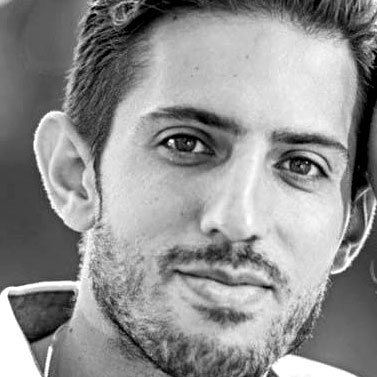
Join the Hope for Adam Legacy Walk, celebrating the spirit of Adam Krief, a father of three whose search for a bone marrow donor gained traction on social media, and those around him who tirelessly worked for a miracle. A donor was found, but his body rejected the transplant and Krief, 31, died in March of a rare blood cancer. Family and friends continue the quest to get people involved, swabbed and cured so no one goes without a donor match. There will be activities for kids. The first 500 registered guests will receive a T-shirt. 9 a.m. Free. UCLA, Drake Stadium, 340 Bruin Walk, Los Angeles. (561) 982-2926. giftoflife.org/hope4adamwalk.
“ISRAEL IN 3D: CIVIL SOCIETY IN ACTION”
The Y&S Nazarian Center for Israel Studies will hold its fifth daylong “Israel in 3D” community conference. Leading civic activists and social entrepreneurs will discuss critical societal issues in Israel and their efforts to help solve them. Panels include “Building a Shared Society,” “The Voice of the Arts” and “Doing Well by Doing Good.” Speakers include Guy Rolnik, one of Israel’s top economics and business journalists, and Tal Schneider, Israeli political journalist and blogger. 10 a.m. $45; $30 for UCLA staff, faculty and professionals younger than 35; $7 for students. UCLA Covel Commons, Grand Horizon Ballroom, 200 De Neve Drive, Los Angeles. (310) 825-9646. international.ucla.edu.
ISRAEL PHILHARMONIC’S “FAMILY MUSIC DAY”
The Israel Philharmonic Orchestra will bring its engaging and educational program to the second West Coast Family Music Day. This rare opportunity is tailored to children in order to spark an interest in music, whether as a musician, conductor or composer. Israeli pianist and educator Orli Shaham will host pre-concert interactive activities, giving each child an opportunity to meet the performers and try their instruments. Shaham also will perform in an audience participation concert. Brunch to follow. All proceeds go to the KeyNote Music Education Program, promoting mutual respect and understanding through music. 10:15 a.m. $125. Beverly Hills Hotel, 9641 Sunset Blvd., Beverly Hills. (310) 277-0100. afipo.org.
“BUILDING BRIDGES — BUILDING MOVEMENTS”
Jews United for Democracy and Justice (JUDJ) invites you to “Building Bridges — Building Movements: A Los Angeles Activist Summit,” an event designed to educate, enlighten and engage visitors. JUDJ is concerned about rising threats to religious tolerance, equal rights, a free and fair press, human dignity, and long-held norms of decency and civil society. The event will begin with convening remarks, “We Were Made for This: How Los Angeles Is Leading the Way on Issues of Justice and Democracy,” featuring Rep. Karen Bass (D-Los Angeles); Los Angeles County Supervisors Sheila Kuehl and Hilda Solis; Los Angeles City Attorney Mike Feuer; Councilmember Marqueece Harris-Dawson; former Supervisor Zev Yaroslavsky; State Sen. Ben Allen; and Los Angeles Police Department Board of Commissioners Vice President Steve Soboroff. Breakout sessions will provide attendees an opportunity for a deeper look into issues central to JUDJ’s founding principles. 12:30 p.m. Free. Leo Baeck Temple, 1300 N. Sepulveda Blvd., Los Angeles. leobaecktemple.org.
FOOD ENTREPRENEURS
From food trucks to pop-ups to social media, enjoy a look at the current food and restaurant landscape in L.A. Engage in a thoughtful conversation about the business realities behind each trend. Featuring Jim Hustead, owner of Fleishik’s, Erven and Maré; and Katie McGehee, co-founder of the digital marketing agency Socially You. Enjoy food from Fleishiks and Roy Choi’s A-Frame. 7 p.m. $10. Cross Campus, 929 Colorado Ave., Santa Monica. yala.org.
ALICIA JO RABINS CONCERT
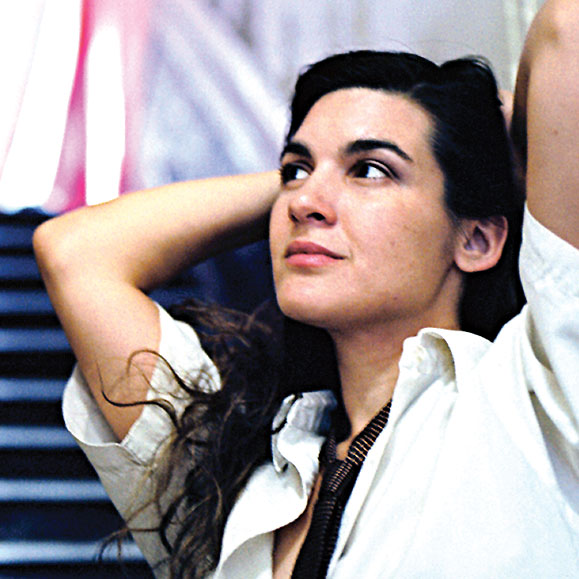
Join Young Adults of Los Angeles, East Side Jews and the Silverlake Independent Jewish Community Center for a live performance of “Girls in Trouble,” an indie-folk song cycle about the complicated lives of biblical women. There also will be a hosted cocktail reception and cash bar after the reception. 7 p.m. $10. The Box at the Silverlake Independent JCC, 1110 Bates Ave., Los Angeles. (323) 663-2255. yala.org.
“SIX DAYS THAT SHAPED 50 YEARS”
Explore the legacy of the past and the future of modern Israel. “Six Days That Shaped 50 Years” is the theme of this year’s daylong iEngage conference. Featured speakers include Rabbi Donniel Hartman of the Shalom Hartman Institute; Rabbi Adam Kligfeld of Temple Beth Am; Rabbi Sharon Brous of IKAR; Rabbi Edward Feinstein of Valley Beth Shalom; and Danielle Berrin, Jewish Journal senior writer and columnist. 9:30 a.m. $36; $18 for students. UCLA Hillel, 574 Hilgard Ave., Los Angeles. hartman.org.il.
PERSONAL REFLECTIONS FROM THE SIX-DAY WAR
In commemoration of the 50th anniversary of the Six-Day War and the reunification of Jerusalem, the Western Region American Committee for Shaare Zedek (ACSZ) NexGen Salon Committee presents David Bahat, an Israel Defense Forces paratrooper who served in the Sinai during the Six-Day War, and Nachum Pessin (via Skype from Jerusalem), executive director of Shaare Zedek Medical Center in Jerusalem. Sushi and dessert provided. 6:30 p.m. $18. Address given upon RSVP (West L.A./Beverly Hills area). (310) 229-0915. acsz.org/salon2017.
GENOCIDE COALITION SYMPOSIUM
Learn about genocide and how to end it. Speakers will include child survivors of genocide in Rwanda and Cambodia. Other participants will represent Yazidis, Syrians, Armenians and multiple African genocides. Organized and moderated by Paul Wilder, the child of Holocaust survivors. 7 p.m. Free. Adat Ari El Synagogue, 12020 Burbank Blvd., Valley Village. (818) 633-1844. adatariel.org.
PHOTOGRAPHER AMOS MORRIS-REICH

Foregoing the political lens through which racial photography normally is viewed, Amos Morris-Reich of the University of Haifa returns racial photography to the history of science and addresses it as a form of scientific evidence. Morris-Reich reconstructs individual cases, conceptual genealogies and patterns of photography practice for the study of “race” from the 19th century to the Nazi era. He shows that photography was used for such things as statistical data, medical observation of Mendelian characteristics and as a form of psychological “thought experiments.” 4 p.m. Free. UCLA, 314 Royce. (310) 267-5327. cjs.ucla.edu.
COMMUNITY CELEBRATION CONCERT
Enjoy a concert featuring Conductor Nick Strimple, the Los Angeles Zimriyah Chorale, organist Iain Farrington and a performance by Body Traffic Dance Company. Reception to follow. Sponsored by Pamela and Randol Schoenberg, on the occasion of the bar mitzvah of their son Joseph Samuel Schoenberg, in memory of Joseph’s great-grandfathers, composers Arnold Schoenberg and Eric Zeisl. 7 p.m. Open seating, first-come, first-served. Sinai Temple, Main Sanctuary, 10400 Wilshire Blvd., Los Angeles. (323) 813-5914.
What to do in Los Angeles this week: May 19-25 Read More »

One of the myths of decorating is that lighter colors work best because they make your rooms look larger and more cheerful, while darker colors make rooms feel small, drab and gloomy. Because of this preconception, many DIY decorators shy away from deeper shades and instead opt for old reliables such as off-white and beige. But the truth about light and dark colors is not so black and white.
Dark walls, flooring or furniture add considerable drama to a room, and they also envelop you like a warm hug. Just flip through any current home décor catalog or magazine and you’ll see that stylemakers are embracing the dark side — from navy blue walls and charcoal gray wood flooring to midnight black accessories.
So go ahead and be bold. With these tips, you don’t have to be afraid of the dark anymore.
Think beyond black, gray or navy. A dark color palette can include deeper shades of red, green, brown or even purple. These deeper shades are, in fact, much richer than their lighter variations and add an instant chic factor to a room.
Dark colors make more impact when there’s contrast. If you have dark walls, balance them with light floors or furniture. Allow the dark elements to bring out the light ones, and vice versa.
Again, contrast is key. A whole house of dark rooms would be monotonous, not to mention very “Addams Family.” It’s very comforting for the eyes — and relaxing to the spirit — to go from a light-colored room to a dark one.
Dark colors are bold enough, so allow everything else in the room to be more subdued. Avoid busy textures or patterns that might fight with the intense hues.
If you want to just dip your toe into this design trend, choose a dark color only on an accent wall or a door. (I’m asked all the time if accent walls are still a thing, and I say “definitely.”) Dark colors also are dramatic on floorboards and window frames.
Rather than making small rooms look tinier, as many people believe, dark colors give presence to a room and make it feel expansive. My favorite example to illustrate this point is the “Pirates of the Caribbean” ride at Disneyland, where the ceiling is painted black to suggest an infinite sky.
Dark walls and furniture are perfect backdrops for bright colors such as yellow, orange and pink, which can provide striking contrast. Try these pops of color with pillows, candleholders or picture frames.
Jonathan Fong is the author of “Walls That Wow,” “Flowers That Wow” and “Parties That Wow,” and host of “Style With a Smile” on YouTube. You can see more of his do-it-yourself projects at jonathanfongstyle.com.
Interior design: Giving in to the dark side Read More »

The Zionist Organization of America launched two broadsides against a Trump administration it has ardently defended, signaling a growing unease on the pro-Israel right with the president’s Israel policies.
The ZOA, the flagship for the conservative pro-Israel community, slammed President Donald Trump for retreating from a campaign pledge to move the U.S. Embassy from Tel Aviv to Jerusalem. It also attacked the appointment of Kris Bauman, a veteran Obama administration negotiator, as the Israel adviser on the National Security Council.
Criticism of Trump from the Jewish right, while growing, is almost always accompanied by a caveat that his Israel policies are better than those of his predecessor, Barack Obama, and praise for some of his appointments.
The ZOA statements came Wednesday, the same day an array of Jewish groups held a celebration in the Capitol of the 50th anniversary of the reunification of Jerusalem.
During the celebration Republican lawmakers – without naming the Trump administration – decried the failure to move the embassy to Jerusalem. One of those present, New York Rep. Lee Zeldin, one of two Republican Jews in Congress, later released a statement explicitly criticizing Trump and urging the move.
Trump the candidate had vowed to move the embassy as one of his first acts upon assuming the presidency, but since elected has retreated from the pledge. This week, an unnamed top U.S. official told Bloomberg News that the relocation from Tel Aviv was off the table for now.
The story prompted expressions of concern of varying intensity from the Jewish right.
Morton Klein, the ZOA president, said in a statement that the slowness to move the embassy “sends a message of weakness” and called it “painful.”
Zeldin, one Trump’s most prominent Jewish supporters during the presidential campaign, said in his statement that the Bloomberg report was “an ill-timed mistake on the part of the administration to make this decision and announcement.”
Nathan Diament, the Washington director of the Orthodox Union, the umbrella group with a constituency that according to polls was lopsided in its support for Trump last year, said in an interview that those voters were likely “disappointed” with the delay.
Klein in an interview Thursday offered up the caveat that he was still grateful that Trump had won the election.
“This guy in his heart and soul is very pro-Israel in a serious way,” he said, naming among other appointments Nikki Haley, the outspoken U.S. ambassador to the United Nations. “So many of us had high expectations it would be 100 percent on Israel; that might have been too high an expectation. He’s so much better than Obama or than Clinton would have been,” referring to Hillary Clinton, the Democratic nominee.
Matt Brooks, the Republican Jewish Coalition director, said Trump’s Jewish critics should keep the bigger picture in mind: His first tour overseas, next week, will include Israel and a visit to the Western Wall.
“It should be comforting, and those who are critical should note the symbolism of the president doing it at this time,” he said, noting the 50th anniversary of the reunification of Jerusalem. “It sends a symbolic message and one that should resonate throughout the Jewish community and the international community.”
Much of the pro-Israel right remains a strong area of Trump support on foreign policy. Breitbart News, with several alumni occupying key posts in the administration, has not advanced tough criticisms of the president’s Israel policy, although it has been critical of Trump on some domestic issues.
Conservative groups that reviled the Obama administration’s nuclear deal with Iran, chief among them the Foundation for Defense of Democracies, are pleased with Trump’s policies. While Trump has not scrapped the deal, he has ramped up his rhetoric targeting the regime and added sanctions targeting Iran’s missile testing.
Conservative pro-Israel voices — among them Klein — have been outspoken as well in defending top Trump advisers who hail from the “alt-right,” a loose assemblage of anti-establishment conservatives that includes anti-Semites but also strident defenders of Israel.
Still, there are signs that unease with Trump’s Israel-related choices is deepening on the right. The tendency in Trump’s first months in office was to blame any decision that the pro-Israel right found unappealing on officials Trump did not appoint – civil service professionals whose tenure dated back to the Obama or George W. Bush administrations, or even further back.
But now, some of the fire is being directed at Trump appointees. H.R. McMaster, Trump’s national security adviser, has earned opprobrium from the pro-Israel right wing for his bid to sideline Ezra Cohen-Watnick, a young NSC staffer who is known for his hard-line Iran views. Trump nixed McMaster’s decision to move Cohen-Watnick to another agency.
Now fire is being directed at Bauman, whom McMaster named recently as his chief adviser on Israeli-Palestinian issues. Klein in a separate statement called Bauman, who served on the U.S. team during the 2013-14 failed Israeli-Palestinian peace talks, “pro-Hamas.”
Klein based his assessment on a screed against Bauman published last week in FrontPageMag, which unearthed a 2009 academic work by Bauman citing views that recommend accommodating Hamas as a necessary evil in any negotiations toward a final status outcome. Bauman also is unstinting in describing Hamas’ brutality and terrorism in the paper.
Daniel Shapiro, until January the U.S. ambassador to Israel, on Wednesday called Klein’s attacks the “lowest of low blows,” noting that Bauman’s brief was to improve security for Israel in the West Bank ahead of a final status agreement.
Also troubling for the pro-Israel right has been Trump’s warmth toward the Palestinian Authority leadership, particularly P.A. President Mahmoud Abbas, whom Trump welcomed at the White House earlier this month and with whom he will meet in Bethlehem next week.
“I’m disappointed he brought a guy who rewards terrorists who murder Jews to the White House,” Klein said, referring to P.A. subsidies for families of jailed and killed terrorists.
The White House said in its readout of the Trump-Abbas meeting that Trump raised the issue of the payments and urged Abbas to stop them.
The pro-Israel right is starting to feel unease with Trump Read More »

Media outlets often write about trending Jewish baby names, but what about more retro names that are due to come back in style?
Parents-to-be may not want to go with what’s popular right now and instead choose something ahead of the curve, by which we mean way behind. Think about all of these favorite names from the past — names that probably sound familiar, as you most likely have uncles and grandparents with them.
Here is a baker’s dozen to consider. Bubbe would approve:
1. Hyman. A version of Chaim, this is a male name in Hebrew that means “life.”
2. Meir. A Hebrew male name, it means “one who illuminates.” (Famous Jews: Israeli writer Meir Shalev and Israeli singer-songwriter Meir Ariel)
3. Myron. Although Myron is actually Greek, many first-generation Jewish-American men were given the name. It means “fragrant, an aromatic shrub, myrrh.” (Famous Jews: animator Myron Waldman, who worked on Betty Boop, Popeye, Superman and Casper the Friendly Ghost; and comedian Myron Cohen)
4. Morton/Morty. Similar to Myron in that it’s not a Hebrew or Yiddish name, but in English, it commonly was used for Jewish immigrants. It means “town near the moor.” (Famous Jew: Morty Seinfeld, Jerry Seinfeld’s TV father on “Seinfeld,” played by Barney Martin)
5. Irving. Another name used by Jewish immigrants and their children, this name is Scottish and means “green river, sea friend.” Feel free to use Irv for short. (Famous Jews: author and screenwriter Irving Wallace, writer Irving Stone and legendary songwriter Irving Berlin.)
6. Harold. This non-Jewish name used by Jewish people is Scandinavian and means “army ruler.” Hal or Harry are fun nicknames. (Famous Jews: actor, writer and director Harold Ramis, of “Ghostbusters” and “Animal House” fame, and Beat poet Harold Norse.)
7. Melvin. Melvin, an English name commonly used by Jews, means “council protector.” Mel, anyone? (Famous Jews: physicist Melvin Schwartz, biochemist Melvin Calvin, and filmmaker, comedian and actor Mel Brooks)
8. Seymour. Seymour, a non-Jewish name also commonly used by Jews, is English and means “marshy land near the sea.” (Famous Jews: theologian Seymour Siegel, and political scientist and sociologist Seymour Martin Lipset)
9. Lucille. A female non-Jewish name, Lucille is French and means “light.” Who doesn’t want to be called Lucy? (Famous Jews: Actress and comedian Maya Rudolph’s daughter is named Lucille. Alas, actress Lucille Ball was not Jewish, although her second husband was.)
10. Rhoda. This female non-Jewish name is Greek and means “rose.” (Famous Jews: philanthropists Rhoda Haas Goldman and Rhoda Pritzker; and Rhoda Morgenstern, the TV character played by Valerie Harper)
11. Gertrude. Gertrude, a non-Jewish name for girls also commonly used by Jews, is German and means “strength of a spear.” Trudy is a great nickname. (Famous Jews: writer Gertrude Stein and composer Gertrud Rittmann)
12. Shirley. This non-Jewish name typically for girls also commonly is used by Jews. Its English meaning is “bright meadow.” (Famous Jews: sports columnist and reporter Shirley Povich, the rare man with the name)
13. Sheldon. This name is English and means “steep-sided valley.” Shel for short is super cute. (Famous Jews: poet, author and singer-songwriter Shel Silverstein and actor, producer and director Sheldon Leonard)
Kveller is a thriving community of women and parents who convene online to share, celebrate and commiserate their experiences of raising kids through a Jewish lens. Visit kveller.com.
13 Jewish grandparent names that are due for a comeback Read More »

As our brain ages, our cognitive abilities naturally decrease and it becomes more difficult to learn new things or devote attention to several things at the same time. Researchers long have been looking for ways to slow down or even reverse this process.
Scientists at the University of Bonn in Germany and the Hebrew University of Jerusalem report in the journal Nature Medicine that they have achieved this goal in mice by administering a small quantity of THC, the active ingredient in the hemp plant (cannabis).
Mice have a short lifespan and begin displaying pronounced cognitive deficits even at 1 year old. The researchers gave doses of THC to lab mice at the ages of 12 and 18 months over a period of four weeks. A low dose was chosen to avoid any intoxicating effect in the mice. After the regimen of treatment, the scientists tested learning capacity and memory performance in the animals — including, for instance, orientation skills and their ability to recognize other mice.
Mice that were given only a placebo displayed natural age-dependent learning and memory losses. In contrast, the cognitive functions of the animals treated with cannabis were just as good as the functions of 2-month-old mice used as a control group.
“The treatment completely reversed the loss of performance in the old animals,” reported professor Andreas Zimmer from the Institute of Molecular Psychiatry at the University of Bonn.
This study was carried out following years of meticulous research, according to the scientists involved. First, the researchers discovered that the brain ages much faster when mice do not possess any functional receptors for THC. These cannabinoid 1 (CB1) receptors are proteins that act as docking stations for cannabinoids like THC from substances such as hashish or marijuana. THC imitates the effect of cannabinoids that are produced naturally in the body and fulfill important functions in the brain.
“With increasing age, the quantity of the cannabinoids naturally formed in the brain reduces,” Zimmer said. “When the activity of the cannabinoid system declines, we find rapid aging in the brain.”
The study suggests that “restoration of CB1 signaling in old individuals could be an effective strategy to treat age-related cognitive impairments.”
To discover the precise effect of THC treatment in older mice, researchers at the Hebrew University of Jerusalem, led by Dr. Mona Dvir-Ginzberg and the late professor Itai Bab, examined the epigenetic changes in the mice’s brains after sustained low dosages of THC.
“The THC treatment induced molecular and epigenetic changes, which no longer corresponded to that of untreated old animals but rather were similar to what we see in young animals,” said Dvir-Ginzberg, who works at the university’s Institute of Dental Sciences.
The THC treatment caused the number of links between nerve cells in the mice’s brains to increase to younger levels. Such links are essential to the brain’s ability to learn.
“It looked as though the THC treatment turned back the molecular clock,” Zimmer said.
Cannabis products already are used widely for medical indications including pain relief. As a next step, the researchers involved in the mice study hope to conduct a clinical trial to investigate whether THC also reverses aging processes in the brain in humans and can increase cognitive ability.
Can cannabis turn back the aging process? Read More »

JQ International, an organization serving Los Angeles’ LGBTQ Jews, held its annual JQ Awards Garden Brunch May 7 at the Beverly Hills home of Angela and Jamshid Maddahi.
“It was a gorgeous day honoring three amazing role models who inspire each of us with their work advocating for the LGBTQ Jewish community,” JQ International founder and Executive Director Asher Gellis said in an interview.
The outdoor event honored community leader Courtney Mizel with the Community Leadership Award, Hollywood producer Zvi Howard Rosenman (“Father of the Bride,” “Buffy the Vampire Slayer”) with the Trailblazer Award and image therapist Liana Chaouli with the Inspiration Award.
Presenting Mizel with her award, Esther Netter, CEO of the Zimmer Children’s Museum, called Mizel “a human in tune and a LinkedIn site all her own … she is fluid in her thinking and intensely present.”
Jewish Journal Publisher and Editor-in-Chief Rob Eshman and Jewish Journal President David Suissa presented Rosenman with the Trailblazer Award.
“I was a gay Jew before there were Jewish queers,” Rosenman said, sharing his story of what it was like growing up gay and Orthodox and how he made a name for himself in Hollywood.
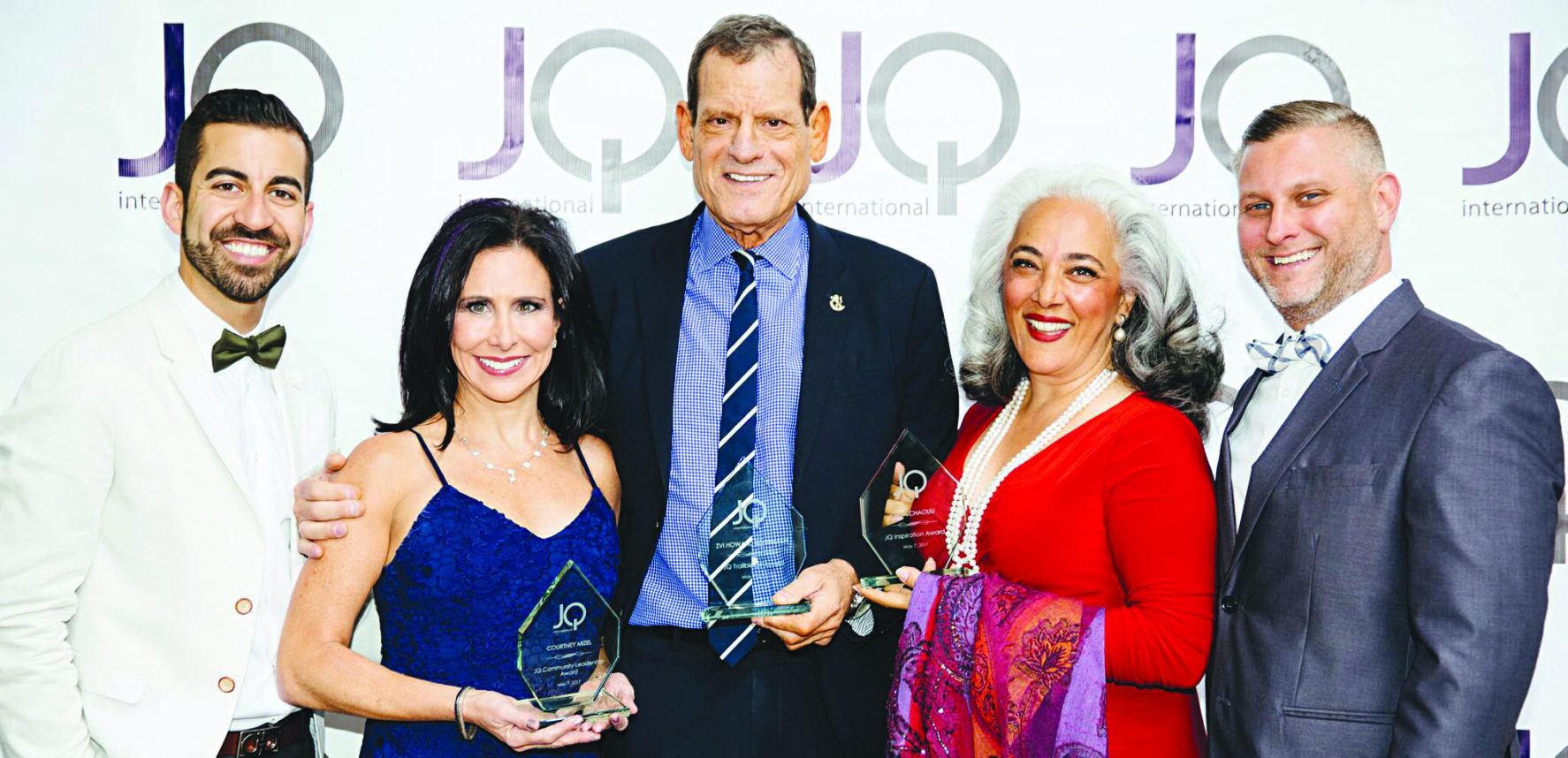
Amanda Maddahi, JQ’s director of operations, presented the Inspiration Award to Chaouli, her aunt, after sharing moving remarks about growing up in the very house where the event was held.
JQ provides programs, services and education to Los Angeles’ LGBTQ Jews and allies. Its social programming and support services include the JQ Helpline, JQ Speakers Bureau, Inclusion Consulting and support groups.
“Together,” Gellis said, “we are changing hearts and minds, and making our Jewish community more inclusive for all.”
— Esther D. Kustanowitz, Contributing Writer

West Hills-based Kadima Day School’s April 2 gala at the Hyatt Regency Westlake in Westlake Village honored school supporters Michaela and Ami Fridman, and Sivan and Avi Kobi, and recognized longtime educator Sara Goren with the Excellence in Education Award.
Michaela Fridman and Sivan Kobi serve on the executive committee of Kadima Day School as Parent Teacher Organization co-presidents.
Goren is the Hebrew coordinator and a Hebrew and Judaic studies teacher at Kadima.
Attendees included businessman and philanthropist Naty Saidoff, who pledged $50,000 to the school; Shawn Evenhaim, namesake of the school’s Evenhaim Family Campus; and Scott Abrams, district director for U.S. Rep. Brad Sherman (D-Sherman Oaks), in whose district the school is located.
Kadima Day School operates a preschool, elementary school and middle school.
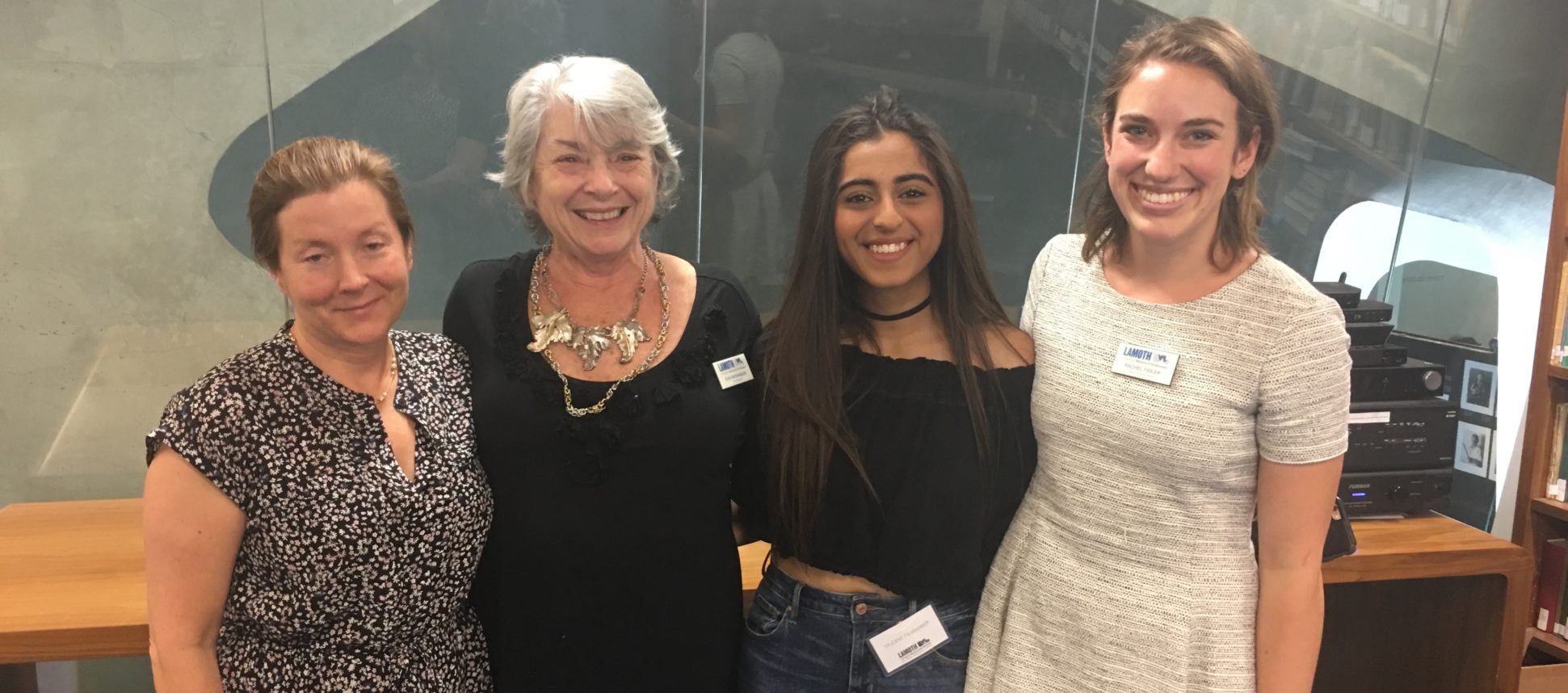
The Los Angeles Museum of the Holocaust (LAMOTH) partnered with the Los Angeles Jewish Film Festival and Jewish World Watch in holding the April 30 student film showcase “Voices of Hope” at the LAMOTH campus at Pan Pacific Park.
The event featured the screening of 12 student films and immediately followed the Jewish World Watch Walk to End Genocide in Pan Pacific Park.
Attendees included LAMOTH Creative Programs Director Rachel Fidler, who led a panel with the student filmmakers after the screening; Naja Butler, director and star of one of the films, “An American Girl”; Los Angeles Jewish Film Festival Director Hilary Helstein; singer-songwriter, activist and educator Jaclyn Riva Beck; Samrina Vasani, an alumnus of a NewGround program bringing high school-age Jews and Muslims together; and Samara Hutman, director of Remember Us and The Righteous Conversations Project.
The museum received about 500 film submissions from students in sixth through 12th grades around the nation.
The screened films tackled “social justice issues and human stories that matter,” Fidler said in an email. The films addressed issues such as bullying in schools, challenges facing young American Muslims, the subverting of gender stereotypes, and the importance of storytelling in carrying on the memory of the Holocaust.
The gathering, attended by about 30 people, was held in the museum’s upstairs library.
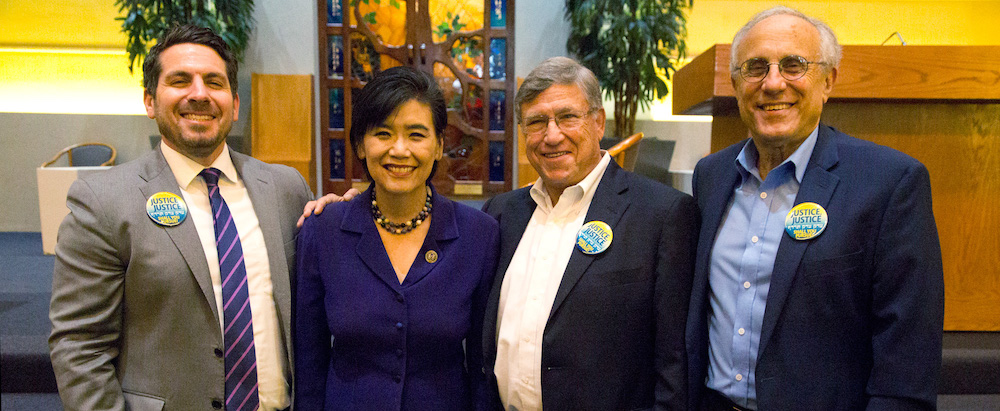
The newly formed social justice committee of the Pasadena Jewish Temple and Center (PJTC) kicked off its programming with an April 20 appearance at the synagogue by U.S. Rep. Judy Chu (D-Monterey Park), whose district includes Pasadena.
PJTC Rabbi Noam Raucher introduced the congresswoman to the approximately 300 temple members in attendance.
After Chu’s opening remarks, Peter Braun, a synagogue member and University of Southern California lecturer in leadership and management, moderated a Q-and-A session with the audience. Discussion topics ranged from Israel to tax policy and health care.
As the event concluded, Rabbi Marvin Gross, a former nonprofit director and chair of PJTC’s social justice committee, presented Chu with a sign reading “Immigrants & Refugees Welcome, We Must Not Stand Idly By … ”
The sign was part of a campaign launched by members of the social justice committee, who distributed 250 signs in Pasadena and the surrounding area.
— Eitan Arom, Staff Writer
At The Jewish Federation of Greater Los Angeles’ annual “It Takes a Woman” (ITAW) event on May 10, Olympic gold-medal gymnast Alexandra “Aly” Raisman discussed what it meant to represent the United States and the Jewish people in the 2012 and 2016 Summer Olympics.
Federation’s Sylvia Weisz Women’s Philanthropy group at the Jewish Federation Valley Alliance organized the event at the Skirball Cultural Center, which drew more than 400 female attendees.
In an onstage interview with Federation President and CEO Jay Sanderson, Raisman discussed her experiences at the two Olympics, the challenges of being a female athlete and how she is now using that experience to teach younger generations about confidence, kindness and positive body image.
Raisman, 22, is a two-time captain of the Olympic gold-medal-winning U.S. women’s gymnastics team and the second most-decorated American female gymnast in the history of the sport. She has earned six Olympic medals, including three gold.
ITAW is focused on introducing women to the work of Federation. Women are the fastest-growing segment of donors within Federation, with gifts made by women in their own names comprising 25 percent of its annual fundraising campaign, according to Federation’s website.
— Esther D. Kustanowitz, Contributing Writer
Moving & Shaking highlights events, honors and simchas. Got a tip? Email ryant@jewishjournal.com.
Moving & Shaking: JQ and Kadima galas; LAMOTH student film showcase Read More »
 Photo – Mohammed and I at Givat Haviva
Israeli Bright Light #2 – Mohammed Darawshe and Givat Haviva Read More »

Israel’s State Archive has released new documents from the Six Days War. These are documents that were sealed for 50 years, since the war, and are now available to the public. There are transcripts of full cabinet meetings and of the security cabinet meetings. There is a lot of material. And a lot of it makes for an interesting read. Here are a couple of pointers for the careful reader of the transcripts, or the reports about them.
1.
In cabinet meetings people say many things. It tense cabinet meetings they say even more things. Thus, when transcripts are released it is easy to isolate quotes and make big headlines out of them to serve a position or an ideology. If it were up to us, a politician muses, we would “deport the Arabs to Brazil.” Is this a statement that proves Israel’s malicious intentions? Some might say yes. They had the same reaction when Yitzhak Rabin mused about his desire to see Gaza drowned in the Mediterranean.
But you can also see it as a statement proving the soberness and realism of Israel’s ministers at the time – a statement proving that they realized, on day one, that occupying a territory in which many Arabs reside is going to be a headache. They did not deport anyone to Brazil. They were stuck with the headache. We are still stuck with it.
2.
Not everything that the ministers say during cabinet meetings seems impressive in retrospect. But what is quite impressive is the ministers’ refusal to engage in desperation in the weeks leading to the war and their reluctance to completely surrender to the euphoria after the war. The ministers behave in these meetings like all Israelis did: the period leading to the war was highly warrying and the country was in a dark mood during the three weeks of “waiting.” The period after the war was one of celebration and sense of invincibility.
The ministers are apprehensive, and they are uplifted – but in a more subdued way. They do not panic before, they do not lose proportion after. Yes, many of their assessments seem naïve, misconstrued, even foolish in retrospect. But this is not due to a lack of seriousness.
3.
Reading the debate about the future of the West Bank feels like deja vu. There are annexationists who wanted to absorb the territory, and believed that the demographic problem – that is, having to absorb so many Arabs along with the territory – will sort itself out. Menachem Begin, a member of the emergency cabinet that was assembled prior to the war, argued that within seven years there will be a Jewish majority in the West Bank (this still hasn’t happen). There are those for whom demography is the key: Pinchas Sapir, the Finance Minister, warns of Israel’s future as a Jewish State if so many Arabs will become residents or citizens of Israel.
It is almost boringly familiar, and yet so distant.
4.
I’m reading a transcript of a security cabinet meeting from the 26th of May, 1967. Yitzhak Rabin, then the IDF’s Chief of Staff, is asked to assess whether Israel can withstand an attack. Look how careful he is: “I think if we have the tactical surprise, there is a possibility… that we will have achievements.”
Here is a question: Was this a professional failure on part of the IDF and Rabin? Consider a different scenario, an imaginary mirror-image scenario: it is the same meeting but Rabin promises a great victory and then Israel faces a military defeat. What would we say in such a case? – probably that the Chief of Staff didn’t not correctly assess the situation, and hence provided Israel’s political leaders with inaccurate information because of which they made the wrong decisions.
But no one has the time, nor the reason to ask the exact same question when the assessment of the military commander is inaccurate in a positive sense – that is, a prediction of great difficulty that later proves to be an overstatement.
5.
Everything is there. A minister warning Defense Minister Moshe Dayan that the IDF ought to be reminded to treat the civilian population humanely. Ministers for and against taking East Jerusalem. Concern because of possible over-eagerness to prolong the war and occupy more territory because of the victories.
And there are also lies that Israel decides to tell. The protocol shows how Israel attacked Syria in the Golan Heights. Minister Yigal Alon calls for the attack, disregarding the possibility of diplomatic tension with Russia because of it. He prefers, so he says, controlling the Heights over diplomatic relations with the Russians. The director of the Foreign Ministry warns against action: attacking Syria will complicate things for us with the Russians, he says. But Rabin wants action. “Ending such a war without hitting the Syrians would be a shame,” he says.
Israel tells the world that the Syrians are fighting. “This is not the truth,” argues Minister Moshe Haim Shapira. True, says Minister Alon. “I admit that this isn’t the truth, but these are the kind of lies that we can tell to have peace” – namely, to have the Syrians’ cannons removed from the Heights that overlook Israel.
6.
Some things still feel different, and the most notable of them is the approach of the representatives of Israel’s religious-Zionist sector. Today, they are the most hawkish. In 1967, they were famously the least hawkish. They were the ones preaching for caution and moderation.
Haim-Moshe Shapira did not want the attack on the Syrians. His friend Zerach Warhaftig cools down Dayan when the defense minister suggests that Israel send its forces to Beirut, Lebanon. “I would argue that we should have some limits,” Warhaftig says.
Discussing the Cave of the Patriarchs in Hebron, on June 18, a few days after the war, Dayan asks his colleagues: “Who gave the order to put a Mezuzah over there?” The Prime Minister, Levi Eshkol, responds: “the marble was broken.”
Dayan: “We come to a place that is holy to Muslims, and also to Christians, and also to us.”
Shapira – the Zionist-religious minister – the predecessor of today’s Habayit Hayehudi party – responds: “especially for them.”
So yes, some things do change.
Six comments on new documents from the Six-Day War Read More »