fbpx

May 15, 2017

Charter schools the key issue as Jewish candidates seek LAUSD seat

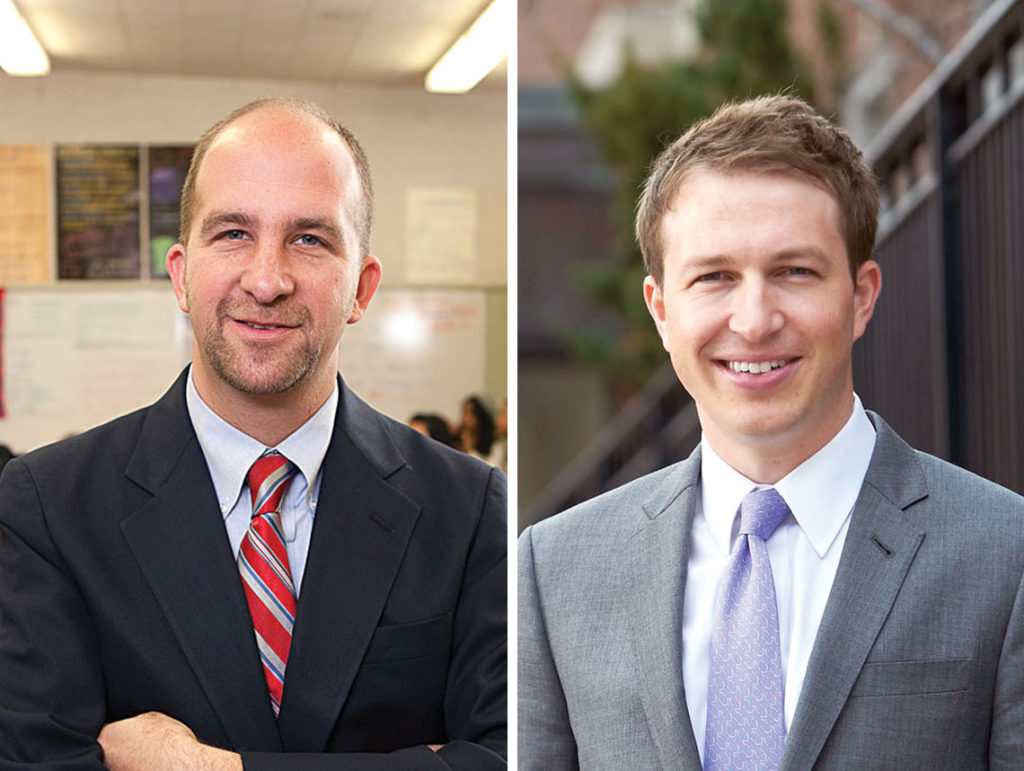
Update: Steve Zimmer, LAUSD board president, conceded the May 16 runoff election for the District 4 seat, encompassing most of West Los Angeles and the West San Fernando Valley.

Ceding the race, Zimmer said he would not call his opponent, according to the Los Angeles Times. The contest between Zimmer, who has the support of unions, and Nick Melvoin, 31, backed by pro-charter school forces, was bitter at times, featuring sensational negative campaign ads and mailers.
 
Together with a win for pro-charter candidate Kelly Gonez in the Valley, Melvoin’s win signals a shift in favor of charter schools on the seven-member board. Election returns were not immediately available.


What normally might be a sleepy contest over a seat on the Los Angeles Unified School District board has instead become the latest proxy battle between teachers’ unions and charter schools.

The runoff between school board president Steve Zimmer, a longtime educator, and reform candidate Nick Melvoin has taken on an outsized significance and drawn record-setting campaign chests. Teachers’ groups, primarily United Teachers Los Angeles (UTLA), have worked toward electing Zimmer, while the California Charter Schools Association and other pro-charter forces have spent heavily for Melvoin. More than $7 million has been spent on the two candidates, records show.

The result is a race whose implications reach far beyond District 4, the Westside Los Angeles district the two men are competing to represent. All the major players — both candidates and the president of the teachers union, Alex Caputo-Pearl — are Jewish.

The two candidates face voters in a May 16 runoff after neither captured a majority of votes in a four-way primary in March. Zimmer came the closest with 47 percent, followed by Melvoin, with 33 percent.

To hear the teachers union say it, the race is about its very existence.

“It’s about whether we continue to have a civic institution of public education,” said Caputo-Pearl, standing outside the union’s Koreatown headquarters as a May Day march kicked off.

The march, he said, signaled the union’s participation in a national campaign “to resist all of the movements that we see coming out of the Trump administration.” Most presciently for the teachers is the fight against efforts, backed by Secretary of Education Betsy DeVos, to promote what supporters call school choice and opponents like Caputo-Pearl brand as privatization.

UTLA’s rhetoric proposes an axis that runs through President Donald Trump, DeVos, billionaires such as Eli Broad who dabble in education reform, and Melvoin, who in 2015 expressed support for a Broad proposal to put half of Los Angeles students into charter schools.

“They intend to create a school system that is not for all kids and is a privatized system,” Caputo-Pearl said.

In a statement, Melvoin disputed that characterization, saying L.A. Unified already is failing students by graduating 7 out of 10 students without basic math skills.

“To me, that’s not a district that’s serving all kids,” he said in the statement.

For his part, Zimmer describes a district that, while not perfect, is trending upward.

“I’m not saying we’re doing well enough, but we are doing better,” he told the Journal earlier this year. “An honest narrative is: This is a district that is improving.”

By contrast, in an op-ed in 2015, Melvoin asserted the district was ripe for a “hostile takeover.” UTLA took those as fighting words.

“Sounds a lot like Steve Bannon saying everything needs to be blown up,” Caputo-Pearl said, referring to the Trump administration adviser known for his disdain for big government.

Melvoin dismissed Caputo-Pearl’s barbs as “childish taunts” in the statement.

A victory for pro-charter forces in District 4, along with another seat up for grabs in the San Fernando Valley between seventh-grade teacher Kelly Gonez, backed by charter advocates, and community organizer Imelda Padilla, with support from unions, would spell a power shift in favor of charter schools on the seven-member school board. Although the district is cautiously favorable to charters — it currently has more charter students than any other school district — pro-charter victories in the two runoffs could mean a board disposed even more favorably to growing its charter enrollment.

Melvoin paints his approach as an all-of-the-above stance rather than an indiscriminately pro-charter one.

But charter forces apparently see an opening in him. Parent Teacher Alliance, a group funded by the California Charter Schools Association (CCSA), has mounted a muscular independent expenditure campaign on his behalf, spending hundreds of thousands of dollars to help him defeat Zimmer. Others who have spent heavily for him include Broad and former L.A. Mayor Richard Riordan, a Republican.

Richard Garcia, a spokesman for CCSA’s advocacy arm, says it supports Melvoin because “he’s open to listening to all voices,” whereas Zimmer would “remain beholden” to unions.

UTLA has responded with a campaign of its own, blanketing the city with mailers supporting Zimmer and attacking Melvoin. One branded Melvoin the candidate most likely to “implement the Trump/DeVos education agenda in L.A.”

Caputo-Pearl doesn’t expect to be able to outspend his ideological opponents in this race. Instead, he’s relying on the union’s manpower to help re-elect Zimmer.

“What we have,” he said, “is the credibility of educators going door to door, being on the phones and standing up for a public education system for all students.”

Charter schools the key issue as Jewish candidates seek LAUSD seat Read More »

Women in Orthodoxy: The plot thickens

Some tense debates are going on right now within the Orthodox movement as it deals with the forces of modernity. Perhaps the most contentious issue among them is whether Orthodoxy should allow women clergy.

The “traditional” camp, represented by mainstream Orthodox groups such as the Orthodox Union and the Rabbinical Council of America, says no. The “open” camp, a fledgling movement of more liberal Orthodox rabbis, says yes.

There are arguments on both sides. The letter of halachah (Jewish law) does not specifically prohibit women clergy. But one of the hallmarks of Orthodoxy is a deep respect for tradition and continuity, to the point that tradition itself can take on a legal status.

The traditional view gives great emphasis to the spirit or the ethos of the law, while the open view looks for legal ways to thread the needle and make tradition more inclusive. It’s a classic struggle, and I see value with both views.

If you go by modern trends, the open view looks like a slam dunk: How can you tell a woman that she cannot do what a man does? This egalitarian mindset has become so ingrained in our thinking that anything less can seem offensive.

And yet, as much as my mind leans toward a more inclusive and open approach, I find myself having a place in my heart for the maintenance of tradition. Maybe this comes from conversations I’ve had over the years with Orthodox women who live happily in the traditionalists’ camp.

Let’s take one example of an Orthodox custom that can offend non-Orthodox Jews — the physical barrier (mechitzah) between men and women in synagogues. This feels like another slam dunk: Why separate men from women?

Here’s what one woman told me who moved from the Reform to the Orthodox camp: The separation helps her better connect with God. Sitting next to her husband can distract her from that intimate moment of prayer. You can disagree with that sentiment, but still respect it.

Similarly, why would so many Orthodox women be OK with only men being officially part of the rabbinate?

Again, it’s because they see something holy in the notion of separation. Shabbat, for example, is a sacred separation from the rest of the week; so is the home from the outside world and so is the bedroom from the rest of the home.

In a marriage, this sanctity of separation means embracing different roles for men and women. Because the woman feels dignity and fulfillment within the roles that she has, she feels no inclination to appropriate the man’s roles. In her eyes, “different” doesn’t mean superior or inferior, it means holy and equal.

In other words, what may look like retrograde to you is sanctity to them. At least with the women I spoke to, they associate this sanctity of difference with holiness in the home and harmony in their lives.

Still, it’s worth noting that Orthodoxy has not been immune from the forces of modernity. In recent years, Orthodox women have become more and more engaged in areas that traditionally have been more associated with men.

Even the statement earlier this year by the Orthodox Union opposing female clergy noted “the important and fundamentally successful roles that women can and must play within our communal and synagogue structures, including as educators and scholars.”

It is the role of women in synagogues, rather than in schools, that is especially sensitive. As is often the case with these debates, it comes down to red lines. Traditionalists want to draw a red line at women clergy; the Open camp doesn’t feel this is necessary.

If no compromise is reached, Open Orthodox institutions, although still a small minority, may end up being excluded from Orthodox umbrella groups — something that would open a permanent breach in the movement. I hope leaders on both sides will struggle to find an arrangement for the sake of heaven.

Maybe each side can give a little. The Open camp can create a spiritual leadership role and a title for women that pushes the halachic envelope yet still falls short of the traditional clergy position, while the Traditional camp can tolerate this arrangement for the sake of communal harmony and broadening the Orthodox tent.

It would be like saying: “We agree to disagree on this one issue, but for the sake of a higher ideal, we have both compromised a little and will coexist under the same Orthodox tent.”

I have dear friends on both sides. When I see the deep attachment to Torah in both camps, it strikes me how much they’re really all on the same side.


David Suissa is president of TRIBE Media Corp./Jewish Journal and can be reached at davids@jewishjournal.com.

Women in Orthodoxy: The plot thickens Read More »

Review: JLab Audio Epic2 bluetooth earbuds

As the tech world moves away from wires, there has never been a better time to make the leap to wireless headphones.

Bluetooth wireless technology has been around for some time now and has come a long way since its early commercial implementations – there is very little fidelity loss and the convenience is hard to argue.

Enter the JLab Audio’s Epic2 earbuds – the vastly improved follow-up to the company’s original Epic earbuds.

When buying wireless headphones there are three main things I consider: audio quality, connectivity and battery life.

Audio quality

The Epic2s offer balanced sound with very good clarity. I was impressed with how much of a song’s detail can be heard.

The bass is decent, though it felt a little thin at times, especially at higher volumes. If you are looking for headphones that really carry a punch there are some better options out there.

Phone calls sounded great, too. Voices sounded crisp and clear and I didn’t have to elevate my voice to be heard by the person on the other end.

The Epic2s can get loud – like, really loud. While this may be great for pumping you up in a gym, be cautious when rocking out on a run as the volume and sound isolation make it very difficult to hear what’s going on around you. Be careful out there.

Connectivity

Wireless headphones are at their best when the user can simply connect them to a device once and never think about it again. JLab has nailed this process with the Epic2s.

The pairing process was a breeze. My iPhone discovered them immediately and in two steps they were ready to rock. The instructions were very straightforward and the audio queues heard through the headphones were a helpful touch.

I haven’t experienced any signal drop while listening to music and was pleasantly surprised by how far I could move away from my device without interruption – a genuinely liberating feeling.

epic-bt-battery
The JLab Epic2’s dual battery system

Battery life

The battery life packed into the relatively small form-factor of these headphones might be their most impressive feat. The company claims the earbuds offer 12 hours of playtime and – while I am often skeptical of company estimates on battery life – they lasted a weeklong trip of moderate use without a recharge.

They pull this off by placing two batteries within the earbuds themselves rather than, say, within the controller which some companies do. While this dual battery setup increases the size of the earbuds I will trade a little added weight for improved battery life every time.

The voice that lets you know your earbuds are connected will let you know the batteries’ status and will warn you when they need to be recharged.

Other important factors

Comfort: The Epic2s are comfortable – though the extra size causes a little irritation during long listening sessions – and haven’t fallen out of my ears even during more intense workouts.

epic-bt-2-cropped-black
The over-ear hook helps with security but could be a little stronger

They come with 8 tip sizes which will allow most users to find a secure fit. I have had trouble with some in-ear headphones in the past, but had no trouble finding a sweet spot with the Epic2s. The flexible over-ear hooks add another layer of mobility confidence, though I wish they held their form a little better.

Controls: The controls are intuitive and take very little time to master. Their simplicity is important because the buttons are located behind your right ear and out of sight while in use. 

The three-button setup allows you to perform most of the basic functions one should expect: adjust volume, skip tracks, answer phone calls and even start your phone’s smart assistant.

Water resistance: The Epic2s have an IPX5 rating – while you can’t jump in the pool with them, they are sweat-proof, splash-proof and can be rinsed off after a workout.

What comes in the box: Epic2 earbuds, 2 mini cable management clips, USB to micro USB cord, travel case and eight sets of tips.

TL;DR

If you have a new iPhone or are just looking to jump into the wireless headphone space, the JLab Audio Epic2 earbuds are a great choice. You get a lot of bang for your buck: balanced sound, secure fit and industry best battery life.

For those of you ready to revisit that New Year’s Resolution, these headphones will help get you off and running.

Review: JLab Audio Epic2 bluetooth earbuds Read More »

What to expect from Trump’s Israel visit

President Donald Trump will be departing on Friday for his first foreign trip overseas with stops in Saudi Arabia, the Vatican, Israel and the West Bank. Daniel Kurtzer, former US Ambassador to Israel and Egypt, told Jewish Insider, “What Trump is trying to do is contrast his close closeness to Israel with that of Obama. Obama didn’t go for the first four years and Trump is going in the first four months.”

[This story originally appeared on jewishinsider.com]

The visit to Israel is part of a long term US strategic investment towards the process, noted Michael Koplow, policy director of the Israel Policy Forum. “Someone in the White House has learned the lesson from the last administration where it was clearly a mistake not to go to Israel early on. (They) realize that if you are going to get the Israelis to make concessions, it’s probably a good idea to actually go to Israel and show the Israelis some love.”

The White House’s showering of love towards Israel is concerning many in Jerusalem, explains Daniel Shapiro, former US Ambassador to Israel from 2011-2017. “When it comes to President Trump’s Israeli-Palestinian peace initiative, both sides are nervous about what this trip, and events beyond it, could produce. Trump is unpredictable, and his team is inexperienced in Middle East negotiations,” he told Jewish Insider.

While Palestinian President Mahmoud Abbas may be uncomfortable abiding by Washington’s demands to cut stipends to terrorists’ families, he still likely appreciates the renewed attention. Abbas is “primarily looking at the revival of interest in the Palestinian issue and his own role as chairman of the PLO as an unexpected political bananza. What he is going to try and do is try to get maximal advantage particularly in terms of his own domestic political credibility,” explained Hussein Ibish, senior resident scholar at the Arab Gulf States Institute in Washington. “As long as the Palestinian issue has been resuscitated — almost brought back from the dead really by Trump —  and he’s standing next to Trump whether in the White House or Ramallah, and there is serious prospects for some benefits on-the-ground, his position which was otherwise very shaky politically becomes really unassailable.”

With Trump’s unpredictable nature and the threats of a Twitter war launched against Jerusalem and Ramallah, Kurtzner emphasized the willingness of both sides to please Trump. “They (Netanyahu and Abbas) are going to try and put on the best face they can: neither one wants the responsibility of failure to be on their doorstep,” he stated. At the same time, Shapiro emphasized the deep underlying challenges preventing any genuine breakthrough between the parties. “Neither Netanyahu or Abbas have any trust in the other, and both face severe domestic political constraints and gaps in their respective positions on the core issues,” he noted.  “So whether they agree to start talks under Trump’s sponsorship, or simply stall for time, they are very likely to fall back into deeply ingrained habits of preparing not for success, but for winning the blame game when failure comes.  That may be the biggest challenge facing Trump’s initiative.”

Yet, for all of the focus on how the trip will impact Israelis and Palestinians on-the-ground, Koplow suggests that the visit may have an additional purpose. “Going abroad and having a high-profile trip where you are seated by leaders in Israel, Saudi Arabia and the Vatican it looks good and certainly won’t escape anyone’s notice that it’s coming at a time when things at home are getting dicey and this won’t be the first President to go abroad and try to use good headlines and nice photos from overseas to push away some trouble he is having at home,” he said.

What to expect from Trump’s Israel visit Read More »

Under Trump, daylight re-emerges in US-Israel relationship

Just days before President Donald Trump’s first visit to Israel, the U.S.-Israel relationship is undergoing its first major crisis in the Trump era. ZOA’s Klein: “The President is getting bad advice.”

HOW IT STARTED: During a Sunday morning interview with Chuck Todd on NBC’s Meet the Press, Tillerson said that any decision to move the embassy from Tel Aviv to Jerusalem would not be made for some time, adding that it would take consultations with Israel and the Palestinians to see if the move would advance the peace process. “I think it’ll be informed, again, by the parties that are involved in those talks,” Tillerson said. “And most certainly Israel’s view on whether Israel views it as being helpful to a peace initiative or perhaps a distraction.”

[This story originally appeared on jewishinsider.com]

Hours after the interview was broadcast, Netanyahu issued a rare statementresponding to Tillerson’s remarks. “Moving the American embassy to Jerusalem would not harm the peace process,” Netanyahu said. “On the contrary, it would advance it by correcting an historical injustice and by shattering the Palestinian fantasy that Jerusalem is not the capital of Israel.” He repeated this statement at the weekly Likud faction meeting in the Knesset on Monday.

DID BIBI ADVISE TRUMP AGAINST MOVING? On Monday, in response to a Fox News report that Netanyahu told Trump not to move the embassy right away, the Prime Minister’s Office released partial transcripts of Netanyahu’s White House meeting as proof that he had urged the President to move the embassy. “The embassy – the PM supports moving it,” a summary of the Oval Office meeting read. During a working lunch at the White House, “the PM was asked about the embassy and explained [that moving it would not lead to bloodshed in the region, as some were trying to intimidate President Trump into believing.”

The Prime Minister’s office also released a transcript of a meeting between Ambassador Ron Dermer and former National Security Advisor Mike Flynn on January 16: “Dermer explained why moving the embassy would help advance peace and not the opposite. This would send the message that we are in Jerusalem to stay. Moving the embassy would force the other side to contend with the lie they’ve constructed – that Israel has no connection to Jerusalem – and will cause them to understand that Israel will be here forever with Jerusalem as its capital.”

Visiting the Wall: According to a report by Israel’s Channel 2, the U.S. advance team rebuffed a request from Netanyahu’s team to accompany Trump while he visits the Western Wall. According to the report, the US team explained that the site is part of disputed territory in the West Bank and not under Israeli sovereignty. An official in Netanyahu’s office expressed“astonishment” over the comment. The official, speaking on condition of anonymity, said Israel has contacted the administration to discuss the matter.

REACTIONS: Abe Foxman, former National Director of the Anti-Defamation League (ADL), lambasted the White House for its “very serious misunderstandings” on sensitive and important issues to Israel and the Jewish people. “It makes many of us — who are hoping for a change in U.S.-Israel relations — nervous,” Foxman, the current Director of Center for the Study of Anti-Semitism at the Museum of Jewish Heritage, told Jewish Insider. “I cannot believe that the traditionally pro-Palestinian functionaries in the American Consulate in Jerusalem are making the decisions on the Kotel and Jerusalem.”

The current CEO of the Anti-Defamation League, Jonathan Greenblatt, urged the White House to clarify its stance following the report. “The Kotel is 100% part of Israel and holy to Jews around [the] world,” Greenblatt wrote on Twitter.

“When a President or Prime Minister needs to put out record of a private conversation to defend themselves against the other or their domestic opposition, it’s not a good sign,” Aaron David Miller, Vice President for new initiatives and a distinguished scholar at the Woodrow Wilson International Center for Scholars, told Jewish Insider. “Remember the agreement between these two [leaders] to manage differences by not going public?”

“Playing with the Jerusalem issue complicates not just the putative peace process, but everyone’s politics,” Miller explained. “If Trump wants to hang a ‘closed for the season’ sign on the peace process before it ever gets started, he should fool around with the Jerusalem issue.”

“The administration has boxed itself in by focusing on Jerusalem and not doing what every other administration (R or D) has done which is to punt the issue,” he added.

Dore Gold, former MFA Director General and current President of the Jerusalem Center for Public Affairs, defended Netanyahu’s action, saying the Prime Minister is right to push on Jerusalem as Israel commemorates the 50th anniversary of the reunification of Jerusalem. “Now that the administration is expressing strong determination to reach a final status deal, naturally Israelis are concerned about what happens to Jerusalem,” Gold said in an email. “This is a core value of national identity for Israelis which may not be fully appreciated by the outside world.”

Republican mega-donor Sheldon Adelson, who will be in Israel during Trump’s visit, was reportedly “furious” about Tillerson’s comments on the embassy. Mort Klein, President of the Zionist Organization of America (ZOA), said on Monday that he is very disappointed with Trump’s handling of the issue. “I am very disappointed he hasn’t moved the embassy,” Klein told Jewish Insider in a phone interview. “It’s a mistake. This harms President Trump’s credibility and if the Arabs don’t respect his credibility, it is more likely that they would be making impossible demands.”

“The President is getting bad advice from some of his aides,” Klein continued. “All I say to his people is: the embassy hasn’t been moved for the 23 years since Oslo and you haven’t gotten peace. So the problem is obviously not moving the embassy to Jerusalem.” Klein elaborated that in recent meetings at the White House he told Trump aides, Steve Bannon and Sebastian Gorka, that “moving the embassy would make the Palestinians and the Arab world understand that Trump is serious and doing what’s right and that the jig is up.”

Klein said he’s worried about Tillerson citing the current Secretary of State’s relationship with former Secretary of State James Baker. “I am concerned that Tillerson will begin to pressure Israel to take stands that they can’t take,” he said. “I am worried.”

A White House spokesperson told Jewish Insider, “The comments about the Western Wall were not authorized communication and they do not represent the position of the United States and certainly not of the President.”

Under Trump, daylight re-emerges in US-Israel relationship Read More »

Western-Wall

Trump Israel visit team member reportedly says Western Wall is ‘part of the West Bank’

A senior member of the U.S. delegation for President Donald Trump’s visit to Israel next week reportedly angered Israeli officials when he said the Western Wall was “part of the West Bank.”

Israel’s Channel 2 reported Monday that the U.S. delegation rejected Israeli requests that Prime Minister Benjamin Netanyahu and an Israeli TV crew accompany President Donald Trump on his visit to the Western Wall. The U.S. official then reportedly said, “It is not your territory, it’s part of the West Bank.”

According to the report, the Israeli delegation was so angry that members started shouting.

An Israeli official told Channel 2 that the Jewish state was “convinced that this statement contradicts President Trump’s policy as expressed in his fierce opposition to the latest [United Nations] Security Council resolution” and that it had asked the United States for clarification on the comment.

In December, the U.N. Security Council passed an anti-settlement resolution with the U.S. abstaining. Trump slammed President Barack Obama for not vetoing the resolution, calling it “extremely unfair.”

Trump will arrive in Israel on May 22, when he will visit the Western Wall and meet with President Reuven Rivlin and Netanyahu. That day also includes a “possible visit” to Yad Vashem, Israel’s Holocaust memorial.

The following day, Trump will speak at Masada, the Roman-era fortress in the Negev Desert, and meet with Palestinian Authority President Mahmoud Abbas.

Trump’s first overseas trip as president will also include visits to Saudi Arabia and the Vatican. The agenda was deliberately set “to bring about all the different countries, all the different religions, in the fight against terrorism,” an aide said earlier this month.

On Sunday, Secretary of State Rex Tillerson raised eyebrows when he spoke of “a peace initiative between Israel and Palestine.” It was not the first time a member of the Trump administration referred to “Palestine,” which the U.S. does not recognize. Earlier this month, White House social media director Dan Scavino Jr. said on Facebook that the president would meet with Palestinian Authority President Mahmoud Abbas in “Palestine.”

A senior administration official called Tillerson and Scavino’s references “unintentional and unfortunate,” The Jerusalem Post reported Monday.

Trump Israel visit team member reportedly says Western Wall is ‘part of the West Bank’ Read More »

Lights of Israel #1 – Yemin Orde Youth Village and Abraham’s Orchard

So much of media attention about Israel focuses on the negative. But there is overwhelming creativity, productivity, and goodness occurring daily that the world just does not see.

I have led five congregational missions over the past eighteen years and introduced two hundred individuals to Israel so as to understand Israeli lives, dreams, hopes, and aspirations.

I returned this week from the latest such trip and in this and the following entries, I will tell stories of people and projects that moved us deeply. I express gratitude to everyone we met and ARZAWorld Travel (i.e. Daat Travel in Israel) whose staff worked with me in putting this special itinerary together.

Our concerns transcended politics, though we met members of the Knesset, journalists, scholars, and activists who spoke to us about the Israeli-Palestinian conflict.

Beyond them, we met leaders who are helping to create a shared society between Jews of all kinds and Israeli Jews and Israeli-Arabs. We visited schools for Jewish and Arab Israeli children studying together. We spent time with Orthodox women, Muslim Arabs, and Bedouin leaders striving to educate their community’s women so they can assume their rightful place in the workforce and lift them and their families out of poverty. We toured the seam-line on the Gaza border with kibbutzniks who have suffered thousands of mortar attacks. We met four extraordinary leaders of Israel’s Reform movement who are building communities all over the state and advocating a liberal, pluralistic, inclusive, and democratic society. We met with one significant Palestinian leader in Ramallah and with the head of the Yesha Council of Settlers over the Green Line in the occupied West Bank. We took a tour with the top expert in what is occurring in East Jerusalem.

To begin, in this blog I want to shine a light on two organizations that deeply inspired my group of synagogue leaders:

Yemin Orde Youth Village is located in the Carmel mountains and is named in memory of British Major General Orde Wingate who trained Palmach troops (the advanced striking force of the Haganah before the establishment of the State of Israel) including Moshe Dayan, Yitzhak Rabin, and Yigal Alon.

Established in 1953, Yemin Orde has welcomed thousands of children from North Africa, Iran, India, Yemen, Ethiopia, the nations of the former Soviet Union, Brazil, Argentina, Ukraine, and France.

Most of the children came to Israel on their own without family. Some are Israeli-born who grew up in tough drug-infected and violent neighborhoods in Tel Aviv and development towns. At Yemin Orde they learned that they could live differently. There they found a home and a family that cared about them and consequently have been able to chart their own positive and productive futures.

Yemin Orde graduates have succeeded in the elite units of the Israeli Defense Forces, as university graduates and leaders in hi-tech, as mayors of towns and villages and as  Members of the Knesset, in business, the arts, and education.

There are 465 students (ages between 14-18) living at Yemin Orde and the youth village has a waiting list of 100 children. The staff gives each child emotional and psychological support so they can build their sense of self-worth and self-esteem, achieve academically and be productive Israeli citizens and leaders.

Yemin Orde receives two-thirds of its budget from the Israeli government and the rest comes from foundations and individual fundraising.

The second is The Orchard of Abraham’s Children – I visited this Israeli Jewish and Israeli Palestinian Nursery School (ages 2-6) in Jaffa in February 2016 and blogged about it then. See https://rabbijohnrosove.wordpress.com/2016/02/29/the-orchard-of-abrahams-children-towards-the-creation-of-a-shared-society/.

The story of the beginnings of The Orchard of Abraham’s Children is among the most inspirational stories we heard. A fine fiction writer could not have made this up.

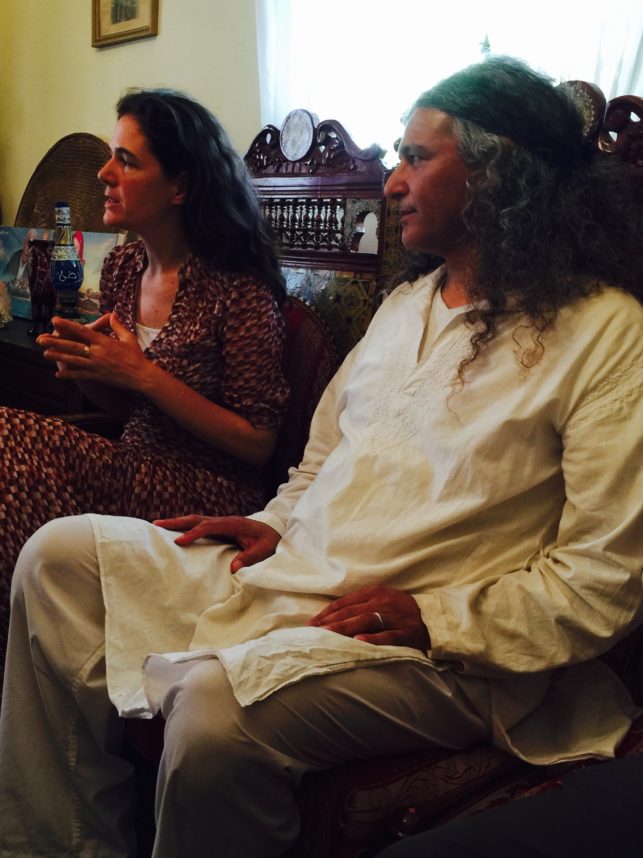
Ihab Balha (a 47-year-old Muslim Sufi Palestinian-Israeli) and his wife Ora (a mid-30s Israeli Jew) met in the Sinai, fell madly in love, married each other the next day, transformed their families, an entire community, and the future of thousands of Israeli Arabs and Israeli Jews. Now in its 7th year, The Orchard has 80 Jewish and Palestinian children and families. (photo is of Ihab and Ora)

There are many more positive and uplifting stories to come. Stay tuned.

Lights of Israel #1 – Yemin Orde Youth Village and Abraham’s Orchard Read More »

Daily Kickoff: Iran’s Khamenei calls Soros a ‘rich American Zionist’ | Sam Altman for CA Gov? | Bibi to appear on Harvey Levin’s show | Guten Gefilte!

Have our people email your people. Share this sign up link with your friends

FIRST LOOK – In an interview with Susan Glasser on The Global Politico podcast, former Secretary of State Condoleezza Rice discussed Trump’s visit to Israel on his first trip overseas: “To go to a place like Israel and see what it’s like to be a democracy in a sea of countries that would have destroyed you had it not been for your toughness and your will… And so these are early days and I think the President and many around him have not been in government. Let’s give it a little time.”

Glasser: You write in your book about that moment, that shock when you realized that Hamas, who had not been expected to win was going to win the elections, basically free and fair, more or less, elections to take over Gaza. That dealt a serious blow to your own peacemaking efforts between the Israelis and the Palestinians. It was not expected. You had pushed hard for the elections.

Rice: “Well, my undiminished faith is that elections have to happen, right? … I think one mistake we made with Hamas was we really should have said they had to disarm if they were going to participate in the elections, along the lines of what was done in Northern Ireland, for instance… So that’s one thing. Don’t let armed militias participate in elections because they have a, shall we say, unfair advantage. It would be true, for instance, of Hezbollah in Lebanon. But a more important one is that yes, if you have elections and the only organized forces are Islamists, radical Islamists, then you’re going to get a bad outcome.” [PoliticoMag]

TOP TALKER — Bibi & Lauder talk to Leibler: “Netanyahu says Lauder peace push is his biggest challenge” by Isi Leibler: “When I spoke to the prime minister, it was clear that [Ron] Lauder’s intervention with Trump angered and distressed him. He referred to Lauder as “my biggest challenge to overcome” because he has immense influence on Trump and is promoting a peace program that had been rejected by Israel but was attractive to an American president possibly easily seduced into believing that a quick peace could be achieved…  [Lauder] told me he is being flooded with letters of support including many from former critics…  He insists that if his efforts fail, we will have tried, nothing will have been lost and we will simply return to the status quo.” [JPost]

These Are the Voices Whispering in Trump’s Ear About Israel and How to Make the ‘Ultimate Deal’ — by Amir Tibon: “In addition to Lauder and Adelson, another billionaire with Trump’s ear is Thomas Barrack, a real estate investor with Lebanese roots who is a personal friend of the president and helped arrange his inauguration events. Barrack has reportedly been advising Trump on the Middle East (not specifically the Israelis and the Palestinians), and also used his vast regional network to help the Trump administration in its early days. Barrack said earlier this month that Trump’s “lack of predictability” has “gained respect” in the Middle East and around the world. “Every foreign leader has come to the table for him,” Barrack added.” [Haaretz]

DRIVING THE CONVERSATION: “U.S. Secretary of State Signals Caution on Israel Embassy Move” By Dion Nissenbaum: “In an interview broadcast Sunday on NBC News’ “Meet the Press with Chuck Todd,” [Rex] Tillerson said the president “is being very careful to understand how such a decision would affect the peace process… I think it’ll be informed, again, by the parties that are involved in those talks,” Mr. Tillerson said. “And most certainly Israel’s view on whether Israel views it as being helpful to a peace initiative or perhaps a distraction.”” [WSJ; NBCNews

“Sheldon Adelson “furious” about Tillerson’s comments” by Jonathan Swan: “Republican mega-donor Sheldon Adelson — a man who has no trouble getting the President on the phone — is “furious” about comments Secretary of State Rex Tillerson made today… The sources say the Las Vegas billionaire doesn’t buy the argument that the embassy move should be contingent on the peace process. He has told Trump that Palestinians are impossible negotiating partners and make demands that Israel can never meet.” [Axios] • Report: Casino Mogul Adelson to Be Questioned in Probe of Israel PM[AP

VIEW FROM JERUSALEM: “Netanyahu Responds to Tillerson: U.S. Embassy Move Would Advance Peace by Shattering Palestinian Fantasy” by Barak Ravid: “Relocating the American embassy would not harm the peace process, on the contrary,” a statement by the Prime Minister’s Bureau said. Moving the embassy, the statement said, “would advance it (the peace process) by correcting a historic injustice and by shattering the Palestinian fantasy according to which Jerusalem isn’t the capital of Israel.” A senior Israeli official said that Netanyahu expressed his desire that the embassy be moved to Jerusalem in his meetings with Trump and Tillerson during his latest visit in Washington. Netanyahu, the official noted, even brought the issue up in several phone calls with Trump since the latter took office as U.S. president in January.” [Haaretz]

Dan Shapiro: “Timing matters. Avoid the emotional 50th anniversary of the Six-Day War, and don’t undercut peace initiatives at key moments… Hard to imagine those Arab states lending support to a US initiative at the exact moment when an embassy move could embarrass them… In my 8 years in the Obama Admin, it was never raised seriously with us by Israeli officials: a dozen issues had higher priority for them… The embassy move doesn’t need to wait until the end of the talks. But doing it smartly means a bit more patience.”[Twitter

Education Minister Naftali Bennett: “I call on the Prime Minister to make clear that we expect the US administration to move the embassy to Jerusalem and recognize a united Jerusalem under Israeli sovereignty. Moving the US Embassy to Israel’s capital strengthens the chances of reaching a true peace, because any agreement based on the division of Jerusalem is bound to fail.” [Twitter] • Deputy foreign minister to Trump: Don’t divide Jerusalem [JPost]

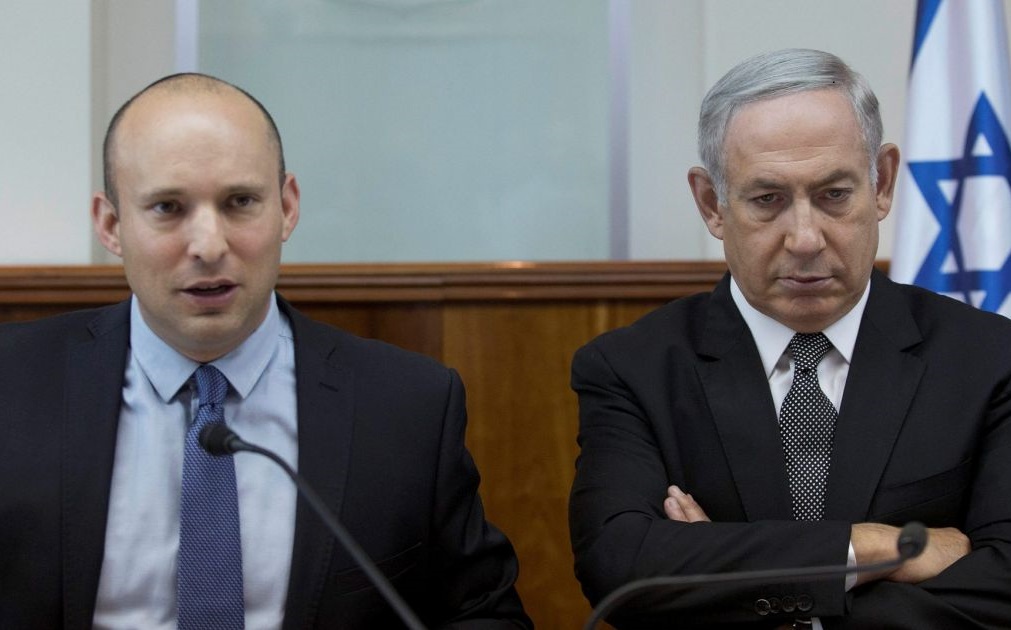
KAFE KNESSET — Bibi vs. Bennett — by Tal Shalev and JPost’s Lahav Harkov:The Likud released a special response just for Bennett, claiming he “memorizes the PMs press releases and then quotes them as if they were his demands.” The never-ending battle between Netanyahu and Bennett over the right wing constituency is expected to escalate, if Trump indeed is determined to reach a peace deal which will entail some Israeli concessions. At the moment, Bennett is focusing on Jerusalem, but if the de facto settlement freeze continues after the President’s visit, pressure from the settler base is likely to increase. While both sides are heating their engines, Netanyahu also made a point yesterday that he is not interested in early elections. In the weekly meeting of the coalition leaders, he said that this government will survive until its last day, in November 2019. Read today’s entire Kafe Knesset here [JewishInsider]

“Russia Recognizes Jerusalem as Israel’s Capital. Why Can’t the U.S.?” by Eugene Kontorovich: “If Mr. Trump nonetheless signs the waiver, he could do two things to maintain his credibility in the peace process. First, formally recognize Jerusalem—the whole city—as the capital of Israel… Second, make clear that unless the Palestinians get serious about peace within six months, his first waiver will be his last… This is Mr. Trump’s moment to show strength.” [WSJ]

SPOTTED: Amb. David Friedman and his wife Tammy have arrived in Israel, according to pictures posted on Twitter by Meron Reuben [Pic]

TRUMP ISRAEL TRIP —  National Security Advisor H.R. McMaster on Friday: “With President Rivlin and Prime Minister Netanyahu, [Trump] will reaffirm America’s unshakeable bond to the Jewish state. With President Abbas, he will express his desire for dignity and self-determination for the Palestinians. And so to leaders and peoples alike, across the entire trip, he will demonstrate his hopes for a just and lasting peace.”

On Netanyahu-Abbas summit: “The final plans aren’t set yet… But it will obviously be up to the President and those leaders about how he wants to engage with them. But he’ll engage with both those leaders there as part of the trip.” [CSPAN]

“Top US official to Post: No plans to hold Netanyahu-Abbas peace summit during Trump trip” by Michael Wilner: “A trilateral meeting is remotely possible given the president’s penchant for acting “on the fly,” the aide acknowledged. But several officials intimately involved in planning the trip would be surprised if such a summit took place. “Let’s not get carried away,” a second senior administration official said… “People are taking Abbas’ comments about willing to meet too far.” … The administration is also weighing to what extent Trump should publicly comment on the conflict at all: A speech is not guaranteed, although at minimum, the White House will offer descriptions of his meetings with Netanyahu and Abbas.” [JPost]

JI PREVIEW — What to Expect from Trump’s Israel Visit — by Aaron Magid: Daniel Kurtzer, former US Ambassador to Israel and Egypt, told Jewish Insider, “What Trump is trying to do is contrast his close closeness to Israel with that of Obama. Obama didn’t go for the first four years and Trump is going in the first four months.” … The visit to Israel is part of a long term US strategic investment towards the process, noted Michael Koplow, policy director of the Israel Policy Forum. “Someone in the White House has learned the lesson from the last administration where it was clearly a mistake not to go to Israel early on. (They) realize that if you are going to get the Israelis to make concessions, it’s probably a good idea to actually go to Israel and show the Israelis some love.”

The White House’s showering of love towards Israel is concerning many in Jerusalem, explains Daniel Shapiro, former US Ambassador to Israel from 2011-2017. “When it comes to President Trump’s Israeli-Palestinian peace initiative, both sides are nervous about what this trip, and events beyond it, could produce. Trump is unpredictable, and his team is inexperienced in Middle East negotiations,” he told Jewish Insider… With Trump’s unpredictable nature and the threats of a Twitter war launched against Jerusalem and Ramallah, Kurtzner emphasized the willingness of both sides to please Trump. “They (Netanyahu and Abbas) are going to try and put on the best face they can: neither one wants the responsibility of failure to be on their doorstep.” [JewishInsider]

“Will Trump launch Mideast shuttle diplomacy?” by Uri Savir: “A senior PLO official close to Abbas told Al-Monitor that despite the positive impressions of his meeting with Trump, Abbas came back to Ramallah with more questions than answers… According to the PLO official, it was Abbas who raised the 2002 Arab initiative in the Oval Office, and he received no negative reactions, neither from the president nor from his advisers… He said that Trump also shared with his Palestinian guests that he will continue to resist settlement expansion.” [Al-Monitor

“White House Staffer Scrubs Mention Of “Palestine” From Facebook Post” by John Hudson: “When asked if this explicit mention to Palestine was intentional, White House spokesperson Michael Short told BuzzFeed it was “unintentional” in an email on Friday. Later in the day, [Dan] Scavino edited his original Facebook post — scrubbing the word “Palestine” and replacing it with “Palestinian Territories.” “That’s a junior mistake,” a longtime Middle East diplomat told BuzzFeed News. “The Israelis will catch him up on that for sure.”” [BuzzFeed]

IRAN DEAL: “US may waive Iran sanctions in coming days” by Laura Rozen:“Notification of the waivers might be issued as early as May 17, a day before Donald Trump is due to depart on his first foreign trip as president, sources told Al-Monitor, while cautioning that the anticipated action and timing could change. That is also a couple of days before Iran holds presidential elections May 19.” [AlMonitor

TRUMP TUMULT — “White House ‘systems failed’ with Comey firing, but Trump pushed the buttons” by Philip Rucker: “Much of the internal blame has fallen to the communications operation, with Kushner and other top officials questioning why the small army of press staffers led by Spicer and Dubke took so long to forcefully defend the president’s decision and agree to a set of talking points that could withstand scrutiny… Inside the West Wing, it became a running joke among some staffers that the answer to every question would be “Rosenstein,” referring to the deputy attorney general, Rod J. Rosenstein, who wrote a memo outlining a case for Comey’s ouster.” [WashPost]

“Jared and Ivanka stay out of the spotlight amid Comey fallout” by Betsy Klein: “On more than one occasion, the power couple has been seemingly absent when the going gets tough… In April, when leaks of infighting within the administration were on top of the news cycle, they were celebrating Passover at the Four Seasons Whistler in Canada, according to reports. And this week was no exception. Though the President’s daughter and son-in-law remained in Washington and working at the White House, they stayed under the radar and away from the cameras following news of Comey’s departure.” [CNN]

2018 WATCH: “Sam Altman for governor? Former San Francisco Mayor Willie Brown says it’s a possibility” by Tess Townsend: “Y Combinator President Sam Altman might run for governor of California — or so says Willie Brown, who spent decades in the California State Assembly and served two terms as the mayor of San Francisco. Brown slipped a few comments on Altman’s apparent interest in holding office into his Sunday column for the San Francisco Chronicle. Altman is considering running as soon as 2018, Brown said… The investor and startup founder has a history of political engagement. He’s been a loud critic of President Donald Trump and funds a voter engagement nonprofit.” [Recode]

TEHRAN WATCH: Khamenei warns against election unrest, George Soros” by Rohollah Faghihi: “The issue of security and calm is very important for the country,” [Ayatollah Ali] Khamenei said in a May 10 speech to graduates of the Imam Hussein military academy… Khamenei also had a few words to say about George Soros, the billionaire investor who has spent millions of dollars around the world to advance political causes. “That rich American Zionist who said that he toppled Georgia with $10 million started to think he could do the same to Iran in 2009,” Khamenei said. “If anyone wants to rise up against the security of the nation, they will encounter a firm reaction.” [Al-Monitor; NYT] • Wondering how Soros feels to be labeled a ‘Zionist’ by Khamenei … or perhaps this is Khamenei’s way of thanking Soros for his support of the Iran deal in 2015…

“Demonization of Soros recalls old anti-Semitic conspiracies” by Vanessa Gera: “The demonization of the American-Hungarian billionaire and Holocaust survivor has spread across Central Europe, with the 86-year-old increasingly accused by nationalists of using his money to force his liberal values, including support for refugees, on their societies. This groundswell began in late 2015, as large numbers of migrants and refugees were arriving in Europe. A far-right nationalist at an anti-refugee rally in Poland set fire to an effigy of an Orthodox Jew as a crowd chanted slogans against Islam and the European Union. The man said the Jewish figure represented Soros.” [AP]

** Good Monday Morning! Enjoying the Daily Kickoff? Please share us with your friends & tell them to sign up at [JI]. Have a tip, scoop, or op-ed? We’d love to hear from you. Anything from hard news and punditry to the lighter stuff, including event coverage, job transitions, or even special birthdays, is much appreciated. Email Editor@JewishInsider.com **

BUSINESS BRIEFS: Kushner Real Estate Project Still Seeking First Chinese Investor[Bloomberg] • Inside the universe of Kushner Companies [TRD] • Delek completes Ithaca acquisition for $590m [Globes] • Blackstone lends David Bistricer’s Clipper Realty $74M for BK rental [TRD] • Israel’s high-tech sector is thriving, and now China wants in on the action [CNBC] • Iran’s Mining Projects on Hold as Investors Fear New Sanctions [Bloomberg]

TALK OF THE TOWN: “Condo Tower to Rise Where Muslim Community Center Was Proposed” by Ronda Kaysen: “One-bedrooms at 45 Park Place start at $1.92 million; two-bedrooms at $3.725 million; three-bedrooms at $4.595 million; and four-bedrooms at $10.5 million. The second duplex penthouse will be listed for about $39 million. Michel Abboud, a founding partner of SOMA Architects, designed the tower; Piero Lissoni designed the interiors… [Sharif] MEl-Gamal does not see the outcome of his project as a defeat, but instead as proof of his grit. “Real estate in New York is a blood sport,” he said.” [NYTimes]

“Fire Damages New York’s Beth Hamedrash Hagodol Synagogue” by Niraj Chokshi: “A fire broke out Sunday at an abandoned Lower East Side synagogue that once housed the city’s oldest Jewish Orthodox congregation. It took the Fire Department about two hours to bring the fire, which started around 7 p.m., under control, a spokesman said. No injuries were reported. The cause of the fire was under investigation. The fire occurred at 60 Norfolk Street, the spokesman said, which is the home of Beth Hamedrash Hagodol, a city landmark built in 1850.” [NYT; Pic]

“Sheryl Sandberg Speaks Out On Judaism — And Grieving” by Jane Eisner: “Sandberg apparently doesn’t pray regularly — she didn’t realize until afterward (her husband’s death) that “Oseh Shalom” is the last line of the Kaddish and the Amidah… But she eagerly embraced the Jewish rituals that shape and structure death and mourning. “Judaism said we should bury soon as possible, so we buried as soon as possible,” she said. “It says we should shovel dirt on the grave, so we shoveled dirt on the grave. I had done that before, for my grandparents. I had been to funerals, I had been to graves, so I found it all incredibly comforting. It gives us a connection to something bigger than ourselves.“ The seven-day period of shiva… was also helpful. “Having your house fill up with the people you love is comforting,” she recalled. So was the constant repetition of the mourner’s prayer: “Jews have been saying it for a long time. Long before I said it for Dave, Dave said it for his father. And before that, for centuries.”” [Forward] • Sheryl Sandberg and Elizabeth Alexander on Love, Loss and What Comes Next [NYTimes

“Elie Wiesel’s Only Son Steps Up to His Father’s Legacy” by Rick Lyman: “Throughout his young life, [Elisha] Wiesel’s father made only one demand — that he marry in the Jewish faith, which he did. But as his father neared death, he made one more request, that his son say kaddish for him. “I was what we call a three-day-a-year Jew,” Mr. Wiesel said. “But I decided that I really wanted to do it, and I wanted to do it correctly.” So, he began to go to synagogue every day, sometimes twice a day. “There was also this moment I remember when I watched my father hold my son during his circumcision,” Mr. Wiesel said. “It was a real sense of connection. My father was terrified of being the end of the line.”” [NYTimes

MEDIA WATCH — “New York Times publisher sends personal appeal to those who canceled over Bret Stephens” by Hadas Gold: “The Times’s Opinion pages remain an independent and unblinking forum for debate from a wide range of viewpoints among open-minded, informed writers and readers. I don’t think, in these polarizing and partisan times, there’s anything quite like it in American journalism,” [the email sent by NYT publisher Arthur O. Sulzberger Jr. read]… A New York Times spokesperson… said less than 6 percent of people who canceled their subscriptions to The Times since Stephens’ hire was announced in April cited the hire or the new column as the reason for the cancellation.” [Politico]

“Associated Press Rebuts Charge That It Aided Nazi Regime” by Daniel Victor: “The review acknowledged some missteps, including the news agency’s lack of protest when its photos were used for Nazi propaganda and its employment of German photographers with active political affiliations. But the news organization… said it “took steps to retain its independence and provide factual, unbiased information to the world despite intense pressures from Nazi Germany.”” [NYTimes

“Trump Arranged Meeting Between Harvey Levin and Israeli Prime Minister, All For Reality TV” by Taryn Hillin and Ryan Naumann: “Our sources tell us that Levin asked Trump to call Netanyahu during their infamous Oval Office meeting (a story we broke) and ask if the Prime Minister would be on Levin’s pseudo reality show “Objectified.” … We’re told Trump obliged, placed the call.. and… the Prime Minister agreed… Levin is catching a flight to Israel this week (he was noticeably absent from TMZ Live on Thursday). We’re told he’ll meet with Netanyahu and tape the show in the next few days.” [Entity

— “The Prime Minister’s Office strongly denied the Entity report. Senior officials at the Israeli embassy in Washington also denied the report and said that Trump had no role in organizing Levin’s interview with Netanyahu. Officials in the Prime Minister’s Office said in recent weeks that Levin had approached the Israeli ambassador to the United States, Ron Dermer, as well as Netanyahu’s foreign media spokesman, David Keyes, seeking an interview with the prime minister for the program. Netanyahu and his advisers considered the request and decided to consent, the officials said.” [Haaretz]

“For Palestinian Hikers In West Bank, A Chance To Enjoy Nature And Escape Tensions” by Daniel Estrin: “Life in the West Bank is tense. That is why four Palestinians started the Shat’ha club about 11 years ago. They wanted to get some fresh air after the violence of the Second Intifada…  “Nature … gives me a lot of power. I found it a very important thing in my life,” says Juwana Rafidi, the hiking organizer for the day… The Shat’ha group has a strict rule for its Palestinian hikers: No Israeli food products — whether they be Hebrew-labeled packs of crackers or Israeli-grown apples — are allowed on the trek.” [NPR

“Noga Erez: ‘I get told by people not to talk about what is happening in Israel'” by Kate Hutchinson: “If you take culture away from places then it doesn’t do good to anyone, it makes that place even worse, because art and culture are the opposition to the political situation,” she says. If anything, she continues, the liberal left needs what positive reinforcement it can get… “It’s so diverse and split,” she says when asked whether young Israelis differ from previous generations about the conflict. “There is a conflict inside Israel about those things because it’s so complicated.” According to Erez, “there is a lot of empathy for the other side,” but she laments how, when it comes to the Netanyahu administration, “the word ‘peace’ is not brought up any more. ‘Hope’ is something that people are cynical about because people have lost hope.” [Guardian]

LongRead: “Seeing with Your Tongue: Sensory-substitution devices help blind and deaf people, but that’s just the beginning” by Nicola Twilley: “In 2007, the Israeli neurobiologist Ella Striem-Amit embarked on doctoral research investigating whether people who are born blind could ever learn to perceive visual information in the way that sighted people do. She joined the lab of Amir Amedi, a neurologist at Hebrew University, in Jerusalem, and they set about training a small group of congenitally blind subjects to use the vOICe. The vOICe translates a camera feed into electronically produced notes according to reasonably simple principles: brightness is mapped to volume, and elevation to pitch… Striem-Amit discovered that teaching people to see using the vOICe required more than simply helping them master the technology. “Congenitally blind people don’t know how vision works,” she explained. “They don’t know principles of occlusion”—that one object can block another—“or that things appear larger when they’re closer.” Yet, after seventy hours of training, her subjects were able to grasp these concepts and to identify shapes, objects, and even faces.” [NewYorker]

DESSERT: “Brut Wine Bar pop-up brings taste of Israel to Tokyo” by Melinda Joe: “The project is the brainchild of LIK Hospitality, launched by Israeli-born expats Ori Kushnir and Sivan Lahat [who] run a startup that develops financial models and trading technologies for companies… Inspired by the serial pop-up restaurant “The Table By” in Madrid, which featured a rotating line-up of Spanish chefs, Kushnir and Lahat teamed up with hospitality expert Aya Ikeda to create a similar project that would help connect chefs looking to open restaurants in Tokyo with potential investors.” [JapanTimes]

“Guten Gefilte! Jewish Delicacies Beguile the German Capital” by Lindsay Gellman: “Gefilte fish can be sexy,” [Jeffrey] Yoskowitz assured the 150 people who gathered in late March in Kreuzberg, in the western part of Berlin, to taste some of the delicacies that had all but disappeared from the city’s shops and restaurants after World War II… “It can’t just be nostalgia; it can’t just be your bubbe’s cooking,” Mr. Yoskowitz said, using the Yiddish word for grandmother. “This is a living food tradition.” [NYTimes

BIRTHDAYS: Canadian molecular biologist and pioneer in human genetics, Louis Siminovitch turns 97… Chair of the Albright Stonebridge Group, she was the first woman to serve as US Secretary of State (1997-2001), Madeleine Albright turns 80… Chairman and CEO of The Raoul Wallenberg Committee of the United States, a human rights organization in NYC, Rachel Oestreicher Bernheim turns 74… CEO of Emigrant Bank, real estate developer, financier and philanthropist, has co-chaired the annual campaign for the UJA/Federation of New York, Howard Philip Milstein turns 66… Actor David Krumholtz turns 39… Noam Finger turns 39… Actress Jamie-Lynn Sigler, known for her role as Tony Soprano’s daughter, Meadow, turns 36… Rochelle Wilner… Ofir Richman

Gratuity not included. We love receiving news tips but we also gladly accept tax deductible tips. 100% of your donation will go directly towards improving Jewish Insider. Thanks! [PayPal]

Daily Kickoff: Iran’s Khamenei calls Soros a ‘rich American Zionist’ | Sam Altman for CA Gov? | Bibi to appear on Harvey Levin’s show | Guten Gefilte! Read More »

How to deal with Trump: the Netanyahu-Bennett debate

Prime Minister Binyamin Netanyahu and Education Minister Naftali Bennett have been having an interesting fight in recent days. It is a fight with clear political undertones and implications – each of these two leaders would like to present himself to the public as the true guardian of Israel’s interests. But it is also a legitimate fight over tactics – namely, about what is the most effective way for Israel to prepare for Donald Trump and his half-baked plan for advancing the Israeli-Palestinian process.

Netanyahu is the leader of Likud, the main party of Israeli right. Bennett is the leader of Habayit Hayehudi, a much smaller party that used to be the political home of right-wing religious Zionists. Netanyahu would like to keep his throne as the leader of the right. Bennett would like to succeed Netanyahu, even though he comes from the wrong party to do that. So there is a political undertone to every debate these two – who also dislike each other personally – have.

Then there is substance – and real questions which need to be settled. For example: is it wise for Israel to let Donald Trump decide for himself whether to move the American embassy to Jerusalem, as he vowed to do – or maybe it is wiser for Israel to put pressure on the American President by reminding him publically that he made a promise and that Israel has expectations based on this promise? Bennett hints that the prime minister is letting Trump off the hook by being cautious about voicing Israel’s expectations. He’s been criticizing Netanyahu to score political points – but also because he seems to think that being clear about Israel’s expectations is the only chance Israel has to achieve its goal.

When it comes to disagreements on tactics, the embassy question is small change. The real question is the Two-State solution. That is, should Israel be clear about its lack of interest in having a Palestinian State – or should it blur its intentions and negotiate its way forward without revealing its true feelings and cards.

Netanyahu is cautious. This is something that many outside observers don’t understand about him because of his occasional bluster and his hawkish image. But truly, he is one of the most cautious leaders in Israel’s history. He does not gamble, he does not engage in sudden moves. He is careful not to miscalculate. He is nothing like Ariel Sharon – who gambled on evacuating Gaza. He is nothing like Ehud Barak – who gambled on Camp David. Netanyahu’s critics would argue that his caution leads to paralysis. His supporters would argue that in a volatile region the only reasonable approach is conservative caution.

Bennett is not cautious. At least not as long as he doesn’t have the mandate to make actual decisions. In other words: Bennett might be bold because he doesn’t have responsibility –  or he might be bold because he is truly bold (Avigdor Lieberman seemed much bolder before he was made Defense Minister). Whatever the case may be, his argument goes as follows: Israel lost an opportunity after Trump was elected. It lost an opportunity because it wasn’t clear enough about its real interests and intentions. Had Israel been wiser, it would have made it clear that the Two-State solution is no longer on the table. In such case, Trump would not have been tempted to become a peace processor.

Bennett argues that Israel’s vagueness creates a vacuum. Peace processors are sucked into this vacuum. Netanyahu believes that clarity could mean trouble. If Israel takes the Two-State solution off the table, international pressure on Israel to propose something else, or measures taken against Israel as retribution, might follow. He also believes that clarity could complicate his dialogue with President Trump. If Israel puts forward a position with which the president isn’t satisfied, he might respond harshly. If Israel is vague, it could first listen to Trump, try to understand his positions, and then make sure to have an approach that accommodates Trump’s sensitivities.

There are two questions that could help determine what would be the better approach. Question number one: what is the price or benefit of keeping Israel’s cards close to chest without making grand pronouncements? Question number two: what is the price or benefit of having an Israeli position not in line with Trump’s?

Bennett is more afraid of vagueness. He is afraid of a slippery-slope peace process that will incrementally erode Israel’s position. He is less afraid of Trump – and his potential fury. Netanyahu is more afraid of Trump. He believes in his own power to navigate a peace process successfully, and believes that remaining on Trump’s good side is a key feature of such success.

Netanyahu makes the following calculation: there is no reason to pick a fight with Trump – because he might end up accepting Israel’s positions. And even if Trump doesn’t accept Israel’s positions, it is probably better to manipulate the President than to confront him. For now Netanyahu has the upper hand. First – because he is the Prime Minister. Second – because Trump has not yet showed his cards and revealed his intentions. If and when Trump becomes more aggressive in his demands, this might change.

How to deal with Trump: the Netanyahu-Bennett debate Read More »

The death of the TV channel that once unified Israel

On a chilly fall night in 1993, I learned that the bespectacled army reservist sitting across from me in an Ottoman-era building in Nablus and dining on watery yogurt and hard-boiled eggs was an executive at Israel’s then-nascent Channel 2.

He wanted to continue our chat on Jane Austen — he noticed I was reading “Sense and Sensibility” — but I insisted that he dish about the new TV channel set to launch just a few weeks later.

It would have ads! It would have original dramatic programming! There would be three different programming companies!

Gone would be the days when you could stroll in any Israeli suburb past 9 p.m. and hear every television turned to state-run Channel 1 and “Mabat la-Hadashot” (A Glance at the News), its nightly newscast.

Mabat, like Channel 1, survived the new competitor, as it would an invasion of cable channels and media streams over the following decades. But on Tuesday, after 49 years on the air and with little warning or ceremony, it aired its final broadcast, part of a government plan that will also close down its sister stations on the radio. Israel Radio, launched in 1936, is winding down its programming and will broadcast music and news bulletins until Monday.

The Israel Broadcasting Authority, or IBA, will be replaced by Kan, a new system that Prime Minister Benjamin Netanyahu wants in its place. Or doesn’t — it’s hard to keep track.

“The way the IBA was shut down is neither fair or honorable,” Netanyahu said in a statement Wednesday, using the passive voice in a statement about a process he had initiated. A consensus that the public broadcasting authority needed to be reformed broke down among parties angling for political influence and cost savings.

For many Israelis, Channel 1 was like army reserves duty: It was a necessary evil you were supposed to tolerate, something OK to hate. But secretly, you occasionally longed for it, the way you longed for the surprising joys of watery yogurt and hard-boiled eggs. Channel 1 offered camaraderie and, above all, purpose.

Channel 1, like the 40 days a year you spent in fatigues, surrounded you with less beautiful but reassuringly familiar faces who shared a mission: making Israel a better and more secure place.

It was virtuous to a fault. Israelis bought color TVs when they became available in the late 1970s, but only so they could fully enjoy Jordan TV. Israel TV lacked the technology to broadcast color, or so we were told.

Except it did have the technology. One Friday night circa 1979 or 1980 at the launch of the weekly movie — a 1950s Western — a technician forgot to turn on the switch that washed out the color.

It was corrected to a black-and-white wash within minutes, but the secret was out and it was infuriating: We had been under the impression that Israel’s government-run broadcaster couldn’t afford color TV. But not only could the government afford it, it was actually paying extra money for technology that could keep everything black and white.

If the reasoning IBA eventually proffered was perverse, it was perverse in a way that made sense in a country just emerging from socialism: We are austere. We are serious. We can’t afford to pretend that we can afford it.

Color soon came to TV and, under the liberal economic policies of the Begin government, markets opened up in Israel. There were more cars available. Travel abroad was easier, and travelers returned home hankering for — and eventually finding — more varieties of cuisine, more diverse fashion.

Channel 1 persisted, along with its quirks.

Animated cartoons were available just once a week, early Saturday evening, when the broadcast was given over to Arabic-language television. (You knew it was Arabic TV because the subtitles switched places: Arabic was on top, Hebrew along the bottom.) Why were Popeye and Little Lulu kosher for the children of Umm el Fahm and not of Tel Aviv? (Of course, children everywhere watched.) Who knows, but I’d guess, again, the ban was a holdover from Israel’s austere beginnings. Arabic-speaking children were not considered part of the socialist experiment and could luxuriate in the decadent joys of aimless, violent humor. Israeli kids deserved stricter fare embodied in the earnest, hectoring young women who helmed Hebrew-language children’s TV.

Friday nights were movie nights, consistently heavy, depressing fare — lugubrious numbers like “Lust for Life,” but also classic Westerns like “Shane.” Comedies were scarce — I can’t recall any — because you were supposed to Learn a Lesson. The movies were followed by a palate-cleansing if inoffensive sitcom: for years, “Night Court.” (For racier fare, you’d have to switch over to Jordan TV for the inane innuendo on “Three’s Company.” The kingdom descended from the Prophet was more profane than the secular Jewish paradise.) There was a news recap, a reading from the weekly Torah portion and then the national anthem.

Friday afternoons were the country’s guilty secret: the “Arab movie,” ostensibly, again, a nod to the country’s Arabic-speaking public, but really a break for all comers from the channel’s deadly serious fare. The whole country seemed to tune in but, tellingly, each Jewish viewer was certain she was the only one to indulge. These movies were everything Israel did not imagine itself to be. They took place in cities teeming with the very poor and the fabulously rich, they delved into wild romantic transgressions, they were high on physical comedy.

Channel 1’s talk shows treated poets like Yehuda Amichai and Natan Zach as celebrities and beratedcelebrities like Goldie Hawn for not coming to Israel more frequently.

And the music shows — you had to attend an actual rock concert to find out that Israeli musicians could actually rock, hop around the stage and involve the audience in a good time. On Channel 1, these same musicians stood in place and barely moved, as if evidence that Israelis could lift their feet off the floor would subvert Labor Zionist notions of Jewish oneness with the earth.

And then there was Mabat. We mocked its anchors as remote and pompous, but goodness, they were Walter Cronkite-level reliable. They did not hold back in interviews and irked politicians of all stripes. They stuck to just the facts, ma’am. When Haim Yavin, who anchored the nightly newscast from 1968 to 2008, pronounced in 1977 and then in 1992 that the elections had produced a “mahapach,” an upheaval — well, by golly, it wasn’t just a change in government, it was indeed an upheaval. Yavin was consistency defined, opening with “Good evening and greetings to all of you” and closing with “Good evening and much peace from Jerusalem.”

Mabat’s independence may have helped kill it. Netanyahu has never made precisely clear why he wanted the Israel Broadcasting Authority replaced, but for a politician who chafes at any critical coverage, critical coverage from a government-run broadcaster must have been especially galling. (And now he reportedly fears that Kan will also cover him critically.) Haaretz published a rundown of the competing political interests that doomed the IBA, including haredi Orthodox, Russian and pro-settlement parties angling for a piece of the broadcast spectrum and jockeying over who will lead the news and general programming divisions of the new channel.

Channel 1 was likely doomed in any case, as ratings had been tanking for years. It ignored the very idea of competition. Channel 2 broadcast its news at 8 p.m. — Israelis like to go out and meet friends after the news, and Mabat insisted on a 9 p.m. broadcast. By the time Mabat got the memo about competing for viewers and switched its broadcasts to 8, it was too late.

Mabat’s news staff delivered a tearful farewell on Tuesday night. The radio stations are running nostalgic music and news bulletins until they, too, suspend broadcast on Monday at 6 a.m.

It’s no understatement to say that a broadcaster that went virtually unchallenged for decades — until the rise in the 1970s of Army Radio and then the launch of commercial broadcasts in the 1990s — shaped the country in profound ways. The modern Hebrew accent itself was forged by two pioneer radio newscasters: Moshe Hovav, of Yemenite origin, and Drora Hovav, his wife, who happened to be the granddaughter of Eliezer Ben-Yehuda, the Vilna-born scholar who almost singlehandedly revived Hebrew as a spoken language. Their Hebrew, combining the Sephardic east and the northern reaches of Europe, reinforced that Israeli Jews were One People.

“This has been like demolishing a house,” Yavin, now 83, told i24 news on Wednesday. “You can get me out of Mabat, but you can’t get Mabat out of me.”

You can’t, it’s true, at least for those of us who were raised on Mabbat and Channel 1. The IBA sticks to us like dybbuks of our better selves.

Channel 2, and eventually the flurry of cable channels that came in its wake, reflected Israel as it evolved: loud, raucous, international and at perpetual odds with itself. Channel 1 was Israel as it once aspired to be: tough, serious, analytical and infused with the spare sensibilities of modern Hebrew poetry.

May its memory be blessed.

The death of the TV channel that once unified Israel Read More »