fbpx

April 28, 2017

Homeless on Pico—Natalie Levine: Day 2 update

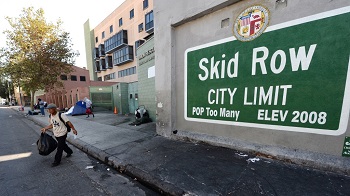
After we posted the video clip yesterday on Natalie Levine, a lot of people asked me: How can we help? What can we do? I felt a twinge of guilt that I told a very sad story without much hope. So this morning I decided to go back and see if I can find her. My heart sank when I saw that she wasn’t there. Because she had told me she “likes Jews,” I figured she was still in the neighborhood. So I drove around, very slowly, looking at sidewalks. Finally, I saw something from far that looked like it could be a homeless person sleeping. It was on the same side of Pico Boulevard where Natalie and I first met. I parked my car and walked over. It was hard to see her face, but as I got closer I realized it was her. She almost had a heart attack after I said her name.

“It’s David,” I said. “We met yesterday.”

“Oh hi,” she replied.

“A lot of people want to help you, Natalie. I posted that film we did yesterday and people want to help.”

She didn’t say much. She just gave me an easy smile and said, “Oh OK.”

But she had a very emotional reaction—a mix of excitement and tears– when I told her that her old Hebrew day school in Connecticut had seen the story and reached out to me. It was as if her childhood had come rushing back into her consciousness, cutting through the pain of the present.

I realized at that point that helping a homeless person takes tactical skill. So, first, I made her promise that she would not leave the spot for a few hours. I gave her water, 20 bucks and my cell number, and told her, “I’ll see you in a bit.”

The first thing was to find a safe place for the night. Actually, no, the very first thing was to clean her up. My amazing friend, Aliza Wiseman, offered to take her to her home until I found a place. She also went to Ross to buy some clean clothes. So, while Natalie was taking a hot shower, getting into new clothes and eating an omelette, I called around looking for motels that would take her. I made several calls, but had no luck until my friend Elaine Courtney, who saw the story on Facebook, suggested a place.

I called. A woman named Lucy answered. She said they had one room left, but it would be more expensive because it had a separate bathroom.

I booked the room. $70 a night, cash only.

As you can see in the photo above, Natalie is now in her room.

Meanwhile, my daughter Mia is setting up a crowdfunding page to give people a chance to help.

Next update on Monday.

Shabbat shalom.

Homeless on Pico—Natalie Levine: Day 2 update Read More »

A Roof, A Bed, and A Table

Didn’t it feel good to see the rain come down this winter, healing our drought, filling our reservoirs and river, bringing the tangy scent of petrichor? Wasn’t it sweet to curl up under a blanket, falling asleep to the soothing rumble of rain on the roof?

But what if there was no roof? What if you had no home, not even a car, and the shelters were full or too far away? What if there were children with you looking for your protection? If all you owned was what you could carry or push in a shopping cart and the bit of tarp you were able to get wouldn’t keep everything dry?

We Jews are obliged to think about things like that. Not only when the homeless person on the corner turns out to be someone we know (so many people are one paycheck away from homelessness) but also when that person is someone we’ve never seen before. Too often, people without homes move unacknowledged and untouched through the world of the housed like emissaries from some other reality, a ghost world interlaced through ours. We Jews are told, “You shall not oppress a stranger, for you know the feelings of the stranger, having yourselves been strangers in the land of Egypt” (Exodus/Shmot 23:9) and “Love/befriend the stranger, because you were strangers in the land of Egypt.”(Deuteronomy/Devarim 10:19)

Yes, as autonomous Americans we might bristle, but the Torah is not just telling us what to do, it’s telling us how to feel. Our tradition requires that we not only act to assist the stranger, the widow and the orphan—the most powerless among us—but also to accept the pain of empathy. We are to open our hearts to the world’s suffering. As the Kotsker Rebbe teaches, “There is nothing so whole as a broken heart.”

The only way to live with a heart filled to bursting is through action, through doing what we can. Our tradition is not something we observe only every week in synagogue on Shabbos, it is how we live each day.

We learn, in Deuteronomy/Devarim 15: 7-8, “If there is among you someone needy, one of your kin, within the gates of the land that HaShem your God is giving you, do not harden your heart and shut your hand against your needy companion. Rather, you must open your hand and lend him sufficient for what he lacks and is wanting.” The rabbis interpreted this instruction in a very concrete way to do with housing. Talmud Bavli Ketubot 67b tell us, “Our Rabbis taught: If an orphan applied for assistance to marry, a house must be rented for him, a bed must be prepared for him along with utensils he needs and then he is married, for it is said in Scriptures, ‘Sufficient for what he lacks and is wanting.’ ‘Sufficient for what he lacks’ refers to the house; ‘is wanting’, refers to a bed and a table.”

Our Talmudic rabbis, the founders of our way of life, understood community as a web of relationship and mutual obligation. They understand that, even in our unredeemed world of rich and poor and unpredictable fortune, there is a level below which we should not allow anyone to descend.

Rabbi Doctor Aryeh Cohen, Rabbi-in-Residence for Southern California’s Bend the Arc chapter, explores this in his essential book of Talmudic analysis Justice in the City. He shows how the rabbinic community of mutual obligation and acknowledged interdependence became the normative Jewish model for city life. As members of a polity, we are obliged to act in ways that reflect our Jewish values.

To act, we need to be informed. So, through the lens of hard cold numbers, what is the housing situation in our city?

At least 26,000 people in the city of Los Angeles are homeless, and 300,000 families are one emergency away from losing their homes.

60% of people in our city who do have homes are renters, which would be fine except that the rent is too high. As of March 2017, one bedroom apartments in Los Angeles rent for $2243 a month on average and two bedroom apartment rents average $2978.

What can be done? As a city, we’ve made steps toward addressing the problem. Last year, voters approved Proposition HHH to provide $1.2 billion for safe, clean housing and supportive services to lift people out of desperation and put them on the road to a better life and Proposition JJJ to ensure that developers who want zoning changes for new housing will hire local workers, including veterans, and include affordable and workforce-priced housing in their developments.

We can do more. The Mayor has proposed a Linkage Fee on new developments to create a dedicated fund for affordable housing in our city. Neighboring cities, such as Pasadena and Santa Monica, already charge such fees as do major cities throughout the country, and they are not driving developers away. It is time for us to reach out to our councilmembers and tell them to support this fee. We taxpayers have already pledged to contribute more. Why should not developers, who benefit from our city, contribute to making it better for everyone?

Richard Bloom, a California legislator, has introduced a two-year bill to repeal Costa-Hawkins, the state law that blocks cities from creating effective rent control. He and other legislators have also brought AB 1505, a bill to allow cities to require affordable housing units in new developments. If you support AB  1505 and 1506, please let your state representatives know.

When our ancestors first came to this country, city life, with all its dangers and difficulties, offered a way to survive and then thrive, to preserve our tradition while learning to be part of this country. Rising rents threaten to take that opportunity away from this generation’s immigrants. Let’s make sure that doesn’t happen.

A Roof, A Bed, and A Table Read More »

This New York City Sunday school teaches Jewish kids Yiddish — and socialism

NEW YORK — The Jewish Sunday school teacher, a black accordion strapped to her shoulders, stands before a photo of a 1927 Jewish protest in Warsaw and introduces her students to an important holiday observed by their ancestors.

It isn’t Passover, which has just ended, but another that is approaching in a couple weeks: May Day, the unofficial May 1 holiday celebrating workers’ rights.

“Socialism is the idea that everyone should have what they need,” says the teacher, Hannah Temple, as a projector flashes images of a protest sign and Jewish immigrants marching in a labor demonstration. On the walls, multicolored signs declare “Jewish communities fight for $15” — a minimum wage campaign — “We are all workers” and “Remember the Triangle Fire,” a reference to the 1911 Triangle Shirtwaist Fire that killed 146 garment workers at a factory and galvanized the labor movement.

Temple teaches the children words to a Yiddish May Day anthem and offers a short primer on early 20th century labor activism.

“We need to sleep some, we need to work some, but we need some time that’s for us,” she says, describing the campaign for an eight-hour workday. She invites the few dozen students and parents in the room to a May Day protest in downtown Manhattan. A few hands go up.

“Maybe?” she asks. “Maybe is great.”

The Yiddish sing-along-cum-socialist teach-in is the morning meeting of the Midtown Workmen’s Circle School, a secular Jewish Sunday school that combines Yiddish language and culture education with progressive social justice organizing. It’s one of eight such schools, called “shules,” in four states serving a total of 300 students aged 5 to 13 — teaching them everything from an Eastern European melody for the Four Questions to how to protest on behalf of underpaid fast-food workers. The curriculum ends with a joint bar/bat mitzvah ceremony for the seventh-graders.
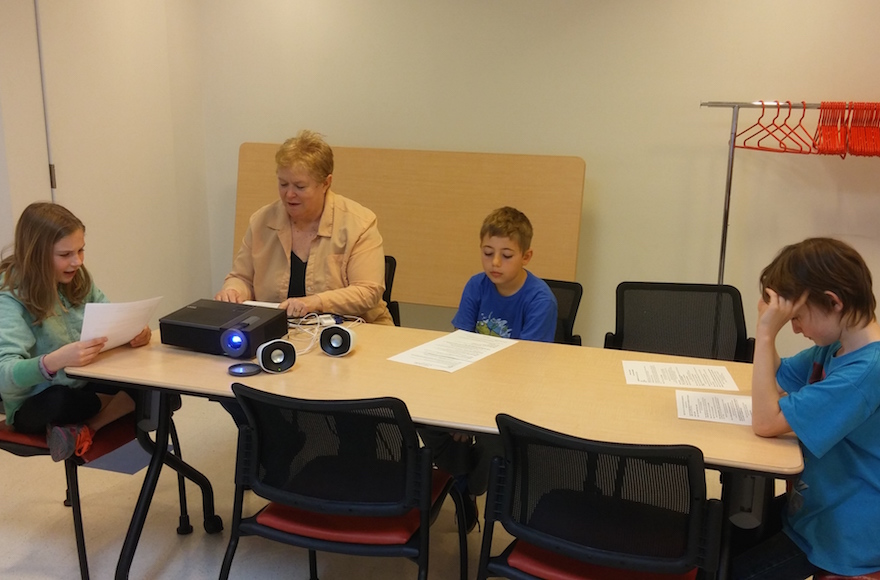
Students at the Midtown Workmen’s Circle School in Manhattan read through a play in Yiddish, April 23, 2017. (Ben Sales via JTA)

Though it’s more than a century old, the Workmen’s Circle, a left-wing Eastern European Jewish culture and social justice group, has seen its fundraising and school enrollment grow in recent years. Part of the boost, leaders say, was due to the diametrically opposed presidential campaigns of Sen. Bernie Sanders, I-Vt., and Donald Trump.

Sanders, says executive director Ann Toback, awakened American Jews to secular, progressive Jewish culture conveyed with a heavy Brooklyn accent. Trump, she adds, sparked Jews on the left to organize in protest.

Workmen’s Circle made a lapel pin bearing the faces of Bernie Sanders and Donald Trump accompanied by the words “mensch” and “putz,” respectively. (Josefin Dolsten via JTA)

Workmen’s Circle isn’t shy about its political leanings. Following the presidential election, it made a lapel pin bearing the faces of Sanders and Trump accompanied by the words “mensch” and “putz,” respectively.

“Before there was Bernie, there was the Workmen’s Circle,” Toback says. “Is there a way we can connect to so many of his followers? The values that he based his campaign on are really the inherent values of the Workmen’s Circle and our movement.”

In the five-month period after the election, the group saw its donations double over the same stretch the previous year. It has opened five of its eight Sunday schools in the past three years. The biggest, in Boston, has more than 100 students. In May, the Manhattan school will be hosting a spring open house for the first time.

“More people are coming to us looking for — ‘I want to engage in social justice activism,’” says Beth Zasloff, director of the Midtown school. “I know that for me, after the election, having a community, having a place to go where I know we can address these issues with our children, felt extremely important.”

The Midtown school, like its counterparts, eschews traditional Jewish Sunday school mainstays like learning Hebrew or studying ritual and prayer. Israel isn’t a focus. Workmen’s Circle has partnered in the past both with Jews for Racial and Economic Justice, a left-wing group that focuses on domestic issues, and Habonim Dror, the left-wing Labor Zionist movement.

Instead, kids take three types of classes: arts and crafts, Yiddish language and history, and culture and social justice. Last Sunday, the three students in the Yiddish class were reading a play, in transliteration, about a robot. The teacher would read a line in Yiddish and translate, which a student repeated.

The arts and crafts class was making banners for an immigrant rights protest. In the history and culture class, four students prepared for their bar and bat mitzvahs next year. For the ceremony, they’ll do a research project on their family history and interview an elderly relative. Later that Sunday, this year’s bar mitzvah class made presentations on children who were killed in the Holocaust.
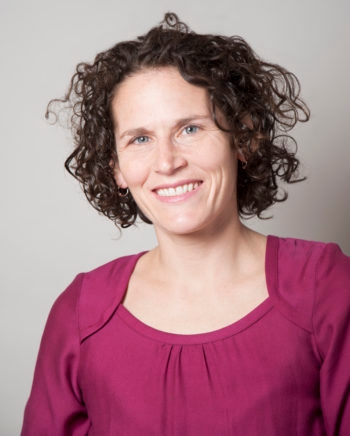
Beth Zasloff, director of the Midtown Workmen’s Circle School (Courtesy of Zasloff via JTA)

One student said knowing Yiddish made her feel like her friends at school who hail each other in the hallways in Bengali. Another said her favorite Workmen’s Circle experience was participating in the Jan. 21 Women’s March in New York City. And for some, the appeal lies in attending a Sunday school that avoids the standard memorization of Hebrew prayers.

“This is secular, and I’m not super religious in terms of my beliefs about God,” says Moxie Strom. “So it’s nice to have something that doesn’t focus so much on ‘God said this and God said that.’”

The Workmen’s Circle/Arbeter Ring was founded in 1900 in large part to help Jewish immigrants from Europe succeed in America. Along with advocating for better working conditions, it offered members services like health care and loans. It supported socialism at a time when Jews on the Lower East Side of Manhattan helped elected a Socialist Party candidate, Meyer London, to Congress.

No longer socialist but still left wing, the Workmen’s Circle fights for those issues largely on behalf of non-Jewish workers, leading campaigns for immigrant rights or better pay.

And instead of helping Yiddish speakers integrate into America, the organization’s cultural mission has flipped, preserving and promoting an old world culture for American Jews. It runs Yiddish language classes for adults and a summer camp for kids, and hosts culinary and holiday events.

“There’s so much culture they’re missing,” says Kolya Borodulin, the group’s associate director for Yiddish programming, who grew up in Birobidzhan, the Soviet Union’s Jewish Autonomous Region. “Jewish holidays, traditions described by famous Yiddish authors — any contemporary issues you name — are reflected in the Yiddish language. So you can see this parallel universe in Yiddish.”

Even if they go to eight years of Sunday school, Borodulin says, the students are unlikely to come out speaking proficient Yiddish, or even reading a page in the language’s Hebrew script. The school’s aim, rather, is to reinforce a cultural and ideological Jewish identity in its students. The aspiration is that years after they leave, they will be able to connect to their Judaism on holidays, in song and on the picket line.

“What resonates most with them is the social justice and having a sense of what we believe in,” says Debbie Feiner, whose two sons, ages 9 and 12, attend the Midtown school. The older one, she says, understands that “when you see some injustice, you need to take action. He can’t be a passive bystander, and he’ll connect that with his Judaism.”

This New York City Sunday school teaches Jewish kids Yiddish — and socialism Read More »

settlement-construction

6 Palestinians injured in West Bank clashes with Israeli troops

Six Palestinians were wounded in a series of clashes with Israeli troops in the West Bank, the Palestinian Red Crescent said.

The clashes Friday came amid a so-called day of rage in support of Palestinian hunger strikers in Israeli prisons, The Times of Israel reported.

In the village of Nabi Saleh, near Ramallah, three people were injured by live fire, the Palestinian humanitarian group said. Another three were injured in Beit Omar, near Hebron. All are in stable condition, a spokesperson for the group said.

The Israel Defense Forces did not immediately comment, The Times of Israel reported.

Some 1,500 Palestinian prisoners have been striking for over a week over demands for better medical care and greater access to telephone calls.

6 Palestinians injured in West Bank clashes with Israeli troops Read More »

Lawmakers introduce bipartisan bill to commission Elie Wiesel bust in Capitol

Two Congress members introduced a bipartisan bill to commission a bust of Holocaust survivor and Nobel Peace Prize laureate Elie Wiesel, who died last year.

Reps. Steve Cohen, D-Tenn., and Ileana Ros-Lehtinen, R-Fla., introduced the bill in the House of Representatives on Friday.

Wiesel, an activist against racism who was well known internationally for his many books, essays and educational projects about the Holocaust, died in July at 87.

Cohen, who is Jewish, and Ros-Lehtinen, an Episcopalian with Jewish heritage, praised Wiesel’s accomplishments in a statement Friday noting that they were introducing the bill during the week of Holocaust Remembrance Day.

“Elie Wiesel was one of the greatest moral forces in the world,” Cohen said. “He is a member of that rare group of people who have had a major individual impact on our world, such as Nelson Mandela, Dr. Martin Luther King Jr. and Mahatma Gandhi.”

Ros-Lehtinen said that a statue or bust of Wiesel in the Capitol “would memorialize him and ensure that we continue to share his story and remind ourselves that, as he said, ‘our lives no longer belong to us alone; they belong to all those who need us desperately.’”

Among the bill’s 51 co-sponsors are 12 Jewish lawmakers: Reps. David Cicilline, D-R.I., Susan Davis, D-Calif, Ted Deutch, D-Fla., Eliot Engel, D-N.Y., David Kustoff, R-Tenn., Alan Lowenthal, D-Calif., Nita Lowey, D-N.Y., Jamie Raskin, D-Md., Jan Schakowsky, D-Ill., Debbie Wasserman Schultz, D-Fla., John Yarmuth, D-Ky., and Lee Zeldin, R-N.Y.


Lawmakers introduce bipartisan bill to commission Elie Wiesel bust in Capitol Read More »

Fed up with Shabbat laws, secular Israelis fund bus service to the beach

TEL AVIV – These secular Israelis are done playing by the rules on Shabbat. They’re going to the beach.

Noa Tnua, a tiny Tel Aviv busing cooperative, has crowdfunded hundreds of thousands of shekels to dramatically expand its service to the coast on the weekends, when most of the country’s public transportation shuts down to observe the day of rest. Some 2,600 Israelis have donated online — a record this year on the popular Headstart platform this year.

“The success of this campaign shows just how fed up people are with the situation on Shabbat,” said Noa Tnua founder and chairman Roy Schwartz Tichon. “If you can’t afford a car in Israel, you’re stuck at home on the weekend.”

The unexpected influx of more than 313,000 shekels ($87,000) and counting since March 15 — nearly doubling Noa Tnua’s original target — has been driven by widespread frustration with Israel’s Shabbat ban on public transportation. But backers of Israel’s religious “status quo” — fiercely guarded by haredi Orthodox politicians — have called such initiatives a threat to the state’s Jewish character.

Noa Tnua, which means Move Forward in Hebrew, has pledged to use its crowdfunded windfall to open two new bus lines this summer — one along Route 18 from Tel Aviv south to Jaffa and Bat Yam, and another from the Negev city of Beersheba to the coastal town of Ashkelon. A public survey to determine the location of a third line has been scheduled for June.

The group also said it will offer soldiers free rides on Route 18 until the end of the year and give away at least 180,000 shekels ($50,000) in rides to disadvantaged populations. The campaign will end Sunday.

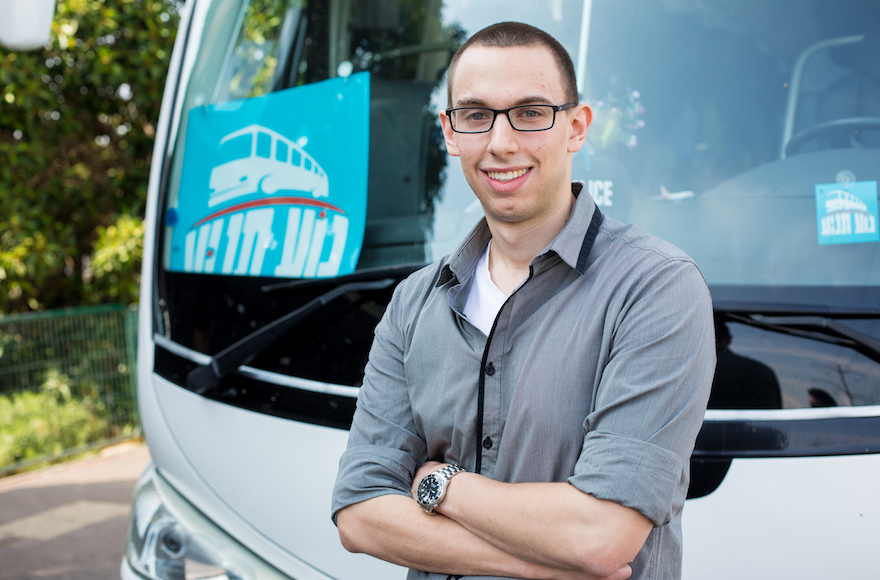
Schwartz Tichon, a 24-year-old student at the Open University, opened Noa Tnua’s first bus line in June 2015 along the busy Route 63 between Tel Aviv and its Ramat Gan and Givatayim suburbs. Using money he saved during his mandatory army service, he started the nonprofit along with board members Noam Tel-Verem, 25, and Lior Tavori, 32.

Elia Halpern and her son riding the Noa Tnua bus to Tel Aviv, 2016. (Courtesy of Halpern)

Every Saturday, a rented 53-seat tour bus traverses the route five times, making about 30 stops, from 9 a.m. to 6 p.m. Nearly 2,000 people have signed up for the service to date, with hundreds using it on summer weekends.

Elia Halpern, 46, a court stenographer and single mom from Ramat Gan, has been a Noa Tnua rider from the beginning. She said getting access to the bus was like “being released from prison.” Before discovering Noa Tnua on Facebook, she had mostly spent her Saturdays at home because she cannot afford a car or taxi rides to nearby Tel Aviv and back.

“Now we go see movies or visit my family in Tel Aviv,” Halpern said. “I recently took my son to the beach on Saturday for the first time. He was so excited. Roy has really done something amazing for me and other people in the area.”

Israel prohibits most public transportation on Shabbat based on an understanding reached in 1947 between then-Prime Minister David Ben-Gurion and the Agudath Yisrael movement, which represented the small haredi Orthodox community of the time. That status-quo agreement became the basis for many religious arrangements in Israel, including in the areas of kashrut, marriage and education.

Allowances and loopholes in the Transportation Ministry’s regulations, passed in 1991, let a limited number of bus lines operate on Shabbat. Haifa and Eilat, cities with large non-Jewish populations, are allowed to have bus services. And shuttles, or “sheiruts,” run in and between some cities based on the claim that they address a vital transportation need, as allowed in the regulations.

In Jerusalem, a private bus service called Shabus has run since 2015. By working as a collective, the group circumvents the requirement that it be licensed by the government. Noa Tnua is similarly structured. Members sign up online for free, and pay 9 shekels per ride via the smartphone app HopOp, which processes the payments after Shabbat.

Roy Schwartz Tichon: “If you can’t afford a car in Israel, you’re stuck at home on the weekend.” (Avihai Levy)

While Israelis have complex and varied views on issues of synagogue and state, there is broad support for public transportation on Shabbat. A survey commissioned last year by Hiddush, a group that promotes religious pluralism, found that 72 percent support keeping at least some buses and shuttles running between Friday afternoon and Saturday evening.

Hundreds of donors posted supportive comments on Noa Tnua’s crowdfunding page, with many complaining about the status quo.

“A successful project. Whenever there is religious coercion, those interested in maintaining a free state must unite,” one wrote Thursday.

“A most welcome initiative until this country regains its senses and there is full public transportation for the entire population,” wrote another.

Schwartz Tichon, who grew up in Haifa taking Shabbat buses for granted, said the Orthodox should not be able to dictate how the whole country spends the weekend, especially when the biggest impact is on the poor. He said his ultimate goal is to make public transportation on Shabbat a reality that the government would simply have to accept.

“If three-quarters of the country wants something, eventually it will get it,” he said. “We’re the ‘Start-up Nation,’ we know how to change things.”

But few are holding their breath for action by Israel’s Knesset, where haredi political parties wield considerable clout, especially on religious issues. Haredim and their supporters have argued Shabbat must be protected for the sake of Jewish unity. In a debate with Schwartz Tichon last week on Israel’s Channel 10 TV station, haredi journalist Benny Rabinovich sounded this theme and vowed to relentlessly oppose Noa Tnua.

“If we want to remain a Jewish state — the secular, religious, haredim, Ashkenazim, Sephardim, all of us — the only thing that makes it Jewish is the Shabbat. Nothing else,” Rabinovich said. “I’ll make sure this bus line is closed because you’re taking actions that are against the law. I promise you that I’ll do whatever it takes in the Transportation Ministry. I will not give up.”

Halpern, who donated 50 shekels to Noa Tnua’s campaign, advocated more of a “live and let live” mentality.

“We shouldn’t force them to have buses in their neighborhoods,” she said, “but they shouldn’t force us not to have them either.”

Fed up with Shabbat laws, secular Israelis fund bus service to the beach Read More »

These comedians want to bring Yiddish humor to TV

It’s safe to say that Eli Batalion and Jamie Elman are some of the funniest Yiddish speakers around. Their Yiddish-English web series, “YidLife Crisis,” is a modern-day, Montreal-based “Seinfeld” that would make any Jewish mother kvell (“It’s in Yiddish!”) and kvetch (“The sex, drugs and Jesus jokes! Oy!”).

The series, which premiered in 2014, follows the nebbish Leizer (played by Batalion) and rebel wannabe Chaimie (Elman) as they wander around Montreal, eat at restaurants and have Talmudic debates about their Jewish identities.

In one episode, Chaimie tries to convince Leizer to order food in a restaurant on Yom Kippur. Leizer reluctantly agrees — but insists the waitress separate the meat and dairy-based foods. In another, which takes place at a kosher sushi restaurant, the two men fight, in Yiddish, over the affection of a woman (played by “Big Bang Theory” actress Mayim Bialik), not realizing that she can understand everything they are saying.

Now Batalion, 36, and Elman, 40, hope to bring their brand of Yiddish humor to a larger audience. The duo is in talks with a Canadian broadcaster to create a TV show based on the web series. In addition, “YidLife Crisis” received an entrepreneurship grant earlier this month from the Jewish philanthropy Natan Fund to further expand its content.

The challenge facing Batalion and Elman is how to broaden the appeal of “YidLife Crisis” beyond the Jewish community without abandoning its Yiddish roots.

Though the pair say they hope to remain in the main roles, the TV show would also introduce a cast of characters from other religious and cultural backgrounds who grapple with similar questions of identity.

The series “would take a lot of the content from ‘YidLife Crisis’ — the chemistry and ideas behind it — but go further down the road of multicultural Montreal, putting a few other multicultural characters on display as well,” Batalion said, speaking with JTA on a conference call with Elman.

They’re not particularly concerned that a departure from the show’s tight Jewish focus will alienate the show’s most devoted fans. Batalion, who has produced, composed and written content for “horror musical” films, assured JTA that a potential TV series “would still be extraordinarily Jewy.”

While the characters would speak more English on TV than in the web series, Yiddish would feature as “a code language” in which Batalion and Elman’s characters interact with older family members.

“We love ‘Transparent’ as a show that at its surface is not about Judaism, but in practice it’s filled with loads of Jewish content. And we think this would be the same,” said Elman, whose acting credits include “Mad Men” and “Curb Your Enthusiasm,” drawing a parallel to Amazon’s acclaimed series following a Jewish family as the father comes out as transgender.

Working on scripts for the TV series keeps Elman and Batalion plenty busy — that means they’ve had to put the third season of the web series on hold.

“The goal from early on was to see if we can take this to long-form, so now that we’re given that opportunity to try, we’re putting all our eggs in that basket,” Batalion said.

They noted, however, that they are still making Yiddish-language videos — including clips of Hollywood classics and holiday songs hilariously dubbed into Yiddish — to satisfy fans hungry for content.

In creating “YidLife Crisis,” Batalion and Elman said they wanted to challenge perceptions both of Yiddish and Judaism.

“We wanted to show a different side of Judaism and a different side of Yiddish, and that Yiddish is not just a language for ultra-Orthodox Jews,” Elman said.

Batalion and Elman, who both learned Yiddish as teenagers at the secular Bialik High School in Quebec, said a goal was to showcase the language and its cultural heritage.

“We also felt that the Yiddish was critical to drawing attention to what we were trying to say, or to some of the themes we were speaking to — themes of culture and how to preserve it,” Elman said. “Yiddish is something that was nearly lost in the Holocaust.”

The pair didn’t become friends until 2007, when Batalion was on tour with his two man show, “J.O.B. The Hip-Hopera,” which follows the biblical character Job as he is transported to modern-day New York. Batalion performed with his co-producer, Jerome Sable, in Los Angeles, where Elman was working as an actor. Wowed by the performance, Elman befriended the pair and went on to produce a web series with Sable.

Batalion and Elman later found a way to meld their friendship and professional goals, creating “YidLife Crisis.” Though the two live on opposite coasts — Batalion lives in Montreal, Elman is still based in Los Angeles — they film the episodes in Montreal. They have also filmed special episodes in Tel Aviv and London.

When asked to describe their relationship, they draw on the two defining characteristics of the show: Judaism and humor.

“Talmudic,” Batalion said of the duo’s connection.

Elman, on the other hand, quipped that it’s “not entirely kosher.”

Jokes aside, that juxtaposition speaks to a central theme in “YidLife crisis”: the tension between the pull of the Jewish tradition and the appeal of secularism. That conflict is also present in the Yiddish language, Batalion said, noting that the language is in fact largely made up of German, a non-Jewish source.

“The language itself is highly honed,” he said. “It speaks to and sounds like a thousand years of Diasporatic experience living in another culture. And that’s what you get in our episodes — it’s all about Jews living in a secular world.”

These comedians want to bring Yiddish humor to TV Read More »

7 Haiku for Parsha Tazria-Metzora by Rick Lupert

7 haiku for Parsha Tazria-Metzora by Rick Lupert (Plus a comforting video that involves potatoes)

I
How can a birth make
a woman unclean? When life
begins, it’s holy.

II
Priests with no degree
in medicine use their eyes
to divide the sick.

III
Road Trip! cried the man
with the discolored skin as
he left the city.

IV
Any excuse to
shave my entire body.
Plus give me two birds.

V
Of course if you can’t
afford two birds, discount fowl
are available.

VI
May have to tear down
little boxes when covered
with ticky-tacky.

VII
In encouraging news:
if you jump in the pool, all
will be forgiven.


And here’s a friendly poem video that focuses on potatoes which I hope you’ll find comforting after the imagery in Tazria-Metzora:

New Potato by Rick Lupert


Los Angeles poet Rick Lupert created a the Poetry Super Highway (an online publication and resource for poets), and hosted the Cobalt Cafe weekly poetry reading for almost 21 years. He’s authored 20 collections of poetry, including “I’m a Jew, Are You” (Jewish themed poems) and “Feeding Holy Cats” (Poetry written while a staff member on the first Birthright Israel trip), and most recently “Donut Famine” (Rothco Press, December 2016) and edited the anthologies “Ekphrastia Gone Wild”, “A Poet’s Haggadah”, and “The Night Goes on All Night.” He writes the daily web comic “Cat and Banana” with fellow Los Angeles poet Brendan Constantine. He’s widely published and reads his poetry wherever they let him.

7 haiku for Parsha Tazria-Metzora by Rick Lupert (Plus a comforting video that involves potatoes) Read More »

University of Wisconsin student resolution blames Israel for police violence against African-Americans

The student government of the University of Wisconsin-Madison included an amendment specifically targeting Israel in a resolution calling for divestment from companies operating in many countries.

The resolution was passed Wednesday by the Associated Students of Madison by a 24-0 vote, with two abstentions. It calls on the university and its foundation to divest from companies involved in private prisons, arms manufacture, fossil fuels and border walls, and banks that “oppress marginalized communities.”

It also blames Israel for training U.S. police in tactics it says harm African-Americans.

The vote comes a month after a divestment resolution specifically targeting Israel failed to pass the student government and two weeks after the student government passed a proposal to create a new financial transparency and ethics subcommittee. The meeting was held April 12, the second day of Passover, when several Jewish representatives were absent.

Wednesday’s resolution uses language brokered between Jewish student leaders and the authors to target unethical corporations in more general terms without attacking Israel. However, during the open forum discussion prior to the vote, some students called for the one-page resolution to be amended to include specific countries and issues, the Daily Cardinal student newspaper reported.

In a statement issued after the vote, the university administration said the resolution is nonbinding and will not result in a change in university policies or its approach to investing.

Jewish students said an amendment added to the one-page resolution brought the resolution more in line with the proposal that failed a month ago. The amendment blames Israel for police violence against African-Americans, citing an exchange program in which senior American police officers travel to Israel to learn about counterterrorism, the pro-Israel organization StandWithUS said in a statement.

During debate on the resolution, anti-Israel activists called the Jewish community “oppressors” and said that Jewish students oppose divestment against Israel because it threatens their “white privilege.”

A Jewish member of the Associated Students of Madison was publicly targeted and harassed by other members of the student government during the meeting as well, according to the campus Hillel.

“The behavior of members of ASM to publicly target and harass the Jewish students and in particular the one Jewish student on ASM was reprehensible,” the university Hillel’s executive director, Greg Steinberger, said in a statement issued following the meeting. “We look forward to engaging the university and the state in a review of what happened tonight at the ASM meeting.”

In their statement, university administrators said, “We are concerned that the actions taken tonight appear to violate a ruling of the Student Judiciary; Jewish members of student government, who raised this issue with the Student Judiciary, walked out of the meeting after expressing concerns that the process was undemocratic and not transparent.

“UW-Madison values and welcomes members of all faiths and identities. We have heard clearly from the Jewish community how targeted they feel by the actions of the last month. Chancellor [Rebecca] Blank has made clear her opposition to the concept of BDS and academic boycotts.”

Israel Action Network, which monitored the campus events along with Chicago’s Jewish federation, said ASM leaders “acted in bad faith and manipulated the rules” to bring back the BDS resolution targeting Israel.

“Anti-Semitism has no place on college campuses, and students should not have to be made to choose between their progressive ideals and their Zionism. IAN, which was founded by Jewish Federations across North America, is committed to ensuring a safe environment for Jewish students on campus,” said Ethan Felson and Geri Palast, IAN executive directors, in a statement.

University of Wisconsin student resolution blames Israel for police violence against African-Americans Read More »

Oppose Charter Amendment C—and strengthen democracy

Did you know that there is an election on May 16? Don’t beat up on yourself if you didn’t, most of your fellow citizens do not know either. The problem is that the very “hiding in broad daylight” aspect of this election might allow some very bad law to be enacted. There is only one item on the ballot for most Angelenos, “Charter Amendment C.” The item has a reform sounding title: “Civilian Review of Police Disciplinary Matters.” Unfortunately, this amendement to the city charter is not a reform. It is an attempt by the Police Protective League (the police officers’ union) to undermine the current disciplinary mechanism.

Under the current system, enacted by Charter Amendment after the Rodney King uprising, there is a Board of Rights attached to and constituted by the Police Commission. In a case where the Chief of Police recommends suspension or demotion an officer may appeal to the Board of Rights. The Board of Rights is comprised of three people—two randomly chosen police officers, and a civilian from a pool handpicked by the executive director of the Police Commission. The Board of Rights cannot recommend a more severe punishment than the Chief, but can recommend a more lenient one.

Under the proposed Amendment, the Board of Rights’s composition will change so that it will be comprised of three civilians. An officer who has received a discipline recommendation from the Chief will be able to choose either the current Board (2 officers and 1 civilian) or the new Board. Neither Board may recommend a more severe punishment.

So why, one may ask, would the Police Protective League, fierce opponents of all manner of civilian oversight, first and foremost the establishment of the Police Commission in its current form itself (Amendment F), be the most vocal and lead supporters of Amendment C, labelling it “civilian oversight?” Why, on the other hand, are the most vocal supporters of police reform and civilian oversight opposed to this measure?

One answer might be that research has shown that over the last five years, civilians on the Board of Rights have overwhelmingly voted for more lenient disciplinary measures. Moreover, the civilians who make up the board are not randomly chosen, they have to go through an interview with the executive director. There is no guarantee (or even probability) that those chosen to be on the board would represent communities most impacted by interactions with LAPD. Under the current system, civilians who want to serve on the Board of Rights must have seven years’ experience with arbitration, mediation, or administrative hearings. Further, if these board members consistently vote against the officers, they can be removed from the pool since it is all at the discretion of the executive director of the Police Commission.

This is most definitely not enhancing civilian oversight despite what the expensive, glossy brochures supporting Amendment C say. This is the worst type of civic engagement—betting on the fact that after a brutal national election and a brutal local election Angelenos will be tired and will probably sit out another election in which there is only one measure up for vote. Then, if they do notice, use misleading advertising to make casual voters think that an unearned windfall for the police union is actually strengthening civilian oversight of the LAPD.

Beyond the fact that this amendment is bad for the residents of the city, the process is bad for democracy. In order for there to be a robust democratic conversation about the issues that impact our city, the residents of the city need to be convinced that the conversation matters, that things can change for the better. If instead of this, the ballot process is used in an underhanded and disingenuous way people—who in any event are working really hard to support themselves and their families, and do not have an abundance of leisure time—will be dissuaded from taking part in the process. Turnout for special elections is already low. We need to defeat this spurious measure so that special elections are no longer used to pass measures that otherwise would be debated and defeated.

Rabbi Chaim Hirschensohn, an early twentieth century American Orthodox Rabbi with a strong love for democracy, argued that the laws in Deuteronomy 16 that are usually taken to be referring to the behavior of judges (“You shall not judge unfairly: you shall show no partiality; you shall not take bribes, for bribes blind the eyes of the discerning and upset the plea of the just.”) are actually referring to democratic elections—that the elections must be fair, that the voters must not bribed, and not so on. It is not a stretch to continue and say that the ballot process must not be abused by deceptive advertising, or scheduling a vote for a time when turnout will be low.

We must defeat Charter Amendment C, get back to the work of actually enhancing civilian oversight of the police department, and enhancing the democratic discourse in our city.


Rabbi Aryeh Cohen, PhD is Professor of Rabbinic Literature at American Jewish University and Rabbi in Residence at Bend the Arc: A Jewish Partnership for Justice.

Oppose Charter Amendment C—and strengthen democracy Read More »