fbpx

April 24, 2017

EXCLUSIVE: Tom Hanks on Elie Wiesel, the importance of Holocaust remembrance


In an exclusive interview, Tom Hanks talks about spending time with Elie Wiesel at the Friar’s Club in New York City where they discussed topics ranging from displaced persons camps to dogs.

Hanks also discussed the importance of Holocaust remembrance.

Interview by Danielle Berrin
Video by Tess Cutler

EXCLUSIVE: Tom Hanks on Elie Wiesel, the importance of Holocaust remembrance Read More »

Extracting meaning from the madness

Rabbi Harold Schulweis wrote 30 years ago that the way we work through the memory of the Holocaust, the Shoah, the way we extract meaning from the madness, would be the most critical question of post-Holocaust generations.

That question remains the premiere challenge of our generation.

Today, on Yom HaShoah, the day of remembering, here are three ways to wrest meaning from the madness.

First, we remember. Remembering is not the same as not forgetting. Not forgetting is driven by fear. Remembering is driven by love. Read survivor testimonies. Watch a film. Feel something. Remember the human capacity for depravity, cowardice and complicity, and remember human courage and compassion. Active memory is a gesture of hesed—it is equal parts an act of grace and an expression of loyalty toward those who lost everything and persisted in breathing and loving and rebuilding nevertheless.

Second, we would do well to reacquaint ourselves with the quiet heroism of the righteous gentiles, hasidei umot ha-olam, who jeopardized everything to protect, support and save the lives of Jews. Their stories remind us not only that good exists even in the heart of evil, but that the demands of human decency call us to stay vigilant to the dangers of bigotry, racism and discrimination even when we are not directly in the line of fire.

In this moment, in America, many minority communities feel like endangered species: diminished, scapegoated and targeted. The threat doesn’t have to rise to the level of Holocaust horror for us to mobilize against it. The Jewish community honors, indeed venerates the Righteous Gentiles who risked and often gave their lives to defend our people. The best way to honor their memory is to strive to be like them. Today we are called to become Righteous Jews. To use whatever resources we have—political, financial, spiritual—to stand up and speak for those whose rights or safety or dignity are threatened. The memory of our suffering calls us not only to hold compassion, but to actively stand in solidarity with those who today are vulnerable to racialized hatred.

Finally, we must stay awake and discerning. Anti-Semitism is a real and present danger. Over the last several years, we’ve seen a spike in violent incidents directed against the Jewish community, the vicious trolling of prominent Jewish leaders and journalists on social media, cemetery desecrations, and—perhaps most ominously—the elevation of unabashed hate mongers—including those who traffic in racist and anti-Semitic tropes—to the highest offices. In France today, the daughter of an avowed Holocaust denier and rabid anti-Semite, someone who herself argues that French Jews ought not be permitted to wear kippot or hold dual citizenship with Israel, is emerging as a lead presidential candidate, again raising the terrifying specter of state supported anti-Semitism in Europe.

And still, the reality of anti-Semitism and the aching truth of the Shoah must not distort our judgment or weaken our discernment.

Not every criticism of Israeli policy, not every analysis of Jewish power or privilege is evidence of anti-Semitism. To turn every critic into an enemy is not only wrong, it is disingenuous and dangerous. It diminishes our ability to respond effectively to the real threat of anti-Semitism, to protect our communities and live by our core Jewish values. We must remember this.

Yom HaShoah is a day not only to mourn, but to rededicate ourselves. Let us remember the past in a way that transforms the present. In a landscape of increasing incivility and cruelty, we honor the memory of those whose lives were tragically cut short by living more compassionate, more purposeful, more meaningful, more dedicated lives.

Zikhronam livrakha– may their memories be a blessing.

Extracting meaning from the madness Read More »

Moving & Shaking: Tom Hanks, survivors and others do a live-reading of Elie Wiesel’s ‘Night’

About 1,000 people attended a reading of “Night,” Elie Wiesel’s memoir of his experience during the Holocaust, on April 23 at Wilshire Boulevard Temple (WBT) in observance of Yom HaShoah, or Holocaust Remembrance Day, the first since Wiesel’s death in July.

“This afternoon’s reading is a wakeup call … a call to activism, to compassion, to understanding,” WBT Rabbi Susan Nanus, one of the event’s organizers, said during her introductory remarks.

Steven Z. Leder, WBT’s senior rabbi, was the first to read from the memoir. He was followed by readers who, among others, included actor Tom Hanks; talk show host Tavis Smiley; Rabbis David Wolpe, Karen Fox, Daniel Bouskila and Laura Geller; philanthropist Sharon Nazarian; Jewish Journal senior writer and columnist Danielle Berrin; and the consuls general of Germany and Israel in Los Angeles, Hans Jorg Neumann and Sam Grundwerg, respectively.

After the conclusion of the reading, which lasted about three hours, the audience in the synagogue’s Byzantine-revival sanctuary stood and observed a moment of silence and then recited the Mourner’s Kaddish for the 6 million Jewish victims of the Holocaust.

A video of the reading can be watched at jewishjournal.com.

On the same day at Congregation Kol Ami, a West Hollywood Reform synagogue, Danny Maseng, chazzan and spiritual leader of Makom LA, recited prayers and lit memorial candles during a ceremony in commemoration of Yom HaShoah.

“Human spirit is the light of God,” Maseng said.

Attendees included David Straus, a board member of Jewish World Watch, and Rev. Keith Cox, spiritual leader at the Center for Spiritual Living Los Angeles.


Moving & Shaking: Tom Hanks, survivors and others do a live-reading of Elie Wiesel’s ‘Night’ Read More »

Larry David is upset that his hard work made Steve Bannon rich — but did it?

The New Yorker’s Connie Bruck has written perhaps the deepest dive into what forces shaped Steve Bannon, President Donald Trump’s top strategic adviser.

We already know lots about Bannon: He helmed Breitbart News before he joined Trump’s campaign last year, and he called the outlet a platform for the “alt-right,” the loose assemblage of hypernationalists that includes white supremacists and anti-Semites, but also fierce defenders of Israel and Jews. Bannon launched Breitbart Jerusalem as a means of correcting what he perceived as anti-Israel media bias.

A former wife accused him of anti-Semitism; he has denied it. He was in the U.S. Navy, a Goldman Sachs banker, then a Hollywood broker, and then a producer of conservative documentaries.

Exploring his Hollywood years, Bruck details a litany of deals gone wrong. There are plenty of nuggets in the piece of Jewish interest. Here are four:

Larry David doesn’t like the ‘Seinfeld’ story – but is it all a George Costanza-style con by Bannon?

Bruck addressed one of the most media-beloved elements of Bannon’s rise: that he made a fortune off of negotiating a syndication deal for “Seinfeld.” In 1992, Bruck reports, Westinghouse hired Bannon’s private-equity fund to sell its small stake in Castle Rock Entertainment, the TV production company that owned the “Seinfeld” reruns. An assessment last year in Forbes said that if Bannon had a one percent stake in syndication, he would have made upwards of $30 million.

Larry David, the co-creator of the comedy starring his friend, Jerry Seinfeld, and the model for Seinfeld’s neurotic buddy George, was unhappy with the association.

“I don’t think I ever heard of him until he surfaced with the Trump campaign and I had no idea that he was profiting from the work of industrious Jews!” he told Bruck. Rob Reiner, who helped found Castle Rock,  was “sick” because of the association.But is Bannon really making money off the show? In a 2015 interview with Bloomberg Businessweek, Bannon said he made five times as much as he expected on the deal involving Westinghouse’s sale of its stake in the show. He claimed to have deferred part of his fee for an ownership stake. He did not say what his stake was.

But here’s the thing: It’s not clear what Bannon’s stake – if any – was. Payouts to Bannon do not appear in available records, Bruck reported, although she noted that the first months of syndication are not available, and he might have been capped and paid out before records were available.

Bruck reviewed Bannon’s extensive divorce papers and found this:

In April, 1997, he submitted an “income and expense declaration,” indicating that his annual salary was roughly five hundred thousand dollars, and that his total assets were around $1.1 million. Any profit participations from “Seinfeld” should have shown up at that time. Either they were not substantial or Bannon failed to disclose them in a sworn statement.

(In 2005 papers related to the divorce Bruck also uncovered this: “He left blank the space for his salary, and reported $967,465 in stocks, bonds, and other assets, and $41,401,067 in other property. The figure is inexplicable, and inconsistent with his other publicly available filings.”)

Why would Bannon boast about a deal that does not appear to have brought him much in the way of return? It’s not the only such anomaly Bruck uncovered. Bannon recently claimed in an interview with the Washington Post to have driven up the price Seagram — then headed by Edgar Bronfman Jr. — paid for PolyGram by bringing in a Saudi prince as a bidder. He said he got “a big fee” for his efforts. But folks involved in the deal told Bruck they could not recall Bannon’s involvement in the deal or any bid from a Saudi prince.

Bannon found the Jewish common denominator.

Bruck found a telling line in one of Bannon’s first documentaries cast in a conservative slant, “In the Face of Evil.” The movie, which chronicles the rise of President Ronald Reagan, acknowledges that Reagan as an actor was never a major Hollywood draw. Why? Because Jewish executives made it so. But wait: It’s not like Bannon is blaming these powerful Jews. It’s more like he’s admiring them.

Studios, in an “unforgiving calculus,” found Reagan wanting, the film says. These “Jewish entrepreneurs,” the film explains, “differed in taste and style, yet shared two common elements: ruthlessness and uncompromising patriotism.”

There’s Goldman Sachs, and there’s also Goldman Sachs

We’ve noted before how Trump, during his campaign, repeatedly trashed Goldman Sachs bankers, and then proceeded to hire some of their top alumni for senior advisory positions.

Bannon also shares an animus toward Goldman Sachs, but is himself an alumnus. Bruck found a rare – perhaps the only – instance of someone asking him to explain the anomaly:

In October, 2010, he appeared on “Political Vindication,” a right-wing radio show in Los Angeles. One of the hosts said that Bannon had been “evil” while he worked at Goldman Sachs. He replied equably, saying, “It was a private partnership then, and a firm of the highest ethical standards,” but it had changed when it went public. He did not mention that since it went public, in 1999, he had made every effort to do business with Goldman.

More corroborating evidence for Bannon’s alleged issue with school-age Jews

Bannon’s ex-wife has said in post-divorce papers that Bannon objected to certain schools for their twin girls because he didn’t want them consorting with Jewish students. “He said he doesn’t like Jews and that he doesn’t like the way they raise their kids to be ‘whiny brats,’” Mary Louise Piccard said in a 2007 filing, referring to The Archer School for Girls.

She also reported that he asked another school director, at the Westland School, why there were “so many Hanukkah books in the library.”

Bannon has vigorously denied the claims. New York Magazine, in November, confirmed the “Hannukah books” incident with the Westland director, but she told the magazine she understood Bannon simply to be curious because the school was secular, and she did not detect an animus toward Jews.

Bruck uncovered an email between Piccard and Bannon in which she directly raises with him his alleged objection to the percentage of Jewish girls at Archer.

“As for the % of Jewish girls at Archer I have no idea what it is nor do I understand why that is such a concern for you,” she wrote in 2007. “I certainly have not been raising the girls to be prejudice[d] against Jews or anyone else for that matter.”

Bannon’s spokesperson told the New Yorker that he was not an anti-Semite, and noted that he paid the girls’ tuition at Archer.

Larry David is upset that his hard work made Steve Bannon rich — but did it? Read More »

Daily Kickoff: The surprising Trump Whisperer for the Palestinians | Adelson ‘waiting patiently’ on Embassy | Snap buys patent from Israeli Mobli

Have our people email your people. Share this sign up link with your friends

THE TRUMP WHISPERERS — NYTimes Names 20 Key Outside Advisors:“Trump Reaches Beyond West Wing for Counsel” by Maggie Haberman and Glenn Thrush: “The media mogul Rupert Murdoch is on the phone every week, encouraging Mr. Trump when he’s low and arguing that he focus on the economy rather than detouring to other issues… Murdoch even called the White House press secretary, Sean Spicer, to buck him up after Mr. Spicer was savaged for a remark about Adolf Hitler.”

“The Clubgoers: Ike Perlmutter, the chief executive of Marvel Comics, who is so reclusive that there are few public photographs of him, has been informally advising Mr. Trump on veterans issues. The two men are old friends, and Mr. Perlmutter has been a presence at Mar-a-Lago. Robert Kraft, the owner of the New England Patriots is a Democrat, but his loyalty to Mr. Trump, Mr. Kraft once said, dates partly to the president’s thoughtfulness when Mr. Kraft’s father died.”

“Childhood Friend: Richard LeFrak. Their fathers were developers together in New York, and the two men have been friends for decades. Mr. LeFrak is a Mar-a-Lago member, and he agreed to be part of an infrastructure effort that Mr. Trump hopes to put forward. Mr. Trump has turned to him to vent frustrations about the slow pace of bureaucracy.” [NYTimes]

–The NYTimes credits Trump’s thoughtfulness when Bob Kraft’s father died but it was really when Kraft’s wife passed away: “When [Kraft’s wife] Myra died [in 2011], Melania [Trump] and Donald came up to the funeral in our synagogue, then they came for memorial week to visit with me,” Kraft told Gary Myers of the New York Daily News. “Then he called me once a week for the whole year, the most depressing year of my life when I was down and out. He called me every week to see how I was doing, invited me to things, tried to lift my spirits. He was one of five or six people that were like that. I remember that.” [CBSSports]

LEFT OFF THE LIST — Ronald S. Lauder, the man who we’re told currently has Trump’s ear on the Israeli-Palestinian issue. According to multiple sources, Lauder is the one who has convinced Trump that ‘the ultimate deal’ between Israelis and Palestinians is achievable, a deal that has eluded each of Trump’s immediate predecessors. Lauder is said to have told the President that the Palestinians are ‘desperate’ for a deal and that ‘Israel is the problem.’ One prominent JI reader in the know even went so far as to characterize Lauder as “the Palestinian’s man in D.C.” According to the folks who think Lauder may be in over his head, there’s the belief that no matter what deal is presented to the Palestinians, it will be rejected. “They could put the ’08 Olmert deal before Abbas right now and he’d reject it,” another insider told us.

We reached out to Lauder’s representatives for comment and we’re still waiting for a response.  

Our guess: Look for some other Trump whisperers, including those on the Times list and officials in the administration, to share their skepticism over ‘the ultimate deal’ in the coming weeks with Trump himself.

FLASHBACK to ’99: “New York cosmetics tycoon Ronald Lauder played a dramatic backstage role trying to broker a peace pact between Israel and Syria, but failed to seal a deal over the Golan Heights. Israeli and Syrian officials said Lauder, a former diplomat and mayoral candidate, frequently shuttled between Damascus and Jerusalem in the past year taking sensitive messages between Syrian President Hafez Assad and then-Israeli Prime Minister Benjamin Netanyahu.” [NYPost]

BACKSTORY: Ron Lauder’s relationship with Trump goes back decades to when the young real estate developer from Queens crossed the East River seeking to gain acceptance into Manhattan society. While not everyone accepted the brash developer, Ron’s mother Estée Lauder did. In 2004, Trump even partnered with Estée Lauder, the company, to launch ‘Donald Trump, The Fragrance.’

When the Trump administration was widely condemned by Jewish groups, including the Republican Jewish Coalition and the ZOA, for omitting any mention of Jews from their official White House statement on International Holocaust Remembrance Day, Ron Lauder was the sole Jewish leader who defended Trump. “It does no honor to the millions of Jews murdered in the Holocaust to play politics with their memory,” Lauder wrote.

During the transition, Lauder met with Trump at Mar-a-Lago in Palm Beach [Pic]

Last night, in a video message to the World Jewish Congress, Trump told delegates that “I want to thank Ronald Lauder, not only for his many years of friendship – and he truly has been my good friend, he even predicted early that I was going to win the presidency – but also for his leadership of this organization. He has done a fantastic job.”

Trump on Holocaust, anti-Semitism: “On Yom HaShoah, we look back at the darkest chapter of human history. We mourn, we remember, we pray, and we pledge: Never again. I say it, never again. The mind cannot fathom the pain, the horror, and the loss. Six million Jews, two-thirds of the Jews in Europe, murdered by the Nazi genocide… Today, only decades removed from the Holocaust, we see a great nation risen from the desert and we see a proud Star of David waving above the State of Israel. That star is a symbol of Jewish perseverance. It’s a monument to unyielding strength… We must stamp out prejudice and anti-Semitism everywhere it is found. We must defeat terrorism, and we must not ignore the threats of a regime that talks openly of Israel’s destruction. We cannot let that ever even be thought of.” [WJC

HAPPENING TODAY — The World Jewish Congress will celebrate 80 years of activities at a gala on Ellis Island. Speakers include WJC’s Rabbi Joel Meyers and Israeli Consul General Dani Dayan, among others. Panels during the day at the Midtown Hilton include a discussion on what it means to be a Jewish legislator today by Reps. Nita Lowey, Eliot Engel and Lee Zeldin, and Israeli successes in Hollywood moderated by Israel’s Consul General in LA Sam Grundwerg with the participation of actress Moran Atias, film and TV producer Howard Rosenman, and Adam Berkowitz, Co-Head of the TV dept. at Creative Artists Agency.

March of the Living — Today on Yom Hashoah, the March of the Living is commencing in Poland with over 10,000 participants from 30 countries. Over 250,000 students, survivors, and educators have participated in March of the Living to Poland and Israel since its inception in 1988. This year’s international march from Auschwitz to Birkenau is being dedicated to the memory of Joseph Wilf who passed away this past summer. Joe was the founding North American President of the March and, we’re told, always had a great pride in being part of its creation and watching its tremendous growth over the years. [MOTL

POTUS SCHEDULE — President Trump will have a working lunch today with Ambassadors from countries that are on the U.N. Security Council, and at 2:30 pm, he will sign a proclamation on Holocaust Remembrance in the Oval Office. On Tuesday, the President will speak at the National Holocaust Memorial Museum’s National Day of Remembrance.

YESTERDAY AT THE WHITE HOUSE — Jason Greenblatt: “Torah study in the Indian Treaty room at the EEOB/White House. Thank you Benjamin B!” [Pic]  

Will Trump visit Israel this summer? — Report by Ariel Kahana: “The U.S Administration and the Israeli government have begun to coordinate a possible presidential visit to Israel. Senior administration officials told their Israeli counterparts that President Donald Trump, Secretary of State Rex Tillerson and U.N. Ambassador Nikki Haley intend to visit Israel in the coming months, as none of them have ever been to Israel. No date has been set yet and at the moment the trip is only at the initial planning stages.” [NRG] • Worth noting: NRG is an Adelson-owned publication

ADELSON ‘WAITING PATIENTLY’ — “Republicans sound alarm on Trump’s troubles ahead of 2018” by Alex Isenstadt: “Adelson, the Las Vegas casino mogul, has privately complained about Trump’s failure to fulfill his campaign promise to move the U.S. embassy in Israel to Jerusalem, three people close to the billionaire said. Adelson is also rankled that some people he recommended for administration posts haven’t yet been tapped. More fundamentally, Adelson is dismayed by what he sees as a state of chaos in the new administration, these people said… An Adelson spokesman, Andy Abboud, said the billionaire is “overall not angry or unhappy” with the president and is pleased with his decisiveness on certain issues. Adelson, he said, is waiting patiently for action on the embassy.” [Politico]

IRAN DEAL: In an interview with the Associated Press, Trump said “it is possible” that the U.S. will pull out of the Iranian nuclear deal over Iran’s activity in the Middle East region — AP: [Do] you believe that they are complying with the agreement? Trump: “No, I don’t say that. I say that I believe they have broken the spirit of the agreement. There is a spirit to agreements, and they have broken it.” AP: In terms of what they are doing elsewhere in the Middle East? Trump: “In terms of what they are doing of all over.” AP: When you talk to European leaders… what do they say about the nuclear deal? Do they want you to stay in that deal? Trump: “I don’t talk to them about it… I mention it, but it’s very personal when I talk to them, you know, it’s confidential. No, they have their own opinions. I don’t say that they are different than my opinions, but I’d rather have you ask them that question.” AP: At this point, do you believe that you will stay in the nuclear deal? Trump: “It’s possible that we won’t.” [AP] • Resistance group alleges Iran grossly violating nuclear deal [FoxNews]

DEEP DIVE: “Obama’s hidden Iran deal giveaway” by Josh Meyer: “Through action in some cases and inaction in others, the White House derailed its own much-touted National Counterproliferation Initiative at a time when it was making unprecedented headway in thwarting Iran’s proliferation networks. In addition, the POLITICO investigation found that Justice and State Department officials denied or delayed requests from prosecutors and agents to lure some key Iranian fugitives to friendly countries so they could be arrested. Similarly, Justice and State, at times in consultation with the White House, slowed down efforts to extradite some suspects already in custody overseas… And as far back as the fall of 2014, Obama administration officials began slow-walking some significant investigations and prosecutions of Iranian procurement networks operating in the U.S.” [Politico]

“State Dept. official reassigned amid conservative media attacks”’ by Nahal Toosi: “Some State Department officials believe the individual, Sahar Nowrouzzadeh, was shifted because of the media attacks… Nowrouzzadeh, a Civil Service officer who helped shape the controversial Iran nuclear deal, had been detailed since last July to the secretary of state’s policy planning team, where she handled ongoing issues related to Iran and Gulf Arab countries… The State Department said in a statement that Nowrouzzadeh has returned to the Office of Iranian Affairs… Nowrouzzadeh is “very smart, deeply knowledgeable about Iran,” said Philip Gordon, who served as a top Middle East adviser to Obama… “If Donald Trump hasn’t torn up the Iran nuclear deal, it may be because he realized that would be a bad idea. And it’s not because one of his policy planning staffers has a family of Iranian origin.”’ [Politico]

OVER THE WEEKEND — Bibi was interviewed by Sean Hannity: “Netanyahu theorized to Sean Hannity about what the outcome would be in a confrontation where an “Islamist terror state” has nuclear weapons. He warned of irreparable damage and said “we cannot allow that to happen.” … Netanyahu told Hannity that his problem with Iran is not merely that it will violate the deal. He said if Iran does not violate the deal, in 12 years, it will “walks into unimpeded enrichment of uranium.”” [FoxNews]

KAFE KNESSET — ‘The strong survive’ — by Tal Shalev and JPost’s Lahav Harkov: Israel came to a standstill at 10:00 this morning for the Yom Hashoah (Holocaust Remembrance Day) siren, as it does every year. Last night, at the opening ceremony at Yad Vashem, Prime Minister Benjamin Netanyahu spoke of the lesson he learned from the Holocaust, which he said he keeps in mind when he shapes strategy for Israel: “The simple truth is that in our world, the existence of the weak is in doubt. When facing murderous countries and organizations, their chances of survival are not great. The strong survive; the weak are erased… The lesson is that we must be able to defend ourselves, by ourselves, against all threats and all enemies. Those who plan to annihilate us are placing themselves in danger of annihilation.” Despite that message, Netanyahu managed to surprise observers by only mentioning Iran once, far less frequently than in previous years.

President Reuven Rivlin also gave a powerful speech, in which he denounced those who see the Holocaust as just another example of mass murder and racism. Rivlin also said that Israel does not just exist to prevent another Holocaust and argued against those who think Jewish identity is just about escaping attempted genocide. “The Jewish People were not born in Auschwitz,” Rivlin pointed out. Read today’s Kafe Knesset here[JewishInsider]

FRENCH ELECTION — “French Jews Fear What’s Next After Marine Le Pen Makes It To The Second Round” by Annabelle Azadé: “Although most pundits predict that Macron will defeat Le Pen, Rabbi Moché Lewi was less relaxed. “In the next two weeks, everything could change. Who knows who the Mélenchon and Fillon supporters are going to vote for … They could vote for Le Pen,” he said… Bernard Abouaf, co-organiser and Director of Radio Shalom, said that he had been discussing the French elections with a friend, who told him a Jew who voted for Le Pen on the eve of Yom HaShoah — Holocaust Remembrance Day — “is a Jew that has lost his soul.”” [BuzzFeed French Jews Relieved by Macron’s Success, but Remain Conscious of Le Pen [Haaretz]

Putin’s Rabbi? “Russia’s Chief Rabbi Berel Lazar warns French Jews: ‘If Marine Le Pen is elected President of France, you should leave the country'” [EJPress]

PROFILE: “How the Financial Collapse Steeled Gary Cohn for the White House” by William D. Cohan: “What Cohn has, that Trump wants, is a record of notching wins in adversarial circumstances, and that’s something that Bannon has not achieved in the early days of the administration. The dyslexic grandson of Jewish immigrants from a suburb of Cleveland, Cohn attended four different schools by the time he got to sixth grade. In high school, he worked part-time in the warehouse of the family’s electrical supply business. When he graduated from American University in 1982, during the peak of the Reagan Recession, he had no job or job prospects.” [Politico

–Connie Bruck’s latest: “How Hollywood Remembers Steve Bannon: He says that, before he became a senior adviser to the President, he was a successful player in the film industry. But what did he actually do?” [NewYorker]

“Former Trump aide: Trump fired me many times and sued me. I still think he was a great boss” by Allison Michaels: “One thing about Donald Trump, I don’t know if I’m ever going to have another boss like this,” Sam Nunberg told White House bureau chief Philip Rucker. “He’s able to make you excel and push yourself. Part of it is because you want to please him.” [WashPost]

“Ivanka Trump adds a chief of staff” by Annie Karni: “Julie Radford — who like her boss is a mother of three young children — was chosen to work for the first daughter after being recruited in February by [Dina] Powell.” [Politico]

2018 WATCH: “Menendez raises $20K from Kushner family” by Herb Jackson: “The $20,000 contributions — $5,000 each from Lee, Marc, Jonathan and Aryeh Kushner — all came from the same address in Livingston, and were made on the same day in January. Lee Kushner is the wife of Murray Kushner, who has a long-running and well-publicized feud with his brother, Charles, who is Jared’s father. Marc and Jonathan are the sons of Lee and Murray Kushner… Marc and Murray Kushner also gave $15,600 in 2013 to the campaign of Sen. Cory Booker.” [NorthJersey]  

** Good Monday Morning! Enjoying the Daily Kickoff? Please share us with your friends & tell them to sign up at [JI]. Have a tip, scoop, or op-ed? We’d love to hear from you. Anything from hard news and punditry to the lighter stuff, including event coverage, job transitions, or even special birthdays, is much appreciated. Email Editor@JewishInsider.com **

BUSINESS BRIEFS: Sheryl Sandberg’s Accidental Revolution: How Sandberg’s grief became the catalyst for a new, emotionally honest management style at Facebook and beyond [Backchannel] • Barry Sternlicht’s Starwood Capital is eyeing CIM’s James Hotel in Los Angeles for close to $975,000 a key, bringing the total prospective sale price to nearly $280 million [RealDeal] • Teddy Sagi Takes London’s Camden Market Owner Private [CND] • An Israeli startup armed with $45 million is taking on Google and Apple in the race to sell your personal data [BusinessInsider]

SPOTLIGHT: “Snap acquires the crucial geofilter patent from Mobli for a record $7.7M” by Mike Butcher: “According to sources, serial entrepreneur and investor Moshe Hogeg, who co-founded Mobli, sold Mobli’s Geofilters patent to Snap this month for $7.7 million. This is believed to be the highest amount paid for a patent from the Israeli tech industry. The news was confirmed in an email to Mobli’s 100 shareholders.” [TC]

“Video Shows Palantir CEO Ridiculing Trump And Slamming His Immigration Rhetoric” by William Alden: “In a Palantir staff meeting in August 2015, the video shows, [Alex] Karp derided Trump’s “fictitious wealth,” called him a bully, and condemned his campaign rhetoric on deporting immigrants. He also said he had given Trump a brush-off… “Like, you could almost make up someone that I find — it would be hard to make up someone I find less appealing,” Karp said of Trump.” [BuzzFeed]

Mike Bloomberg talks 2016 election on 60 Minutes — “If I thought we could win, or had a reasonable chance, I would have done it.” But, “It would be totally unlikely, very unlikely that an independent could win,” Bloomberg added… He told “60 Minutes” that he called to congratulate his fellow New Yorker after he won the election. “We joked about my speech in Philadelphia. And before he finished the conversation, he gave me his personal phone number, his cellphone. I haven’t called him, so I don’t know if — whether he’d answer it now. But … I hope he does a good job,” Bloomberg added.” [TheHill; CBSNews] • Bloomberg gave 60 Minutes a helicopter tour of New York City [CBSNews]

THE AXE FILES — David Axelrod interviewed former Ambassador to Israel Dan Shapiro on his podcast: Highlights — When describing his time in Israel during the Yom Kippur war as a child, Shapiro recalled: “I remember going to the bomb shelters, blacking out the apartment, and the confusion that my parents were dealing with of just trying to understand what was going on. They immediately got pressure from their parents, bring the grandchildren home. What are you doing there? Get out of Israel. But, they decided to stay and help volunteer anywhere they could where people had gone to fight so my father was on a Moshav in a chicken coop. He was in a school teaching. That is what began the sense of identification. This was more than a semester abroad. It turned into something much more meaningful. I can remember playing tag in the bomb shelters with the other kids in the apartment building.”

Shapiro on his Jewish identity: “I grew up in a Reform Jewish household, nowadays I consider myself a Conservative Jew. All those years of religious studies, Jewish summer camps definitely imbued in me a feeling that I as a Jew had a special connection with this country far away. I felt a connection to that history and to the story of return to that story of people who had been exiled from their homeland and finally found their way back home. That spoke to me very personally.”

Regarding the controversial Obama administration decision to abstain from the December UN Security Council resolution 2334, Shaprio emphasized, “I can defend it. It was actually not my preference. Had we been able to shape a resolution to be more like a Quartet report that had been issued over the summer that applied the responsibilities to all the different parties a bit more evenly, that could have been more constructive product.”

While critiquing much of Trump’s foreign policy, the former US Ambassador praised the new administration’s handling of the Israeli-Palestinian file.Shapiro explained that Jason Greenblatt “has made an impressive debut. He didn’t only meet with Netanyahu and Abbas. He met everybody: Israelis of all political stripes, Palestinians of many political stripes: refugees, students, settlers, businessmen.” Listen to the full episode here [CNN]

“Justice Dept. charges man in threat hoaxes to Jewish Community Centers” by Tom Winter and Phil Helsel: “Michael Ron David Kadar, 18, who was arrested by Israeli police in March, is charged in Florida and Georgia with making threatening interstate communications, making interstate threats related to explosives, conveying false information and perpetuating a hoax, and cyberstalking… “Today’s charges into these violent threats to Jewish Community Centers and others represent this Department’s commitment to fighting all forms of violent crime,” U.S. Attorney General Jeff Sessions said in a statement.” [NBCNews] • Israel refuses to extradite teen JCC bomb hoaxer to US [ToI]

TALK OF THE TOWN: “Jerusalem hotels: Unlikely hotbeds of furtive, meticulous romance” by Tracy Frydberg: “It’s the Waldorf Astoria Hotel in Central Jerusalem and these young men and women are engaged in “shidduch dating,” a system of matchmaking used by religious Jews, from the liberal Modern Orthodox to the ultra-Orthodox Haredim. Tourists sharing the lobby stare openly at the daters… Daters in Jerusalem typically start simple and build up their repertoire of hotels as the relationship progresses; the Prima Kings, Leonardo or King Solomon are considered respectable-yet-modest choices for a first date. If things go well, perhaps the Inbal will come next. When things get serious, the nascent couple will move on to the Waldorf or King David, where the patio is really nice during the summer.” [ToI]

DESSERT: “Can You Keep Kosher or Halal in Space?” by Sarah Lewin:“According to Vickie Kloeris, manager of NASA’s Space Food Systems Laboratory, purely kosher meals (food prepared according to Jewish law) or halal (food prepared according to Islamic law) aren’t currently possible for the space station fliers. “We have a single packaging room on the U.S. side. All of the food that’s part of our standard menu that we provide — from what I understand, in order for them to be kosher and halal, they have to be done in separate, unique facilities. Therefore, everything we package would not meet that requirement.” Kloeris noted that it’s possible to travel with a limited allotment of kosher or halal foods, in order to honor an astronaut’s heritage.” [Space.Com]

BIRTHDAYS: Film director, Richard Donner (born Richard Donald Schwartzberg) turns 87… Yeshiva of Brooklyn student who went on to become an Emmy, Grammy, Oscar, Tony and Peabody Award winning singer and actress, Barbra Streisand turns 75… Board chairman of financial publisher TheStreet, also on the board of directors of Gannett and MDC Partners, previously president and publisher of USA Today, Larry Kramer turns 67… Israeli architect and artist, Ron Arad turns 66… President of basketball operations for the Washington Wizards of the NBA since 2003, himself an NBA player (1977-1986), Ernest “Ernie” Grunfeld turns 62… Award winning author and journalist and the former national editor for Politico, Michael Hirsh turns 60… President of Kirtzman Strategies in NYC, previously a journalist, political reporter and television news anchor (2002-2008), author of books about Bernie Madoff and Rudy Giuliani, Andrew Kirtzman turns 56… Television writer, producer and film screenwriter, known as the co-creator and showrunner of the television series “Lost” (2004-2010), Damon Lindelofturns 44… Director of public relations at the Jacksonville office of the Dalton Agency,Brandon Hersh turns 34… President of Cincinnati-based Standard Textile since 1986, VP of JINSA and the Israel Policy Forum, Gary Heiman… Delray Beach, FL resident, Phyllis Dupret… Jeffrey Wohlberg… Mark Waldman… Elaine Berke

Gratuity not included. We love receiving news tips but we also gladly accept tax deductible tips. 100% of your donation will go directly towards improving Jewish Insider. Thanks! [PayPal]

Daily Kickoff: The surprising Trump Whisperer for the Palestinians | Adelson ‘waiting patiently’ on Embassy | Snap buys patent from Israeli Mobli Read More »

What the North Korea crisis tells us about the Iran nuclear deal

The Trump administration last week endorsed a narrative long promoted by critics of the Iran nuclear deal: It’s North Korea all over again.

“An unchecked Iran has the potential to travel the same path as North Korea, and take the world along with it,” Secretary of State Rex Tillerson said Thursday at a press availability. He was explaining why President Donald Trump had ordered a review of the Iran nuclear deal reached by his predecessor, Barack Obama.

“The United States is keen to avoid a second piece of evidence that strategic patience is a failed approach,” Tillerson said.

“Strategic patience” is a rubbery term that critics have applied loosely to presidents – Republican and Democratic – who do not strike back swiftly at evidence of nascent rogue weapons-of-mass-destruction programs, instead preferring diplomatic and economic pressure.

It has been applied to North Korea and the policy first instituted by the Clinton administration in 1994, when it signed the Agreed Framework with that country, but also to how President George W. Bush attempted to renegotiate a North Korea deal in the mid-2000s, and to the chemical weapons removal pact Obama negotiated with Russia and Syria in 2013.

The North Korea framework collapsed in the early 2000s, during the Bush administration, and in 2006, North Korea tested a nuclear device. Syria’s apparent use of sarin gas in an attack earlier this month that killed 89 civilians in rebel-held territory suggested that the 2013 removal of chemical weapons was not fully implemented.

Tillerson’s implication: Without a thorough review of the nuclear deal, Iran could also one day surprise the world with a nuclear test.

Is he right? It’s obviously too soon to say. But here are some ways the Iran deal is similar to its failed North Korea predecessor – and ways it is different.

Sanctions relief

In both the North Korea and Iran cases, some sanctions relief was up front – critics say that was a recipe for failure. With North Korea, the United States agreed to deliver 500,000 tons of oil to the cash-starved nation. (There were other goodies, but these were attached to progress in the dismantling of its nuclear capacity.)

In the Iran deal, the U.S. agreed to unfreeze American-based Iranian assets held since the 1978 revolution, amounting to $400 million, and to lift secondary sanctions targeting businesses in other countries that deal with Iran. (Bans on U.S. business with Iran mostly remain in place.)

It’s not clear yet what benefit Iran accrues from the lifting of the secondary sanctions – estimates vary wildly between $40 billion and $150 billion.

In addition, non-nuclear sanctions – relating to Iran’s backing for terrorism and its human rights abuses – remain in place.

“Tillerson is reflecting concerns that the Iran deal has many of the same inherent flaws as the Agreed Framework and may end up in the same scenario,” said Mark Dubowitz, the executive director of the Foundation for Defense of Democracies, the preeminent think tank opposing the Iran deal.

Daryl Kimball, the executive director of the Arms Control Association, which backed the Iran deal, said that unlike in the North Korea deal, the Iran agreement has “snap-back” provisions that allow the United States to reimpose the sanctions should Iran ever be in violation.

Critics of the Iran deal counter that while the United States may snap back the sanctions, many other nations that were part of the alliance that imposed international sanctions on Iran in 2011 would not. Deal defenders say the prospect of the United States reimposing sanctions on Iran, even if it does so alone, is enough to keep Iran from breaking the agreement.

Inspections

The North Korea deal required the dismantling of three nuclear reactors, one completed and two under construction.

The Iran pact requires 24/7 access to known enrichment facilities and allows inspectors to demand access – albeit with a waiting period of 24 days – at any other facility they suspect of nuclear weapons activity. Tillerson on the day he announced the review of the deal also affirmed that Iran was in compliance.

The North Korea agreement referred only in vague terms to inspections beyond the three facilities and did not explicitly count out weapons-enriched uranium, although its ban was certainly implied in the endgame — a nuclear-free Korean peninsula. (The reactors that were shut down enriched plutonium.) The North Koreans fiercely resisted inspections beyond the three facilities.

The difficulty is not in detecting whether a nation is violating the agreement – intelligence agencies and satellite surveillance have been proficient at tracking down violations. It was North Korea’s attempt to secretly enrich uranium in the early 2000s that precipitated the collapse of the deal, and the Obama administration exposed the existence of a secret uranium enrichment plant in Fordow, Iran, in 2009 based on intelligence reports.

Instead, problems could occur in attempts to inspect sites where inspectors do not have easy access.

Dubowitz said the provision allowing inspectors to demand access to suspected sites may be unenforceable: Hard-liners in the Iranian leadership have said repeatedly that access to military sites would be a no-go.

“It’s the covert sites that are the big problem,” he said. “If you’re not getting into the military sites, the deal is deeply flawed.”

Heather Hurlburt, the director of New Models of Policy Change at New America, a think tank that backed the Iran deal, said the inspections regime is much more intrusive in the Iranian case.

“It’s like comparing the security check at a Manhattan office tower with the security check at Ben Gurion,” she said, referencing the Israeli airport known for its stringent measures.

Neighbors

Iran is a diverse nation with an ancient tradition of multilateral ties with its neighbors. North Korea is a secretive Stalinist regime and has just one significant relationship – with China.

Kimball said the world powers that negotiated the Iran deal granted Iran considerable leverage: Iran does not have the self-contained system that allows Kim Jong-un, North Korea’s leader, to retain power even as his people starve. In order to survive, he suggested, the regime must allow Iranians to trade and thrive.

“The Iranians highly, highly value the removal of nuclear sanctions and access to oil markets,” Kimball said. “There was no similar incentive for North Koreans.”

Iranians “deeply fear” losing access to the outside world, he said.

“As time goes on they will be more accustomed to this liberal environment of trade and investment,” Kimball said, “and that will make it more appealing to them to continue to comply.”

Dubowitz said it was Iran’s ambitions in the region that made it more dangerous, adding that Kim was unlikely to strike unless he felt his regime was threatened. The Iranians, Dubowitz argued, could one day use nuclear leverage to support their expansionist claims in the Middle East, including in Syria, where they are backing the Assad regime in quelling the rebellion, in Yemen, in the Persian Gulf – and against Israel.

“North Korea is an isolationist pariah nation with a Stalinist ideology that appeals to no one,” he said. “Iran sees itself as guardian of the Islamic world.”

Deadlines

The goal of the Framework Agreement was a “nuclear-free Korean peninsula” – no nukes, period. North Korea was to be allowed to get light-water reactors, which are proliferation resistant.

Iran, beginning eight years after the 2015 agreement, will be allowed in increments to reactivate centrifuges that could conceivably enrich uranium to weapons grade.

That has been a key concern of critics of the Iran deal, known officially as the Joint Comprehensive Plan of Action.

“The JCPOA fails to achieve the objective of a non-nuclear Iran,” Tillerson said in his press availability. “It only delays their goal of becoming a nuclear state.”

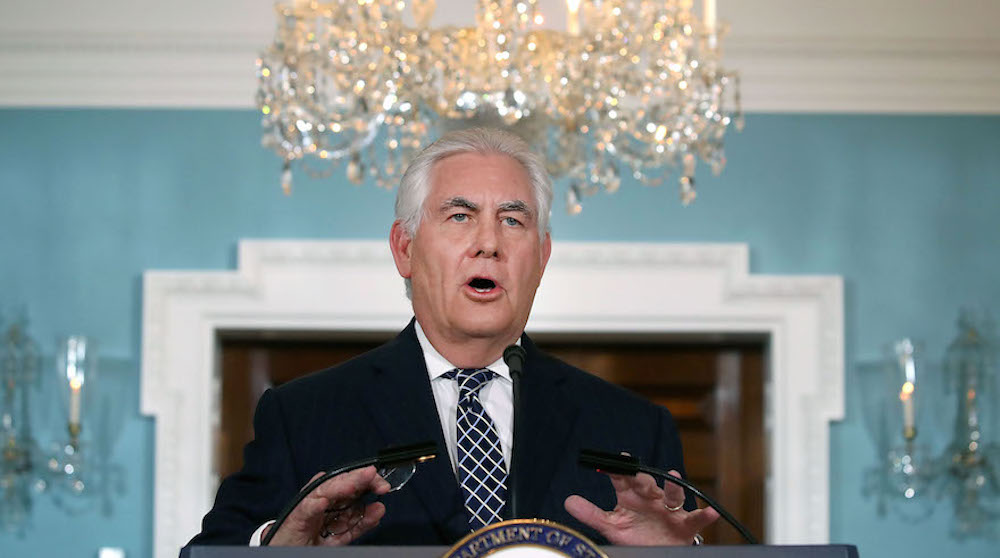
Secretary of State Rex Tillerson speaking about Iran and North Korea at the State Department in Washington, D.C., on April 19. Photo by Mark Wilson/Getty Images

Kimball sounded exasperated at what has become a common misperception.

“The deal obliges Iran to never pursue nuclear weapons in the future,” he said.
While it is true that the agreement allows Iran to enhance its enrichment capabilities over time, and decreases the breadth of the inspections regime, Iran remains a signatory to the Nuclear Non-Proliferation Treaty. As part of the deal, it signed on again to the “additional protocol” that allows International Atomic Energy Agency inspectors expanded access to sites in perpetuity. (Iran had previously shucked off the additional protocol.) The protocol has no sunset clauses.

Why can’t we be friends?

It wasn’t just bad actions by North Korea that killed the deal – it was bad faith and distrust on all sides. President Bill Clinton signed the deal in 1994, but by the time of implementation, an adversarial Republican Congress was in place and frustrated the deliveries of promised heating oil.

In both the North Korea and the Iran cases, missile development has been an obstructing factor. Neither deal touched ballistic missiles, but testing the devices, capable of delivering a nuclear weapon, has exacerbated tensions.

The United States in the late 1990s began to sanction North Korea for its ballistic missile tests, but North Korea defiantly kept testing them and said the sanctions were eroding the framework agreement.

A similar scenario is playing out now. The Obama administration last year and the Trump administration this year issued new sanctions following Iranian missile tests; Iran has said it sees the sanctions as undermining the agreement.

Trump made clear he sees the missile tests as the problem, saying this week of Iran that “they are not living up to the spirit of the agreement.”

What the North Korea crisis tells us about the Iran nuclear deal Read More »

And on his 92d day, he fired the surgeon general

At least I got to thank him for his service while he was still serving.

If you saw the “Diabetic Lesbians and a Blushing Bride” episode of last season’s CBS sitcom “Mom,” an improbably funny series about the struggles of a mother (Allison Janney) and daughter (Anna Farris) in recovery from alcohol and drug abuse, the last five minutes held a shocker for you: a teenager played by recurring guest star Emily Osment dies of a drug overdose.

But then you were in for another surprise: U.S. surgeon general Vivek Murthy in dress blues, flanked by Janney and Farris, warning that drug overdoses kill more Americans than car crashes.  The families behind these numbers, he tells us, need our compassion. The 30-second PSA ends with a 24/7 Helpline number to call “if you or someone you know needs help.” After it ran, calls to 1-800-662-HELP tripled.

Last week, 48 hours before Donald Trump fired him, Dr. Murthy came to Los Angeles to talk to a roomful of TV show runners, producers and writers. Communicating public health messages is central to the surgeon general’s job, and Murthy understands how powerfully entertainment can influence audiences. When we identify with fictional characters, when we’re transported by their narratives, our knowledge, our beliefs, even our behavior can be shaped by made-up stories.

Murthy’s message to the creative community: Opioid addiction is an epidemic. Everyone knows someone struggling with it. But it’s a chronic illness, a disease of the brain, not a moral failure. He asked Hollywood’s help in depicting it that way, and that when they do, to please depict hope, not just pain; recovery, not just despair.

If the surgeon general knew that two years into his four-year term as a nonpolitical appointee, the president was going to ask for his resignation, or that when that happened, Murthy would refuse, forcing the president to fire him, I saw no sign of it that night.

I was his host. As director of the Norman Lear Center, named for the TV pioneer and philanthropist whose shows have wrestled with cancer, sexual assault, racism, homophobia and so many other realities of American life, I’m especially proud of our Hollywood, Health & Society program run by my colleague Kate Folb. For 16 years, HH&S has provided free expert advice to hundreds of shows on issues of public health, safety and security. We connect writers with top medical and scientific specialists to answer their questions; we bring experts to writers’ rooms to brief them on topics ranging from HIV to climate change to the risk of nuclear war; we invite speakers to tell their personal stories, and to inspire writers with their passion to repair the world.

Murthy told the TV writers that when President Obama nominated him in 2013, a nurse at Boston’s Brigham and Women’s Hospital where he worked said to him, “If you can do one thing, please do something about the addiction crisis.” He recounted some of the stories people told him as he traveled the country trying to do what she asked, like the man addicted to opioids who told Murthy that when he was diagnosed with testicular cancer, he actually welcomed the news: He figured that after his surgery, he’d be given painkillers.

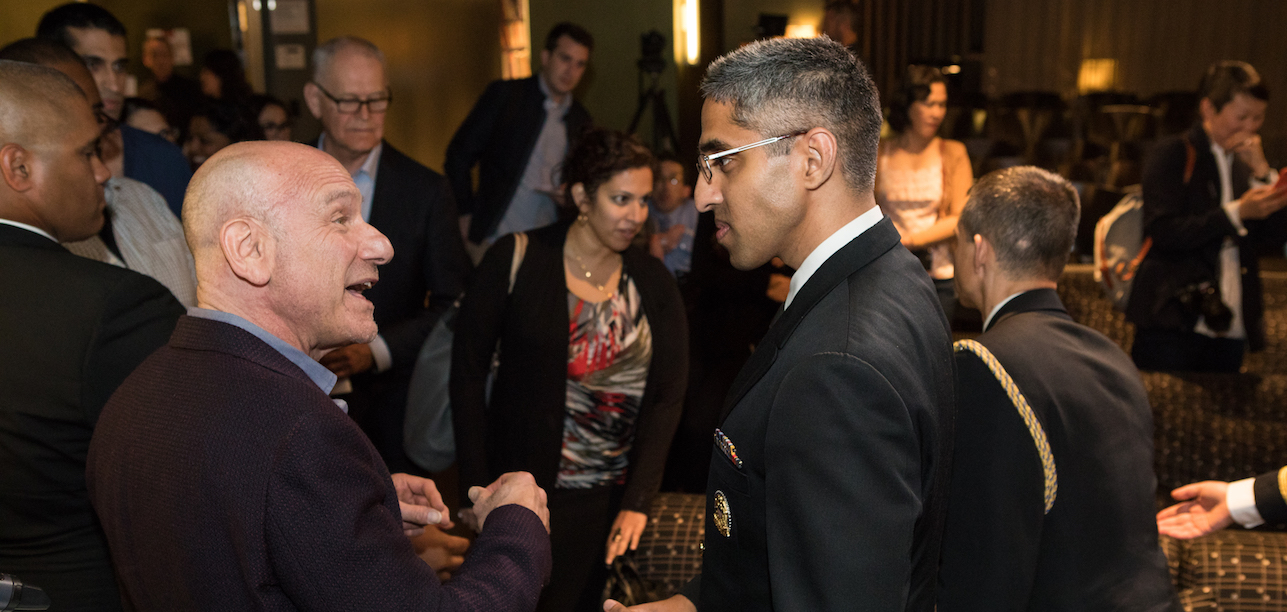
Surgeon general Vivek Murthy, right, and Marty Kaplan. Photo courtesy Norman Lear Center

Cortney Lovell, a 28-year old mom-next-door from upstate New York, told the writers her story as well. She recalled the winter night in her car nine years ago when she deliberately shot an overdose of heroin and cocaine into her veins. She thought death was a better option than the hell of her life. Lovell doesn’t know why she didn’t die that night, but today she’s in long-term recovery from addiction, and she’s helping others prevent and escape from what happened to her.  The writers also heard Gemma Baker, writer/producer and co-creator of “Mom,” and Zoanne Clack, executive producer of “Grey’s Anatomy,” explore the craft of informing audiences while also entertaining them.

And none of us, except perhaps Murthy, had a clue he’d be out the door two days later.

The Senate held up Murthy’s confirmation for more than a year because Republicans held his support of the Affordable Care Act against him, and because the NRA opposed him for calling gun violence a public health issue. Once in office, when he warned that the nicotine in e-cigarettes was harmful to kids’ developing brains, Big Tobacco and right wing groups like Americans for Tax Reform called for Murthy’s ouster. Last week, when he listed the causes of opioid addiction at our event, he included the prescription drug industry’s aggressive pain pill marketing, which made me think he must be on Big Pharma’s hit list, too. With that many strikes against him – to me, badges of honor – it’s amazing he lasted until the Administration’s 92d day.

The farewell message that Murthy, 39, the grandson of a poor farmer from India, posted on his Facebook page is extremely gracious, especially given the circumstances.  I’m not sure I’d be able to pull off being that lovely. But I’m reasonably sure that the nice folks who pulled the trap door under Vivek Murthy are indifferent to the oath known to anyone who’s seen a medical show on TV: First, do no harm.


MARTY KAPLAN is the Norman Lear professor at the USC Annenberg School for Communication and Journalism. Reach him at martyk@jewishjournal.com.

And on his 92d day, he fired the surgeon general Read More »

Anti-Semitic, racist fliers found on Princeton campus

Fliers with anti-Semitic, racist and anti-immigrant messages were posted on the campus of Princeton University.

The fliers were discovered in at least four areas of the campus on Thursday, the Daily Princetonian student newspaper reported, including on the door to the main entrance of the campus Center for Jewish Life.

The person posting the fliers was wearing dark clothing and a ski mask, the Daily Princetonian reported.

The fliers were from a white nationalist organization called Vanguard America, which bills itself as a group for “White Nationalist American youth working to secure the existence of their people.”

Among the charges made on the flier: “Jews are 10% of Princeton’s students, an overrepresentation of 500%,” and 80 percent of the first Soviet government was Jewish.”

The flier also was posted on the group’s Twitter feed on Thursday, the anniversary of Adolf Hitler’s birthday.

https://twitter.com/TrueAmVanguard/status/855124978575998977

The fliers were removed after a complaint was called in to the university.

The campus Public Safety is investigating the fliers as a bias incident.

In an email to the campus community, Michele Minter, vice provost for institutional equity and diversity, said: “Princeton is committed to protecting and promoting free expression, but it regards actions that are threatening  or harassing based on identity as serious offenses. These flyers were contrary to the values of the university, which seeks to create and maintain an environment free from discrimination and harassment.”

Anti-Semitic, racist fliers found on Princeton campus Read More »

Why Marine Le Pen is confident she will be France’s next president

Supporters of Emmanuel Macron were not alone in cheering his victory Sunday in the first round of France’s presidential elections.

Far-right candidate Marine Le Pen, who finished second in the voting, saw it as excellent news. The two will face off in the final round next month after the centrist Macron won 23 percent of the vote, 2 points ahead of Le Pen.

She has called Macron her “ideal” adversary — Macron is relatively inexperienced and without the infrastructure of an established party, and despite running as an independent is nonetheless widely seen as a continuity candidate of the deeply unpopular government of President Francois Hollande.

“A runoff between a patriot such as myself and a caricature of a diehard globalist like him is ideal,” Le Pen, the leader of the Eurosceptic and anti-establishment National Front party, told the AFP news agency on Jan. 17. “It’s a gift.“

To be sure, the sharp-tongued and gravel-voiced Le Pen has also spoken dismissively of other candidates.

But when it comes to Macron, she is not alone in assessing his perceived weaknesses as a candidate. Nor is she alone in believing  that her anti-Muslim party, with its rich record of anti-Semitism, raw nationalism and xenophobia, is closer to the presidency than at any point in its history.

Macron, 39, a youthful-looking former banker who has never held elected office, has generated a huge following among professionals in France’s more affluent cities and regions. A supporter of corporate tax cuts and competitiveness in the job market, he has appealed to voters with a cosmopolitan worldview. He backs the European Union and promotes tolerance toward minorities while acting against radicalization.

But these very characteristics, as well as Macron’s image as an aloof wunderkind who owes his success to a corrupt establishment, make him deeply unpopular to a class, largely low-income, that feels disenfranchised by immigration, globalization and the European Union. Politically this is a perilous position, as witnessed in the 2016 vote in Britain to leave the European bloc and Donald Trump’s election in the United States.

Conservative writer Guy Millière is a Trump supporter who opposes Le Pen, but says Macron is an “inflatable doll” who, if elected, will guarantee “five more years of Hollande” and a continuation of the rule of a “clique that knows nothing about the difficulties of ordinary Frenchmen,” he wrote Monday on the rightist news site Dreuz. “He’s a candidate made up by billionaires.”

Macron’s supporters say that although he served two years as a Cabinet minister under Hollande, a Socialist, Macron is in fact an outsider to the political establishment and the only candidate who stands a chance to transcend bipartisan divisions in a deeply polarized society. Macron also was inspector of finances in the French Ministry of Economy under Jaques Chirac, a center-right president.

Yet that, too, could be an Achilles heel in a country where no independent candidate has won a presidential election since the 1970s.

Relatively inexperienced in politics and lacking the support of established party mechanisms, Macron is now up against one of France’s shrewdest and most seasoned politicians in Le Pen, a career lawmaker who heads one of her country’s most dynamic and hierarchical parties, and whose life partner and father both have devoted their adult lives to politics.

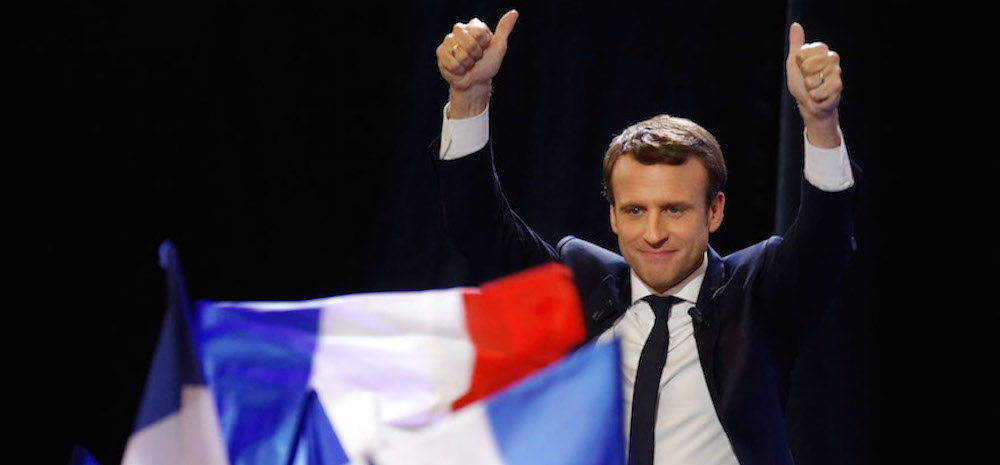
Emmanuel Macron speaking in Paris after advancing to the final round of France’s presidential election on April 23. Photo by Sylvain Lefevre/Getty Images

Le Pen’s family legacy, however, may play in Macron’s favor.

The daughter of National Front founder Jean-Marie Le Pen, a Holocaust denier and open anti-Semite who she succeeded as party leader in 2011, she and her party are widely regarded as extremist and borderline neo-fascist despite her efforts to rehabilitate its image.

Francis Kalifat, the president of the CRIF umbrella group of French Jewish communities, has called Le Pen “a candidate of hate.” On Sunday, he called on voters to vote for Macron in the second round, just to keep Le Pen out of power.

Known in France as a “republican front,” such mobilizations, in which voters set aside their differences and vote for the candidate likeliest to keep National Front out of power, have cost the party many elections. In 2002, the only time National Front participated in the second round of a presidential elections, the republican front resulted in Chirac beating Jean-Marie Le Pen with 82 percent of the vote.

Since then, Marine Le Pen has kicked out of the party dozens of members who were caught making anti-Semitic statements – including her father in 2015 after he said a Jewish singer should be put “in an oven.”

But in a remark that critics said echoed her father’s revisionism, she earlier this month said France was not responsible for how its police rounded up Jewish Holocaust victims for the Nazis.

Marine Le Pen has also vowed to outlaw the wearing of the kippah in public, explaining she does not regard it as a threat but will ban it nonetheless to facilitate imposing similar limitations on headgear worn by Muslims, whom she flagged as a “threat to French culture.”

Kalifat said she was a “threat to French democracy” and Moshe Kantor, the president of the European Jewish Congress, wrote in a statement Monday that the younger Le Pen is “no less dangerous than her Holocaust-denying father.”

Many in the French political establishment concur, and most of the losing candidates in Sunday’s voting urged their supporters to vote for Macron. On Sunday, both Benoit Hamon of the Socialist Party and Francois Fillon of The Republicans of former President Nicolas Sarkozy urged a united front against Le Pen.

But this year, that front has at least one major gap: Jean-Luc Melenchon, the communist candidate, who is also a Eurosceptic, did not call on his supporters to vote for Macron, whose economic and foreign policies are diametrically opposed to Melenchon’s.

Meanwhile, Le Pen is already attacking Macron on points that resonate with many of her voters. In a speech she made to supporters following the first round, she called Macron “Hollande’s extension,” saying he was guaranteed to continue the president’s policy of “mass immigration.” In Macron’s world, she added, “the rich man reigns.”

In light of the challenges facing Macron, even some of his ardent supporters spoke openly of their concern ahead of the final round.

“I don’t consider today as a victory,” Michael Amsellem, one of Macron’s many Jewish supporters, wrote on Facebook. “Having Le Pen in the second round is a tragedy.”

Citing the abstention of Melenchon and his supporters from the republican front, as well as polarization between “protectionists and internationalists, “we are in a major danger zone from Le Pen,” Amsellem wrote.

“The French people are full of surprises,” he added. “This is not going to be so simple.”

Why Marine Le Pen is confident she will be France’s next president Read More »

Episode 35 – Holocaust Memorial Day Special with Yad VaShem Chief Historian Prof. Dina Porat

Yom HaShoah, Israel’s Holocaust Memorial Day, commemorates the 6 million Jews who perished in the genocide. However, in order to prevent the crimes of history from repeating themselves, we cannot simply remember, we must learning from them. We must study the past and compare it to the present. Professor Dina Porat does exactly that at the Kantor Center for the Study of Contemporary European Jewry. Every year on the eve of Yom Hashoah,  the Kantor Center at Tel Aviv University publishes its Report on Antisemitism.

Professor Porat is also the chief historian of Yad Vashem, Israel’s National Holocaust Museum and she joins Two Nice Jewish Boys in this episode for a special on Antisemitism and Yom HaShoah.

iTunes 

Direct Download

Episode 35 – Holocaust Memorial Day Special with Yad VaShem Chief Historian Prof. Dina Porat Read More »