fbpx

March 8, 2017

Hamantashen: As easy as one, two, three corners

What makes the Purim holiday so special? Is it the heroic tale of Queen Esther? The children dressing up in costume to re-create the story? The sweet pastries her story inspired?

For all of these reasons, my family loves Purim! It is a time when our grandchildren and great-grandchildren dress up, attend a Purim carnival and feast at our Purim dinner — a reminder of how our children celebrated when they were young.

This year, we will enjoy the holiday with family and friends at one long table in the dining room. A sampling of our Purim groggers (noisemakers) will be arranged down the center. (We can’t include them all because our collection now numbers almost 100.)

The most popular treats for Purim are hamantashen, three-cornered pastries. They are served throughout the world, filled with poppy seeds, prune jams and more. 

I still remember making my first hamantashen using a recipe I received from my mother. Instead of using the traditional yeast pastry, sold in bakeries, she made them with cookie dough filled with poppy seeds and homemade strawberry jam.

Over the years, I have developed many recipes for making these holiday delights. One year, I added chocolate and poppy seeds to the cookie dough and filled it with a mixture of melted chocolate and chopped nuts, resulting in a decadent treat for chocolate lovers.

Another family favorite is a Poppy Seed Yeast Ring; it’s like a delicious coffee cake that doubles as a hamantashen yeast dough. The dough is covered with a towel and refrigerated overnight, then rolled, filled and served hot for breakfast. Or you can make the dough in the afternoon, refrigerate it for several hours, bake and serve for dessert after dinner.

This year I am including a recipe for a hamantashen pastry filled with vegetables, too. It can be served as an appetizer or a main course for the vegetarians among us.

Remember, the dough and fillings usually can be prepared in advance, and stored in the refrigerator or freezer, then baked when convenient.

Now, go get ready to make some noise — in the kitchen and at the table with your Purim grogger!

DOUBLE CHOCOLATE HAMANTASHEN

– Chocolate Filling (recipe follows)
– 3 cups flour
– 1/2 cup finely ground almonds
– 1 1/2 teaspoons baking powder
– 1/4 teaspoon salt
– 1/2 cup sugar
– 1 cup unsalted margarine
– 3 tablespoons hot water
– 2 tablespoons unsweetened cocoa powder
– 1 egg
– 1 egg white

Preheat the oven to 350 F.

Prepare Chocolate Filling; cover and set aside. 

In the bowl of an electric mixer, combine flour, almonds, baking powder, salt and sugar. Blend in margarine until mixture resembles very fine crumbs.

Blend water and cocoa in small bowl and beat in egg. Add to flour mixture and beat until mixture begins to form dough. Do not over-mix.

Transfer to flour board and knead into a ball. Chill 30 minutes for easier handling. Divide into 6 or 7 portions. Flatten each with palms of hands and roll out 1/4-inch thick. Cut into 3-inch rounds with scalloped cookie cutter. Place 1 teaspoon of filling in the center of each round. Brush edges with a little water. Fold edges of dough toward center to form a triangle, leaving a bit of filling visible in center. Pinch the edges to seal.

Place on a baking sheet lined with lightly greased foil or a Silpat mat and brush with egg white. Bake in preheated oven until firm, about 20 minutes. Transfer to rack to cool.

Makes about 5 dozen hamantashen.

CHOCOLATE FILLING

– 1/2 cup cocoa powder
– 1/2 cup sugar
– 1/3 cup coffee, milk or half-and-half
– 1 cup chopped walnuts or pecans
– In a large bowl, combine cocoa powder, sugar, coffee and walnuts and blend thoroughly.
– Makes about 1 1/2 cups.

In a large bowl, combine cocoa powder, sugar, coffee and walnuts and blend thoroughly.

Makes about 1 1/2 cups.

POPPY SEED YEAST RING

The dough from this recipe also can be used to make Yeast Hamantashen; see below. From “The Gourmet Jewish Cook” by Judy Zeidler.

– Poppy Seed Filling (recipe follows)
– 2 packages active dry yeast
– 1 cup warm milk (110 to 115 F)
– 1/2 pound unsalted margarine
– 2 tablespoons sugar
– 3 eggs yolks
– 2 1/2 cups flour
– Pinch of nutmeg
– 1/4 teaspoon salt
– 2 tablespoons olive oil

Prepare the Poppy Seed Filling; set aside.

In a measuring cup, dissolve the yeast in 1/2 cup of the milk. In a large mixing bowl, cream the margarine with 2 tablespoons sugar until light and fluffy. Add the egg yolks and beat well.

Combine the flour, nutmeg and salt. Add the yeast mixture to the mixing bowl alternately with the flour. With the back of a wooden spoon, smooth the top of the dough and brush with oil. Cover with a towel and refrigerate for several hours or overnight.

Preheat the oven to 350 F.

Divide the dough into 2 portions. Roll out each portion on floured wax paper into a 16-by-20-inch rectangle. Spread half the Poppy Seed Filling over each dough half, leaving a 1-inch margin around the edges. Starting from a long edge, roll up each one, jelly-roll fashion. Bring the ends together to form a ring.

Place each ring in a 10-inch pie pan, sealing the ends together. Brush the top with the remaining milk and sprinkle with poppy seeds. (If you like, you can hold the rings in the refrigerator, covered, for 1 hour.) Bake for 30 minutes or until golden brown. Serve hot.

Makes two Poppy Seed Yeast Rings.

POPPY SEED FILLING

– 3 egg whites
– 1/2 cup sugar
– 1 1/2 cups canned poppy seed filling

In a large bowl of an electric mixer, beat the egg whites until soft peaks form. Fold in the 1/2 cup sugar and poppy seed filling.

Makes 4 cups.

To make Yeast Hamantashen:

Preheat the oven to 350 F.

Roll out the dough and cut it into 3-inch rounds with a cookie cutter. Place a teaspoon of poppy seed filling in the center of each circle of dough. Fold the edges of the dough toward the center to form a triangle, leaving a bit of the filling visible in the center. Pinch the edges to seal.

Place the hamantashen on a baking sheet lined with lightly greased foil or a Silpat mat and bake for 10 minutes; pinch edges again to reseal and bake 10 minutes longer or until golden brown. Transfer to racks and cool.

Makes 3 dozen hamantashen.

VEGETABLE HAMANTASHEN

– Carrot or Eggplant Filling (recipe follows)
– 1/2 cup unsalted margarine
– 1/2 cup sugar
– 3 eggs
– Grated zest of 1 orange
– 2 cups flour
– 1 1/2 teaspoons baking powder
– 1/4 teaspoon salt

Preheat oven to 375 F.

Prepare Carrot or Eggplant Filling; cover and set aside.

In the large bowl of an electric mixer, beat margarine and sugar until well blended. Beat in 2 of the eggs and zest, blending thoroughly. Add flour, baking powder and salt, blending until dough is smooth.

Transfer dough to a floured board and divide into 3 or 4 portions for easier handling. Flatten each portion with palm of hand and roll out 1/4-inch thick. Using scallop or plain cookie cutter, cut into 2 1/2-inch rounds. Place 1 teaspoon of filling in center of each round. Brush edges of round with a little water. Fold edges of dough toward the center to form a triangle, leaving a bit of filling exposed. Pinch edges to seal.

Place hamantashen 1/2 inch apart on a baking sheet lined with lightly greased foil or a Silpat mat. Brush with beaten egg. Bake for 10 to 15 minutes in preheated oven, until golden brown. Transfer to racks to cool.

Makes about 5 dozen hamantashen.

CARROT FILLING

– 1 pound carrots, peeled and grated
– 1 1/2 cups water
– 1/3 cup sugar
– 1/3 cup ground almonds
– 1/4 cup golden raisins

Combine carrots and water in a heavy saucepan and bring to a boil. Simmer, stirring occasionally until all the liquid has evaporated, about 20 minutes. Add sugar, almonds and raisins. Simmer on low heat until thick and liquid is absorbed, about 10 minutes. Cool.

Makes about 2 cups.

EGGPLANT FILLING

– 1 (1 pound) eggplant, peeled and diced
– Water
– 2 cups sugar
– 1/2 teaspoon ground cinnamon
– 1/4 teaspoon ground nutmeg
– 2 tablespoons lemon juice
– Grated zest of 1 lemon

Place eggplant in a large saucepan and cover with water to cover. Bring to a boil and boil until tender, about 10 minutes. Drain and set aside.

Combine sugar, 2 cups water, cinnamon and nutmeg in large saucepan. Bring to a boil. Add eggplant. Remove from heat and cover. Let stand 1 hour.

Remove eggplant with slotted spoon. Cover syrup until thick, about 20 minutes. Add eggplant, lemon juice and zest. Boil until syrup forms into a firm ball when dropped into cold water from spoon, 220 F on candy thermometer. Spoon into a bowl and cool.

Makes about 2 1/2 cups.


JUDY ZEIDLER is a food consultant, cooking teacher and author of 10 cookbooks, including “Italy Cooks” (Mostarda Press, 2011). Her website is judyzeidler.com.

Hamantashen: As easy as one, two, three corners Read More »

‘Last Laugh’: Looking to comedy as a salve and savior

“Whoever has cried enough, laughs.” 

              — German novelist Heinrich Mann

That there is a limit to mourning, or that it must be transformed into its perceived opposite is a provocative idea. Jewish culture has historically laid claim to both emotional expressions, often simultaneously. We are a people for whom the act of remembering is central to identity, and as Jewish holidays remind us like clockwork, we are a people whose memories are tied to historical tragedy.

We were slaves in Egypt. We were exiled and held captive in Babylon. Twice, our temple was destroyed. We were victims of pogroms and anti-Semitism. And unforgettably, we were murdered, more than 6 million of us, during the Holocaust.

What tremendous burdens of memory we bear. It’s a wonder we are here at all, that we have the collective strength to remember. After all, forgetting is much simpler. What is it, a student once asked, that gives Jews such tenacity and resilience in the wake of such a long, dark history of persecution?

We laugh, I said, without considering whether it was in fact true. And certainly there are many reasons — known and unknown — that allow Jewish culture to flourish despite the atrocities to which it has been subjected. But the ability to laugh at jokes in the darkest of times may be the strongest indicator of the potential to survive just about anything.

“The Last Laugh,” a documentary film by Ferne Pearlstein that opens in Los Angeles on March 17, explores this very topic. The film opens with Mann’s statement on tears and laughter, and this strangest of pairings is the focus of the film, which cuts between scenes with Los Angeles Holocaust survivor Renee Firestone and interviews with well-known comics, including Mel Brooks, Jeff Ross, Sarah Silverman, Gilbert Gottfried, Rob Reiner and Judy Gold.

After watching the film, I sat down with Ross to get his thoughts on comedy and tragedy, as well as the responsibility of comedians in our current social and political climate.

“The deeper you go with the humor, the more revengeful it is,” he says in the film. It’s “the Jewish way of getting through it.”

Jews dominate American comedy, and so it’s not the first time that an artist or filmmaker has explored the complex relationship between comedy and tragedy in the context of the Holocaust, a topic that was long considered taboo among comics. There were always Holocaust jokes, of course, even in Nazi Germany and even in the camps, some told by survivors. But never were they as pervasive as they are today, 70 years later.

In the film, Robert Clary, a survivor who entertained other inmates in the camp, says “making people forget where they were was the most important thing.” I asked Ross, king of roast comedy, what he thought about this idea. I was troubled by this statement because as a scholar of Holocaust literature my impulse is to insist that it would have been impossible to forget; to act as if it were feasible diminishes the extent of the atrocity. But Ross disagreed, insisting that it’s about context and where jokes are being told.

And Ross knows a lot about context. He has done comedic specials at places such as Westboro Baptist Church, police departments and prisons with inmates tattooed with swastikas. He’s done stand-up for soldiers and college students. But when it comes to telling jokes in places like concentration camps or war zones, he says the comic is “shining a light.”

Comedy “is resistance, so if no one is listening, if it doesn’t offend somebody somewhere, it’s probably not a joke,” he said. And so we find that telling jokes, even about the Holocaust, can be a way of continuing to resist the fascist and anti-Semitic impulses that led to it, as well as giving those who suffer a reprieve, if only for a moment.

But I had my doubts about the idea of a joke only being a joke if it offends someone, and I couldn’t help but think of my 4-year-old son who won’t stop telling the joke about the chicken crossing the road. Nothing offensive there.

As if he’d read my mind, Ross continued: “Why did the chicken cross the road? Well, somewhere in the world, right now, some kid’s chicken died crossing the road and it’s not funny, it’s not funny. Maybe his only meal crossed the road, and he’s hungry, it’s not funny. So context, timing, audience” matter.

“Even a bad show,” he said, “it can be good, it can be bad, it just can’t be boring . . . it’s torture if it is, just reminding you that you’re stuck.”

Imagine the pressure felt by a Jewish entertainer in the camps, struggling not just to tell jokes but also to make them good so that the audience wouldn’t feel stuck.

But comedy in retrospect differs from comedy during the Holocaust. One survivor in the film says: “Without humor, I don’t think we could’ve survived.” Another tells us, “you can’t live in the shadow” of the Holocaust — and that laughter is her revenge. Yet one cannot but live in its shadow. And so we find that humor, even outside the barbed wire of the camps decades later, works to help the survivor forget, for a moment, that she lives in the shadow of what was lost.

Humor is almost always connected to darkness. Inheritors of trauma, recipients of darkness, often laugh a lot. How else does one shoulder such burdens? Some of the best comics carry the heaviest burdens, I suspect. Or maybe we all carry burdens, and comics have chosen to take some of ours onto their own shoulders. I couldn’t help but ask Ross about his own personal darkness, about what made him do what he does. It’s a question I silently ask the ones who help us laugh until our insides hurt — a glimmer of the pain from which comedy often comes.

“It’s a skill,” he said. “What makes me good at that skill is really your question. And the answer is that I never really got the proper therapy to answer it. … Is it that my mother loved me too much? My parents passed away? Was it that I grew up around tough neighborhoods? Was it a defense from school bullies? Was it a way to get attention, to get girls to talk to me … a fun way to be punk rock and express my freedom of speech? I would say all of these.”

It’s complicated. And it’s a lot to bear.

Given my interest in tragedy, I can’t help but be drawn to the Jewish comic. The collective Jewish load is heavy — temples destroyed, years in exile, death marches and crematoria — but it is expected. It’s what’s added on that is intriguing, the unique, individual darkness colliding with what is carried down generationally. The ability to laugh and make others laugh in spite of it all: it’s a gift.

But with any gift comes tremendous responsibility. Some say that if the Jews are chosen, it is to be more responsible. Given recent news about desecrated Jewish cemeteries and bomb threats, I had to ask Ross about how the world of humor is changing. My own experience as a professor suggests that young people are laughing more than ever. “I love my generation,” tweeted one of my students, “we make everything hilarious.” Students are deeply troubled by the turbulence of our era, yet they laugh constantly. The threat of terrorism is dark and ambiguous, but it’s also the norm into which they were born. What choice do they have but to laugh if they want to survive?

And the new occupant of the White House, Ross suggested, permeates everything that’s happening. “It’s going to affect all comedy, all movies … painting, literature, even the Oscars, it’s less of a party now and more of a protest … Everyone has an agenda. It’s kind of a Trumpian buzz-kill going on right now. But having said this, my jokes about Donald Trump kill.” Ross dives into one of these jokes: “He’s an old friend, and I’m ghost-writing his book; it’s called ‘Mein kampf is bigger than your kampf.’ ”

Ross is quintessentially Jewish. He is never without a deep awareness of his responsibility. I asked him whether his comedy might change over the next four years, and he suggested that he has already become more politically aware, realizing that his niche is getting off the stage, out of the comedy club, into the field. Boots on the ground. Comedians have a responsibility “to not talk just about Trump, but about what’s on page 2, page 3, page 4, and make that interesting and funny,” he said. “Is our responsibility to resist Trump or to assist everybody else who’s lost in the Trump flood right now?”

Those are the kinds of statements that make Judaism great, I thought. And suddenly comedy seems like the only vehicle for hope.

I know — the idea of comedy as savior is ridiculous. Or maybe it’s not. Has humor taken on a messianic shape for this generation? As “The Last Laugh” confirms, humor helped people survive the unthinkable. Some see our current political situation as exceedingly dark, and certainly many young people feel this way. The messiah may or may not be coming, but one thing is certain: laughter is on its way, and in this laughter we find the capacity for hope and resistance. 

Monica Osborne is a writer and scholar of Jewish literature and culture.

‘Last Laugh’: Looking to comedy as a salve and savior Read More »

JCCs to Sessions: We’re ‘frustrated’ with progress on bomb threats

Executives from 141 Jewish community centers signed a letter to Attorney General Jeff Sessions expressing frustration with efforts combating a rash of bomb threats.

The letter, sent Wednesday by the JCC Association of North America, the national organization of Jewish community centers, requested a meeting with Sessions and urged the Justice Department to do more to stop the threats.

It also praised local law enforcement’s response to the incidents and recognized President Donald Trump’s condemnation of them.

“Still, we are frustrated with the progress in resolving this situation,” the letter said. “We insist that all relevant federal agencies, including your own, apply all the resources available to identify and bring the perpetrator or perpetrators, who are trying to instill anxiety and fear in communities across the country, to justice.”

More than 100 bomb threats have hit JCCs and other Jewish sites across the country since the beginning of the year. The latest wave, on Tuesday and Wednesday, targeted 20 JCCs, day schools and offices of the Anti-Defamation League.

The Department of Homeland Security has made its regional experts available to JCCs, and leaders of major Jewish groups met with FBI Director James Comey on March 3. Local JCC directors have repeatedly praised the response of area law enforcement.

“Local law enforcement have represented a beacon of responsiveness and professionalism as our communities have endured dozens of anti-Semitic threats in past weeks,” the letter said. “We respectfully ask that federal agencies, including your own, do the same.”

Authorities have yet to identify the person or people behind most of the threats. Juan Thompson, a St. Louis resident charged with making eight of the threats to avenge a former romantic partner, appears to have been a copycat.

JCCs to Sessions: We’re ‘frustrated’ with progress on bomb threats Read More »

Cardin to oppose Friedman nomination

Sen. Ben Cardin (D-Md.) announced that he will vote against the nomination of David Friedman as U.S. Ambassador to Israel at the Senate Foreign Relations Committee confirmation vote on Thursday.

Speaking to reporters at the Capitol on Wednesday, the committee’s Ranking Democratic Member noted that Friedman’s candidacy contradicts the “bipartisan tradition” of U.S. support for Israel.

Cardin said he was further troubled by Friedman’s written remarks opposing the two-state solution, adding that Friedman would be unable to serve as a “unifying force” and lacks “credibility.”

“Following extensive consideration of Mr. Friedman’s record and taking into account his statements during his nomination hearing, I have concluded that his past record would make it very difficult for him to serve as that unifying force,” he stated.

Cardin to oppose Friedman nomination Read More »

Camp: Welcoming the youngest charges — and their nervous parents

Wondering if your child is ready for overnight camp?

A sure sign, according to Karen Alford, a sleepaway camp consultant, is that he or she has grown tired of day camp.

“At 9, you’ve probably been doing day camp for several years, and there’s just a natural progression to sleepaway camp,” she said.

Of course, Alford added, some kids aren’t ready until they’re older.

“You have to know your child and what they can handle,” she said, adding that “some parents with kids who have trouble separating find camp even more helpful at a younger age because it builds independence.”

Luckily, most Jewish summer camps pay close attention to easing their youngest kids into the sleepaway experience. From pre-camp meet-and-greets to special presents for first-time campers to the common availability of ultra-short sessions — from five to 11 days — camps are acutely aware of the need to gently transition their littlest and newest campers into the culture of overnight camp.

In addition to providing additional resources for the young newbies — and, of course, their anxious parents — many camps also hire additional staff and train them in some hand-holding.

Take Camp Judaea, a pluralist Jewish camp in North Carolina. It offers a Taste of Camp Judaea, an 11-day program for kids as young as 7. Unlike older campers who can “specialize” in certain activities, the youngest campers, called Rishonim, get to sample all of the camp activities, including zip-lining and horseback riding. The Taste program is available for kids until the fourth grade.

“To be honest, in some ways, it’s more for the parents than the campers,” said David Berlin, assistant director of Camp Judaea. “The parents tend to be more nervous. This is our way of hooking them into camp.”

The ratio of campers to counselors is lower for the Camp Judaea’s Rishonim campers, hovering around 3 to 1, as opposed to about 4 1/2 to 1 for the older kids.

To prepare the first-timers, Camp Judaea holds parlor meetings for new families, most of whom come from the southeastern U.S., Berlin said. New campers get to watch a video, hear about a typical day at camp and have their questions answered.

“It allows the families an opportunity to meet the staff before the summer begins,” Berlin said.

They also used to send first-timers a book about sleepaway camp — “Sami’s Sleepaway Summer,” by Jenny Meyerhoff — but it’s out of print. Berlin said the book was a great way to get young campers excited and have them learn what to expect; he’s looking for a replacement.

At Camp Gilboa, located near Big Bear and part of the progressive Zionist Habonim Dror movement, younger campers can experience sessions as short as four nights.

“We focus on easing them into camp,” said Executive Director Dalit Shlapobersky.

But because Habonim Dror offers year-round programming, kids can get involved before  starting camp, and therefore become acquainted with other Gilboa campers and counselors well ahead of time, she said. The camp also invites families to visit during the year for weekends and retreats.

Shlapobersky said campers typically start Gilboa at age 8.

“At that point they’ve already gone through quite a few separations — they’ve had to get used to a new community at preschool, and then a new one at kindergarten/elementary school,” she said. “These things are all about practice. The more time we practice doing something different, the more ready we are to take something new on.”

But Shlapobersky gives campers and families added support through the preparation process, including, beginning in May, weekly emails that focus on different aspects of camp — like what to expect on the first day of camp, what sort of communications there will be to and from camp and a glossary of camp lingo. New campers also receive introductory phone calls from counselors a couple of days before the session begins.

Additionally, Gilboa calls new parents to find out more about individual campers, making the camp more prepared for them when they arrive.

“For example, if we know they’re really into magic, we can have one of the counselors who loves magic tricks ready,” Shlapobersky said.

Camp Ramah in the Berkshires, which is affiliated with the Conservative movement, offers a seven-day Ta’am Ramah (Taste of Ramah) to children entering third grade.

Rabbi Ethan Linden, the camp’s director, said there’s a higher ratio of staff for the youngest kids.

“We’ll have 20 to 25 kids and 10 staff counselors, plus a group leader,” he said, adding that for older kids, there are typically 14 kids to four counselors per bunk.

“We usually have more experienced counselors for the little ones,” he said. “We know we have to hold their hands more.”

Linden said he’s found that most kids are ready to start camp between the ages of 8 and 10 — and agrees with other directors that parents are sometimes the last to be ready. But Ramah in the Berkshires pays extra attention to first-time campers regardless of age.

“We’re particularly sensitive to issues of homesickness and integration,” he said.

Linden said the camp employs staffers called “yoetzim” — people who are a little older, usually parents — who can get involved in tough situations. The camp also does “a lot of training on bunk dynamics, trying to make sure that no campers slip through the cracks,” he said.

“We work to find that one thing the kid loves to do and then use that to ease the transition,” he said.

At Camp Modin, a pluralistic sleepaway camp in Maine and the oldest Jewish camp in New England, the youngest campers are 8. Director Howard Salzberg said Modin used to have even younger campers, but found they weren’t quite ready for the experience.

While Modin doesn’t have extra-short sessions for first-timers — the shortest “regular” session is 3 1/2 weeks — counselors for younger kids are trained to give more personalized attention, Salzberg said.

“We don’t expect these kids to unpack their trunks or do their own laundry,” he said. “We recognize that these kids need extra help changing out of their wet bathing suits, that we need to make sure they’re showering, that they know how to open their soap in the shower, that they’re combing their hair.

“With older kids, it’s more about mentoring. For younger years, it’s more parenting.”

And in some ways, the younger kids are easier, Salzberg added.

“They present different challenges, but honestly, younger kids can be a lot easier than hormonally challenged teenagers,” he said, laughing.

At Modin, newbies are matched with returning campers in a “big brother, big sister” program — the older campers call the younger campers before the session starts, and at camp, they meet on opening day. The older group gives the younger charges a small gift, like a goody bag or a Modin bracelet.

Regardless of what age a child starts camp, the camp directors have noticed that first-born kids tend to start camp older, and slightly more nervous, than their younger siblings.

“Younger siblings have parents more prepared for the sleepaway camp experience, are often familiar with the campgrounds from visiting day,” Alford said. “Plus, they’ve seen how much fun their older siblings have at camp.”

Camp: Welcoming the youngest charges — and their nervous parents Read More »

Grief, challenges lead the way ‘Home’ for playwright Lisa Kron

Years before Lisa Kron wrote the book and lyrics to the musical “Fun Home” — based on Alison Bechdel’s graphic novel about coming out as a lesbian even as her gay father remained closeted — she channeled her own relationship with her father into a play.

Her 1996 solo show “2.5 Minute Ride” draws on how her father, Walter Kron, survived the Holocaust by traveling to New York at 15. He later discovered that his family had been murdered in the Chelmno concentration camp in Poland.

In “2.5 Minute Ride,” Lisa Kron visits Auschwitz with her father as well as his hometown of Fritzlar, Germany, where she becomes confused by how at ease he seems in the country where his family was persecuted.

“Part of what happens to the character of me in the course of the show, as it did in [real] life, was realizing that I had projected a lot of grief onto my father,” Kron, 55, said during a telephone interview from the New York home she shares with her wife, playwright Madeleine George. “But he had his own experience and grief that I wasn’t privy to.

“The way we look at the Holocaust is now codified for us,” Kron added. “We’ve calibrated the amount of horror we’re meant to feel. … But what my father and grandparents lived [through] had no such framework. I wanted to figure out ways to consider that experience and also to look at the difference between … someone else’s lived experience and our own.”

This dilemma is at the core of “Fun Home” as well. The musical explores how the character of Alison Bechdel struggles to understand why her closeted father, Bruce, committed suicide by stepping in front of a truck, several months after she came out as gay at Oberlin College. Early on, the fictional Alison states the show’s central question as she wonders why “My father and I both grew up in the same small Pennsylvania town, and he killed himself and I became a lesbian cartoonist.”

“Fun Home,” at the Ahmanson Theatre through April 1, won five 2015 Tony Awards, including best musical and best book and original score for Kron, who also was a Pulitzer Prize finalist for her work.

In the show, the fictional Alison is played by three actresses of diverse ages to represent the cartoonist from grade school to middle age. “Alison’s desire is to tell the story of her father, yet throughout she’s saying, ‘But is that what really happened? Is that the way it went?’ ” Kron said. “I’ve spent a lot of time trying to figure out how to theatricalize that particular question, and so I hooked into Alison’s story immediately that way.”

Kron’s own family history has been a central theme in some of her best-known work. Her paternal grandfather was the head of the Jewish community in Fritzlar, as well as a teacher in the local Jewish school and the cantor at his synagogue. When he became aware of the Nazi threat, he sent his son, Walter, to the United States in 1937 on a rescue program known as One Thousand Children, the American version of the larger Kindertransport effort in Britain.  The teenaged Walter felt a sense of adventure about his journey to New York, but having been beaten up regularly by anti-Semites in Germany, he was also grateful for the opportunity. “He told me that once he stepped on American soil, all he could think was, ‘Now they won’t be able to get me anymore,’ ” Kron said.

Several years later, her father served as an interrogator of suspected war criminals for the American military. Eventually, as an attorney in Michigan, he co-founded a local synagogue and became known for his Jewish erudition.

“My dad used to say to us, ‘But for the good fortune of being a Jew, I might have been a Nazi,’ ” Kron said.

Meanwhile, Lisa’s mother, Ann, a convert to Judaism, tirelessly worked to heal racial tensions in their community while being unable to heal herself of a debilitating auto-immune disease. Kron’s 2004 play, “Well,” investigates her memories of her mother as well as her own experience of attending all-Black schools as a girl.

The aspiring performer went on to attend Kalamazoo College, a liberal arts college in Michigan, and to move to New York, where she helped found the theater collective “The Five Lesbian Brothers” and to pen plays such as “101 Humiliating Stories” and “In the Wake.”

Of why she has often been drawn to autobiographical material in her work, Kron said, “Both my parents intersected with the major events of the 20th century in very particular ways, which seemed potentially illuminating and unique … so I had a gold mine of material.”

Kron had never written a musical or a piece based on someone else’s work when producers approached her about what would become “Fun Home” about seven years ago. Her collaborator was composer Jeanine Tesori, who also won a Tony for her work on the show.

“[Yet] there was nothing but challenges, epic challenges,” Kron said of creating the book and lyrics. For her autobiographical plays, “I had this endless file cabinet of my own memories,” she said. “But I had no file cabinet of Alison’s memory. So I had to invent things. Also, Alison was available and I asked her questions often.”

Bechdel, further, sent the show’s creators the journal she had kept while creating her graphic novel, as well as period photographs, including a picture of one of her father’s lovers.

Kron’s lyrics describe the cartoonist’s father as a fanatical perfectionist about the family’s Victorian home, which he painstakingly restores as a way to control his inner angst. He ultimately commits suicide because “When your lesbian daughter shows you that you can just come out, then you have to decide whether you are going to come out or not,” Kron said.

“In order to become a new person, you have to step off the edge of something into the unknown, and it’s scary. We see Alison terrified to jump into the unknown, but then she does it. And then we see him standing at the edge of that abyss, [thinking]:  ‘I can see what’s on the other side, and it’s so beautiful.’ But he isn’t that brave. He cannot do it and so he steps in front of a truck instead.”

“Fun Home” is being performed at the Ahmanson Theatre through April 1. For tickets and more information, visit centertheatregroup.org.

Grief, challenges lead the way ‘Home’ for playwright Lisa Kron Read More »

“Truth is anything you can get away with”

This week’s Jewish Journal contains an op/ed by Dennis Prager, a radio talk show host with a periodic column in this paper. He holds up the conservative side of the Journal’s political diversity. He can be generally counted on to take jabs at liberal positions and their advocates.

But his recent column is neither a defense of conservative ideology or policy positions, but rather it is a transparently specious defense of Donald Trump pursued by knocking down straw men that he blames on “leftists…and their poisoning of Jewish life.”

His claim is that there is no “wave of Trump-induced anti-Semitism or racism” related to the president, his rhetoric or his campaign. It’s virtually all the hype of “left wing hysteria…because they hate Donald Trump so much, they want to believe it.”

As evidence, he cites eight incidents where threats, graffiti or other bigoted acts were alleged to have occurred that turned out to be phony. He had to reach back to November to try and make his point.

According to Prager a “serious number” (whatever that means) of anti-Semitic acts “are being perpetrated by leftists” and “there are so many examples of hoaxes perpetrated by Black, Muslim and white leftists that they could fill this issue of the Jewish Journal.”

Prager might want to do a bit more homework.

The Anti-Defamation League, which systematically monitors and catalogues anti-Semitic and racist incidents, just issued a report which documents white supremacists’ “unprecedented outreach effort to attract and recruit students on American college campuses.” There have been over one hundred incidents of white supremacist actions on campus since the school year began with more than 61% of the incidents occurring since January.

The ADL, which is very careful about ascribing causality for anti-Semitic incidents, made clear what it thought, “these hate groups feel emboldened by the current political climate….White supremacists, emboldened by the rhetoric of the 2016 presidential campaign, are stepping out of the shadows and into the mainstream….In January, Jared Taylor [a longtime white supremacist] wrote, ‘It is widely understood that the election of Donald Trump is a sign of rising white consciousness….Now is the time to press our advantage in every way possible.’

Prager will undoubtedly dismiss the ADL’s conclusions as “left wing hysteria…they hate Donald Trump so much, they want to believe it….leftism has poisoned Jewish life.”

Indeed, there are Chicken Littles in the Jewish community who in the past have been too quick to claim anti-Semitism (I have written extensively about that reality for decades both in this paper and elsewhere). But that’s too transparent a diversion to propel forward Prager’s effort to sanitize Trump—he has to ignore over a year and a half of unprecedented incivility and unvarnished bigotry to focus on a few incidents as dispositive.

If one is truly concerned about anti-Semitism (as Prager purports to be) he ought to be troubled by a leader like Trump who undermines the mores of a society that has kept Jews and other minorities safe for over two centuries. Whether Trump condones anti-Semitism in its vulgar forms is an irrelevancy; he promotes and furthers its handmaidens.

stephensIn fact, among the most vocal critics of Trump have been principled conservatives who rightly perceive his danger. Most noteworthy among them is Bret Stephens, the Pulitzer Prize winning columnist for the Wall Street Journal who has made clear that Trump’s modus operandi is lying, “truth is whatever you can get away with.” He warned of Trump’s “assaults on what was once quaintly known as ‘human decency’” in his speech at the Daniel Pearl Memorial Lecture at UCLA last month.

And powerfully on point, Stephens has a special message for those who (like Prager) choose to ignore the threat that Trump poses to our society; the class of pundits who are the “TrumpXplainers”, they rationalize what Trump “meant to say” despite his words being “logically nonsensical.”

As Stephens has observed, “the most painful aspect of this for me has been to watch people I previously considered thoughtful and principled conservatives give themselves over to a species of illiberal politics from which I once thought they were immune. We each have our obligations to see what’s in front of one’s nose, whether we’re reporters, columnists, or anything else. This is the essence of intellectual integrity.”

What is in front of our nose is a president who has the likes of a Steve Bannon and Sebastian Gorka in the Oval Office—individuals with unambiguous ties to extremists and bigots—one who was hesitant to denounce anti-Semitism, who brazenly invokes the discredited America First chant as a call to action, who shamelessly targets a religious minority [Muslims], who has betrayed a profound lack of empathy and understanding for the Black community, who has stereotyped and demeaned Latinos and insults our intelligence with his absurd and incendiary tweets.

Prager’s hostility to liberals doesn’t justify his collaboration with “illiberal politics” and his abandonment of “intellectual integrity.”

Perhaps the admonition of a fellow conservative like Bret Stephens will move him to think again about siding with Trump. That course, as Stephens has written, is “the road of ignominy, of hitching a ride with a drunk driver.”

It’s time to sober up!

“Truth is anything you can get away with” Read More »

Stop celebrating Muslim decency

Being congratulated for basic civility is no compliment

Since the recent wave of anti-Semitic bomb threats, vandalism, and cemetery desecrations, journalistic and social media have vocally celebrated condemnations, fund-raising, and volunteer efforts by Muslim groups in an attempt to bolster interfaith cooperation and rehabilitate the reputation of the Islamic community precisely when its very welcome in America is being questioned like never before.

But nobody deserves congratulations for basic decency. Condemning bomb threats and making donations to repair damage from bias crimes is something good people of all backgrounds do. Liberal hoopla over proper Muslim responses to anti-Semitism is no more than a religious riff on the soft bigotry of low expectations. When Muslims go to extraordinary lengths to show they embrace their Jewish neighbors – and they sometimes do – public praise is appropriate. But headlines about Islamic press releases condemning cemetery vandalism send the opposite message – that in normal circumstances Muslims are callous and heartless.

Imagine these headlines:

  • Asian Driver Arrives At Work Without Incident
  • Jamaican Musician Passes Drug Test
  • Black Man Marries His Children’s Mother


While those headlines aim to challenge nasty stereotypes, they actually reinforce their legitimacy.

News stories about broad community efforts to help besieged Jews that contain a sentence “Even the local Muslim community turned out in force” are entirely appropriate. But special congratulations when Muslims act like, well, people are not compliments.

I know how it feels to have my own group celebrated for simple propriety.

As a Zionist, I am perpetually annoyed by hasbara (roughly, propaganda) that celebrates Israeli actions that are only minimally admirable – like an Israeli soldier who shares her sandwich with a starving Palestinian child or an Tel Aviv hospital that provides an impoverished dying Arab woman with free medical care. Yes, I understand that these examples are intended to debunk the idea that Israelis are not decent (although I have yet to see anti-Israel discourse accusing Israelis of withholding sandwiches from orphans). But the very act of highlighting basic decency legitimizes the slander, which is particularly offensive given the many good Israeli actions that are far from just minimally proper.

The people spotlighting Muslim attempts to repair desecrated cemeteries may think they’re rebutting negative stereotypes. But they aren’t. Sorry to say it, but Americans who fear or hate Muslims don’t do so because they think Muslims tolerate vandalism. They do so because they think Muslims tolerate terrorism. These stories will not dent that perception.

Americans are rightly proud of the way its citizens of many groups came together to help one group among them recover in a time of distress – and Muslims should be part of that celebration. But breathless reports that American Muslims aren’t jackasses after all help nobody – including American Muslims.

David Benkof is a columnist for the Daily Caller, where this essay first appeared. Follow him on Twitter (@DavidBenkof) and Muckrack.com/DavidBenkof, or E-mail him at DavidBenkof@gmail.com.


https://youtu.be/5lGOgreadvU


Stop celebrating Muslim decency Read More »

Moving and Shaking: U.S. Holocaust Museum dinner, de Toledo names new head, Republican Jews meet in Vegas

The United States Holocaust Memorial Museum on March 2 honored Janet and Lenny Rosenblatt and Sheryl and Kenneth Pressberg with the 2017 National Leadership Award, and recognized survivor and philanthropist Max Webb on his 100th birthday.

“As we gather tonight, we are thinking about the threats to JCCs, Jewish day schools and threats to Jewish cemeteries,” dinner co-chair Carol Stulberg said in her remarks. Her co-chairs were Steven and Debbie Abrams, Jill Black, Stanley Black, Fred and Dina Leeds, Nancy Mishkin, Carol and Jac Stulberg, and David Wiener.

The evening at the Beverly Hilton supported the museum’s current campaign, “Never Again: What You Do Matters,” and drew an estimated 1,000 attendees, including actress Rachel Bloom, former Los Angeles Mayor Antonio Villaraigosa, restaurateur Barbara Lazaroff, Remember Us director Samara Hutman and Los Angeles City Attorney Mike Feuer.

The evening began with a video tribute to late Holocaust survivor and author Elie Wiesel, followed by remarks by Sinai Temple Rabbi David Wolpe. Steven Klappholz, director of the museum’s Western regional office, also attended.

Wolpe spoke of Webb’s history as a dance teacher and said his survival and the survival of those like him had meant something to succeeding generations.

“Those of you who are survivors and have given us so much, like Max, you have not returned from hell with empty hands,” Wolpe said. “Your hands are full and you fill us, and we are grateful, and we bless you for that goodness, and we bless this land that opened its arms to so many of you and brought you into this nation and to our lives as a tribute to the resilience of the human spirit, to the possibilities of reaching across generations and cultures to the great unending human dance.”


From left: Leah Schachter, director of Summer@ETTA; Danny Gott of Danny’s Farm; and Miriam Maya, director of The Jewish Federation of Greater Los Angeles’ Caring for Jews in Need and the Los Angeles Jewish Abilities Center, attend the third annual Jewish Community Inclusion Festival. Photo by Cathy Gott.

Celebrating Jewish Disability Awareness and Inclusion Month, the third annual Jewish Community Inclusion Festival was held Feb. 26 at Vista Del Mar Child and Family Services.

More than 200 members of the Jewish community turned out at the social services organization’s Cheviot Hills campus to enjoy gymnastics and fitness activities, arts and crafts, a book reading with children’s author Karen Winnick, a photo booth, a singing performance by children with special needs, and Danny’s Farm, which provides a farm setting for people living with disabilities.

The event was one of several Jewish Federation of Greater Los Angeles Community Service Day projects.

Attendees included Miriam Maya, director of Federation’s Caring for Jews in Need (CJIN) and the Los Angeles Jewish Abilities Center; Lori Klein, senior vice president of CJIN; Sarah Blitzstein, program coordinator at HaMercaz, a program of Federation and Jewish Family Service Los Angeles; Andrew Cushnir, Federation executive vice president; and Cathy Gott, co-founder of Education Spectrum and Danny’s Farm. Gott attended with her son, Danny, for whom Danny’s Farm was created.

Special needs children include those with autism, Down syndrome and cerebral palsy.


ms-shpallMark Shpall has been named the new head of school at de Toledo High School (dTHS), beginning July 1, 2018, when he will replace Bruce Powell, the founding head of school, Bruce Gersh, president of the school’s board of directors, announced in a March 3 letter.

“Mr. Shpall’s history within our community and his background make him uniquely qualified to lead dTHS and to expand upon the foundation built by our founding Head of School, Dr. Bruce Powell,” Gersh wrote in the letter.

Shpall has served in a variety of positions at the school, including dean of students, director of community programming, dean of 11th and 12th grades, and Advanced Placement government teacher. He has a bachelor’s degree from UC Santa Barbara, a law degree from USC and a master’s degree in education from Pepperdine.

Shpall wrote in a letter that he is excited to assume his position: “We are a school that on a daily basis creates the next generation of Jewish leaders as we fill the souls and the minds of our students in equal measure. I look forward to deepening and strengthening this mission.”

During the 2017-18 school year, Shpall will become head of school designate under the direction of Powell.

Powell began his journey in Jewish day school education more than 30 years ago. He was the inaugural general studies principal at the boys and girls schools at Yeshiva University Los Angeles, where he worked for 13 years, and he served as principal of what is now Milken Community Schools before joining New Community Jewish High School, now known as de Toledo, in 2002. 

The school, located in West Hills, has 400 students in grades nine through 12.

— Kylie Ora Lobell, Contributing Writer


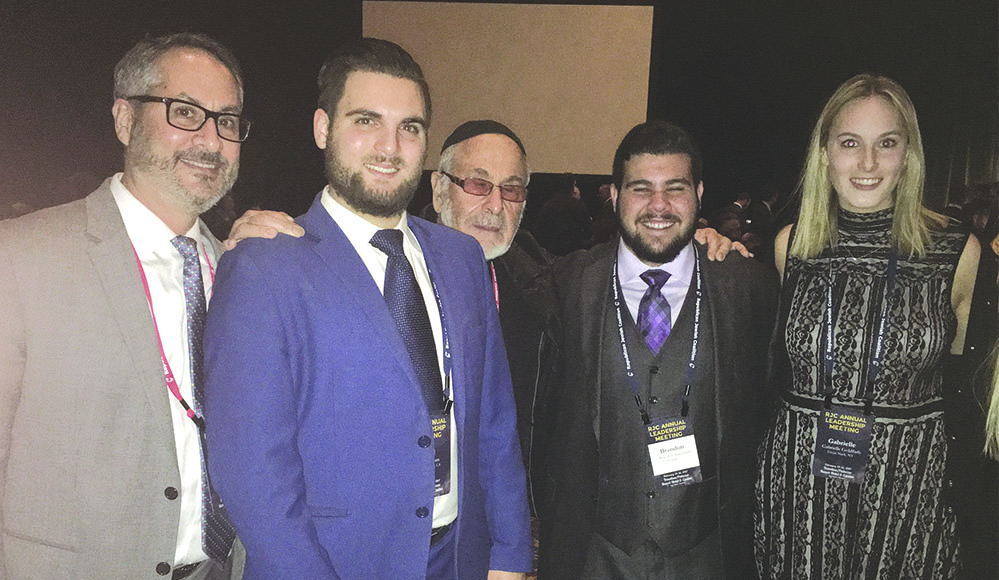
 From left: Josh Kaplan, Mati Geula Cohen, Allen Alevy, Brandon Kaufman and Gabrielle Goldfarb attend the Republican Jewish Coalition’s annual leadership meeting in Las Vegas. Photo by Ryan Torok.
From left: Josh Kaplan, Mati Geula Cohen, Allen Alevy, Brandon Kaufman and Gabrielle Goldfarb attend the Republican Jewish Coalition’s annual leadership meeting in Las Vegas. Photo by Ryan Torok.

Members of the Los Angeles Jewish community were among the more than 500 attendees at the Republican Jewish Coalition’s annual national leadership meeting at the Venetian Las Vegas Resort Hotel Casino on Feb. 24-26.

Cal State Northridge student Brandon Kaufman kvelled about the opportunity to hear from Vice President Mike Pence, who spoke on the first day of the conference.

“It was an incredible experience to hear him speak,” said Kaufman, whose attendance at the exclusive event, which drew coalition donors and their guests, was subsidized by Los Angeles philanthropist Allen Alevy.

“I’m almost 80 years old,” Alevy, who also was in attendance, said. “I’m old enough to have my eyes open. President [Franklin] Roosevelt [a Democrat] … could’ve saved 6 million Jews. He saved no one. … If you learn from history, if you care about the Jewish people, then you are a Republican Jewish Coalition member. … If you don’t care, then you can vote any way you want. Remember, the liberal Democrats have done nothing for us [Jews] ever.”

Kicking off the weekend event — called a gathering of “poker, politics and policy” — Pence discussed the U.S.-Israel relationship, the Trump administration’s support for Jews at a time of increased anti-Semitism, and President Donald Trump’s intention to scrap his predecessor’s health care plan, create jobs and enforce a strict immigration policy.

“We’re going to enact real immigration reform that gives families more choices and will end the broken system that puts the status quo ahead of our kids, and we’re going to uphold the Constitution of the United States of America and the values we hold dear,” Pence told the crowd, which included Angelenos Fred Leeds, Adam Milstein, Mati Geula Cohen, Adam King, Elan Carr and Josh Kaplan.

Additional speakers included Missouri Gov. Eric Greitens, who is Jewish, and Rep. David Kustoff, the freshman congressman from Tennessee, who is one of two Jewish Republicans in the House of Representatives. The other is Rep. Lee Zeldin of New York.

Gabrielle Goldfarb, a student at the University of Wisconsin, attended with her father, Laurence, of Great Neck, N.Y. The younger Goldfarb told the Journal she was grateful to have a moment away from a university she described as a “very liberal school” and to spend time with like-minded people.

“It’s great to come together and be with people with similar beliefs and values,” she said, “and be surrounded by successful people who want a strong United States and Israel relationship.”


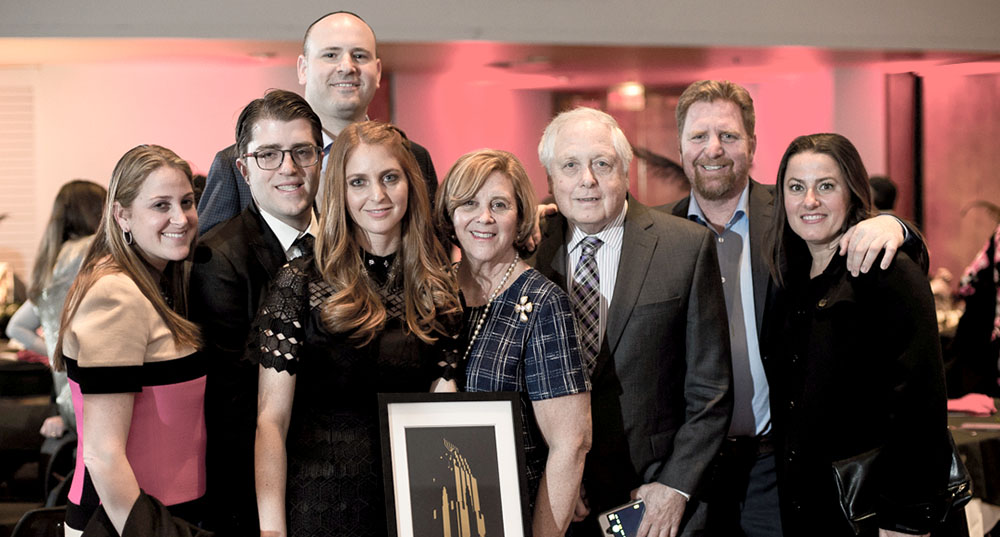
Attendees at the B’nai-David Judea 69th annual dinner include (from left) Danielle Kupferman, David Kasirer, Steven Kupferman, honoree Rachel Kasirer, and Tammy, Ben, Ethan and Coralia Lesin. Photo by Laura Casner Photography.

Recognizing successive generations of B’nai David-Judea Congregation members, the synagogue’s 69th annual dinner on Feb. 26 honored Gail Katz and Mayer Bick with the Migdal David Award, Steve Lowenstein with the Chasdei David Award, and Rachel Kasirer, Zev Nagel and Rabbi Ari Schwarzberg with the Tzemach David Award.

Katz, Bick and Lowenstein were honored “for their lasting contributions to the spiritual life of the B’nai David community,” and Kasirer, Nagel and Schwarzberg, members of the Modern Orthodox synagogue’s young professionals minyan, were recognized “for their commitment to communal growth,” said B’nai David-Judea executive director Adynna Swarz.

More than 300 people came to Stephen Wise Temple to celebrate the honorees, several of whom were involved with bringing to the congregation its first female clergy member, Rabbanit Alissa Thomas-Newborn. Attendees included the congregation’s spiritual leader, Rabbi Yosef Kanefsky, who “has built B’nai David-Judea into a leading center of modern Orthodoxy,” according to the congregation’s website; and congregation president Shana Fishman, vice president at large Duke Helfand, secretary Nick Merkin and treasurer Ranon Kent.

“The dinner was a major success and raised important funds for B’nai David,” Swarz said.

Moving and Shaking highlights events, honors and simchas. Got a tip? Email ryant@jewishjournal.com.

Moving and Shaking: U.S. Holocaust Museum dinner, de Toledo names new head, Republican Jews meet in Vegas Read More »

Scarlett Johansson files for divorce

Actress Scarlett Johansson has filed for divorce from her French husband Romain Dauriac.

Johansson filed for divorce Tuesday in Manhattan Supreme Court, Page Six first reported, noting that she has asked the judge for custody of her daughter Rose, age 3. Page Six reported that Johansson is “gearing up for a nasty custody battle.”

Johansson, 32, and Dauriac, a journalist, married in 2014, shortly after their daughter was born.

Dauriac’s attorney told Page Six that his client would like primary custody of Rose, and to live with her in France. He noted that Johansson “does a lot of traveling.”

The couple reportedly separated over the summer, at Johansson’s initiation.

In a statement to People, Johansson said she would not publicly discuss the divorce.

“As a devoted mother and private person and with complete awareness that my daughter will one day be old enough to read the news about herself, I would only like to say that I will never, ever be commenting on the dissolution of my marriage,” she said. “Out of respect for my desires as a parent and out of respect for all working moms, it is with kindness that I ask other parties involved and the media to do the same. Thank you.”

Scarlett Johansson files for divorce Read More »