fbpx

February 23, 2017

Bret Stephens takes on Donald Trump

I’ve been to almost all of the Daniel Pearl Memorial Lectures. They take place at UCLA and feature notable journalists who speak in honor of the late Wall Street Journal reporter Daniel Pearl. Islamic extremists kidnapped Pearl in Karachi, Pakistan, in 2002 and later murdered him.

All of these lectures have been good; two stand out.

On March 3, 2010, the late Christopher Hitchens spoke of the rising tide of anti-Semitism. What seemed a bit of a stretch at the time now reads like an exhortation from the future, delivered in the past.

Last week, Wall Street Journal columnist Bret Stephens gave the 2017 Daniel Pearl Lecture. By now, many of you have read the essay on the internet, or seen his delivery of it on YouTube.  For those of you who weren’t actually there, you need to know a few things.

As the audience members filtered into the 400-seat Korn Hall, a screen onstage displayed a montage of the life of Danny Pearl: Danny celebrating Passover on a train in China. Danny playing violin with friends. A 10-year-old Danny clowning around the family swimming pool in Encino.

When the speaker took the lectern, the screen behind him filled with a large picture of Danny, in a tie, looking bright, curious and open.

It’s a way of memorializing a remarkable journalist, who dedicated his foreshortened life to helping his readers better understand the world as it is. But it’s a reminder, too, that we live in a world of real danger and that many journalists risk their lives in pursuit of finding the truth.

Stephens took the podium the same week the 45th president of the United States called some of the leading journalists in this country, “the enemy of the people.”

It fell to Stephens, a conservative, to defend his profession, to fight against five dumb words with thousands of thoughtful ones.

Donald Trump, he said, “is trying to depose so-called mainstream media in favor of the media he likes — Breitbart News and the rest. … His objection to, say, The New York Times, isn’t that there’s a liberal bias in the paper that gets in the way of its objectivity, which I think would be a fair criticism. His objection is to objectivity itself. He’s perfectly happy for the media to be disgusting and corrupt — so long as it’s on his side.”

Then Stephens described what happens when people are confronted by a barrage of such untruths.

“The first is that we normalize it, simply by becoming inured to constant repetition of the same bad behavior,” he said.

We also are excited and entertained by it, Stephens said, or we judge it not by an objective standard, but by how it plays.

The fourth point, Stephens said, is the most painful. And it answers a question that has been plaguing me: Why are intelligent people, people I respect, afraid to criticize and oppose this man?

“Watching this process unfold has been particularly painful for me as a conservative columnist,” Stephens said. “I find myself in the awkward position of having recently become popular among some of my liberal peers — precisely because I haven’t changed my opinions about anything.

“By contrast, I’ve become suddenly unpopular among some of my former fans on the right — again, because I’ve stuck to my views. …  The most painful aspect of this has been to watch people I previously considered thoughtful and principled conservatives give themselves over to a species of illiberal politics from which I once thought they were immune.”

Stephens compared what is happening to many Republicans and conservatives to what happened under Communist regimes, which had a similar relation to truth.

“It has been stunning to watch a movement that once believed in the benefits of free trade and free enterprise merrily give itself over to a champion of protectionism whose economic instincts recall the corporatism of 1930s Italy or 1950s Argentina,” he said. “It is no less stunning to watch people who once mocked [Barack] Obama for being too soft on Russia suddenly discover the virtues of Trump’s ‘pragmatism’ on the subject.

“And it is nothing short of amazing to watch the party of onetime moral majoritarians, who spent a decade fulminating about Bill Clinton’s sexual habits, suddenly find complete comfort with the idea that character and temperament are irrelevant qualifications for high office.”

For these Trump supporters, Stephens said, “There’s the same desperate desire for political influence; the same belief that Trump represents a historical force to which they ought to belong; the same willingness to bend or discard principles they once considered sacred; the same fear of seeming out of touch with the mood of the public; the same tendency to look the other way at comments or actions that they cannot possibly justify; the same belief that you do more good by joining than by opposing; the same Manichean belief that, if Hillary Clinton had been elected, the United States would have all but ended as a country.

“This is supposed to be the road of pragmatism, of turning lemons into lemonade. I would counter that it’s the road of ignominy, of hitching a ride with a drunk driver.”

If you weren’t there, you would have missed the long ovation, a cathartic relief, that followed Stephens’ speech — applause for Stephens, applause in defiance of Trump, applause for Daniel Pearl, smiling on the big screen.


ROB ESHMAN is publisher and editor-in-chief of TRIBE Media Corp./Jewish Journal. Email him at robe@jewishjournal.com. You can follow him on Instagram and Twitter @foodaism and @RobEshman.

Bret Stephens takes on Donald Trump Read More »

Pope Francis accepts new Chumash intended to improve interfaith dialogue

Pope Francis on Thursday received a newly published version of the Five Books of Moses during an event hosted by the Vatican, part of a campaign to engage people around the world into interfaith dialogue.

“The extensive introduction to the text and the editor’s note emphasize this dialogical approach and communicate a cultural vision of openness, mutual respect and peace that accords with the spiritual message of the Torah,” Francis said during the ceremony, according to Vatican Radio.

Those behind what is known as “The Torah Project” are Italian-Spanish publisher ACC Arte Scritta and Dan Tartakovsky, a Mexican-Jewish businessman, who oversaw the creation of the annotated and illustrated edition of the Five Books of Moses. It contains commentary in four languages — English, Spanish, Italian and German — and each copy includes a hand-written blessing by the pope.

Francis said the Torah presents “the paternal and visceral love of God, a love shown in words and concrete gestures,” according to Vatican Radio. The book he received is the first copy of 126 editions that will be shipped to museums and universities around the world, according to a press release.

The cover of the Chumash, which features the city of Jerusalem, is made out of wood and pearls. The text is accompanied by 27 lithographs created by Baruj Salinas, a Cuban-born American artist. The piece will be added to the Vatican’s art collection, according to the press release.

Among the guests at the ceremony Thursday were an Argentine-based biophysicist Rabbi Abraham Skorka and Adolfo D. Roitman, a curator of the Shrine of the Book, which houses the Dead Sea Scroll collection at the Israel Museum in Jerusalem.

The Torah Project started at a book fair in Mexico in 2013 when Tartakovsky met Ricardo De La Fuente and Maria Cecilia Braschi, the founders of ACC Arte Scritta, who connected over their passion for artisan art and traditional craftsmen. Back then, the trio came up with an idea of creating a Torah project that would feature creative and inspirational artworks.

“Both art and religion provide emotional, spiritual and aesthetic resources which enable us to connect with the divine and generate thought-provoking realisations,” The Torah Project’s website states (torah-project.com). “It is hoped that this Jewish book will not only motivate people and strengthen their faith, but also enable them to reflect on interfaith dialogue, its problems and the ways to overcome them.”

Pope Francis accepts new Chumash intended to improve interfaith dialogue Read More »

Much hope despite many challenges

How do you overcome a life of disability and immobility with a smile and an internal light? You hold a belief in the goodness of people, a hope for the advancement of treatments, and a dream that a cure is within reach. You keep an open heart and an open mind because, otherwise, you can end up in a dark state of depression and stagnation.

I suffer from Late Onset Tay-Sachs (LOTS), a neuromuscular disease affecting the central nervous system. LOTS can be difficult to diagnose and is often mistaken for ALS, muscular dystrophy, multiple sclerosis or Parkinson’s disease.

I was diagnosed when I was about 21 years old. My parents are both carriers of the LOTS gene, and I inherited this newly recognized strain of what had always been thought of as a fatal, infant’s disease.

I am now 42 years old, yet my mobility and quality of life are comparable to that of a senior citizen.

How does it feel to live with Late Onset Tay-Sachs? In light of this being Jewish Disability Awareness and Inclusion Month, I’ll offer you a glimpse into my reality:

I use a walker but feel lucky that I am not limited to a wheelchair, as most people affected with LOTS are less mobile. Much of the time I am off-balance. I have fallen several times, resulting in broken toes, a broken ankle, scrapes and bruises. I have trouble getting up from chairs.

I need to use ACCESS, a special transportation system in California for the disabled, which has lifts or ramps on its vehicles to accommodate walkers or wheelchairs.

Having LOTS has made it extremely challenging to find employment. Every time I go into a job interview, I feel discriminated against and don’t feel qualified for the position because of my disability. I am well educated — I have a master’s degree in business — but LOTS affects my fine motor skills, making it difficult to do the typing necessary for most jobs. Bending down is also a problem. Imagine all the daily things at work requiring you to do something as menial as bending down to pick something up or getting something from a lower shelf.

The progression of my weakness has been harder to ignore in the past few years, but with exercise and will, I am trying to combat it. I attend physical and aquatic therapy four times a week, where I strive to maintain the strength I have left.

I have been in the hospital more than once for issues related to bipolar episodes, a symptom that affects about 40 percent of the people who suffer from LOTS.

I have suffered from a speech impediment since I was a young boy, which has made it difficult to give speeches or to be understood over the phone. Even the latest dictation machines that type for you don’t want to listen to me. I have taken speech therapy for years to no avail.

Housing is also a major issue. Any steps or curbs at a residence are problematic. If there is a second story, forget about it. I also must consider the proximity of restaurants, grocery stores, banks and pharmacies because of my need for transportation and assistance with chores. In addition, I need the bathroom to have a handrail on the wall that I can use to help me get off the toilet. 

While I am trying to live a “normal” life, being so abnormal in so many areas has been very disheartening. The simple things in life that people take for granted are a constant struggle. I wish I could get up and run over to a friend’s house when they have people over to watch a game without wondering how I will get there. Do they have steps at the house? I can’t have ACCESS take me everywhere, so do I call Uber and will it be handicap accessible? Where do I put my walker? I have difficulty bringing food or a gift for the host, so do I show up empty handed? Ugh! 

A big problem with my rare disease (about 1 in 63,000 people in the U.S. and 1 in 14,000 in Israel have LOTS) is that there is not a treatment or cure. But, there is always hope and a dream for one.

My family has started the nonprofit Late Onset Tay-Sachs Research and Education Foundation to raise funds and awareness that can help researchers find treatments and cures for this terrible disease. But the months of grueling work organizing fundraisers and paying money to update our foundation’s website (lateonsettay-sachs.org) have been a challenge.

Hope involves having the strength and passion to survive and live life to the fullest. Anyone who is sick or well should live by this mantra. Smiling is very important as well, as is being truly present in the moment, since no one knows their future.

Let your heart be open and generous. And strive to be better, more tolerant, more compassionate, more aware, more appreciative, more philanthropic — more alive!

ERIC PASTOR has been battling Late Onset Tay-Sachs for more than 20 years and vows to never give up.

Much hope despite many challenges Read More »

Israel and America: Despair or Opportunity

As children growing up in Jerusalem and Los Angeles, we were taught that Israel would be a “Light unto the Nations.” We were proud of the progressive values inscribed in Israel’s Proclamation of Independence, declaring that Israel would “foster the development of the country for the benefit of all its inhabitants … ensure complete equality of social and political rights to all its inhabitants irrespective of religion, race or sex (and) …guarantee freedom of religion, conscience, language, education and culture.”

Back then, Israel still felt like a miracle. Today, the vision of Israel’s founders seems like a disappearing dream. There is a growing sense of desperation among many American Jews and Israelis as they watch Israel’s governing coalition, still held in the grasp of far-right Jewish nationalists, thwart individuals and organizations working for an open, pluralistic, equitable and peaceful society. In the United States, the election of Donald Trump and his first presidential orders presage at least four years of similar policies and a reversal of the advances made by forward-minded citizens.

All this is taking place in the context of a rapidly changing political environment across the West. Populist movements are gaining greater political power, Euro-skeptics are promoting the disintegration of the European Union, with Brexit the first reflection of this rising tide, and the new American President threatens to break away from global treaties and agreements. Regional orders are disassembling, even as the proposed new order is not yet known.

For the first time since the establishment of Israel, ultra-nationalist and jingoistic leaders in Israel and the U.S., inspired by the same values and sources, have built institutions and created cross-national movements to bring their ideologically-driven plans to fruition. For the first time, moderate and progressive Jews in Israel and the U.S. are subjected to attacks by the reactionary, racist, and agitating policies of their respective governments.

To live and experience these complementary realities in both Israel and America is painful. It is tempting to despair. Yet, these threatening days have also created the potential for new positive realities. If our antagonists are so closely aligned, isn’t it time to establish a coalition that will act together, coordinate and inspire one another to advance shared values and policies?

We believe that time has come. It is time for us, as equal partners, to assess the political landscapes in which we live and identify issues that we can study, strategize, and act upon together.

There are worrisome developments in both countries that we must address: growing economic gaps, political and corporate corruption, the blurred lines between church and state, threats to a freely functioning media, and many more. Only despair stops us from examining and acting upon all of these.

Perhaps most urgently, it is time for us to look together at the great internal existential threat Israel faces – its continued rule as occupying power in the West Bank and control of some three million Palestinians – and consider its effect on both of our communities: the threat this poses to the possibility of Israel being a democratic homeland for the Jewish people; the alienation, isolation, and identity conflict increasingly felt by American Jews, especially our youth.

Since 1948, there have been two exemplary experiences of Jews living in open societies: in the State of Israel and in the United States. Progressives, pragmatists and moderates in Israel and the U.S. now have a common interest in resisting the rise of radical nationalistic populism, so that we can maintain our ability to realize, in both countries, our core and treasured values.

We both have a stake in opposing Trump’s regressive policies and proposals. We both have a stake in fighting the internal erosion of democratic institutions and norms in Israel. We both have an interest learning from each other and engaging together in our common cause. If we do so, it will be the silver lining on the dark clouds hovering above us.

Let us remember, even in these dark days, despair is not the answer. Despair dulls our dreams and takes away our hope. We must help each other resist despair and embrace what the philosopher Jonathan Lear calls radical hope. “What makes this hope radical,” Lear writes, “is that it is directed toward a future goodness that transcends the current ability to understand what it is.”

Avraham Burg, a former Speaker of the Knesset and Chairman of the Jewish Agency, is a writer living in the community of Nataf outside Jerusalem. Jonathan Jacoby, the founding director of New Israel Fund and former President of Israel Policy Forum, is a consultant living in Los Angeles. Their fathers, Yosef Burg and Emil Jacoby, worked together in Paris after WWII to aid Holocaust survivors.


Israel and America: Despair or Opportunity Read More »

Bomb threat forces evacuation of New Orleans JCC

A bomb threat forced the evacuation of the New Orleans Jewish Community Center on Thursday morning.

A phone call threatening a bomb attack was made to the JCC at 9:15 a.m., Katie Steiner of WWL-TV in New Orleans reported in a Twitter post. People were allowed back into the building about two hours after they were evacuated.

JCC staffers told another WWL reporter, Lyons Yellin, who was working out at the facility, that the bomb threat was a recording.

New Orleans Mayor MItch Landrieu tweeted after the incident: “Be clear, anti-semitism will not be tolerated in NOLA.”

This week, the national headquarters of the Anti-Defamation League in New York, a San Diego-area JCC and a North Carolina Jewish day school were subjected to phoned-in bomb threats.

On Monday, 11 JCCs across the country received bomb threats from callers, the fourth such wave of threats in five weeks.

Bomb threat forces evacuation of New Orleans JCC Read More »

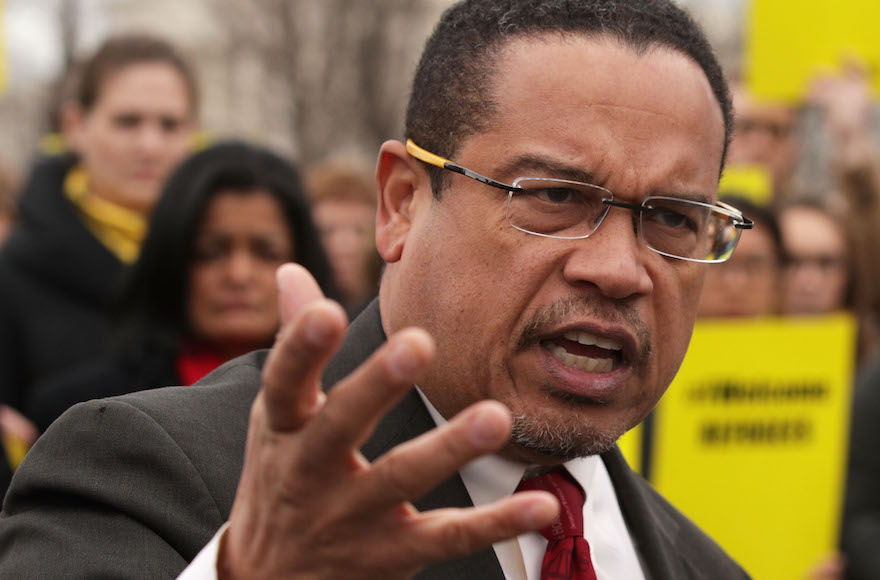
Keith Ellison, in run-up to DNC chair election, calls for party to fight anti-Semitism

Rep. Keith Ellison called for Democrats to speak out against anti-Semitism and reject hatred of refugees during a debate for candidates to head the Democratic Party.

The Minnesota Democrat also made clear during the CNN debate Wednesday evening that he supports Israel and has strong backing from the Jewish community. He is vying with seven others to chair the Democratic National Committee; Ellison is considered among the front-runners with Pete Buttigieg, the mayor of South Bend, Indiana, and former Labor Secretary Tom Perez.

Ellison noted his “long, strong history of interfaith dialogue, interfaith communication.” He called suggestions that he is anti-Semitic – based on his involvement with Louis Farrakhan and the Nation of Islam while he was in college – “smears.”

“I just want to say, it is critical that we speak up against this anti-Semitism because right now, you have Jewish cemeteries being defaced and desecrated,” he said. “Right now, you have Jewish institutions getting bomb threats. We have to stand with the Jewish community right here, right now, four square, and that’s what the Democratic Party is all about.”

Ellison, the first Muslim elected to Congress, added that he spoke at a HIAS event last week to support the right of refugees to enter the United States.

“They’re saying, we were once refugees, and they stood out in New York and demanded that we have respect for refugees now,” he said of the Jewish organization that assists refugees.

Ellison was asked about aid to Israel, noting that at a private 2010 fundraiser, he said that American foreign policy is seen through the eyes of the 7 million citizens of Israel. He responded that he believes the U.S.-Israel relationship is “special and important,” and noted that he has “voted for $27 billion in bilateral aid to Israel over the course of about six or seven votes. I have been to the region many times and sat down with members of the Knesset and worked with them.”

Some 447 electors made up mostly of  state party officials and officials in state government, among others, will vote for DNC chair on Saturday in Atlanta.

Israel and the Middle East likely will not figure highly in their considerations. The electors are concerned much more with rebuilding a party devastated by its across-the-board losses in November’s elections, including for president.

Keith Ellison, in run-up to DNC chair election, calls for party to fight anti-Semitism Read More »

Have we been stupid about anti-Semitism in America?


A.

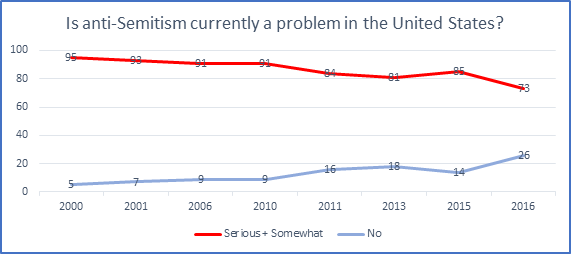
Let me show you something quite incredible, and please forgive me for opening an article with a graph. I know this might not be the most appealing start. Still, bear with me and take a look. In many of the Annual Surveys of American Jewish Opinion that have been published in the last decade and a half, a simple question was asked, in almost exactly the same way: Is anti-Semitism currently a problem in the United States?

Well, is it?

In most surveys, the Jews had three options to choose from: yes, a very serious problem; yes, somewhat of a problem; and no, not a problem at all. Generally, a majority of them answered that anti-Semitism exists, that it is still a constant in the US. Sampling these polls and making a graph out of them, one can easily see that the “somewhat” category is the one most Jews choose. The problem of anti-Semitism is not severe enough to deserve to be called “serious,” and it is not negligible enough to be treated as “not a problem at all.”

Here it is:

And here is what happens when we divide the Jews into just two groups: those who think there is a problem – large or small – and those who believe there is no problem (namely, those answering the question by saying “no, not a problem at all”):

Do you see where this is going? In the last decade and a half, the trend among Jews was to be growingly convinced that anti-Semitism in America is gone, a solved problem, non-existent. In 2016, a quarter of all Jewish Americans responded to the survey by saying there is no such problem. That is more than 20 percent above the numbers of the early 2000s.

So now we must assume one of two things: either the Jews were gradually fooled into believing that anti-Semitism is fast diminishing when it was not. Muted maybe, but not gone. Or we must assume that it truly was declining until some sinister force brought it back.

B.

Were we fooled into thinking that anti-Semitism is a relic of the past that does not belong in modern-day America? Look at another interesting survey for clues – the famous Portrait of Jewish Americans by the PEW research center. An interesting thing happens when you search for anti-Semitism in this survey: you come up with nothing. Not one mention of anti-Semitism in America, not one question about anti-Semitism in America. That is two say: when the good people of PEW strived to paint the portrait of Jewish Americans just four years ago, they assumed that no mention of anti-Semitic fears was necessary. In fact, the only time anti-Semitism is mentioned in the PEW report is when Jewish Americans are asked whether anti-Semitism is a major threat for Israel.

There have also been studies that did tackle anti-Semitic incidents in recent years, especially in college campuses. In most of these studies, the assumptions and findings all pointed in one direction – Israel as the ignitor of anti-Semitic incidents. “Connection to Israel is the strongest predictor of perceiving a hostile environment toward Israel and Jews on campus and, to a lesser extent, of personal experiences of antisemitic verbal harassment,” concluded a study published by the Cohen Center at Brandeis University.

Jews could feel safe in America, except that Israel makes it difficult.

C.

We do not yet know why there is a sudden uptick in anti-Semitic incidents. Arguing that it has something to do with Israel does not seem like the right choice. There is no such indication. But this raises the question: Have we (Jews) been wrong to assume – as a group – that anti-Semitism is in decline? Have we – as a group – showed a misguided tendency to ignore the reality around us?

Three options come up as an answer.

1. We were right all along. Anti-Semitism is not a “serious” problem in America. The current wave of incidents is just noise made by a very small group of bigots and idiots, and it will soon pass. I spoke this morning to former Israeli minister Moshe Arens, one of the most prominent American-born Israelis, and he bluntly told me: “when we see a surge in Aliya – immigration of Jews to Israel – then we will know it is serious.” Since no one currently envisions a wave of Jewish immigration from America to Israel, no one should assume that the problem is very serious.

2. We were right all along, but then something happened. Anti-Semitism was in decline, and Jews were right to claim, in growing numbers, that it is no longer a problem, and surely not a “serious” problem. Now the tide has suddenly shifted. Maybe because of Donald Trump – as many Jews seem to believe (with questionable evidence to prove it). Maybe because of other reasons (blaming Israel is again becoming fashionable – see this article in the Forward, which brings back to life one of the oldest themes in the history of anti-Zionism).

3. We were plain wrong. We were fools. Anti-Semitism is still a force to contend with in America. Of course, American society is not anti-Semitic. It is pro-Jewish. But there are more than marginal elements in society which keep harboring the age-old hatred of Jews, who keep nurturing this hatred, and who keep waiting for an opportunity to bring anti-Semitic tendencies back into the mainstream. In this narrative, Jews in the last decades have been blind to social undercurrents that oughtn’t be ignored. Maybe that’s why many of them look at Trump as a suspect – because their blindness to the possibility of his surprising ascendency is reminiscent of the blindness to the possibility of anti-Semitism’s surprising ascendency.

D.

There needs to be more calm in the discussion about anti-Semitism. That is, because the current wave feeds on hysteria and benefits from it. Waves such as this one – like waves of terrorism, and waves of suicide – tend to have a self-igniting quality. The more we talk about a wave of people committing suicide, the more people are likely to kill themselves. The more we talk about a wave of threats to Jewish centers, the more people are likely to pick up the phone and make such threats – it’s really the easiest thing to do.

Of course, this does not mean that Jews in America, and elsewhere, must ignore the threat or completely dismiss it. But It does mean that, for now, they would be wiser to reduce the level of hyperbole and deal with it more calmly. And it also means that making anti-Semitism a focal point of a political battle against President Trump is unwise.

Have we been stupid about anti-Semitism in America? Read More »

Reconstructionist summer camp will feature the arts

The Reconstructionist movement is planning for a sunny future with the launch of a summer camp in the Los Angeles area.

An overnight camp focused on the arts is set to open in the summer of 2018, thanks in part to a $1.4 million grant from the Foundation for Jewish Camp (FJC).

Camp JRF — which originally stood for Jewish Reconstructionist Federation — will be the Reconstructionist movement’s second. Its first, in northeast Pennsylvania, was founded 15 years ago.

“It’s an amazing camp,” Deborah Waxman, president of Reconstructionist Rabbinical College, said during an interview at Kehillat Israel, a Reconstructionist synagogue in Pacific Palisades. “There’s no way you can’t feel optimistic about the Jewish future when you go to this camp.”

A major reason for a second camp is the Reconstructionist movement’s strong presence on the West Coast.

“By opening in Southern California, the new camp will be within a few hours’ drive of three of the largest congregations affiliated with the Reconstructionist movement,” its website says.

Movement leaders are scouting for a location “within a two-hour radius of Los Angeles,” Waxman said.

Waxman is based in Pennsylvania. When she became the leader of the movement in 2013, she also became the first woman rabbi “to head a Jewish congregational union and lead a Jewish seminary,” according to the website of Reconstructionist Rabbinical College, which also said she “was key in the successful integration of the rabbinical college and the congregational union.” She was named to the Forward 50 list of America’s most influential Jews in 2015.

The camp is planned as a “film- and arts-based specialty camp” for children in the third to 10th grades, according to the movement’s website, jewishrecon.org.

“We really want to take advantage of folks who have a background in the entertainment industry, many of them here [at Kehillat Israel] or at our affiliated congregation in Malibu [Malibu Jewish Center and Synagogue],” Waxman said. “So we want both to draw from the greater L.A. area and to ask folks to drive out and teach for a day or a couple of days, and for it to be a reasonable commuting distance.”

According to the American Camp Association, specialty camps are a growing trend.

FJC awarded the grant as part of its specialty camps incubator, one of six camps under development and financed, in part, from a grant of more than $12 million from the Jim Joseph Foundation and the Avi Chai Foundation.

The grant was provided with the expectation that the camp will be self-sufficient by its third year, Waxman said, adding that FJC preferred renting a location, rather than purchasing one, to avoid “a burden of capital.”

Meanwhile, FJC is interested in pursuing specialty camps because they have “proved to be a huge success for Jewish camp,” Jeremy Fingerman, CEO of FJC, said in a statement, adding that research shows “the specialty model attracts new campers — 66 percent said they only went to Jewish camp because they were attracted to one of the specialties.”

The camp will offer one-week or two-week sessions to campers who have an expertise in the performing arts and those who want to “deepen it, and also some beginners … who want to learn about acting or learn about filmmaking from the beginning,” Waxman said. There also may be a day-camp component to it, she said.

The Reconstructionist movement, the smallest of the four major Jewish denominations, was founded on the teachings of Rabbi Mordecai Kaplan, who was ordained at the Jewish Theological Seminary of the Conservative movement. The Reconstructionist movement takes a progressive stance on interfaith marriages — its seminary generated buzz in 2015 when it announced it would ordain rabbis married to non-Jews — embraces the LGBT community and is vocal on political issues. The Reconstructionist website features statements expressing concern about the election of President Donald Trump, for example.

The Jewish Reconstructionist Federation (JRF) is the former name of the congregational arm of the movement before a 2012 merger between the Reconstructionist Rabbinical College, the movement’s seminary in Wyncote, Pa., and the JRF. n

Reconstructionist summer camp will feature the arts Read More »

Glorious Living

We are a product of our environment, we cannot change.  

th

Our circumstances have been set in motion from the beginning.

We are failures.

We are stuck.

We are worthless.

These sentences are belief systems. They are only real by the conviction that our own minds have set for them. But they are figments of our imaginative minds that lack true imagination, yet ache for invention.

To change our made up voice that thinks these negatives, we must only look inside our own truths that exist underneath, that are drowning, that are aching to be seen.

Try hearing the self that speaks to you quietly, under the loud voice that screams these false beliefs and see how quickly your life becomes alive.

True courage comes from hearing the whisper of your own voice emerge through the sea of the negative rattle.

Today become alive.

See what happens.

It is glorious.


Glorious Living Read More »