fbpx

February 14, 2017

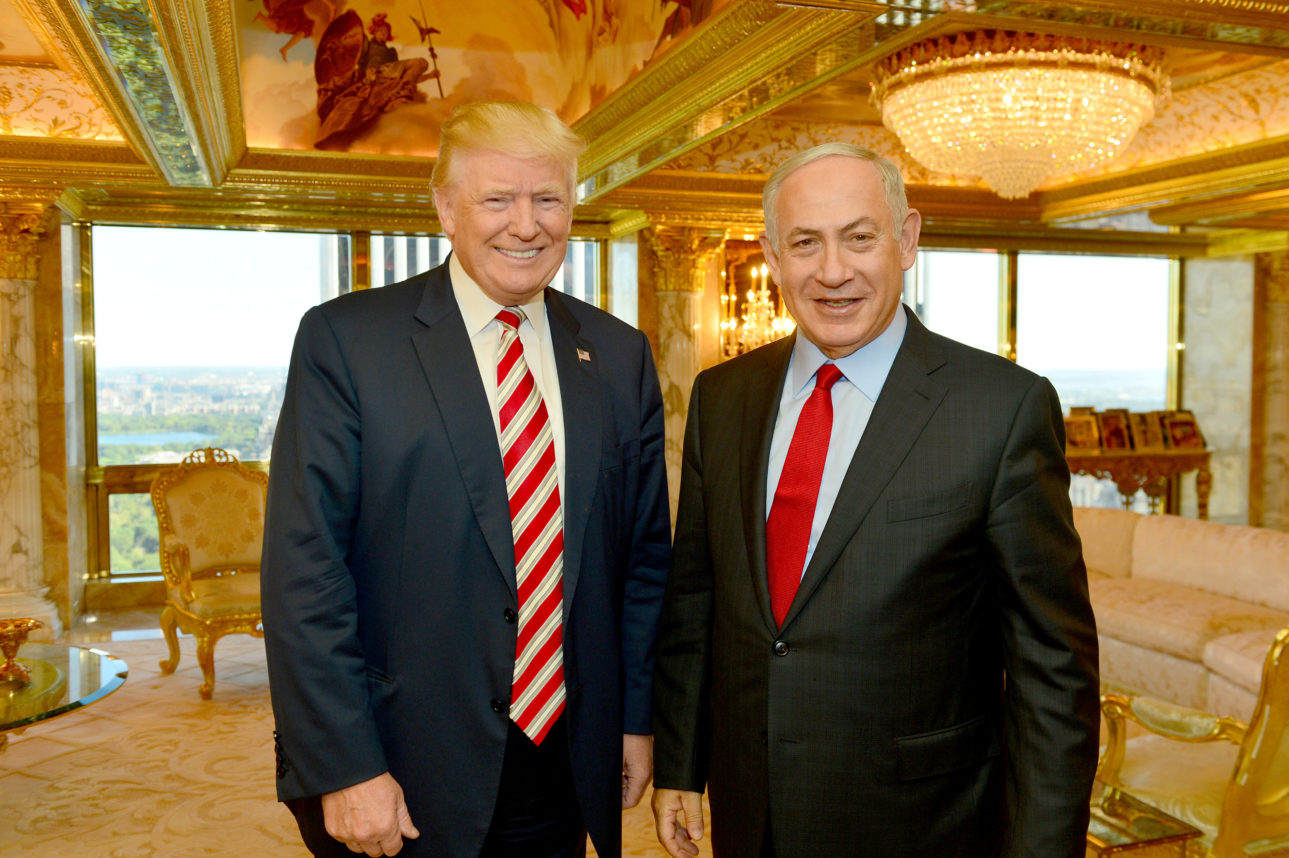
Q-and-A on Trump & Netanyahu

  • What is the main purpose of the meeting between the new president and the veteran Prime Minister?

To demonstrate that a new chapter is about to be written in US-Israeli relations – a chapter different from the one written by the Barack Obama administration. President Trump might not feel obliged to deliver on all of his promises towards Israel (see his recent remarks on moving the US embassy to Jerusalem), but he does want to signal to Israel and to the world that the days of friction are over. At least for now.

  • What does Trump want from Netanyahu?

Time and understanding. No surprises, no taking for granted Trump’s support for every move, no taking advantage of the early days of an administration that doesn’t yet know what it is doing. He also wants to know what’s really important for Israel (and why) and what issues can be negotiated.

  • What does Netanyahu want from Trump?

The list is long, but it begins with something that both leaders want: a signal that the US and Israel are once again on the same page, and a signal that the US intends to go back to a no-daylight policy towards Israel. That is, to coordinate as many moves as possible and prevent a situation in which differences are aired in public. On principle, Trump is going to agree to this. But his character might be an obstacle to implementing it.

  • What about the substantive issues – what’s the top priority for Israel?

Geostrategic matters, starting with Iran. Israel would like to ensure that Iran does not get an opportunity to strengthen its hand further because of America’s lack of interest, commitment, or understanding of the situation. A delicate matter that needs to be discussed between the two leaders is Russia’s involvement in Syria and what it means for the US and Israel’s wish to see Iran contained. Netanyahu would like to present to Trump the opportunity that exists in bolstering the cooperation between Israel and the Sunni Arab states (Saudi Arabia, Egypt, Jordan) and the importance of this unofficial makeshift coalition for the containment, or even rolling back, of Iran.

  • What about the nuclear agreement?

Netanyahu is under no illusion that the agreement will be promptly abandoned by the US. So his hope is to see two possible developments: 1. A more robust policy by the US concerning issues that were not covered by the agreement (Iran’s support for terrorism, Iran’s missile program), 2. An intention to see the agreement extended beyond the 15 year period it currently covers, after which Iran is pretty much free to become a military nuclear power.

  • You haven’t mentioned the peace process with the Palestinians…

The peace process – or the relations with the Palestinians – is not high on Netanyahu’s agenda. But it will surely be discussed. Netanyahu is going to argue that a better approach to this issue is looking at it from a regional perspective – namely, as one of the things that a more robust alliance involving Israel and the Arab states, and supported by the US, can deal with. The Palestinians need Arab support, without which they are not likely to make any significant move towards peace. Israel needs to see a benefit in negotiation beyond being nice to the Palestinians. If the Palestinian issue is one item of a broader Middle East peace agenda, that might work.

  • And settlements?

On settlements, and President and the Prime Minister can easily agree. If one carefully reads Trump’s language on this issue, one realizes that this President is ready to go back to an arrangement similar to the one agreed on in the Bush-Sharon letter. That is: Israel can build and develop the main settlement blocs, but can’t build new settlements. Such an understanding would benefit Netanyahu in two ways: 1. It will give him something tangible with which to demonstrate to Israelis that he achieved something. 2. It will give him a way of demonstrating that his more adult-like approach to dealing with the settlement issue bears more fruit than the confrontational approach advised by his critics on the right, especially by Jewish Home party leader Naftali Bennet. For the president, this could be an easy way to demonstrate that 1. Trump is no Obama (whose administration did not accept that Bush-Sharon understanding as valid) and 2. That he takes a middle-of-the-road, pro-peace, and pro-Israel stance on this issue.

  • Do you expect this to be a positive meeting?

Sure. You might remember that the first Obama-Netanyahu meeting was quite contentious. So for Trump to have a positive first meeting with the Prime Minister is the easiest path to showing that things have indeed changed in US-Israel relations. For Netanyahu, it is essential to have a positive first meeting, as one thing is clear: getting on Trump’s wrong side is not a recommended policy.

  • Do you expect any surprises?

This is Donald Trump. Surprises are no longer surprising.

Q-and-A on Trump & Netanyahu Read More »

Senate confirms Mnuchin for Treasury, Shulkin for VA

The U.S. Senate confirmed Steven Mnuchin as Treasury secretary and David Shulkin as secretary of Veterans Affairs.

Mnuchin was confirmed Monday evening 53-47 along party lines, with Joe Manchin of West Virginia the only Democrat to vote in his favor. He was sworn in the same evening by Vice President Mike Pence, with President Donald Trump present, in the Oval Office.

Democrats opposed Mnuchin, who was treasurer for Trump’s campaign, alleging that the bank he led, OneWest, used foreclosures during the financial crisis of the late 2000s to prey on vulnerable homeowners.

Trump said at the swearing in ceremony that Mnuchin, who also was a Hollywood producer, would be a champion of the middle class.

“To all citizens I say, Steven will be your champion, and a great champion,” Trump said. “He will fight for middle-class tax reductions, financial reforms, and open up lending and create millions of new jobs, and fiercely defend the American tax dollar and our financial security.”

Mnuchin said a priority would be to combat terrorist financing. “I am committed to using the full powers of this office to create more jobs, to combat terrorist activities and financing, and to make America great again,” he said.

The Treasury has under successive administrations been a key venue for targeting terrorist finances through exposure and finances. The scrutiny has intensified since the implementation of the Iran nuclear deal a year ago, in part to assuage Israeli fears that sanctions relief under the deal would facilitate Iranian backing for terrorist groups.

Also on Monday evening, the Senate confirmed Shulkin unanimously. Shulkin, a physician, was deputy VA secretary under President Barack Obama and is the only holdover from that administration.

Both Mnuchin and Shulkin are Jewish.

Senate confirms Mnuchin for Treasury, Shulkin for VA Read More »

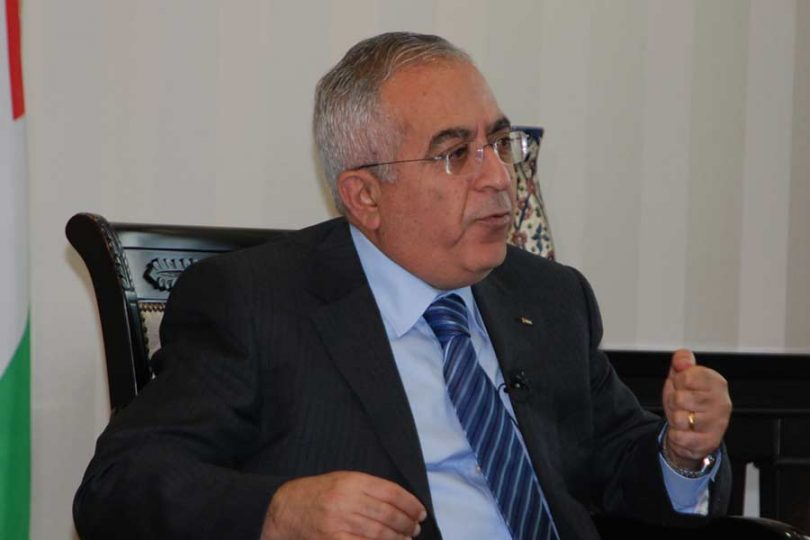
American Blocking of Fayyad UN bid seen by many as unfounded and counterproductive

Growing consensus sees move against Fayyad as wrong move and misread

United Nations Secretary-General Antonio Guterres vowed to continue to recruit qualified candidates for the United Nations’ executive and managerial ranks regardless of their nationality after the Trump administration’s surprise move to block the nomination of former Palestinian prime minister, Salam Fayyad, as the next UN mediator for Libya.

“The proposal for Salam Fayyad to serve as the Secretary-General’s Special Representative in Libya was solely based on Mr. Fayyad’s recognized personal qualities and his competence for that position,” said Guterres in a statement released to The Media Line on Saturday from Istanbul at the start of his five nation Middle East tour that will also take him to the United Arab Emirates, Oman, Qatar and Egypt.

Guterres defended his choice for a successor to German diplomat Martin Kobler in the Libya mediator role citing Fayyad’s extensive knowledge and decades of experience with challenging political, security and development issues.

“United Nations staff serve strictly in their personal capacity, “said Guterres. “They do not represent any government or country.”

UN officials say they were caught off guard by Friday’s statement by the US ambassador, Nikki R. Haley, expressing disappointment that the new United Nations secretary general, Guterres, planned on appointing Mr. Fayyad to the Libya post.

Fayyad, 64, is viewed in diplomatic circles as technocrat.

“He worked in Washington at the International Monetary Fund from 1987 to 1995 and he served as the IMF representative to the Palestinian Authority,” said Guterres’ spokesman, Stephane Dujarric. “Based on the information available to him at the time, the Secretary-General had the perception, now proven wrong, that the proposal would be acceptable to Security Council members,” Dujarric told The Media Line. But Haley’s announcement Friday made it clear that the US would block Fayyad’s appointment based on his nationality as a Palestinian.

“For too long the U.N. has been unfairly biased in favor of the Palestinian Authority to the detriment of our allies in Israel,” said Haley. “The United States does not currently recognize a Palestinian state or support the signal this appointment would send within the United Nations.”

Haley’s announcement prompted denunciations from former US ambassadors to Israel who are familiar with Fayyad and his politics.

“Fayyad was the best Palestinian partner for Israel and [the Libya] job has nothing to do with Israel,” tweeted Martin Indyk, Executive Vice President at the Brookings Institute and a former U.S. Special Envoy for Israeli-Palestinian Negotiations.

Daniel Shapiro, who left the US Ambassador’s post in Tel Aviv on January 20th, concurred.

“If you know Fayyad — decent, smart, honest, ethical, hardworking — it’s much more outrageous.” said Shapiro.

“My guess is [Israel’s UN Ambassador] Danny Danon went directly to Haley to get her to kill the appointment,” said another former American diplomat on background to The Media Line. “The sad thing is Fayyad probably needs a job since the PA has made it impossible for him to engage in Palestine.”

While there has been no official reaction to the American move to block Fayyad’s appointment, Arab intellectuals and pundits voiced their outrage.

“Of all the reasons that might be put across to object to Salam Fayyad as the UN’s envoy to Libya, the fact he is Palestinian is probably the worst,” said Dr. H.A. Hellyer, a senior non-resident fellow at the Atlantic Council and the Royal United Services Institute in London.

“This is blatantly anti-Palestinian bigotry – and is meant to send a signal to the international community that a Trump administration will minimize and block the participation of Palestinians in international institutions wherever possible,” Hellyer told The Media Line.

In Amman, veteran Palestinian analyst Daoud Kuttab said Halley’s move inadvertently boosted Fayyad’s popularity among Palestinians who never really warmed to the technocrat as nationalist leader.

“Palestinians are saying that the US opposition to Fayyad proves that he was never America’s man in Palestine,” said Kuttab who also noted the irony embedded in Ambassador Halley’s thwarting a Ramallah official widely despised by the Hamas leadership in Gaza.

“Americans [are] blocking someone Hamas hates. Are the White House and Hamas on the same side here?”

While Kuttab lauded Secretary-General Guterres for standing up to the Trump administration, diplomats say Fayyad’s nomination is dead in the water largely because the Arab states want to keep the White House on-side in their campaign against the Iranians.

“The Gulf States like Trump because he is escalating against Iran,” said Mohammed Soliman, an Egyptian political analyst. “They won’t push for any sort of support for Fayyad.”

With President Al-Sissi squarely focused on seeking President Trump’s selection of Egypt as America’s foremost Arab partner, it is also unlikely that Cairo will make much noise over the unravelling of Fayyad’s candidacy.

As of Sunday morning only the French and Swedish ambassadors to the United Nations had issued statements in support of the Guterres decision to appoint Fayyad.

“The position needs [Security Council] approval,” said a European diplomat in Cairo familiar with both Fayyad and UN institutions. “I don’t think the US will back down. It would be nice, but very surprising.”

American Blocking of Fayyad UN bid seen by many as unfounded and counterproductive Read More »

Two Jewish brothers standing with our Muslim brothers

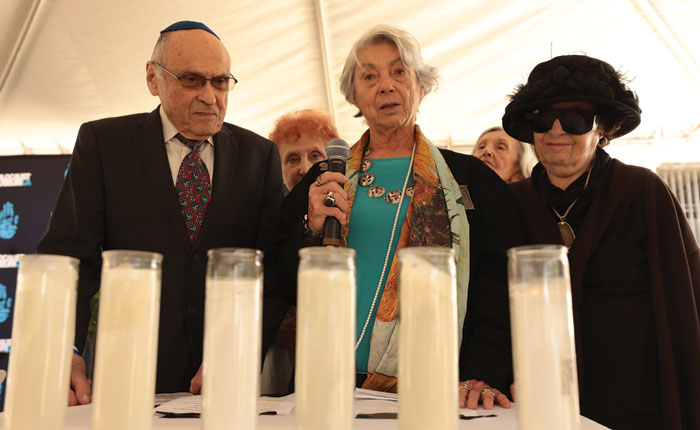
I stood beside my partner Dave outside my family’s house and rang the doorbell to the tune of “Dreidel, Dreidel, Dreidel.” It was the first night of Hanukkah but unlike previous family celebrations, the current political climate had indisputably altered our family dynamic. My mother is a holocaust survivor; my dad fought in the Israeli Army. This past June my brother and his now fiance, Kristine, survived a terrorist attack at the Istanbul Atatürk Airport. Our Jewish identities have been challenged, threatened, and compromised time and time again. As we lit the Menorah, we stood in silence unable to even make eye contact. The flicker of the candles illuminated my family in a way that made them look like strangers. This Hanukkah, it felt like we had enough oil to keep the flames of fear burning for years to come.

During World War II, my grandparents were captured and taken to the Bergen-Belsen concentration camp. While there, my grandmother gave birth and shortly thereafter, a camp guard ripped the child out of her arms and threw it into a fire. That act snatched away the small embers of hope that still remained in my grandparents.

After years of struggling against Nazis, starvation, and typhus epidemics, my grandmother became pregnant once again. She bore the pregnancy while bearing witness to the deaths of tens of thousands around her. For the child, they remained in the camp even after it’s liberation. In September of 1945, my grandmother finally gave birth on soil drenched with death: that brave baby girl would become my mother. When my mother’s parents emigrated to the United States in the late 40s, they did so in search of a better life. They arrived as refugees to the warm embrace of Lady Liberty who helped breathe new life into a future they didn’t feel worthy of.

My father was born in communist-ruled Romania but emigrated to Israel with his family soon after. As a child, he worked on a kibbutz before enlisting in the Israeli Defense Forces at the age of 18. While in the army, he was taught of the evil and terror that awaited him in neighboring countries. He fought in the Six-Day War, a battle that pitted Israel against all of its neighbors and saw things that, even now, has only hinted at. He saved every penny that he ever made and as soon as he finished his service, he traveled to all the lands that he had only read about in books. After growing up in two different countries that had built fences around the possibilities of his future, he broke out and became a citizen of the world. He slept in airports, on park benches, and in bus stations, navigating through each country by talking to locals and following their lead. He’d fly multiple trips on the Concord, go to multiple Olympic ceremonies, and he even climbed Mount Kilimanjaro. Any country my dad was taught to hate, he would visit. He visited the pyramids in Egypt, played chess in Aleppo, and taught English to school kids in Indonesia. Over his lifetime, he’d go on to fill up more than a dozen passports. In January, my dad boarded a plane and made his way to another historic event: the inauguration of President Donald J. Trump.

I have spent the majority of my life marinating in the fear of terrorism. My nightmares began at the age of 10 after Columbine and continued with 9/11, until any place I had ever held sacred was eventually connected to an attack, from movie theatres to concert venues. On a Tuesday morning in September, I watched a cloud of smoke trail over New York City: the North Tower was burning. At 12, I didn’t process what I was watching. It wasn’t until I sat in a stunned world history classroom, watching the towers fall, that I understood. The innocence of our childhood crumbled along with the towers that day. I sat in half empty classes because parents were afraid to send their kids to school. I walked home that day with my best friend since the 5th grade, Nadia. She is Muslim. As a kid, I would tell her about this dreaded day called Yom Kippur in which I had to fast for the entire day. She would immediately counter with this dreaded month called Ramadan in which she had to fast for an entire month. We talked to each other about everything, but that afternoon we walked home in silence. It was hard for me to understand how and when things would get better.

Later that year, we walked to meet her mom at the Starbucks in our neighborhood. Her mom was always at that Starbucks. Before we left, Nadia’s mom gave each of the baristas a Christmas gift with an accompanying card; she left another stack of gifts for the employees that weren’t working that shift. There was Santa Claus, Hanukkah Harry, and then there was Nadia’s mom. For her gift giving wasn’t part of an act or a tradition, it was love in it’s purest form. I saw firsthand what it meant to invest in your community. Nadia and her mom didn’t teach me what it meant to be Muslim: they taught me what it meant to be human, to care, to grieve, to love and to hope.

On June 28th, 2016, my brother Adam and his girlfriend Kristine were at the Atatürk Airport in Turkey when terrorists launched an attack that would go on to kill 45 people and injure hundreds more. My personal world and the world at large felt like they were crumbling, and I began to retreat within myself, terrified of the unknown. I obsessively sifted through Reddit threads that showed security cam footage of the gunmen storming the terminal and loops of the bombs going off. Initially, I was consumed by my fear of the men that had executed the attack, but then slowly my focus drifted to the quiet moments before the chaos. The man leisurely pulling his bag behind him, the girl pushing her friend through the terminal on a luggage cart, the family embracing their son as he turns to catch his flight. Each moment was interrupted by the sound of gunfire and the wave of fire that swept through the terminal. What were the last words that they said to one another? Did they know that they were loved? What dreams were they robbed of? I wrote a piece entitled “Three Little Dots” about the storm of dread and anxiety that had infiltrated my body as my brother texted me during the attack.

Then I got the letters. Their origins were diverse: Germany, Pakistan, Egypt, and even Turkey. But their message was the same: hope. For the first time in my life, it felt like I was seeing the world through my father’s eyes. I finally had a face and a story to put to the countries I had only read about on breaking news chyrons. As the messages continued to come, Adam called to inform us that he and Kristine would be continuing their trip through Europe. I sent my brother screencaps of the messages that I’d receive and hoped he had a chance to breathe it all in. “The world is with you!” I said.

Our families begged them to cut their trip short, but my dad was the lone voice that implored them to continue on. I asked him why. “If they come home now, they may never leave again,” he said. He was right. In the heat of our panic, we had succumbed to our own fears and instincts to retreat from danger.

Our family felt the ripples of the terrorist attack long after Adam and Kristine arrived home. Each of us used the proximity of the event to reaffirm our own skewed perspectives of the world. Many family members now had a direct confirmation of their worst fears–that the headlines would feature names they’d recognize and love. That fear had seeped into the foundation of our family. For the world, and for my family, the question now is, “Where do we go from here?”

When my dad returned home from the inauguration, we greeted each other in silence. That void peaked on the evening of Shabbat when the news broke of the executive order that banned refugees and immigrants from seven predominantly Muslim countries. This executive order hit close to home as both my mother and father immigrated to America fleeing the hardships and tragedy and now immigrants were being denied that same opportunity. As my dad and I sat in silence, he spoke then I spoke. Not in extremities but of vulnerabilities, we spoke of our fears and for the first time in more than a year we spoke to each other, not over each other.

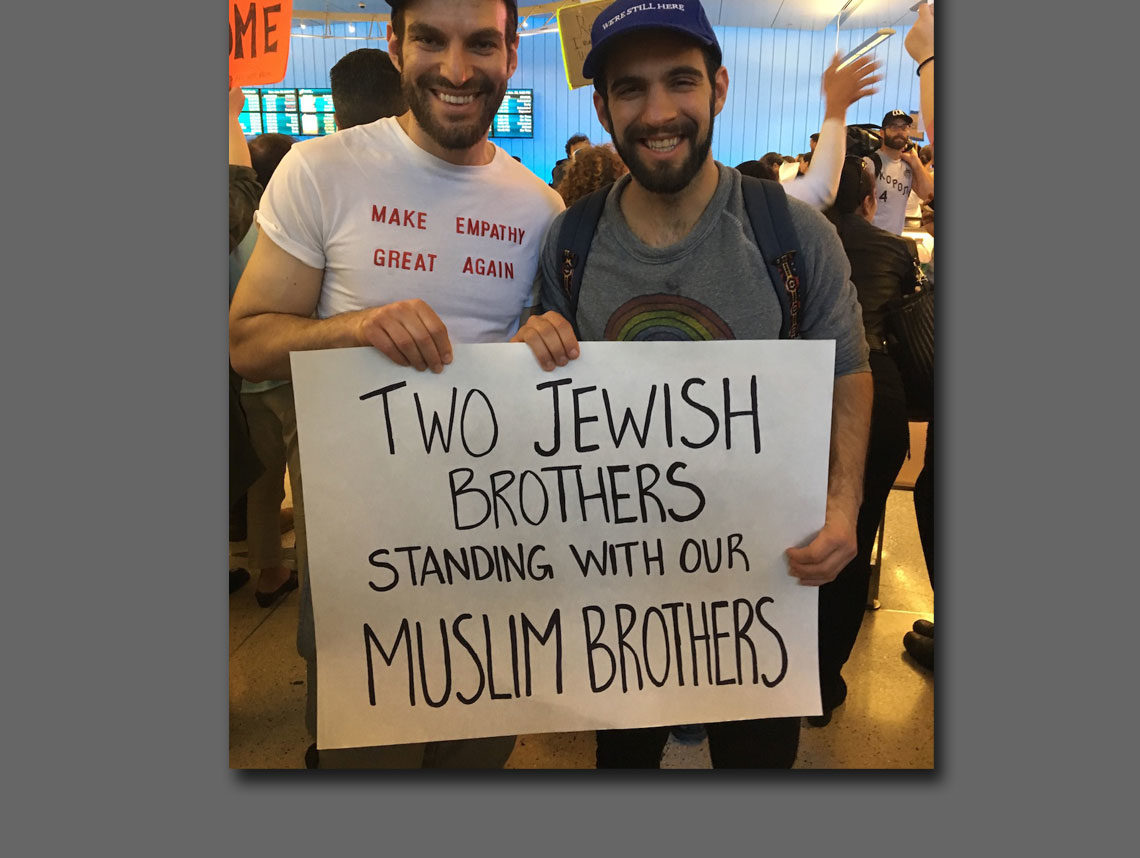
The following Sunday morning in January, my brother and I drove with my dad on the 405 and we talked politics. My dad has made this journey many times before so we followed behind him as he led the way to the Tom Bradley Terminal at LAX. When we arrived, there were already thousands of protesters outside of the baggage claim area. Seven months after the terrorist attack at the Istanbul Atatürk Airport terminal, I found myself standing beside my brother hours after an executive order was issued by the president of the United States targeting refugees and immigrants from predominantly Muslim nations. We saw families consoling each other waiting to hear from loved ones that had been detained. Our family’s story was born out of persecution, loss, and heartache so the pain on display at the airport was familiar. As my dad looked on, my brother and I stood holding a sign together. “Two Jewish Brothers Standing with Our Muslim Brothers.” We stood in that terminal bearing witness to the pain that our country could inflict at the stroke of a pen. As we stood there, a Palestinian couple in their early 30s came up to my brother and I. They had tears in their eyes and without saying a word, opened their arms wide to give us a hug. We held onto one another in silence, and I could hear their faint whimpers. The mom gestured down to her daughter who couldn’t have been older than 4. “Look at their sign.” The little girl looked up at the sign and sounded out the words. “They’re here with you!” Her dad said. The girl smiled at me. I saw my mom’s reflection in her eyes.


Noah Reich is a freelance writer by day, a reader by night and a humanitarian at heart.

Two Jewish brothers standing with our Muslim brothers Read More »