fbpx

February 14, 2017

Dear Bibi: Please put American Jews on your agenda

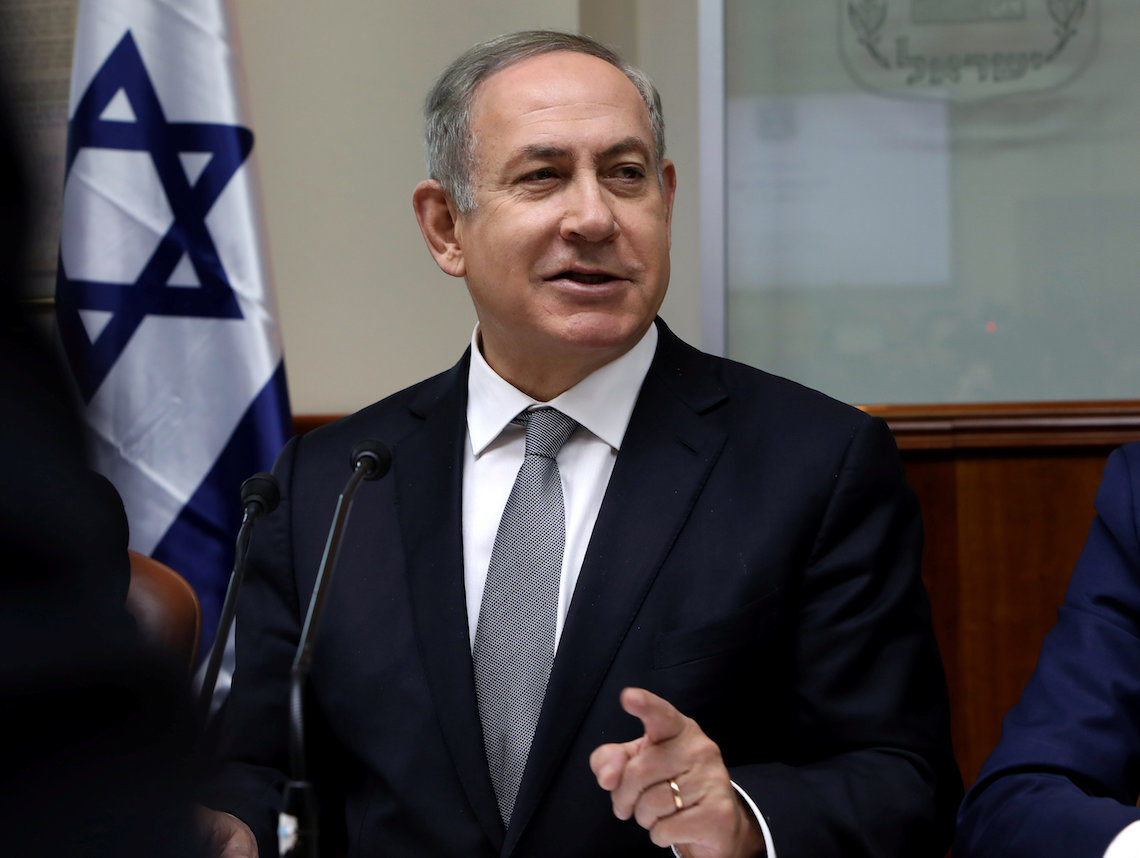
Most eyes will be on how President Trump threads the needle during Israeli Prime Minister Bibi Netanyahu’s visit on Wednesday.  How can Trump advance the Holy Grail of a peace agreement—requiring pressure on Israel to pause West Bank settlement expansion—while distancing himself from Obama policies and showing himself a “true” friend of Israel?

My eyes, however, will be on Netanyahu.

Netanyahu leads the only Jewish nation in the last 2000 years, created to be a refuge for Jews after the Holocaust. As such, Netanyahu has a responsibility to confront anti-semitism worldwide.  And that includes an increasingly vocal anti-Semitism in the U.S.

Netanyahu’s situation is tricky. The U.S. has been Israel’s biggest supporter, providing vetoes in the United Nations, high levels of military and security cooperation, and the largest foreign aid package in the world–$3-4 billion per year, (agreed to for a decade by the supposedly anti-Israel Obama administration).  And Netanyahu will not want to risk undermining the overwhelming support for Israel that Trump has demonstrated so far.

But the moral imperative for Netanyahu is clear.  Trump, his family, and his advisors have at best ignored increasingly virulent anti-Semitism and racism during the campaign and after the election. At worst, they have encouraged it.

The most egregious and blatant instance of Trumpland anti-Semitism was Trump’s last campaign ad: The narration consisted of a conspiracy-theory rant about international elites plotting against the common people that repeated age-old anti-Semitic tropes. After showing a picture of Hillary Clinton (she partners “with these people who don’t have your good in mind”), pictures of three prominent Jews associated with high-finance accompanied the rant: liberal George Soros, the Fed’s Janet Yellen, and Goldman Sach’s Lloyd Blankfein. Released in the very last days before the election, there was little time for the horror of this to sink in among the public.  (The nature and timing of the ad would seem to be a joint product of two of Trump’s top campaign strategists and grudge-holders: Roger Ailes, Nixon’s ad-man and then Fox News chief who was humiliated and fired due to multiple sexual harassment allegations, and loser in a high-stakes Goldman Sachs executive power-struggle that led to his resignation, Steve Bannon.)

More broadly, Trump consistently refused to acknowledge, even much less stand up to, the widespread anti-semitism and racism that cranked up during and after the campaign.  His central strategist, Steve Bannon, claimed the mantle of leadership of the alt-right as the editor of the Breitbart website–and many of the alt-right agreed.  Large swaths of Breitbart readers and alt-right folks are white supremacists, including KKK and Nazi supporters.  Neither Trump nor Bannon have made serious efforts to separate themselves from these deplorables; in fact, this may be Trump’s core base.

During the campaign, anti-semites began using a symbol on social media (triple parentheses) to identify and target journalists of Jewish descent. A tidal wave of anti-semitic social media messages, phone calls, and threats poured in: The ADL counted over 19,000 anti-semitic tweets alone to over 900 journalists, with 83% of them targeting just 10 writers. Many of the tweets came from over-lapping groups of Trump, white nationalist, and alt-right supporters. Melania Trump, when asked about the way that hordes of anti-semites had been harassing a reporter after she had posted a complaint about the reporter’s story, said that the reporter had “provoked” it. Donald himself said of that particular problem, “I don’t have a message to the fans…There is nothing more dishonest than the media.”

How tweets and images from white supremacists and Nazis got funneled into Trump’s twitter feed is anyone’s guess.  His famous Clinton attack-tweet that recycled an anti-semitic image complete with Jewish star and dollar bills is hard to forget.  And Trump’s guiding “America First” slogan itself has historically anti-Semitic overtones. During the campaign, ADL’s Greenblat wrote Trump asking him to drop the theme but was ignored.

Campaign ads, slogans, and social media attacks began to have real-world consequences after Trump’s surprise win.  Racists felt emboldened and hate crimes (the majority of which have been against Jews in recent years) soared across the country.  Swastikas appeared on school lockers. Strangers screamed threats to Latino women on the street. And in the Ronald Reagan building in Washington D.C., white supremacists responded to an anti-semitic speech by alt-right leader Richard Spencer with cheers and Nazi salutes.

When asked about the rise in hate incidents since the election in a 60 Minutes interview, Trump pretended to be surprised.  When it was explained, he did not seem particularly upset and had to be urged more than once to use the televised interview as an opportunity to address the haters: Finally, he could only manage two words: “Stop it,” he said mildly to the perpetrators of hate crimes. (Compare that to the passionate “Lock Her Up” chants Trump led for months, or the two-minutes of jeering he encouraged rally-goers to spew at working journalists.

Trump came to realize that he cannot challenge the racism and anti-semitism in his base. When he tried to “pivot” in the general election and flirted with Latino political leaders, hinting he would soften his stance on deportation to attract more Latino votes. But when Sarah Palin and others criticized that pivot, Trump backed down.  He learned that, once incited, racists cannot be easily pacified.

Trump’s defenders have almost always focused on personal anti-Semitism: The ace-in-the-hole is that his daughter Ivanka converted and married the observant Jewish Jared Kushner. Kushner went so far as to leverage his family’s Holocaust past to personally defend Trump as a lover of Jews in a column he wrote in his own New York Observer.  (Strangely, though, Trump and defenders do not often mention that his son Eric married a Jewish woman; it may be that acknowledging too many Jews in the family would be bad politics.)

One of the strange things about Trump’s success is his ability to align otherwise antagonistic bedfellows. The real question is not whether Trump is personally anti-Semitic, but how Kushner and other Jews can sit in the same room as Trump’s Breitbart and other facilitators of hate and anti-Semitism?  Why did Jewish family members allow Trump to use America First as his governing theme? Why didn’t they insist he do the right thing and apologize for anti-Semitic and Nazi sourced social media posts, or apologize for omitting Jews from the Holocaust statement? The answer provides keen insight into Netanyahu’s dilemma.

Start with the fact that Kushner and Ivanka went to visit the grave of the last Lubavitcher Rebbe the night before the election, apparently to pray to the last great Rabbi for help in next day’s election.  The highest goal of the Rebbe, and of most Hasidic and Orthodox Jews, is to hasten the coming of the (Jewish) Messiah, one element of which entails moving to the Promised Land.

Not surprisingly, then, more politically conservative and more religiously observant Jews tend to be single-issue voters, focusing on which candidate is the strongest (and uncritical) supporter of Israeli policies. Whether it is in Israel or the U.S., they are relatively comfortable with walls, separation, insular communities. In contrast, more liberal and less-observant Jews typically care about full and permanent integration into American life, and are generally more critical of right-wing Israeli policies towards Palestinians.  They view pluralism and tolerance as critical features of a democratic state, whether here or in Israel.

A large majority of Orthodox and Hasidic Jews did vote for Trump, and a similar majority of less observant and more secular Jews voted for Clinton. Although there are supporters of each side at each end of the religious spectrum, it seems that the religious center, like the American middle class, is eroding.  This is where Netanyahu needs to step in.

Just as Israel has relied on American Jews for support, we need to rely on a strong Israel for support in the face of anti-Semitism.  Israel should not simply be a refuge for persecuted Jews, but a leader promoting tolerance and acceptance of Jews—and all others—around the world.  When anti-Semitism climbed in France, Netanyahu famously told French Jews to move to Israel. That is not the answer for us.

Will Netanyahu demand that Trump speak out forcefully for tolerance and respect for Jews wherever they live? Will he demand Trump not only welcome Jews into his family, but welcome the founding Judeo-Christian value of respect and love of the neighbor and stranger back into our politics? Or will Netanyahu come to stroke Trump’s ego, see what more he can he can extract (war with Iran, perhaps?), and throw the Blue Jews to Trump’s wolves?

Mark Feinberg, Ph.D is a UCLA Visiting Scholar and a Research Professor at Pennsylvania State University

Dear Bibi: Please put American Jews on your agenda Read More »

Israelis detain leader of liberal American group

Israeli immigration authorities detained and questioned a leader of the American-based non-profit New Israel Fund on her arrival to Israel.

The agency that manages Israel’s border crossings later apologized for any “anguish” caused by the questioning at Ben Gurion Airport.

The Population and Immigration Authority that its interim director general, Amnon Shmueli, had spoken to the New Israel Fund’s president after the group’s vice president, Jennifer Gorovitz, was detained for questioning upon arrival in Israel on Wednesday, Haaretz reported.

“Shmueli made it clear that the questioning of Gorovitz was routine and that there was no intent to insult her. The director general apologized if she was caused any anguish,” the authority said.

Gorovitz reportedly was held for 90 minutes, prompting an opposition lawmaker to declare that she was being subjected to “political persecution.” NIF is an American-based nonprofit organization that funds various social justice, civil rights and left-wing groups in Israel. Right-wing groups have accused NIF of aiding Israel’s harshest critics. NIF has accused the groups of misrepresenting its work and lying about its grantees.

The questioning of Gorovitz prompted Knesset member Tamar Zandberg of the left-wing Meretz party to complain to Interior Minister Aryeh Deri.

“This is political persecution, harassment and an attempt to silence those who fight for Israeli society,” Zandberg wrote in a letter to Deri.

Gorovitz’s detention came on the same day that Prime Minister Benjamin Netanyahu sought to reprimand Belgian Ambassador to Israel Olivier Bellefor for meeting with the leaders of Breaking the Silence and B’Tselem, two Israeli NGOs that Netanyahu and his government consider anti-Israel.

“Israel views with utmost gravity Belgian Prime Minister Charles Michel’s meeting today with the leaders of Breaking the Silence and B’Tselem, during his visit to Israel,” said the Prime Minister’s Office in a statement.“The government of Belgium needs to decide if it wants to change direction or continue with its anti-Israel path.”

Breaking the Silence is an NIF grantee. B’Tselem has also received funding from NIF.

In an op-ed posted at the Haaretz web site, Gurvitz detailed her detention, which left her shocked and rattled.

“Freedom of expression now comes at a cost and criticism has become tantamount to treason,” she wrote. “How did we get here? Attacks on Israeli civil society are on the rise, supported and sometimes led by the government. Violence and hate have been incited against NIF and our grantees. Legislation has been passed to marginalize those working to protect human rights. Democracies should not use political litmus tests at their airports; they shouldn’t use border control to harass, intimidate, and humiliate visitors. Misusing the security apparatus for political purposes robs everyone of the real security we need.”

Israelis detain leader of liberal American group Read More »

Suspect convicted in 1979 murder of 6-year-old Etan Patz

After two trials and thousands of milk cartons featuring the picture of Etan Patz, a suspect in the 1979 kidnapping and murder of the 6-year-old boy has been convicted.

A New York State Supreme Court jury in Manhattan found Pedro Hernandez, 56, of New Jersey, guilty on Tuesday after deliberating for nine days.

Hernandez’s attorney, Harvey Fishbein, said he would appeal, saying there are “numerous grounds.” Hernandez was tried on murder charges last year, but a Manhattan jury could not reach a verdict after 18 days.

Etan was one of the first missing children to be featured on the side of milk cartons. He disappeared in May 1979 while walking to his school bus stop two blocks from his home in the downtown SoHo section of New York for the first time by himself. Hernandez, then 18, worked nearby at a grocery store.

Hernandez was arrested based on a tip from a brother-in-law. He confessed in 2012 to having strangled Etan in the basement of the grocery store after luring him there with a soda, then putting the boy’s body in a box, which he left in an alley.

Hernandez’s defense attorneys said at the trial that Hernandez is mentally ill and the confessions were coerced.

Jose Ramos, a convicted pedophile, was declared responsible for Etan’s death in a 2004 civil case.

At the first trial of Hernandez, the defense argued that the evidence pointed to Ramos, not Hernandez. In 2004, Justice Barbara Kapnick declared Ramos liable by default after he declined to answer questions about the murder. He was questioned while serving time for raping young boys in Pennsylvania.

Hernandez is scheduled to be sentenced on Feb. 28.

Suspect convicted in 1979 murder of 6-year-old Etan Patz Read More »

A response to the Orthodox Union’s statement on women clergy

Several people have asked me my thoughts on the Orthodox Union’s recent statement regarding women clergy. As you know, the advancement of women’s leadership and scholarship provides one of the fundamental tenets that make Shalhevet High School what it is.  The topic also is important to me on a personal level. I am proud to daven frequently at B’nai David-Judea, a synagogue that employs a female clergy member. My wife has spent this year in Jerusalem studying to become a Yoetzet Halacha. I routinely use my soapbox to call for progress on a host of issues triggering difficult halachic discussions – including women’s issues, LGBT issues, and more – and have received a good deal of flak for those stances.

And yet, I find the resentment towards the Orthodox Union, and these Rabbis in particular, in reaction to this statement, somewhat exaggerated and unfair. Please do not misunderstand me – I have issues with the statement. But I look at the response to this statement (mostly on social media and in private emails) and I see a lot of knee-jerk reactions instead of carefully considered critique. I see individuals demonizing the rabbis who penned the statement, decrying their chauvinism, and declaring their standing on the wrong side of history. Many people I have spoken to do not seem to have read the piece carefully, if at all.

You don’t agree with the decision? Great. Disagree! That is the Jewish way, the Talmudic way, which has charted our course for millennia. I understand that this statement is painful for many people. But let’s not jump to assume the worst about those with whom we disagree. Let’s avoid assuming that its authors acted in bad faith. Rather, collect your thoughts, respond point-by-point, identify what you consider to be any logical missteps, and advance the dialogue on this important issue. All too often these days, people don’t just disagree– they demean, malign, reject and delegitimize. The rabbinic authors of this statement are talmidei chachamim who are filled with ahavat Yisrael, and think day and night about the physical, emotional, and spiritual well-being of the Jewish people.

As I have written in the past on numerous occasions, we need not agree on every issue. I respect and admire Rabbi Kanefsky tremendously. I consider him a role model and a true tzaddik. Rabbi Kanefsky disagrees with the Orthodox Union decision, which is his right. Just as Rabbi Kanefsky retains the prerogative to diverge from the OU’s line of reasoning, so too does the OU have the prerogative to make public that decision and rationale.

I understand the opinion that people often will use halacha to confirm a certain predisposition to an issue. But that is an oversimplification of the halachik process. Halachik decisors draw not only on precedent and clear-cut textual sources but on what they take to be the spirit that animates the halachik system in its totality, a spirit that they have drawn from a comprehensive study of halacha and its sources. Similarly, those who earnestly seek to expand the role of women generally do so in an attempt to advance what they consider to be the goals of the halachik system. We can disagree without arguing that the other side is acting in bad faith.

Given that this debate implicates the overall values of the halachik system, there is enough “give” in centuries of Biblical commentary, Talmudic discourse and Halachik Responsa to justify opposite conclusions on the issue of women clergy. And what’s true of the debate over women clergy is true of a wide variety of other halachik issues that draw upon the relative weight we place on the wide range of halachik values within our tradition. But the existence of multiple values in no way diminishes the integrity of halachik analysis.

Both the supporters and detractors of the OU’s statement approach this issue with important and valid halachik values essential for any honest and thorough conversation over the role of women within the clergy. Let us focus on what both sides in this debate share in common.  A deep commitment to halacha and a recognition that in the year 2017 there is a need for an expanded role for women in synagogue leadership .  The OU document, while saying no to women rabbis, carves out a much greater amount of space for women to serve and lead.  This is significant given the community from which the document emanates.  Yes, many would love to see more; yes, many feel that women rabbis are acceptable in halacha.  Let’s argue, but by all means let’s also recognize how much common ground the two sides of this debate share. The value of honoring Mesorah (tradition) and making religious leadership available to women can both be seen as Torah objectives; the relative weight we give to those values can each support honorable Torah worldviews. And precisely because each worldview comprises Torah values, each position will find halachik support. Should we bemoan this reality? I don’t think so. It speaks to the complexity and depth of the Jewish tradition. We are a tradition of debate, not of unanimity.

There is one reality, however, that we should bemoan: our inability to debate with dignity and respect. We have lost our ability to have genuine empathy for any side that disagrees with our worlviews. If the Jewish community joins our current society at large in choosing this direction, then I struggle to see how we will heal the wounds that have formed in this toxic atmosphere we have created.

When the rest of the world is going so low, should not the Jewish community go high? Does our mission not contain the mandate to shine a light unto the world? If we do nothing but emulate the coarse ways of a polarized world, then who are we?

Modern Orthodoxy can lead the way in shining a Jewish light unto the world. Our rabbinic leadership must begin to define its movement in positive, as opposed to negative terms. Our decisors must describe for us what we as Modern Orthodox Jews can and should be, a vision to which we can aspire, as opposed to offering a steady diet of restrictive pronouncements. Far too many Orthodox Jews feel that the rabbis only show up periodically to offer a “slap on the wrist” when societal norms have gone too far afield. This does not inspire a greater reverence of, and commitment to, halacha. Rabbi Soloveichik, with his writing of the Lonely Man of Faith and other works, inspired a generation. Rav Aharon Lichtenstein and Rav Amital’s writings inspired yet another generation. While they said no at times, and yes at others, everyone was inspired by them, saw their humanity and sensitivity and understood that they were torn and pained at times when they had to say no.

Developing empathy for both sides should be the starting point for dignified debate. Without that, we rush into another one of those communal food fights that throws out lots of heat and generates little light. We are better than that. We should be better than that. Our ancestors did not struggle for millennia to see their descendants turn into dogmatic warriors who constantly turn on each other.

So, this is a call for dignified debate, for radical moderation. This is a call for empathy before judgement. This is a call for reasoned rebuttal. Finally, this is a call for us to shine a Jewish light unto the world, no matter how deep our disagreements.

Are we up to the challenge?


Rabbi Ari Segal is Head of School at Jean and Jerry Friedman Shalhevet High School.

A response to the Orthodox Union’s statement on women clergy Read More »

McGill student leader doubles down on ‘punch a Zionist today’ message

A McGill University student leader who advised on Twitter to “punch a Zionist today” is refusing to resign or retract the comment amid rising Jewish anger on campus against him.

Council member Igor Sadikov did not relent at what was described as a “tense” meeting of the student union legislative council on Thursday.

According to witnesses who attended, Sadikov appeared to double down on his stance, arguing that Jews were not a “a legitimate ethnic group,” according to B’nai Brith Canada.

“I have never felt so targeted, disgusted or disappointed in my life,” Jewish McGill student Molly Harris later wrote in a post on Facebook.

Sadikov, who also is active in the Boycott, Divestment and Sanctions movement against Israel, has denied he is anti-Semitic, noting that his father is Jewish and his mother is half-Jewish. He said his original tweet, which he later deleted, was meant to criticize a “political philosophy,” not Jews.

McGill has condemned Sadikov, joining the Jewish groups  B’nai Brith, the Centre for Israel and Jewish Affairs and the Simon Wiesenthal Center.

The university’s undergraduate arts society formally called on Sadikov to resign and B’nai Brith asked police to investigate whether Sadikov had incited hatred with his tweet.

But the mass condemnation seemed to do little to appease pro-Israel students at McGill, who say they feel increasingly isolated and vulnerable on campus.

At the Thursday meeting, according to reports, council members voted by a wide margin against censuring Sadikov, while a leader of McGill’s BDS group asked why an individual “pro-Zionist” member of the council was not being impeached.

Critics at the meeting charged that council members stayed silent as Sadikov took his stand and also in reaction to the pro-BDS speaker.

McGill’s student union also has the power to impeach Sadikov, but has not moved to do so.

The campus newspaper, The McGill Daily, which Sadikov once served as editor, recently enacted a policy to ban “pro-Zionist” opinion from its pages.

McGill student leader doubles down on ‘punch a Zionist today’ message Read More »

Cartoon in UCLA student paper denounced as anti-Semitic

A political cartoon published in Monday’s edition of UCLA’s daily student newspaper, the Daily Bruin, that comments on settlement expansion in the West Bank has been condemned as anti-Semitic by organizations on and off campus — and has even been denounced by a pro-Palestine student group.

Drawn by UCLA student Felipe Bris Abejón, the cartoon shows Israel’s Prime Minister Benjamin Netanyahu standing in front of the 10 Commandments. At the top of the frame, a caption states, “Israel passes law seizing any Palestinian land.” Below that, “#6 Thou shalt not steal” appears with the word “not” crossed-out with a red “x.”

Below that, the tablets are inscribed: “#7 Thou shalt not kill.” Netanyahu is depicted with a thought bubble saying “#7 is next.”

The cartoon — for which the Daily Bruin has since issued an apology — is commenting on a Feb. 6 legislation known as the “Regulation Bill” that could retroactively legalize roughly 4,000 homes built by Israeli settlers on private Palestinian land in the West Bank. The controversial bill is likely to be challenged in Israel’s High Court.

Danny Siegel, a fourth year student at UCLA who is student body president, said he was outraged by the cartoon.

“As a Jewish student and individual who is actively involved with a variety of Jewish organizations on campus, I was disgusted to see this anti-Semitism in my school’s newspaper,” Siegel said.

“While I’ll be the first to criticize the Regulation Bill, to criticize Israeli policy — policy that was created by a democratically elected government — by using Jewish biblical law as the basis for your criticism when you are not an expert in Judaism, it’s very problematic,” he added. “And then to use the faith to allude to Jews committing genocide as the next step — it’s not political, it’s anti-Semitic.”

Rabbi Aaron Lerner, executive director of UCLA’s chapter of Hillel, explained that the cartoon is part of a string of problematic incidents at UCLA.

“The cartoon Netanyahu’s jump to ‘killing’ smacks of the kind of ‘Israelis are hungry for blood’ statements which have come from BDS [Boycott, Divestment and Sanctions] speakers here at UCLA for the past five years, including Omar Barghouti, who said that Israeli soldiers kill Palestinian babies ‘for sport.’ ”

Abejón, the artist behind the cartoon, has not responded to inquiries from the Journal. He is a former education and resources director for Students for Justice in Palestine (SJP) but, according to Sarah Schmitt, board member and programming director for the organization, “This year [Abejón] was denied admission to the SJP Board because he had expressed views that were incongruent with those of SJP.”

The organization distanced itself from the cartoon in a statement that denies the artist’s affiliation with the group and reads, in part, “Although SJP has repeatedly condemned the policy of the Israeli government with regards to its oppression of Palestinians, it is not and has never been our intention to demonize the Jewish community … Students for Justice in Palestine condemns the publication of this cartoon, as we condemn all efforts to perpetuate stereotypes about any racial, ethnic or religious group.”

FULL STATEMENT http://dailybruin.com/2017/02/13/submission-sjp-condemns-db-editorial-cartoon/

The Daily Bruin’s editorial staff released an official statement on the matter on Monday. It stated, “As a newspaper, we take responsibility for our mistakes and apologize for them, so that’s what we’re doing here. Running this cartoon was an error that we deeply regret. It is wrong to use religion or religious tenets to criticize political policy. And it’s wrong to perpetuate harmful stereotypes — intentional or otherwise. We strive to understand the community that we cover. So as part of our ongoing education, we are reaching out to local religious leaders to help our staff understand the historical context behind these kinds of hurtful images.”

FULL STATEMENT: http://dailybruin.com/2017/02/13/editors-note-to-our-readers/

Lerner verified that the Daily Bruin specifically reached out to Hillel to conduct a workshop for its staff on anti-Semitism.

In the meantime, the cartoon made an impressions far beyond the campus borders.

California State Assembly member, Richard Bloom (D-Santa Monica) released a statement Monday evening criticizing the editors of the Daily Bruin for allowing the cartoon to run in a public university student paper.

“Criticizing a governmental action, in this particular case, Israeli settlement policies, is responsible journalism.  However, calling into question Jewish religious tenets is reckless, immature, and blatantly discriminatory,” he stated.

Bloom suggested the cartoon blatantly disregarded for University of California policy that states, “anti-Semitism, anti-Semitic forms of anti-Zionism and other forms of discrimination have no place at the University of California.”

The Anti-Defamation League offered similar sentiments in its response: “It is deeply offensive, not to mention incorrect, to suggest that the Israeli government is willfully changing the tenets of the Jewish faith to reflect a policy matter. It is one thing to criticize the recent decision regarding settlement made by the Netanyahu government (as many in Israel are doing). It is quite another to impugn core Jewish beliefs. This sort of generalization and stereotyping targets a particular religion and should not be condoned.”

Lerner said he understands that some people are unclear on the line between anti-Semitism and condemnation of Israeli policy, but he has a response at the ready.

“Some have questioned why the cartoon is anti-Semitic with a version of the following question: ‘Isn’t criticizing Israeli policy and asking Jews to live up to their own ethical standards allowed?’ I would answer that the cartoon crosses the line because it conflates a single Israeli Knesset action, which is likely to be overturned in Israel’s courts, with all Jews and our most sacred texts.”

Cartoon in UCLA student paper denounced as anti-Semitic Read More »

Evangelicals are ready to speak for Israel in Trump’s Washington

Evangelicals, who have been advocating for Israel for years, have historically let the Jews take the lead.

Laurie Cardoza-Moore, for one, is excited that they are poised to take on a prominent role. An evangelical TV host and activist, Cardoza-Moore backs President Donald Trump’s pick for U.S. ambassador to Israel, David Friedman, a supporter of the settlement movement who is deeply skeptical of the two-state solution.

And she is confident Trump will make good on his promise to move the U.S. Embassy to Jerusalem from Tel Aviv.

“I am excited to see this development. It further illustrates the commitment of this [incoming] administration,” she recently told a Christian news service. “And God willing, Friedman will be the one who helps orchestrate that transition.”

Cardoza-Moore was in Israel last week filming a new episode of “Focus on Israel,” which is widely syndicated on Christian television. In an interview at a Tel Aviv café last week, she said in over 15 years of pro-Israel work as the president of Proclaiming Justice to the Nations, she has seen evangelicals rally to the cause.

“After the 9/11 attacks, a lot of Christians were ready to hear our message,” she said. “Having read the Bible, they felt we were under a curse and the way to change that curse was to make sure we supported Israel. I always knew if we could get the information to the Christians, they would respond and they would stand up.”

But while that support is undeniable and certainly welcomed by a Jewish state that could use all the friends it can get, it still discomfits many in the pro-Israel camp, especially liberals. They worry evangelicals’ Bible-based views are too right wing, both on social issues as well as Israel affairs.

“There’s a real danger because most evangelicals are very hawkish and hard-line on Israel,” said Dov Waxman, a political scientist at Northeastern University who studies American Jews and Israel. “The more they get involved, that risks alienating more liberal Jews from pro-Israel advocacy and from Israel.”

Cardoza-Moore’s commitment to Israel is unquestioned, and often indistinguishable from what mainstream Jewish groups might take on. In 2013, she gained national attention with a campaign against a geography textbook being used in her Tennessee school district that asked students to consider whether a Palestinian suicide bomber who kills “several dozen Israeli teenagers in a Jerusalem restaurant” is acting as a terrorist or as a soldier fighting a war.

Cardoza-Moore spoke at school board meetings, gathered hundreds of signatures and appeared on Fox News to advocate against using the book. The local Jewish federation took her side. In the end, the school board concluded the book was not biased, but the publisher removed the offending line from electronic and future print editions.

Perhaps Cardoza-Moore’s biggest victory came in 2015, when at her urging, the Tennessee legislature passed a resolution condemning the Boycott, Divestment and Sanctions movement against Israel, the first of its kind in the nation. Although the resolution took no action against BDS, it labeled the movement “one of the main vehicles for spreading anti-Semitism and advocating the elimination of the Jewish state.”

Since then, Cardoza-Moore has pushed for similar resolutions in other states. Ten states have now passed them, and three more are considering doing so. Governors in 15 states have signed laws that prevent the boycott of Israel.

It likely helps that the Republican Party in recent years has been dominant in state politics. The GOP has increasingly become the pro-Israel party. Evangelicals, who make up more than a quarter of the American population and overwhelmingly vote Republican, have shaped the party’s identity on Israel in many ways.

“If we look at why the Republicans tend to take pro-Israel positions, I think a major reason for that is evangelical Christians,” Waxman said. “In red-state America, it’s the views of evangelicals that really matter when it comes to Israel.”

And with Trump’s victory, red-state America is in control of the executive branch. Christians United for Israel, or CUFI, has been ramping up its activities in Washington, D.C. The Israel lobby claims 3.3 million mostly evangelical members. By contrast, the mostly Jewish AIPAC has approximately 100,000, though it is more experienced and better funded.

After long deferring to the American Israel Public Affairs Committee, CUFI founder and board member David Brog said his group planned to get “a little more aggressive” in pushing its policies in the Trump era, when it has clout and connections, including to evangelical Vice President Mike Pence.

“At a time when we have a Republican in the White House and Republicans control the House and Senate, we see CUFI as able to play a leading role in speaking to governing majorities that know they owe their election in large part to our base,” he said.

Brog described CUFI as “within the mainstream” and respectful of AIPAC’s history of bipartisanship. But he acknowledged that CUFI’s members tend to be “right of center” and “skeptical of the two-state solution.” The group, he said, would not necessarily sit out debates or avoid criticizing ideological opponents in an effort to keep them in the pro-Israel camp.

“We need to draw clear lines and be clear about where we stand,” he said. “That does not necessarily damage bipartisanship. Drawing clear lines may help define what it means to be pro-Israel.”

As Bloomberg’s Eli Lake pointed out, CUFI has not taken a position on the two-state solution to the Israeli-Palestinian conflict, which AIPAC officially supports, and has backed legislation to defund the Palestinian Authority, which AIPAC has not. CUFI has also thrown its weight behind Trump’s pro-settlement pick for ambassador to Israel, David Friedman.

Some Jewish observers have suggested that growing evangelical involvement in Israel advocacy could turn Israel into a right-wing Republican issue. Aside from concerns about the implications for Israel, they say, that could make it less attractive to more liberal Jews, who already are drifting away from the community and are increasingly critical of Israel’s policies.

“It’s like a brand. If Israel is associated with right wing and ‘reactionary’ forces, then it’s going to be a turnoff to younger American Jews,” Waxman said. “It may be superficial, but we’re talking about public perceptions.”

Brog, who is Jewish, argued Israel and its supporters could not afford to apply a “religious test” on the issue.

“I got involved in Christian advocacy because I can count,” he said. “If the pro-Israel community is limited to the Jewish community, it’s too small. The reason the American government is pro-Israel is because the American people are profoundly and overwhelmingly pro-Israel. But we can’t take that for granted.”

A senior official at a dovish Israel advocacy group said he thought American Jews and Israel would ultimately define their own relationship, regardless of who else was in the picture.

“I’d be foolish to say evangelical Christians don’t have an effect. But I don’t really care what they say,” said the official, who asked to remain anonymous. “At the end of the day, it’s a homeland for the Jewish people. So it’s how we choose to express our love for Israel that really matters.”

Evangelicals are ready to speak for Israel in Trump’s Washington Read More »

Disney cuts ties, YouTube cancels show of video blogger PewDiePie over anti-Semitic content

Disney and YouTube distanced themselves from the popular video blogger known as PewDiePie after millions of people viewed his videos featuring anti-Semitic content.

In a Jan. 11 video PewDiePie — 27-year-old Swedish citizen Felix Kjellberg — covers his mouth and watches as two South Asian men dressed in green loincloths hold a sign reading “Death To All Jews.” The video was part of PewDiePie’s review of a since-closed website called Fiverr in which one pays $5 for others to heed their on-air requests.

“I don’t feel too proud of this, I’m not going to lie,” Kjellberg said on the video. “I’m not anti-Semitic or whatever it’s called. It was a funny meme, and I didn’t think it would work … I swear, I love Jews. I love them.”

The video was viewed more than 6 million times before it was removed by Google, which owns YouTube.

The Wall Street Journal first reported the dropping of PewDiePie by Disney-owned Maker Studios on Monday evening. The report said the YouTube star had posted nine videos with anti-Semitic content and Nazi references since August.

On Tuesday, YouTube said it was canceling the second season of the video blogger’s reality show and removing him from its Google Preferred, a premium program for advertisers, according to The New York Times.

PewDiePie had more than 53 million subscribers to his video channel and garnered nearly 14.7 billion video views on his main channel, according to Variety.

“Although Felix has created a following by being provocative and irreverent, he clearly went too far in this case and the resulting videos are inappropriate,” a Maker Studios spokesperson told Variety in a statement. “Maker Studios has made the decision to end our affiliation with him going forward.”

Kjellberg defended his videos in a post Sunday on Tumblr.

“I was trying to show how crazy the modern world is, specifically some of the services available online,” he said. “I picked something that seemed absurd to me — That people on Fiverr would say anything for 5 dollars.

“I make videos for my audience. I think of the content that I create as entertainment, and not a place for any serious political commentary. I know my audience understand that and that is why they come to my channel. Though this was not my intention, I understand that these jokes were ultimately offensive.”

He also wrote that he does not support hate-based groups.

Disney cuts ties, YouTube cancels show of video blogger PewDiePie over anti-Semitic content Read More »

Letters from rabbis, Holocaust survivors decry Trump Israel envoy pick David Friedman

Letters to the Senate from hundreds of rabbis, and dozens of Holocaust survivors and scholars say the abuse of the term “kapo” by President Donald Trump’s nominee for ambassador to Israel, David Friedman, should be a factor in considering his confirmation.

An array of liberal Jewish groups organized three separate letters this week to the Senate Foreign Relations Committee: one each from rabbis and cantors, from Holocaust survivors and from Holocaust scholars. The letters will be delivered to senators on the committee before Friedman’s confirmation hearing commences Thursday.

The letters from the rabbis and the cantors, which has accrued more than 600 signatures from clergy of all streams, and from 31 Holocaust survivors urge the committee to reject Friedman.

The 29 Holocaust scholars – including a handful not based in the United States – in their letter stop short of a call to reject Friedman, but say: “We hope that you will keep Mr. Friedman’s disrespectful and politically cynical use of the Holocaust in mind as you consider his nomination to serve as our ambassador to Israel.”

Each of the letters focuses principally on Friedman’s use of the term “kapo” to attack J Street, the liberal Jewish Middle Eastern policy group.

“The historical record shows that kapos were Jews whom the Nazis forced, at pain of death, to serve them in the concentration and extermination camps,” the Holocaust scholars say.

“These Jews faced terrible dilemmas, but ultimately were made into unwilling tools of Nazi brutality. To brand one’s political opponents, members of one’s own community, as kapos, merely for engaging in legitimate debate, is historically indefensible and is a deeply disturbing example of the abuse of the Holocaust and its victims for present political gain.”

The survivors call Friedman’s use of the term “slanderous, insulting, irresponsible, cynical and immensely damaging to our people.”

The rabbis call it the “very antithesis of the diplomatic behavior Americans expect from their ambassadors” and also focus on Friedman’s long association with the settlement movement, including major donations.

“We are very concerned that rather than try to represent the U.S. as an advocate for peace, Mr. Friedman will seek to mold American policy in line with his extreme ideology,” their letter says.

Friedman is a longtime friend and lawyer to Trump.

Organizing the push to persuade the Senate to block his confirmation are J Street, Ameinu, Americans for Peace Now, the National Council of Jewish Women, the New Israel Fund, Partners for Progressive Israel and T’ruah, a rabbinical human rights group.

Partners for Progressive Israel, a group affiliated with leftist Zionist parties in Israel, urged its activists on Monday to call senators and voice their opposition to Friedman.

Christians United for Israel ran a full-page ad in the Capitol Hill daily, The Hill, on Tuesday urging Friedman’s confirmation and was set to run a similar one on Wednesday in the Washington Post.

“The only serious complaint about Friedman is that some disagree with him on policy,” said the ad.

“They don’t like his support for Jewish communities in the West Bank. They object to his skepticism towards a two-state solution,” it said. “But agree or not – these views are far from extreme. Friedman’s positions represent those of a significant and growing percentage of Israelis and Americans.”

Letters from rabbis, Holocaust survivors decry Trump Israel envoy pick David Friedman Read More »

NFL players flap upends Israel’s PR game plan

Almost 30 years ago, the late theater impresario Joe Papp got into hot water when he canceled a scheduled production of a pro-Palestinian play at his flagship Manhattan theater, the Public.

Rumors flew at the time that he caved in to pressure from wealthy Jewish donors, but Papp — born Joseph Papirofsky but muted in his Jewish identity most of his life — had a more personal explanation: “Having so recently reasserted his Jewishness but having never presented an Israeli or Palestinian play,” a JTA article explained, “he didn’t want his first statement on the Israeli-Palestinian conflict to be seen as pro-Palestinian.”

Papp’s decision was seen at the time as a small victory by the pro-Israel camp, an insult to the Arab community — and an embarrassment by champions of artistic freedom. But at a news conference where Papp explained his decision, I heard something else: a curious citizen of the world who didn’t want to enlist in anybody’s propaganda war.

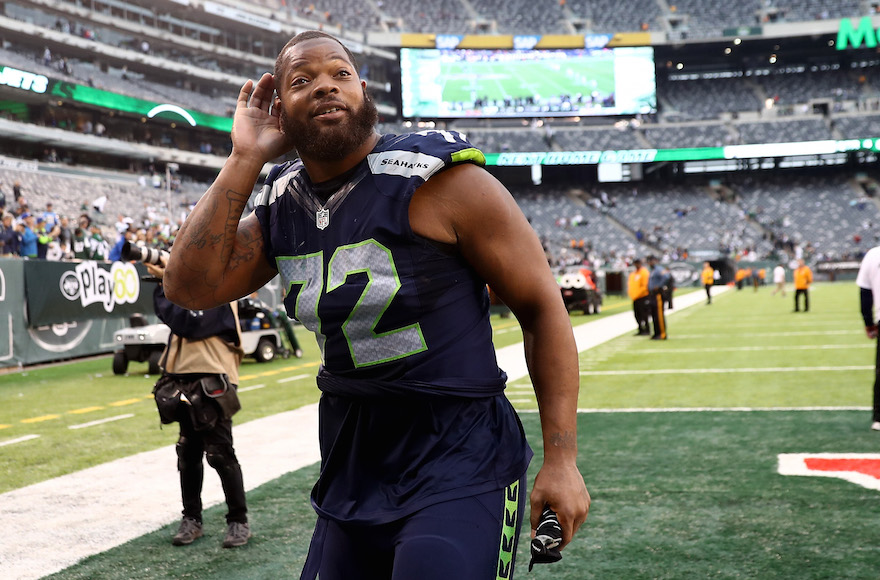
I remembered the Papp incident when I read that Seattle Seahawks defender Michael Bennett and some other NFL players were backing out of a trip to Israel sponsored by the Israeli government and America’s Voices in Israel, an initiative of the Conference of Presidents of Major American Jewish Organizations. Bennett apparently pulled out after reading an article about the trip in The Times of Israel, which included official statements by two Israeli Cabinet ministers saying the trip was intended to counter the Boycott, Divestment and Sanctions movement and the pro-Palestinian narrative about Israel.

Gilad Erdan, whose varied portfolio includes public security, strategic affairs and public diplomacy, said he hoped the visit would offer the players “a balanced picture of Israel, the opposite from the false incitement campaign that is being waged against Israel around the world.” Fighting BDS, he said, “includes hosting influencers and opinion-formers of international standing in different fields, including sport.”

Tourism Minister Yariv Levin hoped the players would come home with “positive stories about Israel” that would “counter distortions and misrepresentations about the Jewish state.”

On Feb. 8, Bennett tweeted that he was not going to Israel, complaining that “I was not aware, until reading this article about the trip in the Times of Israel, that my itinerary was being constructed by the Israeli government for the purposes of making me, in the words of a government official, an ‘influencer and opinion-former’ who would then be ‘an ambassador of good will.’ I will not be used in such a manner.”

He pledged to come to Israel one day, and to visit the West Bank and Gaza, “so I can see how the Palestinians, who have called this land home for thousands of years, live their lives.”

It’s not clear how much the players knew about the sponsors or the purposes of the trip before accepting. The America’s Voices in Israel Facebook page explains that it “organizes week-long missions to Israel for prominent headline-makers with widespread credibility,” in order to generate stories about Israel that “counter distortions and misrepresentations about the Jewish State.” Accounts of the trips show an itinerary heavy on holy and historical sites, fine dining and visits to Israel’s highly regarded human services sector, like a program for people with special needs. The trips are often led by Voices’ director, a rabbi with a background in right-leaning efforts promoting Israel.

Still, my guess is the players didn’t know much about the organizers. Nor did they appreciate the politically charged nature of visiting the region. Every country has a tourism board that tries to entice celebrities with free trips and deluxe accommodations. In recent years, the Golden Globes swag bag has included round-trip tickets to Fiji and a free stay at a five-star resort.

The difference is that Fiji is not a global hot spot, and if anyone is boycotting Fiji it has more to do with a bad Yelp review than an organized political campaign. The BDS movement is intent on demonizing Israel and shaming celebrities who don’t revile the country or are open to hearing both sides of the story.

The day before Bennett announced he wasn’t going, the Nation published an “Open Letter to NFL Players Traveling to Israel on a Trip Organized by Netanyahu’s Government.” Signed by Alice Walker, Harry Belafonte, Angela Davis and others, it is a model in the effort to de-normalize Israel. Quoting Erdan, they assert that the trip was “designed explicitly to improve Israel’s image abroad to counter worldwide outrage over its massacres and war crimes.” Addressing African-Americans like Bennett, it links the Palestinian cause to that of “black and brown communities in the United States.”

And their complaint is not just about the treatment of Palestinians in the West Bank, but a Jewish nation-state “with more than 50 laws that privilege Jewish citizens over non-Jewish citizens.” One of its strangest passages compares Trump’s travel ban on refugees with Israeli restrictions on migrants trying to enter the country illegally from its tense border with Egypt. (Needless to say, the letter does not address why these “asylum seekers” from Sudan and Eritrea see Israel as a more desirable destination than the countries they are fleeing and the Muslim-majority countries they must pass through to get there.)

Like the Israelis, the BDS groups who signed the letter also employ celebrities in the battle of hearts and minds — citing musicians like Lauryn Hill and Roger Waters who have refused to play in Israel. The question for Israel is whether it should fight fire with fire — celebrity with celebrity — in waging public diplomacy.

The good news for Israel is that its opponents often overplay their hand. BDS is not a “peace movement” in the sense that it wants two viable, secure states for Israelis and Palestinians. The letter to NFL players says BDS will target Israel until it “complies with international law and guarantees Palestinian rights” — an intentionally unspecific formula that coupled with the activists’ refusal to talk about a two-state solution or the Jews’ right to a state of their own suggests their ultimate goal is a single binational state.

Perhaps Bennett and the other no-show players caved to the BDS side, although the NFL story is playing in Israel as a fumble on the part of Erdan and Levin. By making explicit the implicit purpose of the “mission,” they put the players in an untenable position. Israel is understandably eager to seize on signs of normalcy in the face of the BDS assault. But sometimes discretion is the better part of hasbara. In recent years Israel has pushed the “Brand Israel” tactic of public diplomacy, backing efforts to promote Israel’s accomplishments in the arts, technology, science and gay rights. When the government’s fingerprints are obvious, such events have inspired protests at film festivals, museums and theaters.

Maybe the problem is contained in the word “mission,” borrowed by Jews from Christian evangelists and suggesting a trip meant to win converts. Perhaps a better model for these kinds of trips is a symposium or a fact-finding trip, exposing visitors not just to what makes Israel fun and inspiring, but to its challenges in all their complexity. If celebs knew they were going to get a range of perspectives on the country and the conflict, perhaps they’d feel more confident in telling the BDS crowd to back off.

To Bennett’s credit, he signals that he has an open mind, and that when he does visit, he’ll hear from both sides. If he does, he’ll experience an Israeli and Palestinian reality infinitely more complex — more multicultural, more historically aware, less reductive — than the patronizingly binary picture scrawled by the authors of the open letter. And he just might discover that Israel has the more convincing story to tell.

NFL players flap upends Israel’s PR game plan Read More »