
fbpx

October 20, 2016

CareerUp: Linking careers, high tech and Jewish millennials

Jewish networking in Los Angeles is a cottage industry, with a number of organizations trying to help young Jews find career advancement, social connections and romance.

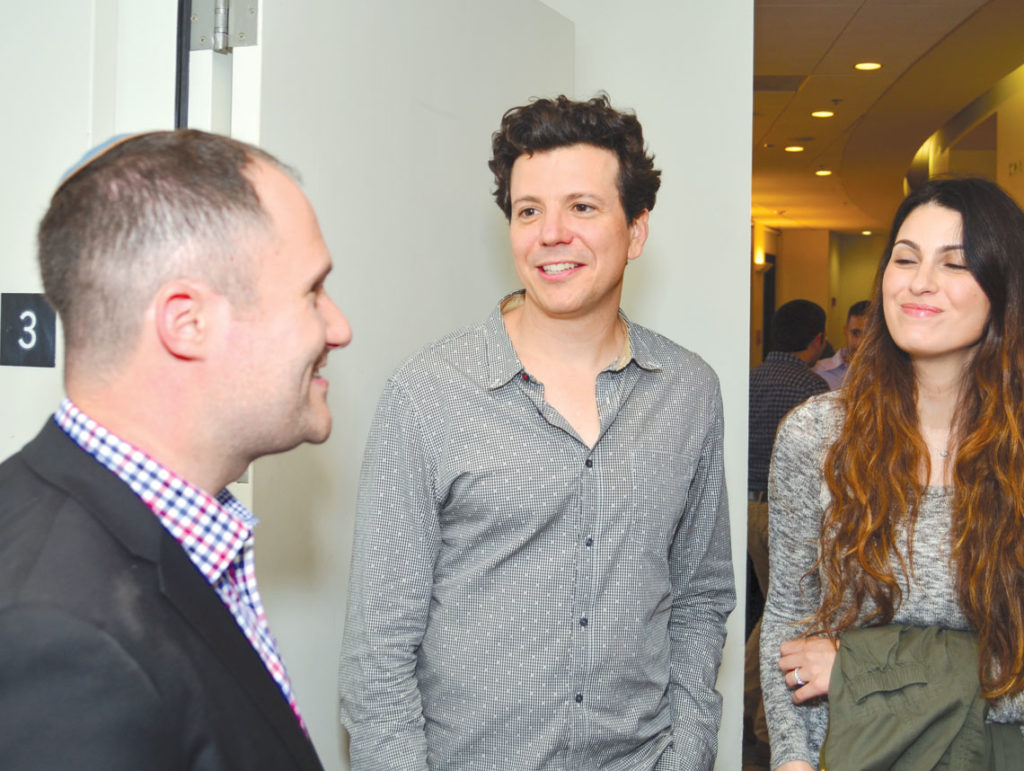
The newest entry into that market, CareerUp, recently held its debut event at the UCLA Hillel Center for Jewish Life.

The goal of the event, said its co-founder Rabbi Adam Grossman, was “to anchor career advancement in Jewish identity and understand from each other where our own path starts.”

Grossman started CareerUp with Bradley Caro Cook, a veteran Jewish networker who previously founded Project Beyond, an organization that sets up industry leaders in Israel with former Birthright Israel participants hoping to immigrate there.

The two never would have met if not for Cook’s persistence.

“I actually tried to blow him off when he first tried to get in contact with me,” Grossman said at the Sept. 29 event.

But Grossman relented, and the two met in Gainesville, Fla., where Grossman is the CEO of the University of Florida’s Hillel. At the time, South Florida was in the grip of a heat wave, and Hillel’s air conditioning wasn’t working properly. So for two days, the pair baked in an 85-degree room as they teased out ideas about how to engage young Jews who otherwise might turn their back on their faith. Eventually, they settled on career advancement.

Cook said CareerUp distinguishes itself from other, similar organizations by building professional networks in different fields and then approaching partners, such as Hillel of UCLA, to recruit young people, rather than simply finding millennials on its own.

Just over a year after Grossman and Cook’s conversation in Florida, about 50 people gathered in an upstairs hall at Hillel of UCLA for an evening program focused on entrepreneurship, media and high tech, titled “From Silicon Beach to Hollywood.”

The students in the crowd were recruited by Hillel along with AEPi, the Jewish National Fund Futures program, and the campus group Tamid, which stresses entrepreneurship as a way to connect youth with Israel.

Weeks before the event, Cook asked student participants about their career goals and “made the shidduchs [matches] between the industry leaders and the students.”

To open the program, Cook and Grossman landed one of the city’s most vaunted young Jewish entrepreneurs, Eytan Elbaz, who with his brother, Gilad Elbaz, co-founded the company that would become Google AdSense. Eytan lectured on the six things he wished he had known at age 25, including, “ ‘No’ has many different meanings” in business and “struggle precedes growth.”

He recounted a story about the company they founded, Applied Semantics, that could have been a plotline from the HBO series “Silicon Valley.”

Early on, the young entrepreneurs agreed to accept as their CEO a “traditional, older, gray-haired tall guy” to appease investors. While their company was scrimping and saving every bit of its $6 million in venture funding, the CEO spent lavishly on luxuries and “strange consultants,” Eytan said. Before long, the Elbaz brothers were down to $400,000 in remaining funds and on the verge of giving up the company.

When the founders decided to fire the CEO, he threatened a lawsuit. At the time, Eytan suggested vandalizing the CEO’s house by covering it in toilet paper. Gilad responded with the voice of reason.

“[Gilad] looked at me with his wide eyes and he said, ‘Why don’t we make the stock so valuable that he regrets he ever did this to us?’ ” Eytan said.

Eventually, they sold the company for $102 million and immeasurably changed the world of online advertising.

After Eytan’s presentation, wellness coach Jordana Reim moderated a panel on “Creating Your Creative Dream Career.” The panel consisted of actor Jamie Elman, who co-founded the Yiddish web series “YidLife Crisis”; Mexican-American singer and lyricist Sam Woldenberg (better known as Jacbern); Israel-Hollywood liaison and activist Lana Melman; music agent Civia Caroline; and Matthew Helderman, CEO of the creative management company Buffalo 8.

Finally, students and professionals broke up into groups of about a half dozen to discuss how virtues named in Pirke Avot could help them increase their effectiveness as networkers.

By the next day, Cook said, many students had already arranged informational interviews with the industry professionals.

Cook considers himself a professional networker. After nine years teaching special education and earning a doctorate in the subject, he decided to move to Israel at age 32. Observing the constant influx of Birthright participants, he decided to create Project Beyond to help young people find careers in Israel.

His CareerUp partner, Grossman, admitted at the event that his own path was a “unique journey into the rabbinate.” He began his career in the Midwest doing freak-out comedy on the streets for a syndicated radio show. After a stint in concert promotion in Boston, he said, “I dyed my hair blond and moved to Australia to surf and bar tend.”

Returning home, he searched for a meaningful career and settled on the rabbinate.

With CareerUp, he hopes to marry Jewish theology with networking, an area that many young people see as crucial to grow their nascent careers. At the September event, just days before the Jewish New Year, he seized on the holiday to drive that point home.

“With Rosh Hashanah upon us, our goal is to more than just change ourselves,” he said. “Our goal is to actually look inside ourselves, to look at our strengths, to see our weaknesses, and to challenge ourselves not just to do better, but actually to see where we can go.”

CareerUp: Linking careers, high tech and Jewish millennials Read More »

Democrats recruit Joe Lieberman in targeting Jewish voters in Florida

Like many of his controversial comments in the past, Donald Trump stepped on his toes by hesitating to say that he would accept the outcome of the Nov. 8 election, former vice presidential candidate Joseph Lieberman said on Thursday.

“I thought Trump, actually for part of it, did better than before. He seemed a little more disciplined. But then he made a big mistake,” Lieberman told Jewish Insider in a phone interview on Thursday. “This is really a violation of the kind of broadly non-partisan American ethic that in the end, you accept the results of the election and that you allow a peaceful transfer of power. I think that will worry people. It probably won’t upset too many of his supporters, but I think for people who have thought at some point about supporting Trump and have gone increasingly concerned in recent days about his focus on the election being rigged – which there’s no evidence of that, whatsoever – what he said last night, pursued the persuadable that Hillary Clinton is their best choice.”

Lieberman faced a similar choice when he ran for vice president on the Democratic ticket with former Vice President Al Gore in 2000. After the U.S. Supreme Court stopped a recount of of uncounted ballots in the state of Florida, Gore eventually conceded the race to George W. Bush despite having reservations about the outcome being determined by justices and having won the popular vote. “The U.S. Supreme Court decision left open a door to another step for Gore, which was to go back to the Florida Supreme Court and ask fro a recount of all the votes,” Lieberman recalled the day he called a ‘frustrating’ moment for the ticket. “Vice President Gore, to his credit, late on the night that the Supreme Court decision came down, he said, ‘It’s time for the good of the country to end this.’ Gore, really in the spirit of this nonpartisan ethic, said, ‘We fought hard, we fell the result is unfair, but now we better accept it and let the country move on.’ That was not easy, but Al Gore really did the right thing.”

Lieberman spoke on the phone from Florida, where he is campaigning for the Clinton-Kaine ticket in the Jewish community of South Florida.

The former senator spoke to Jewish seniors at Palm Beach Century Village and held a roundtable with rabbis and Jewish community leaders in Palm Beach, according to the Clinton campaign. He also spoke at a shul in Broward County.

Jewish voters represent 3 to 6 percent of the electorate in Florida. Clinton is ahead by 3.8 percentage points in Florida, according to the RealClearPolitics average.

Jewish Insider has learned that Lieberman will be featured in a new highly targeted campaign kicking off this weekend by the “Jews for Progress” super PAC, aimed at Jewish voters who are still undecided or persuadable. According to a source with close knowledge of the upcoming activities, in the coming days, JFP will call more than 100,000 unique Jewish households in Florida and launch an online, email and social media campaign in an effort to replicate a successful campaign in 2012 in putting Florida in the Democratic column with the help of Jewish voters.

In an “>showed Clinton leading Trump by 43 points among Jewish voters in Florida. However, among Orthodox Jews, Trump leads Clinton 66-22 percent.

But Lieberman, a modern-Orthodox Jew, insisted that after winning three televised debates in a row, Clinton is in a position to win over many Orthodox Jewish voters. “I think the way this race is going, within the Jewish world, one of the surprising results will be that Hillary Clinton will get a much higher percentage of the Orthodox vote than a Democratic candidate has gotten for a while.”

“The modern Orthodox community is probably already trending more towards Hillary based on not only on feeling that she is a more proven, reliable and predictable supporter of Israel, but also because they are troubled by Donald Trump’s campaign,” he asserted. “I think we may be surprised to see that also happening in the ultra-Orthodox/Hasidic community. Here is the thing: she was the senator from New York for eight years. She got to know the community. And I think, generally speaking, people had a good feeling about their relations with her. She tried very hard to be supportive.”

On Israel, Lieberman said that Clinton as president “offers the hope of the Democratic Party becoming what it has been at its best – a center-left party, not a left party,” pointing to the Democratic Party’s platform. “And I think that’s the kind of party that can win, but also that can get things done for the country.”

The full interview with Joe Lieberman will be published in Jewish Insider’s Democrats recruit Joe Lieberman in targeting Jewish voters in Florida Read More »

The final debate: RBG, Soros and Iran lost amid concession outrage

Donald Trump wants to keep us in suspense.

The Republican nominee’s refusal to say Wednesday evening during the final debate whether he would accept the results of the election is the stuff of breaking news and six-column headlines.

“What I’m saying is that I will tell you at the time, I will keep you in suspense,” Trump said. Hillary Clinton, his Democratic rival, called his promise “horrifying.”

It is unprecedented in U.S. presidential elections for a nominee to not pledge to respect the outcome.

What did Trump mean by “suspense”? Who truly knows – his aides were quick to insist that he would indeed respect the results.

But whether the next three weeks will be “Suspense! Horrifying! Bad!” in a decline of the republic kind of way or “Suspense! Horrifying! Fun!” in a found footage, “Paranormal Activity: Election Day” kind of way, we’re determined not to keep our readers in suspense about Wednesday night’s Jewish content.

Iran, again

Clinton has been reticent about making Iran a major issue throughout the campaign: It’s a hard straddle for her between her skepticism of the nuclear deal reached last year and honoring the legacy of President Barack Obama. (Her running mate, Sen. Tim Kaine, D-Va., was a prominent backer of the deal, and in a rare tonal differentiation from Clinton, has emphasized the deal as a win.)

Yet she was the first to mention Iran in the final debate on the University of Nevada, Las Vegas campus. It was one of several cudgels she used to depict Trump as beholden to Russia. Her most prominent gambit was in goading him to condemn Russia’s responsibility for the hacks into the private emails of her associates as unprecedented interference in the U.S. election. That led to this notable exchange:

Trump: (Putin) has no respect for her. He has no respect for our president. And I’ll tell you what: We’re in very serious trouble because we have a country with tremendous numbers of nuclear warheads — 1,800, by the way — where they expanded and we didn’t, 1,800 nuclear warheads. And she’s playing chicken. Look, from everything I see, (Putin) has no respect for this person.

Clinton: Well, that’s because he’d rather have a puppet as president of the United States.

Trump: No puppet. No puppet. You’re the puppet! No, you’re the puppet!

Clinton worked in her Iran reference when she circled back to Russia a few questions later, after moderator Chris Wallace of Fox News Channel pressed the Democratic nominee on her plans to defeat the Islamic State, the terrorist group also known as ISIS that controls swathes of land in Syria and Iraq.

“I am hopeful that the hard work that American military advisers have done will pay off and that we will see a real — a really successful military operation,” she said, referring to the thrust underway against ISIS in Mosul, the group’s stronghold in Iraq. “But we know we’ve got lots of work to do. Syria will remain a hotbed of terrorism as long as the civil war, aided and abetted by the Iranians and the Russians, continue.”

This was a subtle – probably too subtle – reference to Trump’s suggestion in the second debate that the United States may as well concede Syria to Russia and Iran, a prospect that horrifies Israel and the pro-Israel community. (It was Wallace, not Clinton, who later in the debate cornered Trump on his views on Syria, Russia and ISIS.)

But Clinton’s reference to Iran, and to Mosul, gave Trump the opening for one of his most cogent and damaging arguments against the Obama administration’s foreign policy, and the opportunity to tie it to a prospective Clinton presidency. The assault on Mosul, Trump argued, may be successful, but ultimately it would be a gift to Iran, which he depicted as the prevailing power in Syria and Iraq. And that’s when he brought in the deal, reviled by Republicans as well as by Israel’s government, which exchanged sanctions relief for Iran to a partial rollback in its nuclear program.

Trump: So Mosul is going to be a wonderful thing. And Iran should write us a letter of thank you, just like the really stupid — the stupidest deal of all time, a deal that’s going to give Iran absolutely nuclear weapons. Iran should write us yet another letter saying thank you very much because Iran, as I said many years ago, Iran is taking over Iraq, something they’ve wanted to do forever, but we’ve made it so easy for them. So we’re now going to take Mosul. And do you know who’s going to be the beneficiary? Iran.

Those Jewish names

Trump has taken flak from Jewish commentators – most recently Rabbi Jonah Pesner, who heads Reform Judaism’s Religious Action Center – for invoking, in a sinister way, prominent Jewish figures.

He was at it again Wednesday and it’s always hard what exactly to make of it. He also cites Jewish names (Israeli Prime Minister Benjamin Netanyahu, his son-in-law Jared Kushner) in a positive way to reinforce his arguments, and the Jewish folks he derides, he has genuine beefs with.

On the other hand, Trump seems to subtly emphasize the names – and that coupled with his invocations of grand secret conspiracies is guaranteed to make folks nervous.

The first mention Wednesday went to Ruth Bader Ginsburg, the Supreme Court justice who attacked Trump this summer as a “faker” and then apologized. He cited her as the kind of justice he would definitely not appoint.

Trump: Something happened recently where Justice Ginsburg made some very, very inappropriate statements toward me and toward a tremendous number of people, many, many millions of people that I represent. And she was forced to apologize. And apologize she did. But these were statements that should never, ever have been made.

It’s a legitimate reference, but also emblematic of Trump’s tendency to swerve into personal affronts when he should be dealing with issues. Ginsburg’s attack on him seemed to take precedence, in his mind, over how she and others would rule on abortion and on gun laws.

The second Jewish name check was George Soros, the financier who backs an array of liberal causes. It came up when Clinton attacked Trump for not paying his fair share of taxes.

Trump: So let me just tell you very quickly, we’re entitled [to tax breaks] because of the laws that people like her passed to take massive amounts of depreciation on other charges, and we do it. And all of her donors — just about all of them — I know [Warren] Buffett took hundreds of millions of dollars, Soros, George Soros, took hundreds of millions of dollars … Most of her donors have done the same thing as I do.

Refugees

Refugees these days are seldom Jewish, but the issue remains a priority of an array of Jewish groups, particularly HIAS, the immigrant activist group.

Faulting Obama (and by extension, Clinton) for the carnage in the Syrian city of Aleppo, Trump pivoted to the entry of Syrian refugees into the United States, something Clinton has said she wants to expand.

Trump: She’s taking in tens of thousands of Syrian refugees, who probably in many cases — not probably, who are definitely in many cases, ISIS-aligned, and we now have them in our country, and wait until you see — this is going to be the great Trojan horse. And wait until you see what happens in the coming years. Lots of luck, Hillary. Thanks a lot for doing a great job.

The “Lots of luck” stirred a social media hornet’s nest – the “tens of thousands” of refugees will arrive only if Clinton is elected. Was Trump, behind in the polls, in a Freudian way, conceding?

In any case, here’s how Clinton responded:

Clinton: He’s made these claims repeatedly. I am not going to let anyone into this country who is not vetted, who we do not have confidence in. But I am not going to slam the door on women and children. That picture of that little 4-year-old boy in Aleppo, with the blood coming down his face while he sat in an ambulance, is haunting. And so we are going to do very careful, thorough vetting. That does not solve our internal challenges with ISIS and our need to stop radicalization, to work with American Muslim communities who are on the front lines to identify and prevent attacks.

Jewish immigration advocates, led by HIAS, back Clinton’s argument – refugees coming into the United States are vetted, they say, to a fault, with the process lasting up to two years. Most Jewish groups would also be aghast at Trump’s certainty that “in many cases” the refugees are “definitely ISIS-aligned.” For them it smacks of the nativists who in the 1920s and ’30s insisted that Jews fleeing Europe did not have American interests at heart. (On the other hand, hawkish groups believe Syrian immigrants “pose a grave danger to all Americans – and an even greater danger to American Jews,” as the Zionist Organization of America has put it.)

Qatar and Saudi Arabia

Dinging Clinton’s charitable foundation, Trump brought up donations by Middle Eastern autocrats.

Trump: It’s a criminal enterprise. Saudi Arabia giving $25 million, Qatar, all of these countries. You talk about women and women’s rights? So these are people that push gays off business — off buildings. These are people that kill women and treat women horribly. And yet you take their money.

That’s a bizarre gambit for a developer who has extensive dealings with the same folks.

The final debate: RBG, Soros and Iran lost amid concession outrage Read More »

‘Friends’ co-creator takes on US remake of Israeli TV show about Orthodox family

A producer who co-created the popular television sitcom “Friends” is working on a remake of a hit Israeli TV show about a Charedi Orthodox family.

Marta Kauffman, who is Jewish, teamed up with her daughter, producer Hannah K.S. Canter, to create a series based on “Shtisel,” which has attracted audiences of all backgrounds in Israel. The Israeli original centers around the Charedi Orthodox Shtisel family and their tales of love and loss.

Kauffman’s adaptation, called “Emmis,” will be set in the New York borough of Brooklyn and will be available through Amazon Prime, the online retailer’s streaming service, Variety reported.

Canter learned about “Shtisel” when she saw clips from the drama at an event organized by the National Association of Television Program Executives.

“She was haunted by it,” Kauffman said of her daughter’s initial reaction. “She fell in love with it, and the same thing happened with me. It stays with you. We knew it wouldn’t be easy to sell, but we all felt so passionately about it.”

“Emmis” will closely follow its Israeli counterpart, but Kaufmann is making adjustments to ensure that Jewish traditions that may be unfamiliar to a U.S. audience does not confound viewers.

“In America, the show will be a period piece set in contemporary times. [The family] is living such a different kind of life, it’s like a different century,” Kauffman told Variety. “In television today, people are taking their time telling stories, so we don’t have to explain all the rituals. We will just show it.”

The Israeli-American director Etan Cohen is writing the script for the show.

‘Friends’ co-creator takes on US remake of Israeli TV show about Orthodox family Read More »

7 sites near University of Toronto defaced with swastikas

Swastikas were found at seven sites on and near the campus of Canada’s largest university in what appears to be two separate anti-Semitic incidents.

The first three swastikas near the University of Toronto’s downtown campus were discovered late last month. Just before Yom Kippur last week, two more were discovered on a mural. Two days later, another was found on a nearby sidewalk outside the anthropology building.

Similar graffiti were also discovered on the steps of the school’s mining building and on a city-owned road near the campus.

A University of Toronto spokesperson told The Canadian Jewish News that the university worked to remove the graffiti as quickly as possible.

Rob Nagus, director of the university’s Hillel, said his organization appreciated how quickly the university condemned the acts and removed the daubings.

Nagus told The Canadian Jewish News that it appears the earlier acts of vandalism were unconnected to the ones discovered later.

The Centre for Israel and Jewish Affairs said it was “deeply alarmed” at the vandalism, which “appears to be deliberate acts of hate rather than matters of casual or thoughtless graffiti.”

Meanwhile, B’nai Brith Canada said it has obtained “disturbing” video footage of an unidentified protester performing a Nazi salute outside the university’s Sidney Smith Hall on Oct. 11.

The straight-arm salute was performed on the sidelines of a free speech rally in support of psychology professor Jordan Peterson, who has been criticized recently for refusing to address transgender students by their chosen pronouns.

“This proliferation of Nazi symbolism at one of Canada’s most respected universities is shocking and outrageous,” said Michael Mostyn, the CEO of B’nai Brith Canada.

7 sites near University of Toronto defaced with swastikas Read More »

How all the Jewish MLB players did in 2016

This season promised to be a banner year for Jewish Major League Baseball players — and by and large, the class of ’16 fared pretty well. Many had their best seasons in years and fans were introduced to a couple of promising newcomers.

As the big league calendar reaches its climax with the World Series, here’s a look at what all the Jewish major leaguers accomplished (or not) during the regular season.

Kevin Pillar, Toronto Blue Jays, outfielder

Pillar is a human highlight reel (see this, and this, and this). The Blue Jays outfielder won last year’s Wilson Defensive Player of the Year award. Besides his play on the field, Pillar’s a mensch: He is the team’s nominee for the Roberto Clemente Award, which is handed out each year by Major League Baseball in recognition of “extraordinary character, community involvement, [and] philanthropy.” Along with his defense, Pillar posted respectable batting numbers as a regular starter.

Key stats: 3.4 WAR (Wins Above Replacement), 35 doubles, .983 fielding percentage, 14 stolen bases

Joc Pederson, Los Angeles Dodgers, outfielder

Although the lefty-swinging slugger missed two weeks in the beginning of July due to a shoulder injury suffered while making a game-saving catch and had 74 fewer at-bats than in 2015, he still had 100 hits and 25 home runs, just one fewer in each of those categories than in his impressive rookie season last year for the Los Angeles Dodgers. His clutch home run in the playoff series against the Washington Nationals on Oct. 13 helped the Dodgers advance to the National League Championship Series against the Chicago Cubs.

Key stats: 25 home runs, 68 runs batted in, 26 doubles

Ryan Braun, Milwaukee Brewers, outfielder

The Hebrew Hammer had his best showing since 2012. He enjoyed games of seven, six and five runs batted in and smacked two homers in a single contest six times. The 32-year-old outfielder certainly would have reached the century mark in RBIs for the sixth time in his 10-year career had he not missed 27 games due to injury (plus the birth of his son). Braun was named the Brewers’ most valuable player but the team, which finished fourth in the N.L.'s Central Division, is rumored to be willing to part with its six-time All-Star and his $13 million contract. Like Pillar, Braun was nominated by his team for the Clemente Award.

Key stats: .305 batting average, 30 home runs, 91 RBIs, 16 stolen bases, .538 slugging percentage

Ian Kinsler, Detroit Tigers, second baseman

Kinsler set a franchise record with eight leadoff home runs in a single season. He homered in four straight games in May and three straight in June, finishing with 28, his highest total since his 31 in 2011. The Tigers infielder had a scary moment when he was hit in the head with a pitch that caused him to miss several days in late September. The Tigers finished with a record of 86-75, second in the American League Central but 2 1/2 games short of a wild card spot.

Key stats: 28 home runs, 88 RBIs, 29 doubles, 14 stolen bases

Danny Valencia, Oakland Athletics, utility

Valencia approached personal bests in almost every offensive department. Ostensibly a third baseman, Valencia saw action at five positions, including designated hitter. His best game came on May 15, when he hit three homers and drove in five runs in a 7-6 win over the Tampa Bay Rays.

Key stats: 17 home runs, 22 doubles

Alex Bregman, Houston Astros, infielder

The promising 22-year-old rookie struggled early after making his major league debut on July 25, going six games before getting his first hit and batting just .198 through 21 games. But the Astros infielder finished strong and wound up with eight home runs and 34 RBIs in 49 games — that works out to 26 homers and 112 RBIs over a full season — and a slash line (batting average/on-base percentage/slugging percentage) of .264/.313/.478. A hamstring injury put him out of action for most of the last three weeks, which may have been a reason the Astros missed an A.L. wild card slot, finishing third in the West with an 84-68 record, five games out of the running.

Key stats (through 49 games): 8 home runs, 34 RBIs, 13 doubles

Scott Feldman, Houston Astros-Toronto Blue Jays, pitcher

The former 17-game winner had a few mediocre performances as a starting pitcher this year before finding his niche in the bullpen. The tallest of the Jewish players at 6-foot-7, Feldman was dealt from the Houston Astros to the Toronto Blue Jays at the trading deadline but never seemed to mesh with his new team. He was left off the Jays roster for the A.L. Championship Series.

Key stats: 3.97 earned run average, 56 strikeouts in 40 games

Richard Bleier, New York Yankees, pitcher

The lefty reliever made his major league debut on May 30 and was used mostly as a middle reliever in his 23 appearances. The 29-year-old’s best outing came on Sept. 12 against the Dodgers, when he pitched four hitless innings.

Key stats: 1.96 ERA, 1.043 walks/hits per inning pitched

Ike Davis, Texas Rangers system-New York Yankees, first baseman

Davis languished in the Texas Rangers’ minor league system before being released on June 12. The Yankees picked up the fancy-fielding first baseman the next day, but never really gave him a chance, sending him to the minors after just over a week. The 29-year-old son of former big leaguer Ron Davis was a member of Team Israel, which won the World Baseball Classic qualifier last month in Brooklyn to qualify for the tournament's quarterfinals in March in South Korea.

Jon Moscot, Cincinnati Reds, pitcher

Moscot, a righty, wouldn’t have any luck if he didn’t have bad luck. He made five appearances in the majors this year before going down with an inflamed shoulder a year after an intercostal strain ended his rookie season after just three games. Once he healed from the 2016 injury, he spent the rest of the season in the minors.

Brad Ausmus, Detroit Tigers, manager

The former longtime major league catcher finished his third season as Detroit’s manager and dealt with the usual set of injuries and slumps that all skippers face. The Tigers finished second in the A.L. Central, narrowly missing a wild card playoff berth, but his job was rumored to have been in danger on several occasions. Ausmus will be back in 2017, but the front office may not have much patience if the team gets off to a slow start.


Ron Kaplan is the author of the forthcoming book “Hank Greenberg in 1938: Hatred and Home Runs in the Shadow of War” and host of Kaplan’s Korner, a blog about Jews and sports.

How all the Jewish MLB players did in 2016 Read More »

Sepulveda Pass tunnel would connect Jewish L.A. — if it ever gets built

Since the Jewish population began to emigrate from its old East Los Angeles haunts, large communities began to settle on either side of the Santa Monica Mountains in the West Valley and West Los Angeles — and never the twain shall meet.

But if county voters approve a sales tax on the November ballot, those two populations could be connected by a train underneath the congested Sepulveda Pass within 20 years.

At an estimated cost of $10 billion, the Sepulveda Pass project is the grandest and most expensive of the items promised by Measure M, the ballot initiative hoping to revolutionize public transportation in L.A. 

Some critics roll their eyes when the county’s Metropolitan Transportation Authority (Metro) touts proposals of such grand scale, pointing to years of mothballed plans. Yet the prospect of changing L.A.’s Jewish geography has some community members riled up in support — particularly at Leo Baeck Temple, an iconic Reform synagogue nestled in the pass.

For Rabbi Ken Chasen, the congregation’s senior rabbi, Measure M is not just about making it easier to get to the shul, though the tunnel would do that. Instead, it’s about bringing L.A.’s Jews into close quarters with the other communities that share the city with them.

“Our whole motive with this is about those doors opening up … and all of L.A. actually encountering each other on a human level,” he said. “As a Jewish principle, it’s like a huge fundamental.”

The shul’s slogan for its Measure M efforts is telling: “Connect people face to face and not bumper to bumper.”

The grand plan

Until recently, even the mention of a train under the Sepulveda Pass met with guffaws. In May, when candidates at a state senate debate for a district that includes parts of the West Valley were asked about the idea, Steve Fazio, the Republican candidate, compared it to the idea of offering jetpacks to commuters.

“We’ll strap it on, fly it around,” he said. “It’ll have an airbag on it — you’ll love it.”

Yet Metro is dead serious about the idea.

Measure M offers a “comprehensive plan” to update L.A.’s transportation system, of which the Sepulveda Pass project is “a very real component,” said Pauletta Tonilas, chief communications officer for Metro.

In a phone interview, Tonilas described a three-phase plan to connect the North Valley to Los Angeles International Airport. 

First, express lanes would be added to the I-405. Next, rail would be laid under the pass to connect the Van Nuys Orange Line station with the planned Purple Line station at Wilshire and Westwood boulevards. Finally, rail would be built out to 96th Street in Westchester. (A separate project, called the East San Fernando Valley Transit Corridor, would connect the Van Nuys station to Pacoima with a rapid transit bus or rail line.)

Metro expects to run trains from the Valley to the city by 2033 and to finish the project entirely by 2057, according to the expenditure plan that accompanies the ballot measure.

The Sepulveda Pass is just one item proposed in Measure M. Other projects would accelerate the Purple Line subway extension under Wilshire Boulevard, extend the under-construction Crenshaw Line north through West Hollywood and build the Gold Line out to Claremont, to name a few.

All that, though, is contingent on passing the November ballot measure with a 67 percent vote, adding a half-cent onto the county’s sales tax and pushing it above 10 percent in some cities, and to 9.5 percent in the city of Los Angeles. In addition, the measure would remove the expiration date on a previous half-cent tax passed in 2008, extending it in perpetuity.

If Measure M passes, 2 cents of every dollar spent in L.A. County would go into Metro coffers for the foreseeable future. In 2018, the first year it would be in effect, the tax would pull in some $860 million, Metro estimates. And the agency has made clear, at least in the short run: No tax, no tunnel.

Besides linking two vibrant Jewish communities, the proposed tunnel would change the character of a mountain pass that, in itself, is home to many of L.A.’s most prominent Jewish institutions. 

Flanking the 7 miles of freeway between Westwood and Sherman Oaks are American Jewish University, Milken Community Schools, Stephen Wise Temple, the Skirball Cultural Center and Leo Baeck.

These institutions represent a midcentury push to “centralize the diverse and dispersed Jewish communities in one place,” said Erik Greenberg, director of education and visitor engagement at the Autry Museum of the American West.

In an online exhibition called “The Jewish Pass,” part of UCLA’s Mapping Jewish L.A. project, Greenberg charted the history of the route and its significance to the larger community. 

The institutions that rose on its banks, he wrote, offer “a glimpse into the beliefs and ideals that helped shape American Jewish observance and culture over the past fifty years.” In a phone interview, he doubted if institutions of such breadth and size were likely to arise again.

Mixed messages

In April, Metro CEO Phil Washington addressed a crowd of faith communities allied in supporting the measure who had gathered at Leo Baeck Temple.

Leo Baeck congregants had been working for months, meeting with city and county officials to ensure that the Sepulveda Pass was given consideration on any proposed ballot measure, and Washington was ready to project an air of near-certainty.

“We are looking to accelerate the Sepulveda Pass,” he said to applause. “I believe we will. People who want to build this rail line are already discussing it. The big challenge is being successful in November.” 

But as Metro projects have inched themselves, mile by mile, into court battles and construction delays, many across the county have lost faith.

“We’ve been promised all sorts of stuff and never gotten it,” said Bob Anderson, a board member for the Sherman Oaks Neighborhood Council, who wrote an op-ed opposing the measure in the local politics blog CityWatch.

With Measure R, a similar half-cent county sales tax passed in 2008, voters were promised a “Subway to the Sea.” That project soon became a subway toward the sea as costs rose and budgets dwindled. The Purple Line is now expected to reach the Veterans Affairs complex in Westwood, some 5 miles short of the beach.

Anderson said the Sepulveda Pass project could suffer a similar fate to the Purple Line extension because the measure doesn’t specifically lay out a plan for its completion.

“The Sepulveda Pass project is fantastic,” he said. “We need it. But we need to make sure it’s done right and we really have input into it.”

Meanwhile, some Metro critics say that behind closed doors, the county agency is less certain about the Sepulveda Pass plan than it lets on in public.

Measure M opponents like Torrance Mayor Pat Furey say Metro’s plan gives short shrift to South Bay communities like his and that, to placate critics such as him, Metro officials have implied the Sepulveda Pass project could be delayed and money redirected to South Bay projects. Washington and his deputies said as much in an Oct. 10 meeting at the Torrance mayor’s office, Furey told the Journal.

“One of the things they laid out was that the Sepulveda Pass was so intricate and so environmentally involved that the environmental process, they expect, will take perhaps decades,” Furey said in a phone interview. “And based upon that, it was their belief that that would free up money for the other processes.”

The mayor said he believes Washington was using the idea of repurposing Sepulveda Pass funds as a “carrot for us to sort of buy into” Measure M.

Norwalk Mayor Mike Mendez said Metro officials — though he couldn’t recall exactly which ones — spun a similar story during a meeting of the Gateway Cities Council of Governments, which represents a string of Los Angeles communities bordering Orange County. Those officials, he said, “made some comments that this might not even happen,” referring to the tunnel. 

Mendez made it clear that he doesn’t oppose the idea of a tunnel under the Sepulveda Pass, but rather opposes Measure M on the grounds that it’s not fair and equitable to cities like his. He said he sees Metro’s campaign tactics as deceptive.

Beverly Hills Mayor John Mirisch, a longtime Metro opponent, agreed that the issue is problematic. 

“[Metro] is trying to get people to support the tax by promising things they think will appeal to various parts of the county,” he said during an interview in his office. “They’re throwing transit scraps and crumbs.”

Mirisch has led his city in multiple legal battle against the agency, which he sees as bloated and in dire need of reform. Of the Sepulveda Pass tunnel, he said, “this is the big bone they’re throwing to the Valley.”

Tonilas, of Metro, was adamant that the agency would not raid Sepulveda Pass funds to pay for projects elsewhere. “That is absolutely not going to happen,” she said.

It’s possible that Sepulveda Pass funds could go toward other projects — but only if the valley-to-city tunnel were accelerated by a public-private partnership, she said, and not at the cost of delaying the tunnel.

“Maybe some folks misunderstood that, but we have every bit of the intention of delivering what is in that plan,” Tonilas said. “And Sepulveda Pass is absolutely part of the plan.”

Cost concerns

Few say improving L.A.’s transportation infrastructure is a bad idea. Yet in selling the Sepulveda Pass project, even supporters note that the daunting price tag poses a challenge. Of the $10 billion cost, Measure M would raise only about $2.9 billion — leaving the rest up to funding from federal, state and other sources. 

“The response we got, even from people who were sympathetic, was, ‘Yeah, it’s a great idea, but that’s too much money — it’ll never happen,’” said Eric Stockel, Leo Baeck’s vice president of social justice.

Those objections failed to dampen the congregation’s enthusiasm. During the 2013 Los Angeles mayoral race, Stockel’s community-organizing team pressed the four leading contenders for commitments to a Sepulveda Pass improvement project during a candidate forum at Leo Baeck.

Now, organizers from Leo Baeck are phone-banking for Measure M and encouraging congregants to vote for it, Chasen said.

Most agree that public transportation would go a long way toward stitching together L.A.’s Frankenstein monster of far-flung neighborhoods. But come November, the county’s voters will have to decide whether Metro can pull it off.

“The public is our No. 1 boss,” Tonilas said. “The public is who we work for. … The people will decide on Nov. 8 if this is something we should move forward with.”

Sepulveda Pass tunnel would connect Jewish L.A. — if it ever gets built Read More »

Meant2Be: Till love do us part

Jessica and I realized from the start that ours was not a match made in romantic partner heaven. 

She had a prestigious, high-paying job; I was a struggling writer constantly scrambling for work. She lived in a beautiful home in the hills, with a swimming pool and luxury car; I drove a used Ford Taurus and got a break on my humble apartment’s rent by doing assorted managerial tasks for the owner. While she loved having deep discussions about weighty topics, theater, opera, and sharing innermost thoughts and feelings, I was more into popular culture and keeping things light, comedic and on the surface.

Jessica proposed that since we were so different, and obviously not each other’s soul mates, but liked each other nonetheless, why not love the one we’re with — date each other regularly while we continued searching for our true matches? And as soon as one of us met someone where intimacy was about to occur, we’d inform the other so as to end our arrangement. 

Regular romance while looking for one’s soul mate? Suggested by the woman in the relationship? Where do I sign?

As the months passed, neither of us ever brought up the initial agreement, nor did we refer to meeting or dating others. Our agreement just bided its time in the back of our minds. 

Then, about nine months into my relationship with Jessica, I met Sarah. Among her other wonderful qualities, Sarah laughed out loud and frequently at my jokes, which of course is catnip for any comedy writer. While my relationship with Jessica was pleasant, secure and affectionate, the one with Sarah awakened my heart and energized my soul.

I envisioned informing Jessica about Sarah, and Jessica responding, “Oh, thank God. This makes it that much easier for me to let you know about my relationship with Bobby.” Or something along those lines.

What I never anticipated was Jessica’s actual response: tears. I was stunned to discover that Jessica did not want me to leave. She was not dating anyone, she hadn’t even been looking to date anyone. She had grown to love me and wanted me to stay.

I reminded her of our initial agreement, which I added, was her suggestion in the first place.

And then, Jessica surprised me again by sweetening the deal, as it were. She told me she had visions of us living together as a couple, traveling the world. She’d pay for everything and support my writing career. I could just stay home and write, without having to worry about bills or a day job.

Oh, man! One woman tempts me with passion and laughter; the other with lifelong financial security and international travel. I felt like I was living that old Mary MacGregor song, “Torn Between Two Lovers.” I had to make a choice. This was a life-changing decision. Either way, someone was going to get hurt.

I had visions of my future life with Jessica. We’d be in some charming little flat in Paris. I’d be working on my Great American Novel while she read the works of Victor Hugo on the sofa. Off in the distance, a street musician would play “La Vie en Rose” on the accordion. We’d wander down to dinner at one of Paris’ intriguing cafes in the Latin Quarter. Rent?  Job search?  Credit card late payment fees? Things of the past! My main responsibility would be to love Jessica. It didn’t take a genius to see the appeal.

Visions of my future life with Sarah appeared next. We’d travel and take trips, but they’d mostly be local. I could still be a writer, but the writing would have to be done at night and on weekends, wedged in around my day job to pay the bills. And yet, there was no denying that with Sarah, I’d have nonstop, passionate, full-throttle love and laughter.

And there it was. I decided that those were the things I didn’t want to live without, couldn’t live without.

Did I have any regrets about leaving Jessica? Honestly, yes, from time to time. Especially when things got tight financially. But those regrets became short-lived when I considered Sarah’s priceless laughter and love, allowing us to cue “La Vie en Rose” as the two of us slow danced under a streetlight, and she adjusted my Canter’s Deli baseball cap to the perfect angle, in the romantic Fairfax District of Los Angeles.

(Update: As much as I love romantic fairy- tale endings, mine turned out to be short-lived; Sarah and I split up after 4 1/2 years. We’re still friends, but that’s another story. Cue, this time, Nat King Cole’s version of “When I Fall in Love.”)


Mark Miller, a former Jewish Journal dating columnist, has been a writer/producer on numerous TV sitcom staffs. His first book is a collection of humor essays, “500 Dates: Dispatches from the Front Lines of the Online Dating Wars.” 

Meant2Be: Till love do us part Read More »

Experiencing Israel within the tension of perceptions and politics

If you had asked me two years ago what was the likelihood of me traveling to Israel, I would have said 5 percent, simply because I always like to leave some room for the universe to surprise me.

My aversion to Israel was mostly due to negative feelings in my LGBTQ community. I know a lot of smart, queer Jewish folks who strongly support boycotting Israel until the conflict with the Palestinians is resolved. As these things do, it boiled down to a sound bite: Israel commits apartheid against the Palestinians, apartheid is bad and therefore Israel is bad. The politics of the situation were directly in conflict with my values. I believe that all human beings deserve food, water, joy and the ability to put their children to bed without fear for their safety. 

Not having a lot of financial access to international travel — I write a body liberation LGBTQ blog and work a lot of gigs to be able to do that — I never considered Israel as a possible destination. I’m not Jewish; it never felt like a big loss.

My partner’s father, Mel, passed away two years ago while she was going through chemotherapy for breast cancer. Being Jewish was very important to him, but Dara had complicated feelings about Judaism, in part because in trying to make spaces where Jews feel safe, she feels they have fallen out of alignment with their values. For her, core values of repairing the world would not result in how the present-day politics are playing out in the West Bank.

Still, Dara wanted to honor him by going to Israel with Reality Global, a project of the Charles and Lynn Schusterman Family Foundation. I was certain this almost entirely subsidized weeklong trip was a brainwashing expedition. When she returned with reports about all of the different perspectives about the Palestinian conflict and a desire to find more ways to connect with Judaism, I was shocked. I met people from her trip who are very smart and who care about repairing the world. They were not brainwashed.

One of her cohort encouraged me to apply to the inaugural Reality Storytellers trip, bringing together journalists, writers, movie producers, documentarians, actors, speechwriters and more. A descendent of the tribe of Levi, my grandfather is buried on the Mount of Olives, and I knew it would probably be my only chance to visit his grave. I was also moved by assurances from a lot of people I respect that the trip was balanced with a lot of nitty-gritty about the conflict. 

I like to base my decisions around my values and faith rather than on fear. I know that peace doesn’t come from avoiding conflict; it comes from looking at the things that challenge it and creating solutions. I was excited to learn about peace solutions from Israelis and Palestinians directly and not through the media. 

And it turns out Israel was nothing like what I expected. 

We learned from the most incredible tour guide, Michael Bauer, who had me feeling like I was earning a master’s degree in Israel, the Israeli-Palestinian conflict, the Bible and modern-day Middle East conflict.

The pace of the trip was challenging —practically moving all day from 6:30 a.m. to midnight (at least). Absorption was difficult as we hurtled from experience to experience. Folks who have been to Israel before cannot believe how much we did.

We toured the radio station Galatz and learned how media in Israel both interact with and stem from the military. It was fascinating to learn about how mandated military service affects Israelis. The reality of your children having to risk their lives in that way changes how you interact with politics. I think that U.S. politics would be very different if we had compulsory military service.

Visiting the Western Wall was challenging to me as someone who believes gender is beyond binary. The fact that the Orthodox rules require men and women to pray separately is a barrier to participation for many folks I love, including genderqueer people and all the women rabbis I know. I was happy to visit the new mixed-gender area under construction, to get to touch the Wall and put my energy into an ancient site that is now a site of compromise reflecting the diversity of the modern Jewish experience. 

We had the fortune to sit with a survivor from Auschwitz while she told us her story in a room at Yad Vashem. She had the same accent as my grandfather — strongly Eastern European. I sobbed so hard in the bathroom for how horrific the Holocaust was and how grateful I was that my grandfather escaped.

The same day, during a precious two hours of free time, I took a taxi to the Mount of Olives. I didn’t have time or capacity to figure out how to get right to my grandfather’s actual gravesite, but I visited and traded rocks from my home in Los Angeles with the area beside the graveyard. It felt like the best possible day to honor my grandfather escaping the horror of the Holocaust, and what a sweet ending his story has, to have been married to my smart and beautiful grandmother for 35 years. 

Israel is a country that embodies contradictions. Holding multiple conflicting perspectives seems common — some people desire peace but also fear for the safety of their children. We took an ATV ride to a war-torn building on the Syrian border, where our guide taught us about the history of the conflict in Syria. We were looking over the gorgeous Golan Heights and heard bombs going off. I felt the beauty of the place and the heartbreak of the  millions who have had to flee the country because of the ceaseless war. I felt both hopeless to help, given the enormity of the conflicts in the Middle East, and the unavoidable urge to try. 

Returning home, I was broken open — I felt shifts in my perspective on myself and on the world. That was a common theme among the lifelong friends I made on that tour bus in Israel, which also included a pass through the West Bank. We talked a lot about the power of Storytellers to change the world. We keep people alive telling their stories; we open hearts and minds through sharing experiences. 

I started blogging about the trip when I got home. I had to say something; I had to describe to the people in my life and my readers what it was like. How Israel is so much more than conflict — it’s more about resilience and how hard it is in the modern world to accommodate all of the different people and values within it. 

It’s hard to “come out” in the LGBTQ community when you have an opinion that goes against radical politics. I believe boycotts are one solution to problems but only work when in concert with other modalities, something I believed before I took this trip. The problem with boycotts and sound bite activism is that it drowns out other solutions and the ways people can act to create change. I had to steel myself for criticism and lost friendships.

I’ve kept the focus of my writing on how the trip increased my capacity as a leader and a writer. How my work to make the world safe for people to love themselves is strengthened by the depth of the experience. My hope is that I help people understand more about the human side of the conflict, and understand that diversity is a human mandate. 

Our world is made up of so many different people who are further diversifying. We need to create safety and the ability to thrive for everyone.  I left with many more questions and greater curiosity, specifically about the LGBTQ community in Israel and the West Bank, how they navigate the tensions of diversity, values and politics, how they work for peace, and how they stay resilient. 

Two years ago, I never would have thought I would travel to Israel. Now, I know I must return.


BEVIN BRANLANDINGHAM is a Los Angeles-based blogger who writes about body liberation, travel, plus-size fashion, relationships and more at queerfatfemme.

Experiencing Israel within the tension of perceptions and politics Read More »

How to make a fall harvest centerpiece

I love flowers, but when fall rolls around, I prefer making arrangements with fresh herbs and vegetables. It’s a great way to celebrate the bounty of autumn, and the centerpiece can be deconstructed — and used for cooking — after you display it. This arrangement also makes a welcome hostess gift for all of your fall gatherings.

What you’ll need:

– Vase 
– Rubber bands
– Asparagus
– Raffia
– Herbs
– Vegetables

1. Line vase with asparagus spears

2. Fill the vase with vegetables

3. Use wooden skewers as stems

” target=”_blank”>jonathanfongstyle.com.

How to make a fall harvest centerpiece Read More »