fbpx

August 16, 2016

Donald Trump says anti-Semitic immigrants will be barred under his plan

Donald Trump said he would test would-be immigrants for anti-Semitic beliefs and that Israel would be a key ally in defeating radical Islam.

Speaking Monday in Youngstown, Ohio, the Republican presidential nominee outlined national security policies that included “extreme vetting” for would-be immigrants, including for those who would reject what he described as American values of tolerance.

“We should only admit into this country those who share our values and respect our people,” Trump said.

Explaining why he favored such a policy, he cited the French experience as an example.

“Beyond terrorism, as we have seen in France, foreign populations have brought their anti-Semitic attitudes with them,” he said.

It’s not clear which “foreign populations” he was referring to, although from the broader context of his comments, targeting “radical Islam,” it appears he was speaking of Muslims from North Africa. Anti-Semitism existed and at times thrived in France for centuries before its recent waves of immigrants, although recent high-profile attacks on Jews have been carried out by French Muslim extremists.

Trump also said Israel would be key in an alliance to face down the spread of radical Islam.

“As president, I will call for an international conference focused on this goal,” he said. “We will work side by side with our friends in the Middle East, including our greatest ally, Israel.”

Much of Trump’s targeting of would-be immigrants focused on attributes he has associated with Islam.

“In addition to screening out all members or sympathizers of terrorist groups, we must also screen out any who have hostile attitudes towards our country or its principles – or who believe that Sharia law should supplant American law,” he said, referring to the Muslim religious canon.

The Anti-Defamation League immediately took to Twitter to express concerns about Trump’s reiterated call to ban Muslim entry and entry from countries subject to violence.

“Refugees from Syria, Iraq, etc. are fleeing the same terror we fear,” the ADL said. “Suspending immigration would only trap those who need refuge most.”

Also speaking out was HIAS, the lead Jewish group advocating for immigrants and refugees.

“For the American Jewish community, the thought of barring a refugee family because of their religion or home country is simply unpalatable,” Melanie Nezer, the group’s vice president, said in a statement.

Trump dedicated a chunk of his speech to decrying what he described as a decline in American security under President Barack Obama and Hillary Clinton, the Democratic presidential nominee who was secretary of state in Obama’s first term. He referred to the nuclear rollback for sanctions relief deal with Iran.

“The nuclear deal puts Iran, the No. 1 state sponsor of radical Islamic terrorism, on a path to nuclear weapons,” he said. “In short, the Obama-Clinton foreign policy has unleashed ISIS, destabilized the Middle East and put the nation of Iran – which chants
‘Death to America’ – in a dominant position.”

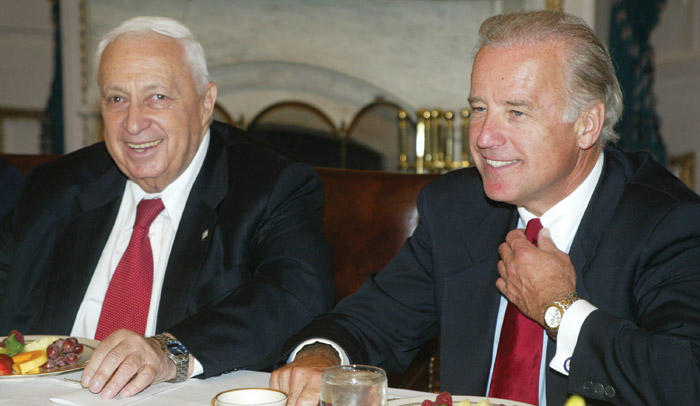
In an almost simultaneous appearance with Clinton in Scranton, Pennsylvania, Vice President Joe Biden also invoked Israel in attacking Trump’s national security policies.

Biden noted Trump’s claim last week that Obama had founded ISIS, the Islamic State terrorist group. Trump doubled down on the claim for days before claiming he was being sarcastic.

“The leader of Hezbollah, a direct threat to our ally Israel, repeated that claim,” Biden said.

Donald Trump says anti-Semitic immigrants will be barred under his plan Read More »

Raisman wins silver, Biles wins record-equalling fourth gold

Simone Biles showed off her sassy moves and explosive tumbles on the floor exercise to win a record-equalling fourth gold at the Olympics on Tuesday.

A day after a wobbly performance on the balance beam ended the American's hopes of leaving Rio with a record haul of five golds for a female gymnast, she was back on form to capture the floor title with 15.966 points.

Aly Raisman completed a one-two for the United States by earning 15.500, while Briton Amy Tinkler burst into tears after a crowd-pleasing floor display to Kenny G's version of the song “Oh, Pretty Woman” earned her the bronze.

However, there was no doubting who was the star of the show.

A sultry routine full of hip-swinging moves to samba music had the Brazilian crowd on their feet as she flew high into the air to execute her trademark element, a soaring double layout with half-twist at the end.

Cries of “oohs” and “aahs” accompanied each of her complex tumbling passes, she drew gasps of admiration as she balanced her entire body weight on her right toes while spinning around twice and had the audience roaring their approval as she bounced her bottom off the floor to strike her final pose.

The ear-to-ear grin, which had disappeared on Monday after she ended up with bronze on the beam, was back on show again and Biles gave the crowd a thumbs up as she waited for her score.

The mark that did flash up not only earned her a fifth medal at her debut Games, it was also the highest score of her four floor performances over the past 10 days.

The 19-year-old team, all around, vault and floor exercise champion became the first woman in 32 years, and fifth overall, to win four golds at a single Games.

The Soviet Union's Larisa Latynina (Melbourne 1956), Hungary's Agnes Keleti (Melbourne 1956), Czech Vera Caslavska (Mexico City 1968) and Romania's Ecaterina Szabo (Los Angeles 1984) were the only other women to have four golds at a single Games.

Raisman wins silver, Biles wins record-equalling fourth gold Read More »

‘Sausage Party’: Where food meets faith (and the F-word)

A new movie out just last weekend focuses on the role of faith in our daily lives: Who shapes our beliefs and what do we do when confronted with facts that directly contradict our belief system? Do we reject faith or double down on embracing it, despite any looming truths? The movie also tackles concepts of ethnic tribalism, moral relativism and more. You might not have guessed that this is Seth Rogen’s latest vehicle, “Sausage Party,” an R-rated animated film.

Don’t mistake the Pixar-spoofing CGI film for “Toy Story” or “Finding Dory” — this film featuring characters cursing a blue streak, is saturated with sexual innuendo and engages in one visually overwhelming and unbelievably graphic sex orgy. NPR called the film “gleefully profane.” 

The film centers on Frank, a protagonist sausage trying to find (and fill) his bun. But the writers — including actor-writer Rogen (who stars as Frank) and his longtime collaborator Evan Goldberg, along with their frequent collaborators and executive producers Ariel Shaffir and Kyle Hunter — went beyond the joke to construct a belief system for sentient food.

“We didn’t set out to write a movie about [faith],” Shaffir said in a phone interview. “The genesis was ‘the secret life of food.’ ” But as the writers discussed it, they realized that “the food can’t believe that they get eaten is the starting point, so what do they believe?” 

The food characters at the film’s fictional Shopwell’s supermarket expresses their beliefs every morning, in a musical number titled “The Great Beyond,” that deliberately recalls show-stoppers in “The Little Mermaid” and “Beauty and the Beast.” Indeed, the song was composed by eight-time Oscar winner and 19-time Oscar nominee Alan Menken, who composed those Disney classics with his late partner, Howard Ashman, and with lyrics by Tony-nominated and Grammy-Award winning lyricist Glenn Slater. 

In the writing process, the filmmakers realized the song — in the script from the start — was actually the key to setting up the structure of faith for the film’s characters. 

“We tied it to the belief system and who created it and how it got changed and perverted throughout the aisles, making them at odds with each other,” said Hunter, who co-wrote the lyrics with Slater, along with Rogen, Goldberg and Shaffir.

‘Sausage Party’: Where food meets faith (and the F-word) Read More »

Nazi ‘gold train’ dig in Poland may finally separate fact from fiction

Treasure hunters in Poland will start digging Tuesday for a hidden train long rumored to be filled with Nazi gold from the end of World War II.

Andreas Richter and Piotr Koper, who a year ago said they had located the train using ground-penetrating radar, will lead 35 volunteers on the privately funded dig in southwestern Poland.

“The train is not a needle in the haystack — if there is one, we will find it,” project spokesman Andrzej Gaik told Agence France-Presse.

The team should know by Thursday whether there is a train at the site, which is located near old railway tracks between the cities of Wroclaw and Walbrzych, Koper told Polish television. Three 300-foot-deep holes are to be drilled with special equipment. The dig is to be live-streamed online.

According to local legend, as German forces fled the Soviet army in 1945, they hid the train containing gold, gems, weapons and valuable art in a secret tunnel near Wroclaw. Despite decades of rumors and amateur searches, the train’s existence has never been proved.

Richter and Koper last year reported finding soil anomalies that hinted at the train’s existence. A study by the AGH University of Science and Technology in Krakow found no such evidence, but concluded there may be a tunnel at the site.

“If we find a tunnel, then that is also a success. Maybe the train is hidden inside that tunnel,” Gaik told AFP.

During the Holocaust, the Nazis melted down jewelry from Jews and other prisoners sent to concentration camps. As Allied forces advanced at the end of the war, the Nazis sent the gold back to Germany. According to experts, not all the gold has been found.

Nazi ‘gold train’ dig in Poland may finally separate fact from fiction Read More »

Former aide to top Nazi opens up, says few would’ve taken stand

Joseph Goebbels’ former personal secretary reveals what it was like working for Adolf Hitler’s chief propagandist in a new film about her life.

The documentary, “A German Life,” premiered last month at the Munich Film Festival.

Brunhilde Pomsel, now 105, revisited the story — from working for leading Nazis to hiding out in Hitler’s infamous bunker — in an interview with the Guardian published Monday. She expressed little guilt about her role in the heart of “the Nazi propaganda machine,” according to the London newspaper, saying most people who say they would have stood up to the Nazis are mistaken.

“Those people nowadays who say they would have stood up against the Nazis – I believe they are sincere in meaning that, but believe me, most of them wouldn’t have,” she said. “The whole country was as if under a kind of a spell … I could open myself up to the accusations that I wasn’t interested in politics but the truth is, the idealism of youth might easily have led to you having your neck broken.”

Pomsel acknowledged that she was involved in “massaging downwards statistics about fallen soldiers, as well as exaggerating the number of rapes of German women by the Red Army,” but she described it as “just another job.” She fondly recalled Goebbels and his wife and children, and said she was terrified to see his transformation during his infamous “total war” speech in February 1943 in Berlin.

Despite being so close to one of Hitler’s closet confidants, Pomsel claimed to be unaware of the genocide she was helping to perpetrate.

“I know no one ever believes us nowadays – everyone thinks we knew everything,” she said. “We knew nothing, it was all kept well secret.”

As to why she was speaking out now, including for more than 30 hours with the filmmakers, after largely keeping quiet for the past 70 years, Pomsel said: “It is absolutely not about clearing my conscience.”

In the last days of World War II, in April 1945, Pomsel joined Goebbels in Hitler’s bunker, where she said they drank alcohol “to retain the numbness.” She recalled learning that Hitler had killed himself, followed a day later by Goebbels and his wife, who also poisoned their children to death.

Pomsel said she only learned about the Holocaust after returning home, referring to it as “the matter of the Jews.”

She later returned to work as a secretary at the state broadcaster, where she went on to become the director of programming, a high-paying job that required travel. She retired at 60, in 1971.

In 2005, when the Holocaust memorial opened in Berlin, Pomsel inquired for the first time about a Jewish friend, whom she said she knew life had become difficult for under Hitler.

“I went into the information center and told them I myself was missing someone, an Eva Lowenthal,” Pomsel recalled.

A man went through the records and soon tracked down her friend, who had been deported to Auschwitz in November 1943 and declared dead in 1945.


Former aide to top Nazi opens up, says few would’ve taken stand Read More »

Gov. Christie signs New Jersey anti-BDS measure into law

TRENTON, New Jersey – The State of New Jersey on Tuesday became the tenth state in the nation to implement a law that opposes the Boycott, Divestment and Sanctions (BDS) movement against the state of Israel.

Flanked by local Jewish community leaders, Governor Chris Christie signed into law a bipartisan measure that prohibits the state from investing in pension and annuity funds that boycott Israel or Israeli businesses.

“Let folks in Israel understand that there still are people in the United States – and people of both parties in this state – who understand that unequivocal, unashamed, unapologetic support of Israel is a policy of the state of New Jersey,” Christie said at a signing ceremony in Trenton, NJ on Tuesday. “And it should be the policy of the United State of America, and hopefully will be in the years going forward.”

“I am happy to add my voice and my signature to this law. It’s with American and Israeli leadership together [that] the world can be a safer place, in every respect,” he added.

Anti-BDS laws have already been enacted in nine states – Alabama, Arizona, Colorado, Florida, Georgia, Illinois, Indiana, Iowa, and South Carolina. And in June, New York Governor Andrew Cuomo 


   ” target=”_blank”>Subscribe here.


Gov. Christie signs New Jersey anti-BDS measure into law Read More »

Jordan’s schools more open to Syrian refugees

This article originally appeared on The Media Line.

In many parts of the world, mid-August is back-to-school season with frazzled parents dragging cranky children through store aisles buying school supplies, uniforms and books. The parents are often eagerly awaiting the first day of school after the two-month school vacation; the kids are often a little less eager.

But in Jordan, Turkey, and Lebanon, more than a million children of Syrian refugees, many of whom fled Syria years ago, are not enrolled in any educational program. In Jordan, bureaucratic obstacles, as well as a poverty rate of more than 86 percent, have made it harder for children to go to school.

According to Bill Van Esveld, senior children’s rights researcher at Human Rights Watch, in Turkey, over half a million children under the age of 18 out of a total of 900,000 Syrian refugee children are not in school, and in Lebanon more than 250,000 children were not in school. In Jordan, there are 145,000 in school and 83,000 not attending school.

One reason is that Jordanian regulations, put in force before the Syrian refugee crisis began five years ago, is that any child who has been out of school for three years cannot return to school. In addition, refugees must present “service cards” issued by the Interior Ministry to enroll in public schools. Refugees who left camps after July 2014, and do not have a male Jordanian relative over 35 years old as a guarantor, are not eligible to receive these cards. Human Rights Watch says the total number of cases could be in the tens of thousands.

Mohammed Thneibat, Jordan’s Minister of Education, today announced that every child in Jordan under the age of 18, can enroll in school for the coming year. Those who do not have service cards will have until the end of the first semester to deal with the government bureaucracy.

“This is a really positive signal,” Van Esfeld told The Media Line. “The hope now is that we have some time to continue to work on the Interior Ministry to make sure they won’t be kicked out of school.”

The obstacles are not only bureaucratic, however. Many children have to work to help their families make ends meet. Child marriage has increased dramatically, and parents often worry about girls’ safety on the way to school.

But as the Syrian civil war has dragged on, and more and more children have missed years of school, there is concern about an entire lost generation of children and teenagers.

“One of our top priorities is to make sure that every vulnerable child gets an education,” UNICEF spokesman in Jordan Miraj Predhan told The Media Line. “Jordan is on the right track but needs support from the global community.”

One new program aims to allow 25,000 children who have not been in school for more than three years, to enroll in special classes to catch up on what they have missed and then join regular classes. However, according to Human Rights Watch, this program would only apply to children age 8 – 12.

The problem of Syrian refugee children not in school gets worse for odler children. Only about 5,500 of an estimated 25,000 or more secondary-school age Syrian children were enrolled in formal education last year. Others are working.

Getting Syrian children back in school is a priority for human rights groups. They hope that a success in Jordan will pave the way for similar programs in Turkey and Lebanon.

“The donor community has woken up and they would like to see a success story in Jordan,” Bill Van Esfeld said. “They say they want to prevent a lost generation but in many ways we already have it.”

Jordan’s schools more open to Syrian refugees Read More »

Mid-August political notes: This race is probably over, now what?

1.

In a comprehensive article for Slate, Yascha Mounk connects many dots and reaches a troubling conclusion: “Liberal democracy is decomposing into its constitutive parts: Over the next decades, much of the world will face a tragic choice between illiberal democracy, or democracy without rights, and undemocratic liberalism, or rights without democracy.”

His article is long, but the gist of it is this: the people all over the world (Turkey, Britain, US) don’t seem to be able to govern themselves wisely. So either the world caves in to populism and becomes much less liberal, or the elites take over to keep liberalism intact while ignoring the masses, namely reducing the level of democracy.

Mounk makes some good points, but not all the points he makes are good. He seems to think that Donald Trump is a more serious problem than terrorism. But is he really?

2.

There’s nothing the media hates more than to admit that a political race is over before it even began. It is bad for ratings. It is bad for business. It makes our professional lives less interesting. It forces us to look elsewhere for stories – and that’s tough. And yet, the Trump-Clinton race seems to be over before it even began. Americans seem to have been convinced – the candidate himself convinced them – that Trump is not fit to be President.

In the coming weeks, you will see more GOP heavyweights announcing their decision to climb off the Trump train wreck. In the coming weeks, the main worry of the Clinton campaign will become: how do we keep the voters interested in coming to the polls. In fact, Clinton is the one who needs Trump to seem at least a little threatening, so less voters decide to skip the voting booths.

3.

Can he still win? Of course he can. As we all know, in politics everything is possible. Yet it is worth remembering that even in politics the extraordinary is rarer than the ordinary. Those who have a commanding lead in the polls usually win (in Truman vs. Dewey the surprise came because of the faulty methodology of surveys, not because of a dramatic last minute change in voters’ minds). Those who seem unfit to rule usually lose. The primary process is problematic and can provide for a quirky result – a McGovern, a Goldwater, a Trump. The general election is less problematic and in most cases ends reasonably. Not always with a President to your liking, but with a President whose positions and views are within reason. In fact, many Americans should be thanking Trump for making so many past potential and actual presidents seem so much more reasonable than they seemed to be at the time.

4.

The fact that the voters consider Trump unfit does not make Hillary Clinton any better as a candidate. But the current political circumstances provide Clinton with a rare opportunity: in an era of polarization she has an opportunity to tilt the US back toward the center, and the growing grumble of the left proves that some people already get it.

Clinton, as a first term president who’d surely like to get a second term, is going to have to be careful as she governs from the center. She cannot afford losing her own party in the process. But she can at least try, and if the public likes what it sees her party might have to play along.

5.

If Trump loses it does not make Clinton a better candidate. If Trump loses it also does not mean that he was wrong on all things. In a year of anger and a craving for change, Trump could have been the next president had he been ten or twenty percent less Trumpish. In other words: some of his instincts aptly reflect how Americans feel – about the world, about immigration, about the economy – even if he, as a candidate, seems like an overstatement.

6.

The next four years in US-Israel relations depend on three things:

A. How Clinton prioritizes Israel related issues

B. Whether Clinton considers it politically beneficial for her to battle with Netanyahu

C. Most importantly: what happens on the ground in the Middle East 

On point A my prediction would be “relatively low.” On point B it would be “somewhat beneficial,” but she would not want to let it become a distraction. On point C all bets are off – but Syria is key. Clinton will have to decide early on if there’s still something she wants to do in Syria that makes sense. It might be too late, though. In fact, she might want it to be too late and save herself the headache. 

7.

Have you noticed that, relatively speaking, there is very little talk about the Jewish vote this year? Four years ago, I considered this matter interesting enough to write a short book about it just prior to Election Day. It began with these paragraphs (I cut them much shorter here):

2008 was a no-brainer.

Yes, for a couple of months there was noise, there was a shadow, there was doubt… In retrospect though, it is clear that Barack Obama vs. John McCain was a no-brainer…. All Obama had to do was pass a couple of simple tests to get his fair share of the Jewish vote…

2004 was a no-brainer.

It was hardly as exciting as the 2008 campaign, and hardly as historic… there was not a chance that Bush would get a share of the Jewish vote much higher than what Republicans had gotten used to from Jewish voters since the early Nineties.

2000 was a no-brainer.

With Joe Lieberman, the first Jewish candidate of a major party for the vice presidency?…

Will 2012 be any different? Can it be any different?

As you know, 2012 was somewhat but not much different. And you are welcome to write the paragraph for 2016. It should not be difficult.

8.

Also note that the candidates are not coming to Israel this summer.

Mitt Romney was in Israel in the summer of 2012. Obama was in Israel in the summer of 2008. But this year the candidates are not coming to Israel. They are not coming for several reasons:

A. There is no real contest for the Jewish vote.

B. Clinton does not need to bolster her image as a stateswoman and Trump has more urgent issues to deal with.

C. Israel’s value as a political asset is somewhat in decline.

Of course, point C is the only one about which Israelis and their supporters have to fret. But in this election cycle reaching such a conclusion is almost inevitable. The Democratic Party has a growing section of Israel-unfriendly leaders and activists. The GOP elected a candidate whose interest in engaging the world is minimal. The comforting news for Israel: Clinton, the next President, is neither this nor that.

Mid-August political notes: This race is probably over, now what? Read More »