fbpx

July 18, 2016

Jewish Party ID: More Democrats, more Republicans

Since the last update of the Jewish Party ID tracker we did not do much.

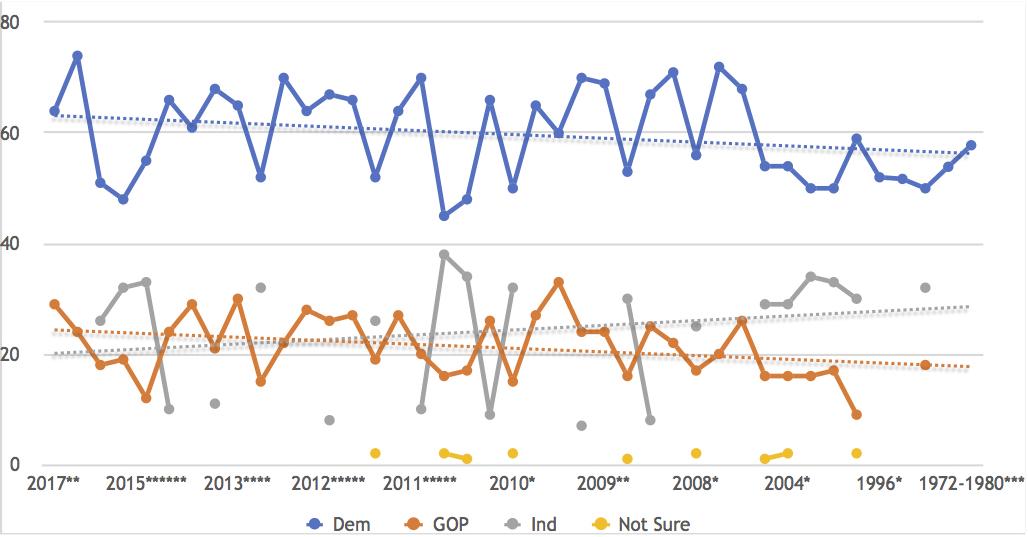
Three sets of data were added, from AJC, PEW, and Gallup. And we also added a trend line to the graph below.

Why a trend line? To show you something that might evade the eye, since it’s very slow and gradual, yet consistent. The percentage of Democratic Jews is climbing, as is the percentage of Republican Jews. The only trend line that is moving downwards is the one of Independents.

Is this surprising? Not really. America is becoming more polarized, and Jews are also becoming more polarized. The trend line is hardly consistent in its ups and downs, and in fact, three years ago we saw an uptick in the number of Jewish Independents. Still, a gradual, slow, polarization seems to be happening. Another one of the many themes that could make Jewish unity and dialogue more complicated.

[table id=1 /]

Jewish Party ID: More Democrats, more Republicans Read More »

Peter Beinart joins US Jews for civil rights-style protest in West Bank

Dozens of American Jews spent Friday in the West Bank practicing nonviolent resistance against Israel’s presence here.

On hand to help were some bold-faced names in the American Jewish community’s Israel debate, including Peter Beinart, a leading liberal U.S. Jewish thinker, and Amna Farooqi, the Muslim president of J Street U.

The activists used tactics familiar from the U.S. civil rights movement to provoke Israeli authorities in Hebron — the most volatile city in the West Bank and the site of frequent clashes between Israelis and Palestinians. When many of the activists staged a sit-in and refused a military order to leave a Palestinian property, Israeli police detained six of them with dual Israeli citizenship.

Though anti-occupation demonstrations in the West Bank are nothing new, such a large group taking action under the banner of American Judaism is.

The some 45 Americans and other Diaspora Jews came to the West Bank earlier in the week with the Center for Jewish Nonviolence, a new movement that organizes Diaspora Jews to challenge Israeli rule in the West Bank. The 10-day trip is dedicated to community service and political action on behalf of the Palestinians.

The activists expressed confidence they were part of a historic shift.

“I feel like I’m seeing the emergence of a new leadership. It’s really remarkable,” Beinart told JTA. “People will try to write these guys off as lefties that don’t have any connection to the Jewish community. But it’s amazing when you talk to them, these kids actually come from the bosom of the Jewish community. A lot of them are affiliated. A lot of them are doing this without the knowledge of their families, with a lot of pain in their families.”

On the schedule Friday was an action in partnership with Palestinian and Israeli activists to turn what they said was a forsaken Palestinian metal factory in the Israeli-military-controlled areas of Hebron into the city’s first Palestinian movie theater. They expected to be disrupted by police and possibly arrested.

During the bus ride from their hotel in Bethlehem to the factory, the activists sang “Olam Chesed Yibaneh” (“The World is Built with Loving Kindness”) in English and Hebrew. Most were American Reform or Conservative Jewish millennials from major American cities like San Francisco, Chicago and New York. But older generations, Orthodox Judaism, and Europe and Australia were represented as well.

The activists have deep Jewish ties. Many belong to left-wing Israel advocacy groups such as J Street and the New Israel Fund, and others to groups that more deeply divide the pro-Israel community, including Jewish Voice for Peace, which supports the Boycott, Divestment and Sanctions movement against Israel, and IfNotNow, which holds its own sit-ins at U.S. Jewish groups.

Ethan Buckner — a 26-year-old organizer for an environmental group in Berkeley, California, and a singer-songwriter with a eyebrow piercing — said he had avoided confronting the Israeli-Palestinian conflict for most of his life. But he said Israel’s “murder” of Palestinian civilians during the 2014 Gaza War pushed him to get involved with IfNotNow protests.

Israeli authorities removing activists from the Center for Jewish Nonviolence from property in the West Bank city of Hebron, July 16, 2016. 

Buckner said his father, a Conservative cantor in Minnesota, had previously tolerated but not endorsed his anti-occupation activism. Sharing with his dad his firsthand experiences of “how the occupation is a nightmare” for Palestinians and also Israelis seemed to have an effect, he said.

“Those stories and photos really moved him in a way that I haven’t seen him moved before to really start to also take responsibility. I think there’s a growing sense of understanding of how American Jews share responsibility for what is happening,” he told JTA.

At the Palestinian property — a dirt lot with several low-slung cement structures — the Center for Jewish Nonviolence activists were joined by their Palestinian and Israeli partners. The dozen or so Palestinians were part of a local movement called Youth Against Settlements. The handful of Israelis were from All That’s Left: Anti-Occupation Collective, a Tel Aviv-based group that engages Diaspora Jews. More activists from the Israeli group had tried to join, but their bus was turned back by police at the Gush Etzion Junction en route from Tel Aviv.

One of the Palestinians, Jawad Abu Aisha, said the property was declared a closed military zone at the start of the second intifada in 2001, and even since that order was lifted in 2008, he was kept from reclaiming the factory by military and settler harassment. The activists said this was a common experience for Palestinians with property in the Israel-controlled section of Hebron.

Hebron is home to some 200,000 Palestinians and fewer than 1,000 Israeli settlers, who live under heavy military protection. The city, religiously significant to both Jews and Muslims, has long been a hothouse of Jewish-Palestinian violence. Many of the Palestinian terrorists involved in the recent wave of terror against Israelis have come from Hebron. In March, an Israeli soldier shot to death a felled Palestinian attacker.

Working with foreigners is central to Youth Against the Settlements’ strategy for supporting fellow Palestinians living in Hebron — and so much the better if those foreigners happen to be American Jews, according to a leading activist in the movement, Mutasem Hashlamoun.

“Palestinian media is always at our protests, but there is much more international media here for this group,” Hashlamoun told JTA, gesturing toward the many journalist documenting the activists. “For Palestinians, too, who only see the settlers and the soldiers and think Jews are just against them in everything, having Jews chanting against the occupation helps change their mindset.”

After sneaking onto the property, the activists got to work clearing scrap metal, weeds and debris and — once it was clear they had been spotted — singing Jewish and protest songs. Amid the work, bags of popcorn labeled “Cinema Hebron” were passed around, and a handmade sign that read “Cinema Hebron: Coming Soon” was triumphantly erected.

Meanwhile, a growing number of soldiers, police officers and settlers gathered on the street. They recorded the activists, and the activists recorded them. One of the settlers, a longtime Hebron resident named Tzipi Schlissel, told JTA the Palestinians were using the activists as a weapon against the Jews. She said the property they were cleaning up had been used by terrorists in the past.

“[The activists] think they’re doing a good thing, but they’re really helping the terrorists,” said Schlissel, whose father, a prominent settler rabbi named Shlomo Ben Raanan, was killed by a Palestinian terrorist in 1998. “I’ll tell you, in the Holocaust, Jewish people helped Hitler, too.”

After a few hours of work, a dozen soldiers and police officers entered the property to declare it a closed military zone. Thirty or so activists sat on the ground, locked arms and sang “Lo Yisa Goy,” a Hebrew song about peace. The authorities quickly pulled up the activists one by one and shepherded them up the street.

Israeli citizens were singled out and detained. Five were dual American citizens, the other was Canadian. They were charged with presence in a closed military zone and illegal gathering and questioned. Two were also charged with organizing an illegal gathering.

Ilana Sumka, the CEO of the Center for Jewish Nonviolence, said the authorities’ apparent reluctance to detain American Jews validated her movement’s approach.

“I take that as evidence that there’s tremendous power in our strategy. Right? Because the Israeli military didn’t want to have a skirmish with American Jews, I think because they understand the American Jewish community is essential to Israel’s future,” she said. “We’re already planning our next nonviolent campaign, which will take place around the milestone of 50th anniversary of the occupation next summer.”

Israel gained control of the West Bank following the Six-Day War in 1967.

An officer at the Kiryat Arba police station referred JTA to the Israel Police for comment. The police did not respond to questions about the reason for the arrests or the targeting of Israeli citizens.

In response to a JTA inquiry, the Israel Defense Forces said: “On Friday, June 15, dozens of people gathered on a property in Tel Romeda. The gathering evolved into a disturbance of the peace, including clashes with IDF forces. In order to prevent escalation into violence, the Military Commander ordered the closure of the area. Accordingly, non residents were required to leave the premises.”

After being evicted from the property, most of the activists set off for the police station where the detained Israelis were being held, in the neighboring religious Jewish settlement of Kiryat Arba. Singing and holding hands, they marched across town — down the empty and heavily militarized Al-Shuhada Street and past the Tomb of the Patriarchs. At various points friendly soldiers and a Druze police officer helped guide them.

Once at the station, the activists demanded the release of the Israelis and were refused. That led to more sitting, singing and chanting in the hot afternoon sun.

Soldiers and settlers – swaggering teenage boys in knit kippahs and giggling young girls – were bewildered by the Jews protesting outside their homes in Hebrew. One settler boy held out his phone so his friend on the other end could hear their singing. Some of the girls took photographs and video, but protested when cameras turned toward them.

Activists were asked to translate their bright blue shirts, which read: “Occupation is not our Judaism.”

At one point, a soldier pulled out of the prison gate in a white jeep and sang along with the activists over the car’s loudspeaker, briefly raising hopes that he was a supporter. But he ended his performance by chanting “oc-cu-pa-tion,” pumping his fist to the tune. Other soldiers laughed.

Around 2 p.m., the activists left the Israelis in the hands of legal counsel and, declaring a victory of sorts, headed to a late lunch. The Israelis were released just ahead of Shabbat and banned from Hebron for two weeks. The Center for Jewish Nonviolence activists are set to fly home Wednesday. Cinema Hebron will have to wait.
Peter Beinart joins US Jews for civil rights-style protest in West Bank Read More »

Bernie Sanders picked as a headlining speaker at Democratic convention

Bernie Sanders will be a headlining speaker at the Democratic convention.

Sanders, the Independent senator from Vermont and the first Jewish candidate to win major party nominating contests, will speak the first night, July 25, as will Michelle Obama, the first lady.

Last week, Sanders endorsed Hillary Clinton, who won the Democrats’ presidential nomination. A prime speaking slot was one of his conditions for the endorsement, as well as the inclusion in the platform of some of his campaign planks, including a $15 minimum wage, Wall Street regulatory reforms and an overhaul of campaign finance.

Also speaking, according to the convention press office, are President Barack Obama, Vice President Joe Biden and former President Bill Clinton. Chelsea Clinton, the daughter of the presumptive and former president, will speak on July 28, the last night of the convention, prior to Hillary Clinton.

Bernie Sanders picked as a headlining speaker at Democratic convention Read More »

UNRWA’S dark agenda

UNRWA was founded under UNGA Resolution 302 in 1949. Set apart from the UNHCR that deals with all the world’s refugees, UNRWA is unique and only deals with Palestine refugees. Its separateness and absurd definition of inherited refugee status is reminiscent of Augustine’s “eternal witness,” whereby Jews were permitted to exist, but only in perpetual impoverishment. UNRWA does not merely permit ongoing refugee status: it demands and encourages it.

In the fourth century, Church founder Augustine coined the term “eternal witness” to proscribe the purpose of Jews. Under this dictum, Jews were cast into a pariah status of rejection, homelessness, loathing and impoverishment. This status developed with European culture, expressed not only in church sermons, but also in the arts and socio-political structures. In 1215, The Fourth Lateran Council decreed that Jews wear distinguishing clothes and badges to be identified as objects of loathing.

While some changes occurred after the Enlightenment including Napoleon’s liberation of Jews, Augustine’s stigma remained. Consequently, about half of German and Austrian Jews converted to be accepted into mainstream society, Heine and Mahler being well known examples. The Hep-Hep riots, the Edgardo Mortara and Dreyfus Affairs as well as the Holocaust, significantly occurred after the Enlightenment.

The arts, maintained the image of the homeless Jew. Writers such as Goethe, in his Wilhelm Meisters Wanderjahre wrote of a new society in America, that excluded Jews. Wagner’s operas reflected his political beliefs such as the metaphor of the wandering Jew in the Flying Dutchman.  Despite Jewish assimilation, artists such as Manet, Cezanne and Degas publicly supported French popular incitement against Jews while Renoir considered Jews to be “natives of no country.” The theme of “eternal witness” prevailed well after the Holocaust—in the popular Arthur Mee Childrens’ Encyclopaedia, Jews were depicted as having been condemned to wander for having rejected Christ.

In 1904, Pope Pius X advised Herzl that he could not support a Jewish state, “as Jews had not recognised our Lord, therefore we cannot recognise the Jewish people.” He further said that while it was unpleasant to have the Turks in control of Jerusalem, Jewish control was out of the question.

In 1964, Pope Paul Vl, visiting Jerusalem, declined to refer to Israel by name, meet the Chief Rabbi or visit places of Jewish significance.  The following year, he promulgated Nostra Aetate which absolved Jews of collective responsibility for the death of Christ and decried antisemitism. Yet the Vatican only established relations with Israel in 1993. The present Pope, Francis usually refers to Israel as “the Holy Land” rather than by its name which implies sovereignty.

Leon Poliakov referred to Israel as “the Jew among the nations.” The implication was that Israel as a sovereign state, experiences similar pariah status as envisaged by Augustine.

Accordingly, Israel is singled out for multiple condemnations at various UN bodies. Displaying its anti-Jewish bias, UNESCO dejudaizes the Judaism’s holiest places, reassigning Arab names to the Western Wall and other Jewish sites.  The EU, whose constituent states mostly do not vote against such resolutions, also insists on special labelling of Israeli products from the disputed territories, ignoring all other territorial disputes. The ICRC only permits Israeli membership without its Star of David insignia. The list is by no means exhaustive, but illustrates the extent to which “the Jew amongst the nations” has to struggle against isolation.

UNRWA, originally meant as a temporary refugee agency for displaced Arabs in the 1948 war with Israel, is the only refugee agency that specifically has an agenda that differs substantially from the other UN refugee agency, the UNHCR. Whereas UNRWA employs nearly 30,000, to service some 5 million people, uniquely including the descendants of the original 650,000, UNHCR has 8500 employees to service 65 million worldwide and does not include descendants of resettled refugees.

Unlike UNHCR, UNRWA has politicised its role, colluded with Hamas and continues to perpetuate the plight and uncertainty of refugees and their destinies. It has tailored its refugee programs to enhance the misery of these people for its own dubious ends. UN Watch has documented UNRWA staff posting anti-Semitic cartoons while UNRWA school pageants proudly incite and demonise Jews and their state.

Some seventeen centuries after Augustine’s “eternal witness,” contempt and loathing have morphed into many forms including the current concept of UNRWA. The purpose was always to shame the Jew. UNRWA has enthusiastically adopted this role, reinforced by annual  commemorative events such as Nakba (catastrophe) Day that encourages resilience and hope to return to Palestine, rather than resolving the refugee crisis per se. Noteworthy are rejections of offers such as by Canada in 2001,to absorb Palestinian refugees. In other words, UNRWA primarily seeks to replace a UN member state, rather than improve lives.

UNRWA encourages Nakba events in order to label Israel as a nation of guilt, shame and born in sin. Encouraging Palestinians to be resilient and hopeful, instead of fomenting new lives as UNHCR does, Palestinians are openly encouraged to await their “return to Palestine”—a euphemism for Israel’s dissolution.

UNRWA’s role is the “Jew badge” of Israel—a modern manifestation of Augustine’s “eternal witness,” primarily meant to shame and loathe.

Some US lawmakers are reviewing the efficacy of UNRWA which is to be welcomed. Yet UNRWA’s purpose goes beyond refugees and a balance sheet.

The time has come for the US and EU, both committed to fighting antisemitism, yet also UNRWA’s largest donors, to take a sober and honest look as to what exactly they are funding. Denial and rationalisation are no longer defensible.

Ron Jontof-Hutter is a writer and fellow at the Berlin International Centre for the Study of Antisemitism. His satire on political correctness and antisemitism, “The trombone man: tales of a misogynist,” was recently published.

UNRWA’S dark agenda Read More »

Former Hawaii governor: Unlike Democrats, GOP united on Israel

On the first day of the Republican convention in Cleveland, with fewer traditional Republican Jews “>unanimously approved by the party’s platform committee last week, as proof that the Republican Party is the home for Jewish voters in the November election.

American Jews, the former Hawaii Governor stressed, in five of the last six presidential elections have supported the Republican candidate by increasing numbers. “The support for Republican presidential candidates by American Jews have tripled over the past twenty-five years,” she said.

Though she urged Republicans to support the Republican ticket, Lingle made no mention of Trump’s stance on Israel. Instead, she blasted President Obama and Hillary Clinton’s foreign policy. “Clinton and Obama have treated our allies as strangers, insulted their leaders, and ignored their advice and interests,” said Lingle.

Former Hawaii governor: Unlike Democrats, GOP united on Israel Read More »

The politics of fear

Newt Gingrich– he’s no George Washington.  In fact, as Lloyd Bentson might have said, he’s no Dan Quayle either.

Entering this week’s Republican National Convention, it’s remarkable how low our political rhetoric has sunk.  Gingrich last week offered his vision of how best to restore calm to an increasingly anxious and traumatized nation.  The former Speaker and erstwhile candidate for Vice President of the United States suggested that “we should frankly test every person here who is of a Muslim background, and if they believe in Sharia law, they should be deported.” 

Tolerance in America has a complicated and tortured history.  But the ideal is clear, and Jews know its vision well.  After nearly 2000 years of persecution in Christian Europe, Jews arrived on the shores of a nascent United States to find the blueprint for a very different kind of society. In his famous 1790 Letter to the Jews of Newport, George Washington declared that the United States “gives to bigotry no sanction, to persecution no assistance, requires only that they who live under its protection should demean themselves as good citizens, in giving it on all occasions their effectual support.”

America has not always lived up to that standard. In the 1930s, mired in the depths of the Depression and facing the looming Nazi threat in Europe, the State Department sharply curtailed Jewish immigration from Europe.  The most public manifestation of that xenophobic policy was American officials’ refusal to allow the MS St. Louis permission to dock in this country, ultimately forcing its Jewish refugee passengers back to Nazi Germany and into the gas chambers.  Citing in part fears of Nazi agents embedded among the clamoring Jews, the heartbreaking action was heavily influenced by inflamed anti-Semitic rhetoric, emanating from the likes of Father Charles Coughlin and Henry Ford.

Later, again fearing an unseen and ill defined threat of alien forces, the United States forced nearly 120,000 persons of Japanese descent into relocation centers during most of World War II.  In 1944, the United States Supreme Court affirmed this tragedy, ruling that the concerns of wartime, and particularly the fear of espionage, justified such extreme measures. 

History has ultimately been unkind to these deviations from the vision of American tolerance.  Critically, they have never resulted in the increase of personal safety for Americans their proponents have promised.  The wartime restrictions on Jewish immigration have regularly been cited as having been inconsistent with the nation’s historic role as a refuge from evil.  As for the wartime relocation of Japanese Americans into relocation centers, the acting U.S. Solicitor General issued a rare “admission of error” in 2011, conceding the suppression of vital evidence, and nullifying the precedential impact of the Supreme Court’s ruling.  Even former Supreme Court Justice Antonin Scalia noted that the decision “will not survive,” and will eventually be overruled.

These are no doubt difficult, and in some ways unprecedented times. Just as the world seemed to be spiraling toward collapse in the 1930s and ‘40s, international terrorism and domestic gun violence today appear to be rampant and out of control.  Coupled with dizzying technological change, it feels as if real security is quickly slipping away.  The sense of dislocation is palpable; the fear understandable and real.  And the result is a politics of fear.

The rising threats of the 21st century may be unique, but the moral choices they present are not.  Americans– in World War II but at other times as well– have been tempted to seek illusory comfort by lashing out at the “other,” to close doors, to circle the wagons, to abandon the principles that make this country great.  In each instance they sought to build a wall and, to paraphrase Paul Simon, “to keep out the foreigners, they made it strong.” 

There is a reason that Donald Trump speaks the way he does.  He lashes out at Mexicans generally as “rapists” and “drug dealers.” He stirs fears of unnamed Muslims celebrating in the streets after 9/11.  He suggests barring Muslims as a group from entering this country.  

He accuses a federal judge of bias based upon his national origin.  He accuses unnamed blacks of calling for a moment of silence for the Dallas police shooter.  And his sycophant would-be running mate suggests that a test to evaluate Muslim religious belief might be the solution to our woes.

They speak in such vagaries because there is simply no evidence to subject an entire people, an entire nation, an entire belief system, to collective punishment. Those who seek to do so need, by definition, to resort to demagoguery, innuendo, and broad strokes of accusation. They stir up the suspicion necessary to indict the mysterious stranger, to abandon cherished values, and to jettison the ideals upon which this nation was founded.  People are increasingly terrified of the unknown, of violence that appears unabated, and they seek comfort amid simple answers.  They seek someone to blame.  And at times like these, sensing a leadership vacuum, there’s always someone willing to stir the pot and provide that scapegoat.  Rational evidence of individual culpability is too cumbersome, fealty to American values too idealistic.  Much easier to cut to the chase, to root out the problem with a single stroke of group exclusion.

These are not normal times, and this is not a normal election.  The world is an uncertain place; the fear of lost personal safety is legitimate, and that fear is real.  The stark choices presented are the same as they have always been in such times: the impulse towards Father Coughlin’s darkness, versus the vision of George Washington’s light.  Until now, more or less, our nation has generally found its way back to Mount Vernon.  

Make America great again?  Rarely has the call seemed more urgent.  Now is the time to defeat the gathering forces of darkness, and confine this ugly movement to its rightful place in the dustbin of history.

Stuart Tochner is a shareholder at Ogletree, Deakins, Nash, Smoak & Stewart, a national employment law firm.  He is also an executive committee and board member at Temple Beth Am, currently serving as the Vice President of Personnel, and a member of the Board of Trustees of Camp Ramah in California.

The politics of fear Read More »

Loss has no closure

I was just listening to the news about, Lane Grave, the 2 year old boy that was dragged away, by an alligator at Disney World in Florida.

The horror happened in front of his parents. As it was reported, the authorities had given up on finding the child alive, but according to the newscaster, they were continuing their search to find the body in order to bring “closure “ to the parents.

I have heard the word “closure” used countless times over the years, and as a long time psychotherapist specializing in helping victims of crime and trauma, it is my firm opinion that using this word in this context should stop. In my years of working with those who have had their lives torn asunder, there is no closure to the tragic grief that comes with unexpected loss. It is that road which has no end and in the case of the missing toddler, finding this body will not alter or diminish the devastation this family is just beginning to understand.

People want to believe that many of life’s tragedies can be tidied up, that wounds can be mended, and that peace and order can be restored. As other people’s misfortune reminds us, we too are vulnerable to the vicissitudes of life. We feel threatened when we see how fragile life can be, and to rid ourselves of our anxieties, we make up a story of an ending called “closure” to make us feel better.

In fact, we do get better. Wounds do improve, but the road back is often long and circuitous. The use of the word closure is an indicator of wishful thinking and it is infuriating to those of us who know the truth and treat those pained people who have been sold this easy ending to tragic circumstances.

My wonderful father was murdered almost eight years and the murderer has never been arrested. It is easy to imagine that if only they could find the bastard, then maybe, I and my family could finally have “closure” and be freed from the profound pain and ache in our hearts. I would love to see this person found and convicted. I would love to see justice on behalf of my father. But, my father is never coming back, nor is this two year old child who lost his life at Disney World. I don’t write this piece in anger, I simply want others to understand the gravity of loss and know that life is often more complicated than trying to simplify it with one word.

Lin Manuel Miranda, the author of the Broadway show Hamilton, wrote the best words I’ve ever heard about loss. The song “It’s Quiet Uptown” captures perfectly the pain Alexander and Angelica Hamilton feel after the death of their son Phillip. “There are moments that words don’t reach—There is suffering too terrible to name—you hold your child as tight as you can and push away the unimaginable—The moments when you’re in so deep it feels easier to just swim down”

Rick Shuman, Ph.D. is a psychotherapist in Los Angeles.

Loss has no closure Read More »

Turkey’s former attache to Israel reportedly confesses to planning coup

Turkey’s former military attache to Israel reportedly has confessed to plotting the failed military coup to unseat President Recep Tayyip Erdogan.

Citing Turkey’s state-run Andalou news agency, The Times of Israel reported Monday that Akin Ozturk made the confession while under interrogation. In photos circulating in Turkish media Ozturk, who is also the former chief of the Turkish Air Force, appears to have a number of injuries to his head and upper body.

The coup began late Friday night and was quelled by the next day. More than 200 died during the attempt. Thousands of soldiers were rounded up on Sunday by forces loyal to the government on suspicion of being involved in the coup.

In statements to Turkish media over the weekend, Ozturk denied being involved in the attempted coup.

Ozturk, who retired from the Turkish army last year, was the country’s military attaché to Israel from 1996 to 1998, according to The Times of Israel.

Last month, Turkey and Israel formally reinstated diplomatic relations following a six-year freeze. On Monday, Israeli Prime Minister Benjamin Netanyahu said the coup attempt will have no effect on the agreement between the two countries.

A terror attack at an airport in Istanbul hours after the reconciliation deal was signed killed at least 41 and injured more than 230.

Turkey’s former attache to Israel reportedly confesses to planning coup Read More »

NFL player Nate Ebner makes US Olympic rugby team

Nate Ebner of the New England Patriots has qualified for the U.S. Olympic men’s rugby sevens team competing next month at the Rio Olympics, becoming the only NFL player to make a U.S. Olympic team.

Ebner, 27, who is Jewish, was included on the 12-man roster released Monday by USA Rugby. Joining Ebner on the squad is another Jewish player —  Zack Test, 26, of Southern California.

According to ESPN, Ebner took a leave of absence from the Patriots in May to train and attempt to make the Olympic team. He will rejoin the Patriots — Ebner is a safety and special teams standout — following the Olympic rugby tournament from Aug. 6 to 11.

The Ohio native was the youngest player ever to make the U.S. men’s sevens team when he joined the squad at 17. He went on to become an All-America rugby player at Ohio State University before joining the school’s football team and being drafted by the Patriots in the sixth round of the 2012 NFL draft.

Ebner’s father, Jeff, was the Sunday school principal of Temple Sholom in Springfield, Ohio. In 2008, he was killed at 53 by a man who beat him while attempting to rob his auto reclamation shop.

“He taught me the importance of being Jewish,” Ebner told the Jewish Journal of Massachusetts last year. “My dad stressed finishing strong in every task I did and conduct myself always in a proper manner.

Speaking of his grandparents, he added: “They make sure I keep up with Jewish events and that I remember my origins.”

On the Patriots, Ebner is teammates with Julian Edelman, whose father is Jewish and who reportedly has been getting in touch with his Jewish side over the past several years.

Test, who attended the Ronald C. Wornick Day School in Foster City, California, has been a member of the U.S. sevens team since 2009. He played in the Maccabiah Games in Israel.

Rugby sevens is a fast-paced version of the sport featuring teams of seven players playing seven-minute halves — as opposed to the normal 15 players and 40-minute halves. This year marks its Olympic debut.

Rugby has not been played in the Olympics since 1924. The U.S. team that won the gold medal that year included Samuel Goodman, a Jewish player who also managed the club. Goodman also played for and managed the U.S. team that won the gold four years earlier.

NFL player Nate Ebner makes US Olympic rugby team Read More »

Cleveland police chaplain delivers invocation at Republican convention

The Orthodox rabbi who serves as chaplain to the Cleveland police delivered the invocation at the start of the Republican National Convention in Cleveland.

Rabbi Ari Wolf, who also works as an administrator for the haredi Orthodox Telshe Yeshiva in the Ohio city, was a last-minute stand-in, according to Matzav.com, which first reported his invitation to the convention. Wolf replaced the prominent Manhattan modern Orthodox Rabbi Haskel Lookstein, who withdrew Friday, three days before the convention began.

In the invocation Monday afternoon, Wolf asked for God’s blessings for the convention, and for God’s protection as America faces threats at home and abroad. 

“We ask your blessings on our country and our people,” Wolf said. “We seek your guidance and continued protection. Dear God, we live in perilous and dangerous times. Today, our beloved country is under attack, our family values, our moral principles and even our very democracy is threatened.”

Wolf’s invocation also nodded to the recent killings of police officers in Baton Rouge, Louisiana, and Dallas. He asked for God to “watch over and safeguard our police officers and all our first responders who work each day and night in every city, town and hamlet of our great nation to protect us and our freedoms.

The rabbi began and ended the invocation in Hebrew. He referred to God at the start as “avinu she’bashamayim,” our heavenly Father, and ended with the three-verse priestly blessing asking for God’s protection and peace.

Lookstein had accepted the invitation as a gesture to Ivanka Trump, whose Jewish conversion he oversaw, and whose father Donald Trump is the presumptive Republican presidential nominee. But following intense pressure from alumni of the Ramaz School, the elite Manhattan Jewish prep school he once ran, Lookstein withdrew.

“Unfortunately, when my name appeared on a list of speakers at the convention, without the context of the invocation I had been invited to present, the whole matter turned from rabbinic to political, something which was never intended,” he wrote in a letter Friday to his community. “Like my father before me, I have never been involved in politics. Politics divides people.”

Lookstein’s invocation, whose text he released, seemed to give a subtle rebuke to Trump’s rhetoric. The invocation would have asked God’s protection from threats “from within, by those who sow the seeds of bigotry, hatred and violence, putting our lives and our way of life at risk.”

Cleveland police chaplain delivers invocation at Republican convention Read More »