Republican presidential front-runner Donald Trump retweeted an account called “@WhiteGenocideTM” on Friday, prompting a backlash on social media over the real estate billionaire's sharing of an apparent neo-Nazi's depiction of rival candidate Jeb Bush.
Trump, who is campaigning for the first contests on Feb. 1 in Iowa and Feb. 9 in New Hampshire, is known for attacking other candidates competing for the party's nomination to run for the White House in November's general election.
Trump retweeted Donald Trumpovitz, who uses the handle “@WhiteGenocideTM,” gives the location of the account as “Jewmerica” and features an image that references George Lincoln Rockwell, a prominent figure in the neo-Nazi movement in the United States.
The tweet read, “@realDonaldTrump Poor Jeb. I could've sworn I saw him outside Trump Tower the other day!” and included a photoshopped image of Bush holding a “Vote Trump” sign.
Tim Miller, communications director for Bush, tweeted in response on @Timodc: “The Godwin's Double: Trump's anti-Jeb retweets now include one from a Nazi's account and another calling Jeb a Nazi.”
The Trump campaign did not immediately respond to a request for comment.
In November, Trump retweeted and then deleted a collage attacking former Florida governor Bush that featured a swastika.
Some on Twitter were appalled and perplexed by Friday's retweet by Trump, who has not sought the backing of white supremacist groups but several say his success has helped them win new supporters.
Kris Hammond (@KrisHammond), who identifies himself as a civil rights attorney on Twitter, said: “#Trump retweets account with the words “white genocide” in the handle. Plays to #whitenationalism base.”
Natalie Borden (@Natalie_Borden) tweeted: “Guy, who likely will be a POTUS, retweeting a Twitter user named “White Genocide” who says he lives in “Jewmerica.” What a day…”
A week ago, a white supremacist group said it had placed thousands of automated phone calls in Iowa urging voters to support Trump's bid for the Republican nomination because “we don't need Muslims.”
The telephone campaign is led by the American Freedom Party, which on its website says it “shares the customs and heritage of the European American people.”
Five people were killed in a school shooting in a remote part of Saskatchewan on Friday and a suspect is in custody, Canadian Prime Minister Justin Trudeau said.
Two people are in critical condition after the shooting in La Loche, which is about 600 km (375 miles) north of the city of Saskatoon.
“Obviously this is every parent's worst nightmare,” Trudeau said.
Mass shootings are relatively rare in Canada, which has stricter gun laws than the United States. In the country's worst school shooting, 14 college students were killed at Montreal's Ecole Polytechnique in 1989.
Extra doctors and nurses have been sent to treat patients in Keewatin Yatthe Regional Health Authority's 16-bed hospital, said spokesman Dale West.
Teddy Clark, chief of the Clearwater River Dene Nation, said that his daughter told him about the shooting, the Canadian Broadcasting Corporation reported.
“I know there are some casualties and there are some people that are in critical condition that are being medivaced to the nearest cities, I would imagine Fort McMurray or Saskatoon.”
La Loche Grade 10 student Noel Desjarlais told the CBC that he heard multiple shots fired at the school.
“I ran outside the school,” Desjarlais said. “There was lots of screaming, there was about six, seven shots before I got outside. I believe there was more shots by the time I did get out.”
A cellphone video taken by one resident and broadcast by the CBC showed students walking away from the school through the snow-covered ground and emergency personnel moving in.
La Loche Community School is a pre-kindergarten to Grade 12 school, which houses about 900 students in two buildings.
There was an emergency at the building that houses grades 7 to 12, the school district's Facebook page said. Both that building and the elementary school were put on lockdown.
In 2014, a teacher expressed concern about violence at the La Loche school, citing an incident where a student who had tried to stab her was put back in her classroom after serving his sentence, and another attacked her at her home.
“That student got 10 months,” Janice Wilson told the CBC of the student who tried to stab her in class. “And when he was released he was returned to the school and was put in my classroom.”
President Barack Obama will speak at a ceremony honoring Righteous Among the Nations at the Israeli embassy in Washington, D.C., a sign of warmed ties between Obama and Israel’s government.
Obama’s appearance at the Jan. 27 ceremony, marking International Holocaust Remembrance Day and conducted together with Yad Vashem, Israel’s Holocaust memorial authority, is the latest signal that the Obama administration and the government of Israeli Prime Minister Benjamin Netanyahu are putting behind them tensions created by the Iran nuclear deal.
An official ceremony for Righteous Among the Nations has never before been held in the U.S.
“It is a great privilege to recognize, on behalf of the Jewish state, the heroism of those to whom the Jewish people owe the highest debt of gratitude,” Israeli ambassador Ron Dermer said in a statement. “I also deeply appreciate President Obama’s acceptance of our invitation to speak at this historic event. It will be a worthy tribute to the worthiest among us.”
Ties between the U.S. and Israeli governments were frayed during the months leading to the finalization of the sanctions relief for nuclear rollback deal between Iran and six major powers, which Netanyahu vigorously opposed.
The deal went through late last year and was formally launched last week. In recent months, the sides have made an effort to show that while they still disagree on the deal, they are back to working closely together. Netanyahu and Obama had a friendly summit in November in Washington.
Netanyahu met this week at the World Economic Forum in Davos, Switzerland, with Secretary of State John Kerry, the Iran deal’s lead champion, and Vice President Joe Biden. All parties said the meetings were productive. Bilateral negotiations to continue and to expand the U.S. defense assistance package to Israel have intensified in recent weeks.
“I think he recognized that the fight’s over and we can move on,” Kerry told the media this week after meeting with Netanyahu.
Dermer’s invitation and Obama’s acceptance is notable in itself. The ambassador was deeply involved in making the case in Congress against the Iran deal, and reports have circulated that some administration officials prefer not to deal with him. Netanyahu has stood by his envoy, and a number of Democrats in Congress, including backers of the deal, have praised him for striving to maintain good relations with the caucus despite differences over the deal.
Yad Vashem is the authority that confers the title Righteous Among the Nations upon non-Jews who risked their lives to save Jews during the Holocaust
The ceremony will recognize Roddie Edmonds, an army sergeant who while being held captive in a German prisoner of war camp, refused orders from a German commander to identify Jewish POWs under his command; Lois Gunden, an American teacher in France who made the children’s home she ran a safe haven for Jewish children, and Walery and Maryla Zbijewski, a Polish couple who cared for a Jewish girl who had managed to flee with her mother from the Warsaw Ghetto.
After public furor over the second consecutive year of all-white Oscar acting nominations, the Academy of Motion Picture Arts and Sciences voted to endorse new procedures for increasing diversity at the Oscars and within the academy itself.
The changes will affect the academy's voting requirements, its membership structure and governing bodies, with the goal of doubling the number of women and minority members by 2020.
“The Academy is going to lead and not wait for the industry to catch up,” the academy's president Cheryl Boone Isaacs said in a statement.
The series of changes were approved Jan. 21 at a special meeting of the academy's 51-member governing board, according to the New York Times.
The most significant change implemented is related to the group's voting procedures and will most likely affect older academy members who are no longer working. Beginning next year, voting status will be granted only to those members who have made at least one movie in the last 10 years. Any member who has not made a film in a decade will become an “emeritus” member who does not pay dues and is allowed “all the privileges of membership, except voting.”
The academy is also promising to launch “an ambitious, global campaign” to recruit more diverse members and will immediately add three new seats to its Board of Governors that will be nominated by Boone Isaacs and confirmed by the board. Efforts to increase diversity within the academy's executive and board committees will also be made, according to a statement.
Earlier this week, film director Spike Lee told “Good Morning America” he and his wife would not attend this year's Oscars, though he refrained from calling it a 'boycott.'
Lee was joined by actress Jada Pinkett Smith, wife of Will Smith, who also publicly declined to watch or attend this year. “We must stand in our power,” she tweeted.
George Clooney joined in the chorus, telling Variety he believes “African Americans have a real fair point that the industry isn’t representing them well enough. I think that’s absolutely true.”
“[W]e’re moving in the wrong direction,” Clooney said, citing four films that could have been nominated this year but were not, including: “Creed,” “Concussion,” “Beasts of No Nation” and “Straight Outta Compton.”
“And certainly last year, with 'Selma' director Ava DuVernay — I think that it’s just ridiculous not to nominate her.”
Academy president Boone Isaacs, a woman of color, deserves credit for taking steps to recalibrate the system. On Jan. 18, she released a statement saying she was “heartbroken and frustrated about the lack of inclusion,” declaring: “It's time for big changes.”
Hillary Rodham Clinton’s campaign took aim at her rival Bernie Sanders’ Middle East policies, saying they would leave Israel vulnerable.
Jake Sullivan, a foreign policy adviser to Clinton who also served with her when she was secretary of state, depicted as dangerous Sanders’ proposal to normalize relations with Iran, made during the most recent debate for Democratic presidential candidates. \
“Iran seeks the destruction of Israel, Iran is a leading sponsor of terror in the region, Iran is flouting international law with its ballistic missile tests and its threats against our allies and partners,” Sullivan said in avideo the Clinton campaign posted to social media this week.
A clip in the Clinton video cut off Sanders, an Independent senator from Vermont, before he elaborated in the debate earlier this month that he did not advocate exchanging ambassadors and said that the United States should remain wary of Iran.
The candidates were commenting during the debate on the sanctions relief for nuclear rollbacks deal achieved last year between Iran and six major powers. Like President Barack Obama, the candidates back the deal, while the full slate of Republican candidates opposes it, as does Israel’s government.
Sullivan also focused on Sanders’ argument in an earlier debate, in November, that Muslim nations, including Iran, should contribute troops to combating the Islamic State.
“It’s like inviting one of the arsonists to join the firefighters, not to mention the fact that it would be putting more Iranian firepower right on Israel’s doorstep,” Sullivan said.
Iran already has a role in Iraq and Syria combating the Islamic State; Sanders in his comments appeared to suggest that the United States lead the effort, but rely on Muslim troops to engage in combat. He did not suggest that Iran raise its already pronounced profile.
Listening to music gets me through the commute. I like coming to work and seeing the San Gabriel Mountains and going home to the ocean. I’m a fraud analyst. I work behind the scenes to investigate the scams and schemes that thieves use to take advantage of older people. Sometimes I go home feeling heartbroken. It’s unfair what they do to innocent people.
In a surprise move, the Cleveland Cavaliers have fired Israeli-American head coach David Blatt in just his second season.
“Frankly ‘pretty good’ is not what we’re here for … That’s not what we’re in the business to be.” Cavaliers general manager David Griffin said during a press conference. “I’m not leaving an unprecedented team payroll to chance.”
Bench coach Tyronn Lue will take the vacant position.
Blatt, the first Israeli head coach in NBA history, lead the Cavaliers to the NBA Finals in his rookie season and was sitting atop the Eastern Conference (30-11) this year before the sudden split.
Questions concerning Blatt’s control of the team began circulating during last season’s Eastern Conference semifinals. LeBron James showed frustration with a number of coaching decisions throughout the game, including
“To be honest, the play that was drawn up, I scratched it,” James said after the game. “I just told coach, ‘Just give me the ball. We either going to go into overtime or I’ma win it for us.’ It was that simple.”
Though it has become increasingly clear that no professional coaching job is safe, this move feels particularly brash.
Blatt’s first foray into the NBA was a brief but successful one. I imagine he will find a new home sooner than later since, as we have learned, there are bound to be plenty of available jobs for the taking in the near future.
A Holocaust survivor in Haifa is believed to be the oldest man in the world.
Yisrael Kristal, 112, achieved that status this week after Yasutaro Koide of Japan, also 112, died, Haaretz reported Thursday.
Kristal’s grandson, Oren, received an email this week from the Gerontology Research Group, an international organization that tracks the world’s over-110 set, alerting him that the Polish-born Auschwitz survivor was up for the honor.
Upon hearing the news, Kristal said in Yiddish: “The joy of my old age.”
To be officially certified as the oldest living man, Kristal must present documentation from the first 20 years of his life. However, Haaretz reported, the earliest official document Kristal possesses is from when he was 25.
Born on Sept. 15, 1903, in the town of Zarnow, Kristal moved to Lodz in 1920 to work in his family’s candy business. He continued operating the business after the Nazis forced the city’s Jews into a ghetto, where Kristal’s two children died. In 1944, he was deported to Auschwitz, where his wife, whom he had married at age 25, was killed.
In 1950, he moved to Haifa with his second wife and their son, working again as a confectioner.
Kristal’s daughter Shula Kuperstoch told The Jerusalem Post that he has been religiously observant his whole life and continues to lay tefillin each morning.
“The Holocaust did not affect his beliefs,” Kuperstoch said. “He believes he was saved because that’s what God wanted. He is not an angry person, he is not someone who seeks to an accounting, he believes everything has a reason in the world.”
“His attitude to life is everything in moderation,” she added. “He eats and sleeps moderately, and says that a person should always be in control of their own life and not have their life control them, as far as this is possible.”
Interviewed by Haaretz in 2012, at the comparatively youthful age of 109, Kristal declined to offer a theory for his longevity, instead saying, “It’s no great bargain. Everyone has their own good fortune. It’s from heaven. There are no secrets.”
Asked if his diet was responsible for his long life, he said, “In the camps there wasn’t always anything to eat. What they gave me, I ate. I eat to live; I don’t live to eat. I don’t need too much. Anything that’s too much is no good.”
Bashar Masri is not your typical billionaire real estate developer.
Born in the Palestinian city of Nablus in 1961, as a teenager Masri was apprehended and jailed by Israel eight times for throwing rocks and organizing demonstrations, the first time when he was 14 years old. During the first intifada, he served as a conduit between the uprising’s leadership and the Palestine Liberation Organization, then based in Tunisia. He later grew close with Yasser Arafat. When the late Palestinian leader touched down in Washington for the signing of the Oslo Accords in 1993, Masri says he was the one who opened the airplane door.
Now, after having spent much of his early life resisting the Israeli occupation, Masri stands accused of colluding with it.
Masri is the developer of Rawabi (Arabic for “The Hills”), a high-tech city of gleaming apartment buildings rising from the West Bank hills north of Ramallah. Hailed as a linchpin of the future Palestinian state, the city has drawn visits from U.S. Secretary of State John Kerry and United Nations Secretary-General Ban Ki-moon, as well as support from an array of American Jewish groups, including AIPAC and the Anti-Defamation League.
But to some in the Palestinian community, the very idea of Rawabi is a betrayal. These critics say building a modern, comfortable Palestinian city serves merely to normalize the Israeli occupation of the West Bank — a charge Masri rejects out of hand. If it were not Palestinians building on those hills, he says, it would be Israeli settlers.
“A project like Rawabi that may appear to some as sugarcoating the occupation,” Masri said, “is in reality defying the occupation.”
Rawabi is the largest real estate project in Palestinian history and, according to Masri, the first new Palestinian city in 1,000 years. Situated on 1,600 acres, it is home to a 20,000-seat amphitheater, has created 6,000 jobs in construction and engineering and, Masri estimates, will create another 5,000 in the next 10 years in retail, health and other sectors. Masri says he is in talks with major technology companies in an effort to lure them to open offices in Rawabi.
The first phase of construction alone has cost $1.2 billion, a third of which was funded by Masri’s company, Massar International, and the remainder by the Qatari government. Ultimately, Rawabi will encompass over 6,000 apartments and house approximately 30,000 residents.
Despite those ambitions, however, the project has been beset with delays. Masri waited four years for the Israeli government to provide access to water and approve an access road, which even now remains too narrow to serve the projected population.
The Palestinian Authority has also not stepped up, Masri says, despite initial promises to fund and support the project. The city’s three schools and medical clinic are all privately funded, as is the sewage and water system. Rawabi is the only Palestinian city with its own fiber optic network — also privately funded.
“We believe the Palestinian Authority should have seen the project as a top priority and should have supported it … by building a school, by building a road, building a clinic, building the sewage treatment, building a water tank,” Masri said. “Unfortunately, their contribution so far has been zero when it comes to funding.”
The first phase of Rawabi consists of 1,300 apartments — only 637 are ready, and only 140 of those are occupied. The first “Rawabians” were supposed to move in a year ago, but with the water and road delays, they only moved in this August.
According to Masri, political unrest in recent months led to Israeli checkpoints on area roads, which deterred buyers worried they might have trouble reaching their jobs in nearby cities if they moved in. Such concerns are part of the reason Masri is trying to establish Rawabi as an IT hub and why he has billed it as a place to “live, work and grow” — not as a bedroom community where people live but work elsewhere.
“Sales have slowed down because of the political situation,” said Masri, looking sadly out his window at the construction cranes and workers that are operating six days a week to finish the project. “People are concerned that this is not the right time to make a move, not the right time to borrow such big loans. It’s upsetting for us. Because of the political situation, we could not celebrate the first people moving in.”
Units range in price from $70,000 to $500,000 — cheaper, Masri says, than nearby Ramallah, the seat of the Palestinian Authority, which lacks Rawabi’s amenities.
What might also be keeping people from buying and moving in is the harsh criticism Rawabi has received from the Palestinian community. In order to get Rawabi off the ground, Masri had to cooperate with Israeli government officials, enlist the help of Israeli advisers and work with Israeli contractors.
That opened Masri to charges he was undermining calls for a boycott of Israel. The Palestinian Boycott, Divestment and Sanctions National Committee has accused Masri of “normalization with Israel that helps it whitewash its ongoing occupation, colonization and apartheid against the Palestinian people.” Wasel Abu Yousef, a senior Palestinian official, told Al-Monitor that “all Palestinian factions” should be boycotting Israel, “including Rawabi.”
Basim Dodin, right, and his wife Asma are among the first Palestinian residents of Rawabi. Photo by Yardena Schwartz/JTA
To Masri, the criticism is absurd.
“They know damn well we don’t have a choice. There is not a single Palestinian home built in Palestine that does not have Israeli products,” he said, incredulously. “Eighty-five percent of the cement in all of Palestine — in all of the West Bank and Gaza — is coming from Israel. In the West Bank, all of our electricity is from Israel.”
Where Masri draws the line is cooperating with settlements. Israeli companies working to develop Rawabi signed a contract vowing not to use settlement products, which has angered right-wing Israeli lawmakers.
Basim Dodin, 55, who with his wife, Asma, was among the first buyers to move to Rawabi, has heard the criticism as well. Friends have asked why he was going to live in an Israeli town and charged that the development is an Israeli government project, but Dodin was undeterred.
“Our economy is strongly linked to the Israeli economy,” Dodin said. “So what’s wrong if we have cooperation with Israeli companies in building this city and benefit from the Israeli experience and technology in building such a city?”
Despite the obstacles and criticism, Masri considers his project a huge success.
“I’m very hopeful of Rawabi, just like I’m hopeful of the Palestinian state,” Masri said. “It will happen; it’s just a matter of time. We can speed it up also, and Rawabi is part of the speedup.”


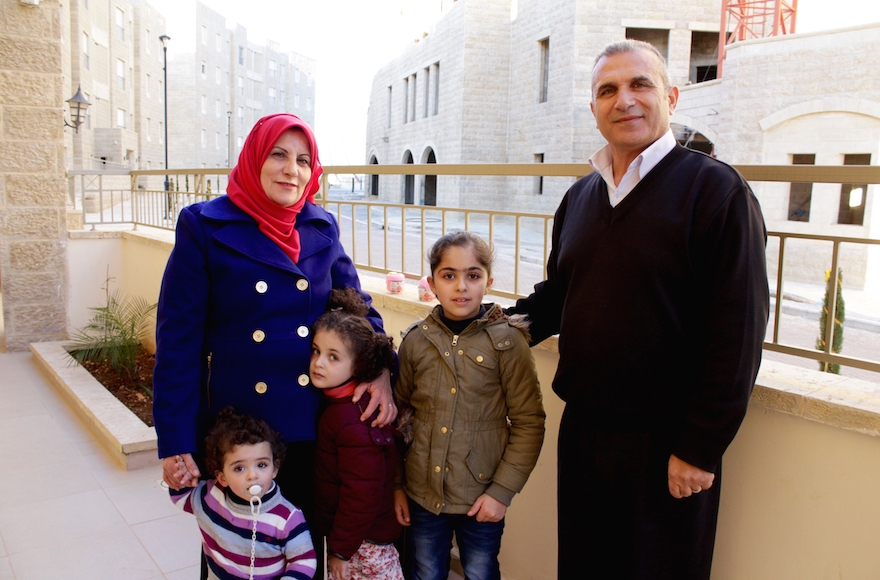 Basim Dodin, right, and his wife Asma are among the first Palestinian residents of Rawabi. Photo by Yardena Schwartz/JTA