fbpx

November 2, 2015

Haredi rabbi says murder was punishment for gay pride parade

A haredi Orthodox leader called the murder of a young couple by Palestinians a punishment from heaven for the gay pride parade in Jerusalem.

Rabbi Meir Mazuz, the head of Tunisian Jewry in Israel and the Kisse Rahamim yeshiva in Bnei Brak, made the assertion on Sunday in Jerusalem at an event marking the shloshim, or 30 days, since the killing of Eitam and Naama Henkin in a drive-by shooting in front of their four children. Mazuz is also the spiritual leader of the Yachad political party founded by former Shas party chief Eli Yishai.

The two oldest of the Henkins’ children attended the memorial.

“Gay pride parade? Pride in what?” Mazuz said in videotaped remarks that were posted on the Hebrew language Walla news website. “What pride is there in opposing nature? What pride is there in opposing God? For this comes punishment.”

He called on Jews to stop performing “immoral acts.”

“We must avoid acts of Sodom and Gomorrah that have multiplied over the past year,” he said.

He also said that Jews should avoid visiting the Temple Mount in order to avoid “provoking the nations.”

The Henkins, who were both in their 30s, were murdered near the West Bank settlement of Itamar while they were driving home with their children, ages 4 months to 9 years, from an event in Hebron. The children were not wounded in the attack. Eitam Henkin was a dual American-Israeli citizen.

A haredi Orthodox man stabbed six marchers at the Jerusalem gay pride parade in late July, leaving a 16-year-old girl dead. Thousands participated in the 14th annual Jerusalem March for Pride and Tolerance, which went through the center of the city.

Haredi rabbi says murder was punishment for gay pride parade Read More »

Israeli army to soldiers: Beware of CIA attempts to recruit you

An Israel Defense Forces intelligence department has called on its officers and soldiers to be wary of attempts to recruit them to America’s Central Intelligence Agency.

The advisory from the IDF’s information security department, which is part of the intelligence department, calls on Israeli military officers to “be aware and report any unusual incidents,” Israel’s Channel 2 reported Sunday.

“Every security body fears having its confidential information leaked,” an unnamed Israeli defense official told Channel 2.

It is not known why the advisory was being issued at this time. U.S. intelligence agencies, including the CIA, have attempted to recruit Israelis in the past, according to the report.

Israeli army to soldiers: Beware of CIA attempts to recruit you Read More »

Billionaire investor Paul Singer throws support to GOP’s Rubio

Billionaire hedge fund investor Paul Singer said he is backing Republican presidential candidate Marco Rubio.

Rubio, a Florida senator, is the only candidate who can “navigate this complex primary process and still be in a position to defeat” Hillary Rodham Clinton in the November general election, Singer said in a letter sent to dozens of his friends and fellow Republican donors, The New York Times reported over the weekend.

Singer, who is Jewish and lives in New York, gave more money to Republican candidates and causes last year than any other U.S. donor, according to the Times.

Rubio made a strong showing in last week’s Republican presidential debate in Colorado featuring. Several of the candidates in the crowded field were vying for Singer’s support.

Politically, Singer is extremely pro-Israel and a proponent of same-sex marriage. He is on the board of the Republican Jewish Coalition and a major donor to The Israel Project.

He is known for buying the debt of sovereign countries and then seeking full payment, including Peru, the Congo and Argentina. Argentine President Cristina Fernandez de Kirchner has called him a “vulture” and linked Singer’s money with efforts to prevent Argentina from signing a memorandum of understanding with Iran on jointly investigating the 1994 AMIA Jewish center bombing, which killed 85 and injured 300. The memorandum, which has received international criticism, was signed in January 2013.

Forbes puts Singer’s net worth at $2.1 billion.

Billionaire investor Paul Singer throws support to GOP’s Rubio Read More »

Rabbinical Council of America officially bans ordination and hiring of women rabbis

The Rabbinical Council of America, the main modern Orthodox rabbinical group, formally adopted a policy prohibiting the ordination or hiring of women rabbis.

The policy announced Friday by the RCA came after a direct vote of its membership, according to the organization.

The resolution states: “RCA members with positions in Orthodox institutions may not ordain women into the Orthodox rabbinate, regardless of the title used; or hire or ratify the hiring of a woman into a rabbinic position at an Orthodox institution; or allow a title implying rabbinic ordination to be used by a teacher of Limudei Kodesh in an Orthodox institution.”

Limudei Kodesh refers to religious studies.

“This resolution does not concern or address non-rabbinic positions such as Yoatzot Halacha (advisers on Jewish law), community scholars, Yeshiva University’s Graduate Program for Women in Advanced Talmudic Study, and non-rabbinic school teachers,” the resolution concludes. “So long as no rabbinic or ordained title such as ‘Maharat’ is used in these positions, and so long as there is no implication of ordination or a rabbinic status, this resolution is inapplicable.”

Maharat is an acronym meaning female spiritual, legal and Torah leader. It is a designation granted by Yeshivat Maharat, an institution for women in Riverdale, New York, founded by Rabbi Avi Weiss.

In 2010, following the establishment of Yeshivat Maharat, the RCA issued a resolution on women’s communal roles stating that the RCA “reaffirms its commitment to women’s Torah education and scholarship at the highest levels, and to the assumption of appropriate leadership roles within the Jewish community. We strongly maintain that any innovations that impact the community as a whole should be done only with the broad support of the Orthodox rabbinate and a firm grounding in the eternal mesorah (tradition) of the Jewish people.”

A follow-up 2013 resolution on Yeshivat Maharat, as it ordained its first cohort of maharats, said: “Due to our aforesaid commitment to sacred continuity, however, we cannot accept either the ordination of women or the recognition of women as members of the Orthodox rabbinate, regardless of the title. The RCA views this event as a violation of our mesorah (tradition) and regrets that the leadership of the school has chosen a path that contradicts the norms of our community.”

Rabbinical Council of America officially bans ordination and hiring of women rabbis Read More »

Germany’s Jewish umbrella warns lawmakers on euthanasia law

Proposals to change Germany’s euthanasia law have drawn strong warnings from Germany’s main Jewish organization.

The Central Council of Jews in Germany said Monday that there must be no liberalization of assisted suicide in the country.

Euthanasia is a particularly sensitive topic in Germany, as an estimated 200,000 people — most of them mentally and physically handicapped — were murdered in the Nazi “euthanasia” program, their lives considered “unworthy” by the state.

On Friday the Bundestag is to consider possible changes to the euthanasia law, which is particularly strict in cases of assisted suicide.

Doctors are allowed to hasten death for a dying patient by providing high doses of pain medication or withdrawing treatments that sustain life, if the patient has expressed a wish for this treatment. But it is illegal to provide a patient with the means for suicide and then fail to alert emergency medical services once the person is dying.

On the table are various proposals — some to loosen and others to toughen the law.

“Seriously ill and elderly people should not be pushed to commit suicide,” Central Council President Josef Schuster, a
physician and member of the Central Ethics Committee of the German Medical Association, said in a statement.

Schuster expressed particular concern about two proposals from groups of legislators. One would allow a terminally ill adult who is capable of making decisions to enlist a doctor to provide the means for suicide, at the time and place of the patient’s choosing.

Under current law, if a person wishing to die has swallowed pills provided by a second person, the assisting person must immediately call for emergency medical help or face up to a year in jail.

Another proposal on the table would provide a legal framework for associations dedicated to assisted suicide under specific conditions.

Both have raised alarm bells for Schuster.

“Assisted suicide must not become a regular service provided by doctors, an alternative to care for the dying,” he said, urging more
support for palliative and hospice care for the dying.

German President Joachim Gauck also recently praised his country’s volunteer hospice movement without commenting directly on the upcoming Bundestag debate.

Germany’s Jewish umbrella warns lawmakers on euthanasia law Read More »

VIDEO: Hillary bumps into Hatzalah founder, says she will continue to support Israel

Democratic presidential candidate Hillary Clinton promised to support Israel during a random encounter in a selfie video with Eli Beer, founder of United Hatzalah of Israel.

Beer, who was on the same plane with Clinton Monday morning, introduced his family to whom he described as “the next president of the United States” as she was sitting in first row on business class before takeoff from LaGuardia Airport.

“You’re a big supporter of Israel, you know that?” Beer told the presidential hopeful as she nodded her head in agreement. “[You should] continue.”

“I will,” Hillary replied.

Hillary was en route to Chicago for three fundraisers, including a morning reception at the home of Invenergy LLC CEO Michael and Tanya Polsky.

Polsky hosted several fundraisers for President Barack Obama.

In the afternoon, Eric Janssen will host a $2,700-per-head fundraiser. Hosts of the event include Democratic donor Fred Eychaner and Congresswoman Jan Schakowsky.

Chicago Mayor Rahm Emanual, who’s hosting the presidential hopeful for lunch, recently endorsed Clinton along with 134 mayors from across the country. “I’ve had the honor of working with Hillary as a First Lady, Senator and Secretary of State, and in each role she has shown the leadership, values and concrete plans that make her the best choice to be our next president,” Emanuel said in a statement sent out by the Hillary campaign on Friday. “I’m with Hillary and will be working tirelessly over the next year to make sure she is given the opportunity to lead this great country.”

This post originally appeared at Jewish Insider.

VIDEO: Hillary bumps into Hatzalah founder, says she will continue to support Israel Read More »

On Europe trip, Abbas gets red carpet — and some hard questions

On his way to several meetings with Dutch parliamentarians last week, Palestinian Authority President Mahmoud Abbas and his entourage passed 300 demonstrators flying Israeli flags.

Like the Israeli government, the protesters, who convened outside at the urging of Dutch Jewish and Christian pro-Israel groups, accuse Abbas and his government of supporting deadly attacks against Jews. Incitement by Abbas and others, they charge, is a major catalyst for the recent wave of Palestinian terrorism in which 11 Jewish-Israelis have been killed and more than 50 Palestinians have died, including dozens identified by Israel as assailants, in Israel’s attempt to stem the violence.

Their argument echoes one that Israeli Prime Minister Benjamin Netanyahu and his European envoys have been making regularly since September, when the latest round of unrest began. But neither appears to have had much impact on how the Palestinian leader is received by European leaders.

On his recent trip to the continent, Abbas visited Switzerland, Belgium and the Netherlands, meeting with top EU leaders and receiving the honor of an audience with Dutch King Willem-Alexander. In September, the mayor of Paris bestowed the Grand Vermeil medal, the city’s highest honor, for Abbas’ efforts to achieve peace.

Such gestures have angered many Israel supporters in Europe, particularly in light of recent comments seen as encouraging violence against Jews.

“We welcome every drop of blood spilled in Jerusalem,” Abbas said on Palestinian television in September.

The organizers of the anti-Abbas demonstration in The Hague wrote in a statement: “It defies logic that the Dutch government should receive with all honors the Palestinian Authority, which urges its population to kill Jews.”

European leaders remain willing to embrace Abbas because they fear the alternatives could be worse, according to Uri Rosenthal, who served as Dutch foreign minister from 2010 to 2012. It is “not because the Palestinian record is so great, but out of a political calculus in which Abbas is seen as the only [other] option to Hamas or to chaos,” Rosenthal told JTA.

Beyond this lies growing resentment in European capitals toward Netanyahu, who has alienated many European leaders with his hard-line stance on peace talks, his refusal to halt settlement construction and, most recently, his controversial claim about the role of a Palestinian leader leading up to the Holocaust.

“All of these things, all that mistrust toward Netanyahu, means his voice about Abbas and other matters is not heard in Europe,” said Gil Taieb, a vice president of the CRIF umbrella group of French Jewish communities. “It just doesn’t count.”

That view was endorsed by a senior European diplomat, who spoke to JTA on condition of anonymity, citing regulations prohibiting officials from expressing private views. Netanyahu’s inflammatory rhetoric, including his warning on the eve of Israeli elections in March that “masses” of Arabs were coming out to vote, diminished European good will toward the Jewish state and its receptiveness to Israeli complaints, the diplomat said.

Adding to the problem is the perception that Netanyahu is looking for any excuse to avoid making progress toward peace.

“For a long time, this has been the one issue that Israel presented as the main problem to moving forward with peace talks — simply because it was the only thing Israel could think of to stall progress,” the diplomat said.

In his talks in Europe, Abbas used Netanyahu’s rhetoric and settlement policy to deflect criticism. Settlement construction and Israeli occupation “drive Palestinian violence — not any words spoken by a Palestinian leader,” Abbas told a delegation of the Center for Information and Documentation on Israel, the Dutch Jewish community’s main pro-Israel lobby and watchdog on anti-Semitism.

As for incitement, Abbas said at the Oct. 30 meeting, “it is not only coming from the Palestinian side,” adding that he would be willing to discuss “all incitement, Israeli and Palestinian,” with Israel and the United States, but that Israel is not interested.

Saeb Erekat, a senior Palestinian negotiator who also attended the CIDI meeting, described as “shameful and inciting” Netanyahu’s statement on Oct. 20 that Haj Amin al-Husseini, a pro-Nazi Palestinian leader, advised Adolf Hitler to “burn the Jews.” Netanyahu subsequently said he did not mean to diminish Hitler’s responsibility for the Holocaust.

The European official noted that Palestinian incitement is more prevalent and pronounced than in Israel, and added that EU leaders “repeatedly bring up this subject” in their talks with Abbas. Still, he said, there is a case to be made for examining Israeli incitement “also by Netanyahu, but especially from ministers around Netanyahu.”

At the CIDI meeting, the delegation patiently listened to Abbas’ complaints about Netanyahu. When he was finished, Joep de Geus, the 22-year-old chairman of CIDI’s youth department, read to him a quote from Fatah Central Committee member Jamal Muhaisen, who on Oct. 7 said that the murder of a settler couple the previous week in front of their children was a case of “one fulfilling his national duty voluntarily, as best as one can.”

Looking at Abbas, de Geus asked: “Your excellency, do we really need a trilateral committee to tell us whether this is incitement?”

“We the Palestinians are not perfect,” Abbas replied, “but these things need to be discussed as a whole.”

On Europe trip, Abbas gets red carpet — and some hard questions Read More »

Italian soccer chief: ‘Nothing against’ Jews and gays, just keep them away from me

The president of the Italian Football Federation said he has “nothing against” Jews and gays, but that he prefers to keep such people at a distance.

The comments by Carlo Tavecchio were recorded for an interview with the online magazine Soccer Life and published on the website of the Italian daily Corriere della Sera.

Tavecchio made the remarks while talking about a Jewish-Italian businessman Cesere Anticoli.

“It was bought by that Jew, Anticoli,” Tavecchio said in the recording. “I have nothing against the Jews, but better to keep them at bay.”

He used the Italian term “ebreaccio,” a pejorative for “ebreo,” or Jew.

He also said: “I don’t have anything against gays – but keep them away from me.”

Tavecchio said in response to the publication of the recording: “It’s blackmail; retaliation from someone to whom I denied funding, who recorded me without my knowledge, not as part of an interview. What’s more, the audio file could have been tampered with.

He added: “If you listen to the recording, my words are clear: I have had long personal and professional relationships with Jews. The charges of homophobia are also groundless.”

Tavecchio was elected president of the Italian Football Federation in August 2014. He has made racist comments in the past.

Italian soccer chief: ‘Nothing against’ Jews and gays, just keep them away from me Read More »

At Rabin rally, calls to pursue peace and defend democracy

Some 100,000 people joined together in central Tel Aviv on Saturday to pay tribute to slain Prime Minister Yitzhak Rabin, but they were divided over what exactly they were rallying for.

The demonstration, which marked the 20th anniversary of Rabin’s assassination by a Jewish extremist incensed by his government’s efforts to reach a peace accord with the Palestinians, was called “Remembering the murder, fighting for democracy” — a nod to the slaying’s universal lesson of respecting the rule of law and the country’s elected leaders, no matter their politics.

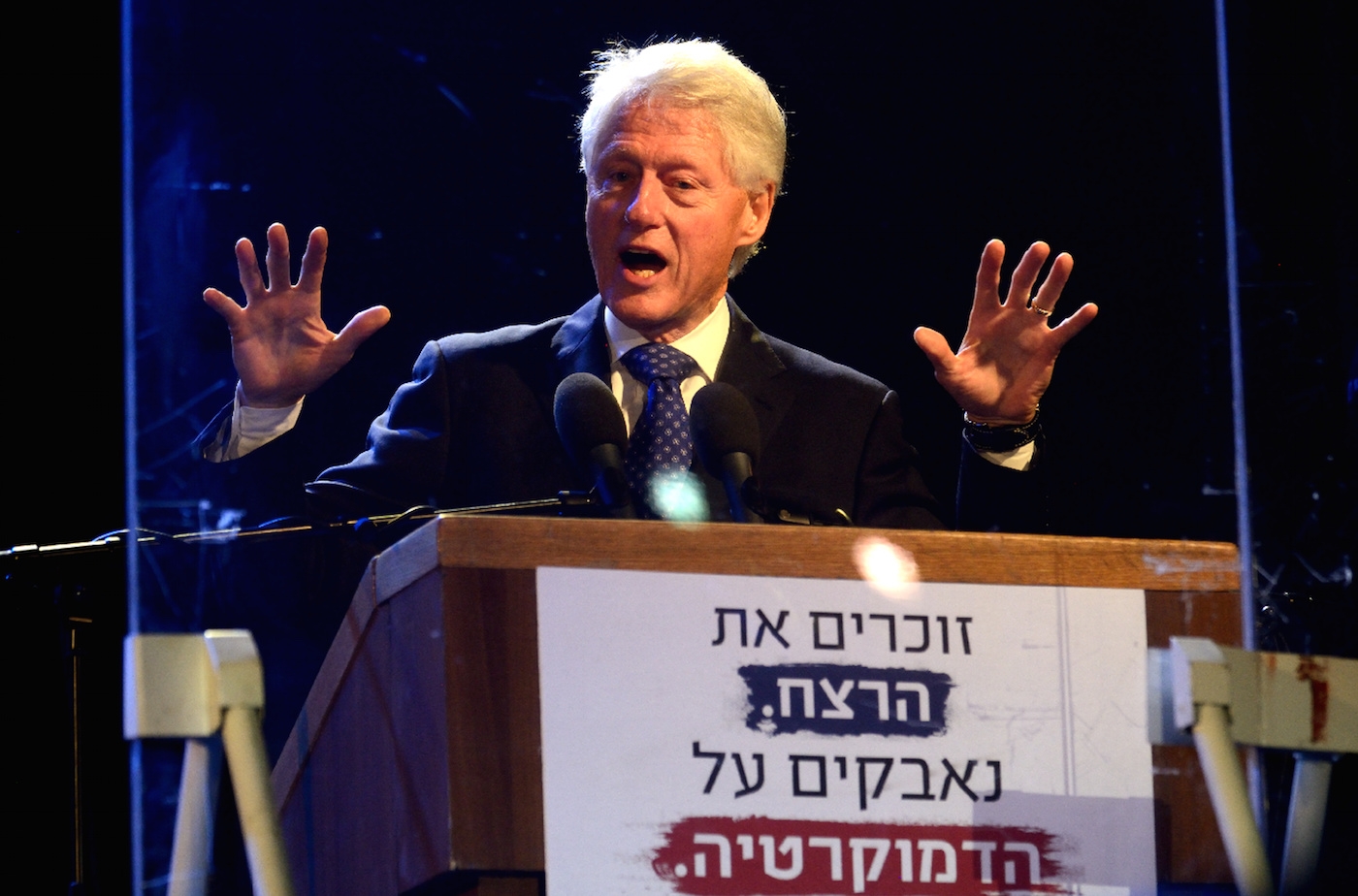
But some of the event’s speakers were interested in a different cause. The top-billed speaker, former U.S. President Bill Clinton, devoted much of his address to praising Rabin’s dedication to the peace process, and he concluded with a call to finish Rabin’s work.

“The next step will be determined by whether you decide that Yitzhak Rabin was right,” Clinton said. “That you have to share the future with your neighbors, that you have to give their children a chance, that you have to stand for peace, that the risks of peace are not as severe as the risks of walking away from it.”

President Barack Obama struck the same chord in a video address, where he lauded Rabin for relentlessly pursuing peace. The Obama speech sounded like a thinly veiled jab at Prime Minister Benjamin Netanyahu, who recently told lawmakers that Israel would not withdraw from territory in the foreseeable future and would “live forever by the sword.”

“Yitzhak Rabin understood the dangers Israel faces, but he also said the Palestinians are not to be ruled over forever by force,” Obama said. “Like a true statesman, he was willing to exhaust every opening, every possibility for peace. In these difficult days, his life, his dream, can inspire us.”

Former U.S. President president Bill Clinton speaking at a rally in Tel Aviv to mark 20 years since the assassination of Prime Minister Yitzhak Rabin. (Gili Yaari/Flash90)Former U.S. President Bill Clinton at a Tel Aviv rally remembering Yitzhak Rabin called on the crowd to finish the slain prime minister’s efforts toward peace. Photo by Gili Yaari/Flash90

The addresses that did focus on social solidarity and respect for democracy in turn made little mention of the peace process. Israeli President Reuven Rivlin thanked Israelis for their resilience and — having himself received death threats — declared that leaders fighting extremism are not afraid. But in praising Israeli democracy, he also obscured the distinction between Israel and its West Bank settlements.

“Even in the midst of the current bloodshed, even in the face of the heinous terrorism which does not distinguish between Tel Aviv and Gush Etzion, Beersheva and Kochav HaShachar, Israel’s democracy has not ceased to realize its strength and resilience,” Rivlin said, naming a pair of Israeli cities and a pair of settlements. “And for this we are today filled with pride.”

Even the signs in the crowd were split. Some stated “It is forbidden to raise a hand against democracy.” But others, sponsored by Peace Now and Israel’s left-wing parties, carried slogans like “Rabin understood: two states,” or a sign with Rabin’s face and the word “leadership” on one side, and Netanyahu’s face and the word “cowardice” on the other.

Tal Segev, 15, a member of the Scouts youth group holding a Peace Now sign, said he came to the rally “to emphasize that the message won’t be forgotten, the message of peace.”

But Eliad Avreki, 35, one of the few men in the crowd wearing a kippah, said the rally was “not a matter of right or left.” The focus, he said, should be on promoting civil dialogue to prevent extremist acts. A coordinator for the religious Zionist, pro-settlement youth group Bnei Akiva, Avreki said he went to anti-peace process rallies before Rabin’s assassination, but sobbed when he heard about his death.

“I opposed his path,” Avreki told JTA. “But I opposed his death even more.”

At Rabin rally, calls to pursue peace and defend democracy Read More »

Erdogan says world must respect Turkish election result

A jubilant President Recep Tayyip Erdoğan on Monday cast the return of Turkey to single-party rule as a vote for stability that the world must respect, but opponents fear it heralds growing authoritarianism and deeper polarization.

The AK Party, whose roots are in political Islam, defied pollsters and even the expectations of its own strategists in a general election on Sunday, consolidating support from the right to claw back a parliamentary majority that will bolster Erdogan's grip on power. 

It was a personal triumph for the combative leader, who despite being constitutionally above party politics as head of state had shaped the AKP's executive committee and its parliamentary candidates in the run-up to the vote.

The result handed the AKP 317 of the 550 seats in parliament, only 13 short of the number Erdogan would need for a national referendum on constitutional changes he wants to forge a presidential system granting him full executive powers.

“The national will manifested itself on Nov. 1 in favour of stability,” Erdogan said in comments to reporters after praying at a mosque in Istanbul. 

“Let's be as one, be brothers and all be Turkey together.”

The vote came at a critical time for Turkey on the global stage, with the United States dependent on Turkish air bases in the fight against Islamic State in Syria, and the European Union desperate for Turkish help with its growing migration crisis.

Erdogan's victory, two weeks ahead of a G20 leaders' summit in Turkey, leaves Western allies dealing with an emboldened leader they may already know, but whose cooperation has not always been easy to secure.

Financial markets rallied, with the lira currency on track for its biggest one-day gain in seven years and stocks up 5 percent, relieved that uncertainty from an election cycle stretching back almost two years had finally ended.

But the result left the 50 percent of Turks who did not vote AKP in shock: from liberal secularists suspicious of Erdogan's Islamist ideals to left-leaning Kurds who blame the government for resurgent violence in the largely Kurdish southeast.

Since nationwide anti-government protests and a corruption scandal around Erdogan's inner circle in 2013, his opponents had lived in the hope that the power of modern Turkey's most divisive leader was finally on the wane.

“Back to Square One” said the headline on Today's Zaman, a newspaper critical of the AKP, casting the outcome as a result of a divisive and fiercely nationalist campaign.

Washington said it was deeply concerned that media outlets and journalists were subject to pressure during the campaign.

Amid reports that journalists were pressured in order to weaken political opposition, spokesman Josh Earnest said the White House had urged Turkish authorities to uphold the values of its constitution.

GREEN LIGHT FOR GREATER POWER

Erdogan won Turkey's first popular presidential election in August 2014 after more than a decade as prime minister and immediately vowed to use his mandate to strengthen what had been a largely ceremonial post appointed by parliament.

Even without constitutional change, he wasted little time flexing his political muscle, hosting cabinet meetings in his new 1,000-room Ankara palace and surrounding himself with powerful advisors in what effectively became a “shadow cabinet”.

His opponents hoped that the loss of the AKP's majority in a June 7 election, raising the prospect of coalition government, would put a stop to such overreach of his powers. But Sunday's result has put his ambitions firmly back on track.

“The view that the June 7 elections were a 'no' to the executive presidency has been collapsed,” said Mustafa Sentop, a senior AKP official who previously spearheaded the party's efforts at constitutional reform.

“The numbers are not enough at the moment, but I think these elections show a desire for the presidential system to be instilled. It could be seen as a green or yellow light for the presidency,” he told Reuters.

It remained to be seen whether the additional 13 parliamentary votes needed to support a referendum could be found, but it was an ambition on which the AKP would “definitely not give up”, he said.

In the meantime, a source in the presidency said, the cabinet would continue to meet in the palace “from time to time” suggesting no let-up in Erdogan's influence on daily affairs.

Erdogan has consistently portrayed criticism of his leadership as part of a foreign-backed effort to belittle him and undermine Turkey's influence in the region.

“Now a party with some 50 percent in Turkey has attained power … This should be respected by the whole world, but I have not seen such maturity,” he said on Monday, criticising global media coverage of the election.

DEEPER POLARISATION

The rise in AKP support on Sunday appeared to have been motivated by renewed fighting between the security forces and Kurdistan Workers Party (PKK) militants in the predominantly Kurdish southeast since a ceasefire collapsed in July.

Right-wing voters supportive of the renewed military campaign abandoned the nationalist MHP, while conservative Kurds and liberal Turks who blame the PKK for the unrest turned their back on the pro-Kurdish Peoples' Democratic Party (HDP).

“The recent sense of instability in Turkey, coupled with Erdogan's “strong man who can protect you” strategy seems to have worked. This is a victory for both Erdogan and for the PKK,” said Soner Cagaptay, director of the Turkish Research Program at The Washington Institute.

“Erdogan has managed to consolidate much of the political right,” he said in an email.

But in doing so he has also further alienated opponents.

The HDP, which is set to control 59 seats in parliament, accused Erdogan on Sunday of a deliberate strategy of polarisation to stir up nationalist support. Erdogan meanwhile said the election outcome was a message to the PKK and its allies that violence could not coexist with democracy.

Analysts are divided on whether an emboldened Erdogan will now seek to push an even harder military strategy in the southeast, or whether he will return to a peace process with the PKK he initiated two and a half years ago.

“It must continue, but with a new understanding,” said one senior AKP official familiar with the peace process, adding that, in line with Erdogan's majoritarian view of democracy, the HDP's role as mediator would from now on be limited.

“That role is finished. The most they can be is one of the actors.”

Erdogan says world must respect Turkish election result Read More »