fbpx

April 6, 2015

Arab-Israeli lawmaker calls out int’l community over Yarmouk massacre

Arab-Israeli lawmaker Ahmad Tibi called the Islamic State takeover of the Yarmouk Palestinian refugee camp “a crime against humanity.”

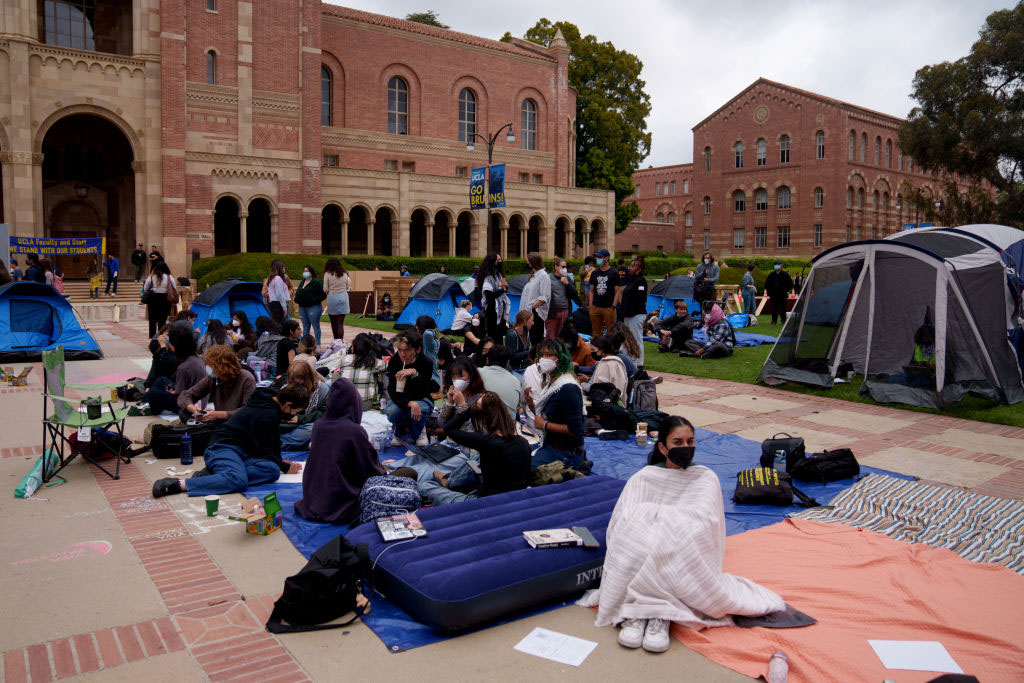
Tibi, a member of the Arab Joint List party, said on Monday that the international community, and Arab countries specifically, bear responsibility for allowing the violence in Yarmouk to occur.

More than 1,000 Palestinians have been killed since the Islamic State took over about 90 percent of the camp in the last week.

“I feel anger and great sadness about what is happening in what is left of the camp,” he said. “There is a moral double standard. If other people were the victims, not Palestinians, it would be different.”

Prior to the takeover, Yarmouk was under siege by the Syrian government.

Hundreds of Palestinians have fled the camp since the start of the takeover, and tens of thousands during the four years of civil war in Syria.

Tibi said Yarmouk is “another case where the refugees who suffered in the Nakba of 1948 are now suffering again.” Nakba refers to Israel’s attaining of statehood.

On Sunday, Palestinian Authority President Mahmoud Abbas in Ramallah called on the sides not to drag the Palestinian refugees in Yarmouk into Syria’s conflicts.

“We announced more than four years ago that we have not interfered in the internal affairs of any Arab country and therefore we reject any interference in our affairs,” Abbas said during the dedication of a public garden. “We have no relations with what is going on in Syria.”

On Monday, a Palestinian refugee living in Yarmouk, identified as M, told Ynet, “Today I walked through the bombs and sniper fire to feed my children. You have to understand, my neighbor went to get food for his children, was shot by a sniper and died. Today we buried him. That’s how it is here: If you want to feed your children, you need to take your funeral shroud with you. There are snipers on every street, you are not safe anywhere.”

Arab-Israeli lawmaker calls out int’l community over Yarmouk massacre Read More »

Jewish dermatologist to the stars found dead in Miami

Dr. Frederic Brandt, Jewish cosmetic dermatologist to the stars, was found dead on Sunday in his Miami home.

His publicist, Jacquie Trachtenberg, confirmed the death to The New York Post: “He passed away this morning. He was suffering from an illness. Everyone who knows him is devastated… I worked with him for over 20 years and he was an amazing man, not only was he a brilliant doctor, but he was the kindest human being.”

Read more at The Jewish Daily Forward.


Jewish dermatologist to the stars found dead in Miami Read More »

Hezbollah says Iran nuclear agreement ‘rules out specter of regional war’

The leader of Lebanon's Hezbollah said on Monday that a framework nuclear agreement that Iran reached with world powers last week rules out the specter of regional war.

“There is no doubt that the Iranian nuclear deal will be big and important to the region,” Sayyed Hassan Nasrallah said in an interview with Syria's al-Ikhbariya television.

“The agreement, God willing, rules out the specter of regional war and world war,” he said.

The tentative accord, struck on Thursday after eight days of talks in Switzerland, clears the way for a settlement to allay Western fears that Iran could build an atomic bomb, with economic sanctions on Tehran being lifted in return.

Nasrallah said the accord would prevent conflict as “the Israeli enemy was always threatening to bomb Iranian facilities and that bombing would definitely lead to a regional war.”

The Shi'ite Muslim Hezbollah was founded with Iranian help in the 1980s to fight Israel in Lebanon. It has grown into a powerful political and military force and is fighting alongside President Bashar al-Assad's army in Syria's civil war.

Hezbollah says Iran nuclear agreement ‘rules out specter of regional war’ Read More »

SodaStream reportedly changes some labeling to ‘Made in the West Bank’

SodaStream changed the labels on some of its products to note that they were manufactured in the West Bank, according to an international media group.

The labels were changed to read “Made in the West Bank” following a complaint filed nearly a year ago with the Oregon Department of Justice, the International Middle East Media Center, a collaboration between Palestinian and international journalists, reported.

Two groups that advocate for boycotting products made in the West Bank accused SodaStream of violating the state’s Fair Trade Practices Act by labeling its products as “Made in Israel” when its main production plant is in Maale Adumim, a West Bank settlement.

Oregon’s Fair Trade Practices Act is a consumer protection law that makes false advertising of a consumer product illegal.

The complaint was filed last May by the PDX Boycott Occupation Soda! Coalition and the Mid-Valley BDS coalition of Oregon’s Willamette River Valley. SodaStream is preparing to move from its West Bank headquarters.

“This appears to be the first time that an Israeli settlement manufacturer has corrected its labels for products sold in the United States,” Rod Such of the PDX Boycott Occupation Soda! Coalition told the media center. “Many people of conscience refuse to purchase products made in Israel’s illegal settlements on occupied Palestinian land in the West Bank, but in the case of SodaStream they were deceived by false labeling that claimed the products were produced within Israel’s internationally recognized borders.”

SodaStream has long come under fire for producing its popular line of home carbonation machines in the West Bank. In October, the company announced it would close the Maale Adumim factory and move it to Lehavim, in southern Israel. The move is expected to be completed by the end of 2015.

SodaStream reportedly changes some labeling to ‘Made in the West Bank’ Read More »

Supreme Court rejects Alan Gross’ appeal in suit vs. U.S.

The U.S. Supreme Court rejected Alan Gross’ appeal in a $60 million lawsuit he filed against the U.S. government.

On Monday, the high court rejected the appeal of the Jewish-American contractor, who spent five years in a Cuban prison, Reuters reported.

Gross and his wife sued the U.S. government for negligence in 2012, saying it had sent him to Cuba without adequate supports.

Last year, the U.S. Court of Appeals for the District of Columbia ruled that the U.S. government was immune from claims arising in a foreign country. A district court originally rejected the suit.

Gross was released from prison in December as part of negotiations between the Obama administration and the Cuban government aimed at normalizing relations between the two countries.

Cuba had sentenced Gross to 15 years for providing Internet equipment to the local Jewish community under a program that the government found suspicious.

In a separate development, Gross will receive $3.2 million in a settlement reached with the U.S. Agency for International Development and DAI, a contractor with which he worked.

Supreme Court rejects Alan Gross’ appeal in suit vs. U.S. Read More »

Want to stop Iran’s nukes? Use less oil

With the conclusion of a framework agreement over Iran’s nuclear agreement last week, many remain profoundly unsure whether the deal will successfully prevent Tehran’s acquisition of a nuclear weapon.

Under the terms of the agreement, much of Iran’s nuclear infrastructure will remain in place. Its Shahab-3 missiles are still capable of reaching Tel Aviv. And its capacity to produce enriched uranium, while diminished, would not be erased.

The diplomats negotiating with Iran are understandably focused on two key fuels, uranium and plutonium, but they ignore the one ancient fuel driving the entire process: oil.

Petrodollars have been financing Iran’s nuclear program for almost two decades. The world powers negotiating with Iran are struggling to establish a robust monitoring system to ensure that Iran cannot break out to build a bomb, but the average person can help slow the centrifuges simply by reducing their household and commercial demand for oil.

Even though Iranian oil has been proscribed by international sanctions, all oil is fungible. When oil consumption is measurably reduced in America and elsewhere, it lowers the value of oil in global markets. That cheapens the value of Iran’s oil, the financial furnace of its nuclear program.

According to data compiled by Bloomberg, Iran needs oil to sell at approximately $143 per barrel to maintain its social, governmental and military programs. But the global glut, combined with the recession and some conservation, have driven recent prices into the high $40s and $50s per barrel. This means that even if sanctions are relaxed, Iran will still be hurting at the pump and in the bank.

Iran has been storing its unsellable surplus in 13 supertankers parked in the Persian Gulf, Bloomberg reported. Each tanker can carry about 2 million barrels, and estimates based on the depth of their hulls suggest the ships are laden with crude. These ships have floated like seaborne warehouses for more than a year, and many suggest more than two years. In the meantime, Iran has cut its output from a pre-sanctions 2012 level of 2.5 million per day to just over 1 million today.

Oil impoverishment is the only reason Iran is now negotiating on its uranium enrichment. The two are linked.

In any international accord, it would take Iran some time to recover from its oil glut, especially with millions of barrels at sea waiting for customers. The floating oil reserves would likely be sold first.

Consumers and businesses can make that recovery more difficult without buying an electric car, peddling a bicycle to work or canceling a road trip. Transportation accounts for roughly two-thirds of U.S. petroleum imports. Most gasoline today contains 10 percent ethanol, an alcohol fuel derived from corn and other crops. The recent Hollywood documentary “Pump,” in which I made a brief appearance along with numerous other oil addiction experts, revealed that most modern motor vehicles can accept E-85 — that is, up to 85 percent ethanol with a simple software update, and in some cases a single click, automotive engineers explain.

Even more compelling, “Pump” demonstrates how more than 9 million American flex-fuel automobiles, the ones with a yellow gas cap, are already built to accept E-85. This one software update could drastically cut American oil consumption if ethanol supply rose commensurately.

The engineers in the “Pump” documentary demonstrated that the software update process takes only a few minutes. If government and commercial fleet managers, as well as ordinary consumers, see how easy it is to switch, America could be swept by a sea-change reduction in our dependence on foreign oil. Regardless of what the nuclear negotiators and inspectors do, average people could help permanently drive the outcome.

(Edwin Black is the author of “IBM and the Holocaust,” a New York Times best-seller, along with several books on the oil industry.)

Want to stop Iran’s nukes? Use less oil Read More »

Visitors to Israeli park turned away for carrying chametz

Visitors to a public park in Israel were turned away because they carried food that was not kosher for Passover.

The security guard at the entrance to the park in Afula, in northern Israel, was checking visitor’s bags for weapons and for chametz, according to reports.

Visitors found to have chametz in their bags were not allowed into the park. Several ate their sandwiches outside the park before gaining entry.

“The Afula municipal park is a public facility that serves the residents of the city and its environs, and so the public is asked to refrain from bringing chametz into it during the holiday, as is customary in many other public institutions,” the municipality said in a statement.

Israeli law prohibits the display and sale of chametz during Passover. Chametz also is prohibited in hospitals and other public institutions.

Barak Avivi, a Tel Aviv attorney, told Haaretz that he was considering filing a class-action lawsuit with the municipality on behalf of those who were turned away for having chametz with them.

Visitors to Israeli park turned away for carrying chametz Read More »

Obama: nuclear deal not predicated on Iran recognizing Israel

President Barack Obama on Monday poured cold water on an Israeli demand that a nuclear deal between world powers and Iran be predicated on Tehran recognizing Israel.

“The notion that we would condition Iran not getting nuclear weapons in a verifiable deal on Iran recognizing Israel is really akin to saying that we won't sign a deal unless the nature of the Iranian regime completely transforms,” Obama said in an interview with National Public Radio (NPR).

“That is, I think, a fundamental misjudgment,” he said.

Obama: nuclear deal not predicated on Iran recognizing Israel Read More »

How do you talk to kids about God?

Talking openly with children about sensitive subjects is hard. It always has been. In my parents’ generation, the three-letter taboo was S-E-X. My older sister was 13 when my dad gave a kid “The Talk” for the first time. It was the ’80s, and my dad dodged it like any educated man of his time. He tossed her a sex-education book and said, “Read this, but don’t do it.” 

Discussing sex isn’t quite so scary today. Many modern fathers don’t flinch when their daughters ask about anatomy or start inquiring about how babies are made. But progressive thinking has a way of replacing certain taboos with others. And today, for a great many parents, there is a new three-letter word: G-O-D.

With two of Western religion’s most important holidays—Easter and Passover—in the air, I find myself thinking back to the first time I had the “God Talk” with my own daughter. Maxine was barely five years old when she piped up from the backseat on the way home from her Los Alamitos preschool one day. 

“Mommy,” she said, “you know what? God made us!”

I felt like a cartoon character being hit in the back of the head with a frying pan. My heart raced. I’m quite sure I began to sputter. Visions of Darwin and the evolving ape-man raced through my mind, followed closely by my childhood image of the big guy upstairs in his flowing white robes. I couldn’t speak. 

And, in the awkward silence that followed, I was forced to confront the truth: The idea of talking to my kid about God—and, more specifically, about religion—scared the bejesus out of me.

I swallowed hard and forced myself to speak. “Well,” I said, “Who is God?”

Now, I don’t remember if Maxine actually said “duh,” or whether she simply bounced a “duh” look off the rearview mirror. But I can tell you that the “duh” message came across loud and clear. 

“He’s the one who made us,” she said, her eyebrows knitted. “Okay… well, what is God doing now?” I tried for casual.

Again with the nonverbal “duh.”

“God is busy making people and babies,” she answered. 

This information could not have been delivered with more certainty. My little girl, who had never heard an utterance of the word “God” in our house, aside from decidedly ungodly uses of the word, now had it all figured out thanks to a Jewish classmate who also happened to be her very first boyfriend. I was beaten to the punch by a cute preschool boy. 

I let the subject drop, but my chest constricted all the way home. It stayed that way for hours. Why hadn’t I been prepared for this? What was I supposed to say now that she was getting her information from this boy at school? 

As a science-minded non-believer with a generally non-confrontational personality, I was stumped by how to handle the situation. I wanted to be truthful about what I believed to be truth, but I didn’t want to indoctrinate her into my worldview either. And I certainly didn’t want others indoctrinating her into theirs, either. So where did that leave me? Was I to sit Maxine down and tell her that evolution, not God, was responsible for her existence? Was I to impose my own beliefs on her, the way other parents seemed to be doing? Or should I leave her alone to explore on her own timetable? What was the difference between guidance and pressure anyway? What was I willing to “let” her believe, and what wasn’t I?

Luckily for me, I have a husband who is cool under pressure. Later that day, after I’d rather breathlessly presented him with all the facts of the disastrous car ride, I asked him, “What if she believes in God?” His answer, my wakeup call, has become a mantra I repeat often. He said, “It’s not what Maxine believes, but what she does in life that matters.”

What I took from this was: Relax . . . it’s just God.

So I set aside my own irrational concerns and began to talk with my kid about God—lots of gods, actually. We talked about Brahman and Buddha, Jesus and Muhammad. My husband bought her a Children’s Bible, and I brought home lots of picture books highlighting aspects of various religious cultures.

To my delight, Maxine became genuinely interested in religion—as long as it came in bite-size pieces, rather than overly long oratories. She became engaged in the stories we told, and good at deciphering the various “moral” aspects of various tales for herself. In her hands, the Bible wasn’t a tool of indoctrination, but a tool of religious literacy—even critical thinking. Once when she was reading the 10 Commandments, for example, she got to the 10th and read (aloud): “Never want what belongs to others.” Then she stopped and corrected Moses. “Well, you can WANT what belongs to others,” she said. “You just can’t HAVE it. You can buy one for yourself.”

In the four years that have passed since Maxine first told me about God, we have discussed the subject countless times. I have learned that compassion and an open mind are more important than being right. I’ve also learned that the best way to combat intolerance is with knowledge, and that the best way to combat indoctrination is with critical thinking. No longer is there awkwardness around the subject. We talk about lots of different beliefs, encourage her to learn about what motivates the faith of others, and make clear that there is no shame in choosing an unpopular path. After all, her own parents are happy, well-adjusted, and (I like to think) good-hearted people. 

Today, Maxine is 9 and believes in God “two days a week — on Sundays and Wednesday.” Is that logical or rational? No. But who cares? It works for her, and that’s what’s important. 

I haven’t always done everything right. I have stumbled sloppily through more than a few conversations along my own journey and regretted my word choices now and again. (Our unique biases have a way of filtering through from time to time, despite our best efforts.) But, because the conversations keep coming, I’ve almost always had a chance to right my wrongs, to clarify my position, to bring a new perspective to each situation. The point here is not to be perfect—as my daughter says, “That would be boring”—but to give us something to aim for. 

Exposing kids to various brands of spirituality and religion (not to mention non-religious philosophies) is not only fascinating and surprisingly fun; it also has the potential to improve our children’s— and our own—awareness about and compassion for the multiplicity of kinds of people in the world. Like the “sex talk,” discussions about God may come up sooner (and differently) than you had pictured. But it’s our obligation to embrace it. After all, if we’re not prepared to explore ideas of God, religion, and faith with our curious children, someone else will do it for us.  

Someone cute.

Wendy Thomas Russell is an award-winning journalist and author of Relax, It’s Just God: How and Why to Talk to Your Kids About Religion When You’re Not Religious. Russell hosts a blog called Natural Wonderers at Patheos.com and writes an online column for the PBS NewsHour. She wrote this for Thinking L.A., a partnership of UCLA and Zócalo Public Square.

Buy the Book: Brown Paper Press, Amazon

How do you talk to kids about God? Read More »

How your Seder should conclude

Passover is the beginning….

Do you know the concluding words in the Passover Haggadah?  In many ways, they are more important than the beginning words.

The central message of Passover is that God liberated Israel from 430 years of Egyptian slavery, and that all humans have the right to live in freedom.  We tell the story to remind ourselves, and to teach our children, of both the sacrifice our people made and that God freed us from oppression.  

At the Seder, after telling and teaching the history of our people, the Passover meal commences. For many of us, however, the evening concludes once dinner is finished. That’s not, however, where the evening ideally concludes.

The Seder ends with the words: L’shana haba-ah b’yrushalayim (next year in Jerusalem).  One might understand these words literally, in the hope that next year we actually will celebrate Passover in Jerusalem.  I would suggest another meaning.

Jerusalem is not just a physical location; it represents the Jewish spiritual and moral epicenter. It is an ethereal concept, which we should aspire to incorporate into our religious lives.  Concluding our Seder with “Next Year in Jerusalem”, implies that we are on an ongoing journey to a deeper connection and level of Jewish understanding.  In other words, next year, may we be more spiritually and morally committed as Jews.

In other words, we were liberated from the shackles of Egyptian slavery for the purpose of “becoming Jerusalem”.

Commencing on the second day of Passover we count the next 49 days leading up to Shavuot; Shavuot commemorates the moment when God gave the Torah at Mt. Sinai. We literally “count the days” from the holiday of liberation, Passover, to the holiday of the receiving of the Torah, Shavuot.  That the two holidays are so deeply interconnected is yet another reminder that our liberation from slavery was just the beginning of a very long and meaningful journey.

Rabbi Woznica is a rabbi of Stephen Wise Temple

How your Seder should conclude Read More »