fbpx

April 4, 2012

Judy, The Foodie

My mom is Judy, the foodie. She is the Mr. Yuk of sodium nitrates, and high fructose corn syrup. I think she’d rather I marry a non-Jewish woman than have me eat anything with partially hydrogenated oils.

I want to make my mom proud but it’s easier to invite your buddies out for beer and wings than beer and quinoa.

I live with a double consciousnesses of knowing that my food choices are informed by the omnipresent judgmental shadow of Judy, the foodie, the health food crusader who hasn’t eaten red meat since ‘72. She is the baby boomer carrying reusable grocery bags to the farmer’s market where she buys produce like jicama,persimmons, and watermelon radishes. When I visit she feeds me parsnips.

I am very lucky Judy cooked nutritious home made meals five nights a week. I just didn’t see it that way. While she baked lemon pepper chicken and stir fried Chinese vegetables, simmered Thai coconut bowls, and boiled tortellini, I wanted out.

“F*ck salmon croquettes!” I pouted.

Red meat wasn’t allowed in our house. If I was lucky I could sneak in a Stouffer’s Pepperoni Pizza. I waited for the day when I could feed my insatiable appetite for frozen pepperoni.

At age 16, I spent a summer living with my Aunt Barb and Uncle Larry in San Diego. I found refuge in carne asada, and prime rib. I ate meat with meat with a side of meat.  I spent so much time in the men’s room you could’ve easily renamed it “Elliot.”

I became self diagnosed with Irritiable Bowel Syndrome. Every time I ate red meat, especially coupled with cheese, I suffered physical pain. Though I did get my summer reading done rather quickly.

While in the midst of my beef binge, I gave up chicken, my first true love. I don’t like to get into it, but there were a few troublesome experiences that culminated in a nightmare I had during which I awoke to find a flock of chickens pecking at me. I did not eat chicken from August of 2000 through my freshman year of college in 2004.

In college I ate like a monster. My buddies and I nightly trecked up the hill to Crown College at UC Santa Cruz for late night cheeseburgers and Sierra Mist, and ice cream and cookies because we weren’t under the influence of anything.

I even recorded a Youtube video about my love for Gummy Bears: “> Toxicity of Sugar  Judy, the foodie, brainwashed CNN’s Sunya Gupta!

Maybe Judy, the foodie, had been right all along. I thought about it. I never got IBS from a parsnip.

It is a process to change your eating habits. It happens gradually. I am now a closeted healthy eater. I’m a 147lb IBS survivor who eats Kashi and brussel sprouts. I no longer live by the promise that a “Jersey Mikes is coming soon.”

I’m also a problem solver. I’ve had trouble sleeping the last few nights. I wake up in the middle of the night, drink pineapple juice and then fall asleep. It’s nice falling asleep with the taste of fresh pineapple to guide me into dreamland.

I still drink and eat chicken wings because I’m a guy, but I try not to buy snacks with high fructose corn syrup or partially hydrogenated oils.

I’ve recently discovered turkey pepperoni, a step in the right direction even if the pepperoni is filled with sodium nitrates.  I’m trying, but sodium is still my favorite nitrate.

Judy, The Foodie Read More »

“Upside Down” ……..breaking free from the Shackles

Quiet the volume and listen to the noise
Underneath the veins of the city that’s alive
art cries through the mouths of starving folk
songs cry through the vocals pleading hope

Time is running, running, running
and the trains are coming, coming, coming

And we wait for a new day to come
and we wait for a new tune to hum
and we play our eyes across the train
drifting, drifting,
failing to notice we must be all the same

But time is running, running, running
and the trains are coming, coming, coming

Doors revolve like a universal sphere
tolls are paid and our pockets empty bear
our backs are turned to the hungry that wait
yet they keep on singing
under the subway pleading,
our heels grinding to the cement floor
never entertaining there could be more

And time is running, running fast
and the clocks keep ticking ticking past

Artists, Bankers, Wall street brokers,
geeks, thinkers, homeless, floaters
every color, all God’s creatures breathe in the same raw air
weaving side by side
eating ride by ride
dozing half alive
intimate, organic, primal connection
all ignoring the world’s intention

And we keep riding, riding, riding fast
as the clocks keep ticking, ticking past

Through the night and half past dawn
at last a lone voice encroaches on
upside down he sees the world
riding past him like a tornado twirls
the masses fail to stop and search who
as the vocalist tries to force time to stand still
even the riders cannot change his will
he chants like he has all the time to pass
looking searching feeling fast
an amphitropous exposé
he begs the world to see like he

and the folks cease staring ahead like sheep
and soon their minds begin to peek
the riders stop one by one
as time finally halts mid-air
the lone voice sings a familiar dare
of hope and loss and resonating despair
and he promises the riders through his voice of emotion
that it can get better if we utter commotion
and the dollars roll out one by one
clapping, tears, and joys are sung
the moment is paused it transforms disarray
as a virtue emerges to light that day

Although the clocks tic tic tock
and the hustle and bustle does not seem to stop
we can carve a moment out of clay
like a work of art, a Van Gogh, or Monet.
We can listen to
the pulse of our hearts and the routine beats
that pass one by one or we can pause at our feet.
We can view the beauty we share
and realize there is much more to bear
than the economic treadmill of exhaustion we climb
or the disappointment or diminished pay check tossed
trade material deprived for sublime instead of loss.

We can take the time to transform our space,
lend a penny, or a smile or a tune against the race.
We can change our world and stop the time
we can enlighten ourselves and dare to climb
upside down like the man standing on his head
seeing the colors the music instead
and before we even realize we will be higher and higher,
a holy space will encompass something new will transpire
hold our hands together and create abundance all around
break free from the shackles
and   listen
    to
  the
      sound.

Have a Happy Passover
enliven change, inspire freedom, instigate innovation…

“Upside Down” ……..breaking free from the Shackles Read More »

German author Grass says Israel endangers world peace

Nobel Prize-winning German writer Guenter Grass has attacked Israel as a threat to world peace and said it must not be allowed to launch military strikes against Iran, in a poem that led one German newspaper to brand him “the eternal anti-Semite.”

Grass, 84, a seasoned campaigner for left-wing causes and a critic of Western military interventions such as Iraq, also condemned German arms sales to Israel in his poem “What must be said”, published in the Sueddeutsche Zeitung daily on Wednesday.

His words were criticized in Germany, where any strong condemnation of Israel is taboo because of the Nazi-perpetrated Holocaust. Grass’s own moral authority has never fully recovered from his 2006 admission that he once served in Hitler’s Waffen SS.

“Why do I say only now … that the nuclear power Israel endangers an already fragile world peace? Because that must be said which may already be too late to say tomorrow,” Grass wrote in the poem.

“Also because we – as Germans burdened enough – may become a subcontractor to a crime that is foreseeable,” he wrote, adding that Germany’s Nazi past and the Holocaust were no excuse for remaining silent now about Israel’s nuclear capability.

“I will not remain silent because I am weary of the West’s hypocrisy,” wrote Grass, who won the Nobel Prize for Literature in 1999 for novels such as “The Tin Drum” chronicling the horrors of 20th century German history.

Israel is widely assumed to have the Middle East’s only nuclear weapons, which it neither confirms nor denies. These could be carried by Dolphin submarines it has bought from Germany.

The Jewish state has threatened to take military action, with or without U.S. support, to halt what it sees as a nuclear threat from Iran. Tehran says it is developing nuclear technology for purely peaceful purposes.

Germany said recently it would sell Israel a sixth Dolphin submarine and shoulder part of the cost – but also warned its ally that any military escalation with Iran could bring incalculable risks.

“ETERNAL ANTI-SEMITE”

The poem called for an international ‘agency’ to take permanent control of both Israel’s nuclear weapons and Iran’s atomic plant.

The Welt newspaper called Grass “the eternal anti-Semite” in a front page article commenting on the poem, which was widely circulated in advance of its publication.

“Grass is the prototype of the educated anti-Semite who means well with the Jews. He is hounded by guilt and feelings of shame and at the same time is driven by the wish to weigh up history,” the newspaper wrote on Wednesday.

The American Jewish Committee in Berlin said Grass’s poem was an attempt to delegitimize Israel’s security policy.

“Guenter Grass has turned the situation on its head by defending a brutal regime (in Iran) that has not only for many years systematically disregarded international agreements but also trodden them underfoot,” said its director Deidre Berger.

“Grass does terrible harm to German-Israeli friendship when he describes Israel’s necessary security policies as a crime…”

Asked about Grass’s poem at a news conference on Wednesday, a German government spokesman declined to comment but said that artists in Germany enjoyed freedom of expression.

Grass is for many the voice of a German generation that came of age during Adolf Hitler’s war and bore the burden of their parents’ guilt.

But Grass, who for decades urged Germans to come to terms with their Nazi past, lost much of his moral authority after his belated admission in 2006 that he had once served in Hitler’s Waffen SS.

One of the most powerful organizations in Nazi Germany, the SS was first an elite force of volunteers that played a key role in the Holocaust, operating the death camps in which millions died. But by the war’s end, most were drafted and many under 18.

Grass said he was called up to join the SS as a teenager and insisted that he never fired a shot. But some critics inside and outside Germany said this explanation had come too late.

Grass made the confession shortly before publishing his autobiography “Peeling Onions” which details his war service.

Additional reporting by Alexandra Hudson; Writing by Gareth Jones; Editing by Tim Pearce

German author Grass says Israel endangers world peace Read More »

Opinion: Keeping Holocaust memory alive—and sacred

The destruction of Solomon’s Temple by the Babylonians in 586 BCE was the first great national tragedy in Jewish history. During the subsequent exile, four fast days commemorating the calamitous event were added to the Jewish calendar: the 10th day of the Hebrew month of Tevet, when the siege of Jerusalem began; the 17th of Tammuz, when the walls of Jerusalem were breached; the 3rd of Tishri, marking the assassination of the Gedaliah, governor of Jerusalem; and Tisha b’Av, the 9th of Av, when the Temple was destroyed.

For more than 2,500 years these fast days have remained on the Jewish religious calendar, and the Book of Lamentations continues to be read on Tisha b’Av. This is as it should be.

Even though it is a far more recent horror, the Holocaust was no less a national Jewish catastrophe than the destruction of the first and second Temples. Yom HaShoah, designated as the official Jewish day of remembrance for the millions annihilated by Nazi Germany and its multinational accomplices, is as ritually significant and divinely inspired as Tisha b’Av. This year, Yom HaShoah falls on April 19.

The preservation and transmission of our parents’ and grandparents’ memories is the most critical mission to which the children and grandchildren of survivors must dedicate themselves to ensure meaningful and authentic Holocaust remembrance in future generations. As the ranks of those who suffered alongside the murdered victims of the Holocaust steadily dwindle, the task becomes ever more urgent.

In his keynote address at the First International Conference of Children of Holocaust Survivors in 1984, Elie Wiesel mandated us to do what the survivors “have tried to do—and more: to keep our tale alive—and sacred.”

“You have screened Yourself off with a cloud, so that no prayer can pass through,” we read in Lamentations. And yet it is told that Reb Azriel David Fastag, a disciple of the Chasidic rebbe of Modzhitz, spontaneously composed and began to sing what has become the best-known melody to Maimonides’ 12th Principle of Jewish Faith while in a cattle car from the Warsaw Ghetto to the Treblinka death camp: “Ani ma’amin be’emuna sh’leima, b’viat hamashiach; v’af al pi she’yismameya, im kol zeh, achakeh lo b’chol yom she’yavo”—“I believe with perfect faith in the coming of the Messiah; and even though he may tarry, nevertheless I will wait every day for him to come.”

A young Jew managed to escape from the Treblinka-bound train, taking with him the niggun, the melody, of Fastag’s “Ani Ma’amin.” Eventually the melody reached the Modzhitzer rebbe, who is said to have exclaimed, “With this niggun, the Jewish people went to the gas chambers, and with this niggun, the Jews will march to greet Moshiach.”

My mother, who had survived Auschwitz and Bergen-Belsen, died in 1997 hours after the end of Rosh Hashanah. Six months later I took our daughter, Jodi, then a college sophomore, to Poland for the first time. She and my mother had been very close and spent a great deal of time together as Jodi was growing up. We went to Warsaw and Krakow, and then to Auschwitz.

On a gray day with a constant drizzle, I showed Jodi Block 11—the death block at Auschwitz where my father was tortured for months. Then we went to Birkenau, where we walked in silence past the decaying wooden barracks. After 15 or 20 minutes, Jodi turned to me and said, “You know, it looks exactly the way Dassah [which is what she called my mother, Hadassah]—it looks exactly the way Dassah described it.”

I realized that a transfer of memory had taken place. My daughter, born 33 years after the Holocaust, had recognized Birkenau through my mother’s eyes, through my mother’s memories that Jodi had absorbed into her consciousness.

For the past several years, grandchildren of survivors at Park Avenue Synagogue in New York City have described their grandparents’ experiences as a core element of what is evolving as our Yom HaShoah liturgy. Thus deportations, separations from parents and siblings, selections for the gas chambers, desperate escapes, nighttime ambushes of Nazi troops by partisan units, and avoiding death in secret hiding spaces and on forged identity papers cease to be abstract concepts.

As family histories merge with haunting songs and melodies that were sung in the ghettos and camps, we are reminded that these firsthand, personal accounts that together chronicle the enormity of the Holocaust must enter our theology just as the testimonies of the prophets Jeremiah and Ezekiel became part of our Scripture.

At the Passover seder we recite “B’chol dor vador chayav adam lir’ot et atzmo ke-ilu hu yatza mi-mitzrayim”—“In each generation it is incumbent on each of us to see ourselves as if we had come out of Egypt.”

We have been entrusted with a precious and fragile inheritance that ultimately belongs to the entire Jewish people and to humankind. In the aftermath of the Holocaust, each of us, and our children and our children’s children, must also see ourselves as if we had emerged from Auschwitz, Bergen-Belsen, and all the other ghettos and camps, the forests and secret hiding places of Nazi Europe. To do so, all of us, and our children and our children’s children, must discover the past by immersing ourselves as best we can in the survivors’ memories until they become a part of us.

Menachem Z. Rosensaft is vice president of the American Gathering of Jewish Holocaust Survivors and Their Descendants. He teaches about the law of genocide and World War II war crimes trials at the law schools of Columbia, Cornell and Syracuse universities.

Opinion: Keeping Holocaust memory alive—and sacred Read More »

Grad rocket traces found in south Eilat, after strong explosions shake the city

Security forces found traces of a Grad rocket near a building site in the Shahamon neighborhood in south Eilat early on Thursday morning, after strong explosions shook the city.

The strong explosions were heard approximately twenty minutes after midnight on Wednesday. No injuries were reported, although there were reports of some city residents suffering from shock after hearing the explosions. 

Police and security forces are continuing to search for traces of rockets, which are thought to have been fired toward the city from the Sinai Peninsula.

Read more at Haaretz.com.

Grad rocket traces found in south Eilat, after strong explosions shake the city Read More »

New construction announced for eastern Jerusalem

Israel issued tenders to build hundreds of new apartments in eastern Jerusalem and the West Bank.

Israel’s Construction and Housing Ministry on Tuesday reportedly published tenders for 632 units in the eastern Jerusalem neighborhood of Har Homa; 180 units in Givat Zeev, located to the north of Jerusalem in the West Bank; and 69 in Katzrin on the Golan Heights.

A ministry spokesman told the French news agency AFP that the tenders are not new, although anti-settlement activists said it was the first time the orders were made public.

Meanwhile, Israeli Prime Minister Benjamin Netanyahu said Wednesday that he will submit a plan to legalize several West Bank outposts and avoid the demolition of another. At a Cabinet meeting, Netanyahu said he asked Attorney General Yehuda Weinstein to “find a solution” for the Ulpana neighborhood in Beit El “that would obviate the need for demolition.” The government had previously agreed to evacuate the illegal outpost by May.

Netanyahu also told the ministers that he will submit, with the recommendation of Defense Minister Ehud Barak, a plan to legalize the outposts of Bruchin, Sansana and Rechalim, which are said to be built on private Palestinian land.

“We are strengthening Jewish communities in Judea and Samaria, and we are strengthening the Jewish community in Hebron, the City of the Patriarchs,” Netanyahu said, according to the Government Press Office. “But there is one principle that we uphold. We do everything according to the law and we will continue to do so.”

The announcement came as Jewish settlers who last week occupied a house in Hebron near the Cave of the Patriarch were evacuated by Israeli security forces.

New construction announced for eastern Jerusalem Read More »

New Iranian Jewish art gallery shines light on Jewish artists

During the last ten years a growing number of young, educated and successful Iranian American Jews have ventured into the arts and entertainment industry as their primary profession. The sense of sharing their creative energy and aspirations has been attractive to young Iranian Americans Jews living in L.A. who are now wanting to break with their community’s traditions of going into the classic professions of medicine, law or business. I have had the special pleasure of witnessing the new generation’s attraction to the art world and even interviewed Iranian Jewish art curator, Shulamit Nazarian in 2010 following her exhibition of the art works of several contemporary Iranian Jewish artists in L.A..

More recently, I was delighted to attend the grand opening of the “Illoulian Contemporary” art gallery in West Hollywood headed by another up and coming Iranian Jewish art curator, Candice Illoulian. Last week I caught up with Illoulian who was featuring the unique art work of William Benhamou, a 24-year-old well-known French Jewish artist. The exhibition was abuzz because of Benhamou’s very interesting “pop art meets street art” style of work as well as the large crowd of young Iranian Jews drawn to the gallery. For his part, Benhamou was excited to have his work which combines photography, video, writing and painting on display in Los Angeles as well as the support of young Iranian American Jewish art lovers.

The following is a portion of my interview with Illoulian regarding her new art gallery, her attraction to a career in art and her involvement of with Benhamou….

Can you share a little with us about your background as an art curator and interest in the field?

Art has always been a passion of mine. I was an Art History major and Business Administration minor at USC, anticipating a career in the art world.  Upon graduation, I held positions working at Christie’s Auction House in New York City, The Metropolitan Museum of Art and a few art galleries both in Los Angeles and New York.  I am a member of the Los Angeles County Museum of Art, Museum of Contemporary Art, Museum of Modern Art, and the American Friends of the Israeli Museum.  I also serve as the Arts and Cultural Affairs Commissioner for the City of West Hollywood.

What motivated you to open your own art gallery?

Opening an art gallery has been a life long goal of mine and around the High Holidays last year, my dream came true and I opened my gallery. I am always on the search for new talent and not looking for any particular style. However, it is important for me to be deeply moved by the artist’s work. I seek artists who demonstrate depth and range in their artistic expression, who are unafraid to be controversial and avant-garde, and who have the power to shake your core. My aim is to find captivating and thought provoking artists who can rattle both art lovers and non-art lovers alike; these are such artists whom I am looking to exhibit.

How did you get involved with William Benhamou and why did you choose him for your grand opening exhibition?

In the beginning stages of my gallery, I spoke to a mutual friend, Sarah Hart, and she raved about William and insisted that we meet. She introduced us on Facebook, where we consequently arranged to meet via Skype, since I was in Los Angeles and he was in Paris. William Benhamou’s genius lies in the fact that he can create art that plays on pop-culture and are very light upon first glance, but bear a much deeper meaning pertaining to contemporary social and politically charged issues. Every time I see any of his given work, I find a new meaning, new symbolism, and some perverse play on society that makes me laugh out loud even when I am by myself. I chose William as my opening show because his work is extremely vibrant, energetic and tantalizing, which is how I wanted to introduce myself to the art world.

Are you looking to exhibit more work in your gallery from Iranian Jewish artists?

Of course I would love to have the opportunity to display Iranian-Jewish artists! As I said before, if I connect with the artist and believe in his or her work, I would love to display their art. I already work with an Iranian Jewish sculptor, Angela Larian, whose sculptures are absolutely exquisite, heartfelt and multifaceted, all the while celebrating human nature in its most organic form. I am looking forward to presenting her new body of work in the near future.

What do you think our community as Iranian Jews in L.A. has to contribute to the art scene in the city and in the U.S.?

We as a community harbor great talent which we have to support in order for them to shine in both the national and international art arena. I would love to use my gallery to help pave the road for these aspiring artists seeking recognition in the art scene.


The following are paintings created by William Benhamou….

Photo
Photo
Photo
Photo
Photo
(left to right; Dr. Morgan Hakimi and Candice Illoulian, photo by Karmel Melamed).


New Iranian Jewish art gallery shines light on Jewish artists Read More »

Families Will Gather in Malibu for SoCal’s First Jewish LGBT Weekend Retreat

Children being raised in lesbian, gay, bisexual and transgender (LGBT) families are likely to face some pretty awkward questions from their peers: How come you have two mommies? How were you born if you have only dads? Who lights the candles at your house?

Rabbi Lisa Edwards of Beth Chayim Chadashim (BCC), the world’s oldest LGBT synagogue, says kids might encounter a whole range of attitudes, including jealousy and bullying, which is why her synagogue, along with Congregation Kol Ami and other local Jewish institutions, has initiated Southern California’s first Jewish LGBT Family Shabbaton.
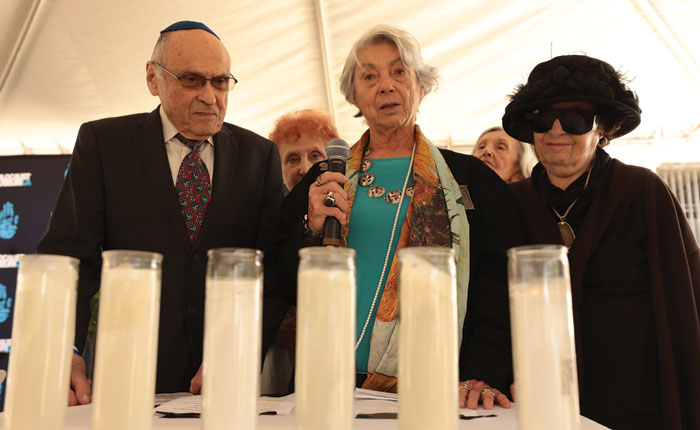
The landmark weekend will unite Jewish LGBT families from across the Southland at the Shalom Institute in Malibu from April 20 to 22.

The Shabbaton, which has the support of more than 20 congregations and organizations, was organized at the request of LGBT families themselves,  Edwards said.

“It’s something LGBT families feel a need and desire for even though they have been welcomed into mainstream communities,” she said. “A weekend like this will let them know that their family is a lot like other families.”

Rod Bran and John Scoles, members of both BCC and Temple Israel of Hollywood, are looking forward to attending with their 6-year-old daughter, Katie.

“It’s nice for similar families to experience a community environment where we’re not being judged by others that our families are different,” Bran said.

He says Katie has been told by other kids “that she can’t be alive if she has two dads. But when she goes to a camp like this, her situation is typical.”

The weekend will include traditional Jewish camp activities such as Shabbat and Havdalah services, song sessions and campfires, hikes and zip lining, arts and crafts, yoga and gardening, as well as opportunities to discuss issues affecting LGBT families in a safe, welcoming and supportive environment.

According to Leah Zimmerman, director of education at BCC, discussions will address the various compositions of LGBT families — whether formed through adoption, fostering or surrogacy — and questions of multiracial and multifaith identity, as seen through a Jewish lens in a heteronormative world.

“It’s realizing that you are a part of a larger conversation and a larger community,” said Zimmerman, who is an ally of the LGBT community, along with her husband and their two daughters. “Bringing people together from different congregations helps to create a stronger LGBT community. Our kids see themselves as part of BCC, but what I’m interested in doing for them is helping them see themselves as part of a larger Jewish community, and know that BCC is not the only place that recognizes them as Jewish and invites them to be part of the community.”

Although many local synagogues are welcoming toward LGBT individuals and families, most don’t offer relevant activities and programs because there isn’t enough demand or resources.

There are no official programs to support LGBT congregants at Adat Ari El in Valley Village, and for this reason, the LGBT Jewish Family weekend has the congregation’s endorsement.

“These families are Jewish, and want support and strength from our tradition. They want opportunities to connect with one another,” said Senior Rabbi Jonathan Jaffe Bernhard, who has been with Temple Adat Ari El for 15 years. “The shabbaton is a wonderful way to create these opportunities for them.” 

“We want to reinforce the idea that you don’t have to choose between your faith and your family,” said BCC Executive Director Felicia Park-Rogers, who has two sons with her partner, Leo Baeck Temple Assistant Rabbi Rachel Timoner. “Judaism in its broadest form is so welcoming of families based on commitment and love, following the principles and ethics and traditions of Judaism.”

The organizers are hoping the weekend turns into an annual event.

“So often when you start something, you don’t know if it’s going to be the first and only or the first of many,” Edwards said. “Hopefully this will be the first of many.”

Registration deadline is April 5. For more information and to register for the weekend visit shalominstitute.com.

Families Will Gather in Malibu for SoCal’s First Jewish LGBT Weekend Retreat Read More »

Northridge home defaced with swastikas

[UPDATE Apr. 10: Girls admit to syrup swastikas, mother could face charge]

[UPDATE Apr. 5: Girls admit to syrup swastikas, mother investigated]

The Los Angeles Police Department’s Devonshire Division is investigating the Tuesday morning vandalism of a Northridge home as a hate crime.

Three swastikas and the word “Jew” were written in maple syrup on the home’s front walkway. Feces were also found near the home’s front door and toilet paper was strewn in the property’s trees, according to the homeowner.

LAPD Sgt. Humberto Najera said the victim’s residence was hit with what appeared to be a prank, but police are investigating the incident as a hate crime and as an act of vandalism because the graffiti was anti-Semitic.

“We don’t treat these things lightly,” Najera said.

The incident took place sometime between midnight and 6:30 a.m. on April 3, according to the homeowner, who works out of a home office with a window that overlooks the front yard. He first noticed the toilet paper in a tree.

“I went outside to make sure there wasn’t additional damage, and when I opened up the door there was feces on the doorstep, maple syrup all over my door and on the doorstep and walking up to the door, two swastikas and the word ‘Jew’ and a third swastika,” said the homeowner, who spoke with The Journal on condition of anonymity.

The homeowner, the son of a Holocaust survivor, posted an image of the vandalism on Facebook. The photo has since gone viral.

The homeowner, a father, believes the incident could be related to three teenaged girls – former friends of his daughter.

He said that another house in the neighborhood, about three-quarters of a mile away, was vandalized with toilet paper around the same time. He added that his daughter is a friend of the daughter of the other victimized family.

The victims have not yet contacted the Anti-Defamation League (ADL).

“We’re always concerned when we see swastikas,” said ADL Senior Associate Director Alison Mayersohn, who planned to follow up with police officials Wednesday morning.

The homeowner described his neighborhood as ordinarily “very quiet,” and said he could not recall other incidents of anti-Semitism taking place in the area. He was, however, jolted by this incident.

“It’s 2012 and we’re still dealing with people hating Jews because we’re Jews,” he said.

Northridge home defaced with swastikas Read More »