fbpx

February 17, 2010

Ernest Auerbach, Santa Monica real estate developer, dies at 93

Ernest Auerbach, a Santa Monica real estate developer and racehorse breeder, died Feb. 1 at 93.

Born in Brooklyn, N.Y., he moved to a farm in upstate New York during the Great Depression, where he grew and sold produce, and later became a produce broker. At the outbreak of World War II, Auerbach entered the U.S. Army and was placed in the Horse Cavalry, where he developed what became a lifelong love of horses. After the war, Auerbach moved to California, launching in 1946 the Ernest Auerbach Company in Santa Monica, which focused on real estate construction, management and financing. In 1977, he developed a thoroughbred breeding farm in San Diego County, where he bred and trained many successful racehorses, including a winner of the Santa Anita Goodwood Handicap. In 2001, Auerbach founded Ramona National Bank, which became First Business Bank, a community bank based in San Diego.

Auerbach and his wife, Lisa, were benefactors of many local institutions, including City of Hope, American Youth Symphony, Jewish Community of Pacific Palisades/Kehillat Israel Synagogue, American Jewish University, The Jewish Federation, Jewish National Fund, and Jewish Home for the Aging (now the Los Angeles Jewish Home).

In addition to his wife, Auerbach is survived by his daughters, Lorna (Larry) Wheat and Heidi (John) Farkash, and three grandchildren. Contributions in Auerbach’s name may be sent to the Jewish Healing and Hospice Center of Los Angeles, 10573 W. Pico Blvd., Suite 850, Los Angeles, CA, 90064 (jhcla.org) or American Jewish World Service (ajws.org).

Ernest Auerbach, Santa Monica real estate developer, dies at 93 Read More »

Once More, With Feeling

Peter Wollstein lived in the Shanghai Ghetto when he celebrated his bar mitzvah in 1947. But now, looking back more than six decades later, he says he is unhappy with his Chinese simcha.

“I memorized a couple of prayers, and that was about it,” said Wollstein, whose family fled Nazi Germany prior to the start of the Holocaust. “It wasn’t very demanding.”

Wollstein, 75, has become more deeply involved in Jewish life in recent years, and his cursory bar mitzvah in China has inspired him to go back and give it another try. Last year, after the High Holy Days, he joined a class to study for a second, more authentic experience.

Second b’nai mitzvah are not uncommon. The average lifespan is 70 years in Jewish tradition, and a second bar or bat mitzvah is typically celebrated at 83. But when Wollstein is called to the Torah with the rest of the Valley Beth Shalom (VBS) adult b’nai mitzvah class on April 3, it will be as a bar mitzvah do-over.

Wollstein’s family lived in Berlin when he was born in 1934. His father, a political activist who worked in the greeting card industry, served an 18-month prison sentence for distributing guerilla literature shortly after Hitler came to power.

“I am told he was in prison when I was born,” Wollstein said.

After his father was released, the family secured the right to leave Germany. Their first choice, the United States, was denied. When the family was allowed to leave for Japanese-occupied China, Wollstein says they were forced to relinquish their assets.

“It certainly was better than had we stayed behind,” he said. “It was survival.”

Under pressure from the Nazis, Japan’s imperial army ghettoized the approximately 20,000 German Jewish refugees in the crowded square-mile Hongkou District, known as the Shanghai Ghetto. Wollstein shared a one-room apartment, bereft of plumbing, with his father and uncle.

Wollstein said his father arranged for him to attend Catholic school, adding that there were no options for a Jewish education.

“My counterparts in this country studied Torah, [but] I never learned how to read Hebrew,” he said.

Soon after his bar mitzvah, Wollstein’s family immigrated to the United States, settling in Minnesota, where he studied at the University of Minnesota, Minneapolis. After marrying in 1958, Wollstein spent 35 years working academic administration jobs at various universities around the country. He says his career hindered exploring his Jewish identity.

“Professionally, I lived an assimilated life,” Wollstein said. “Opportunities for regular interaction with people in the Jewish community was much more limited than it might have been if I had become a lawyer or a doctor.”

Ten years ago, when Wollstein retired, he and his wife started connecting to Judaism on a deeper level. Still, having another bar mitzvah “was not even in my thought process at the time,” he said.

After his wife died in 2004, Wollstein moved to Los Angeles, where he met and married Judy Geller, a former VBS president.

Following in his new wife’s footsteps, Wollstein became active in the synagogue.

In October, he joined the adult b’nai mitzvah class, and says he is now finally learning how to read Hebrew.

This new life “has made me a little more conscious of what it means to be a Jew,” he said.

Adults who study to become b’nai mitzvah are often women who didn’t have the opportunity to become a bat mitzvah, partly because the practice was uncommon prior to the 1970s. This year the VBS class features 11 students, three of whom are men. Wollstein is the youngest, and two of his friends, both turning 83 this year, are celebrating their second bar mitzvahs.

When it was his turn to read at the beginning of a recent class, Wollstein opened his binder, revealing his parasha with the words written phonetically above the Hebrew script. He recited his part slowly, taking care to articulate his words, barely infusing his voice with melody but still in key.

“Good,” said Yosi Dresner, who teaches the class twice each week. “A fraction slower, and it’s great.”

Rabbi Ed Feinstein, who will preside over the service with Wollstein and his peers, says people often don’t stop to consider the journey that has preceded a student’s arrival in a b’nai mitzvah class.

“We see an 85-year-old guy, and we say, ‘Yeah, he’s an old guy.’ [But] you don’t realize that guy has history, a story,” he said.

When Wollstein has his second bar mitzvah during Passover, Feinstein said, “it’s a chance for us to get to know him again.”

Once More, With Feeling Read More »

Leon Lipkis, 1916 – 2009

Leon (Lee) Lipkis was born in Salt Lake City to Russian immigrant parents, Abram Lipkis and Mary Altschuler. The family moved to Los Angeles in 1928. Lipkis attended John Burroughs Junior High and Los Angeles High School, where he played Varsity C Basketball and water polo, and spent long summer days on the beach with friends. Lipkis graduated as a Bruin, then attended the Southern California College of Optometry.

Although he was a pacifist, when the U.S. entered World War II, he was trained as an officer and became a U.S. Air Force Captain. He was deployed to the 451st Bomber Squadron out of Essex, England, and produced a book on the wartime work of the squadron.

After the war, he married Joyce David and opened a private optometric practice in Leimert Park. Lipkis developed a special knack for diagnosing unusual visual problems and for helping patients rehabilitate damaged brain function. As an equal opportunity optometrist, he delighted in fitting contact lenses on dogs, and on kangaroos at the L.A. Zoo.

Lipkis helped build the B’nai Israel Synagogue in South Los Angeles, where he served multiple terms as president. He volunteered his optometric services for the Venice Family Clinic and formed a mutual aid group for optometrists. He served on the boards of B’nai Israel and the Southern California College of Optometry. He was a founding board member of TreePeople, remaining active until his death. Lipkis was also an active member of the Brandeis Men’s Breakfast Club.

Lipkis enjoyed playing and watching tennis, was an early investor in the Lakers, and a major Bruins and Lakers fan.

He is survived by his sons, Don (Arlene), Roger (Desiree) and Andy (Kate), and his grandchildren, Phoebe, Kira, Alex, Henry, Sienna and Skye.

A memorial service, including dedication of the Joyce and Lee Lipkis Garden, was held at the TreePeople Center for Community Forestry on Nov. 28, 2009.

The Lipkis family invites contributions to TreePeople in Lipkis’ memory to support the garden. For more information, visit TreePeople.org.

Leon Lipkis, 1916 – 2009 Read More »

The Separation Between Holy and Mundane

The spiritual and the secular are distinct realms that often collide, intersect, overlap and infringe upon one another. Nowhere is that phenomenon more visibly and more frequently at play than in the Jewish homeland: The state flag bears a religious symbol, civil marriages are sanctioned by a religious court, it is illegal to require an employee to work on Shabbat, and, as Israeli artist Nira Pereg illustrates in one of her videos, public city streets in some neighborhoods in Israel are blocked off to traffic in observance of Shabbat.

The intersection of two worlds — the sacred and the secular, the living and the dead, the society and the individual — is what Pereg explores in a complementary pair of video art installations at the Santa Monica Museum of Art and the adjoining Shoshana Wayne Gallery. “Nira Pereg: Sabbath 2008” and “Kept Alive,” on display until April 17 and Feb. 27 respectively, are documentary-style recordings of what most Israelis would consider commonplace activities hardly worth a second glance: a young Orthodox man in a black hat trotting down the street on a late Friday afternoon, two young boys in kippot dragging a barrier across a small road, a gravedigger shoveling dirt, women bending over a grave marker.

But for Pereg, a 40-year-old Tel Aviv native who grew up amid the hustle and bustle of strictly secular city life, the mundane became a source of fascination when she realized the layers of meaning that existed just beneath the surface of these activities.

It took spending a few years away from home working and teaching video art in Germany and France for Pereg to rediscover the intricacies of her own culture. What lured her to other countries — the novelty of the “other” — ultimately allowed her to turn a critical and artistic eye upon elements of Israeli life that never occurred to her before as worthy of exploration.

“In Paris, I was an outsider, so I was able to observe,” Pereg said before a panel discussion at the museum last month, featuring Rabbi Bradley Artson, dean of American Jewish University’s Ziegler School of Rabbinic Studies, and Rabbi Sharon Brous, founding rabbi of IKAR. “Only after spending a few years away from Israel was I able to suddenly find things that were foreign and interesting — like the fact that everything in Israel is gated: the windows, the doors, front yards, backyards. Everything is so protected, guarded. There is such an emphasis on territory and borders. It’s not like that in other places.”

The delineation of physical borders is a major theme in “Sabbath 2008,” a seven-minute video documenting the blocking off of roads leading into Orthodox neighborhoods in and around Jerusalem in preparation for the Sabbath. As the sun starts to fade, neighborhood residents drag police barriers across streets, diverting traffic, blocking public access and translating private beliefs into tangible boundaries. Here is where the secular ends and the holy begins, they declare.

The three-channel video installation, “Kept Alive,” which chronicles the routine activities at Jerusalem’s Mountain of Rest cemetery, also highlights the daily interplay between religious and secular elements of Israeli society. Shots of Orthodox men praying at a gravesite are juxtaposed with images of Arab workers digging holes; sweeping panoramic views of the mountain, every inch of it covered with white stone markers, alternate with close-ups of a busy construction site, where the hillside is demolished to make room for more graves. Here, the borders between worldly and otherworldly are clearly defined.

In a country where riots are set off by the opening of a parking lot on the Sabbath, as occurred in Jerusalem in June, the choice to focus artistic expression on the effect of religion on urban environments is potentially contentious.

“To open the camera lens in Israel is a political act,” Pereg said. “It’s an intense landscape to work in.”

“Nira Pereg: Sabbath 2008” is on display through April 17 at the Santa Monica Museum of Art, Bergamot Station G1, 2525 Michigan Ave., Santa Monica. (310) 586-6488. The Separation Between Holy and Mundane Read More »

David Arquette: The Females of My Life

At the Geffen Playhouse recently, David Arquette twisted off his gold wedding ring to reveal the inscription he shares with his wife, Courtney Cox: “A deal’s a deal. 6-12-1999.” The ornate script recalls the couple’s marriage in a multifaith ceremony in which Arquette broke a glass to honor his Jewish mother.

The youngest of acting siblings Rosanna, Patricia, Richmond and Alexis, Arquette is perhaps best known for playing doofuses, such as the cop Dewey in the “Scream” franchise; for founding Coquette Productions with Cox and, of late, for executive producing ABC’s “Cougar Town,” starring his wife as a 40ish divorcee who fancies younger men.

The wedding ring came off, briefly, because he was discussing how themes of marriage and family resonate for him in his latest endeavor: playing a devoted, if daft, husband and father in Joanna Murray-Smith’s “The Female of the Species,” at the Geffen through March 14. The farcical satire revolves around a pompous feminist author (Annette Bening) who is taken to task by a chagrined former student, her own daughter, Tess (Mireille Enos), Tess’ husband, Bryan (Arquette), and an uber-macho taxi driver (Josh Stamberg).

It is just Arquette’s second role on a professional stage: “I’d been doing some projects I wasn’t crazy about as an actor. They were fine, but that’s all they were,” he said of why he considered a theater job. He said he loved “Female of the Species” and was fascinated that it explores how feminism has affected both men and women. Even so, he was anxious about reading for the show’s director, Randall Arney, who is also artistic director at the Geffen.

“I’m a horrible auditioner,” Arquette said sheepishly. “I got rejected for years until I got my first part. There’s just something about going into a room and being judged that takes all the creative energy out of me. It’s so hard in this town, because you do get beat up, and it does mess with your confidence. Part of the big learning curve on this for me has been to feel comfortable in my skin and embrace the character without getting the jitters.”

Arquette comes across as sweet and funny — he hugs a visitor — but also vulnerable and self-effacing. It’s easy to see why he was startlingly heartbreaking in Tim Blake Nelson’s “The Grey Zone,” in which he played Hoffman, the most fragile and guilt-ridden of a squad of Sonderkommandos (Jews who manned the crematoria) — a project he undertook, in part, to connect to his Jewish roots.

“I’ve always felt that David’s comedy is based on shame,” Nelson said of why he hired Arquette for the role in 2001. “The comic tension in his work is about his characters trying to be something they’re not, so they’re ashamed of who they actually are. And Hoffman is a character based on shame.”

Murray-Smith also was impressed by Arquette’s vulnerability: “I’ve never seen an actor as nervous in an audition — he was sweating and just looked at me as if he were saying, ‘I know I’m not going to get the part.’ But his talent and brilliance shone through, not just in his comic timing but in this sense of innocence he brings to a character who at times can be vain and bombastic.”

Arquette is also drawn to the play’s dissection of parenting and motherhood, and soon the conversation turns to his own late mother, Mardi (nee Brenda Nowak), whose life embodied the kind of positive transformation made possible by the feminist movement. Born in Scranton, Penn., she was the daughter of a refugee from Nazi-occupied Poland. “She had a really rough childhood; there was some abuse that was very traumatizing to her,” including being molested by a neighbor, Arquette said. “As she grew up, she was beautiful and, like other women [of her generation], learned to use her body to sort of get what she wanted — she became a pinup model as well as an actress. Once, I was going through a book, ‘I was a ‘50s Pinup Model,’ and I found a picture of her, and I was like, ‘Mom, what is this?’”

The change came after the family moved to Los Angeles, when, Arquette said, his mother went back to school, became a teacher, and got her license as a marriage and family counselor while she was sick with breast cancer. “She got the actual certificate when she was on her deathbed [in 1997], and to me it was like, ‘Mom, you did it, you broke the cycle, you graduated.’ It was a beautiful moment.”

Arquette was born on a Virginia religious commune his parents co-founded that embraced aspects of Hinduism, Buddhism and Islam (his father, Lewis Arquette, eventually converted to Islam). It was the group’s leader who urged his parents, both actors, to move to Hollywood, per his philosophy of “using your gifts to make the world a better place,” Arquette said. After the cross-country trek in a “totally funky 1960s van,” Dad taught improvisational comedy and all the children took improv as well as acting classes. “I always knew I liked to make people laugh,” Arquette said. “When we were kids we listened to a lot of Monty Python and comedy albums, and my brothers and sisters and I were always joking around.”

Arquette credits his mother for instilling in him a sense of being Jewish. Although she rebelled against her own observant upbringing and embraced Eastern thought, she nevertheless loved and explained the Jewish holidays to her children. Arquette today lights Chanukah candles with his daughter, Coco, and he reports, “What I love more than anything is Yiddish; it’s so soulful…. I wanted a bar mitzvah but didn’t have one as a kid,” he added. “I still may get one — maybe for my 40th birthday.”

Arquette’s parents separated but never divorced; when his father was dying of heart failure in 2001, as Arquette was shooting the action comedy, “Eight Legged Freaks,” “he told me, ‘Your mother was always the love of my life,’” Arquette said. “That was so sad,” he added. “It’s one of my big philosophies in life that, for men, if you’re going to be married and have kids, you have to make it work. Obviously if you’re in a bad relationship, it’s one thing, but some of the time, it’s you, and there’s a lot of work to be done on both sides. And I think men often have like a ‘grass is greener’ outlook on life and can easily be tempted to take off.” As for his own level of commitment, he said, “I’m unavailable to other people. My heart is closed, reserved for Courtney, my family and Coco, on a relationship level.”

So — speaking of the feminist movement — how does Arquette handle being married to someone who is far more successful than he is as an actor?

“That really does bug me,” he said. “It’s not jealousy as much as I just have a drive to be successful; it’s ingrained in men to be, like, the breadwinner, and the type of success you get on a show like ‘Friends’ is a very rare opportunity.  But I’m getting less and less concerned with it and more and more accepting.”

Arquette places his wedding ring back on his finger as he prepares to perform in the night’s preview. “I love that I get to wear my wedding ring in this play,” he said. “I usually have to take it off, which is always a bummer.”

For tickets, visit http://www.geffenplayhouse.com/.

David Arquette: The Females of My Life Read More »

Obituaries: February 19-25, 2010

Bernard Arieff died Nov. 30. He is survived by his daughter, Diane; son, Phillip (Yaffa); brother, David (Susan); five grandchildren; and three great-grandchildren.

Harold Bell died Dec. 4 at 90. He is survived by his wife, Edith; sons, Donald (Gail Jacobson), Gary (Jane) and Richard (Nancy); seven grandchildren; and two great-grandchildren. Mount Sinai

Pearl C. Berman died Dec. 2 at 80. She is survived by her daughters, Elaine (Jim) Black and Evone (Gary) Taylor; son, Joel (Hallie) Berman; five grandchildren; and three great-grandchildren. Mount Sinai

Ann Bledstein died Dec. 2 at 92. She is survived by her daughter, Michele (Benjamin) Susman; sons, Burt (Adrien) and Mark (Linda); six grandchildren; and five great-grandchildren. Mount Sinai

Ruth S. Britton died Dec. 12 at 85. She is survived by her husband, Alexander L; daughter, Michele (Jeffrey) Bass; son, Sanford; two grandchildren; and brother, Jack (Adrienne) Stein. Mount Sinai

Eliezer Czerniak died Dec. 1 at 86. He is survived by his wife, Cynthia; three daughters; and four grandchildren.

Pola Dancyger died Dec. 6 at 89. She is survived by her husband, Abe; sons, Michael (Barbara) and Ted; four grandchildren; and brothers, Joe (Mildred) and David Peskin. Mount Sinai

Alan C. Danon died Dec. 5 at 74. He is survived by his wife, Simone; sons, Steven (Caleen) and Marc; one grandchild; sister, Enid (Paul) Armond; and brother, Joseph (Sandy). Mount Sinai

James Donnelly died Dec. 12 at 40. He is survived by his son, James; sisters, Tamara (Gary) Vandergraat, Colette (Michael) Kramer, Gloria Margolis, and Trisha; twin brother, Andrew; and brothers, Gary Margolis, Mark Margolis, Tim, Tye and Douglas Brown. Mount Sinai

David Enzer died Dec. 2 at 71. He is survived by his wife, Rosemary; and sister, Andrea (Leonard Palatnick) Wilder. Mount Sinai

Bert R. (Budd) Levine died Sept. 23 at 83.  He is survived by his wife, Bunny; daughter, Janet; sons, Hank (Joan) and Danny (Karie); sister, Helen; daughter-in-law, Evelin; eleven grandchildren; and four great-grandchildren.

Theodore C. Levy died Dec. 8 at 78. He is survived by his wife, Lorelei “Lolly”; daughter, Jan (Bob) Shpinerl; son, Jeff (Anndee); six grandchildren; and sister, Cynthia Schultz. Mount Sinai

Batia Littner died Dec. 7 at 80. She is survived by her husband, Nathan; daughter, Lesley; and sons, Dan and Jerry. Mount Sinai

Clotide Manopla died Dec. 2 at 80. She is survived by her daughter, Marianne (Bob) McKim; son, Albert (Nina); two grandchildren; brothers, Joe, Isaac (Shulamit) and Roger (Rosita); and sisters, Freda (Jose Nessim) and Francine Silvera. Hillside

Eva Matyas died Dec. 10 at 89. He is survived by his daughter, Judith; and son, Leonard. Mount Sinai

Anita Medjes Miller died Dec. 6 at 82. She is survived by her husband, Philip; daughter, Iris (Kenneth) Bragar; son, David (Joani) Medjes; step-daughter, Janice (George) Geldin; step-son, Russell (Jo); 12 grandchildren; and nine great-grandchildren. Mount Sinai

Lois “Dolores” Meisels died Dec. 3 at 80. She is survived by her daughter, Hillary; son, Marc (Monica); two grandchildren; and sister, Elsie Ellenburg. Mount Sinai

Harriet Ruth Modler died Nov. 29 at 70. She is survived by her husband, Peter; sons, Stephen (Lilly) and Richard; and four grandchildren. Mount Sinai

Frieda Normile died Dec. 7 at 98. She is survived by her son, Roger (Carol); three grandchildren; two great-grandchilden; and niece. Mount Sinai

Jan Platt died Dec. 6 at 54. She is survived by her husband, Rick; sons, Jeffrey and David; parents, Carolyn and Allen Lasky; and sister, Sunie Lasky. Mount Sinai

Mindy Mann Rosenbaum died Nov. 23 at 84. She is survived by her daughter, Vicki (Benni) Garfinkel-Jakubovic; and one grandchild.

Marianne Schneider died Dec. 6 at 90. She is survived by her niece, Laela (Zad) Leavy; and four great-nieces and great-nephews. Mount Sinai

James Falender Sharp died Nov. 29 at 75. He is survived by his wife, Rhoda; sons, Robert (Mary) and Roger (Shari) Hyman; and two grandchildren. Mount Sinai

Joseph Shorr died Dec. 8 at 89. He is survived by his wife, Concepcion; daughter, Ivy (Timothy) Jelden; son, Howard (Loise); and five grandchildren. Mount Sinai

Morris Siegel died Dec. 1 at 88. He is survived by his daughter, Robin Rose; son, Mark (Darlene); and three grandchildren. Mount Sinai

Ethel Simmons died Dec. 3 at 85. She is survived by her sons, Robert (Carol) and Richard (Bobbi Buffington); and one grandchild. Mount Sinai

Helen A. Westergard died Dec. 2 at 89. She is survived by her daughters, Tobi Trujillo and Marilyn Goldin; two grandchildren; and two great-grandchildren. Mount Sinai

David Youlovsky died Nov. 23 at 91. He is survived by his daughters, Wendy (Jack) Dytman and Ferne Cassel; and two grandchildren. Mount Sinai

Lila Yudell died Dec. 8 at 78. She is survived by her husband, Bernard; daughter, Caryn (Aaron) Jackson; and two grandchildren. Mount Sinai

Obituaries: February 19-25, 2010 Read More »

Demonstrators Support Palestinian Petition to Stop Museum of Tolerance in Jerusalem

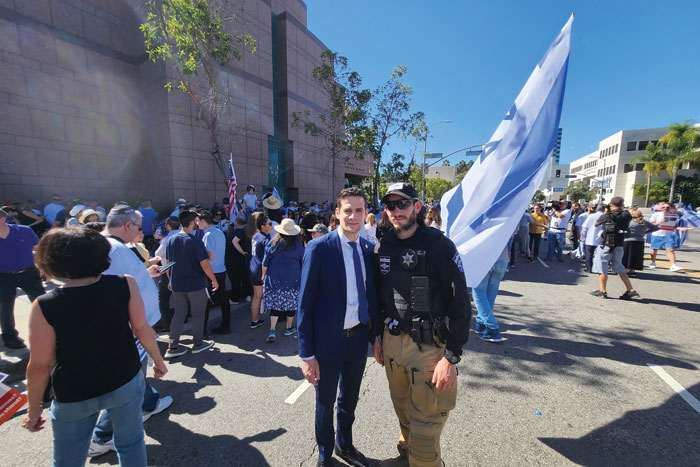
Activists in Los Angeles, Geneva and Jerusalem demonstrated last week in support of a Palestinian petition to the United Nations aimed at preventing the Simon Wiesenthal Center from building a Museum of Tolerance on what activists say is part of a medieval Muslim cemetery in Jerusalem.

Sixty families who say they have relatives buried in the Mamilla cemetery signed the petition asking the U.N.’s High Commissioner on Human Rights to investigate the issue. A decision by the U.N. would not carry any legal authority to overturn a 2008 ruling by Israel’s Supreme Court green-lighting the project.

Rabbi Marvin Hier, dean of the Wiesenthal Center, said the $80-million museum, already under construction, will go forward. He emphasized that the 3-acre site had been a municipal parking lot since 1960, and does not affect the Mamilla cemetery adjacent to the site.

“From 1960, every day Muslims and Jews and Christians parked their cars there,” Hier said in a phone interview. “How can Muslims park their cars every day on what they call a sacred cemetery which houses the remains of their ancestors? Obviously, they did not think it was a cemetery, and that is why the Supreme Court ruled against them.”

But activists say the original parking lot also violated Muslim remains, and building a museum dedicated to tolerance and human dignity atop it is an additional affront.

“When years ago Arabs built on top of an ancient Jewish cemetery, Jews the world over were understandably outraged. It is just as big an outrage, as well as a severe blow against peace and religious tolerance in the Middle East, for the Simon Wiesenthal Museum of Tolerance to now seek to build a new museum of tolerance on the sacred burial site of Muslims,” said Rabbi Leonard Beerman, the founding rabbi of Leo Baeck Temple in West Los Angeles and a longtime human rights activist.

Beerman spoke at a press conference last week held across the street from the Simon Wiesenthal Center on Pico Boulevard. Reform rabbis, human rights activists and Muslim and Christian leaders attended the press conference, organized by the National Lawyers Guild, a human rights bar association.

Hier said human rights organizations and the media have bought into a propaganda-driven campaign being led by Sheik Raed Salah, leader of the extremist Northern Branch of the Islamic Movement in Israel. The Wiesenthal Center has filed complaints with The New York Times, the BBC and other outlets protesting the use of a picture of Muslim tombstones in the Mamilla cemetery adjacent to the site, making it look as if the Wiesenthal Center is ready to bulldoze the site — which Hier said is an “abject lie.” The BBC has apologized for using the picture.

Dueling opinion pieces in the Los Angeles Times on Feb. 12 pitted Hier’s assertion that the Israel Antiquities Authority and the Supreme Court determined the site was not a cemetery and could be used for construction against a piece by Saree Makdisi, a UCLA professor who claims that the Wiesenthal Center is desecrating tens of thousands of graves.

The Wiesenthal Center has suffered a huge public relations blow with thiscontroversy. The Reform movement’s rabbinic umbrella group came out against the museum, and protesters have included everyone from Palestinian activists to Orthodox students. Frank Gehry, the original architect on the project, recently pulled out, though he said it was out of financial concerns, and not because of the political issue.

But Hier said it is a fight worth fighting. The site is one of the few parcels available for building close to the city’s tourism center, he said, adding that Israel greatly needs the messages of tolerance the Museum has been able to impart to its 250,000 multi-ethnic visitors a year in Los Angeles.

“We’re not going to give in to them because it’s much too important a project,” he said. “We’re not going to give in to a bunch of fanatic Israel bashers or people who might be envious that the Simon Wiesenthal Center is going to have something to say on the issue of tolerance in Israel.

“We’re going forward, without any apologies, on that spot,” Hier said. “It will be built, and it will be a great institution and will do for people in Israel what the Museum of Tolerance has done for people here in Los Angeles.”

Demonstrators Support Palestinian Petition to Stop Museum of Tolerance in Jerusalem Read More »

Parashat Terumah (Exodus 25:1-27:19)

People in need of assistance have approached me over the past 18 months in numbers I have not seen before in my service as a rabbi. The economic downturn, which is still very much our reality, has rendered many a giver of tzedakah (charity) a new recipient and has made the circumstances faced by many existing recipients all the more desperate.

Many people still blessed with sufficient means to assist those in need have stepped forward, seeking to learn where and how they might contribute their funds to make the most important and needed difference. While such dedication is nothing short of inspirational, needs exceed available means to assist and Jewish institutions and organizations struggle to manage expenses to remain solvent.

The economic downturn is not the only financial challenge faced by the Jewish community. Bernard Madoff did such broad and deep damage to Jewish institutions, and to numerous committed philanthropists who support them, that the generation emerging in the Jewish community might come to be known in the future as the post-Madoff generation. Our era might be defined by its challenge to sustain the Jewish present as much as by its call to ensure the Jewish future — an unexpected departure from the financial hurdles of recent generations and one entirely unpredicted fewer than two years ago.

But challenges and even crises often present important opportunities. This week’s Torah portion, Terumah, may well include an important message for each of us in the Jewish community to understand and respond to the opportunities amid the challenges presented by Madoff’s betrayal of his own people.

As Moses led the Israelites in their journey toward the Promised Land, and after God’s revelation at Mount Sinai, the Torah teaches us that God instructed Moses to solicit voluntary gifts from the Israelites, with their decision to participate remaining voluntary and their degree of generosity a matter of personal choice. The purpose of this “campaign” was to enable the entire community to work together to build a Tabernacle, a central locus for God’s presence among the people: “They shall build for me a Sanctuary, and I will dwell among them” (Exodus 25:8).

The particular phrasing of the instruction to construct the Tabernacle offers some important insights and charges, as important for us in the post-Madoff era as they were for our ancestors living in relative austerity while journeying to freedom and purpose in the Promised Land.

Per the commentary in Avot D’Rabi Natan, one of the earliest compilations of rabbinic literature, “Great is work, for even The Holy One of Blessing did not abide among Israel until they worked.” It wasn’t enough that a Tabernacle be made to exist; it was vital that a collective undertaking — a broad-based, voluntary commitment — be assumed by the Jewish people, each as he was moved, to build not only a symbolic locus for God’s presence, but, thereby, a community worthy of God’s presence and one that could therefore enjoy God’s presence throughout.

The charge to assume a voluntary, collective endeavor whose success depends upon everyone working together is as important today as it was in the desert. The call to each and every one of us to consider carefully the consequences of our own commitment and financial generosity — or the lack thereof — echoes through time to eras such as our own today. The obvious insight of the verse itself, that our earnest invitation to God to reside in a space we build together among us, is a reminder that any Jewish achievement in any era can endure only to the extent that it involves and engages a sizeable proportion of the community, which is committed and dedicated to give more as it is needed.

The grand opportunity in the post-Madoff era is to make the Jewish community and the welfare of the Jewish people, here and abroad, the primary beneficiary of our personal and communal commitment and generosity. In our era, we can no longer afford to see a mere 10 percent of all Jewish philanthropy allocated to assisting other Jews and supporting Jewish organizations and institutions that serve Jews primarily. Due to near catastrophic loss of funds thanks to Madoff, a constant percentage will mean a severe decrease in vital services and necessary subsidies provided by Jewish schools, synagogues, pro-Israel organizations, Jewish welfare service organizations and international Jewish relief efforts.

If we rise to the occasion, the Madoff challenge can serve as an important opportunity for us to recalibrate our priorities and remind ourselves that we need everyone, in every way, to maintain the Jewish present, let alone ensure the Jewish future.

If we all choose to contribute together, to sustain it together and to build it together, the Jewish present will inspire an even greater Jewish future — just as it did so long ago in the desert.

Rabbi Isaac Jeret is the spiritual leader of Congregation Ner Tamid of South Bay ( Parashat Terumah (Exodus 25:1-27:19) Read More »

Koreans study Jewish family values, traditions and history as secrets to longevity

Thirty-five Korean ministers and professors visited the Los Angeles Jewish community last week, sitting in on high school Torah classes, attending morning prayers, joining a Shabbat meal and studying Jewish texts with local rabbis.

All devout Christians, these students of Judaism hailed not only from South Korea, but also from Korean communities in Russia, China, South America, Canada and across the United States.

They were not interested in converting to Judaism or in proselytizing Jews, but rather were here to learn the secret to Judaism’s survival.

“Jews successfully conveyed the Torah, the traditions, the history — especially the history of suffering — and the family values based on Torah for 3,000 years with no generation gaps,” said the group’s leader, Yongsoo Hyun. “The Christian people lost the value of how to raise children who are holy. We are recovering that history to spread it all over the world.”

Hyun, 62, a Presbyterian minister and professor who moved to the United States in 1975, has spent the last 18 years studying the Jewish community and spreading his Jewish gospel from his Mar Vista-based Shema Education Institute.

This is the ninth annual tour of Los Angeles Hyun has led, the culminating event of a three-semester course attended by 400 students each year at locations around the world. Hyun says 3,000 Koreans have graduated his class, paying $350 a semester, and he believes about 3 million people have been affected by his teachings through seminars led by his disciples or by reading one of his 22 books on Judaism, which have sold hundreds of thousands of copies in South Korea.

Hyun focuses on family, jumping off the biblical idea of keeping three generations together — as in Abraham, Isaac and Jacob, or the Torah’s refrain of “you and your children and your children’s children.”

But some Jews might not recognize the Judaism Hyun teaches. He speaks of a Judaism with intact families and no faulty transmission lines between parent and child. He speaks of Jewish Nobel laureates gaining their wisdom through Jewish studies, though most did not have a Jewish education.

His understanding of Judaism derives almost exclusively from observance of Orthodox families and studying with traditional rabbis. He believes the father is primarily responsible for transmitting texts and traditions to children, with the mother being responsible for the family’s emotional well-being and helping the father.

“I don’t get high grades in modern feminist literature, but I don’t think this division of labor is clear cut. Both parents contribute appreciably to both the intellectual and the emotional training of their children,” said Rabbi Yitzchok Adlerstein, who has been Hyun’s mentor. “It is partially Dr. Hyun’s reaction coming from a very man-centered society, where these divisions of labor still exist, and he thinks he spots them in traditional Judaism, but I don’t see them in my home or in my community.”

Adlerstein, a professor of Jewish law and ethics at Loyola Law School, said Hyun is as loyal a friend as the Jewish community and Israel will find, as well as a personal friend. Hyun pursues Jewish knowledge assiduously, and he knows more about Jewish texts and traditions than most Jews.

The visitors to Los Angeles, many of whom brought their families, toured the Museum of Tolerance, Beth Jacob Congregation in Beverly Hills, the Skirball Cultural Center, American Jewish University and YULA Boys High School and went on a shopping spree at 613 The Mitzvah Store before participating in a commencement ceremony at the JJ Grand Hotel in Koreatown at the end of their weeklong stay.

Koreans often compare themselves to Jews — a beleaguered people from a small country surrounded by enemies, which is, like ancient Israel, divided in two. Their brothers in North Korea are persecuted, while millions of Koreans in the Diaspora — and even those in the increasingly westernized South Korea — struggle to maintain their traditions and a standard of excellence for their children.

Hyun’s interest in Judaism began in 1990 while working toward his Ph.D. in education at Biola University, a Christian school in Orange County. As part of his studies, he was moved by what he saw as the God-centered nature of Jewish education, compared to the student-centered nature of classical American education.

He started taking classes at the University of Judaism (now American Jewish University), but was turned off by the liberal approach he found there. He switched to Yeshiva University of Los Angeles and, after some persistent nudging, ended up talking with Adlerstein, who was teaching there at the time.

Adlerstein, currently director of interfaith affairs at the Simon Wiesenthal Center, invited Hyun to his home for Shabbat dinner. Now Hyun and his wife — and often dozens of Hyun’s guests — regularly attend Adlerstein’s Passover, Rosh Hashanah and Shabbat meals.

Hyun set up the Shema Education Institute in 1992, and has since become something of a cult figure among his followers in South Korea and in the Korean Diaspora.

“We have had great leaders like Moses, and Paul in the New Testament, and Dr. Hyun’s discovery of the secret of Jewish survival is one of the greatest discoveries in human history,” said Yeong Pog Kim, with Hyun translating.

Kim has 2,000 members at his Presbyterian Church of Love and Peace near Seoul, and he said he is slowly introducing them to Jewish family values and educational methods.

He believes the Jewish give and take between teacher and student can revolutionize staid Korean classrooms. And it will make families stronger, as husbands learn to respect their wives and spend more time with their children.

Like many of Hyun’s students, Chi Nam Kim, a pastor in Toronto, has modified how he observes the Lord’s Day. Now, his wife lights candles every Sunday, and he says a prayer over the wine and the bread, and blesses his children and wife, all dressed in their best traditional clothes.

Chi Nam Kim explains this commitment by quoting Rabbi Abraham Joshua Heschel’s observation, “More than the Jews have kept the Sabbath, the Sabbath has kept the Jews.”

One student, Jin Sup Kim, prays three times a day, reciting the Shema and the biblical chapters that come after it, along with verses from the New Testament.

Jin Sup Kim is vice president of the divinity college at Baekseok University, a Christian school near Seoul with 30,000 students.

Kim earned a Ph.D. in ancient near eastern studies at Philadelphia’s Dropsie College, now known as the Center for Advanced Judaic Studies at the University of Pennsylvania. 

Kim, who teaches Hebrew, named his children Salome, Emet and Chesed, Hebrew words for peace, truth and kindness. During summer and winter breaks, he studies the Bible with his children for hours every day and encourages his 950 divinity students to do the same.

Kim leads a division of the Shema Education Institute and his own organization, the Korean Diaspora Revival Foundation, with offices in Israel aimed at drumming up Korean support for Israel and Judaism.

Addressing the anti-Semitism some Christian missionaries imported into Korea has been a clear benefit of the program.

“I didn’t like the Jewish people because of what they did to Jesus and Paul in the New Testament,” said Yeong Pog Kim, the minister from Seoul. “But now I turned to being pro-Israel. Now it opened my eyes to see the Jews positively, as a friend, and to see the Old Testament with a positive mind.”

In the past decade, South Korea has sent more tourists — mostly Christian pilgrims — to Israel than the rest of Asia combined, and the political relationship between the two countries continues to improve, according to the Jerusalem Center for Public Affairs.

While Israel needs that kind of international support, and the attention the Shema Education Institute is offering the L.A. Jewish community is flattering, is this attention all positive?

Adlerstein isn’t so worried about the Koreans’ filtered interpretations of Judaism — they are, after all, not planning to become Jewish. But Adlerstein does worry about what some refer to as reverse anti-Semitism, something he has seen in many parts of the world.

“Putting Jews up on a pedestal for how they are educated or for their achievements is sort of nice, but at the same time, it sends the message that the reason why we like Jews or will tolerate them is because they act on a higher plane. And we don’t always act on a higher plane, and these positive stereotypes are not always true,” Adlerstein said. “We would rather be accepted because we are a people and all people deserve tolerance and acceptance.”

Still, there is something compelling about the expectation, Adlerstein said.

“As a traditional Jew, I can’t fight it too much because I do believe it is what the Ribbono Shel Olam [Master of the Universe] asks of us. He does ask of us to live on a higher plane, to be an or lagoyim [a light unto the nations]. I find this insistence in some people who are not anti-Semites, but who insist on Jews being different, to be disturbing and exhilarating at the same time.”

Koreans study Jewish family values, traditions and history as secrets to longevity Read More »