fbpx

August 16, 2007

Briefs: Winning essays, scholarships, tikkun olam, kosher winners, saving singers

A $5,000 Essay Contest

A citywide essay contest will offer students in first through 12th grade a chance to win prizes for themselves, their teachers and their schools, and see their winning work published in The Jewish Journal.

The contest is being held in conjunction with American Jewish University’s Celebration of Jewish Books Festival, which will take place Nov. 5-11, 2007.

Students must write brief essays of no more than 450 words on the theme, “Jews are the People of the Book. What does this mean to you today?”

A panel of judges, arranged by The Journal, will select four winning entries in each grade category. The winners will receive a $250 Borders bookstore gift card, a $250 Borders card for their teachers and a $750 Borders card for their school library.

The Journal will publish the winning essays in print and at jewishjournal.com. All L.A.-area students are eligible. The deadline for entries is Oct. 17.

Visit www.jewishjournal.com for entry form and rules or call (310) 440-1246.

Scholarships Help Create New Lives

The Jewish Vocational Service (JVS) celebrated the accomplishments of the 2007-2008 JVS Scholarship Fund awardees in a ceremony at UCLA Hillel on July 12.

The recipients shared their personal stories to highlight the unique challenges the scholarships helped them overcome.

Alice Feldman was raised by a single mother with a lifelong struggle against severe depression. She moved in with her grandparents at the age of 16 and worked her way through Valley College and then UCLA, where she received her bachelor’s degree in 2004. Feldman is now a second-year doctoral student at Western University of Health Sciences-College of Pharmacy.

With the help of JVS scholarships, Jonathan Franks completed his undergraduate work at UCLA. His father is disabled by chronic back pain, and his mother was supporting a family of five as a preschool teacher. Also with the help of JVS, Franks is entering his second year at the UCLA School of Medicine, where he hopes to study surgery.

Jamie Zimmerman, a three-time recipient, is completing her final year at UCLA. Zimmerman grew up in an abusive single-parent home and even endured homelessness. At 15, she was the sole supporter of her family, while achieving As in school. She eventually became independent and in her years at UCLA, became a leader of the Jewish community there and worked in Peru and Zambia on humanitarian missions. She was accepted for early admission to the Mount Sinai School of Medicine in New York.

In addition to financial aid, JVS offers job search assistance to the recipients’ parents, an internship program for students interested in Jewish community service and other career-focused and mentorship programs.

Jewish residents of Los Angeles who plan to attend full-time programs are eligible for the scholarships, which are entirely need based.

For information, visit http://www.jvsla.org/.

— Julie Gruenbaum Fax, Education Editor

Tikkun Olam Pays Off

Two Los Angeles teens are among the five recipients of the first annual Diller Teen Tikkun Olam Awards. Erich Sorger, a 17-year-old Beverly Hills resident, and Shira Shane, a 19-year-old Encino native, each a won a $36,000 grant to use for college or to further implement their tikkun olam visions.

Beginning this year, up to five Jewish teens from California will be selected annually to receive a Diller Teen Tikkun Olam Award funded by the Helen Diller Family Foundation through the Jewish Community Endowment Fund of the Jewish Community Federation of San Francisco, the Peninsula, Marin and Sonoma Counties.

Sorger, a student at Beverly Hills High School, founded a program called Dollars for Dwayne, named after a homeless man he befriended. He and a group of volunteers collected items that UCLA students left on the sidewalks of Westwood at the end of the semester, including furniture, clothes and appliances, and donated them to the National Council for Jewish Women’s thrift shop.

The store sells the items and donates the proceeds to charity. Sorger estimated that his items have raised about $16,700 so far.

While a student at New Community Jewish High School, Shane, who now attends Stanford University, formed Teens Against Genocide, a coalition of 25 high schools throughout Los Angeles. Led by Shane, Teens Against Genocide organized a rally and raised $10,000 that will be used to build wells and medical clinics in the Sudan.

For more information, visit http://www.sfjcf.org/diller or e-mail Robyn Carmel at RobynC@sfjcf.org.

— Derek Schlom, Contributing Writer

Kosher Winners

Two sisters from Torrance, Abby and Sarah Sanfield, are among the winners of the first annual Orthodox Union Kosher Essay Contest.

Students in grades four through 12 nationwide were asked to write either a short fictional story featuring characters that face obstacles in their observance of kashrut or an essay about the importance of a kosher diet in their own lives.

Sarah, a fifth-grader, wrote “The Pot,” a story about a young girl named Anya who obeys her mother’s dying wish by taking a pot with her when she is forced to live in an orphanage, where she struggles to maintain a kosher lifestyle.

Abby, who is in the seventh grade, wrote “Kamp Kosher,” about a girl who decides to follow the laws of kashrut after attending a Jewish summer camp and subsequently convinces her father to transform his restaurant into a kosher eatery.

For more information visit http://www.oukosher.org/.

— DS

Singing to Save

A group of students at New Community Jewish High School raised $4,000 at a benefit concert, “Singing to Save,” on June 14 to support Jewish World Watch’s mission to end the genocide in Darfur. The members of two of the school’s clubs, United Students With a Cause and Club Kodesh, planned the event, which was held at the school’s campus in West Hills. The concert featured performances by Eleventh Hour Ash and Todd Herzog.

For more information, go to http://www.ncjhs.org.

— DS

Briefs: Winning essays, scholarships, tikkun olam, kosher winners, saving singers Read More »

CSUN exemplifies the changing face of ‘Jewish Studies’

Jewish studies programs at American colleges keep growing, but the enrollment curve of Jewish students in such programs remains largely flat or is drooping.

The explanation for this seeming paradox is that more and more non-Jews are signing up and, to continue this trend, universities must reach out to other ethnic and religious groups, professor Jody Myers said.

That’s exactly what’s happening at the California State University, Northridge, where Myers has coordinated the Jewish Studies Interdisciplinary Program for two decades. In any given year, non-Jews make up 50 percent to 70 percent of some 800 students in Jewish studies classes, Myers estimated, and she is bullish that the long-term trend will continue.

CSUN is the major college in the San Fernando Valley, but little is known of its Jewish component outside the area, to Myers’ quiet frustration. Most of the Jewish community’s attention, and philanthropic money, go to the higher-profile and better-publicized programs at UCLA and USC.

Leaving the academic aspect aside for a moment, if one marker of a university’s “Jewishness” is the number of Jewish students on campus, then CSUN can hold its own, with the size of its Jewish enrollment reflecting the growing Jewish population of Los Angeles’ one-time “bedroom community.”

The most recent data from campus Hillel centers indicate that UCLA still tops the list with some 4,500 Jewish students, representing about 12 percent of the total student body. (In the 1960s and ’70s, the proportion of Jewish students was estimated at 25 percent or higher)

CSUN and USC are next, both claiming about 3,300 Jewish students, with other strong concentrations at Pierce, Valley and Santa Monica community colleges. Most Jewish students at CSUN, like their classmates, are older than the national average, often attending part-time or seeking career changes. They tend to focus on practical subjects, such as business administration.

In Jewish studies classes, the ethnic and religious variety of the non-Jewish majority includes Christian Asians and Armenians who want to learn about the ancestral roots of their religion, African Americans probing problems of ethnic identity, spiritual seekers, explorers of mysticism whose interest has been sparked by Madonna and other kabbalah-quoting celebrities and many who are just plain curious why Jews and Israel are constantly in the news.

“We are an interesting people,” Myers observed.

Myers celebrated a landmark of sorts this year, when the three members of the first graduating class majoring in modern Jewish studies received their bachelor’s degrees. An option for a minor concentration in Jewish studies has been available since the beginning of the program in 1969 and graduated 15 seniors this year.

The menu of 24 courses in Jewish studies ranges from such staples as classes in “Introduction to Judaism,” “Elementary Hebrew and Conversation” and “The Bible” to the more exotic “Cultural Theories and Methodologies,” “Issues in Jewish-American Writing” and “Natural Environment and Judaism.” Looking at the breadth and depth of Jewish study offerings at CSUN, Myers asserts that “UCLA and USC [not to mention American Jewish University — formerly University of Judaism — and Hebrew Union College-Jewish Institute of Religion] aren’t the only game in town.”

That’s true, but the “game” has different goals. They reflect the different missions of California’s higher education systems, as well as certain distinctions dividing — like the Santa Monica Mountains — the Los Angeles basin from the San Fernando Valley.

CSUN does not have prestigious research centers like UCLA’s Center for Jewish Studies or USC’s Casden Institute for the Study of the Jewish Role in American Life, which draw distinguished scholars from around the world and stimulate classroom courses. By contrast, Myers said, “at CSUN we’re part of a campus whose mission is mainly to produce teachers and managers, not researchers.”

She sees the education of Jewish teachers as a top priority of her program, but also high on her list is raising the Jewish profile on an ethnically diverse commuter campus. To that end, Myers tries to organize public lectures that will be of interest to the general campus, such as one by a Jewish expert on bioethics in an era of new technology, and “What Kind of a Jew Was Jesus?”

At the same time, Myers is connecting with the outside general and Jewish communities in the Valley, which she describes as a “generally educated audience, with many intercultural interests.” She has launched a Jewish-themed film series and scheduled some public lectures at off-campus locations. Another important outreach is through the well-established course on “Service Learning in the Jewish Community,” a combined academic and job program, which places students with Jewish social agencies and synagogues.

Myers, a native of Minneapolis, studied at Brandeis University and received her doctorate at UCLA. In 1985, she joined the faculty at CSUN, where she also holds the title of professor of religious studies. She juggles these responsibilities with her other life as a wife and mother of three children, while also writing scholarly articles and books, most recently “Kabbalah and the Spiritual Quest: The Kabbalah Centre in America,” coming out this month.

She has now taken on the additional job of fundraiser, aiming for a $2.5 million endowment fund to take the Jewish studies program to the next level. At the top of her wish list is an endowed professorship in Modern Middle Eastern Jewish Studies, and expanded community service and public lecture programs. Guiding the effort will be a community advisory board chaired by Mark Lainer.

For more information, call Myers at (818) 677-3007 or visit http://www.csun.edu/jewish.studies, or contact Myers by e-mail (jody.myers@csun.edu) or phone (818-677-3007).

CSUN exemplifies the changing face of ‘Jewish Studies’ Read More »

A jewel above rubies

Jewels captivate hearts. Beyond their physical qualities or economic value, there is something about coruscating colors and refractions of light that fills our soul with joy.

“A story is told that God’s divine throne is filled with empty spaces of varying sizes and designs. Each space represents the soul of a person who has fulfilled his or her task in this world. Each soul is a different colored jewel…only when the spaces are filled and the crown is complete, will the messiah descend and the world be completed.”

The Jewish calendar month of Elul began yesterday. It is customary during Elul to begin spiritual preparation for the high holy days. For the third consecutive year, artist/musician Craig Taubman has compiled 29 unique stories that comprise “Jewels of Elul.” Limned by an extraordinary group of people including Elie Wiesel, the Dalai Lama, Deepak Chopra, Matisyahu and Neshama Carlebach, each story is a reflection on this year’s theme of ‘hope and healing.’

Each day throughout the month, a new “jewel” will be posted to the website and hard copies are available for free, thanks to the generous contribution of the Shaare Zedek Medical Center in Jerusalem.

Elul begins the repentance process; “selichot,” prayers for forgiveness, echo inside our minds. It is believed that the Hebrew letters of Elul—Alef-Lamed-Vav-Lamed—represent an acronym for the phrase “Ani l’dodi v’dodi li,” which in English translates to “I am my beloved’s and my beloved is mine.” The ‘beloved’ being God and ‘I’ being the Jewish people.

As a people, we look to each other and to God as we reflect on our lives and ask forgiveness from those we have hurt. We forgive one another and we forgive ourselves. Thus, healing begins and we can look to the future with hope.

For a dose of daily inspiration, you can find the glittering jewels at www.jewelsofelul.com.

A jewel above rubies Read More »

‘Funny,’ The Forward says, ‘Brad Greenberg Doesn’t Look Christian’

I’ve been looking forward to this afternoon, for the moment when I would join the fold of recent Q&As on The Forward‘s Web site. I didn’t get the Luke Ford treatment (not that I deserved it), but The Forward has posted that Q&A/profile with yours truly.

It’s pretty odd to be on the opposite side of the looking glass. I was certain I would say something that would culminate with me packing my desk—my wife is in PR, but I’ve had little media-training, except, of course, being a member of the MSM . But I think I survived.

Here’s the article’s lede, followed by three portions of the Q&A:

It’s not surprising that a major Jewish newspaper would have its own “God Blog.” One might be surprised, however, upon learning that a Jewish newspaper’s “God blogger” is a church-going Christian. And one certainly wouldn’t expect said Christian to have a last name that starts with “Green” and ends with “berg.”

…

            You describe yourself on your blog as a “God-fearing Christian.” What does that mean?

To me that means that I’m somebody who believes in the Bible as the word of God and somebody who believes specifically in the divinity of Jesus and that Jesus was the Christ. It’s something I am upfront about because I don’t want it to be some kind of secret that comes out in forms of rumor or innuendo. I put it out there because I think it’s important that people know that this is what I believe, and that it’s no something that affects me as a journalist.

            Has your background posed any unique challenges for you in covering the Jewish community?

I know that on it’s face it makes parts of the community queasy. If my name were “Mitch Hennigan,” it wouldn’t really be an issue. But everybody assumes that if my name’s “Greenberg” and I’m Christian, I must have converted out, which isn’t the case. When I started this job, everybody I talked to was like, “So, are you a Jew for Jesus?” And I was very clear: No, I’m not involved in Jews for Jesus. No, they have not slipped a mole into the Jewish Journal. I don’t have a special calling to baptize all of “those pagan Jews.” I think when people understand who I am, when they see the sensitivity of my reporting, and the fact that I am just a really curious journalist who does care about this community and is interested in the stories that are affecting it, I think it breaks down those walls.

            You’re halachically Jewish. When Jews find out that you’re a practicing Christian, do they ever try to bring you “back to the fold?”

I think that may be subtly going on. It hasn’t been anything that overt. I’m sure that a lot of people think that because I’m at the Jewish Journal, I think there is a perception that I’m here because I want to return to the community. And in ways I want to be able to identify with the community. I’m kind of struggling with how that can be done, how I can be Jewish while not adhering to the religion. But this is a thousands-year-old problem, the question of who is a Jew. I don’t anticipate being the answer.

Read the rest here.

‘Funny,’ The Forward says, ‘Brad Greenberg Doesn’t Look Christian’ Read More »

Bishop: Christians should call God ‘Allah’

AP courtesy of the WP:

THE HAGUE, Netherlands—A Dutch Catholic bishop who once said the hungry were entitled to steal bread and advocated condom use to prevent AIDS has made headlines again, this time by saying God should be called Allah.

“Allah is a very beautiful word for God. Shouldn’t we all say that from now on we will call God Allah?” Bishop Tiny Muskens said in an interview broadcast this week. “God doesn’t care what we call him.”

This reminds me of a debate in the Presbyterian Church USA denomination last summer on the names by which we should call God. A committee report—they’ll form one to discuss putting in a new water fountain—came up with these acceptable nicknames for the Father, Son and Holy Ghost:

  • Sun, Light and Burning Ray
  • Compassionate Mother, Beloved Child and Life-giving Womb
  • Giver, Gift and Giving
  • Rainbow of Promise, Ark of Salvation, and Dove of Peace
  • Lover, Beloved and the Love, and Binds Together Lover and Beloved
  • Overflowing Font, Living Water, Flowing River
  • One From Whom, the One Through Whom, and the One in Whom We Offer Our Praise
  • Rock, Cornerstone and Temple
  • Fire That Consumes, Sword That Divides, and Storm that Melts Mountains

To which my pastor, the Rev. Mark Brewer of Bel Air Presbyterian, a church largely out of sync with the more liberal denomination, quipped: ““You might as well put in Huey, Dewey and Louie.”

Bishop: Christians should call God ‘Allah’ Read More »

When the Episcopal schism comes between brothers

GetReligion points out “one of the most poignant feature stories about the Episcopal Church’s sexuality debate that I have seen in more than 15 years of writing about the topic.” It’s from the Boston Globe, written by their religion reporter, Michael Paulson, who shares a Pulitzer for his work helping uncover the Catholic clergy sex scandal.

The Murdoch brothers don’t often talk about the controversy dividing the Episcopal Church, but they really don’t have to: In the Murdoch family, schism starts at home.

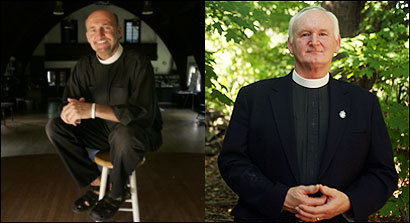
The Rev. Bill Murdoch, 58, [pictured right] an Episcopal priest in West Newbury, is so frustrated by the Episcopal Church’s selection of an openly gay bishop that he is bolting and taking his parish with him. At the end of this month, he is to be consecrated a bishop by the Anglican Church of Kenya, and he will return to the North Shore to start a new Kenya-affiliated parish there.

But the Rev. Brian Murdoch, 53, [left] an Episcopal priest in West Roxbury, is not planning to join his brother for the ceremony in Nairobi and is not celebrating his elevation to bishop.

That’s because Brian, as Bill has long known, is gay.

(skip)

“My brother and I love each other and always will,” [Bill] said by e-mail. “My family and I love Brian and have always been proud of his service to others for the sake of the Gospel and the many, many people Brian has loved in the name of Christ. The pain of our disagreement over this issue will not change my love for him.”

(Photo: Globe)

When the Episcopal schism comes between brothers Read More »