By Karmel Melamed
June 2007
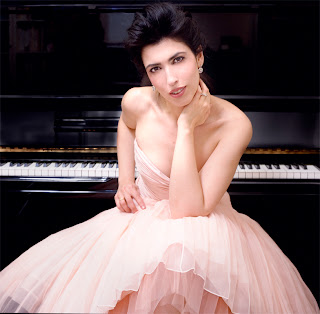
It is not often young Iran Jews who have grown up and lived in the U.S. for the majority of their lives embrace the music and culture of their parents from Iran. Yet for Iranian Jewish pianist Tania Eshgahoff, Persian music has been one of the most powerful influences in the music she composes and performs. Living in New York, Eshgahoff is one of a growing number of young Iranian Jews who have chosen non-traditional careers in the entertainment industry and achieved some success. After having studied music from a young age, Eshaghoff has since gone on to record her music, perform at many prestigious venues including Carnegie Hall in New York and for distinguished audience including Empress of Iran, Farah Pahlavi. Recently Esghahoff chatted with the magazine about her latest album “A Road to Tehran” and a little about her life as an Iranian Jew choosing a musical career.
Can you give us some background on yourself and how you became involved in music?
Well like many, music was in my life early on. Especially through my mother who was quite musical and free spirited. She would always introduce my sister and I to the world of music in Iran. Whether it was music from the Mediterranean, from the Middle East, or the Modern West, of British bands or great American pop music. Also my parents would always take advantage of public programs. So we would often go to concerts in the parks or concert halls. They had a very hands-on approach in raising us within our environment culturally. But as I learned, I began to notice the rhythms of Persian Folk music and classical music. I was deeply moved by Javvad Maroufi as I am today. For he is one of the few musicians who actually notated his music for pianist such as myself to interpret and learn from.
What exactly motivated you to choose a career in music?
Many of us have our day dreams when we are young. For me, being on stage or in a rock-band or some sort of musical surface was meaningful to me. Some how my lifelong daydreams of playing music actually materialized. Music chose me. I was a bit afraid and well aware that being a Persian Jewish girl, the ideas of fantasy musical careers could only be played in my head and not in public. I think as I was growing up, I thought it to only be a hobby. For I must continue with the traditions of getting married and starting a family of my own. I would often tell family members, on random occasions, but learning that I was just a bit dreamy. Imaging, how can a young girl, who has never left her parents house, who is expected to marry before the age of 25, children by 27, try to pursue her art, her music. My twenties were eye opening, adventurous and life-changing.
Your music is obviously Persian influenced, why have you as a young Jew who has been raised in the U.S. with so exposure to Western culture still decided to embrace Persian music?
I get asked that question often and I can not really explain it. At age 7, I was attached to Persian melodies. I wanted to constantly repeat the rhythms of the Santour, but I wanted it to be symphonic. I remember when no one was around, I would get into it. I mean really lose myself in the music—I could hear violins and deep bass drum rolls. I could hear a harpist play a chord and French horns add to each measure. But it was very frustrating because I had these sounds in my mind but did not know what it meant and why it is when I play my piano that all that comes out is piano notes. Persian music has been my preface for everything. It sings to me and connects deep in the root of who I am. I am learning maybe it is because of all of those minor chords, how can you not get emotional from that.
Can you share with us what the average day in the life of a Persian Jewish musician? Do you just compose music, practice it and then perform?
For some, they sit down each day and write music at a given time. My husband, who is a doctor but also a published writer, sits each night for several hours and writes. I find that amazing! I have never been as disciplined as others. Even as a child I hated to practice but loved to play. The draw back is, you will eventually learn the piece, but it just takes longer if you don’t practice regularly. My days are broken up more openly to weeks. I practice for about 2 weeks and write for about 2 weeks, until the music comes together. I had just given several concerts, so I am moving toward making music again. It is sort of a natural cycle. However, if I sit at the piano long enough the music starts to come out—from where I don’t know. I try to listen to music that I enjoy and that inspires me. That is where most inspirations come from for artists enjoying other people’s art. There are days that I practice for about 5 to 7 hours a day, depending on the actual piece. If it is challenging, that is when I get inspired and want to figure it out and reinterpret it immediately.
Most Persian parents frown upon their children going into careers that are not the traditional professions of medicine or law. What reaction did you receive from friends and relatives when you told them about your desire to pursue a career in music?
Interesting question and it is a bitter-sweet answer. It was not encouraged as a life-long career. Even now, I do face certain criticism and judgments about playing on a big stage. The appropriateness of pursing ones art as a Persian-Jewish woman is mixed with the idea of a Persian Jewish woman giving up and compromising marriage. I think many who feel that way, did not have opportunities to explore what is deep with in them. They only know the obligations, joys and commitment to family, not pursuing this inner-child music obsession. I wish children would begin to have the opportunity, to feel what it is like when your music is being played by these wonderful instruments, among hundreds and hundreds of souls sitting in the audience. You learn that only you, yourself can decide how badly you want something. If you work hard at it and surround yourself by people who support that, you will make it!
How important is Judaism in your life and how are you involved in the Jewish community in New York?
I identify myself as a Sephardic Jew first before anything else. I only realized that when I began to open my horizons to different cultures here in New York. Growing up, I wanted to be like the American girls free! They did not have the strict upbringings that I and my sister and cousins had. After fighting with that for nearly 20 years, I began to return to the traditions and appreciate the way our parents raised us. The traditions of Judaism are what have grounded me in every decision that I make. I was raised in a very traditional Jewish family, I have 38 first cousins from both sides. When my family gets together for a barbeque or Shabbat dinner in Great Neck, we have to get it catered at this point because mah-shah-laha we are a growing family.
Has Judaism at all influence your creation of music?
I would say again that because my mother was so musical and loved music, she tried to expose us to everything. As a child, my father attended a traditional Persian temple. My mother loved anything American. So she would also take us to services at a conservative American Temple where they had a choir and the cantor would sing as if it was Puccinis Tosca. I know for sure, that had a huge impact on me. That is where the minor chords were permanently embedded in my mind.
Share with us a little about the motivation behind your latest album?
The last album “A Road to Tehran” was truly inspired by the earthquake in Bam, Iran. I had attended a relief concert for Bam and was moved by the photographs that I was seeing. Realizing that 2000 children in just 21 seconds became orphans was an enormous burden to absorb. So I wrote a piece called 21 seconds, that would reflect the movement of the earthquake and that started the album. Finishing the album was due to the generosity of my husband, Ahron, who motivated me to continue on and dig deeper for each piece. How fortunate I am.
You’ve performed for some prestigious audiences and at well known venues including Carnegie Hall in New York City. Have there been any highlights so far and what have you not achieved that is still a goal?
As artists, you are always reaching further because you forget the last concert or song you write. It holds it memories in the past. So I am always dreaming of playing further and reaching out to different audiences. I have been fortunate to play and be invited to play in on many prestigious stages in New York. My next vision is to have a concert in Los Angeles, as Persians in L.A. have a different sensibility. Here in New York we tend to intellectualize our heritage. We have wonderful galas at the many cultural centers like the MET, to preserve our artifacts from the Persian Empire. In L.A. you feel that it is Iran. I find some children born in L.A. somehow have a slight Persian accent and that is amazing! Parents really speak Farsi to their children, children speak Farsi to each other. I find my fellow New Yorkers to be more assimilated to the American culture. Where as in L.A. Persians have a take-over approach and want to grow the culturally, with less assimilation.
Do you think mainstream America is ready to embrace Middle Eastern and Persian influenced music amidst the threat of terrorism coming from that part of the world?
Living in New York City, I find myself in a world that is very accepting of people’s heritage. New York is incredibly cosmopolitan, it is a cultural Mecca. So I never feel a hesitation but more a celebration of this type of music. Non-Persians are so moved that they can understand this music. They feel that they have just visited Iran— they are interested, and open to learning. It has a Middle Eastern mysticism but the orchestration is very western and classical. And young Persians are a bit enthralled that their parents’ old-folk music is in a form that is very contemporary for them to embrace and feel proud that this is their heritage. In fact a network here in New York has been inquiring about the work I do and find it interesting that there are Jewish Iranians here in New York making beautiful music and art, so different from the headlines we are seeing today.
What advice or words of wisdom do you have for young Persian Jews who want to pursue careers in music or the entertainment industry?
My advice is simple. Continue to play and study your craft, whether it is playing music, photography, film making etc. Play even if you think that no one will ever have a chance to listen. Do not stop!! If you stop, then when the opportunity does come and it will, you will not be ready and it will take more time. Find one mentor to help you, my mentor has been Edward Smaldone, Director of the Copeland School of Music in New York. He has been the conductor leading me toward my dreams. It is hard to do it on your own, so don’t be afraid to ask for help. Ask and you shall receive.
Thank you Tania for chatting with us and we wish you the best of luck for your music in the future.
For more information on Tania Eshaghoff, visit: http://www.taniaproductions.com/



