fbpx

September 22, 2005

525,600 Minutes

I was sitting in the AMC theater in Woodland Hills, a captive of a dull series of pre-movie advertisements, when I started to think about my next column. I considered writing about fasting (argue that a tall Starbucks latte might be an acceptable fasting exception, compared to a venti latte which is clearly a fasting faux pas); sitting with your kids in the adult service (discuss pros and cons of having children with shpilkes join you in the main sanctuary); and High Holiday attire (assert that Macy’s should have a High Holiday clothing department comprised of conservative yet fashionable clothes that come in textures appropriate for 100 F temperatures, but in fabrics that say “fall”).

These thoughts were interrupted by a preview for the movie version of the Tony Award-winning Broadway musical, “Rent.” A bunch of hip, actors and actresses with soaring voices and dazzling smiles appeared on the screen singing the opening lines to “Seasons of Love”: “525,600 minutes; 525,000 moments so dear; 525,600 minutes; how do you measure, measure a year?”

I mentally deleted my other potential topics and began thinking how as Americans and Jews we take stock of those 525,600 minutes in two very different ways. As Americans, we anticipate the upcoming 525,600 minutes with unbridled optimism, making big, bold resolutions. As Jews, we examine the year that has just passed, searching those 525,600 minutes for wrongs that we may have caused, or mistakes that could have been avoided.

But the differences in the Jewish approach and the secular approach to marking a new year aren’t just philosophical.

On New Year’s Eve 2005, we will make a slew of resolutions that will be kept for a week or two, dress in party clothes that rarely see the light of day, drink like Prohibition might make a comeback and eat like the calories are on hiatus. The most that many of us will contemplate on New Year’s Day, the first day of 2006, are the instructions on the child-proof cap guarding the Tylenol.

For Rosh Hashanah, we will dress conservatively, visit our synagogues in huge numbers, and eat our meals at home. It is a time for introspection, not partying.

What is the best way to move toward a new year? The Jewish method that calls for an intense review of the past year, or the American approach of entering each new year with a sort of reckless optimism oblivious to what has come before? It seems that the answer depends on whether or not one is a parent.

If you have children, you need to approach each and every new year with one eye on the past and the other eye on the future. To look only backward ignores the reality that our children are constantly changing: the baby that was just on our lap is now a toddler painting pictures; the kindergartener who raided our lipstick to play dress up is now a middle-school kid asking for makeup of her own. The child who screamed at us to stay when we dropped them off at preschool now screams at us to leave them alone when their friends are around.

But even though our children are constantly moving forward toward adulthood and a life of their own, we still must look back and consider our past parenting errors, and figure out how to fix them. The punishment for failing to look at our past parenting mistakes is to make them again; the punishment for failing to make plans for our parenting future is to parent a child that no longer exists. We must face each year with the optimism of New Year’s Eve, and the introspection of Rosh Hashanah.

During the Days of Awe that begin with Rosh Hashanah and end with Yom Kippur, I will consider how I spent last year’s 525,600 parenting minutes. Was I too lenient, or too strict? Did I try to shape my child into my image, or was I respectful of my child’s attempts, however shaky, to design her own identity? Did my child spend more time with me, or with his GameBoy? Did I cheer as loud when he did a random act of kindness as when he scored the game-winning point in basketball?

But I will also consider the gift of a new 525,600 minutes, minutes that are fresh and untouched. How will I respond when my daughter begs for a cellphone, asks for a razor to shave her legs or is dumped by a friend? How many minutes a day should she be allowed to IM? What will I do when she finally talks back? How will I make time every day to actively listen to my son and daughter when so many other things seem to get in the way?

The song from “Rent” continues with this verse: “525,600 minutes; 525,600 journeys to plan.”

This year, lets plan our parenting journeys with the exuberance and optimism with which we approach the American New Year, but with the thoughtfulness with which we approach the Jewish New Year. Let’s keep one eye on our parenting past, and the other eye focused on our parenting future so that we may experience 525,600 minutes of Awe.

L’Shanah Tovah.

Wendy Jaffe can be reached at wjaffewrite@aol.com.

525,600 Minutes Read More »

Iranian Community Mourns Its ‘Anchor’

More than 2,000 mourners packed the Nessah Cultural Center in Beverly Hills this summer to bid farewell to Hacham Yedidia Shofet. During the funeral, the powerful sound of the shofar blended with the recorded voice of Shofet, who at his own request, led a prayer at his funeral. His seeming presence made it seem all the more difficult to believe that he was gone — after being the anchor of the community for so long.

This High Holiday season marks a milestone for the Iranian Jewish community in Southern California, which numbers nearly 30,000. For the first time since Iranian Jews began to settle here in large numbers, Shofet will not be present as either their actual or symbolic leader. Shofet had been a spiritual force for more than seven decades — most of that time in Iran, where he’d played a powerful political role, as well.

Shofet died early this summer at 96, after several years of declining health. His passing leaves behind a community in transition, one that revered him, but also one that relied less and less on his influence and direction. It’s a community that had begun to see him more with a sense of nostalgia than as a leader.

However, he always commanded respect, and when he called for unity in the community, the Iranian Jewish diaspora took the injunction seriously. With his passing, tensions and factionalism that had been roiling behind the scenes could become more open and intense.

“So long as Hacham Yedidia Shofet was alive, the deep respect and feeling of reverence that the community held for him prevented the younger rabbis from wandering too far from the mainstream on either side,” said Sam Kermanian, secretary general for the Iranian American Jewish Federation, a community umbrella organization.

Now the mantle of spiritual leadership falls to Rabbi David Shofet, the middle-age son of the late leader. Like his father, he practices an Iranian style of Judaism, developed over more than 2,500 years, that balances elements of Conservative and Orthodox traditions.

However, he’s inherited a restive flock. The offspring of the immigrant generation is pulling in different directions. Some are shedding much or all of their religious practice or even exploring other religions; many others are turning to Orthodoxy.

None of this internal disintegration seemed possible in Iran, where Jews struggled against frequent oppression to hold onto their religion and culture. In many ways, they succeeded spectacularly. For more than 2,500 years, Iranian Jews lived in relative isolation from the rest of the Jewish world, but they remained Jews, held together by leaders such as Shofet.

The community understands the debt they owe to Shofet and his predecessors.

Following the funeral services, a motorcade and five rented buses were necessary to transport all those who wanted to attend the burial at Groman Eden Memorial Park in Mission Hills. Even that wasn’t enough of a goodbye for the 96-year-old patriarch. Approximately 5,000 mourners attended a later memorial.

Shofet served in a quasi-political capacity as representative of the nearly 100,000 Jews in Iran. He spoke for Jews and protected their interests during the reign of the shah, and also for two years under the Islamic regime of the Ayatollah Khomeini that followed.

He immigrated to Southern California in 1981, where he tended to religious and social issues within the Iranian Jewish community here. The issues in the United States were not as immediately perilous as those in Iran, but Shofet soon found he had to deal with fractiousness and assimilation that threatened to erase an Iranian Jewish identity thousands of years in the making.

While many Iranian Jews have been saddened by the loss of Shofet, they’ve had to shift their focus to the future. Community feuding, which had been kept in check out of respect for Shofet and by Shofet’s delicate diplomacy and voice of moderation, are likely to re-emerge.

A serious rift became apparent nearly 10 years ago between those practicing traditional Iranian Judaism and Iranian Jews who adopted a more religiously observant Eastern European form of Orthodox Judaism. Young Iranian Jews have been drawn to more than two dozen Orthodox synagogues in the Pico-Robertson area and along Ventura Boulevard in Encino.

Critics of the new Orthodoxy say that it has broken up families, because the young adult proselytes frequently reject their parents’ generation for not being religious enough.

“It’s just ridiculous, [Orthodox rabbis] have used religious issues of the bedroom and food as weapons that [have] been given to our children to be used against us,” said Pouran Mogahvem Cohen, a West Los Angeles resident.

She organized a support group for families in conflict because of religious differences between the older and younger generations.

“Everyone involved in our group has the main goal of bringing unity in the community by not creating divisions in families or brainwashing our children to drop their university studies and careers, only to go off to some yeshiva across the country,” she said.

A different perspective comes from leaders of the Orthodox shuls. They insist they are addressing the community’s true spiritual needs, which were suppressed in Iran but can achieve full expression given the religious freedom of the United States.

“In Los Angeles, there are hundreds and hundreds of fully observant Persian families, and this past Passover, just through me, we had 1,000 families that sold their chametz, which shows that definitely a good portion of our community is becoming more observant,” said Rabbi David Zargari of the Torat Hayim Center in the Pico-Robertson area.

To reduce the tensions of these religious differences, Cohen’s group in late 2003 organized three question-and-answer seminars held at the Nessah Center, Beverly Hills High School and the Eretz Cultural Center in Tarzana, respectively. She said each seminar was attended by nearly 2,000 Iranian Jews. Also attending were various social and religious leaders, including those from Orthodox synagogues, whose leaders participated as panelists. It was the sort of unity-building exercise that Shofet approved of — except that nothing was settled, Cohen said.

“Their rabbis had no answers for us, and there was nothing resolved,” Cohen said. “Our main achievement was in making people in the community more aware of this problem to protect their children from this type of fanaticism.”

But efforts at peacemaking continue. Last year, the Iranian American Jewish Federation passed a resolution calling on all religious factions in the Iranian Jewish community to accept each other and respect the rights of community members to practice Judaism as they wish.

The intervention was “meant to calm everyone down and to promote the social unity of the community,” Kermanian said. “In essence, what it meant was that any attempt by any single faction to dictate religious policy to the entire community was unacceptable, and the only solution was for all to be free to pursue their own ways of practice.”

This goal doesn’t get any easier in the absence of Shofet.

“The community was his family, and he believed in the well-being of all people, not just Jews,” said David Shofet of his father. “He loved every Jew no matter who he was unconditionally, and his tremendous spirituality is why old and young people were drawn to him.”

Which means that David Shofet, who looks to be in his mid- to late 50s, has big shoes to fill, though he, too, is well regarded after working alongside his father for more than 25 years.

The community is never likely to have another figure as revered and influential in the United States as the elder Shofet was in Iran.

According to Shofet’s 2001 memoirs, written in Persian by Manucher Cohan, he was born in the central Iranian city of Kashan into a family with 12 generations of rabbis. Over the years, Shofet gradually gained prominence among Iran’s Jews and non-Jews for his eloquent speeches and his ability to connect easily with all who approached him for help. Ultimately, he became a liaison and spokesperson for Iranian Jews before the shah, government officials and even Islamic clerics. There’s no such equivalent position for an Iranian Jewish leader in the United States.

However, in Iran, Shofet commanded enough respect to intervene when Jews were in dire trouble, for example, with the Iranian government. He was instrumental in persuading the shah and other government officials in the early 1950s to allow Iraqi Jews, who had illegally left Iraq, to find temporary refuge in Iran before eventually immigrating to Israel, said Ebrahim Yahid, a close colleague of Shofet.

“We had many rabbis, teachers and hachamim in Iran, but he was the most open minded and most beloved of them all,” Yahid said. “He was even respected by the most fanatic Islamic clerics in Iran who did not have friendships with Jews — all because of his gentleness and humility.”

Following the 1979 Iranian revolution, Shofet, along with thousands of other Iranian Jews, eventually immigrated to Southern California. While no longer working as a liaison for Iranian Jews, he continued to serve as a symbolic religious figure, urging Iranian Jewish families to preserve their Jewish traditions. In the United States, Shofet, with his son and other community leaders, helped establish the Nessah Center, first in Santa Monica and then in Beverly Hills.

Over the last five years, Shofet was gradually forced to retire from community work due to failing health. His son took over day-to-day leadership duties.

“Replacing Hacham Yedidia is impossible. The closest we can come to him is his very able son, Rav David Shofet, who has dedicated his life to Iranian Jewry like his father did,” said Andy Abrishami, a Nessah board member and the elder Shofet’s son-in-law. “It’s hard to be a rabbi under any circumstances, especially when you’re a rabbi for Iranian Jews, because their expectations are much higher, but he [David Shofet], with his humility and dedication, has captured the Iranian Jews’ favor.”

If David Shofet can’t bring the often-divided community together, it isn’t clear who can.

“The crucial test for our community now is whether it can hold the center together,” Kermanian said. “At this point, this seems like an extremely tall order, which only Rabbi David Shofet, Hacham Yedidia’s son and our community’s preeminent rabbi, has the chance to fulfill.”

Cohen, the critic of the new Orthodoxy, expressed similar hopes, saying, “We have no expectations from [Orthodox rabbi] Zargari or the others, but we are looking to David Shofet for real, true leadership. This community wants him to truly be a father figure to us. [And] we want him to be as open-minded as his father was.”

Zargari, for one, said he’s open to dialogue with Jews who don’t practice his Orthodoxy: “They are my brothers and sisters. I don’t look down on them or think that I’m better than them in anyway. And it must be mutual. We have to learn to be tolerant and respect each other.”

There’s hope for the future in such sentiments, said Dr. Shirzad Abrams, co-founder of the Graduate Society Foundation, a local organization that promotes the continuity of Iranian Jewish history and Judaism among young Jews.

“The fact that there is contact between [different factions] is positive,” he said. “I’d be very afraid and totally frustrated if they stopped talking to each other.”

Iranian Community Mourns Its ‘Anchor’ Read More »

Right on Time

“I have to wait a month longer this year to eat apples and honey,” complains Jeremy, 16.

“No, the first of Tishrei is always the first of Tishrei,” I say, referring to the date on the Jewish calendar that marks our New Year.

“But it’s not till Oct. 4,” he answers.

Jewish time, to most people, means that Shabbat services and synagogue board meetings begin 15 to 30 minutes late. But true Jewish time means that our days and our holidays adhere to a primarily lunar calendar, corresponding to the waxing, waning and reappearance of the moon as it circles the earth. Jewish time also means that our days begin at sunset and our months begin when the crescent of the new moon is just visible. (It’s no mistake that the Hebrew word for month, chodesh, is related to the Hebrew word for new, chadash.)

And it means that our days don’t correspond — except every 19 years, give a day on either side — to the dates on our secular or Gregorian calendar, based on the earth’s orbit around the sun.

“Wait till 2043,” I say. “Rosh Hashanah will fall on Oct. 5, the latest it’s ever been.”

But the first of Tishrei will always be the first of Tishrei, whether it falls on Sept. 5 or Oct. 5. And around the world, all on the same day, we Jews will be carrying out God’s commandment, expressed in Leviticus 23:24, “In the seventh month, on the first day of the month, you shall observe complete rest, a sacred occasion commemorated with loud blasts.”

Devising this Jewish calendar, and celebrating sacred occasions at their appointed times, as God instructs in Leviticus, entails more than running outside at sunset and staring at the sky looking for the first appearance of stars.

“Which, in Los Angeles, you can’t even see,” my frustrated amateur astronomer husband, Larry, says.

Although that’s exactly what used to happen. In ancient times, when people saw the new moon, they would report their sighting to the Sanhedrin, the high court in Jerusalem. After the Sanhedrin confirmed their testimony, the religious court would declare a new month and alert the Jewish community — initially by lighting fires atop mountaintops and later by dispatching messengers.

But there were some complications. For starters, the mean lunar month is 29 days, 12 hours, 44 minutes and 3 1/2 seconds, making a lunar year 354 days. That’s about 11 days shorter than the solar calendar, which runs 365 1/4 days. And that’s problematic for the pilgrimage festivals — Pesach, Shavuot and Sukkot — which are agricultural holidays and thus season-sensitive.

After all, you couldn’t very well celebrate Pesach, known as Chag Ha-Aviv (the Festival of Spring), in October.

“And you couldn’t celebrate Chanukah in August, right before school starts, because we’d get pencils and binders as gifts,” Jeremy notes. “How messed up would that be?”

So the ancient Jews had to intercalate their lunar year to correspond with the solar year.

“Intercalate? Is that even a word?” asks Gabe, 18.

“Ask Hillel the Second,” I answer.

Hillel the Second was a patriarch who, as head of the Sanhedrin, devised a fixed Jewish calendar based on mathematical and astronomical calculations that standardized the length of months to 29 or 30 days. He also cleverly inserted an extra month — seven times every 19 years, in the third, sixth, eighth, 11th, 14th, 17th and 19th years of the cycle — to keep the holidays regulated according to seasons.

Maybe he was heeding the psalmist who said, in 90:12, “Teach us to count our days rightly, that we may obtain a wise heart.” Or maybe he forgot his wife’s birthday one too many times.

A more informal form of intercalation probably appeared earlier, scholars surmise. For example, if the road to Jerusalem was too muddy to travel or if there were not enough baby lambs to sacrifice, the ancients waited another lunar cycle to celebrate Pesach. This leap month is Adar II, though technically Adar I is the extra month. And the month of Nisan, which contains the pivotal holiday of Pesach, remains the start of the calendar year.

“What Hillel and the other Jews didn’t do is make sure that all the Jewish holidays fall on the weekdays,” points out Danny, 14, always happy to miss a day of school.

But the ancient Jews did succeed in giving us, with their lunar/solar calendar, a way, despite our living in mostly urban and technological environments, to stay tuned to the natural rhythms of the universe.

And they did succeed in giving us, despite our living in a primarily secular world, a way to stay tuned to the natural rhythms of the Jewish universe, moving us forward through the cycles of the Jewish year, which provide a range of emotional and spiritual experiences while rooting us solidly in our traditions and history.

And so, at sunset on Oct. 3, we celebrate Rosh Hashanah. We celebrate a new moon, a new month and the new year of 5766. And as we reflect on the past year and commit to changes in the coming year, we know, as always, that Rosh Hashanah is right on time.

Freelance writer Jane Ulman lives in Encino with her husband and has four sons.

Right on Time Read More »

Sephardic Dinner Spices Up Holiday

As Rosh Hashanah approaches, I am reminded of our trip to Italy a few years ago. We arrived in Milan in the early afternoon and checked into our hotel, planning to attend Rosh Hashanah services that evening at the Sephardic Synagogue.

We were relaxing in our room, and were surprised when the phone rang, because we did not think any one knew where we were. It was Adina Cohen, inviting us to her home for dinner after Rosh Hashanah services.

Cohen was born in Beirut, and her husband, Rabbi Eliezer Cohen, the retired chazan (cantor) of the Sephardic synagogue, is from Cairo. They now live in Milan, and both have strong Sephardic backgrounds. They had heard from their nephew, Moshe Salem, who lives in Los Angeles, that we were traveling in Italy and might be in Milan during Rosh Hashanah.

After services, we met them outside the synagogue and walked to their home, along with several members of their family. We were seated in the living room and met their three daughters, Melitta, Sharon and Elisheza, as well as aunts, uncles, cousins and friends, as they arrived from the synagogue.

The Cohens welcomed their guests, and we were all invited into the dining room, where a large table that almost filled the room was set for the holiday meal. Almost everyone spoke English, but they made sure that we sat close to their daughters, who were educated in Israel and spoke several languages. They made us feel welcome, and explained many of the Sephardic customs with which we were unfamiliar.

The evening began with washing of the hands, and a blessing was recited over the two round, home-baked loaves of challah. The rabbi broke off pieces of the challah, dipped them in salt and sugar and passed a piece to each guest. Adina Cohen explained, that for this special bread, the dough is left to rise only once and takes less time to prepare. The unusual texture, crusty on the outside, yet light and soft inside, comes from kneading the dough to its maximum elasticity, and is quite different from the challah that I make for my family.

Then the ceremonial foods were presented. Each dish was served separately, and a special blessing was said. First a plate of sweet dates, representing peace and beauty, was passed around the table. Then a bowl of fresh pomegranate seeds in rose water was served, the symbol of fertility and worthy deeds.

Next, slices of candied zucca (pumpkin) were eaten, representing a full year of good blessings for the family. Hubbard or butternut squash is the closest to Italian zucca, and may be used instead.

Also, during the New Year celebration, leeks are eaten to bring good luck, and Adina Cohen brought out a large leek frittata that was cut into wedges and served. The final dishes consisted of apple slices cooked in honey to symbolize a sweet year, and bowls of black-eyed peas, expressing hope for the future.

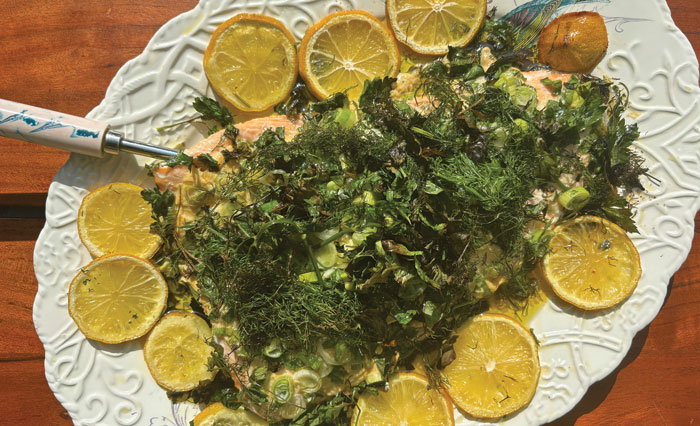
We thought the evening was over, but it was just beginning. The formal dinner started with a whole poached salmon, that was cut and served at the table, topped with homemade mayonnaise. Cohen told us that some of the foods that she serves now, such as fish, were not usually eaten in Lebanon, because they were considered a luxury and almost impossible to find. Since her marriage, many of the dishes she prepares for Rosh Hashanah are her husband’s family recipes from Egypt.

Roasted veal stew was the main course. Cohen mentioned that often lamb is eaten during Rosh Hashanah, but since it was not available, they substituted veal. Crusted rice, first steamed and then fried, was the perfect accompaniment for the veal, and was served along with stewed zucchini and sauteed Swiss chard.

Dessert was simple and refreshing — platters of sliced melon and cactus pears garnished with mint leaves.

Sharing and friendship were at the heart of this wonderful evening, as well as the special role that the foods played. It was a family affair, Cohen a talented cook, baked the challah and prepared the entire dinner herself. Her daughters, were in charge of setting the table and responsible for doing the dishes, and Eliezer Cohen performed the service.

Inspired by the hospitality of the Cohen family in Italy and fascinated by our experience with the Sephardic foods they served for Rosh Hashanah, we have added these dishes to our family holiday dinner.

Symbolic foods are: dates, pomegranate seeds with rose water, candied pumpkin, leeks, apples cooked in honey, black-eyed peas, baked beets.

Rosh Hashanah Challah

2 packages active dry yeast

3/4 cup warm water

2 tablespoons sugar

3 to 4 cups flour

1/4 teaspoon salt

3 eggs

Sesame seeds

Combine yeast with water and pinch of sugar. Set aside.

In a large mixing bowl, combine flour, remaining sugar, salt and two eggs. Add yeast mixture to flour mixture.

Dough will be moist and sticky. Knead about 10 minutes, adding flour or water as needed, until maximum elasticity. Dough should still be moist. Sprinkle dough with flour, cover with plate or towel and let it rise until double, about one hour.

Divide dough in half; place each half on a lightly floured board and lightly knead into two round loaves. Place on a greased baking sheet, leaving space between loaves as they will rise when baking.

Brush with beaten egg and sprinkle with sesame seeds. Bake at 350 F for 20 to 30 minutes or until golden brown and completely baked inside.

Makes two loaves.

Leek Frittata

4 eggs

Salt and freshly ground black pepper

5 medium leeks (about 3/4 pound), white part only, split and washed well

4 tablespoons olive oil

Mix the eggs, salt and pepper with a fork.

Slice the leeks into thin slices. In a 12-inch nonstick skillet, heat olive oil and cook over medium-high heat until tender for six to eight minutes.

Pour the eggs over the leeks, mix and cook over medium-low heat until the eggs are set on the bottom but soft on the surface, three to four minutes.

Put a plate over the frittata and invert the skillet to reverse the frittata onto the plate. Slide the frittata back into the pan to cook the other side. Cook for about five minutes. Slide onto a platter, cut into wedges and serve hot or at room temperature.

Serves eight to 10.

Veal Stew

This stew can be prepared a day ahead and tastes even better after the flavors have a chance to meld.

4 pounds veal shoulder, cut into 2-inch cubes

Salt

Freshly ground black pepper

1/3 cup olive oil

1 onion, diced

2 garlic cloves, minced

2 carrots, peeled and sliced

2 celery stalks, sliced

1 cup dry, white wine

3 cups veal or chicken stock

1 large tomato, chopped

1 tablespoon tomato paste

2 bay leaves

10 whole black peppercorns

4 sprigs fresh parsley

8 sprigs fresh thyme, tarragon or oregano

4 long sprigs fresh marjoram or 1 teaspoon dried marjoram

1 tablespoon dried thyme, tarragon or oregano

10 pearl onions, par boiled for 5 minutes and peeled

Preheat the oven to 350 F.

Season the veal on both sides with salt and pepper. In a large heavy pot or casserole, heat the oil and saute the veal on both sides until brown.

Add the onions and garlic and saute until soft, about five minutes. Add the carrots, celery and saute for five minutes. Add the wine and simmer for two minutes. Add the stock, tomato, tomato paste and bring to a boil.

Combine the bay leaves, peppercorns, parsley and fresh and dried herbs in a piece of cheesecloth; tie with a string and add to the pot. Cover and bake for 2 1/2 hours or until tender.

Toss in the pearl onions. Remove the cheesecloth bag. Serve in soup bowls.

Serves eight to 10.

Judy Zeidler is the author of “The Gourmet Jewish Cook” (Cookbooks, 1988) and “The 30-Minute Kosher Cook” (Morrow, 1999). Her Web site is members.aol.com/jzkitchen.

Sephardic Dinner Spices Up Holiday Read More »