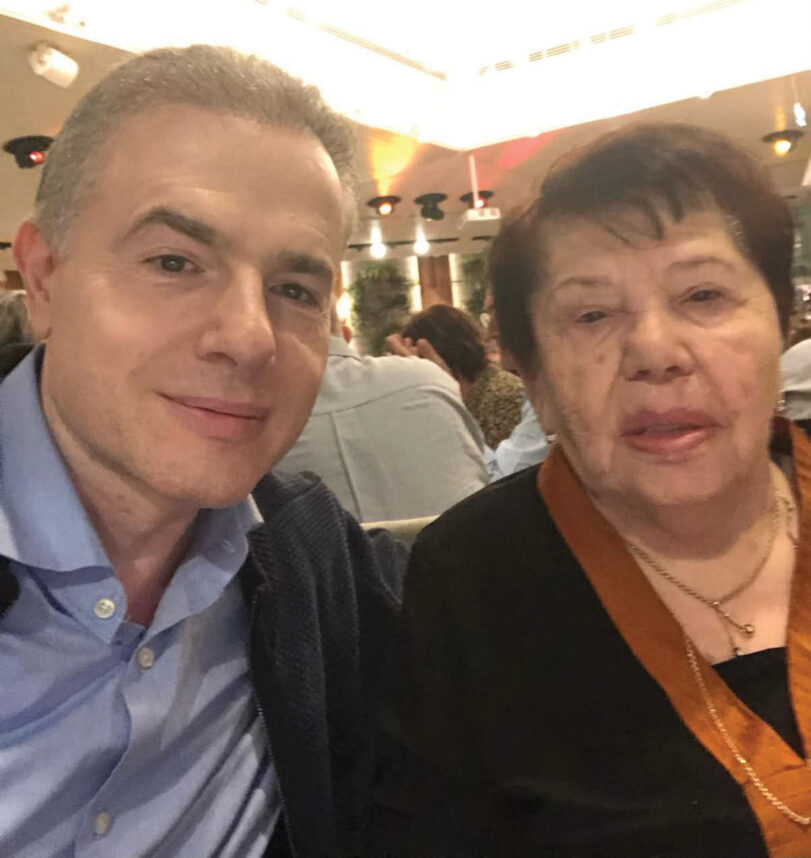
What’s a nice Jewish boy doing in a profession where he can’t eat? If his name is David Cohen, he is making the mealtime sacrifice to break into the ultra-competitive Southern California jockey colony at Hollywood Park.
Although his diet could place him at the same table as Gandhi or Twiggy, Cohen knows that overweight and underemployed go hand in hand in the horseback profession.
Cohen, 19, launched his career during Memorial Day weekend, one year after graduating from Laguna Beach High School. He is the son of Morry Cohen, a longtime owner and breeder who races under the name 5 C Stable.
“Because my father owned horses, I pretty much started from the ground up,” said Cohen. “I groomed horses for six or seven months for our trainer, Jorge Gutierrez, and learned everything from feeding to medication with the vets. I did most everything with about 20 horses last summer at Del Mar.”
Cohen envisions a long-range future in racing as a trainer but wants to ride for the next decade or longer. To make that adjustment, he reduced from 122 to 109 pounds.
“I was lifting weights and balanced my diet out,” Cohen said. “I started to eat less quantity and take more vitamins.”
His limited diet nevertheless has a Jewish flavor.
“I start each morning with a wheat matzah and tea,” he said. “Sometimes the matzah is flavored apple, sometimes cinnamon, sometimes peach. A big square is about 100 calories.”
For breakfast, Cohen will eat a small portion of scrambled eggs, for lunch a small salad, for dinner a little chicken with vegetables.
Cohen also has been forced to sacrifice socially.
“I wake up at 3:30 in the morning and am at work at 4:45,” said Cohen of his routine of galloping horses for several trainers. “I haven’t gone out at night in four years.”
Cohen lives with his father in Arcadia, near Santa Anita, and had been exercising horses for about two years before acquiring his apprentice license in May.
He won his first race at Del Mar on Aug. 11 with a bold come-from-behind victory along the rail aboard Quiten Boy, a 45-to-1 long shot. Cohen scored his sixth victory from 87 mounts during the Oak Tree meet at Santa Anita on Oct. 1 with Holy Request, another longshot at 47-to-1 odds, for trainer Barry Abrams.
Jewish jockeys are a rarity. Walter Blum, who rode primarily in New York during the 1950s, ’60s and ’70s before becoming a racing official at Florida tracks, is the only Jewish rider to have earned a spot in the Racing Hall of Fame in Saratoga Springs, N.Y.
In California, the most successful Jewish jockey has been Bill Harmatz, a contemporary of Bill Shoemaker who won several major stakes during the ’50s and ’60s. Harmatz, a scholastic gymnastics star from East Los Angeles, won the 1959 Preakness Stakes aboard Royal Orbit. He later became a successful businessman in Vista and remains nearly as fit in his 70s as during his riding years.
Cohen has a long way to go to be mentioned in the same breath as Blum or Harmatz. His apprenticeship is considerably different than that of Duddy Kravitz. As a neophyte jockey, he is allowed to ride with a 10-pound weight concession from what his horse is assigned to carry until he wins five races. The weight concession is dropped to seven pounds and later to five until he wins 45 races or one year passes, whichever comes last.
Cohen has ridden most of his early races for his father’s stable.
“I wouldn’t use him if I didn’t have total confidence in him,” Morry Cohen said.
David Cohen will continue to ride at Santa Anita through the conclusion of the Oak Tree meet on Oct. 31 before shifting to Hollywood Park for a meet beginning on Nov. 3.
Steve Schuelein is a freelance sports writer based in Playa del Rey.