Israel turned 66 years old in 5774, the year that just passed. Some 8.2 million people live in Israel, of which 24,000 immigrated in the past year. Some 178,000 babies were born, and 42,000 people died. Jews make up 75 percent of the population; Arabs make up 20.7 percent. When Israel was founded in 1948, just 806,000 citizens lived in the Holy Land. Prime Minister Benjamin Netanyahu took the opportunity this past Independence Day to stand up for the fundamental right of Israel to be a nation for the Jewish people.
Then came the Gaza war. The third war in Gaza, which flared up this past summer, turned into a tunnel war after Hamas had holed up in a maze of underground passages. These attack tunnels, some nearly 100 feet deep and close to 2 miles long, had several outputs and presented the greatest threat to Israel. Israelis are convinced that the kidnapping and murder of the three Jewish students, which led to this new military conflict, prevented Israel from experiencing something much worse — an unexpected attack from Gaza through the tunnels with the aim of massacring Israelis living near the Gaza border, as well as mass hostage-taking.
The very idea that hundreds of heavily armed Hamas terrorists could emerge from burrows in the middle of villages and perpetrate a massacre has triggered panic among many Jewish mothers in southern Israel.
In the fighting that followed, Hamas made every effort to claim perished combatants as civilians. Hamas has stated officially that only a small minority of the dead was part of the militia, with the aim of presenting the civilian death rate far above average. It has been proved without a doubt that Hamas continuously, cruelly and cynically used kindergartens, schools and hospitals as missile bases and thereby deliberately exposed civilians to risk. Thus, last July, 260 rockets were fired from schools, 127 from cemeteries, 160 from mosques, 50 from hospitals and 597 from various population centers. With such attack bases, Hamas hoped its rockets would incite Israeli retaliation, and thus deliberately provoked the killing of its own civilians. Killed children are an integral part of the strategy of Hamas, spread throughout the world and intended to serve the Hamas propaganda. Meanwhile, Hamas TV shows 3-year-olds in its children’s program drilled to fight against the Jews. Unfortunately, a concise and accurate quote from Golda Meir has not lost its relevance: “Peace will come when the Arabs will love their children more than they hate us.”
Meanwhile, 20 years of talks with the Palestinians have led to nothing. If the border control to the Gaza Strip is ceded to Fatah, this would mean that Hamas de facto controls the borders. Since the beginning of this war in Gaza, Fatah militia in Gaza participated in mortar and rocket attacks against Israel. The Fatah leadership did not keep this fact a secret; it was proud of it. Thus, Fatah published a poster on its Facebook page on July 9 with the heading “brothers in arms.” Below one sees terrorists of Fatah, Hamas and Islamic Jihad with the headline: “A God, a homeland, an enemy, a target.”
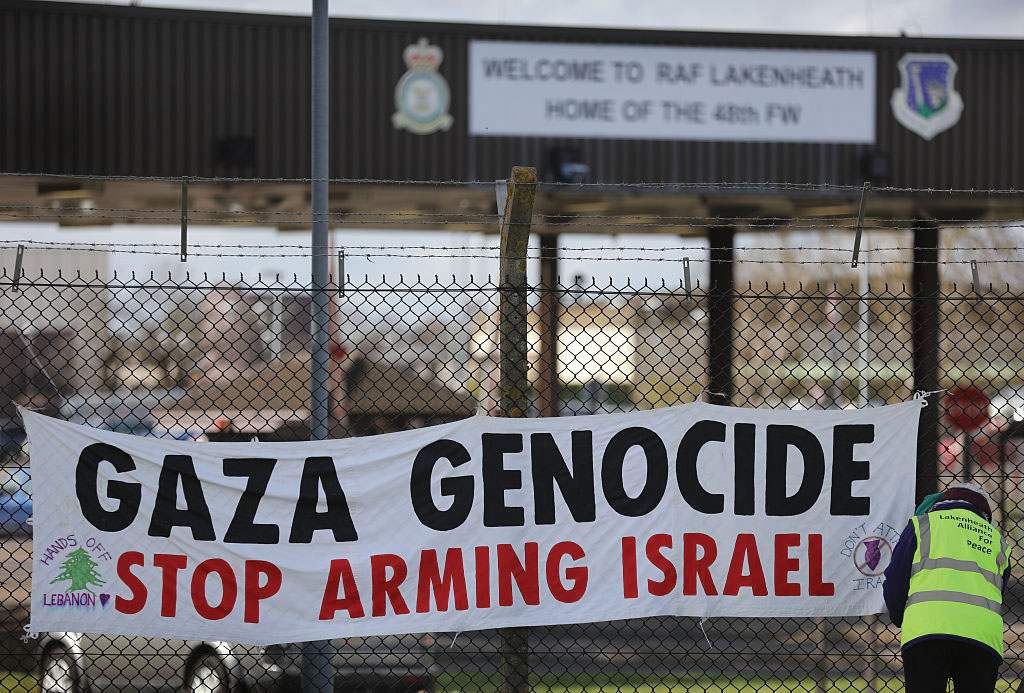
In the aftermath of the war, Israel has been set in the pillory as a war criminal and child murderer. One can talk raw numbers: 1,881 Palestinians killed, and 67 Israelis killed.
“Yes, it’s true,” emphasizes the historian Matthias Küntzel, who was honored in 2011 by the Anti-Defamation League for his commitment against anti-Semitism. “The whole world was, over four weeks, a witness of an exorbitant war crime. However, it was not the Israelis who committed this crime but the religious fanatics of Hamas.”
Every evening, TV news showed dead children in Gaza without any mention of the cruel background of Hamas policy. Consequently, the uninformed viewer was led to sympathize with Hamas and against Israel.
Those images stoked sometimes-violent anti-Semitism worldwide, which aroused terrible associations with the past. In July, anti-Semitic attacks rose in America by 130 percent, in Europe by 436 percent, in South Africa by 600 percent and in South America by a shocking 1,200 percent compared to July 2013. With regard to the European Union (EU) there was, however, a positive message, namely from Brussels: The activity of the aggressive Israel-hater Catherine Ashton as EU foreign minister has come to an end. Federica Mogherini as her successor (effective Nov. 1) suggests the righteous hope that the fatal, perfidious EU anti-Israel resolutions will belong to the past, and that finally a fair European policy toward Israel can be expected.
During the Gaza war, one of the major players in the region was largely out of sight: Iran, which to the present day is the only state that has openly threatened to wipe out Israel. But the Islamic Republic of Iran was actively involved in the Gaza war. Its connection with Hamas, which deteriorated due to Syria, is back on track. Iran supplied Hamas and the Islamic Jihad with weapons and allegedly also gave direct instructions to the commanders of Hamas in the Gaza tunnels. The Iranian fingerprints in Gaza were clearly seen in training of the Hamas fighters as well as their technological knowledge of weapons production, development and handling. Although the Gaza war distracted attention from Iran and its nuclear weapons program, Hamas is not an existential threat to the Jewish state, but Tehran’s nuclear program probably is. In this respect, the Gaza conflict came at a very unfavorable time for Israel. Yuval Steinitz, the Israeli minister of international relations and intelligence services, regards the Iranian threat with anything but optimism: “Israel is deeply concerned,” he told reporters. “We are of the opinion that the international negotiations with Iran go in the wrong direction. What Iran offers is superficial, cosmetic in nature. Unfortunately, no acceptable agreement with Iran seems to move forward. Iranians get almost everything they want, but they hardly give anything.”
The situation of innocent people abused by a terrorist organization in Gaza is heartbreaking, but the facts are clear: There will be no lasting cease-fire with Hamas. Its reign of terror must be stopped; there is no long-term alternative. This was also seen with the announcement of the last cease-fire, which Netanyahu did not bring to a vote in the Cabinet because he supposed, without a doubt, that the majority of Israelis favor an end to Hamas, even if more deaths will be inevitable to achieve this objective.
However, the main finding of the Gaza war should be the importance of Israeli presence — at least on a military level — in the disputed areas. Since the withdrawal from Gaza in 2005, Israel has not been physically present in Gaza. This left a vacuum that gave Hamas the opportunity to turn Gaza into a giant terrorist network. This fact confirms the need for an Israeli security presence in the region. Moreover, this fact also led to the Israeli population’s overwhelming rejection of, at this stage, leaving the West Bank to the Palestinians, which could similarly pave the way for Hamas to gain power there. After the repeated outbreaks of terror and bombings from Gaza on Israel’s population, Israeli skepticism about further territorial concessions to the Palestinians is only logical.
But it’s best to finish with some positive impressions of the past year. Even under the conditions of the fighting in Gaza, Israel’s population showed its beautiful side. The sympathy for affected residents in southern Israel was very strong everywhere and was expressed, among other ways, in mass invitations to the people of the south from Israelis in the safe north. Another example of the newly ignited Israeli sense of belonging: Some 30,000 people attended the funeral of a fallen lone soldier (Max Steinberg of Los Angeles). And government circles received a greater understanding abroad for Israel’s actions as part of its self-defense against barbarian enemies.
The year that is ending also saw the surprising start of a hopeful alliance between Israel, Egypt, Saudi Arabia, Jordan and the United Arab Emirates as a concrete result of the Islamists’ advance in Iraq, Syria and Libya. This alliance may reduce what has been an increasing international isolation of Israel, although it will also change current strategic agreements in a dramatic way. Hamas once enjoyed the massive support of Saudi Arabia and Egypt. Today, however, both countries feel threatened by Hamas, which in turn is strongly supported by Qatar and Turkey.
The Near and Middle East are experiencing constant change, to which Israel must react carefully but also consistently. Despite the difficulties of this past year, numerous extremely creative and significant activities in many fields continued in Israel. Let us hope that these admirable achievements will continue in the New Year.
Arthur Cohn is the Academy Award-winning producer of “The Garden of the Finzi-Continis,” “One Day in September” and many other films. This essay is translated and adapted from the original German.