Israel’s civilian and military authorities swung into full alert after the magnitude of the terror attacks against the United States became apparent.
Prime Minister Ariel Sharon summoned an emergency session of the Security Cabinet on Tuesday, together with key defense and security personnel.
The country’s air space was closed to foreign aircraft, and other measures apparently were taken that were not publicized. Abroad, Israeli embassies and other trade and diplomatic missions were ordered to close completely, or, in certain cases, reduce to skeleton staffs.
Beyond the emergency measures and the wave of shock and sympathy that swept the nation, analysts predicted several potential implications for the Jewish state: namely, the attacks on New York and Washington would bring home to an apathetic world the real meaning of terrorism — which Israelis have understood for years — and perhaps would create greater sympathy for Israeli counterterrorism efforts
Terror “is the No. 1 enemy of mankind,” Foreign Minister Shimon Peres said. “It is a threat to humanity.”
Peres voiced his confidence that the United States would “know how” to counter the threat. “The account must be rendered to state after state, without mercy, until this is eradicated,” he said.
There is some anxiety that any American response, when it comes, could somehow involve Israel. Just as the U.S.-led coalition against Iraq during the 1991 Persian Gulf War led to Iraqi Scud missile attacks against Israel, Israelis worried this week that countries targeted by Washington, or countries sympathetic with those targeted, would hit back at the Jewish state.
Another political assessment is that, in the wake of this cataclysmic event, American sympathies and perhaps other Western opinion on the Israeli-Palestinian conflict could tilt in Israel’s favor.
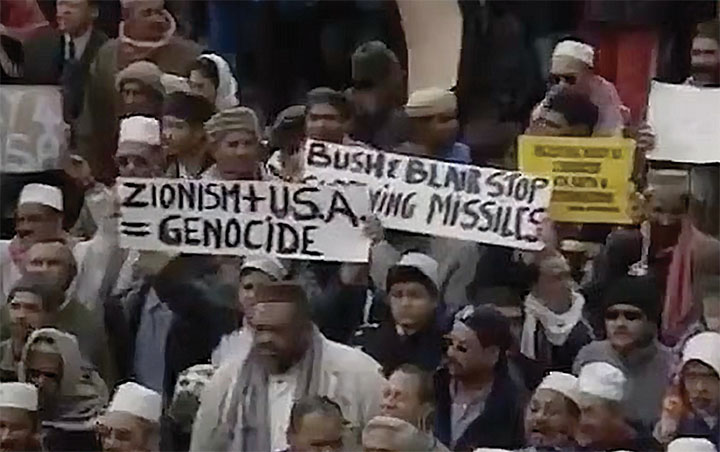
Bolstering this assessment were the demonstrations of glee and gratification among Palestinians, both on the West Bank and in refugee camps in Lebanon. These manifestations were quickly picked up by international media and could discredit the Palestinians.