
Of the approximately 5.3 million American adults who consider themselves Jewish, 22 percent say they have no religion, according to a new survey of American Jews conducted by the Pew Research Center and released on Oct. 1.
The study’s findings show a dramatic increase over the past decade in the number of Americans who consider themselves to be Jews — culturally, ancestrally — but not by religion. The last wide-ranging study of Jews across America — the 2000-01 National Jewish Population Survey (NJPS) — found just 7 percent of Americans who self-identify as Jews say they have no religion. The Pew Center survey, by contrast, found 6 percent of American Jews call themselves atheists, 4 percent call themselves agnostic, and an additional 12 percent say their religion is “nothing in particular.”
The trend away from religion is most visible among members of the Millennial generation — 32 percent of American Jews born between 1980 and 1995 fall into this growing group — and it parallels a rise in religious disaffiliation among all Americans: A 2012 Pew Center survey found 20 percent of Americans answer “none” to a question about religion.
Jews who have no religion are, perhaps not surprisingly, less engaged with the Jewish community and its organizations than are those who consider Judaism their religious identity.
“Jews of no religion are much less attached to the Jewish community,” Greg Smith, director of U.S. Religion Surveys at the Pew Research Center, said. “They are much less likely to be raising their children Jewish. This is a large segment of the U.S. Jewish population with attachments to Jewish life that are often quite tenuous.”
The Pew Center study, a multimillion dollar project that was funded jointly by the Pew Charitable Trust and the Pennsylvania-based Neubauer Family Foundation, was “conducted on landlines and cellphones among 3,475 Jews across the country from Feb. 20 to June 13, 2013,” and has a margin of error of 3 percentage points. According to the Pew press release, “More than 70,000 screening interviews were conducted to identify Jewish respondents in all 50 states and the District of Columbia.”
The survey paints a sweeping, if somewhat familiar picture of contemporary American Jews, who are, according to the data, for the most part better educated, better off and more politically liberal than most of their fellow countrymen. The average American Jew is also older than the average American, and, when compared to other religious minorities in America, far more likely to marry a member of another faith and less likely to feel that religion is an important part of his or her life.
That said, 94 percent of American Jews say they are proud of being Jewish — although what it means to be Jewish in America in 2013 varies widely. Large majorities of American Jews said remembering the Holocaust (73 percent) and living an ethical and moral life (69 percent) are, to them, essential parts of being Jewish. A significant minority of respondents — 42 percent — said that having a good sense of humor is key to being Jewish, similar to the number of Jews who considered “caring about Israel” to be essential.
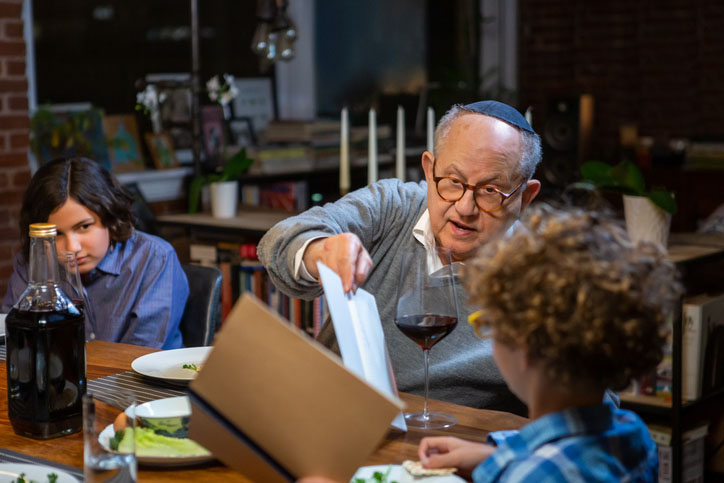
Still, the trend of American Jews moving away from traditional markers of Judaism is visible — across the entire spectrum. Levels of participation in Jewish religious practices — attending a Passover Seder, fasting for all or part of Yom Kippur and lighting candles on the Sabbath — all declined from the levels found in the 2000-01 NJPS. Jews of all denominations have become less traditional over the courses of their lives.
About 10 percent of American Jews say they are Orthodox — and these Jews tend to be younger, have more children, hold more conservative political and social views, and are more tightly connected to other Jews than their co-religionists. Nevertheless, about half of those raised Orthodox no longer apply that label to themselves.
But even if Orthodox Judaism appears in the Pew Center study to have “low retention rate,” 89 percent of those raised Orthodox still consider their religion to be Jewish. The numbers are lower among those raised in Conservative (83 percent) and Reform (71 percent) homes.
The rates of disaffiliation are particularly high among Jews who marry non-Jews — and even higher for the children of these intermarried couples. One-third of all intermarried Jews who are raising children said that they are not raising their children Jewish at all. The rate of intermarriage appears still to be rising: Of all the Jewish respondents to the survey who have married since 2000, 58 percent wed a non-Jewish spouse.
Jack Wertheimer, a professor of American Jewish history at the Jewish Theological Seminary, has urged Jewish communal leaders to take a stronger stance against intermarriage, yet even he said the results of the Pew Center study surprised him.
“I did not expect the news to be quite this bad,” Wertheimer told the Journal on Oct.1.
“I did not expect the levels of assimilation to rise quite so rapidly.”








 More news and opinions than at a Shabbat dinner, right in your inbox.