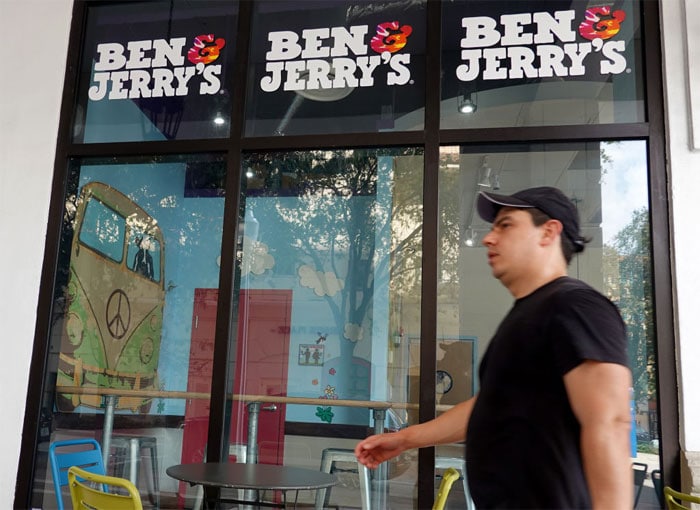
Representative Ritchie Torres (D-NY) and three other members of Congress wrote in a letter to the Securities Exchange Commission (SEC) obtained by the Journal that they have “deep concern” over Unilever’s actions in response to Ben & Jerry’s Israel boycott.
In July, Ben & Jerry’s announced that they will no longer be conducting business in the “Occupied Palestinian Territory” and will operate elsewhere in Israel. Unilever, the parent company of Ben & Jerry’s, has repeatedly stated that under their contract with Ben & Jerry’s, the ice cream giant’s Independent Board has full autonomy to engage in such activism and that Unilever does not support the Boycott, Divestment and Sanctions (BDS) movement.
Torres, along with Representatives Josh Gottheimer (D-NJ), Andrew Garbarino (R-NY), and Brian Fitzpatrick (R-PA), wrote in the November 26 letter that Ben & Jerry’s Israel move runs afoul of anti-BDS laws in more than 30 states, and states like Arizona, New Jersey, New York and Florida have already announced that they are divesting from Unilever over the matter. They argued that Unilever’s SEC filings omit acknowledgement of such “adverse consequences” to the company over the boycott as well as the fact that Ben & Jerry’s “can pursue whatever actions it chooses to take in pursuit of its social agenda—without the oversight of Unilever and without regard to the effects of Unilever. Evidence in support of this concern is the decline of Unilever ADS common shares by approximately 13% since the announcement of the boycott, equivalent to a loss in shareholder value of $21 billion.”
The letter concluded: “In the interests of shareholders, consumers, and public policy, we believe it is appropriate for the SEC to take steps to ensure the full disclosure of all information necessary to make Unilever’s filings in compliance with the rules and regulations of the United States’ SEC. Unilever is a widely held company with a current market capitalization of $135 billion, which places in jeopardy the manifold United States institutions, pension funds, and endowments which hold its shares on behalf of its beneficiaries.”
Michael Ashner and Samuel Ashner, who are stakeholders in Unilever, sent a similar letter to the SEC about the matter. The October 14 letter, which was also obtained by the Journal, stated that the autonomy granted to the Ben & Jerry’s board under their contract with Unilever “exposes all Unilever shareholders to the actions taken by the independent Ben & Jerry’s board in pursuit of its social agenda, without Unilever oversight and regardless of the consequences to the business of the parent.”
Michael Ashner, who heads Winthrop Capital Partners and started the Coalition to Hold Unilever Accountable, told the Journal, “You can’t have it both ways if you are Unilever. On the one hand, if you say you can’t override [the Ben & Jerry’s boycott], then you’ve got to disclose the material risk. If you can override, then you are participating in the boycott yourself, which they claim they are not.”
He added: “It is our view that boycotts, in any form, creates an existential problem to the State of Israel. That is the issue we’re focused on.”
Unilever did not respond to the Journal’s requests for comment.