fbpx

March 16, 2026

Ethically Produced AI Film? Filmmaker and Professor Says “Yes”

Long before artificial intelligence entered film sets and editing rooms, director Stuart Acher spent time thinking about the future.

His favorite film was “Back to the Future,” the 1985 box office hit about time travel and alternate timelines, and featured flying cars and hovering skateboards. For Acher, the film remains his north star on storytelling and about where movies could go.

Today, artificial intelligence tools can generate images, voices and scenes in ways that once required large visual effects teams.

For filmmakers, the question is no longer whether AI will appear in the creative process. It already has.

Acher works as a director, editor and professor who teaches AI filmmaking at Emerson College. The son of a Polish-born opera singer and an Egyptian-born advertising executive who worked on Madison Avenue, Acher found his way into filmmaking as a student. At the Sundance Film Festival in 2012, film critic Roger Ebert championed Acher’s short film “Bobby Loves Mangos.” The recognition led to a development deal with DreamWorks. Since then, Acher directed feature films including “#Stuck,” starring Joel David Moore and Madeline Zima, and “Mantervention,” starring Mario Van Peebles and Chloe Bridges. He has directed television including episodes in Season 5 of “Z Nation,” and has spent years working as a film editor on projects across Hollywood.

In 2025, he released an AI-generated short film titled “Next Stop Paris,” produced for TCL Studios. The project combined performances by actors with AI-generated visuals and environments. More than 80 people contributed to the production over an eight-month period, including writers, actors, visual effects artists, designers and engineers.

Acher described the film as an “ethically-produced AI project.” The film relied on actors and artists whose work guided the AI-generated imagery rather than fully replacing human creators.

A scene from the AI-generated short film, “Next Stop Paris.”

“At first every person was afraid of being replaced,” Acher said. “My inquisitiveness was like, ‘Well, know your enemy, right?’” Instead of rejecting the technology, Acher decided to experiment with it.

“And as I started working on it, I realized, oh wait, this is a tool,” he said. “This thing’s not going to replace me or anyone pretty quickly because you really need even a story to tell.”

One year later, the tools have already changed.

“Every 10 minutes there’s a brand new tool or a re-upping of a version of a tool that works so well that if you don’t stay relevant, you get left behind,” he said. “If I spend one week on vacation, I will be behind in the AI advancement of tools.”

Acher said many of the tools now used for AI filmmaking did not exist when his team created “Next Stop Paris.” Filmmakers have entered what he calls the “AI race.”

“There’s trillions of dollars being put into these tools every day by major companies.” And now, AI systems are blurring the production boundaries that comprised traditional filmmaking for a century: pre-production, production and post-production.

Despite the arrival of new technology, Acher said one part of filmmaking remains unchanged: actors.

“Nothing’s going to replace an actor,” Acher said.  “Even the process allows magic that just will never be captured alone in a room.”

In his own work, Acher records actors performing scenes and uses those performances to guide AI-generated visuals.

Generative AI still carries major risks, especially in the hands of belligerents. Fabricated images and deepfake videos can circulate around the world before anyone questions whether they are real.

“The accusation is the nail in the coffin,” Acher said. “It doesn’t matter whether it’s true or not.”

Acher’s own personal filter is drawing a line between storytelling and what he calls the ravenous hunger to “capitalize eyeballs online” at all costs.

“I call it the C word: content,” Acher said. “I don’t like that word.” Quality storytelling, he said, has already begun to take a back seat. The technology already lowers barriers for people who want to make films. At the same time, he questioned whether these shortcut tools automatically lead to better storytelling.

“This is all great, it’s the democratization of filmmaking,” he said. “But I’m not sure filmmaking should be democratized. Not everyone is capable of being a great storyteller.”

Many AI filmmakers, he said, focus on visuals or trailers rather than full narratives.

“There’s a lot of trailers and a lot of smoke and mirrors of people putting stuff out there, but there’s not storytelling with beginnings, middles, and ends.”

For students learning the technology, Acher said the lesson remains the same. “To me, if you want to be a filmmaker today using these tools, you still need to be a traditional filmmaker,” Acher said.

One place where Acher believes AI may help filmmakers is in historical storytelling. For more than a decade, he has worked on a documentary about Traian Popovici, a Romanian mayor who issued documents that protected thousands of Jews from deportation during the Holocaust.

“He saved 20,000 Jews and no one knows who this guy is,” Acher said. The project also includes research into Acher’s own family history and the disappearance of his great-grandfather during the war.

The investigation took him across Eastern Europe while searching for contemporary documents from over 80 years ago. At one point, he clandestinely filmed inside a former KGB headquarters while searching for archival material connected to his family history.

AI tools are now changing the massive budgets required for recreating historical scenes in documentaries. It’s one of the reasons Acher says he’s fired to ramp up his production pace.

“I can now do all these recreations and things that I could never afford to shoot,” Acher said. “And now with a modest budget, we can actually complete the film.”

AI filmmaking tools represent another chapter in a long history of technological change in film production. Color film and sound were introduced in the mid-20th century, and production evolved again as digital filmmaking arrived. The most important ingredient in storytelling remains the same, then, now and in the future.

“Heart,” Acher said. “If you don’t come from a place of heart, the storytelling is inauthentic, and it might as well have been created fully by AI.”

Ethically Produced AI Film? Filmmaker and Professor Says “Yes” Read More »

Does Poverty Lead to Terrorism?

The Islamist terrorists who struck in Michigan, Virginia, and New York last week didn’t know each other. They didn’t belong to the same terrorist group. And they attacked three very different types of targets.

But they had one important thing in common: they didn’t fit the stereotypical profile of a terrorist.

For years, certain politicians, diplomats and pundits have promoted the theory that poverty is the main cause of terrorism. That belief has been the basis for some major U.S. foreign policy initiatives, such as aid to the Palestinian Authority.

Give people jobs—these “experts” say—and then they will have something to lose, so they won’t resort to terrorism.

According to that view, the typical terrorist is young, unemployed, and single. But again and again, the actual biographical details of terrorists tell a different story.

The terrorist who attacked the synagogue in Michigan last week, Ayman Mohamad Ghazali, was 41. He had children, he was gainfully employed at a local restaurant, he had a house, and he had a car. Yet he packed his car with explosives and went looking for the nearest Jews to blow up.

The Islamist fanatic who murdered a professor on the campus of Old Dominion University, in Virginia, likewise was much older than the so-called typical terrorist. He wasn’t in his teens or early 20s, and he wasn’t unemployed. Mohamed Bailor Jalloh was 36, and he had respectable job, serving in the Virginia National Guard.

The extremist who threw a bomb at protesters near Gracie Mansion in Manhattan last week was younger than the others; Emir Balat was 18. But nothing else about him fit the supposed profile of a terrorist.

“When he was only 13, he programmed bots to buy pricey sneakers the moment they dropped,” the New York Times reported.  “His father would drive him to the parking lot of a Wawa convenience store, where he would sell them to a sneaker dealer, sometimes making more than $200 a pair.”

When he was in high school, Emir “began selling contractor supplies online — flooring, sinks and vanities, mini-splits and power tools.” He had a thriving business. He was making a lot of money, especially for a teenager. He, too, had plenty to lose.

There’s a great deal of anecdotal evidence along these lines from other Islamist terrorist attacks in the United States.

For example, Faisal Shahzad, who tried to blow up Times Square with an explosives-filled SUV in 2010, was a 30 year-old father of two with an MBA and a job as a financial analyst.

Syed Farook and Tashfeen Malik were a middle-class Muslim couple, both college graduates. He worked as an environmental health specialist. They had a six-month old daughter. Then they massacred 14 people at a holiday party in San Bernardino in 2015.

Demographic analyses of groups of terrorists have found similar patterns.

Consider the 415 Hamas leaders and activists whom Israeli Prime Minister Yitzhak Rabin deported to Lebanon in 1992. Dozens of them were medical doctors, university professors, or administrators of institutions of higher education. Three-fourths were married; one third had between one and four children, and one-fourth had five or more children. They, too, had a lot to lose.

Most of the 9/11 hijackers came from “comfortable backgrounds,” terrorism expert Dr. Brooke Rogers wrote in NATO Review in 2012. Two-thirds of them had attended college, some had master’s degrees, and most had professions. Likewise, Rogers noted, “two‑thirds of British terror suspects are reported to come from middle‑class backgrounds.” She concluded that there is ample evidence “that directly contradicts the assumed link between poverty and terrorism.”

Alan B. Krueger and Jitka Maleckova, who studied the connection between poverty and terrorism for the National Bureau of Economic Research in 2002, concluded that “having a living standard above the poverty line or a secondary school or higher education is positively associated with participation in Hezbollah.” Similarly, James A. Piazza, writing in the scholarly journal Terrorism and Political Violence in 2006, concluded that “contrary to popular opinion, no significant relationship between any of the measures of economic development and terrorism can be determined.”

The phenomenon is not limited to Islamists. Studies by scholars of the Nazi era have found that a large majority of elite SS officers were university-educated professionals, and many had doctorates. Timothy Snyder, in his book Bloodlands, notes that 15 of the 25 commanders of the Einsatzgruppen—which massacred over one million Jews in Eastern Europe in 1941-1942—had doctorates.

From the Holocaust to contemporary Islamist terrorists, it seems clear that poverty is not the cause of terrorism, and education and jobs are not its cures. Last week’s attacks across the United States have illustrated that fact once again.


Dr. Medoff is founding director of The David S. Wyman Institute for Holocaust Studies and author of more than 20 books about Jewish history and the Holocaust. Follow him on Facebook to read his daily commentaries on the news.

Does Poverty Lead to Terrorism? Read More »

Jewish Notables from the 98th Academy Awards

At the 98th Academy Awards, the most prominent Jewish names on the broadcast didn’t take home the gold Oscar statuettes.

Last year, Jewish actors Adrien Brody and Mikey Madison won Oscars for Best Actor and Best Actress. The year before that, biopics of three Jews — “Oppenheimer,” “Maestro” and “Golda” — were nominated in major categories. But this year, the most Jewish presence came during the In Memoriam segments.

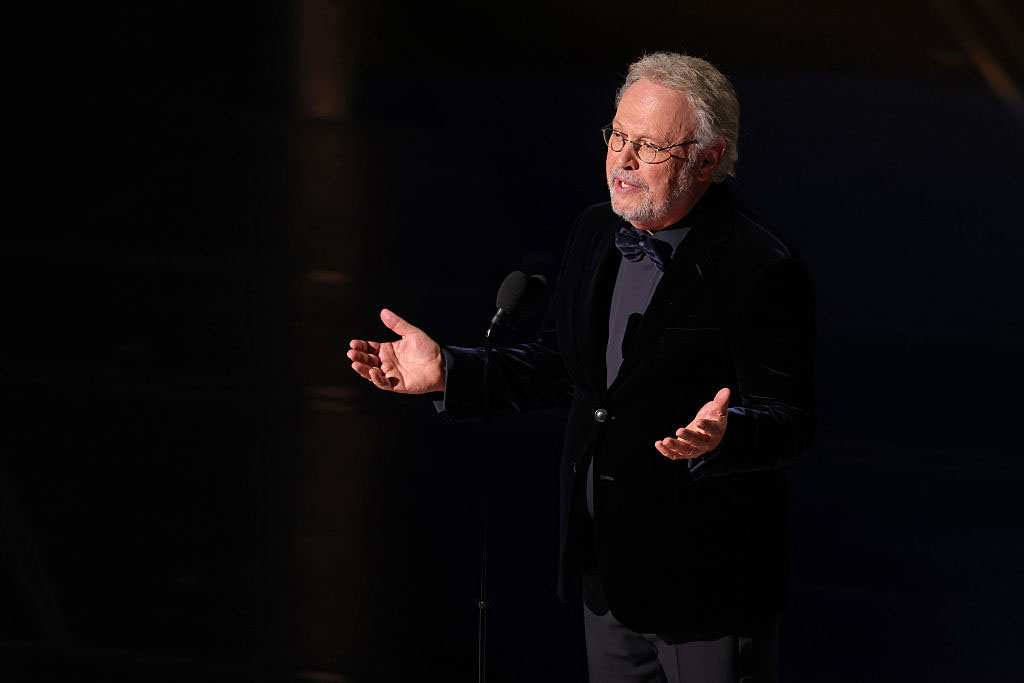
The film community was shaken by the killing of director Rob Reiner and wife Michele Singer Reiner. The tribute to them was one of the most somber moments of the evening at the Dolby Theatre in Hollywood. Actor Billy Crystal took to the stage to speak about Reiner  and the impact of his filmmaking. The two first met in 1975 when Crystal appeared on an episode of “All in the Family.”

“My friends, Rob’s movies will last for lifetimes because they were about what makes us laugh and cry and what we aspire to be,” Crystal said. “Far better in his eyes, far kinder, far funnier and far more human. And when Michele Singer entered his life, they were unstoppable. A gifted photographer, she not only produced films with Rob, but it was her energy that had them working tirelessly to fight social injustice in the country that they both loved. Now Rob and Michele Reiner became the driving force in the landmark decision for marriage equality across the United States, and their loss is immeasurable. And to the millions who have enjoyed his films all these years, I want you to know here and around the world how many times Rob told me that it meant everything to him that his work meant something to you. And for us who had the privilege of working with and knowing him and loving him, all we can say is, ‘Buddy, what fun we had storming the castle.’”

Rob Reiner’s “movies will last for lifetimes because they were about what makes us laugh and cry and what we aspire to be. … Far better in his eyes, far kinder, far funnier and far more human.” – Billy Crystal

It ended when the screen showing posters of Reiner-directed films was lifted to reveal 17 actors who starred in them.


Among them were  Kevin Pollak (“A Few Good Men”), as well as Fred Savage, Carol Kane and Mandy Patinkin from “The Princess Bride.”

Two-time Oscar winner Barbra Streisand remembered actor Robert Redford, who passed away on Sept. 16. Streisand concluded by singing the title song from “The Way We Were,” the 1973 film starring both her and Redford. That film won two Academy Awards, one for Best Original Score (by the late Marvin Hamlisch), and another for the film’s titular song, co-written with Alan and Marilyn Bergman. Alan passed away on July 17 last year at age 99 and was also featured in the evening’s “In Memoriam” segment.

Others in the “In Memoriam” segment included Swiss producer and six-time Oscar winner Arthur Cohn (“One Day in September”), producer Stanley R. Jaffe (“Kramer vs. Kramer”), screenwriter Jeremy Larner (“The Candidate”), longtime Amblin Entertainment publicist Marvin Levy, Argentine composer Lalo Schifrin (“Mission: Impossible,” “Enter the Dragon” and the “Dirty Harry” films), British playwright Tom Stoppard (“Shakespeare in Love”), and documentarian Frederick Wiseman (“Titicut Follies”).

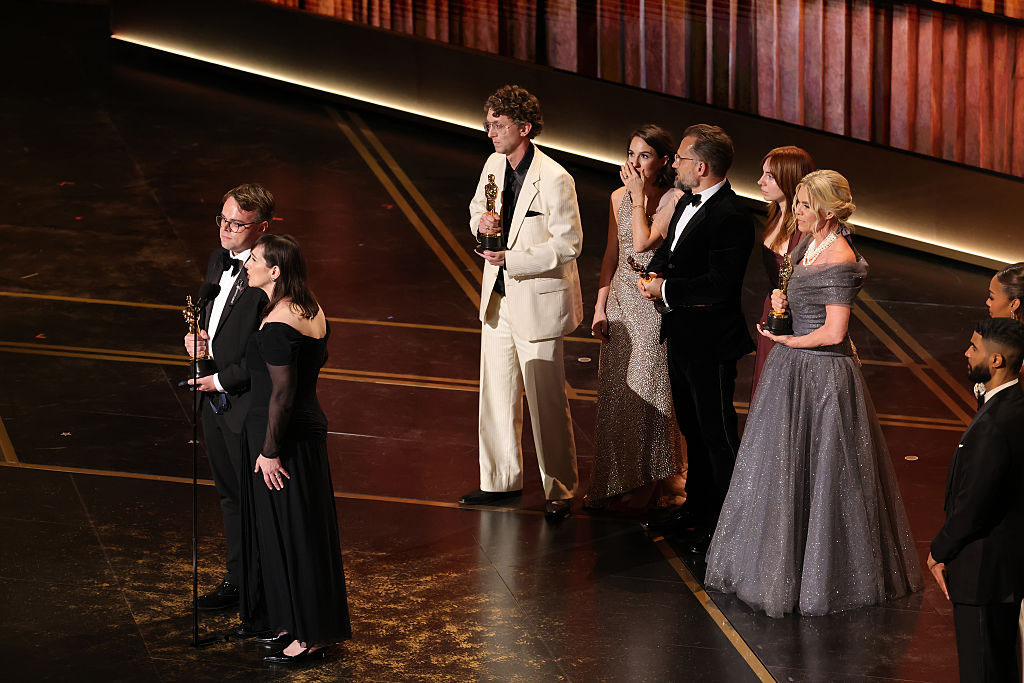
Jewish filmmakers David Borenstein and BBC’s Lucie Kon both took home awards for Best Documentary Feature for “Mr. Nobody Against Putin.” The documentary is about a Russian school official secretly documenting state propaganda after the invasion of Ukraine.

(L-R) Pavel Talankin, Robin Hessman, David Borenstein, Alžběta Karásková, Radovan Sibrt, and Helle Faber accept the Documentary Feature award for “Mr. Nobody Against Putin” onstage during the 98th Oscars at Dolby Theatre on March 15, 2026 in Hollywood, California. (Photo by Kevin Winter/Getty Images)

“’Mr. Nobody Against Putin’ is about how you lose your country,” Borenstein said in his acceptance speech. “And what we saw when working with this footage is that you lose it through countless small little acts of complicity. When we act complicit when a government murders people on the streets of our major cities, when we don’t say anything, when oligarchs take over the media and control how we can produce it and consume it, we all face a moral choice. But luckily, even a ‘nobody’ is more powerful than you think.”

Several Jewish artists were nominated for awards this year but did not win.

Songwriter Diane Warren received her 17th Academy Award nomination for “Dear Me” from the documentary “Diane Warren: Relentless.” While she still has yet to win an Oscar for her songwriting, Warren did receive an Honorary Oscar in 2023.

“Marty Supreme,” a sports comedy loosely inspired by the life of Jewish table tennis champion Marty Reisman, was one of the most Jewish-themed films in contention this year. The film, set largely on New York’s Lower East Side, follows a ping-pong player and Jewish immigrant in the United States post-World War II. “Marty Supreme” was nominated for nine awards, yet took home zero. Among them were three Jewish nominees, Timothée Chalamet (nominated for Best Actor) Josh Safdie (nominated for Best Director) and Ronald Bronstein (nominated for Best Original Screenplay).

Director Steven Spielberg received his 23rd overall nomination, as a producer for “Hamnet.” Producer Jerry Bruckheimer received his second nomination as the producer of “F1.”

The French animated short film “Papillon” (“Butterfly”), which tells the story of Alfred Nakache, a Jewish swimmer who competed for France at the 1936 Berlin Olympics, was nominated for animated short film. In 1941, he was a world champion and record holder for the 200m butterfly. In 1943, Nakache and his family were arrested and sent to Drancy internment camp in northern France. The following year, Nakache and his wife and daughter were deported to Auschwitz, where he was the only one to survive. Following the war, he became one of only three known athletes to have survived the Holocaust and who went on to compete at the Olympics. He was inducted into the International Jewish Sports Hall of Fame in 1993.

Three films nominated for awards involved the Israel-Hamas war. Israeli filmmaker Hilla Medalia’s documentary short “Children No More: Were and Are Gone” lost in the Best Documentary Short category and Meyer Levinson-Blount’s short film “Butcher’s Stain” lost in the Best Live Action Short category.

A Tunisian film, “The Voice of Hind Rajab,” about a Palestinian child killed in Gaza, was nominated for Best International Feature. Actor Javier Bardem presented the award for that category, but before the announcement, he said “No to wars and free Palestine” uncensored on the broadcast. Norwegian film “Sentimental Value” ended up winning Best International Feature.

Advocacy group Creative Community for Peace addressed Bardem’s comments in a statement, saying “The irony of calling for ‘no war’ and then chanting a slogan of a terror organization that started a war.”

Jewish Notables from the 98th Academy Awards Read More »