
Former Hostage Omer Shem Tov Shares Story of Survival for Jewish National Fund-USA Event
“I saw miracles day after day.”
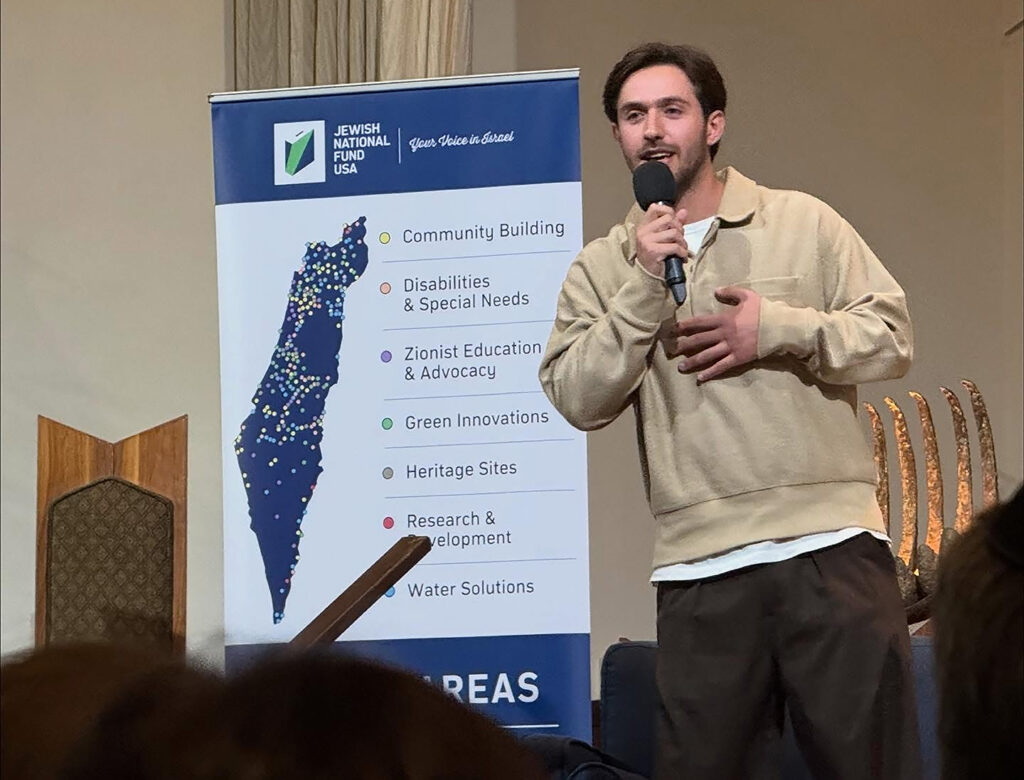
Omer Shem Tov proclaimed this from the stage at Sinai Temple on Thursday, Nov. 20, where he spoke to a packed room about his captivity. The Jewish National Fund-USA event, titled, “505 Days: Omer Shem Tov’s Story of Survival from Gaza,” featured a Q&A with Rabbi Nicole Guzik and Rabbi Erez Sherman and a nearly nearly-one hour speech from Shem Tov, who was only 20 years old when Hamas terrorists captured him.
He told his enrapturing story in detail, adding in inspirational messages along the way. He started by telling the crowd, “Ever since I came back from captivity, I wrap tefillin every day and I talk to Hashem as if he’s right next to me. I say, ‘Hashem, please to give me light and hope and resilience so when I talk to another person, I can give them light and hope and resilience too.”
Shem Tov then took a pause, and said, “I’m Omer Shem Tov and I’m a free man!” to an eruption of cheers. He began to tell his story.
“I’m Omer Shem Tov and I’m a free man!”
On the night of Friday, October 6, 2023, Shem Tov had Shabbat dinner with his parents, which was special that week: It was his mom Shelley’s birthday. After wishing his mom a happy birthday, he set off for the Nova Music Festival, where he was meeting his friends.
At 6:29 a.m. the next day, sirens started going off because Hamas was shooting missiles into Israel. Shem Tov, like all Israelis, was used to it. The party stopped as people as headed for their cars.
He received a call from his father, who told him, “This is not only a missile attack. Terrorists are invading Israel.”
Shem Tov thought there were maybe a dozen terrorists crossing the border – until he started hearing gun shots “in every direction,” he said. “They were coming from the east, the west, the north, and the south.”
He ran in a field with his friends, Maya and Itay Regev. He saw bodies all around him.
His phone rang; it was from an unknown number. The voice on the other end said it was a mutual friend, Ori Danino.
“Send me your live location,” Danino said. “I’m coming to get you.”
Shem Tov reflected, “He drove right back into a terror attack to save us.”
When Danino found Shem Tov and the Regevs, they swiftly jumped into his car. They saw Hamas terrorists in cars surrounding them. Danino shouted, “Everyone down!”
“I can still hear the sound of those bullets going next to my head,” said Shem Tov. “I hear Maya talking on phone with father. She was screaming, ‘Dad, they shot me! I’m about to die!’”
Danino ran off to confront terrorists – and that was the last time Shem Tov saw him.
“I truly believe Ori was my guardian angel, he said. “If it wasn’t for him, I wouldn’t be here today telling my story. May his soul rest in peace.”
Shem Tov then looked up, and two terrorists were pointing rifles at him. They shattered the window and dragged him out by his hair. They tied his hands behind his back, spit on him, and sat on him as if to declare victory. He looked over and saw the tire on a car and thought, “This is the way I’m going to die. They’re going to run me over with their truck.”
He then caught a glimpse of the Regevs; Maya’s leg was nearly detached from the rest of her body.
“I cannot unsee the image of Maya’s leg,” he said.
The terrorists threw Shem Tov onto the truck and drove him into Gaza – they were there in only five minutes. He saw men, women, and children cheering, screaming, “Allahu Akbar!”
“They were celebrating like it’s their own fourth of July,” he said. “They were so happy to know Jews were murdered, and women were raped and kids were slaughtered. I was shocked.”
For the next 15 months, Shem Tov was moved from location to location, seeing miracles along the way. He would be placed in various apartments in Gaza; at first, he was with Itay, and the terrorists would dress the two up like women when they were out on the street.
The last apartment he was in with Itay, the terrorists left them alone for several hours. He got up and started cleaning out of boredom. Then, he took a nap on the floor and woke up to a familiar whistling sound: bullets whizzing past him. The nearby window shattered on him. The glass cut his legs. He heard loud explosions as the building shook. Everything went pitch black.
“I grabbed Itay,” he said. “I thought, at least if the building collapses, we are next to each other. We prayed and prayed and prayed.”
Eventually, a terrorist walked in, covered from head to toe in dust. “The whole block was bombed, except for this place,” he told them.
Shem Tov said, “I thought, ‘I just cleaned it!’”
The crowd laughed. Several times throughout his speech, he added in jokes like this, and talked about all the open miracles he saw and how he leaned into his faith.
“I did the Shema every single day,” he said. “I spoke with Hashem for five minutes every day like He is right there with me.”
Itay was taken and released; Shem Tov was stuck. A terrorist took him underground. They walked for one hour and 15 minutes down the tunnel and threw him into a cell where he couldn’t stand up or extend his arms. He was in complete darkness.
He was there for 50 days, starving, only getting a biscuit per day and a few sips of salty ocean water at one point. It was so dark that he thought he had gone blind. He hadn’t showered for 90 days.
One day, the terrorists took him to another tunnel that looked like an apartment. It had bathrooms and a kitchen. They fed him much more food, which he quickly ate. When he was finished, the terrorists told him, “You cannot stay here. You have to go back to the tunnel where you came from.”
“I was upset, but I was grateful for the day I had there,” Shem Tov said.
Then, another miracle: he soon learned that the IDF was right above him, and they had bombed the other tunnel with the small cage. He was going to get to stay in this bigger tunnel, with nine terrorists.
He survived by cooking, cleaning, and fixing things around the tunnel for the terrorists. One time, he woke up, and all the terrorists were sleeping. He picked up their rifle and was prepared to shoot them.
“My heart was pounding like crazy,” he said. “I was sweating. Suddenly, I had [a vision] that the rifle would jam.”
Shem Tov put it down and went back to sleep.
Then, another miracle happened: the IDF left, so the terrorists went above ground. They found books and papers in Hebrew and gave them to Shem Tov. One was from Chabad, and it contained the Parsha story of Joseph being stuck in a pit. He was released and became the viceroy of Egypt.
“It’s a sign from Hashem and I will become viceroy of hostages,” Shem Tov said.
For five months, he read that Parsha and held onto hope. He learned Arabic by listening to the terrorists – but they didn’t know he understood them.
Out of nowhere, the terrorists told him he was going to be released.
“Before you leave, show us how this place works,” they said to him.
“Because I did everything for them, I gave them a tour of the tunnel,” Shem Tov said, laughing.
Before he was set to be released, the terrorists fed him much more food to make him gain weight quickly; it was a tactic to make it look like the hostages had been treated well.
The day of his release, he climbed up a ladder out of the tunnels, blindfolded, and felt the cold breeze caressing his skin.
“I take this big breath of fresh air after 450 days in tunnel alone by myself,” he said.
Shem Tov was forced to participate in the Hamas ceremony where he stood on a stage and the terrorists showed him off.
“It was grey and raining,” he said. “But for me, it was the sunniest day of the year.”
Finally, he was taken back to Israel, where he reunited with his parents, brother and sister. He stayed up until 3 a.m. with them, and then his mother Shelley, who was fiercely advocating for his release the entire time, told him to get some rest.
“She put a chair next to my bed, caressed me until I fell asleep and looked at me all night as if I was a newborn baby,” Shem Tov said.
Nine days later, he was on a flight to the United States, meeting with the president to urge him to negotiate a release for the rest of the hostages. Since then, he has spent all his time flying around the world doing the same.
Looking around at the crowd at Sinai Temple, Shem Tov left the stage with an inspiring message.
“Thank you for being the light you are,” he said. He thanked God, “who brought me here today and made sure I’m alive and healthy and I can tell my story and finish my mission.”
He continued, “I am Omer Shem Tov. And I’m a free man.”
Former Hostage Omer Shem Tov Shares Story of Survival for Jewish National Fund-USA Event Read More »

