fbpx

November 4, 2025

Tucker Carlson’s Apology to Christian Zionists? Don’t Be Fooled

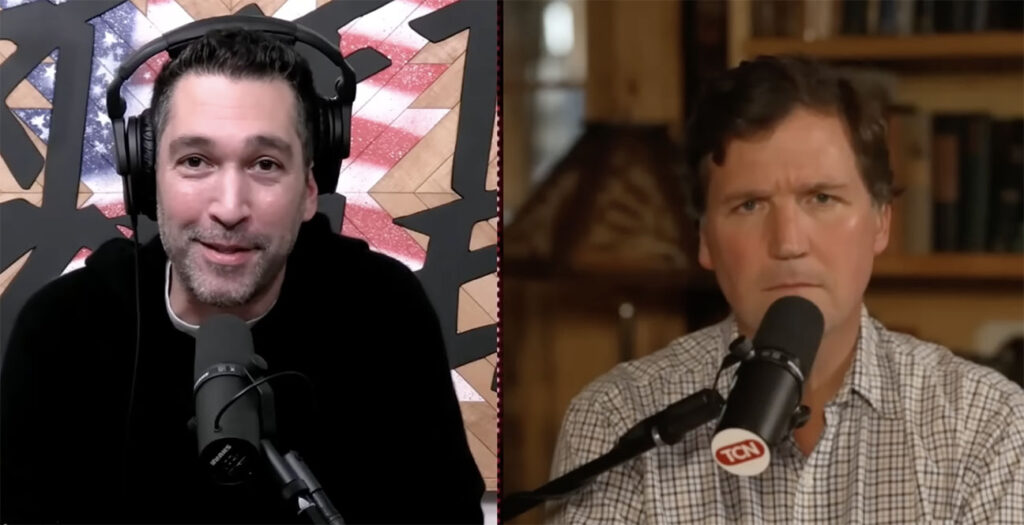
On Dave Smith’s podcast this week, Tucker Carlson tried to rewrite his own history.

“But I just want to say at the outset, because this has been weighing on me,” he told Smith. “I did say something that I really regret saying that I didn’t fully mean. I said it because I was mad… I said something to the effect of, ‘I despise Christian Zionists.’ And I’m just sorry that I said that, because I don’t… Some of the nicest people I know are Christian Zionists… I want to be very specific about what I was talking about. In at least a couple of different occasions, the Israeli government bombed churches in Gaza and killed a bunch of Christians. And not an accident, of course.”

Just days earlier, during his Nick Fuentes laundering session, Carlson had said flatly (and quite calmly) that he “hates Christian Zionists more than anybody” and that they must be suffering from a “brain virus,” because Tucker Carlson—the theologian emeritus of Cable News U—had deemed their beliefs “anti-Christian.” All this as Stalin- and Hitler-adoring Nick Fuentes nodded approvingly.

Now Carlson is trying to dilute the venom—excusing his insults because he was “mad,” while pivoting to a new accusation that Israel deliberately bombed churches. In one breath he posed as a penitent Christian; in the next he recycled an antisemitic canard about Jews killing Christians. The juxtaposition was as revealing as it was cynical.

Carlson’s “apology” was not repentance. It was rebranding – provoke outrage, plead misunderstanding, then double down with a new lie that shifts blame to Israel or its supporters.

A Three-Year Descent

Since his April 2023 departure from Fox News, Carlson has become a globe-trotting apologist for autocrats and antisemites. His October 2025 interview with white-nationalist Nick Fuentes—whom he treated with respect rather than revulsion—wasn’t an aberration but the culmination of years of rhetorical decay.

Platforming Extremists

During the Fuentes interview, Carlson let the Holocaust-minimizing influencer rant about “Zionist media control” without challenge, even calling him “enormously talented.” Lawmakers from both parties and Jewish organizations swiftly condemned the broadcast.

This isn’t new. For years Carlson has flattered strongmen from Putin to the Ayatollah, platformed numerous antisemites, and echoed talking points from regimes that regard Jews and liberal democracy as enemies.

The Church-Bombing Lie

There are tragedies in every war, but Carlson’s “not an accident” claim—used to excuse his tirade against Christian Zionists—turns unintended collateral damage into an intentional crime. It mirrors Hamas propaganda: take one image, strip away context, and weaponize it against Israel.

By alleging Israel “bombs churches” and kills Christians deliberately, Carlson revives one of history’s oldest antisemitic tropes—an updated “Christ-killer” story for the social-media age.

In reality, two very different incidents occurred in Gaza. In October 2023, an Israeli airstrike targeting a Hamas command post struck near the Greek Orthodox Church of St. Porphyrius in Gaza City. Hamas terrorists had been operating nearby, and debris from the strike collapsed an adjacent building, killing civilians sheltering there. On July 17, 2025, Israeli tank shrapnel from a Hamas-initiated firefight hit part of the Holy Family Catholic Church in Zeitoun, injuring several. In neither case was the church itself targeted. Israel expressed regret, investigated, and presented evidence of Hamas activity in the area.

This is what happens when a terror group fights from residential blocks, hospitals, schools—and yes, churches. The blame belongs to Hamas, which uses its own civilians as shields, not to Israel.

Such tragedies are not unique. In World War II, U.S. bombers accidentally destroyed a hospital in Amsterdam while aiming for a Gestapo HQ. In 2002, a U.S. airstrike in Afghanistan mistakenly hit a wedding, killing dozens. War is chaos. Yet no serious person claimed America deliberately targeted a wedding. Carlson knows this history but pretends Israel—a democracy fighting an enemy that hides among civilians—is somehow uniquely evil.

Why It Matters

Carlson remains one of America’s most watched commentators. If his audience accepts his distortions uncritically, the American right risks mainstreaming antisemitic and conspiratorial worldviews once confined to the fringe.

His rhetoric also undermines the moral coalition—Jews, Christians, and classical liberals—that has long defended the West’s civic foundations. By attacking Christian Zionists, he seeks to weaken one of Israel’s most enduring bastions of support and one of America’s strongest alliances.

The Fake “Apology”

Carlson’s sudden contrition isn’t about truth; it’s about damage control. His Fuentes interview cost him credibility even among loyal viewers. Now he’s trying to cast himself as a misunderstood truth-teller, the man who “asks hard questions.” But he isn’t asking questions—he’s laundering answers written by tyrants and antisemites.

The Larger Pattern

In the past three years Carlson has:

  • Dismissed Russia’s invasion of Ukraine as a NATO provocation;
  • Downplayed China’s repression of Uyghurs; and
  • Amplified anti-Western narratives from Moscow to Tehran.

He has also conducted softball interviews with Vladimir Putin and Iran’s Ayatollah Khamenei, granting them unchallenged platforms to pose as victims of Western aggression. He plainly implied in his eulogy for Charlie Kirk that the “hummus eating Joos” did it. In 2024 he hailed fringe podcaster Darryl Cooper—a conspiracy theorist who claims Hitler was “misunderstood,” the Nazis didn’t intend genocide, and Churchill was the “real villain” of World War II—as “America’s best historian.” Tucker’s choice of “historian” says everything.

Carlson’s attacks on Israel fit the same pattern. Each time he questions the Jewish state’s legitimacy, he advances the same poisonous message: Western democracy is corrupt, its defenders’ hypocrites, and its enemies the real victims.

The Moral Cost

Carlson’s “apology” exploits understandable Christian sympathy for Palestinians while erasing Hamas’s responsibility for Gaza’s misery—and for every casualty caused by the war Hamas started.

Hamas hides among civilians, stores weapons in homes, fires rockets from next to—and even inside—houses of worship, and builds command tunnels beneath hospitals. Its leaders live in Qatari luxury while ordinary Gazans suffer. Yet Carlson never mentions this.

Israel, by contrast, is the only country in the region where Christians worship freely, vote, and serve in public life. The Christians of Gaza whom Carlson claims to champion live under Hamas—a regime that has persecuted them for years, confiscating property, closing churches, and silencing dissent.

Meanwhile, his “church-bombing” narrative perfectly serves Hamas’s propaganda: fracture Christian support for Israel and recast a defensive war as a morality play with Jews as villains. Across the Middle East and North Africa, hundreds of churches have been destroyed and Christian populations decimated—from Iraq to Syria, Egypt to Sudan. In contrast, Israel’s Christian population has grown from about 34,000 in 1949 to over 190,000 today—an increase of nearly 500 percent. Under Palestinian and Hamas rule, Christian communities have withered almost to extinction. Carlson never mentions that.

No Free Pass

Christian Zionists span a spectrum—pastors, philanthropists, activists—united by belief in Israel’s biblical and moral significance. Carlson shouldn’t get to smear them and then claim he simply “misspoke” out of anger. His platforming of Fuentes and his deliberate smears of Israel and its supporters demand accountability, not gaslighting or amnesia.

If America wants to remain anchored in truth, it cannot excuse those who launder lies about “Zionists” and whitewash hate as “just asking questions.” Tucker Carlson’s apology isn’t repentance—it’s rehearsal. And the encore will be worse if people keep applauding.


Micha Danzig served in the Israeli Army and is a former police officer with the NYPD. He is currently an attorney and is very active with numerous Jewish and pro-Israel organizations, including Stand With Us and the FIDF, and is a national board member of Herut North America.

Tucker Carlson’s Apology to Christian Zionists? Don’t Be Fooled Read More »

Trump and American Precedents

Precedent provides lifeblood for any democratic republic. Practicality dictates that only a limited number of government practices can be required or prohibited expressly by law. Such laws can be viewed as the “hardware” of government practice. But respect for tradition, the “software,” is critical as well. Harm to precedent may prove to be the most damaging legacy of the Trump years.

Trump is not the first president to trample precedent. Until Franklin Roosevelt’s 1940 re-election, no American president ever served more than two terms. When Washington created the precedent by leaving power voluntarily after his second term, he was hailed widely as a hero reminiscent of Roman General Cincinnatus. A Republican slogan from 1940 claimed that “Washington wouldn’t, Grant couldn’t and Roosevelt shouldn’t.” But in the wake of Hoover’s disastrous tenure and with European war threatening, Americans endorsed breaking the informal term limit. In the 1950s, with conservatives again ascendant, tradition-conscious Republicans codified the two-term limit in the 22nd Amendment.

New precedents can also become problematic. The means of managing potential criminality in the White House had never been fully established before Trump’s first term.

We may have benefitted from the absence of formal precedent. Presidents considering illegal action might be restrained by the fear of future prosecution. Indeed, Richard Nixon had been prosecuted for alleged Watergate crimes until pardoned by President Ford.

That pardon, however, was a one-off. A precedent emerged only in the Supreme Court’s 2023 ruling in Trump v. United States. The Court showed great deference for presidential power, shielding any actions potentially related to official presidential duties.

This unfortunate precedent now offers protection for presidents who would violate the law. They need only a fig leaf of legitimacy. Nixon once claimed falsely that, “when the President does it … it is not illegal.” The Supreme Court virtually endorsed that once dubious claim.

Ironically, an administration that undermines American political tradition also styles itself as conservative. Nothing could be less conservative than breaking precedents that protect us all. Conservative Republican office holders who would be expected to defend precedents have stayed on the sidelines. They know that Trump’s power in their party is so undisputed that he can “primary” any of them and end their careers.

In a recent exception, Senator Cruz of Texas protested FCC Chair Brendan Carr’s threat to the Jimmy Kimmel Show’s broadcast rights. Cruz warned correctly that nixing shows expressing liberal views might create a precedent that could threaten conservative shows in a future Democratic administration. Good point. But where are Cruz and others on Trump’s sending unwanted federal troops to American cities and exploiting federal research funds to promote an ideologic agenda at American universities?

Political re-districting poses perhaps the greatest threat to American governmental traditions.

Political re-districting poses perhaps the greatest threat to American governmental traditions. In the past, no matter how foolish the government’s actions seemed, the next election offered voters the unfettered option to “throw the bums out” and change directions.

Until now.

At Trump’s behest, Republicans in Texas have broken the longstanding tradition that re-districting occurs every ten years following the census. That practice made simple sense, as the census can change the number of districts and require new maps. Under Texas’s previous Congressional district map, the 42% of Democrats voting for Harris in the 2024 election controlled only 29% of Texas’s congressional seats. With the new hyper-partisan districting, the 42% are expected to control only 21% of the seats. The Texas scheme takes the hands of the voters off the levers of power. If competitive, hyper-partisan districting becomes the norm, fair and truly representative government my prove difficult to restore.

This November Californians face a difficult choice. They can stand aside and ignore the redistricting in Texas and Missouri. Or they can break our non-partisan re-districting precedent to counterbalance anti-democratic changes elsewhere. Control of the House of Representatives and a potential critical check on Trump’s power are at stake.

Are Democrats just using the crisis as an excuse to rid the state’s delegation of Republicans? No.  If they were, they would not have included a provision restoring non-partisan re-districting in 2030. That feature reflects hope for restoration of political fair play in a post-Trump America.

Should Californians sacrifice our non-partisan practices to resist Trump’s assault on our political traditions? Though we might prefer even-handed politics, you cannot bring boxing’s Marquis of Queensbury rules to a knife fight.


Dr. Daniel Stone is Regional Medical Director of Cedars-Sinai Valley Network and a practicing internist and geriatrician with Cedars Sinai Medical Group. The views expressed in this column do not necessarily reflect those of Cedars-Sinai.

Trump and American Precedents Read More »

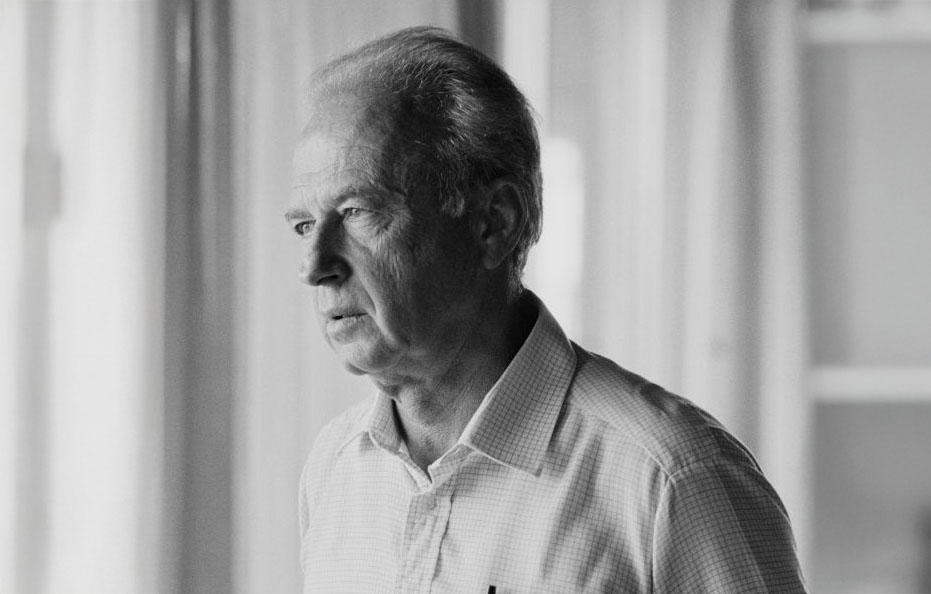
The Night Rabin Died

Recently, I read Ayelet Tsabari’s “Songs for the Brokenhearted.” It’s a novel about grief and love, mothers and daughters, and the complexities of Sephardi and Israeli identity — set, in part, in 1995. One thread follows a teenage boy drawn into the same ideological currents that gave rise to Yigal Amir. As I read, I found myself traveling back in time: from Petah Tikvah to Jerusalem to the Tel Aviv peace rally that changed history — and changed me.

Perhaps the book especially resonated because I spent the summer of 1994 in Israel. It was a season that now feels almost euphoric. The first Oslo Accords had been signed, and hope was palpable everywhere. I remember climbing Masada at sunrise and being told we’d have to descend early: King Hussein of Jordan was coming. The impossible suddenly seemed possible.

A year later, in November 1995, I was in my New York apartment when the news came of Rabin’s assassination. I remember the darkened room, the walk to the Israeli Consulate, the swollen eyes after Rabin’s funeral. That night, I understood that my identity was bound to am Yisrael — that when Israel mourned, I mourned too.

While I am neither historian nor political analyst, I am not alone in saying that Rabin’s death changed the course of Israeli history. Even today — maybe especially today — the “what ifs” still reverberate across Israeli society and Jewish communities around the world. Looking back, I can trace the ways I was profoundly changed on and by that night; I leave it to the scholars to do the same for Israel and world Jewry.

This fall, as the 30th anniversary approached, I found myself drawn to “Class of 95/Machzor 95″— a collection of Israeli poetry that looks back on that night and all it changed. Reading it, I was struck by how the voices of that generation — the ones who came of age in that grief — are still asking the same questions I am: what broke that night, and what might still be repaired.

And yet, even as I write this, I can still hear that song — the one Rabin sang just moments before he was shot: “Shir LaShalom,” the song for peace. I can hear the crowd’s voices rising, the paper lyrics fluttering in the night air like fragile prayers. “Don’t say the day will come — bring the day.”

Since Oct. 7, 2023, I’ve thought often of that night — and of how the crowds still gather in Tel Aviv, not in Kikar Rabin but in Kikar HaChatufim, Hostages Square. Different plaza, different decade — but the same ache in the air, the same need to stand shoulder to shoulder and sing. I think of what it means to be a part, deeply, of am Yisrael — to love, to grieve and still to yearn for the promise of Medinat Yisrael.

Maybe that’s what endures: the insistence that we keep showing up, keep singing. That to believe in peace, after all that has been shattered, might seem naïve but is actually holy. That the act of standing together — with candles, with songs, with tears — is itself a form of faith.

Thirty years later, I still believe the melody matters. To remember, to grieve, to dream — and to keep singing “Shir LaShalom,” even when the harmony feels impossible. Because hope, too, is a form of courage.

“Don’t whisper a prayer —
sing a song for peace with a loud shout.
Don’t say the day will come —
bring the day.
Because it is not a dream —
and in all the city squares,
sing only for peace.”

(“Shir LaShalom,” Lyrics: Yaakov Rotblit; Music: Yair Rosenblum)

To the memory and legacy of Yitzchak Rabin, z”l. 


Rabbi Sari Laufer is the Chief Engagement Officer at Stephen Wise Temple and Schools in Los Angeles. 

The Night Rabin Died Read More »