Countdown to Freedom: How the Last 20 Living Hostages Returned to Israel
For the first time in 738 days, Israel could say that all of its remaining living hostages were back on Israeli soil.
Operation “Returning Home,” launched by the Israel Defense Forces (IDF) on Oct. 12, concluded the next day with the return of 20 survivors and the repatriation of four bodies from Gaza (as of press time). The final convoy of IDF and Shin Bet vehicles crossed back into Israel in the early hours of Tuesday morning, concluding the hostage crisis.
The hostages came home in two separate convoys, with confirmations of them crossing into Israel separated by about two hours and 20 minutes.
Just before 8:00 AM Israel time, Israeli Air Force helicopters were in place near southern Gaza as the Red Cross was en route to northern Gaza to receive the first convoy of hostages.
The operation’s plans were opaque to the public, with few details coming out in real time.
Back in the U.S., this was all taking place in the early morning hours (Israel is 10 hours ahead of Los Angeles, and seven hours ahead of the U.S. East Coast). Speculation ran rampant across social media throughout the night on when exactly it would be time to celebrate.

At 9:11 a.m. Israel time, the IDF confirmed that first seven returning hostages — Matan Angrest (22), Guy Gilboa-Dalal (24), Alon Ohel (24), Eitan Avraham Mor (25), Gali Berman (28), Ziv Berman (28), and Omri Miran (47) — were “being escorted by IDF and ISA forces back to Israel for medical assessment.”
Many social media accounts mistook those IDF statements to mean that the hostages were back on Israeli soil, safe and sound. This only became more rampant as photos started circulating of the families doing FaceTime calls with their loved ones — no longer captive by Hamas — but at this point, still not back in Israel.
At 9:35 AM Israel time Monday, the IDF confirmed that the first seven hostages had left Gaza and were back into Israel, and were en route to the initial reception center in southern Israel. Just before 10:00 a.m., the Red Cross headed to a meeting point in southern Gaza for further transfers. In Israel, the seven hostages were undergoing medical evaluation and families started to be briefed and reunited. An hour and a half later, at 11:28 AM, the Red Cross confirmed 13 additional hostages transferred to its custody. Fifteen minutes later, the 13 had been transferred to an IDF and ISA convoy, still making its way out of Gaza.
At 11:55 a.m. Israel time, the IDF confirmed the news the world had waited nearly two years to hear: “There are no more living Israeli hostages in Hamas captivity.”
In the second convoy were Nimrod Cohen (21), Rom Braslavski (21), Bar Kupershtein (23), Evyatar David (24), Yosef-Chaim Ohana (25), Matan Zangauker (25), Segev Kalfon (27), Ariel Cunio (28), Avinatan Or (32), David Cunio (35), Elkana Bohbot (36), Maksym Harkin (37), and Eitan Horn (39).

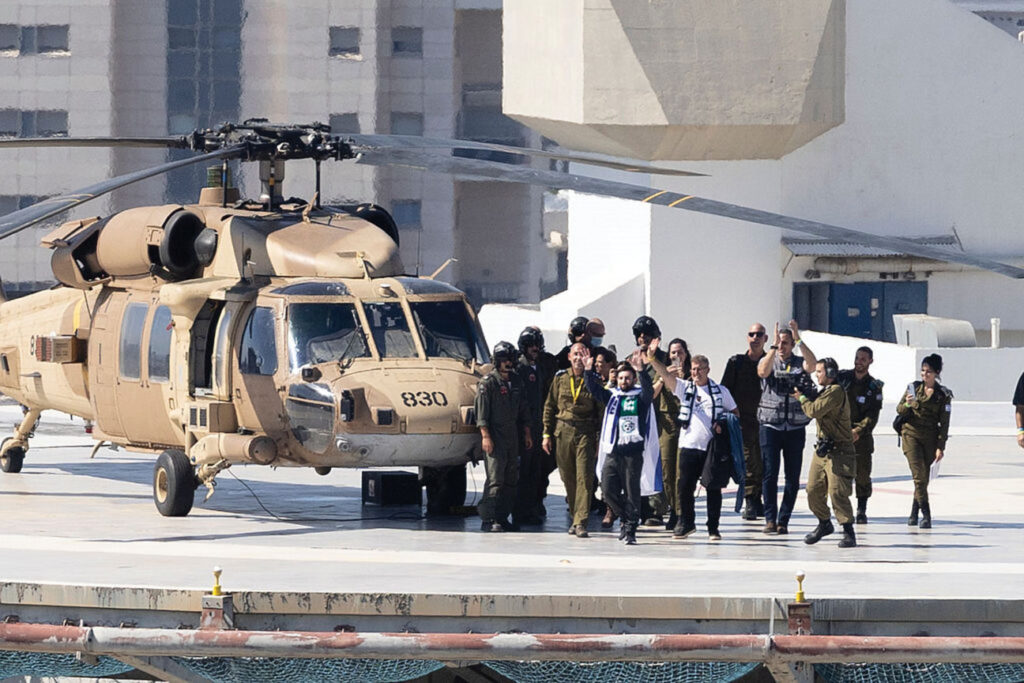
Over the next 20 minutes, the 13 freed hostages in the second convoy were airlifted by helicopter to hospitals across Israel.
By sunrise in Washington, D.C., those who had not stayed up all night following the scant official news reports on the hostages’ status woke to news they had been waiting for: videos of former hostages reuniting with their families began to surface online.
Reunion Videos Circulate
Families of hostages waited through the night at military bases and hospitals all over Israel for official word. Among the first confirmed to have survived was Matan Zangauker, whose mother Einav received a phone call from him before his release. “You are coming back home. You are all coming home. I love you,” she told The Independent. “The war is over. There is no more war.”

Bar Kupershtein, 23, who was working as a medic at the Nova Music Festival when he was abducted, was also among those returned. His mother, Julie, told The Guardian. “Seeing my child after two years — everything is fine. Thank you to the soldiers, thank you to everyone.” His father, Tal, who suffered a stroke five years earlier, got out of his wheelchair to embrace him. “It was the first time he had stood since surgery,” the family said in a statement. “Two years during which Tal kept moving forward, doing everything possible despite his own challenges — all so he could be ready for that hug with Bar.”
Matan Angrest, 22, made a FaceTime call to former hostage Keith Siege (65). The pair had been held captive together until Siegel was released in February of this year.
Omri Miran (48) was reunited with his wife Lishay and their daughters Roni (4) and Alma (2) at Beilinson Hospital in Petah Tikvah. He had been abducted in front of them during the Oct. 7 attacks. The Times of Israel reported that his daughters played beside him during his medical check, and he saw Alma walk and say “Abba” for the first time.
Then came more scenes from hospitals where other hostages were reuniting with their families.
Among the most widely shared reunions was that of Avinatan Or (32) and Noa Argamani (28), whose abduction from the Nova Festival had become one of the defining images of Oct. 7. Argamani was rescued from Gaza with three others by Israeli forces on June 8, 2024. Sixteen months later, following Or’s release from Hamas captivity, a video from the Israeli government showed Or first embracing his parents, his mother reciting the Shehecheyanu, before walking into a room where Argamani was waiting. The two hugged and kissed.

Twenty-one year-old Nimrod Cohen from Kibbutz Nir Oz was the youngest IDF soldier taken hostage by Hamas when his tank was attacked near the Gaza border. Over the past two years, testimonies from rescued and released hostages said that Nimrod was confined in a small cage, shackled and repeatedly interrogated about his military role. Fellow captives said he suffered from skin infections, hearing loss and malnutrition. Despite this, he managed to send a message through intermediaries earlier this year: “I am okay. Don’t worry. I love you.”
Nimrod’s aunt, Noga, told YNet News, “Physically he is thin and weak, pale and has not seen sunlight. You can see on his face that he went through a difficult period and we fear that he also endured torture. Despite all this, I saw his smile. Nimrod is a quiet and gentle boy with a half-shy smile that says it all. We are so happy to see him and that he held on for two years in such conditions.” Cohen was transferred to Sheba Medical Center, where doctors said his recovery would require “a long and careful process.”
Netanyahu and Trump Address Knesset
During this time, U.S. President Donald Trump and Israeli Prime Minister Benjamin Netanyahu spoke to the Knesset and officially declared that the war was over and the living hostages were home.
“We remember the 1,200 people Hamas savages slaughtered in cold blood, including dozens of Americans,” Netanyahu said during his 28-minute speech. “We remember entire families burned alive as they embraced each other. We remember the beautiful young Israelis brutally gunned down at the Nova Music Festival. We remember the hundreds of our citizens dragged into the dungeons of Gaza, including 12 Americans. These monsters took babies as hostages.”
At one point, Netanyahu made reference to the lyrics of Israel’s national anthem, “Hatikvah,” “Hope is our national anthem, hope is our creed, hope is our strength,” Netanyahu said. “It is time, my friends, to realize that hope and to expand the circle of peace.”
Trump then addressed the Knesset where, over the course of a 66-minute speech, he celebrated the living hostages’ return, praised Netanyahu and Israel’s military, credited U.S Special Envoy to the Middle East Steve Witkoff and his son-in-law Jared Kushner for negotiations, claimed credit for striking Iran’s nuclear program, criticized former U.S. Presidents Obama and Biden, and spoke about expanding the Abraham Accords and rebuilding Gaza through Arab funding.
“Let me also convey my tremendous appreciation for all of the nations of the Arab and Muslim world that came together to press Hamas to set the hostages free and to send them home,” Trump said. “We had a lot of help. We had a lot of help from a lot of people that you wouldn’t suspect, and I want to thank them very much for that. It’s an incredible triumph for Israel and the world to have all of these nations working together as partners in peace. And it’s pretty unusual for you to see that, but it happened in this case.”
Present in the gallery at the Knesset was California State Senator Henry Stern (D-Malibu), who had attended multiple hostage solidarity events since October 2023. In a statement, Stern said, “Israel’s fight to bring its people home has reminded the world that we don’t stop searching for one another. The courage of the hostages and the endurance of their families represent the best of what our shared humanity can achieve.”
As the returning hostages arrived at hospitals across Israel, IDF and Shin Bet teams prepared for a second, more somber transfer. At 5:01 p.m., the IDF reported that the Red Cross was heading to southern Gaza to receive the coffins of deceased hostages. By 6:15 p.m., two coffins had been transferred, with two more expected. At 7:33 p.m., the Red Cross confirmed all four had been received. Shortly after 8 p.m., IDF and ISA forces escorted the caskets into Israel, holding a brief military ceremony in Gaza where soldiers draped them in Israeli flags, saluted, and recited a psalm before accompanying the families to the National Institute for Forensic Medicine for identification.
On Tuesday, Oct. 14, the IDF said its representatives had notified the families of Guy Illouz (26) and Nepalese national Bipin Joshi (23) that they were among the four bodies repatriated. Two of the names were withheld pending identification, and the IDF urged the public “to act with sensitivity and wait for official confirmation before publishing any details.”
At 10:39 p.m. Israel time on Tuesday, the IDF released a further statement: “According to information provided by the Red Cross, four coffins of deceased hostages have been transferred into their custody and are on their way to IDF and ISA forces in the Gaza Strip. Hamas is required to uphold the agreement and take the necessary steps to return all the hostages.”
Outside Sheba Medical Center, relatives gathered behind barriers as buses and ambulances arrived under guard. Applause rippled through the compound as families held photos of loved ones who did not return. Volunteers passed out water and Israeli flags. Children who had spent half their lives waiting gripped yellow ribbons in their hands.
In Tel Aviv, crowds filled Hostage Square, waving flags and singing as yellow ribbons once again lined the plaza.
Countdown to Freedom: How the Last 20 Living Hostages Returned to Israel Read More »