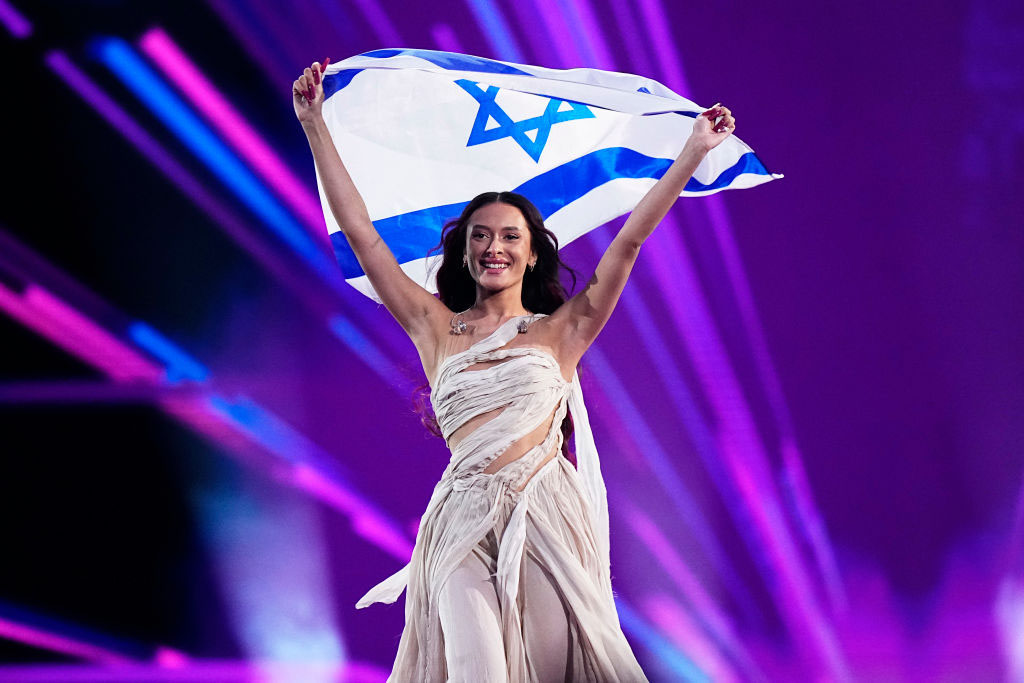
When the 68th Eurovision Song Contest came to a close, Israel’s Eden Golan and her ballad, “Hurricane,” placed fifth overall at the Grand Final on May 11th
With so much vitriol being thrown at her and Israel throughout the leadup to Europe’s biggest song competition, her talent and perseverance on stage and backstage were a defiant, soulful, electrifying lift for her homeland of Israel and Jewish people around the world. And Golan’s domination of the public televote makes Israel’s 2024 entry in Eurovision feel very much victorious.
In front of a global audience — and a green room full of antagonists — and despite scrutiny of both the content of the song and worldwide virulent backlash against Israel’s mere presence in the competition amid the war with Hamas, Golan galvanized Jews and music lovers around the world.
Throughout the week leading up to the final, the scene outside of the arena had a torrent of protests against Israel and Golan. She was booed at a semifinal rehearsal. The Times of Israel reported that before the semifinal round this week, “a major anti-Israel rally was held in the city center, with an estimated 12,000 attendees.” The paper also reported that “at least nine people were arrested at the protest, and police used pepper spray to disperse crowds.” BBC reported that despite the massive anti-Israel protests in Malmö, a comparatively small group pro-Israel demonstrators gathered with Israeli flags and sang Golan’s song while surrounded by local police. Twenty-one year old Swedish climate activist Greta Thunberg joined pro-Palestinian protesters this week demonstrating in Malmö, and was arrested on May 10. Golan would be pretty much confined to either her hotel room or rehearsal space throughout the week, with an armed security detail worthy of a top diplomat protecting her. Indeed, Golan was Israel’s cultural ambassador to the world this week.
Protestors held banners parodying the Eurovision logo that read “no to genocide.” They chanted “Free Palestine” and “Israel is a terror state” outside of the hotel where Golan was staying. Her family stayed behind and watched from Israel due to safety concerns.
Even backstage, Golan couldn’t escape the jeers. Greece’s Marina Satti audibly yawned at a press conference while Golan was speaking. She finished eleventh. Portugal’s Iolanda wore a dress designed by antisemitic cartoonist Naji Al Ali. She finished tenth. Dutch singer Joost covered his head with a flag when he was seated next to Golan. He was disqualified for allegedly unrelated reasons. Ireland singer Bambie Thug said that she cried with her team upon hearing that Israel qualified for the final. She, too, finished behind Golan, in sixth place.
A Polish journalist asked Golan at the press conference, “have you ever considered that your presence poses a risk to other participants and the public?” Poland’s entrant Luna didn’t even make it past the semifinal.
Golan took the high road at the press conference saying, “I think we’re all here for one reason, and one reason only. The EU is taking all safety precautions to make this a safe and united place for everyone. So, I think it’s for everyone, and we wouldn’t be here for any other reason.”
At the beginning of the Grand Final program on Saturday, as each performer paraded onto the Eurovision stage, Golan walked out in a white dress, draped in an Israeli flag as the song “I Love It” by Swedish duo Icona Pop played. About 30 minutes later, as the sixth performer out of 25 in the final, Golan took the stage to perform “Hurricane” for the final time. The song began with Golan leaning backwards as if dead in the wind, while thunder and lightning emanated from the stage. The eerie reverberated synth bass rang out four notes before the piano kicked in, breaking the tension with a bright spotlight on Golan. She wore a distressed satin-looking white dress, with long dark hair featuring two thick lavender streaks flanking her face. She stared into the camera and sang the first lyrics, “Writer of my symphony/Play with me/Look into my eyes and see/People walk away but never say goodbye.” She belted the lyrics as five dancers accented the song’s pain. After exactly three minutes, she thanked the crowd. A casual observer could easily have missed the low-pitched boos underneath the crowd’s cheers.
Shortly after Golan’s performance, she appeared on a quick Instagram Live interview with author and Israel activist Noa Tishby, who could barely contain her excitement.
“You stood out there, you were loud and proud, you showed everybody what it means to be a Jew,” Tishby praised Golan. “You were bullied, you were booed, people were yelling at you because you’re Jewish, because you’re Israeli.”
Golan replied, “I felt so much power going on stage with all the hate and all the negativity around. I was just there to spread love and spread our voice, and I don’t know, it just gave me so much power. Honestly. I feel amazing. I am so overwhelmed. I’m ecstatic and I just love everyone for all the support that I am getting.”
Tishby told Golan what she’s observed over the past two days since Golan got booed at a rehearsal.
“Because you jumped in the polls so high, because the song is so incredible and you’re so incredible and there’s something about it. It’s almost like a counterculture that [is] voting against the hate and [is] voting against this demonization of Israel, and people are saying…‘this is the counterculture.’” After the Instagram Live ended, Tishby told her over 750,000 followers, “we are the counterculture, so let’s go and show the world what it means to be loud and proud Jews and Israelis. Am Yisrael Chai!”
After performances by the 25 finalists, Eurovision organizers tallied the votes from the public and a jury of music industry pros from each country. Every time votes for Israel were announced, the boos got a bit more pronounced, albeit mixed with cheers from the Malmö Arena crowd. In the end, Switzerland’s singer Nemo came in first place, with their song “The Code.” Golan would place fifth.
Two hours after the final scores were revealed, Golan posted her thoughts on social media:
“…..where do I begin? First let me start by saying how proud I am of how far we got. I’m honored and grateful for the privilege to represent my country especially during these trying times. From the moment we started this journey our goal has always been to share the strong voice of Israel on one of the biggest stages and I believe we accomplished just that. to say it was easy would be a lie, but with your support and love it gave me the strength to continue and put on the absolute best performance i knew i can do. I want to thank everyone who supported me from all over the world, my country, the incredible members of this delegation and my family that I can’t wait to see and hug so so so tight. and of course a massive thank you to EVERYONE that voted because of you we made it this far. I love you. Lastly, I dedicate my participation in the ESC to the voices we can’t hear, the hostages — we are desperately waiting for you all to return home.עם ישראל חי 🇮🇱🎗🫶🏻”
In March, Israel had to revise the lyrics to the song submission due to objections from Eurovision organizers. “Hurricane” was originally titled, “October Rain.” The original version of the song also had the lyrics “there’s no air left to breathe” and “they were all good children, each one of them.” There was speculation that these were references to the Hamas terror attacks on Israel on October 7, 2023. Nearly 1,200 were murdered and 252 taken hostage that day.
Golan is a major star in Israel. In the 48 hours between qualifying for the Grand Final and the end of the contest, Golan’s total Instagram followers grew from just over 200,000 to over 334,000. As of press time, that number has increased to 364,000 Instagram followers. Her monthly listens on Spotify ballooned from 578,000 after the semi-final to 919,400 by the day after the Grand Final. The song “Hurricane” racked up nearly 6 million views on YouTube in just one month, and another 600,000 in the two days between the semi-final and the Grand Final.
Golan, 20, was born in Kfar Saba, Israel in 2003 to a Latvian-Jewish father Eddie and a Ukrainian-Jewish mother Olga. Both of her parents were born in Soviet Russia before moving to Israel. The family moved to Russia when she was six, but returned to Israel in 2022. Eddie is a businessman and Olga is Golan’s manager. Golan’s family did not travel with her to Sweden from Israel for security reasons.
The last time Israel took first place was in 2018, with singer Netta performing the song “Toy.” Netta took to Instagram to praise Golan.
“She’s one of the only beacons of light we had in six months,” Netta wrote. “Everything here is dark. We’re in a loop without a way out. I always believed good energy sends the negative away. Things happening are horrible- and we need people like Eden to help us out.”
The Consul General of Israel in Los Angeles Israel Bachar spoke with the Journal about the situation unfolding at Eurovision.
“I think Eurovision became a political quagmire instead of an artistic competition, and it’s a shame,” Bachar told the Journal. “And mostly, the shame goes to the protestors who do not protest against the Iranian regime. This past week, [Iran] announced that they were going to execute a musician, a rapper [Toomaj Salehi], so they need to protest against that regime, not against a beautiful, young artistic soul who’s coming for an art competition. It’s quintessential hypocrisy. The last year teaches us that a new ‘fighting Jew’ is emerging, and the October 8th Jews understand that the battlefield is everywhere: it’s in the music industry, it’s on the campuses, it’s in Israel, and it’s in Sweden. We have to fight.”
Creative Community for Peace (CCFP), a Los Angeles-based non-profit entertainment industry organization that promotes “the arts as a bridge to peace” weighed in on the news about Golan.
“Israel’s remarkable run at Eurovision shows yet again that BDS may scream loudly, but ultimately can’t silence or bully extraordinary Israelis like Eden Golan and the vast majority of the global public that rejects this hateful campaign.” – Ari Ingel
“Israel’s remarkable run at Eurovision shows yet again that BDS may scream loudly, but ultimately can’t silence or bully extraordinary Israelis like Eden Golan and the vast majority of the global public that rejects this hateful campaign,” Ari Ingel, CCFP’s executive director told the Journal. “This was evidenced in Israel securing the second highest total in public voting. While broadcasters in countries like the U.K. capitulated to the mob awarding Israel zero points, the British public voted Israel the best of the night, awarding Israel 12 points. Creative Community for Peace is grateful to the wide range of leaders in the entertainment industry who joined our campaign to ensure that Israel was included in Eurovision. Eden’s undeniable talent, poise, strength, and humanity is an inspiration to us all and a clear example of how to stand proud against hate. We look forward to watching her great career ahead.”
When Israel hosted Eurovision in 2019, there were many calls for contestants to boycott the event. CCFP successfully encouraged many contestants not to boycott.
While not particularly well-known in the U.S., Eurovision is a massive pop culture event across Europe. It can be described as “‘The Voice’ meets the Olympics” — top singers competing under their country’s flag to be declared champion.
In 2023, Eurovision had more than 162 million viewers, roughly 20% of Europe’s entire population. Past winners who got their big break at Eurovision include Sweden’s ABBA, whose hit “Waterloo” won in 1974 and Céline Dion, representing Switzerland in 1988 (also the last time the Swiss won before this year).
Though not located in continental Europe, Israel has participated in Eurovision since 1973. Australia is another non-European participant. Traditionally, the winner of the previous year’s country gets to host the following year. The 2023 winner was Swedish singer Loreen for the song “Tattoo.” Israel placed third in 2023, with Noa Kirel’s song “Unicorn.” The 2025 show will be held in Switzerland.
Golan arrived at Ben Gurion airport on Sunday morning pushing a cart with three large suitcases. As she made her way from baggage claim, she was moved to tears as hundreds of fans gathered to welcome her back home.
Prime Minister Benjamin Netanyahu had much praise for the singer.
“I saw that you received almost the highest number of votes from the public and this is the most important thing, not from the judges but from the public, and you held Israel’s head up high in Europe,” Netanyahu told Golan. “You have brought immense pride to the state of Israel and the people of Israel. Congratulations.”
Breaking Down the Numbers: Who voted for Israel?
When you break down the numbers from the public televote, Israel did mighty well. No other participant country in 2024 received top votes from more countries than Israel. Israel was the top vote-getter from voters in 14 different countries, as well as “the rest of the world” countries that are not part of Eurovision. The countries where Israel received the most public fan votes are Australia, Belgium, Finland, France, Germany, Italy, Luxembourg, Netherlands, Portugal, San Marino, Spain, Sweden, Switzerland, and the United Kingdom.
It is important to note that Israel was also the top public televote recipient in the five most-populated Eurovision participant countries: Germany (83 million), United Kingdom (67 million), France (65 million), Italy (59 million) and Spain (47 million). This plurality of votes in those countries means that Israel received a lot of individual votes—think of it as if a U.S. Presidential candidate that won a plurality of votes in the states of California, Texas, Florida, New York, and Pennsylvania (but instead of each state being worth a proportionate number of electoral votes, in Eurovision, first place in a particular country earns you 12 votes from each).
Besides France, United Kingdom, Australia, and Germany, the other ten countries where Israel received a plurality of votes each have a Jewish population under 30,000. In other words, the public voted for Golan’s performance in countries where there is not a sizable Jewish population. Below is a table of those 14 countries, ranked by total population:
|
Country where Israel Received Plurality Public Televotes |
Total Population |
Jewish Population |
Jewish Pop. % |
| 1 |
Germany |
83,166,711 |
118,000 |
0.14% |
| 2 |
United Kingdom |
67,736,802 |
292,000 |
0.43% |
| 3 |
France |
65,633,194 |
440,000 |
0.67% |
| 4 |
Italy |
58,870,762 |
27,000 |
0.05% |
| 5 |
Spain |
47,163,418 |
13,000 |
0.03% |
| 6 |
Australia |
26,354,800 |
118000 |
0.45% |
| 7 |
Netherlands |
17,835,787 |
29800 |
0.17% |
| 8 |
Belgium |
11,755,084 |
29,000 |
0.25% |
| 9 |
Sweden |
10,609,243 |
15,000 |
0.14% |
| 10 |
Portugal |
10,247,605 |
3,300 |
0.03% |
| 11 |
Switzerland |
8,888,570 |
18,500 |
0.21% |
| 12 |
Finland |
5,532,156 |
1,300 |
0.02% |
| 13 |
Luxembourg |
653,468 |
700 |
0.11% |
| 14 |
San Marino |
33,938 |
no data |
no data |
Although Croatia received the most points in the public televote, the most populous country in which Croatia won a plurality of votes is Azerbaijan, with a population of only 10.2 million.
Israel was the second-most popular public televote recipient in Albania, Austria, Cyprus, Czechia, Ireland, Moldova, and Slovenia. And those countries where Israel placed second have miniscule Jewish populations.
| |
Country where Israel Received 2nd Most Public Televotes |
Total Population |
Jewish Population |
Jewish Pop. % |
| 1 |
Czechia |
10,701,777 |
3,900 |
0.04% |
| 2 |
Austria |
9,006,398 |
10,000 |
0.11% |
| 3 |
Ireland |
4,994,724 |
2,557 |
0.05% |
| 4 |
Albania |
2,845,955 |
<100 |
~0 |
| 5 |
Moldova |
2,640,400 |
3,100 |
0.12% |
| 6 |
Slovenia |
2,108,977 |
<100 |
~0 |
| 7 |
Cyprus |
888,005 |
<100 |
~0 |
In the public televote, Israel placed…
3rd in Denmark, Georgia, Iceland.
4th in Azerbaijan, Greece, Latvia.
5th in Estonia.
6th in Malta, Norway, Poland.
8th in Lithuania, Serbia.
10th in Armenia.
In fact, Israel ranked in the top ten for the public televote in all but two participant countries: Croatia and Ukraine.
How The Eurovision Juries Voted for Israel:
For the Jury vote, Israel earned only 52 votes, which ranked them in twelfth place. No country’s jury ranked Israel #1 or #2.
Juries that ranked Israel…
#3: Germany, Cyprus, Norway
#6: Belgium, Estonia
#7: Lithuania
#8: France, Malta, Moldova, Georgia
#9: Latvia
One of Norway’s jury members, 24-year old singer Daniel Owen, admitted on Sunday that he did not vote for Eden Golan and Israel because “what is happening in Palestine is heartbreaking and I cannot in any way support Israel’s actions. In my opinion, Israel shouldn’t have been allowed to participate in Eurovision at all.” Owen said in the video to his 57,400 TikTok followers that he did this despite knowing it violates the rule that jury members must not “favor or discriminate against any participant [for]… any reason other than the song and performance.” Even without his support, the four other jury members from Norway combined to rank Golan their third favorite. Norway’s entrant, folk band Gåte, placed dead last in the Eurovision final with their song “Ulveham.”
Juries did NOT rank Israel in their top ten:
Albania, Armenia, Australia, Austria, Azerbaijan, Croatia, Czechia, Denmark, Finland, Greece, Iceland, Ireland, Italy, Luxembourg, Netherlands, Poland, Portugal, San Marino, Serbia, Slovenia, Spain, Sweden, Switzerland, Ukraine, United Kingdom
The winner, Switzerland, received first place jury votes from 22 countries and second place votes from ten countries.
Who did Israel vote for?
Israel’s public televoters as well as Israel’s jury ranked Luxembourg as their favorite performance.
Luxembourg’s performer, Tali Golergant was born in Jerusalem.
Who did Israel’s public televoters rank the highest?
- Luxembourg, 2) Ukraine, 3) Germany, 4) Italy, 5) Armenia, 6) Croatia, 7) Georgia, 8) Austria, 9) France, 10) Cyprus
Who did Israel’s jury rank the highest?
- Luxembourg, 2) Germany, 3) Ukraine, 4) Austria, 5) Italy, 6) Switzerland, 7) Croatia, 8) Portugal, 9) Georgia, 10) France
Israel’s History at Eurovision
Israel has hosted Eurovision three times: in 1979 and 1990 at the International Convention Center in Jerusalem, and in 2019 at the Expo Tel Aviv.
Israel’s Eurovision Winners:
1978: Izhar Cohen and the Alphabeta, “A-Ba-Ni-Bi”
1979: Milk and Honey, “Hallelujah”
1998: Dana International, “Diva”
2018: Netta, “Toy”
Israel’s second place Eurovision finishers:
1982: Avi Toledano, “Hora”
1983: Ofra Haza, “Hi”
Israel’s third place Eurovision finishers:
1991: Duo Datz, “Kan”
2023: Noa Kirel, “Unicorn”