fbpx

April 12, 2024

Fear and the Remedy – Thoughts on Torah Portion Tazria/Metzora
Fear and the Remedy

Thoughts on Torah portions Tazria/Metzora 2025 (adapted from previous years)


This week’s Torah portion is about mass fear, or better put, how to stave off mass fear. Mass fear makes people, and groups of people, think, say, and do irrational and destructive things.


You wouldn’t know that this Torah portion is about the fear that produces irrationality and destructiveness, personal up to national, from a first read. On the surface, most of this week’s (and next week’s) Torah portion is about a skin lesion called “tza’ra’at.” In older Bibles, this skin disease was translated as “leprosy,” but modern medicine has ruled that out. What is described in most of these two Torah portions is a frightening growth on the skin and on the walls of dwellings that would have caused fear, disgust, and revulsion.


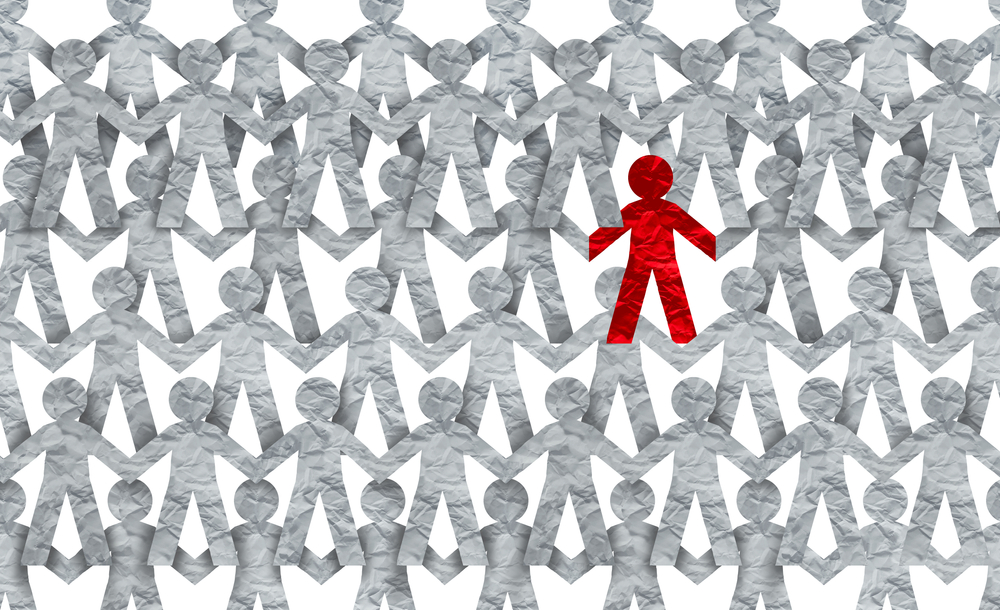
The natural reaction of a group of scared people would have been to banish the afflicted person for fear of contagion. An overreaction on the part of a group of fearful people would have been to kill the afflicted person, the skin disease being thought to be a result of some demonic possession. A person with some disease or condition that marks them as different can quickly become “other” – less human than the rest of us, to be marked off, excluded, banished, or killed. Nowadays, we don’t need a skin disease to prompt the fear that produces the will to destroy someone. Sometimes, deep prejudices (and even merely disagreeing) can be enough to produce the will to obliterate.


The Torah portion describes a process that effectively gets ahead of the mob, a process that is boring and strange to the reader, until you understand the deeper thing going on – preventing people from acting on mass fear.


The impartial priest who is in charge of the case only needs to find out if tza’ra’at is actually afoot. The priest more or less says, “Everyone calm down. I’ve got this one.”


Then we have detailed instructions for dealing with the outburst of the frightening skin condition. The Kohen acts as a physician, diagnosing the unsightly, severe scurf as either tza’ra’at or not. If the Kohen determines that the rash is not the feared condition, the person is declared “clean.” Everyone can relax. The inciters of the mob skulk off until the next opportunity.


If the Kohen decides that the scurf is actually tza’ra’at, a detailed ritual, including the afflicted person’s temporary removal from the camp, kicks in. The precision of the ritual and the time it consumes would weary any mob (or most readers of this Torah portion, for that matter).


Mob violence coalesces around fear, hatred, judgmentalism, and action based on fear. Precise thinking kills that energy. Nothing ruins the ecstasy of the mob more than deliberate cogitation, rational debate, and the careful weighing of all points of view. Feelings such as fear do matter, of course, if there is real, immediate danger. That rational fear must be translated into a rational plan of action. Fear is bad when it becomes bad, when it takes us to a place without reason, without clarity, without a just and humane way forward. Then good thinking can become our salvation – our salve.


The precise, boring, and even disgusting details of this Torah portion are like a balm to the burning itch to fear, hate, expel, banish, silence, and kill. Calm, rational, careful, and compassionate thinking can be a remedy for the most dangerous condition of all – the human condition.


Life on Earth can be randomly cruel and destructive, and often there is little we can do but try to respond wisely and compassionately. Whatever other people do, our role is to make things better. Our character doesn’t depend on what other people do; our character depends on what kind of person we want to be become. In a crisis, be the solid, wise one, not the one who joins in caustic chorus.


I go back to the priest in our Torah portion dealing with the outbreak of an ugly and fearsome skin disease. The ultimate job of the priest was to calm the nerves of the mob, to get to the truth of the matter, to protect the group if they indeed need protection, to let the afflicted know they were being cared for, and ultimately to get society back to its stasis, until the next time.


There is great beauty under the rather repelling surface of this week’s Torah portion, a beauty that can be found in each of us

Fear and the Remedy – Thoughts on Torah Portion Tazria/Metzora Read More »

Jewish UCLA Faculty Speak Out Against Antisemitism During UC Regents Health Committee Meeting

Several Jewish UCLA faculty members spoke against antisemitism at the university’s medical school during the public comment portion of UC Regents Health Committee meeting on the morning of April 10.

The faculty members, organized by the Jewish Faculty Resilience Group (JFrg) at UCLA, all wore navy blue jackets with yellow ribbons to show solidarity with those still being held hostage by Hamas. They had marched to the meeting at UCLA’s Carnesale Commons from the Ronald Reagan UCLA Medical Center.

The first of the faculty members to speak was Dr. Richard Finn, professor at the Geffen School of Medicine at UCLA in the Department of Medicine, Division of Hematology/Oncology. “It is clear to me that there is now a cancer that has taken hold in the School of Medicine and is metastasizing into the health system. That cancer has a long history of destruction, and it is antisemitism,” Finn declared. “Its presence predates Oct. 7 and, ironically, has emanated from the required Systemic Racism and Health Equity course.”

Finn told the Regents that the course featured a guest speaker, who has referred to the Oct. 7 massacre as “justice,” and led the class in a chant of “Free Palestine.” “This was not challenged by the staff that were present,” he said. “Events such as these need to stop.” Finn concluded by reading a quote from Dr. Jeffrey Flier, former dean of Harvard Medical School, saying that if the reports about the guest speaker are true, “UCLA Medical School requires a formal investigation by its governing board and its accreditation by the Association [of] American Medical Colleges should be questioned for profoundly inadequate oversight of its curriculum and pedagogy.”

Alyssa Ziman, professor of Pathology and Laboratory Medicine at UCLA, criticized the systemic racism course for oversimplifying “identity into a divisive and racist oppressor vs. oppressed narrative. It stereotypes Jews as white and privileged. The course content includes content of antisemitic images resembling those from Nazi Germany. This fosters potential bias against Jewish patients and a hostile environment for Jewish students.” She added that “Jews are a diverse, multiethnic multiracial people” and called for the UC Regents to “pause this course for an external review into its antisemitic stereotypes.”

UCLA Professor of Medicine Zev Wainberg explained that the speaker, who was supposed to give a lecture on housing and justice, was “dressed in terrorist clothing” and “led them in prayers, and instructed them on Marxist, anti-capitalist political rhetoric, accused UCLA Medical School of teaching ‘white science’ and yelled ‘Free, Free Palestine.’ The UCLA staff member then singled out a nonparticipating medical student, possibly for discipline.” He called for the course to be suspended and investigated, arguing that what took place during the lecture violated university policy against indoctrination.

Faculty members shared other antisemitic incidents at the UCLA medical school:  Dr. Vivien Burt, Professor Emeritus of Psychiatry at UCLA, recalled attending a “Depathologizing Resistance” Zoom earlier in the month for psychiatry residents in which “the presenters argued that burning one’s self to death for a cause was not necessarily mental illness”; the presenters pointed to Aaron Bushnell burning himself to death while shouting “I will no longer be complicit in genocide” and “Free Palestine” in February as an example. The presenters also denounced a statement from the American Psychiatric Association for not mentioning that the Oct. 7 massacre “was due to 75 years of colonization.” “This is but the latest and most grotesque example of how antisemitism has been allowed to metastasize at UCLA,” Burt continued. “I implore the regents to act for the safety of our students, faculty and staff.”

Dr. Ann Raldow, associate professor in the Department of Radiation Oncology at UCLA, claimed that the medical school’s Justice, Equity, Diversity and Inclusion (JEDI) program held a mandatory panel called “Compassion, Empathy and Our Hippocratic Oath” in February. “One Jewish panelist and ethicist was told his perspective was not relevant due to his perceived group identity,” Raldow said. “Another co-panelist used the platform and espoused anti-Israel rhetoric, denying the school of medicine’s antisemitism issues and claiming that faculty with power and privilege — often antisemitic code-speak for ‘Jewish’ — suppress criticism of Israel. Another panelist downplayed the toxicity of phrases like ‘from the river to the sea, Palestine will free,’ which is the Hamas charter’s proclamation for the erasure of Israel and its Jewish population. “Such language intimidates, isolates, and fosters a negative environment for Jewish students and faculty,” Raldow added, reiterating the JFrg’s call for the School of Medicine to be independently investigated over antisemitism.

A Jewish student also spoke, saying that “blatant antisemitism has become normalized” as have “disruptive demonstrations” on campus. “I’ve tried to avoid coming to campus as much as possible … because I do not feel safe here,” she said. The student added that it’s “incredibly hard to focus on my studies,” telling the Regents how she had to walk by “a large pig with a bag of money and a Jewish star on it” on her way to a final a few weeks ago. “My classrooms have been vandalized and so have the outside of buildings with messages that are antisemitic,” she alleged. “UCLA must take actions against students and faculty that violate the time, place and manner restrictions which affect the ability of Jews to study and work on campus. The only way for these violations to stop is for UCLA to punish violators, as is recently done at Pomona and Columbia.”

Rabbi Noah Farkas, executive director of the Jewish Federation of Los Angeles, lamented the “injustice to the Jewish students and the Jewish faculty who are under assault physically and psychologically by the systemic antisemitism that has metastasized at this school.” “I have had professors, I have had students in my office crying and screaming, feeling like they need to leave,” claimed Farkas. “I want to say on behalf of the Jewish community that you, UCLA, are embedded in a larger city, the largest Jewish community on the West Coast … and we are watching you. We will organize against you. We will do all the work that is necessary to protect our people on campus and bring them back in safety.”

“I want to say on behalf of the Jewish community that you, UCLA, are embedded in a larger city, the largest Jewish community on the West Coast … and we are watching you. We will organize against you. We will do all the work that is necessary to protect our people on campus and bring them back in safety.” – Rabbi Noah Farkas

A couple of keffiyeh-wearing pro-Palestinian students spoke as well. A student claiming to speak on behalf of Students for Justice in Palestine and the UC Divest Coalition said she is “ashamed to study at an institution complicit in the genocide of thousands” and that “my tuition dollars are being funneled through BlackRock into the hands of weapons manufacturers that are actively massacring tens of thousands of Palestinians.” “Put your people over your profit for once, divest your billions from BlackRock, and reinvest into your community of students and workers whose needs are not being met in the slightest,” she added.

The other, a second-year resident, explained that her mother “traveled to Palestine during the First Intifada” and had told her about “tanks rolling through the town square at curfew every night, shots being fired 24/7 … she was forever changed by this experience of seeing a land being decimated by her own tax and student dollars. That was almost 40 years ago, and still today the genocide continues and today we’re willingly paying for it.”

At the end of public comment, UC Regent John Pèrez said: “The points that are made are heard by the board… we will act on issues raised despite the fact that we’re prevented from engaging.”

Assistant Clinical Professor Kira Stein, who chairs the JFrg at UCLA, told the Journal after public comment ended, “We had a huge turnout, we were the largest group of speakers … and we are mobilizing. We are serious about making a stand against antisemitism, the UC Regents saw this and it was very powerful.” She urged “the Jewish community at large to support us and to be involved and engaged and to help put pressure on the UC Regents to take antisemitism much more seriously and to enforce their own law and code of conduct when it comes to helping Jews be safe on campus.”

JFrg at UCLA Co-Chair Dr. Elina Veytsman, who is also the director of clinical services at the UCLA PEERS Clinic, called the Jewish faculty member’s remarks at public comment “a very strong show of unity and solidarity and strength among the Jewish community and it’s something that we haven’t had before Oct. 7 and we’ve all come together to stand up for the truth and also to combat the misinformation and the indoctrination that’s happening here on campus. It was really powerful to have somebody outside of UCLA, Rabbi Noah Farkas …  standing up for what’s going on here and it felt good to know that we have support from the Jewish community.”

Jewish UCLA Faculty Speak Out Against Antisemitism During UC Regents Health Committee Meeting Read More »

Are We Going to Stop for Lunch?

Jan Karski was among the first to warn the world about the Holocaust. A member of the Polish Underground, Karski courageously went back and forth between German-Occupied Poland and the Allied countries. During his missions, he infiltrated several concentration camps and brought word to the world of the horrors he witnessed there. And he was ignored.

This might have shocked Karski, but not the Polish Jews; they had been reaching out every way they could to their brethren in the United States, but to no avail. In 1942, just before he left Warsaw Ghetto to bring a report to the United States, these Polish Jews explained to Karski that:

Jewish leaders abroad won’t be interested. At 11 in the morning you will begin telling them about the anguish of the Jews in Poland, but at 1 o’clock they will ask you to halt the narrative so they can have lunch.

Breaking for lunch is the hard stop of feigned interest, the end of a meeting that was merely for show.  The Jews of America didn’t care enough to do anything.

When Rabbi Joseph B. Soloveitchik reflected on the American Jewish response, he wrote:

Let us be honest. During the terrible Holocaust, ‎when ‎European Jewry was systematically destroyed in gas chambers and crematoria, the ‎American ‎Jewish community did not rise to the occasion…. and we ‎did ‎precious little to save our unfortunate brethren…..

We witnessed the most ‎horrible ‎tragedy in our history, and we were silent.

Jews are obligated to help other Jews. This is far from an obvious idea; no other national group inculcates a similar sense of mutual responsibility. Yet the slogan “all Jews are responsible for one another” is a foundation of Judaism.

The source of this obligation is unclear. Rabbi Shneur Zalman of Liadi (Likutei Amarim 32) wrote that “all Israelites are called actual “brothers” because their souls are rooted together…with only the bodies separated.” To be a Jew is to have an innate connection with other Jews; they are always brothers and sisters, even if they are from another family.

Rabbi Soloveitchik takes a non-mystical approach, one rooted in history and halakhah. Jews have a mutual covenant which was established during the exile in Egypt. It is based on shared experiences of persecution and suffering, which have remained a reality for much of Jewish history. Antisemitism doesn’t discriminate between Jews; when one Jew is attacked, every other Jew knows they’re vulnerable.

The Covenant of Egypt is a partnership between Jews forged by a collective history. This covenant becomes the foundation of Jewish identity. To stop caring about other Jews is to stop living as a Jew.

We are required to feel the pain and suffering of other Jews. As Rabbi Soloveitchik puts it: “If boiling water is poured on the head of a Moroccan ‎Jew, the prim and proper Jew in Paris or London must scream….”

In other words, Jewish unity begins in Egypt. A comment in the Midrash (Pesikta Chadata 13) sees the Egyptian exile as having a silver lining, because it forces all Jews to build bridges. Initially, the sons of Jacob who were born to Rachel and Leah looked down on the sons of the maidservants Bilhah and Zilpah. But after 400 years in Egyptian exile, God says “I will redeem them and give them the Pesach ritual, …and they will declare, “We were all slaves to Pharaoh.” And then all Jews will be equal.”

The hidden lesson of Pesach is to remember we were all once slaves, and therefore we must all know each other’s pain. When a mob of antisemites chases Jews anywhere, it is a danger to Jews everywhere.

Unity most naturally emerges from uniformity. But now, Jews have become more fragmented and dispersed. Differences of religion, ideology and culture have made division the new default setting.  For the last 200 years, the age old value of unity is no longer a given.

With each new crisis, what remained to be seen was: would the Jewish community meet the challenge?

During the Holocaust, American Jewry failed; but a few years later, they would step up.

The Soviet Jewry movement began on April 27, 1964, when Yaakov Birnbaum convened the founding meeting of the College Students’ Struggle for Soviet Jewry (SSSJ). About 200 people attended the first meeting.

Birnbaum’s vision was to start with students organizing protest rallies. Student action would inspire the larger Jewish community to join in the protests, which in turn would pressure the American government to act; and then the American government would pressure the Soviet Union to let the Jews leave. The vision seemed fantastically quixotic at the time; but less than a decade later, tens of thousands of exit visas a year were being granted to Soviet Jews. Birnbaum was right.

Driving Birnbaum was guilt. Just twenty years earlier six million Jews were murdered and American Jews did nothing. Would American Jews fail once again?

In a flyer inviting students to the April 1964 meeting Birnbaum wrote:

A recent visitor to Russia was approached by a man with glowing eyes, who whispered “Far voos shveigt ir?” “Why do you  keep silent?” We, who condemn silence and inaction during the Nazi Holocaust, dare we keep silent now?

Birnbaum was determined that American Jews would not repeat the mistakes of the past. The Jews of the Soviet Union were in pain, and the Jews of America would scream for them.

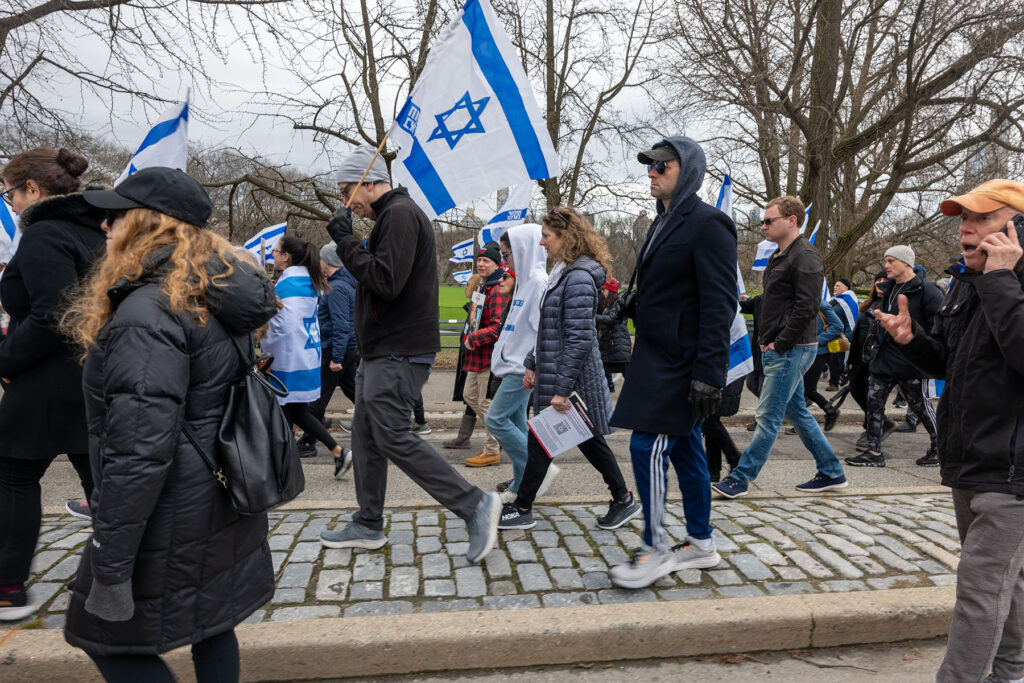
Now, in 2024, history turns to us again. So far, the American Jewish community has been exceptional in its support for Israel. But there is a long road ahead, and the question remains: will we continue with this support?

Donor fatigue has started to set in. Fundraising campaigns are scuttled because people don’t want to be asked again. This is understandable. There is a certain rhythm to ordinary fundraising; causes make asks once or twice a year, and move on. This year has been different, with a new request for funds on an almost daily basis. I have been told more than once that people have reached their limits. It is certainly exhausting to keep up this level of support.

I cannot contradict this sentiment. There has been exceptional generosity over the last six months, with people giving above and beyond what they have ever done before. How much more can we ask for?

But I think we can change our perspective if we consider two things. First, this war is a marathon, not a sprint; unlike past crises, this conflict will not pass in a matter of weeks or months. Israel will need to keep going. And so will we.

More importantly, we need to recognize the screaming pain our brothers and sisters in Israel are enduring. People’s lives have been completely crushed. Rachel Goldberg-Polin, whose son Hersh has been held captive in Gaza for six months, says that every day she “puts on a costume and pretends to be a human.” A friend who lost a child in battle months ago refuses to be consoled, unable to find joy in nearly anything. And I hear from parents of soldiers that when their children are on the battlefront in Gaza, they cannot sleep at night, and they jump every time the doorbell rings.

Our fatigue pales in comparison with their pain. And now the challenge put before American Jewry is: Are we going to stop for lunch?


Rabbi Chaim Steinmetz is the Senior Rabbi of Congregation Kehilath Jeshurun in New York.

Are We Going to Stop for Lunch? Read More »